
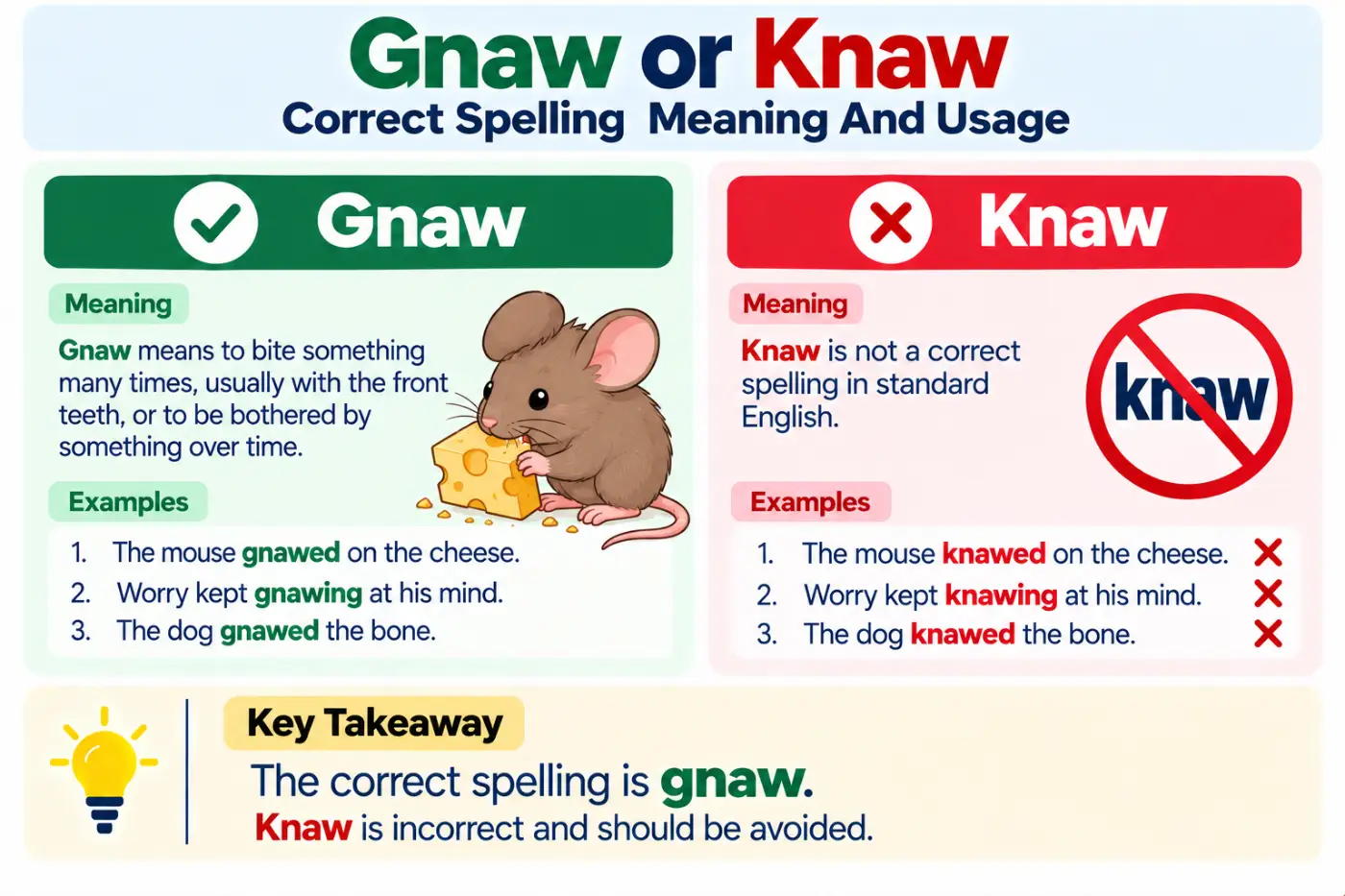
If you’re unsure about gnaw or knaw, the correct spelling in standard modern English is gnaw. It means to bite or chew something repeatedly, often with enough force to wear it down. The letter g is silent, which explains why many people find the spelling confusing.
You might use this word to describe a dog chewing a bone, a mouse damaging a piece of wood, or a nagging worry that won’t leave your mind. In each case, the spelling stays the same, even though the meaning changes slightly with the context.
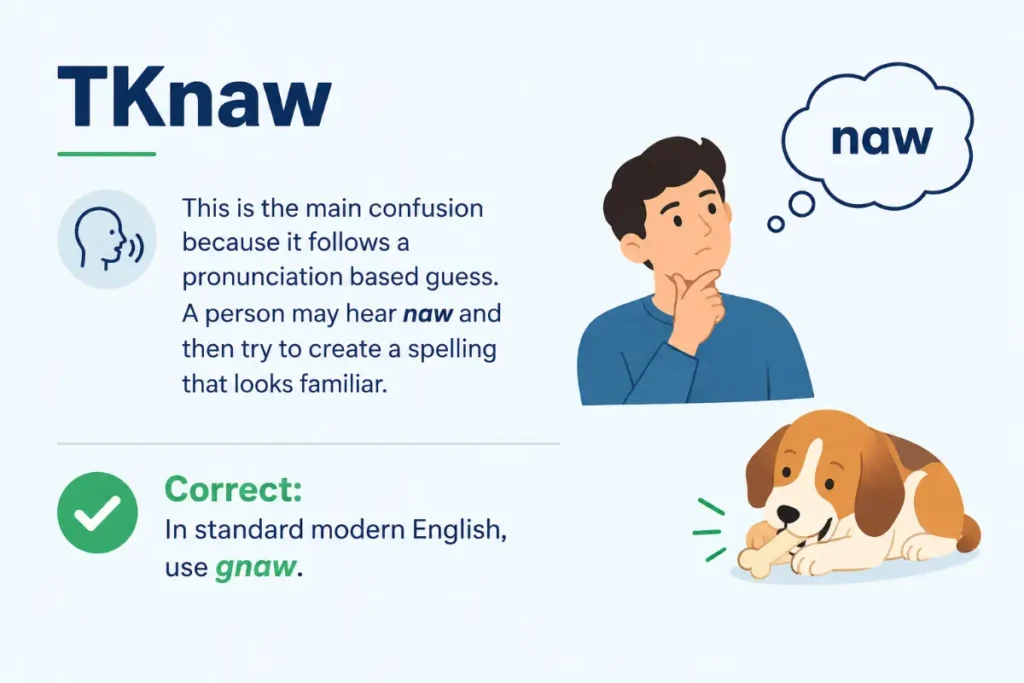
The confusion comes from the gap between spelling and sound. English has several words that begin with silent letters, and this is one of them. Since the word sounds like naw in common American pronunciation, writing it with a k may seem reasonable.
This guide explains the correct spelling, the meaning, the pronunciation, and the grammar. You’ll also find natural examples, related words, common mistakes, and practical tips to help you remember the right form when writing.
Learn the difference in comment vs coment Which Spelling Is Correct..
Quick Answer
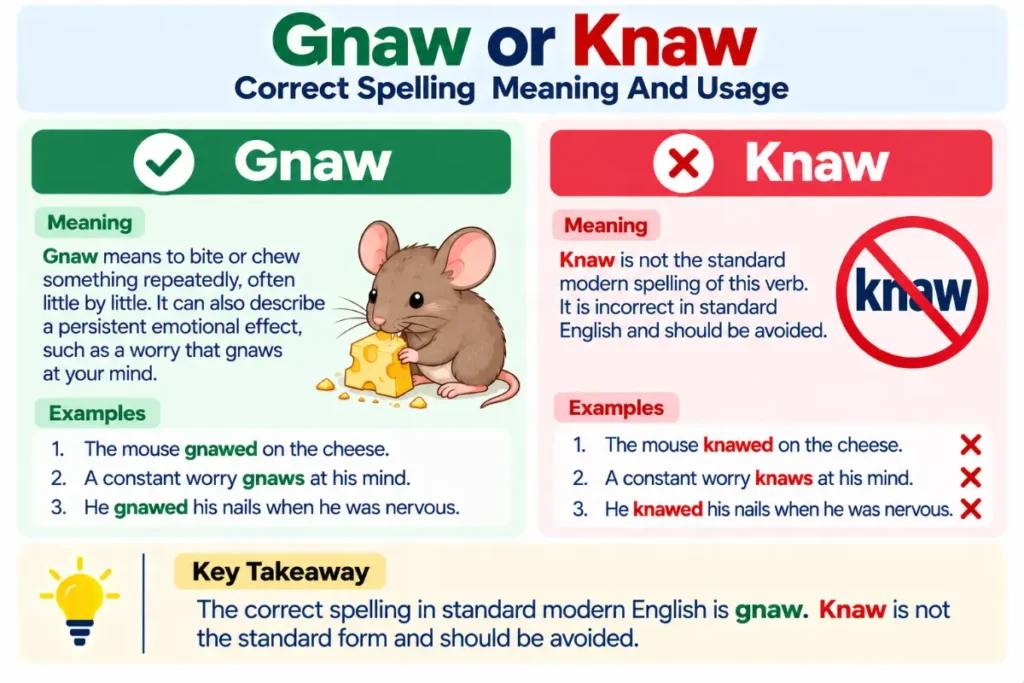
Gnaw is the correct spelling in standard modern English. Knaw is generally a misspelling when you intend to use the verb meaning to bite or chew something repeatedly.
The g in gnaw is silent, so the word sounds like naw in American English. Remember that the word begins with the letters g and n, even though you pronounce only the n sound.
Quick Definition
To gnaw means to bite or chew something repeatedly, often to break it down or wear it away. The verb also describes a persistent feeling that causes worry, guilt, or discomfort. For example, a dog may gnaw on a bone, while regret may gnaw at someone’s mind.
Comparison Table
| Feature | Gnaw | Knaw |
|---|---|---|
| Standard spelling | Yes | No for the intended modern English verb |
| Meaning | To bite repeatedly or cause ongoing worry | Usually a spelling error for gnaw |
| Part of speech | Verb | Not the standard form of this verb |
| Pronunciation | /nɑː/ in common American English | Intended pronunciation usually matches gnaw |
| Formality | Suitable for formal and informal writing | Avoid in standard writing |
| Common contexts | Chewing, animal behavior, worry, guilt | Accidental misspellings and spelling questions |
| Example | The puppy likes to gnaw on its toy. | The puppy likes to gnaw on its toy. |
The distinction is straightforward in everyday English. Use gnaw when describing repeated biting or a persistent emotional burden. Don’t use knaw as a substitute in school assignments, business emails, reports, or other standard writing.
There is a historical detail worth knowing. Older Scottish records contain forms related to both spellings, including knaw in historical usage. That doesn’t make knaw the accepted spelling of the modern English verb in ordinary American writing.
Meaning and Definition
The verb has two main uses. One describes a physical action, while the other describes an emotional experience. Both meanings share the idea of something continuing to wear away at a person or object.
What Does Gnaw Mean
In its literal sense, gnaw means to bite or chew something over and over. The action often involves a hard object or repeated effort. Animals commonly gnaw on bones, wood, food, and other materials.
For example, a mouse may gnaw through a cardboard box to reach food. A puppy may gnaw on a rubber toy while teething. A beaver can gnaw through tree trunks as part of its natural behavior.
The verb often suggests more than one quick bite. It brings to mind repeated chewing that gradually changes or damages the object.
The word also appears in expressions such as gnaw at, gnaw on, and gnaw away at. These patterns help explain exactly how the action happens or what it affects.
The Figurative Meaning
The figurative meaning describes a feeling that continues to trouble someone. Worry, guilt, doubt, fear, and regret can all gnaw at a person.
Consider this sentence. A missed deadline began to gnaw at him during the weekend. The deadline isn’t physically biting him. Instead, the thought keeps returning and makes it hard for him to relax.
This use works because persistent worry can feel like something slowly eating away at your peace of mind. It gives an invisible feeling a physical image that readers can understand.
You can also use the word to describe a problem that gradually weakens something important. For example, a lack of trust can gnaw away at a friendship over time.
Is Knaw a Real Word
Knaw is not the standard spelling of the modern English verb discussed in this article. In ordinary writing, readers will usually interpret it as a misspelling of gnaw.
However, language has a long history, and historical dialect records can contain forms that differ from modern standard English. The Dictionary of the Older Scottish Tongue records historical spellings associated with this word, including knaw. That evidence calls for a careful distinction between historical usage and present day spelling advice.
For modern American English, the practical rule remains simple. Write gnaw when you mean repeated biting or persistent emotional discomfort.
Key Differences Explained
The main difference between these forms is spelling. The intended meaning and pronunciation usually stay the same when someone types knaw by mistake.
Spelling
Gnaw begins with a silent g followed by n. This letter combination may look unusual if you’re learning English or relying on sound to guide your spelling.
Knaw replaces the initial g with k. That change doesn’t produce the standard spelling of the verb. If you’re writing for a general audience, choose gnaw.
Meaning
The standard verb can describe repeated biting or an ongoing emotional burden. The spelling error doesn’t create a different standard meaning in ordinary modern English.
For example, a dog gnaws on a toy, and a troubling thought gnaws at someone. Both sentences use the same verb in different ways.
Grammar
The word functions as a verb. It changes form to match the tense and grammatical structure of a sentence.
- Present tense: The dog gnaws on a bone.
- Past tense: The dog gnawed on a bone.
- Present participle: The dog is gnawing on a bone.
- Past participle: The bone has been gnawed.
These forms keep the same spelling pattern at the beginning. The initial g remains silent in each form.
Pronunciation
In common American English, the word sounds like naw. The initial g has no separate sound, and the n begins the spoken word.
This creates a mismatch between spelling and pronunciation. A listener hears the sound but can’t identify the first written letter from the sound alone.
Formality and Context
The correct form works in casual conversation, school essays, business communication, scientific descriptions, and creative writing. It’s an ordinary English verb rather than slang.
The incorrect spelling may appear in casual messages, search queries, or early drafts. Those appearances don’t make it suitable for edited writing.
Regional Usage
American and British English use the same standard spelling. Pronunciation differs slightly across accents, but the initial g remains silent. Australian and Canadian English also use the established spelling rather than a separate regional spelling.
Which Form Is Correct
Use gnaw. Modern English dictionaries identify it as the standard verb for repeated biting and for persistent worry or discomfort. Oxford and Cambridge both recognize its literal and figurative uses.
The reason for the spelling is historical rather than phonetic. English spelling preserves many older letter patterns even after pronunciation changes. In this case, the initial g remains in writing but has disappeared from the spoken form.
You can see a similar pattern in words such as gnat and gnome. In each example, the written g doesn’t receive its own sound in common modern English pronunciation.
Don’t try to solve this problem by spelling the word exactly as it sounds. English spelling often reflects a word’s history as well as its present pronunciation.
For a quick editing decision, ask yourself what you mean. If you’re describing repeated biting, chewing, or an ongoing worry, write gnaw.
Sentence Examples
These ten examples show how the word fits into everyday speech and different kinds of writing.
- Everyday conversation. My puppy loves to gnaw on the corner of his blanket.
- Pet care. Give the dog a safe chew toy so he doesn’t gnaw on the furniture.
- School writing. The mouse used its sharp teeth to gnaw through the cardboard.
- Workplace communication. The unresolved budget issue continued to gnaw at the manager.
- Text messages. That awkward conversation is still gnawing at me.
- Academic writing. Rodents use their incisors to gnaw through tough materials.
- Formal writing. Persistent uncertainty continued to gnaw at the witness.
- Social situations. I could tell the mistake was beginning to gnaw at her.
- News reporting. Investigators found evidence that rodents had gnawed through several electrical cables.
- Storytelling. As the night grew colder, hunger began to gnaw at the traveler.
Notice how the physical and figurative meanings fit naturally into different situations. The word can describe damage you can see or distress that someone feels.
Common Spelling Mistakes
Several errors can occur when writers rely on pronunciation instead of remembering the standard spelling.
1. Knaw instead of gnaw. The silent g makes the word sound as though it could begin with another letter. Remember that the accepted modern spelling starts with gn.
2. Gnawed spelled as knawed. The past tense keeps the original spelling pattern. Write the dog gnawed the bone, not the dog knawed the bone.
3. Gnawing spelled as knawing. Adding the ending ing doesn’t change the initial letters. The correct form is gnawing, as in the dog is gnawing on a toy.
4. Gnaws spelled as knaws. For the third person singular, add s to the standard verb. Write the puppy gnaws on its toy.
5. Using chew and gnaw as perfect substitutes. These words overlap, but they aren’t always interchangeable. Chew often describes breaking down food in the mouth, while gnaw suggests repeated biting or gradual wear.
The first four errors involve spelling. The fifth involves meaning. Learning both distinctions will help you write more clearly.
You may also want to read Mather vs Mother Which Spelling Is Correct.
Pronunciation Guide
The word has one syllable and a silent initial g. You pronounce the n sound followed by the vowel sound used in words such as father in many American accents.
Gnaw
American English IPA
/nɑː/
Easy pronunciation guide: naw.
Number of syllables: one.
Stress pattern: the only syllable carries the stress.
The International Phonetic Alphabet represents the common American pronunciation as /nɑː/. Cambridge lists /nɔː/ for its British pronunciation, while the American form is commonly shown as /nɑː/. Actual vowel quality can vary by accent.
Common Pronunciation Errors
- Don’t pronounce the g as a separate sound. The word doesn’t begin with the same sound as go.
- Don’t add an extra syllable. It is a one syllable word.
- Don’t confuse the written letters with the spoken sounds. The n begins the spoken word, but the written word begins with gn.
If you’re unsure, say the word aloud and then check the spelling separately. Pronunciation can help you recognize the word, but it won’t always tell you how to write it.
Etymology and Word Origin
The word has deep roots in the history of English. Oxford traces it to Old English gnagen and identifies it as a word of Germanic origin. Related forms appear in other Germanic languages, including German and Dutch.
The modern spelling preserves a historical letter combination that no longer matches the pronunciation exactly. Over time, spoken English changed, but the written form retained the initial g.
The physical meaning is the older and more direct sense. It describes biting or chewing repeatedly. The figurative meaning developed from the idea of something slowly wearing away at a person or object.
That shift is easy to understand. Repeated biting can damage a hard surface little by little, and persistent worry can similarly wear down someone’s confidence or peace of mind.
The history also explains why a spelling based on sound can lead to an error. English has retained many older spelling patterns even as its sounds have changed.
Regional Usage
The spelling doesn’t change across major English varieties. Differences are mainly found in accent and pronunciation rather than the written form.
American English
In the United States, gnaw is the standard spelling. The word appears in everyday speech, pet care advice, animal behavior discussions, fiction, and descriptions of worry.
American pronunciation is commonly represented as /nɑː/. The sound resembles naw, which can make the silent initial g easy to overlook.
British English
British English also uses gnaw. Many British speakers pronounce it with a vowel represented by /ɔː/, although pronunciation varies by accent.
There is no standard British spelling change from gnaw to knaw. The same spelling applies in formal and informal writing.
Australian English
Australian English uses the established spelling gnaw. There is no general Australian spelling rule that replaces the initial g with k.
The spoken vowel may differ from American or British pronunciation because Australian English has its own accent patterns.
Canadian English
Canadian English also uses gnaw as the standard form. Pronunciation may resemble American English in many contexts, but individual accents differ.
For readers in all four regions, the spelling advice stays the same. Use gnaw in standard writing.
Grammar Rules and Part of Speech
Gnaw is a verb. It can take a direct object, appear without one, or combine with a preposition to express the action more clearly.
How to Use the Verb
Use the verb directly before the thing being bitten when the sentence doesn’t need an extra preposition.
For example, the puppy gnawed the toy. The sentence is complete because the object of the action is clear.
You can also use the verb with on or at. These patterns are common when describing repeated biting or a continuing emotional concern.
- Gnaw on something: The rabbit gnawed on a carrot.
- Gnaw at something: She gnawed at her lower lip.
- Gnaw at someone: Doubt began to gnaw at him.
- Gnaw away at something: The constant criticism began to gnaw away at her confidence.
- Gnaw through something: The mice gnawed through the packaging.
The choice of preposition depends on the meaning and the sentence. Don’t add one automatically when the verb already works with a direct object.
Verb Forms and Tenses
The main forms are gnaw, gnaws, gnawed, and gnawing. These forms follow familiar English verb patterns.
| Grammatical form | Example |
|---|---|
| Base form | Dogs sometimes gnaw on bones. |
| Third person singular | The puppy gnaws on its toy. |
| Simple past | The puppy gnawed on its toy. |
| Present participle | The puppy is gnawing on its toy. |
| Past participle | The toy has been gnawed. |
The past tense is gnawed, not knawed. The same spelling rule applies to the participle and the other forms.
Can You Use It at the Start of a Sentence
Yes. The verb can begin a sentence when the grammar supports it.
For example, Gnawing on a hard bone kept the dog occupied. Here, the ing form begins a phrase that explains what kept the dog occupied.
You could also write, Gnaw at the problem long enough, and you’ll eventually find its weak point. This is an imperative sentence that tells someone to keep working at a problem.
Starting a sentence with the word doesn’t change its spelling or pronunciation.
Formal and Informal Grammar
The verb is appropriate in both formal and informal English. The main consideration is context.
In a scientific report, you might describe how rodents gnaw through wood or plastic. In a personal message, you might say that a mistake has been gnawing at you all day.
Both uses are natural. In formal writing, make sure the figurative meaning fits the tone and purpose of the document.
Real Life Usage Examples
The word appears in several types of writing because it describes both a visible action and an internal feeling.
Daily Conversation
- The puppy keeps trying to gnaw on my slippers.
- I couldn’t sleep because the thought of missing my appointment was gnawing at me.
These sentences sound natural in everyday American English. The first describes a physical habit, while the second expresses worry.
Email and Workplace Communication
- The unresolved customer complaint has been gnawing at me, so I’d like to address it today.
- Repeated delays began to gnaw away at the team’s confidence in the project.
The first example fits a direct workplace message. The second is suitable for a project update or a discussion of team morale.
Academic Writing
- The researchers observed that the animals used their teeth to gnaw through the test material.
- Persistent uncertainty can gnaw at a person’s confidence during a demanding decision making process.
The first sentence describes observable animal behavior. The second uses the figurative meaning to explain a human experience, although a formal paper may call for more precise wording.
News and Journalism
- Inspectors found damaged wiring where rodents had gnawed through protective coverings.
- Questions about the missing funds continued to gnaw at the department’s leadership.
Journalists can use the literal sense when describing damage. The figurative sense can help communicate an ongoing concern, though the writer should avoid using it in place of specific evidence.
Literature and Storytelling
- Hunger began to gnaw at the traveler as the last light disappeared behind the hills.
- For years, the secret had gnawed at her until she finally decided to tell the truth.
Both examples use physical sensations to communicate emotional or bodily pressure. This makes the word useful in stories that focus on suspense, regret, hardship, or fear.
Related and Confused Terms
Several words share part of the meaning but carry different shades of meaning. Choosing the right one helps your writing sound more precise.
1. Chew. To work food or another object between your teeth. Chew is a broad term, while gnaw often suggests repeated biting or wearing something down.
2. Nibble. To take small bites. A child may nibble on a cookie, while a dog may gnaw on a tough bone.
3. Bite. To close the teeth on something. A bite can happen once, while gnawing usually suggests a repeated action.
4. Chomp. To bite down with force or make a noticeable chewing motion. It often sounds more energetic and informal than gnaw.
5. Munch. To chew food steadily, often with an audible or noticeable action. Someone might munch on crackers but gnaw on a tough piece of food.
6. Worry. To feel anxious about something. Worry is a direct description of an emotion, while gnaw at adds the idea of a persistent thought that keeps bothering someone.
7. Trouble. To cause concern or discomfort. A problem can trouble someone without creating the repeated, wearing sensation suggested by the figurative use of gnaw.
8. Erode. To wear something away gradually. Erode often describes physical or gradual change, while gnaw can suggest repeated biting or a persistent emotional effect.
These words overlap, but they aren’t interchangeable in every sentence. Think about the action or feeling you want the reader to picture before choosing one.
Expert Editor Insight
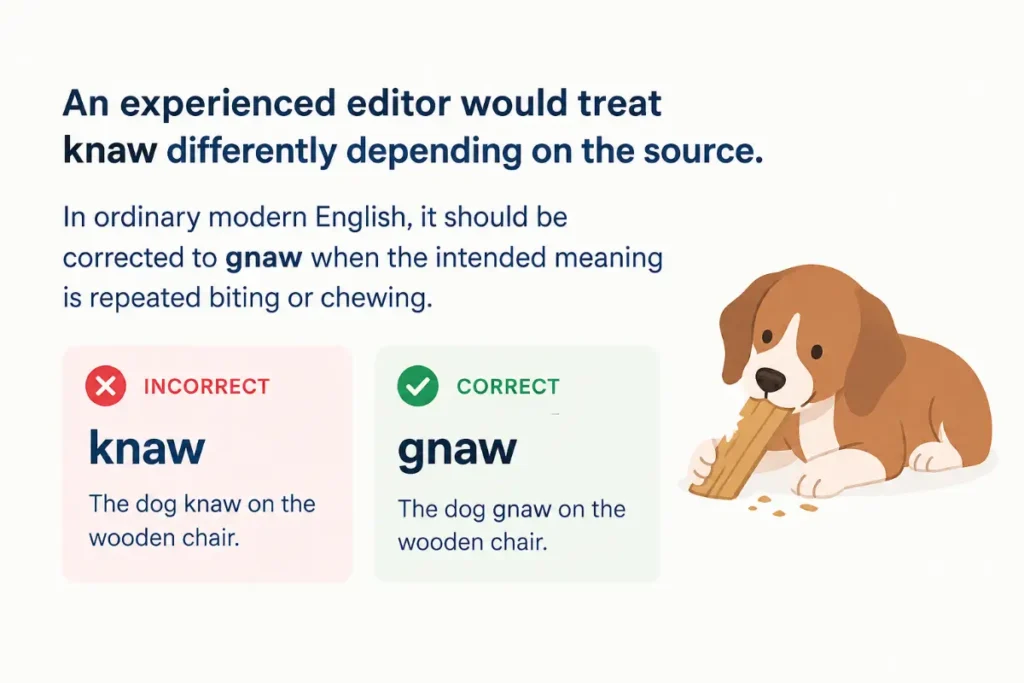
An experienced editor looks at both the spelling and the sentence’s intended meaning. The silent g is the main reason people type knaw, especially when they spell words by sound. A spell checker may flag the incorrect form, but it can’t always judge the intended meaning or catch every unusual name. Read the sentence in context, confirm the word’s meaning, and check the spelling before publishing. For professional writing, consistency matters more than trying to make an unusual spelling match the way a word sounds.
Need another quick comparison? Read hope you are doing well Meaning And Better Ways To Use It.
Conclusion
When choosing gnaw or knaw, remember that gnaw is the correct spelling for the standard modern English verb. It describes repeated biting and chewing, as well as persistent worry or discomfort. The initial g is silent, which explains why the word can be difficult to spell from sound alone. Its spelling stays the same in forms such as gnaws, gnawed, and gnawing. The easiest way to remember it is to connect the word with other English words that begin with a silent g, such as gnat. When writing an email, school assignment, or professional document, use gnaw and check the surrounding sentence to make sure the meaning fits.
FAQs
Is Knaw a Real Word?
Knaw appears in historical Scottish language records, but it isn’t the standard spelling of the modern English verb meaning to bite repeatedly. In ordinary American writing, treat it as a misspelling of gnaw. If you encounter it in an old text or a proper name, consider the historical or personal context before correcting it.
What Does Gnaw Mean?
Gnaw means to bite or chew something repeatedly, often wearing it down over time. The word also describes a persistent feeling of worry, guilt, or doubt. For example, a mouse can gnaw through a box, and regret can gnaw at someone’s mind. The exact meaning depends on the context of the sentence.
Which Is Correct Between Gnaw and Knaw?
Gnaw is correct in standard modern English when you mean repeated biting or persistent worry. Knaw is not the accepted spelling for that verb in ordinary writing. The confusion happens because the g is silent. Remember the written form rather than relying on the sound alone.
How Do You Pronounce Gnaw?
In common American English, gnaw is pronounced /nɑː/, which sounds like naw. It has one syllable, and the initial g is silent. British pronunciation often uses /nɔː/. The vowel can vary across regional accents, but speakers do not pronounce the initial g in the standard word.
Can Gnaw Start a Sentence?
Yes. The word can start a sentence in its base form or an ing form, depending on the grammar. For example, Gnawing on the toy kept the puppy busy. You can also begin a command with Gnaw, as in Gnaw carefully at the tough material. The initial spelling remains unchanged.
What Is a Synonym for Gnaw?
Useful alternatives include chew, nibble, bite, chomp, and munch for physical actions. For the figurative meaning, words such as worry, trouble, and torment may fit. The best choice depends on the sentence. Gnaw often suggests a repeated action or a concern that continues to wear someone down.
Why Do People Confuse Gnaw and Knaw?
People confuse these forms because the g in gnaw is silent. When someone hears the word without seeing it written, the pronunciation provides no clear clue that the first letter is g. This is a common challenge in English, where the spelling of some words preserves older forms that no longer match their pronunciation.
Is Gnaw Appropriate in Formal Writing?
Yes. Gnaw is a standard English verb that works in formal and informal writing. It can describe physical damage in scientific or technical reports, and it can express persistent concern in essays or other prose. Use it when its meaning fits the context, and choose a more precise term if the subject requires technical detail.