
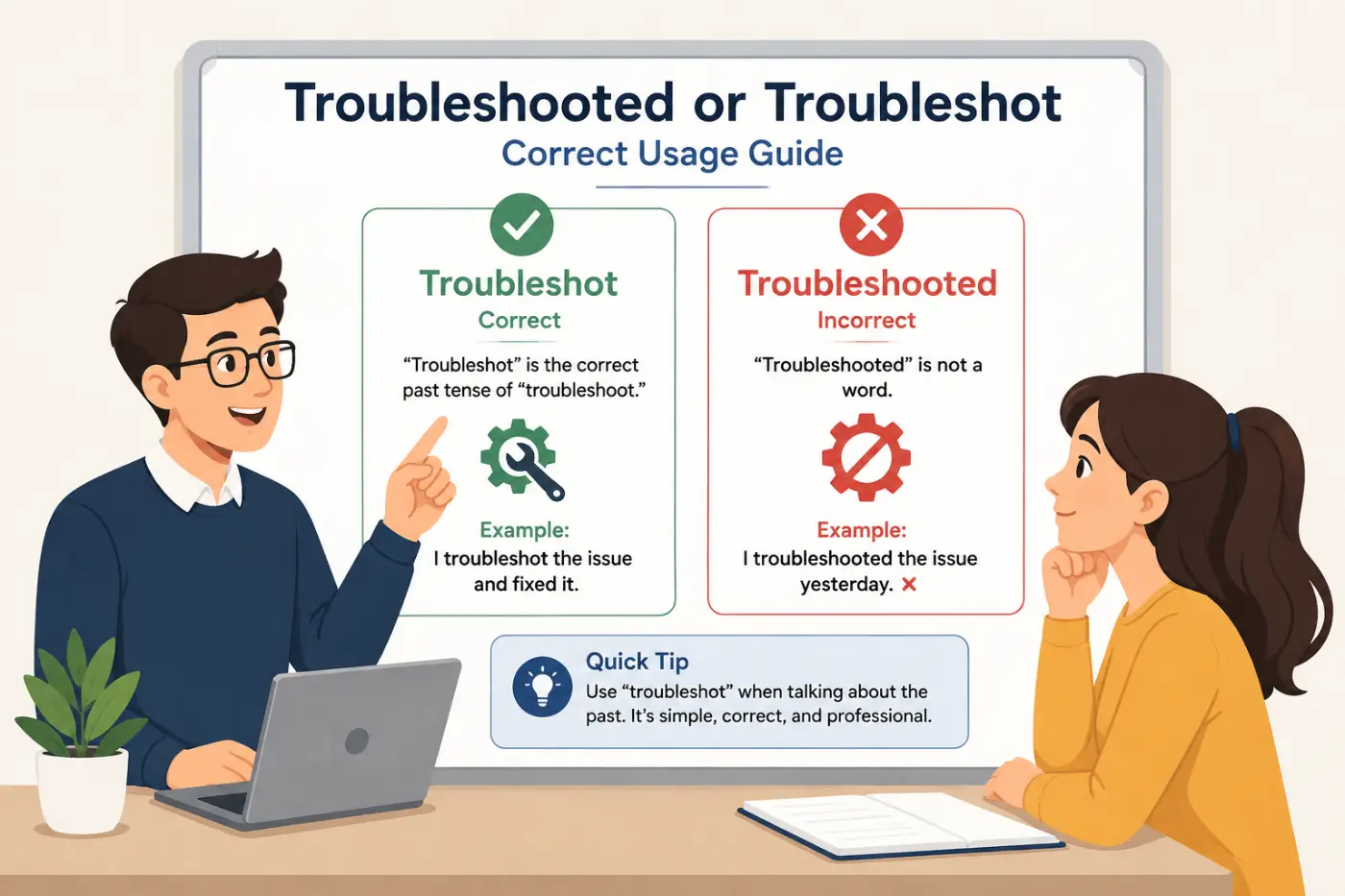
This guide explains the difference between troubleshooted or troubleshot in plain English. You’ll learn the correct past tense, pronunciation, grammar rules, sentence patterns, common mistakes, word history, regional usage, and practical examples. By the end you’ll know exactly which form to use in an email, report, technical document, conversation, or professional setting.
If you’ve ever written troubleshooted and then wondered if it actually sounded right you’re not alone. This verb creates a small grammar trap because its ending looks like many regular English verbs. The correct past tense is troubleshot. Troubleshooted is not the standard past tense used in edited English.
The reason is simple once you see the pattern. The verb troubleshoot is built from trouble and shoot. It follows the irregular past tense pattern of shoot, which changes to shot rather than taking the regular ending ed. Merriam Webster lists troubleshot as the past form of troubleshoot. Cambridge Dictionary does the same.
Learn the difference in emersion vs immersion: Correct Meaning and Usage.
Quick Definition
Troubleshot is the standard past tense and past participle of troubleshoot. It means that someone investigated a problem and worked to find or fix its cause. Troubleshooted is not the standard form recommended by major English dictionaries. Merriam Webster and Cambridge Dictionary both list troubleshot as the past form.
Quick Answer
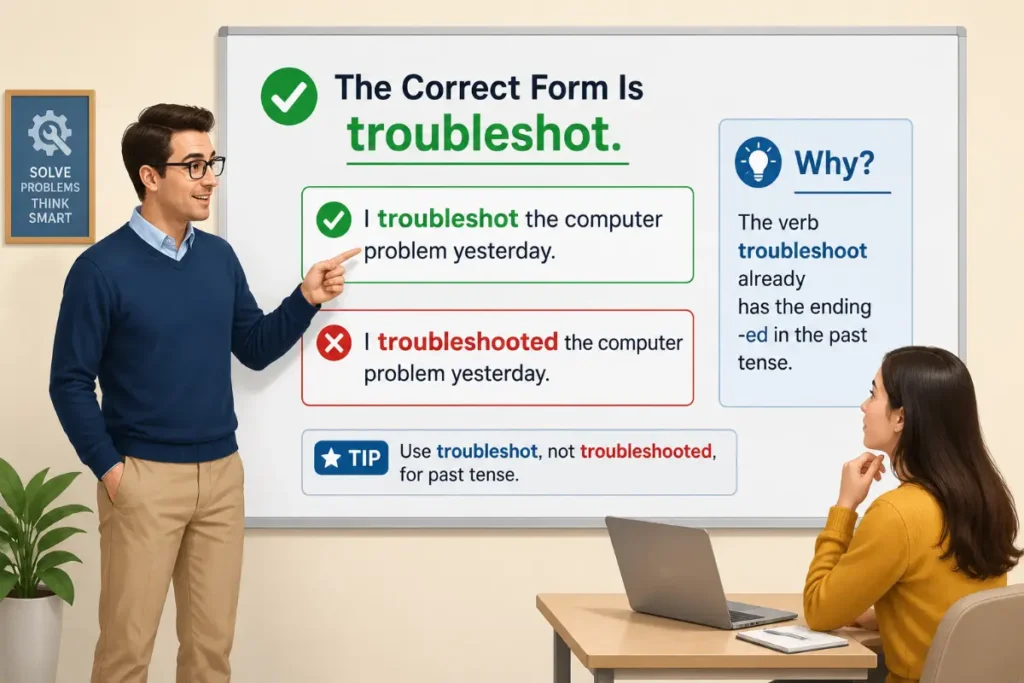
The correct form is troubleshot. You should write I troubleshot the computer problem yesterday rather than I troubleshooted the computer problem yesterday.
The verb troubleshoot is irregular because it follows the pattern of shoot. Just as shoot becomes shot in the past tense troubleshoot becomes troubleshot.
Comparison Table For Troubleshooted And Troubleshot
| Correct Form | Meaning | Part of Speech | Origin | Usage Frequency | Formality | Common Contexts | Example |
|---|---|---|---|---|---|---|---|
| Troubleshot | Investigated or solved a problem in the past | Verb | Built from troubleshoot and the verb shoot | Standard and widely accepted | Neutral and professional | Technology equipment systems repairs | I troubleshot the network issue yesterday. |
| Troubleshooted | Intended to express the past action of troubleshooting | Verb form | Created by treating troubleshoot as a regular verb | Nonstandard and much less accepted | Informal or incorrect in edited English | Common learner error and occasional informal usage | I troubleshooted the issue yesterday. |
Meaning And Definition
Meaning Of Troubleshooted
Troubleshooted is an understandable attempt to form the past tense of troubleshoot. The problem is that English does not normally form this verb’s past tense by simply adding ed.
A learner who writes troubleshooted is usually applying a perfectly reasonable English rule to the wrong verb pattern. Many English verbs form their past tense with ed. We have worked, tested, fixed, checked, and repaired. That pattern is so common that it can feel natural to write troubleshooted.
English has plenty of exceptions though. The verb shoot becomes shot. Since troubleshoot contains shoot as its second element it follows that irregular pattern.
Major dictionaries do not list troubleshooted as the standard past form. Merriam Webster gives troubleshot while Cambridge Dictionary also gives troubleshot as the past form.
That makes troubleshooted a nonstandard formation rather than a preferred alternative.
Meaning Of Troubleshot
Troubleshot means that someone investigated a problem in the past and attempted to identify or solve it.
For example:
The technician troubleshot the printer yesterday.
This tells us that the technician worked on the printer problem at some point in the past.
The word is especially common in technical contexts. People troubleshoot computers, networks, machines, software, electrical systems, appliances, vehicles, websites, and other equipment. The meaning can also extend beyond technology. Someone can troubleshoot a process, a workplace problem, or an organizational issue.
Cambridge defines troubleshoot as discovering why something does not work effectively and helping to improve it. Its Business English definition also describes troubleshooting as finding the cause of a product or system problem and trying to find a solution.
Merriam Webster defines the verb in terms of investigating or dealing with a problem in the role of a troubleshooter. It lists troubleshot as the past form.
Key Differences Explained
- Spelling.
Troubleshot is the standard past tense. Troubleshooted is a nonstandard formation. - Grammar role.
Both forms attempt to function as past tense verbs. Only troubleshot is the standard form in edited English. - Meaning.
There is no meaningful difference in intended meaning. Someone who writes troubleshooted usually means the same thing as someone who writes troubleshot. - Tone.
Troubleshot sounds natural and professional. Troubleshooted can sound awkward to experienced English speakers. - Context.
Use troubleshot in technical documentation, workplace communication, academic writing, resumes, reports, and other formal or edited contexts.
The key point is that this is not a difference in meaning. It is a difference in grammatical form.
Which Spelling Is Correct
Troubleshot is the correct standard form.
The strongest evidence comes from established dictionaries rather than personal preference. Merriam Webster lists troubleshot directly after the main entry for troubleshoot. Cambridge Dictionary also displays troubleshot as the past form.
The linguistic reason is also clear. Troubleshoot contains shoot. The verb shoot has the irregular past form shot. The compound verb keeps that irregular pattern.
You can think of it as a family resemblance:
shoot → shot
troubleshoot → troubleshot
This pattern appears in other compound verbs too. English often preserves the irregular form of a verb when that verb becomes part of a larger compound.
A useful editor’s test is to remove the first part of the compound. If the base verb has an irregular past form that remains active in the compound then the compound often follows it.
That’s why troubleshot feels unusual at first but is grammatically correct.
Sentence Examples
Here are natural examples using troubleshot.
- I troubleshot the network problem before the meeting started.
- She troubleshot the printer and got it working again.
- Our technician troubleshot the software issue remotely.
- We troubleshot several connection problems during the installation.
- He troubleshot the machine for nearly two hours.
- The IT team troubleshot the server after users reported an outage.
- I troubleshot the application and found that the configuration was incorrect.
- They troubleshot the equipment before putting it back into service.
- The engineer troubleshot the electrical system and identified the faulty component.
- She troubleshot the problem quickly and explained the solution to the customer.
Now compare those sentences with the common nonstandard form.
- I troubleshooted the network problem yesterday.
- She troubleshooted the printer before lunch.
- Our technician troubleshooted the software issue.
- We troubleshooted the connection problem together.
- He troubleshooted the machine for two hours.
These sentences are understandable. A reader will know what the writer means. However, troubleshot is the standard form you should choose in polished English.
Common Mistakes And Misspellings
Several mistakes appear because English speakers expect troubleshoot to behave like a regular verb.
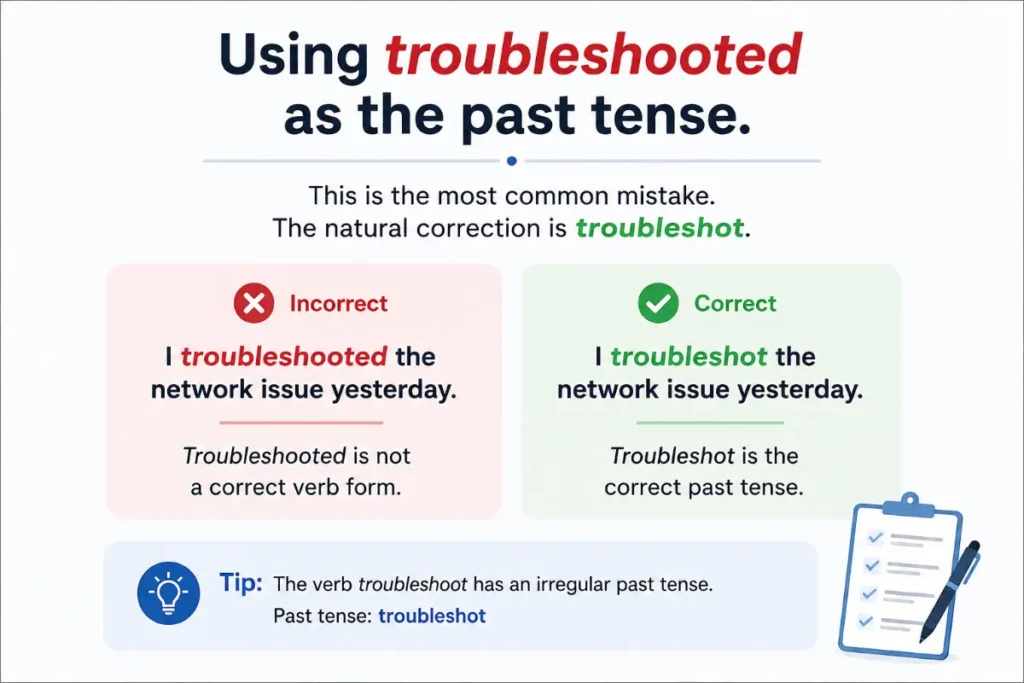
- Using troubleshooted as the past tense.
This is the most common mistake. The natural correction is troubleshot. - Writing troubleshoted.
Some writers try to combine the irregular form with the regular ed ending. That produces an incorrect form. - Using troubleshoot for a completed past action.
For example I troubleshoot the computer yesterday is incorrect in standard past tense grammar. The sentence needs troubleshot. - Using troubleshooting after have incorrectly.
The present participle troubleshooting should not replace the past participle after have. Write I have troubleshot the problem. - Confusing troubleshoot with repair.
Troubleshooting usually involves investigating the cause of a problem. Repair may be the final action. You can troubleshoot something without personally performing the final repair.
Why do people type troubleshooted?
The answer lies partly in pattern recognition. Human language processing relies heavily on familiar patterns. When people see a verb that looks like a normal English verb they often predict the regular ed form automatically.
The spelling can also create a mental trap because troubleshoot is much longer than shoot. The irregular part sits at the end of a compound word and can be easy to overlook.
This is an example of morphological analogy. A speaker knows that many verbs form the past tense with ed and applies that familiar pattern to a verb that belongs to an irregular group.
That mistake does not mean the speaker lacks English knowledge. It shows how strongly English patterns influence word formation.
Pronunciation Guide
The pronunciation of troubleshot is fairly straightforward once you divide the word into parts.
Merriam Webster gives troubleshoot as /ˈtrə bəl ˌshüt/ and troubleshot as /ˈtrə bəl ˌshät/. Cambridge gives a similar pronunciation pattern for the verb.
A simple syllable guide is:
trou ble shot
The word has three spoken parts.
An easy audio style spelling for American English is:
TRUH bul SHOT
The final part is pronounced like shot.
One common mistake is to pronounce the ending as though it were shooted. Avoid that pattern. The past form changes from the vowel sound in shoot to the sound in shot.
Compare these forms:
troubleshoot sounds like TRUH bul shoot
troubleshot sounds like TRUH bul shot
The spelling change is small but the vowel sound changes too.
Still confused? Compare EKG vs ECG Which One Is Correct 2026.
Etymology And Word Origin
The history of troubleshoot helps explain why its past tense is troubleshot.
Merriam Webster identifies troubleshoot as a back formation from troubleshooter and gives its first known use as 1918.
The word is built from two familiar English elements: trouble and shoot. Its meaning developed around the idea of finding and dealing with trouble.
The important part for grammar is shoot. This verb has an old irregular past form:
shoot → shot
The compound troubleshoot preserves that pattern:
troubleshoot → troubleshot
The word has become especially associated with technical work. Modern dictionaries show examples involving computers, equipment, networks, systems, and other problems.
This history also explains why adding ed feels tempting but does not produce the standard form.
The broader word final has a different history entirely. Merriam Webster traces final through Middle English and Anglo French to Latin finalis and finis. That history has no connection to troubleshoot.
Understanding word families can be useful when you’re trying to remember irregular forms. Instead of memorizing troubleshot as an isolated spelling you can connect it directly to shoot → shot.
Regional Usage In The US
American English uses troubleshot as the standard past tense of troubleshoot. It appears naturally in technical support, engineering, information technology, workplace communication, and everyday conversation.
You might hear someone say I troubleshot the issue yesterday during a work discussion. The form can sound slightly unusual at first because many people expect ed after a verb. Native speakers who know the word generally recognize troubleshot without difficulty.
American professional writing should use troubleshot.
Regional Usage In The UK
British English also uses troubleshot as the standard past form. Cambridge Dictionary lists troubleshot for the verb in British English as well as American English.
The meaning is essentially the same. British speakers use the word for investigating technical problems and finding solutions.
You may encounter troubleshooted in informal writing or user generated content but that does not make it the preferred standard form.
Regional Usage In Australia
Australian English follows the same general grammatical pattern. Troubleshot is the appropriate standard past form.
The word is particularly useful in workplace and technical contexts. Australian English does not normally require a different past tense such as troubleshooted.
Regional Usage In Canada
Canadian English also follows the standard English pattern troubleshoot → troubleshot.
Because Canadian English shares many grammatical features with both American and British English troubleshot works naturally in professional writing across Canada.
There is no major regional version that makes troubleshooted the preferred standard past tense.
Grammar Rules And Part Of Speech
Troubleshoot is a verb. It can function as both a transitive and intransitive verb.
As a transitive verb it can take a direct object.
The technician troubleshot the network.
Here the network receives the action.
It can also appear without a direct object when the context already makes the problem clear.
The technician spent the afternoon troubleshooting.
The simple present form is troubleshoot.
I troubleshoot computer problems.
The third person singular present form is troubleshoots.
She troubleshoots software issues.
The simple past form is troubleshot.
She troubleshot the software issue yesterday.
The present participle is troubleshooting.
She is troubleshooting the software issue now.
The past participle is also troubleshot.
She has troubleshot similar problems before.
This is one of the most useful patterns to remember:
Present: I troubleshoot.
Past: I troubleshot.
Present perfect: I have troubleshot.
Continuous: I am troubleshooting.
The word troubleshooted does not belong in this standard verb pattern.
Placement In A Sentence
The verb can appear naturally in several positions.
We troubleshot the problem yesterday.
After lunch we troubleshot the connection issue.
The technician troubleshot the system before the customer arrived.
She has troubleshot similar errors many times.
You generally do not need special punctuation simply because you use troubleshot. Follow the normal punctuation rules of the sentence.
If you place an introductory phrase before the main clause you may need a comma based on the phrase and sentence structure.
For example:
After several failed attempts the team troubleshot the issue successfully.
The punctuation depends on the sentence structure rather than the verb itself.
Real Life Usage Examples
Daily Talk
I troubleshot the Wi Fi problem this morning.
He troubleshot the printer before everyone arrived.
In everyday conversation people often use simpler phrases such as I fixed the problem. Still troubleshot is completely natural when the focus is on diagnosing the cause rather than simply fixing the result.
I troubleshot the login issue and found that the account settings were incorrect.
We troubleshot the connection problem and restored access this afternoon.
The word works well in professional email because it communicates a specific type of technical work.
Academic Writing
The research team troubleshot the equipment before collecting the final measurements.
The students troubleshot the software before beginning the simulation.
Academic writers may prefer a more specific verb such as diagnosed, identified, or resolved when the exact action matters.
News Writing
Engineers troubleshot the system after the unexpected shutdown.
Technicians troubleshot the equipment before operations resumed.
News writing often uses the verb when reporting technical problems and responses.
Literature
He troubleshot the old machine until the engine finally started.
She troubleshot the strange device with patience and a notebook beside her.
In creative writing the verb can help establish character and setting. A technician who troubleshoots a machine is doing more than simply repairing it. The word suggests investigation and problem solving.
Related And Confused Terms
Several words overlap with troubleshot but they aren’t perfect substitutes.
- Diagnosed.
This focuses on identifying the cause or nature of a problem. - Debugged.
This usually refers to finding and removing errors in software or computer systems. - Repaired.
This means fixing something that is damaged or not working. - Resolved.
This emphasizes bringing a problem to a successful conclusion. - Fixed.
This is the broad everyday term for making something work again. - Investigated.
This emphasizes examining a problem to understand what happened. - Analyzed.
This focuses on examining information or a situation carefully. - Solved.
This emphasizes finding an answer or solution.
These words are related to troubleshooting but they highlight different stages of problem solving.
For example diagnosed may describe finding the cause while repaired may describe correcting the physical fault. Troubleshot can cover the investigative process that leads toward the solution.
Expert Editor Insight
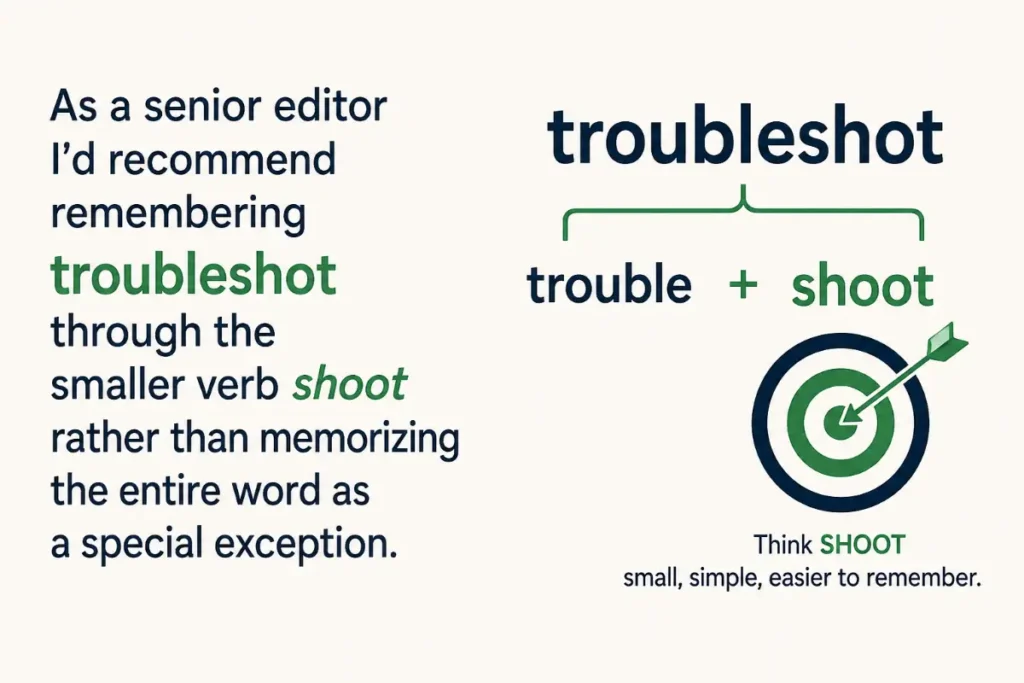
As a senior editor I’d recommend remembering troubleshot through the smaller verb shoot rather than memorizing the entire word as a special exception. Think shoot becomes shot and then carry that pattern into troubleshoot becomes troubleshot. This approach is faster and more reliable than trying to remember that the word simply looks unusual. Dictionary entries from Merriam Webster and Cambridge support this form directly.
Grammar checkers may flag troubleshooted because it conflicts with the recognized irregular form. Some software can miss unusual word formations or accept them based on context so a dictionary remains the better final authority for questions about standard usage.
A related grammar guide is seperate or separate Correct Spelling and Usage Guide.
Conclusion
The correct past tense is troubleshot. Troubleshooted is a common but nonstandard formation that comes from treating troubleshoot like a regular verb. The reliable pattern is shoot → shot and therefore troubleshoot → troubleshot. Major dictionaries including Merriam Webster and Cambridge Dictionary support this usage.
Use troubleshot in professional writing technical documents emails reports and everyday English. If you’re unsure remember the smaller word inside the compound. Shoot becomes shot. That simple connection makes the correct form much easier to remember.
FAQs
Is Troubleshooted A Real Word?
Troubleshooted is an understandable formation but it is not the standard past tense of troubleshoot in edited English. Major dictionaries list troubleshot instead. If you are writing an email report resume article technical document or academic paper use troubleshot. It follows the irregular pattern of shoot which changes to shot in the past tense.
What Does Troubleshot Mean?
Troubleshot is the past tense and past participle of troubleshoot. It means that someone investigated a problem and worked to identify or solve its cause. The word is especially common in technical settings involving computers equipment networks machines and software. For example The technician troubleshot the network issue yesterday means the technician investigated the problem in the past.
Troubleshooted Or Troubleshot Which Is Correct?
Troubleshot is correct in standard English. Troubleshooted results from treating troubleshoot like a regular verb that forms its past tense with ed. However troubleshoot follows shoot and therefore uses the irregular past form shot. The correct pattern is shoot → shot and troubleshoot → troubleshot. Major dictionaries support troubleshot as the standard form.
How Do You Pronounce Troubleshot?
Troubleshot is pronounced approximately TRUH bul SHOT in American English. Merriam Webster gives the pronunciation /ˈtrə bəl ˌshät/. The word has three spoken parts that can be thought of as trou ble shot. The final sound matches shot rather than shoot.
Can Troubleshot Start A Sentence?
Yes. Troubleshot can start a sentence when the grammatical structure calls for a past tense verb. For example Troubleshot the network issue before the meeting would normally need a clear subject in standard prose such as The technician troubleshot the network issue before the meeting. The verb itself has no rule that prevents it from appearing at the beginning of a sentence.
What Is A Synonym Of Troubleshot?
Useful alternatives include diagnosed, debugged, investigated, analyzed, repaired, resolved, and fixed. The best choice depends on the exact action. Diagnosed emphasizes finding the cause. Repaired emphasizes fixing damage. Resolved emphasizes reaching a solution. Troubleshot is especially useful when someone systematically investigates a problem to discover what is wrong and how to correct it.
Why Do People Misspell Troubleshoot?
People often write troubleshooted because they apply the regular past tense pattern used by many English verbs. Words such as tested, checked, and fixed naturally take ed. Since troubleshoot looks like a modern technical verb people may not immediately recognize its connection to shoot. Once you remember shoot → shot the correct form becomes much easier to recall.
Is Troubleshot Suitable For Formal Writing?
Yes. Troubleshot is suitable for formal writing and professional communication. It appears naturally in technical documentation workplace reports resumes academic material and business communication. For example Troubleshot network connectivity issues and improved system reliability is a clear professional statement. If you want a more specific verb you can use diagnosed, resolved, or repaired depending on the exact work you performed.