
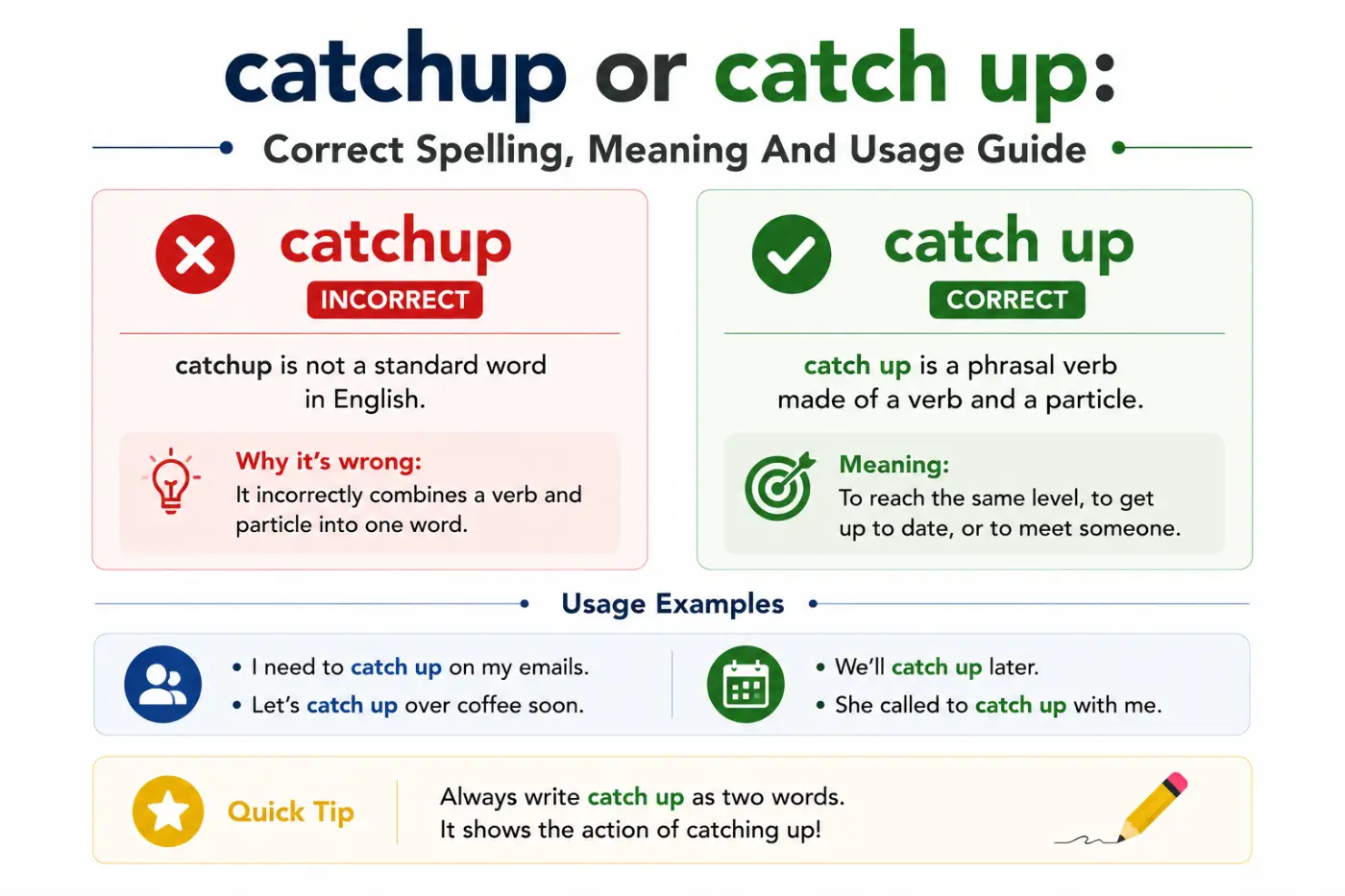
catchup or catch up can look like a simple spelling choice, but the answer depends on what you mean. If you are using the expression as a verb meaning to reach someone, complete missed work, or exchange recent news, catch up is the standard two word form. The one word form catchup has a different established meaning in dictionaries. It can refer to a variant spelling of ketchup.
The confusion happens because English sometimes turns verb phrases into nouns and adjectives. That process can create forms that look almost identical but behave differently in a sentence. You may write I need to catch up on my reading, but you can also see the noun form catch up in informal expressions that refer to a meeting or conversation. Standard dictionaries commonly represent that noun with a hyphen in many contexts.
For everyday American English, the safest rule is straightforward. Use the two word verb form for actions. Use a noun or adjective form only when the grammar calls for it. This guide explains the difference, meanings, pronunciation, grammar, regional usage, common mistakes, sentence patterns, related expressions, and an easy editing rule you can use whenever the spelling feels uncertain.
For another common grammar confusion, see excel vs accel Which One Should You Use in 2026.
Quick Definition
Use catch up as a phrasal verb when you mean reaching someone or something, getting up to date, or completing work that was delayed. Catchup as one word is a recognized noun for a variant spelling of ketchup. A related noun form is commonly written as catch up with a hyphen in dictionary usage.
Quick Answer
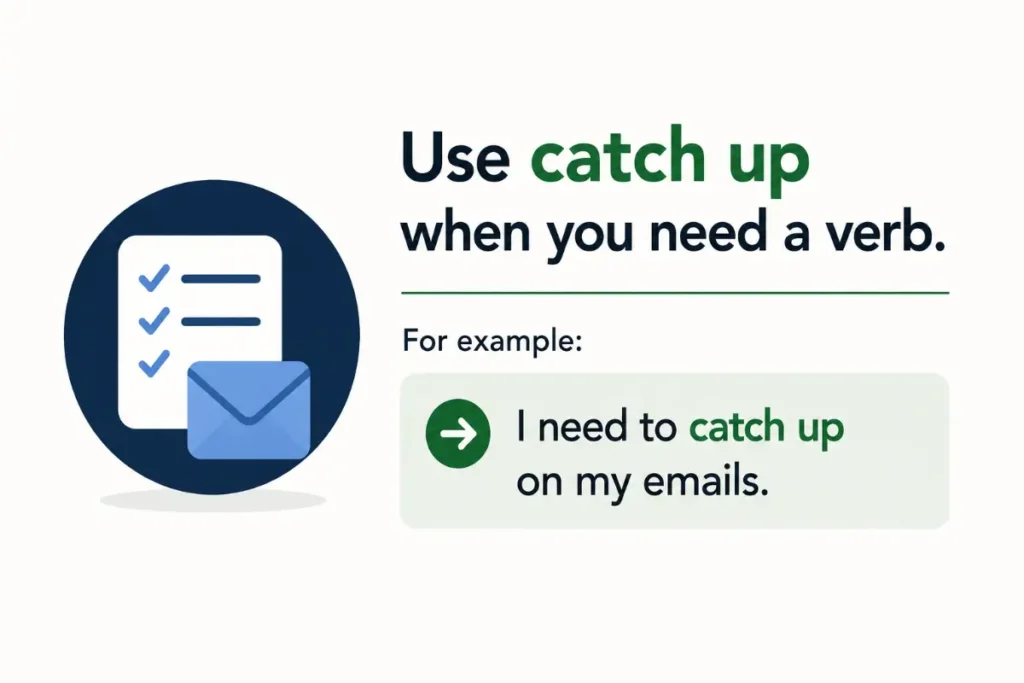
The correct form for the verb is catch up.
Write:
I need to catch up on my reading.
Do not write:
I need to catchup on my reading.
The one word form has a separate dictionary meaning connected with ketchup. When the phrase functions as a noun, standard dictionaries also recognize a noun form commonly written with a hyphen, especially for a meeting, conversation, or effort to reach the same level.
Comparison Table For The Different Forms
| Form | Meaning | Part of Speech | Origin | Usage Frequency | Formality | Common Contexts | Example |
|---|---|---|---|---|---|---|---|
| Catch up | Reach someone or something, become up to date, or complete delayed work | Phrasal verb | Verb catch plus particle up | Very common | Neutral and conversational | Work, school, travel, conversation | I need to catch up on my reading. |
| Catchup | Variant spelling of ketchup | Noun | Historical spelling associated with ketchup | Uncommon | Neutral but less usual | Food and historical spelling | The recipe calls for catchup. |
| Catch up with a hyphen | A meeting, conversation, or process of reaching a level | Noun | Developed from the verb phrase | Common in specific noun uses | Informal to neutral | Meetings, work, progress, media | We had a catch up after lunch. |
The exact noun spelling can vary by dictionary and style system. Cambridge records catch up with a hyphen as a noun for a meeting or conversation in UK usage and as a noun for the process of reaching the same level in mainly US usage.
Meaning And Definition
Meaning Of Catchup
Catchup is a real English word, but it is not normally the form you want when writing the verb.
Cambridge Dictionary lists catchup as a noun meaning another spelling of ketchup. Collins also records catchup as a noun meaning ketchup.
For example:
The fries came with catchup and mustard.
This use is uncommon compared with the familiar spelling ketchup. Still, it explains why calling catchup simply an incorrect spelling would be inaccurate.
There is another interesting point. Some modern informal writing uses catchup as a one word noun for the act of catching up. Dictionary evidence shows that this usage exists, but the more established dictionary form for that noun is commonly written catch up with a hyphen.
That distinction matters because a word can appear in real writing without being the best standard choice for every grammatical role.
Meaning Of Catch Up
Catch up is a phrasal verb with several closely related meanings.
The first meaning is to reach someone or something that is ahead of you.
I ran faster to catch up with my friends.
Here the speaker was behind the friends and moved faster until they reached them.
The second meaning is to reach the same level or standard as someone else.
She missed two weeks of school and is working hard to catch up.
The third meaning is to do work that you did not have time to complete earlier.
I stayed late to catch up on my emails.
The fourth meaning is to get the latest information about something or talk with someone about recent events.
We met for coffee to catch up.
Cambridge Dictionary records these major uses including reaching the same standard, completing something that was delayed, and discussing recent news.
These meanings share a central idea. Something is behind, missing, or ahead, and the action brings things closer together.
The Main Difference
The clearest way to understand the forms is to look at their grammatical jobs.
- Catch up is a verb phrase. It describes an action.
- Catchup is a noun with a separate established meaning. In dictionary usage, it refers to ketchup.
- The noun connected with catching up is usually written with a hyphen in dictionary entries. It can refer to a meeting, conversation, or process of reaching the same level.
- The verb requires two words. You catch up with a person. You catch up on work. You catch up on the latest news.
- Pronunciation does not clearly separate the forms. That is one reason the spelling causes confusion.
- Context determines meaning. The sentence I need to catch up on my homework clearly uses a verb phrase. The word catchup on a food label points to a sauce.
The important lesson is that spacing can signal grammatical function in English. The words may sound identical, but their written forms tell the reader how they are being used.
When To Use Catch Up
Use the two word form when it acts as a verb.
Reaching Someone
I walked faster so I could catch up with my brother.
The runner finally caught up with the leader.
They waited for us to catch up.
In each sentence, the phrase describes movement toward someone who is ahead.
Reaching The Same Level
The smaller company is trying to catch up with its larger competitors.
After missing several classes, Maya worked hard to catch up.
The new team has a lot of ground to cover before it can catch up.
This meaning can be literal or figurative. You can catch up physically with a person or figuratively with a standard, skill, competitor, or level of progress.
Completing Delayed Work
I need to catch up on my homework.
He spent Saturday catching up on paperwork.
I’m trying to catch up with all the reports I missed.
Cambridge specifically recognizes the use of catch up on something for doing work that could not be completed earlier.
Getting Recent Information
I need to catch up on the latest news.
We talked for an hour so I could catch up with her.
Let’s meet this weekend and catch up.
This use is especially common in American conversation. It often suggests that two people have not spoken recently and want to exchange news.
Catch Up With And Catch Up On
These two patterns are closely related but serve different purposes.
Use catch up with when the focus is a person, group, competitor, or thing you are trying to reach or reconnect with.
For example:
I need to catch up with Sarah.
The company is trying to catch up with its competitors.
We finally caught up with the group.
Use catch up on when the focus is work, information, news, reading, or another activity you have missed.
For example:
I need to catch up on my emails.
She spent the evening catching up on her reading.
We watched the recordings to catch up on the lessons we missed.
Cambridge records both patterns and distinguishes their meanings through context.
A simple memory rule is this.
With usually points toward a person or thing.
On usually points toward information or unfinished work.
There are exceptions and other patterns, but this distinction covers many everyday sentences.
Can Catch Up Start A Sentence
Yes. Catch up can appear at the beginning of a sentence when the sentence structure calls for it.
For example:
Catch up with me after the meeting.
In these examples, the phrase appears in an imperative sentence. The subject you is understood.
It can also appear at the beginning of a statement.
Catch up is harder when several weeks of work have piled up.
The placement is not a problem. What matters is that the phrase retains its two word verb structure.
Sentence Examples
Here are ten natural examples that show the most common uses.
- I need to catch up on my homework before Monday.
- We met for coffee so we could catch up on everything that happened last month.
- She walked faster to catch up with her friends.
- The student stayed after class to catch up on missed lessons.
- Our team is working hard to catch up with the competition.
- I spent Sunday catching up on emails.
- Call me later when you have time to catch up.
- He watched the earlier episodes to catch up with the story.
- The company needs to invest more if it wants to catch up with its competitors.
- I missed the meeting, so could you catch me up on what happened?
These examples show why the phrase is so useful. It can describe physical movement, progress, unfinished work, news, communication, and learning.
Common Mistakes And Misspellings
Writing Catchup As The Verb
Incorrect:
I need to catchup on my work.
Correct:
I need to catch up on my work.
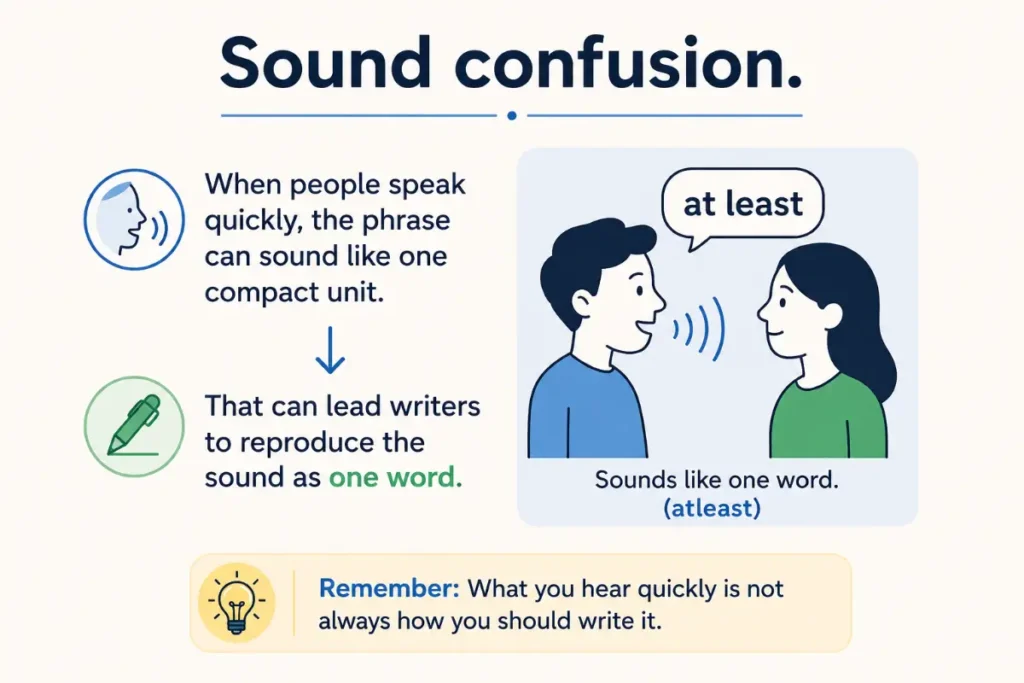
The mistake happens because the phrase sounds like one unit when spoken. English speakers naturally compress sounds in connected speech, so the written spacing can be easy to overlook.
Using Catch Up As A Noun Without Checking Style
You may see:
We had a catch up yesterday.
Many readers will understand this immediately. However, dictionary entries commonly use a hyphen for the noun form. Cambridge records catch up with a hyphen as a noun in this sense.
If you are writing for a formal audience, check the style guide your publication or organization follows.
Confusing Catchup With Ketchup
Catchup is an established variant spelling of ketchup. That does not make it the correct spelling of the verb phrase.
For example:
Please catch up on the report.
This is about completing work.
Please pass the catchup.
This can refer to the condiment.
The surrounding words make the difference obvious.
Writing Catch Up With Every Meaning
Writers sometimes use catch up with when they mean complete unfinished work.
I need to catch up with my homework.
This sentence can be understood, but catch up on my homework is the more natural standard pattern for unfinished work.
Forgetting The Preposition
The phrase often needs a following word or phrase to complete the meaning.
I need to catch up.
This is perfectly acceptable when the context is already clear.
But:
I need to catch up my emails.
is incorrect in standard American usage.
Write:
I need to catch up on my emails.
The preposition matters because it shows the relationship between the action and the thing being completed.
You may also want to read Courtesy Vs Curtesy Which Word Should You Use in 2026.
Pronunciation Guide
The verb catch up is commonly pronounced /kætʃ ʌp/ in American English. Cambridge gives the American pronunciation of catch up as beginning with the sound in catch followed by the short vowel sound in up.
A simple pronunciation guide is:
KATCH UP.
There are two main sound parts.
catch + up
The stress pattern is straightforward, with the phrase naturally receiving emphasis according to the sentence.
The noun catchup meaning ketchup has a similar sound. Cambridge gives its pronunciation as /ˈkætʃ.ʌp/.
That identical or near identical sound explains much of the confusion. A listener cannot rely on pronunciation alone to know which written form the speaker intends.
You have to use context.
If someone says:
I need to catch up.
They are talking about an action.
If someone asks:
Do you want catchup with your fries?
The context points toward the condiment.
Etymology And Word Origin
The verb phrase catch up developed from the ordinary verb catch and the particle up. The basic idea is physical. Someone who is behind moves forward until they reach the person or thing ahead.
That physical idea gradually developed broader meanings. A person can catch up with a competitor. A student can catch up with classmates. A worker can catch up on delayed tasks. Friends can catch up by exchanging news.
Dictionary sources trace the noun catch up form to the verb phrase. Dictionary.com dates the noun and adjective use to the nineteenth century.
The one word noun catchup has a completely different history when it means ketchup. Historical dictionaries record catchup as an early spelling of the condiment. Cambridge and Collins both recognize it as a variant of ketchup.
The condiment word itself has a much older and separate history connected with Asian sauce terms. Collins traces ketchup through Malay and Chinese sources.
So the two meanings should not be treated as one spelling rule. They come from different language histories.
Regional Usage
American English
American English commonly uses catch up as the phrasal verb.
You might hear:
I need to catch up on work.
Let’s catch up sometime.
She ran to catch up with the group.
The noun form is also established. Cambridge records catch up with a hyphen as a noun for the process of reaching the same standard or level and gives mainly US usage for that sense.
For the condiment, ketchup is the normal modern spelling for most American readers. Catchup exists but is much less familiar in ordinary food writing. Collins recognizes catchup as an American noun variant of ketchup.
British English
British English also uses catch up as the verb.
For example:
I need to catch up on my work.
I’ll catch up with you later.
The noun form can refer to a meeting or conversation. Cambridge records this use in UK English and gives catch up with a hyphen.
Catchup as the condiment spelling is also recognized, but ketchup is much more familiar in ordinary modern writing.
Australian English
Australian English uses catch up as the standard phrasal verb for the same core meanings. The phrase can describe reaching someone, completing missed work, or getting current information.
The noun and adjective forms follow broader English usage patterns. Writers should focus on grammatical function rather than assuming that every related form should be joined into one word.
Canadian English
Canadian English also uses catch up as the standard verb phrase.
For example:
I need to catch up on my assignments.
We should catch up after work.
The spelling choice for the verb does not change simply because the variety of English changes. The main distinction remains grammatical.
Grammar Rules And Part Of Speech
Catch up is a phrasal verb.
A phrasal verb combines a verb with another short word called a particle. Here catch is the verb and up is the particle.
The combination creates meanings that are not always predictable from the individual words.
For example:
I caught the ball.
This is different from:
I caught up with my friend.
The first sentence describes grabbing something. The second describes reaching someone who was ahead or reconnecting with someone.
The phrase can be followed by several different structures.
Catch Up With Someone
Use this pattern when the focus is a person.
I need to catch up with my sister.
Catch Up With Something
Use this pattern when the focus is a standard, level, or thing that has moved ahead.
The company is trying to catch up with the market.
Catch Up On Something
Use this pattern for work, information, reading, news, or another activity that has been missed.
I need to catch up on my reading.
Catch Someone Up On Something
This construction means giving someone the latest information.
Can you catch me up on the meeting?
Cambridge specifically defines catch someone up on something as giving someone the latest news or information about something.
Catch Up Without An Object
You can also use the phrase without naming an object when the meaning is obvious.
I’ll catch up later.
We need to catch up sometime.
The missing object is understood from context.
Catch Up In Formal Writing
Catch up is perfectly acceptable in standard English. You do not need to replace it simply because you are writing formally.
For example:
The researchers reviewed earlier studies to catch up on recent developments.
The company is working to catch up with changes in consumer demand.
These sentences are grammatical and clear.
However, formal writing may sometimes benefit from a more precise alternative.
Instead of:
The team needs to catch up on the latest research.
You could write:
The team needs to review the latest research.
The second sentence is more specific. It tells the reader exactly what action is required.
This does not mean catch up is too informal for serious writing. It means that precise writing chooses the expression that best matches the intended action.
Catch Up In Everyday Conversation
This phrase is extremely useful in casual speech because it can cover several social situations.
If you have not spoken to a friend for months, you might say:
We should catch up soon.
If you missed several lessons, you might say:
I need to catch up.
If you missed a conversation, you might ask:
Can you catch me up?
These examples show how context shapes meaning.
The phrase can also express a sense of progress.
I’m finally catching up with my work.
That sentence means the amount of unfinished work is becoming smaller.
The same phrase can describe competition.
Our team is catching up with the leaders.
Now the meaning is about reaching the same level.
One small phrase therefore handles several related ideas.
Real Life Usage Examples
Daily Conversation
I haven’t seen you in months. We need to catch up.
I’m going to call my cousin tonight and catch up on her news.
The first focuses on reconnecting. The second focuses on learning recent information.
Email And Workplace Communication
I’m taking this afternoon to catch up on outstanding reports.
Can we schedule a short catch up after the client meeting?
The first uses the verb. The second uses the noun form commonly written with a hyphen in dictionary style.
Academic Writing
Students who miss several classes may need additional time to catch up with the rest of the class.
Researchers must regularly review new publications to catch up on developments in their field.
These examples show that the phrase can work naturally in academic contexts.
News Writing
Smaller manufacturers are trying to catch up with larger competitors.
The government introduced additional classes to help students catch up after missed instruction.
These uses focus on progress and reaching a previous standard.
Literature And Storytelling
He slowed down and waited for his sister to catch up.
After years apart, the two friends met for coffee and spent the afternoon catching up.
The phrase works well in storytelling because it can describe both physical movement and human relationships.
Related And Confused Terms
Keep Up
Keep up means maintain the same pace or level. Catch up usually suggests that you were behind and are trying to reach the same point.
Get Up To Date
This means obtaining the latest information or becoming current again.
I need to get up to date on the project.
Make Up For Lost Time
This phrase means trying to compensate for time that was lost.
She studied all weekend to make up for lost time.
Reach
Reach can describe physically arriving at someone or something or achieving a particular level.
The company reached its target.
Catch up emphasizes the idea of coming from behind.
Overtake
Overtake means moving ahead of someone who was previously in front. Catch up only requires reaching the same position and does not necessarily mean passing.
Review
Review means examining information again. It can sometimes replace catch up on when the focus is specifically on reading or checking information.
Reconnect
Reconnect means restoring contact with someone after a period apart. It can overlap with the social meaning of catch up.
Update
Update means giving or receiving the newest information. It is closely related to the information sharing meaning of catch up.
These terms are useful alternatives, but they do not all mean exactly the same thing. Strong writing depends on choosing the word that matches the precise idea.
Why The Spacing Causes Confusion
The phrase sounds like one compact unit when people speak quickly. Native speakers often reduce the space between words in connected speech, so the listener hears a smooth sequence rather than two clearly separated written words.
This creates a common spelling trap.
A writer may think:
catchup
because that is how the phrase sounds.
But English spelling does not always follow spoken rhythm. Many phrasal verbs remain separate even when speakers pronounce them as a single flowing unit.
The same issue appears with many common expressions in English. Spoken language moves quickly, while writing preserves grammatical boundaries.
That is why it helps to identify the part of speech before choosing the spelling.
Ask yourself:
Am I describing an action?
If yes, write catch up.
Am I naming a noun?
Then check the appropriate noun form for your style.
Am I talking about ketchup?
Then catchup can appear as a recognized variant, although ketchup is the familiar modern spelling.
Expert Editor Insight
An experienced editor would not treat every appearance of catchup as the same kind of error. The first question is always context. If the writer means completing missed work, reaching another person, or exchanging news, the verb should be written as catch up.
A useful editing habit is to circle the phrase and identify its grammatical role before changing the spelling. This works better than relying only on spellcheck because a spelling tool may recognize a real word while missing the fact that it is wrong for the sentence.
You may also want to read onsite vs on-site: Correct Usage Explained.
Conclusion
catchup or catch up becomes easy to choose once you identify the meaning and grammatical role. Use catch up as the standard phrasal verb when you mean reaching someone, reaching the same level, completing missed work, or getting current information. The one word form catchup has a separate established meaning connected with ketchup, while the noun connected with the action is commonly written with a hyphen in dictionary usage.
The most useful rule is simple. If you can replace the phrase with reach, become current, complete missed work, or exchange recent news, you almost certainly need the two word verb form. If you are talking about the condiment, catchup can be a recognized variant, although ketchup is far more familiar in modern American writing.
Before proofreading, ask one question: What job is this expression doing in the sentence? If it describes an action, keep catch and up separate. That small grammar check will prevent most mistakes.
FAQs
Is catchup a real word?
Yes. Catchup is a real English word. Dictionaries recognize it as a variant spelling of ketchup. It can also appear in informal writing as a one word form connected with the idea of catching up, but the more established noun form for that meaning is commonly written with a hyphen. So catchup is not simply an incorrect spelling, but it is not the normal verb form.
Which form should I use for the verb?
Use catch up as two words when you are describing an action. Write I need to catch up on my work, or She ran to catch up with her friends. The two word form is the standard phrasal verb. Writing catchup as the verb can confuse readers because dictionaries recognize the one word form primarily as a spelling connected with ketchup.
What does catch up mean?
Catch up has several related meanings. It can mean reaching someone who is ahead, reaching the same level or standard, completing work that you missed, or getting current information from someone. For example, I need to catch up on my reading means I need to complete reading that I could not do earlier.
What is the difference between catch up with and catch up on?
Catch up with usually focuses on a person, group, competitor, or thing you are trying to reach or reconnect with. Catch up on usually focuses on work, reading, news, or information that you missed. You can catch up with a friend and catch up on your emails. The preposition changes the relationship between the action and its object.
Can catch up be used as a noun?
Yes. The noun form is commonly written with a hyphen in dictionary usage. It can describe a meeting or conversation in which people exchange recent news, or it can describe the process of reaching the same level as someone or something else. Cambridge records both noun meanings and identifies differences in regional use.
Is catchup another spelling of ketchup?
Yes. Catchup is recognized as a variant spelling of ketchup. Cambridge and Collins both list it as a noun referring to the condiment. However, ketchup is the familiar modern spelling for most American readers. So if you are talking about tomato sauce for fries or a burger, ketchup will usually be the clearest choice.
How do you pronounce catch up?
Catch up is pronounced approximately KATCH UP in American English. Cambridge gives the phrase as /kætʃ ʌp/. The pronunciation is easy to say, but the spelling can cause confusion because the two words flow together naturally in everyday speech. Remembering the grammar helps you preserve the written space between catch and up.
Is catch up appropriate in formal writing?
Yes. Catch up is standard English and can appear in academic, professional, and formal writing. Still, a more specific verb may sometimes be stronger. For example, review, complete, reach, update, or recover may communicate the exact action more clearly. The phrase itself is not grammatically too informal for serious writing. Its suitability depends on the meaning and sentence.