
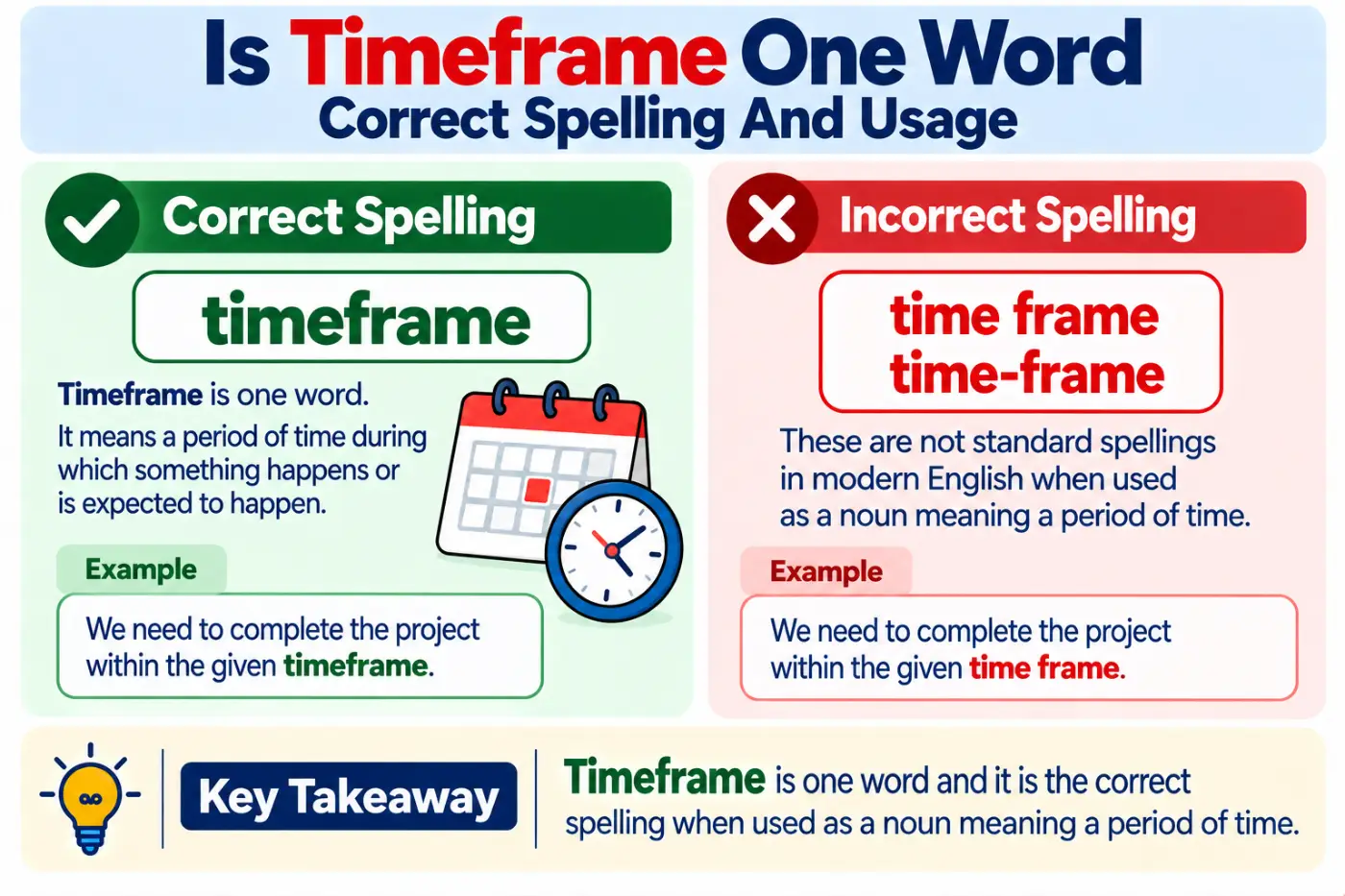
is timeframe one word is a common question because you will see both timeframe and time frame in published English. The short answer is yes. Timeframe is accepted as one word in modern English but time frame is also widely used and accepted. The best choice can depend on the dictionary style guide publication or organization you follow.
The confusion exists because English compound words often change over time. Some begin as separate words and gradually become closed compounds as people use them more frequently. That process is not always consistent. One dictionary or editorial style may prefer the closed form while another source may retain the two word form.
For most everyday writing you can use timeframe if your preferred dictionary accepts it. In edited or professional work consistency matters more. If your school employer publisher or style guide prefers time frame follow that convention throughout the document. This article explains both forms their meaning grammar pronunciation history regional use and the practical differences that matter when you write.
Still confused? Compare In house KPIs Explained With Examples and Best Practices.
Quick Definition
Timeframe and time frame both refer to a period during which something happens or is expected to happen. Timeframe is an accepted closed compound in modern usage while time frame remains a common two word form. In formal writing follow the spelling preferred by your dictionary style guide school or organization and stay consistent.
Quick Answer
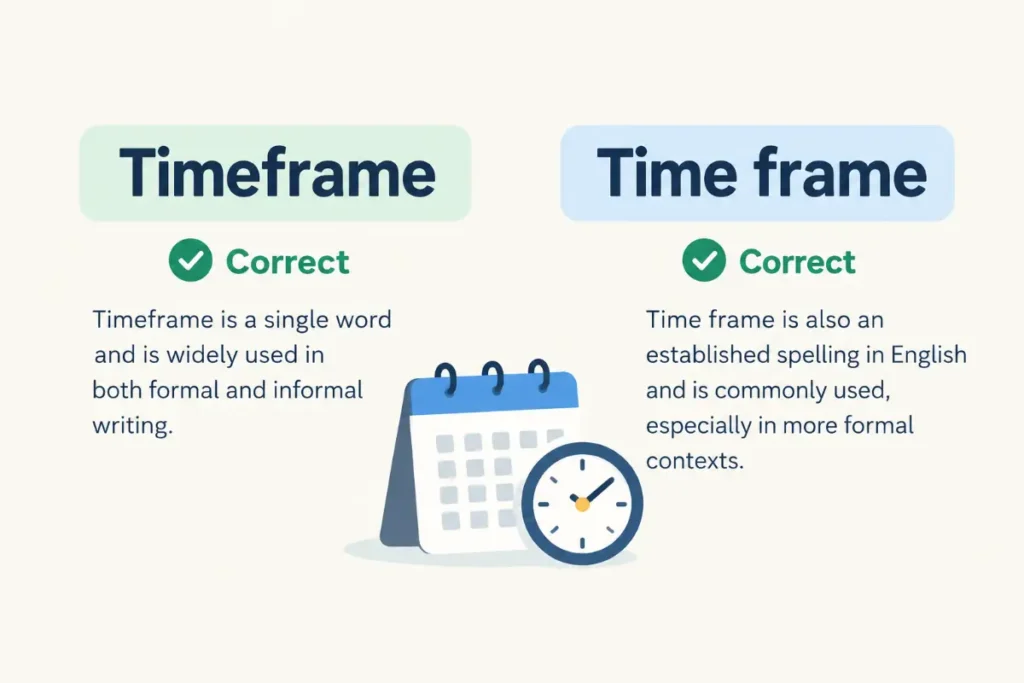
Yes timeframe can be written as one word. The two word spelling time frame is also established in English so treating either form as universally incorrect would be misleading.
For general writing choose one accepted form and use it consistently. If you must follow an editorial style or house dictionary use the form that source recommends.
Comparison Table Is Timeframe One Word
| Form | Status | Meaning | Part Of Speech | Structure | Formality | Common Contexts | Example |
|---|---|---|---|---|---|---|---|
| Timeframe | Accepted modern form | A period in which something happens or should happen | Noun | Closed compound | Neutral | Business projects schedules planning general writing | We need a realistic timeframe for the project. |
| Time frame | Accepted alternative form | A period in which something happens or should happen | Noun phrase or open compound | Two words | Neutral | Formal writing edited prose schedules planning | What is the time frame for completion? |
The important distinction is visual rather than semantic. In ordinary use both forms communicate the same basic idea. The choice often comes down to editorial convention.
Meaning And Definition
Meaning Of Timeframe
Timeframe is a noun that refers to a period of time connected with an event process plan deadline or expected result. It can describe a fixed period or a general estimate.
Consider this sentence.
The contractor gave us a six week timeframe for the repairs.
Here timeframe means the period expected for the repairs to be completed.
The word appears naturally in business project management education healthcare customer service construction technology and everyday conversation. People often use it when discussing how long something may take.
It can also refer to the period in which an event occurred.
The researchers examined records from the same timeframe.
Here the noun identifies a particular period rather than a deadline.
Meaning Of Time Frame
Time frame carries essentially the same meaning. It refers to a period associated with an action event process or plan.
For example:
The exact time frame for the move has not been decided.
The sentence tells us that the period planned for the move is still uncertain.
The main difference between timeframe and time frame is therefore spelling style rather than meaning. One is a closed compound and the other is written as two separate words.
You should not assume that seeing time frame means the writer made a spelling error. It remains an established form.
Why Both Spellings Exist
English compounds often develop gradually. Two words that regularly appear together can begin to function as a single concept. Over time writers may start closing the space between them.
You can see similar patterns across English vocabulary. Compound forms do not all develop at the same speed and dictionaries do not always adopt a new spelling at exactly the same time.
That creates periods in which multiple forms coexist.
Time frame developed from the ordinary words time and frame. Together they express the idea of setting boundaries around a period of time. As the expression became familiar some writers and dictionaries adopted timeframe as a closed compound.
Modern English therefore contains both forms.
This is not unusual. English spelling is shaped by usage history convention and editorial preference. It does not always provide one simple mechanical rule for every compound noun.
Key Differences Explained
The distinction becomes easier once you separate spelling from meaning.
- Spelling. Timeframe appears as one closed compound. Time frame contains a space between the two elements.
- Meaning. Both forms normally mean a period in which something happens has happened or is expected to happen.
- Grammar. Both function as nouns in normal usage. They can serve as subjects objects and complements.
- Pronunciation. The spelling difference does not normally create a meaningful pronunciation difference.
- Formality. Neither form is inherently casual or unprofessional. Editorial preference determines which one may be favored in a particular document.
- Context. Both appear in discussions of schedules deadlines projects plans events and expected completion periods.
- Regional usage. English varieties can show different preferences but there is no simple rule saying one spelling belongs exclusively to one country.
- Consistency. Switching repeatedly between timeframe and time frame in the same document can look careless even when both forms are accepted.
The last point matters most in professional editing. Pick a form based on your required reference and then keep it consistent.
Which Form Is Correct
Both timeframe and time frame can be correct depending on the editorial convention being followed.
English dictionaries and style systems do not always treat compound words identically. Some references recognize the closed compound while other editorial traditions favor or preserve the open form. That variation explains why careful writers encounter both spellings.
The linguistic principle behind this variation is compound formation. English frequently combines familiar words to create a single lexical idea. Some compounds remain open while others become closed after extended use.
This means the question is not simply correct versus incorrect. It is better understood as accepted variation.
If you are writing casually and do not have a required style guide timeframe is a reasonable modern choice. If you are preparing academic professional or published work check the dictionary or style rules required for that document.
Most importantly do not alternate between the spellings without a reason.
How To Choose The Best Spelling
You do not need to spend several minutes debating the spelling every time you write the term. Use a simple order of priority.
- Follow the style guide required by your school employer client or publisher.
- Check the preferred dictionary if your style guide names one.
- Follow your organization’s established house style if one exists.
- If no rule applies choose an accepted form and use it consistently.
- During proofreading search the document for both versions so you can catch accidental changes.
This approach is more useful than trying to declare one spelling correct in every possible setting.
Consistency gives polished writing a professional feel. Readers should notice your message rather than changes in spelling style.
Sentence Examples
The following examples show timeframe used naturally in American English.
- The team needs a realistic timeframe for completing the project.
- Can you give me a timeframe for the repair?
- We expect to receive an answer within that timeframe.
- The teacher gave students a two week timeframe to finish the assignment.
- Our manager has not announced a timeframe for the office move.
- The exact timeframe depends on how quickly the materials arrive.
- Please include an estimated timeframe in your email.
- The company shortened the timeframe for testing the new system.
- We cannot promise a specific timeframe until the review is complete.
- The study focused on events that occurred within a narrow timeframe.
The same ideas can also appear with the open form.
The team needs a realistic time frame for completing the project.
Please provide an estimated time frame for delivery.
The meaning does not change simply because the compound appears as two words.
Common Spelling And Usage Mistakes
The biggest problems with this term involve consistency meaning and unnecessary repetition rather than serious grammar errors.
Switching Between Both Forms
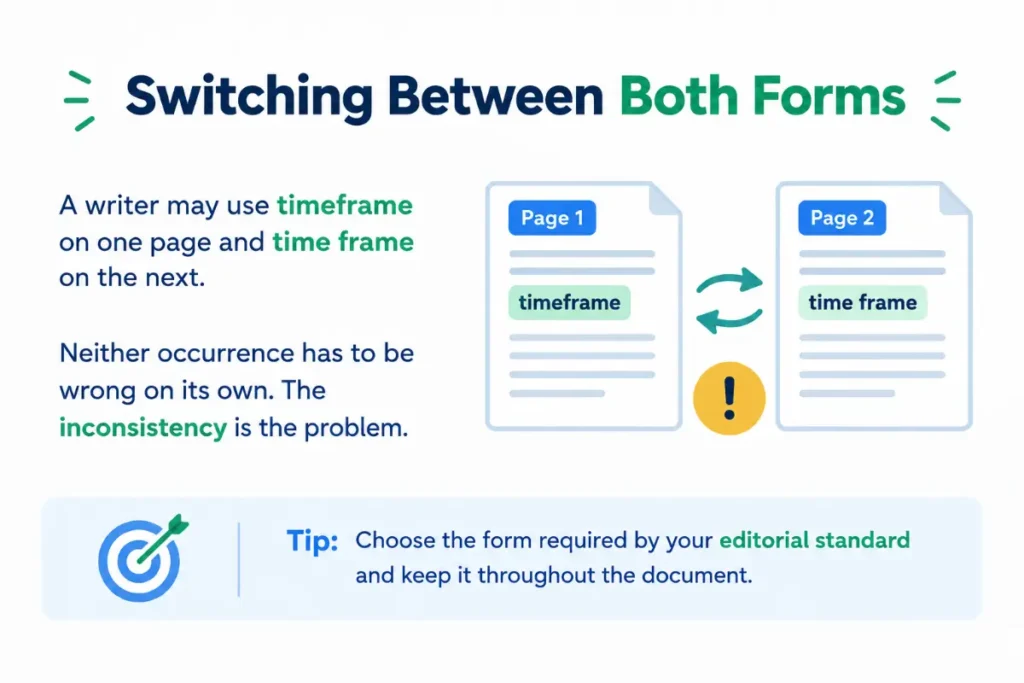
A writer may use timeframe on one page and time frame on the next.
Neither occurrence has to be wrong on its own. The inconsistency is the problem.
Choose the form required by your editorial standard and keep it throughout the document.
Assuming Time Frame Is Always Wrong
Writers sometimes believe the closed compound has completely replaced the open form.
That is too absolute. The two word version remains established and appears in edited English.
Assuming Timeframe Is Always Wrong
The opposite claim causes the same problem.
The closed compound is used and recognized in modern English. Do not automatically correct every instance to the open form unless your required style calls for that change.
Using Timeframe When You Mean Deadline
A timeframe is a period. A deadline is the final point by which something must be completed.
Compare these examples.
Our timeframe is four weeks.
Our deadline is October 30.
The first describes a span of time. The second identifies a specific final date.
Writing An Unnecessary Compound Form
Writers sometimes try to create forms such as timeframes when they really need a different expression such as schedules dates deadlines or periods.
Timeframes is a normal plural when you genuinely mean several periods. Still the most precise noun depends on the idea you want to communicate.
Timeframe And Deadline Are Not The Same
These terms often appear in the same conversations but they do different jobs.
A timeframe tells you how much time is available or expected. A deadline tells you the final date or time for completing something.
Imagine that a client approves a project on May 1 and expects completion within six weeks. Six weeks is the timeframe. The specific final date can serve as the deadline.
This distinction matters in business communication. If someone asks for a deadline and you provide only a broad timeframe you may not have answered the question precisely.
Compare:
The expected timeframe is three to five business days.
The deadline is Friday at 5 p.m.
The first allows a range. The second sets a fixed endpoint.
Choosing the precise word makes instructions clearer and reduces misunderstandings.
Timeframe And Timeline Are Different
Timeframe and timeline are related but they are not exact synonyms.
A timeframe describes a period in which something occurs. A timeline usually shows events tasks or stages arranged in chronological order.
For example:
The project has a six month timeframe.
The project timeline shows design in January testing in March and launch in June.
The first sentence tells us the overall duration. The second describes the sequence of major events.
This distinction is especially useful in project management workplace communication and planning. If you need to describe the duration use timeframe or time frame. If you need to show the order of events timeline is usually more precise.
A related grammar guide is plural of loaf Is Loaves Correct.
Grammar Rules And Part Of Speech
Timeframe functions primarily as a countable noun. That means it can have singular and plural forms.
Singular:
We need a shorter timeframe.
Plural:
The two projects have different timeframes.
The open form behaves in the same basic way.
We need a shorter time frame.
The projects operate within different time frames.
Articles can appear before the noun.
A timeframe.
The timeframe.
An estimated timeframe.
You can also modify the noun with an adjective.
Realistic timeframe.
Short timeframe.
Long timeframe.
Specific timeframe.
Expected timeframe.
The noun often follows prepositions such as within during or over.
We expect a decision within that timeframe.
The changes occurred during the same timeframe.
The project developed over a long timeframe.
These constructions are grammatically straightforward. Most errors come from word choice or style consistency rather than sentence structure.
Using Numbers With Timeframe
Writers often place a duration before the noun.
For example:
We expect a three week timeframe.
The project has a six month timeframe.
Your broader writing style may affect how compound modifiers before nouns are punctuated. If your required style calls for a particular treatment follow it consistently.
You can often avoid complicated constructions by rewriting the sentence.
Instead of:
We have a six week timeframe.
You can write:
We have six weeks to complete the project.
The second version sounds more direct in everyday conversation.
That leads to a useful editing principle. You do not have to use timeframe merely because it sounds professional. Sometimes days weeks months schedule or deadline communicates the idea more clearly.
Pronunciation Guide
Timeframe is generally pronounced /ˈtaɪm freɪm/.
It contains two clear sound units.
Time frame.
The main stress naturally falls strongly on the first element although pronunciation can vary slightly with sentence rhythm.
Time rhymes with climb.
Frame rhymes with same.
Writing the expression as one word does not mean you need to blend the sounds into a completely different pronunciation. The two lexical elements remain easy to hear.
The open spelling time frame has essentially the same pronunciation.
For learners of English this makes pronunciation easier than spelling. You do not need to learn two spoken forms. You mainly need to remember that written conventions can present the expression as either a closed compound or an open compound.
Etymology And Word Formation
The expression combines time and frame. Both words have long histories in English but their combination into the modern expression is much newer than either individual word.
Time refers broadly to duration sequence or a measurable period. Frame has several meanings connected with structure boundaries or something that surrounds and defines another thing.
Together they create an intuitive image. A time frame places conceptual boundaries around a period.
The expression developed as an open compound. Modern usage also supports the closed spelling timeframe.
This type of change is common in English. Frequent combinations can become increasingly unified in meaning and eventually in spelling. The process does not happen overnight which is why open and closed forms may exist side by side for years.
You do not need the historical background to use the word correctly but it explains why disagreement about the spacing persists.
Regional Usage
American English
American English uses both timeframe and time frame. The preferred spelling may change according to the dictionary publication organization or editorial system being followed.
In everyday American writing the closed compound is familiar and easy to understand. Professional writers should still check house style when consistency is required.
British English
British English also uses the expression to describe a period associated with an action event or plan. Writers can encounter both closed and open treatments depending on the source and editorial convention.
There is no need to invent a strict US versus UK rule for this word. Actual usage is more flexible.
Australian English
Australian writers also use the term in business planning government communication everyday writing and other contexts. Editorial preferences can influence spacing.
The safest approach remains the same. Follow the required reference for the document and maintain consistency.
Canadian English
Canadian English uses the same basic expression and meaning. Writers may encounter both spellings in different contexts.
Again the difference is primarily orthographic. The meaning remains a defined or expected period of time.
Formal And Informal Writing
Timeframe works naturally in professional communication but it is not limited to formal writing.
A manager might write:
Please provide a timeframe for completion.
A friend might ask:
Do you have a timeframe for moving?
Both uses sound natural.
Still there are situations where simpler wording feels warmer and more direct. Instead of asking What is your timeframe for getting here you might ask When do you think you’ll get here?
The best writers choose words according to the situation rather than trying to make every sentence sound formal.
In academic writing you should pay particular attention to precision. If you mean a historical period period may be clearer. If you mean the duration allowed for a task timeframe may work well. If you mean the last acceptable date deadline is more exact.
Real Life Usage Examples
Daily Conversation
Do you have a timeframe for moving into your new apartment?
The mechanic gave me a rough timeframe for the repair.
These sentences use the word to ask about or describe an expected period.
Email And Workplace Communication
Please send us an estimated timeframe for completing the review.
Our current timeframe depends on final approval from the client.
The term is useful in workplace writing because plans often involve estimated periods rather than exact dates.
Academic Writing
The analysis focuses on changes that occurred within the selected timeframe.
Researchers examined several events from the same time frame.
Both forms can communicate the intended period. Academic writers should follow the spelling convention required by their institution or publication.
News And Journalism
Officials did not provide a timeframe for reopening the road.
The agency has not announced a time frame for completing the investigation.
Journalistic style can depend heavily on the publication’s own editorial rules so different outlets may make different spelling choices.
Literature And Storytelling
The story moves across a surprisingly short timeframe.
The exact time frame of the events remains unclear until the final chapter.
The term is less expressive than words such as era period season or age so fiction writers may choose alternatives depending on tone.
Better Alternatives In Different Contexts
Timeframe is useful but it is not always the most precise choice.
Period
Use period for a general span of time.
The study covers a ten year period.
Deadline
Use deadline for the final date or time by which something must be completed.
The deadline is Monday.
Duration
Use duration when you are emphasizing how long something lasts.
The duration of the course is eight weeks.
Timeline
Use timeline for a chronological sequence of events stages or tasks.
The project timeline includes research testing and launch.
Schedule
Use schedule for planned activities and their assigned times.
Please check the training schedule.
Window
Use window for a limited period during which something can happen.
The delivery window is between noon and 3 p.m.
Date Range
Use date range when you have specific beginning and ending dates.
Select a date range for the report.
Turnaround Time
Use turnaround time for the period needed to complete and return a service task order or request.
Our usual turnaround time is three business days.
Choosing among these words gives your writing greater precision. They overlap but they do not all mean exactly the same thing.
Related And Confused Terms
Several words sit close to timeframe in meaning but each carries its own emphasis.
- Timeline. A sequence of events arranged by time rather than simply the duration available.
- Deadline. The final point by which a task must be completed.
- Schedule. A plan showing when activities are expected to happen.
- Duration. The amount of time that something lasts.
- Period. A general span of time.
- Interval. A period separating events or points in time.
- Time span. The amount of time between a beginning and an end.
- Turnaround time. The period required to complete a task request or service.
These distinctions are worth learning because replacing every time related noun with timeframe can make writing vague. Precision usually sounds more natural than repetition.
Why Compound Words Change Over Time
English contains open closed and other compound forms. An open compound keeps spaces between its elements. A closed compound joins them together.
The tricky part is that usage can change.
A familiar combination may begin as two words because speakers still perceive each element separately. As the combination develops a stable meaning readers may increasingly treat it as one lexical unit.
Dictionaries observe established language use but their editorial policies can differ. As a result one reference may close a compound earlier than another.
This explains why asking for a single universal rule can sometimes produce an oversimplified answer. English develops through actual use and established conventions do not always move at the same pace.
For writers the practical lesson is simple. Check the reference that governs your work and then remain consistent.
Expert Editor Insight
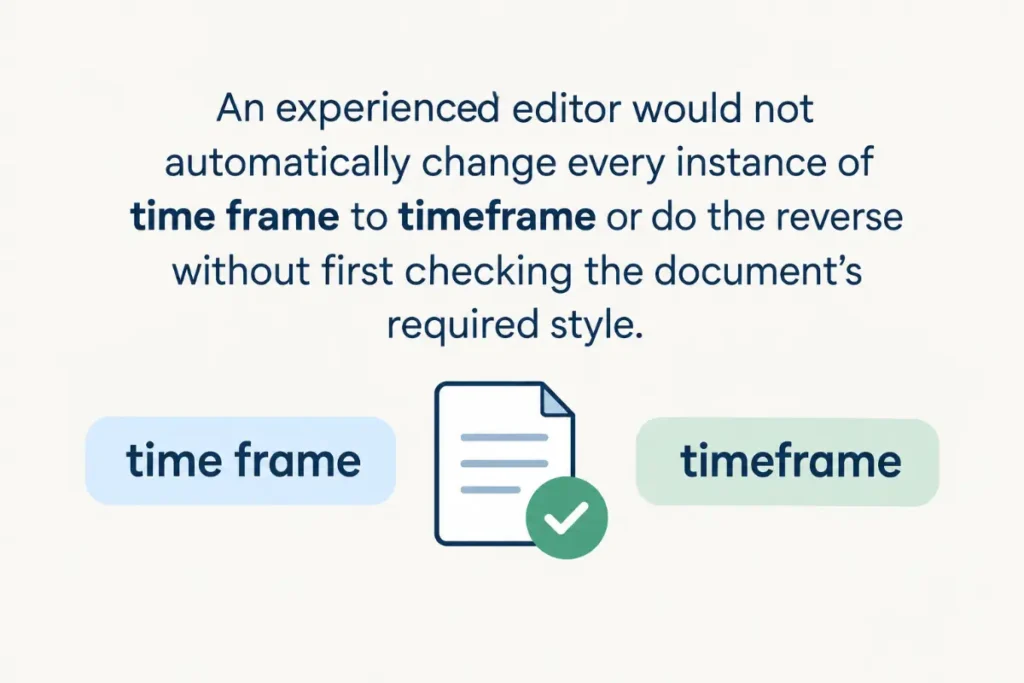
An experienced editor would not automatically change every instance of time frame to timeframe or do the reverse without first checking the document’s required style. The real editing issue is consistency. Spellcheck and grammar software may prefer one form because of the dictionary built into the program but that suggestion is not proof that the other established form is universally wrong. Expert tip: search your finished document for both spellings before publishing. That ten second check catches accidental inconsistency immediately.
Many readers also check Attornies or Attorneys Which Spelling Is Correct in 2026.
Conclusion
is timeframe one word has a more flexible answer than many spelling questions. Yes timeframe is an accepted one word form in modern English. Time frame is also an established spelling so you should not automatically treat it as an error. Both forms usually describe a period in which something happens or is expected to happen.
For professional academic or published work follow the dictionary or editorial style required for that document. If no specific rule applies choose an accepted form and stay consistent. Also remember that timeframe deadline timeline and duration have related but distinct meanings.
A simple editing tip can prevent most problems. Search your finished document for both spellings. Pick the form your style requires and make every occurrence match.
FAQs
Is Timeframe One Word Or Two Words?
Both timeframe and time frame are used in modern English. Timeframe is an accepted closed compound while time frame remains an established open form. Your best choice depends on the dictionary style guide school employer or publication you are following. If no required style applies choose one accepted spelling and keep it consistent throughout the document.
Is Timeframe A Real Word?
Yes. Timeframe is used as a noun meaning a period during which something happens or is expected to happen. You may see it in project planning business communication schedules research and everyday writing. The existence of the two word form time frame does not make the closed compound automatically incorrect. Editorial preferences can differ between dictionaries and organizations.
What Does Timeframe Mean?
Timeframe means a period associated with an event action plan or expected result. For example a three week timeframe means that roughly three weeks are available or expected for something to happen. The term does not necessarily identify a fixed final date. If you mean the exact last date for completing something deadline may be the more precise word.
Is Time Frame Also Correct?
Yes. Time frame is an established way to write the expression and carries the same basic meaning as timeframe. The difference lies mainly in spacing and editorial preference rather than definition. If a publication employer or academic institution prefers the open form use it. Avoid switching between the two spellings in the same document unless there is a specific reason.
What Is The Difference Between Timeframe And Timeline?
A timeframe describes the period available or expected for something. A timeline usually presents events or stages in chronological order. A project might have a six month timeframe while its timeline lists research in January testing in March and launch in June. The words are related but choosing the precise term makes planning and professional communication much clearer.
Is Timeframe The Same As Deadline?
No. A timeframe is a period while a deadline is a specific final point for completing something. For example a project might have a four week timeframe and a deadline of October 30. In casual conversation people sometimes use these ideas loosely but professional communication benefits from keeping the distinction clear so expectations are easier to understand.
What Is The Plural Of Timeframe?
The plural of timeframe is timeframes. If you use the open spelling the plural is time frames. For example you can say The two departments work with different timeframes. The plural is useful when discussing several projects periods or schedules. As with the singular form keep your chosen spelling consistent with the editorial convention you are following.
Is Timeframe Appropriate In Formal Writing?
Yes. Timeframe can be appropriate in professional academic and other formal contexts if it matches the spelling convention required for the document. Still precision matters more than formality. Use deadline for a fixed final date timeline for a sequence of events and duration for how long something lasts. Choosing the most exact term makes formal writing stronger and easier to understand.