
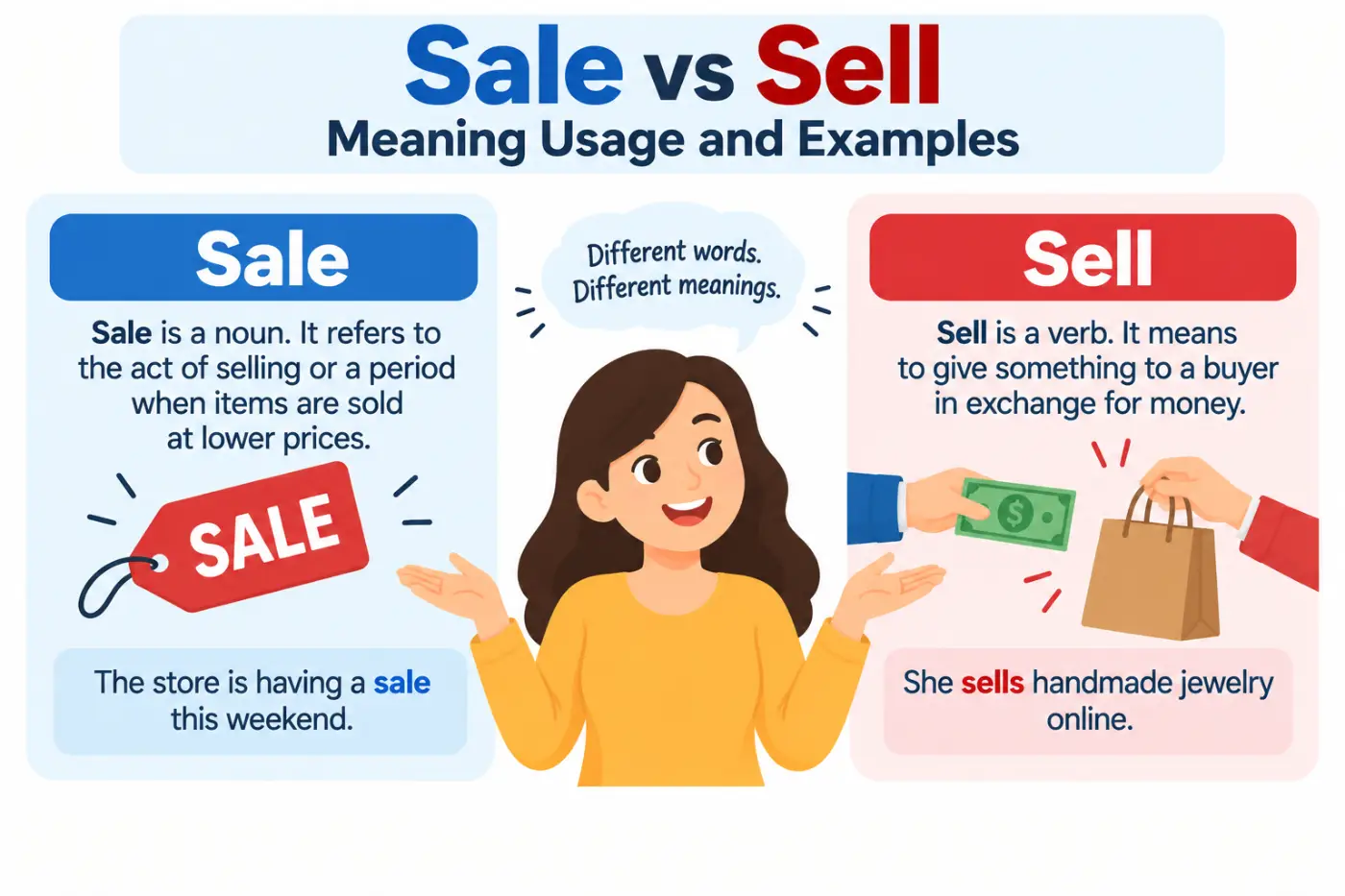
sale vs sell can be confusing because both words are closely connected to buying and selling something. The key difference is simple. Sale is usually a noun while sell is a verb. You use sale to talk about an event, transaction, or act of selling. You use sell to describe the action of giving something to someone in exchange for money.
For example, you might say, The store has a summer sale. You could also say, The store will sell its products at lower prices. The two words describe the same general business idea, but they perform different jobs in the sentence.
The confusion often comes from their similar pronunciation and shared meaning. English also uses several related forms such as seller, selling, sold, and sale. Once you understand the grammatical role of each word, choosing the right one becomes much easier. This guide explains their meanings, differences, pronunciation, grammar, origins, common mistakes, regional usage, and natural examples so you can use them confidently in everyday and formal writing.
You may also want to read pent vs pants Meaning and Usage Explained.
Quick Definition
Sale is a noun that refers to an act of selling, a transaction, or a period when products are offered at reduced prices. Sell is a verb that means to give something to another person in exchange for money. The words are related but cannot always replace each other because they have different grammatical roles.
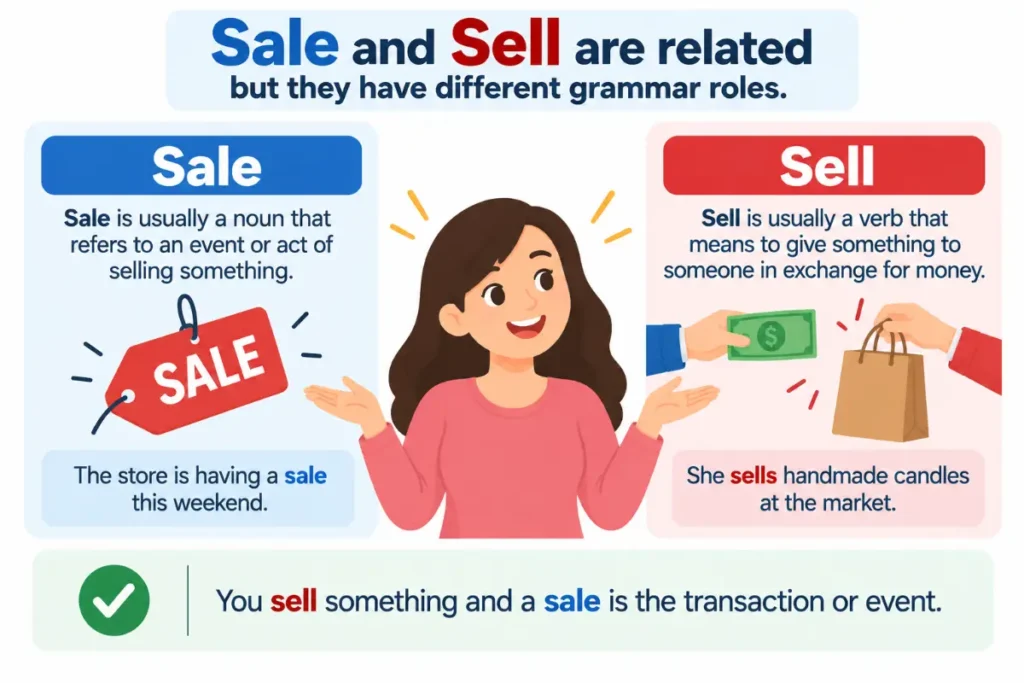
Short Answer
Use sale when you need a noun. Use sell when you need a verb.
For example, The store is having a sale uses sale as a noun. The store will sell shoes at a discount uses sell as a verb.
A quick test can help. If the word describes an action someone performs, sell is usually the right choice. If it names an event, transaction, or discount period, sale is usually the right choice.
Comparison Table Sale Vs Sell
| Form | Meaning | Part Of Speech | Origin | Usage Frequency | Formality | Common Contexts | Example |
|---|---|---|---|---|---|---|---|
| Sale | An act of selling, a transaction, or a period when goods are offered for purchase, often at reduced prices | Noun | From Old English and related Germanic forms connected with selling and exchange | Very common | Neutral and formal | Retail, business, shopping, contracts, finance | The store is having a weekend sale. |
| Sell | To give something to another person in exchange for money or another agreed value | Verb | From Old English sellan and related Germanic forms | Very common | Neutral and formal | Retail, business, commerce, everyday conversation | They sell fresh bread every morning. |
The important point is grammatical rather than merely visual. Sale names something. Sell describes an action.
Meaning And Definition
Meaning Of Sale
Sale is a noun. It has several connected meanings, all centered around selling or exchanging goods and services.
One common meaning is a transaction in which ownership of something changes from one person or organization to another in exchange for money.
The sale of the house was completed last week.
Here sale refers to the transaction itself.
Another common meaning is a period during which a store reduces prices or promotes products.
The store is having a holiday sale.
In this sentence, sale refers to a special shopping period.
Sale can also refer to the act or process of selling something.
The sale of the company took several months.
This meaning is common in business and financial writing.
The word can also appear in familiar expressions such as for sale and on sale.
The house is for sale.
This means someone is offering the house for purchase.
These shoes are on sale.
This usually means the shoes are being offered at a reduced price, although the exact meaning can depend on context.
Meaning Of Sell
Sell is a verb. It describes the action of offering something to another person in exchange for money or another form of value.
The store sells furniture.
Here sells describes what the store does.
She sold her old laptop.
Here sold is the past tense of sell.
They are selling tickets online.
Here selling is the present participle.
Sell can also have broader meanings. You can sell an idea, convince someone to accept a proposal, or persuade someone that something has value.
The manager sold the team on the new plan.
In this sentence, no physical product changes hands. Sell means persuade or convince.
The word therefore has both a direct commercial meaning and several figurative uses.
The Core Grammar Difference
The clearest way to understand these words is to identify their grammatical roles.
Sale is a noun.
Sell is a verb.
Consider this pair.
The store had a sale.
The store will sell clothing.
In the first sentence, sale names an event or commercial period. In the second sentence, sell describes the action performed by the store.
This difference explains why the words cannot simply replace each other.
You would not normally write:
The store will sale clothing.
That sentence is incorrect in standard English because sale is a noun and the sentence requires a verb.
Likewise, you would not write:
The store is having a sell.
That does not work in standard English because the sentence needs a noun such as sale.
Understanding grammar is more useful than memorizing isolated examples. When you know the job a word performs, the correct choice becomes much more obvious.
Key Differences Explained
- Part of speech. Sale is primarily a noun. Sell is a verb.
- Meaning. Sale refers to a transaction, selling event, or discounted shopping period. Sell describes the action of transferring something in exchange for money or value.
- Sentence function. Sale can serve as a subject or object. Sell normally functions as the main verb or part of a verb phrase.
- Verb forms. Sell changes to sells, sold, and selling depending on tense and grammar.
- Plural form. Sale can become sales when referring to multiple transactions or events.
- Pronunciation. The two words have the same pronunciation in standard American English. They are homophones.
- Spelling. Sale contains the letters a l e. Sell contains two l letters and ends with a different vowel sound in spelling, even though the pronunciation is the same.
- Context. Sale commonly appears in retail and business language. Sell can appear in retail, business, conversation, persuasion, sports, marketing, and many figurative contexts.
- Formality. Both are standard English words and work in casual and formal contexts.
- Regional usage. The basic distinction remains the same across major English varieties.
Which Form Is Correct?
Both sale and sell are correct words. The right choice depends on the grammatical role and meaning you need.
Use sale when you need a noun.
The sale begins tomorrow.
Use sell when you need a verb.
The store will sell the products tomorrow.
A useful editing method is to look at the word immediately before the blank. If the sentence needs an action, you probably need the verb sell or one of its forms. If the sentence needs the name of an event or transaction, sale may be the better choice.
Compare these examples.
They plan to sell their car.
They announced the sale of their car.
The first sentence focuses on the action. The second focuses on the transaction.
How Sale Works In A Sentence
Because sale is a noun, it can appear in several common structures.
Sale As The Subject
The sale starts Friday.
Here sale is the subject of the sentence.
Sale As The Object
We attended the sale yesterday.
Here sale receives the action of the verb attended.
Sale After A Preposition
The store is having a sale.
The word sale follows the article a and functions as the object of having.
Sale In A Noun Phrase
The sale price is lower this week.
Here sale modifies price and helps describe the type of price.
Sale In Common Expressions
The most common expressions include for sale and on sale.
The car is for sale.
The jackets are on sale.
These expressions are extremely common in American English.
How Sell Works In A Sentence
Sell is a verb and changes form depending on the subject and tense.
Present Tense
I sell books online.
They sell fresh vegetables.
For third person singular subjects, use sells.
She sells handmade candles.
Past Tense
Sell has an irregular past tense.
I sold my old phone.
They sold the house last year.
The past form is sold, not selled.
Present Participle
The present participle is selling.
She is selling her car.
They are selling tickets online.
Infinitive
The basic form appears after to.
I want to sell my bike.
He plans to sell the business.
Knowing these forms helps prevent a different set of common mistakes.
Sale And Sell In Business English
Business writing uses both words constantly, but they usually appear in different structures.
A company might announce a sale of one of its divisions.
That same company might sell the division to another company.
The first sentence focuses on the transaction. The second focuses on the action.
Marketing also uses both terms.
The store is having a summer sale.
The store wants to sell more products this summer.
In business communication, choosing the correct form helps make the sentence precise. A noun describes the commercial event while the verb describes what a person or company does.
Sentence Examples
Here are natural examples showing how both words work in different situations.
- The store is having a big sale this weekend.
- We plan to sell our old furniture before moving.
- The sale begins at nine in the morning.
- She sells handmade jewelry online.
- The company announced the sale of its largest division.
- They sold their house after several months on the market.
- These shoes are on sale today.
- I’m trying to sell my old laptop.
- The business made a large sale to a new customer.
- The salesperson explained how to sell the product more effectively.
These examples show why context matters. Sale names something while sell describes an action.
Common Mistakes And How To Fix Them
Using Sale As A Verb
Incorrect: We will sale our old car.
Correct: We will sell our old car.
The problem is grammatical. The sentence needs a verb after will. Sell is the base verb while sale is a noun.
Using Sell After An Article
Incorrect: The store is having a sell.
Correct: The store is having a sale.
The article a usually introduces a singular countable noun. Sale fits this structure while sell does not.
Confusing Sale With Sold
Incorrect: They sale the house last year.
Correct: They sold the house last year.
The sentence describes a completed action in the past, so the irregular past tense sold is required.
Writing Selled
Incorrect: She selled her car.
Correct: She sold her car.
Sell is an irregular verb. Its past tense is sold.
Confusing On Sale And For Sale
On sale usually means a product is available at a reduced price.
For sale means something is being offered for purchase.
The house is for sale.
The shoes are on sale.
A house can technically be advertised for sale without being discounted. The two expressions therefore carry different ideas.
You may also want to read Baloney vs Bologna Which Word Should You Use 2026.
Why The Confusion Happens
The words are closely connected in meaning and pronunciation. In standard American English, sale and sell are pronounced the same way. That makes them homophones.
Because their sounds are identical, you cannot rely on pronunciation to decide which spelling belongs in a sentence.
Instead, grammar provides the answer.
If you need a noun, choose sale.
If you need a verb, choose sell.
This is a good example of why English spelling can be tricky. Two words may sound exactly alike while performing completely different grammatical jobs.
The surrounding words provide the clues. Look at the sentence structure rather than trying to hear the difference.
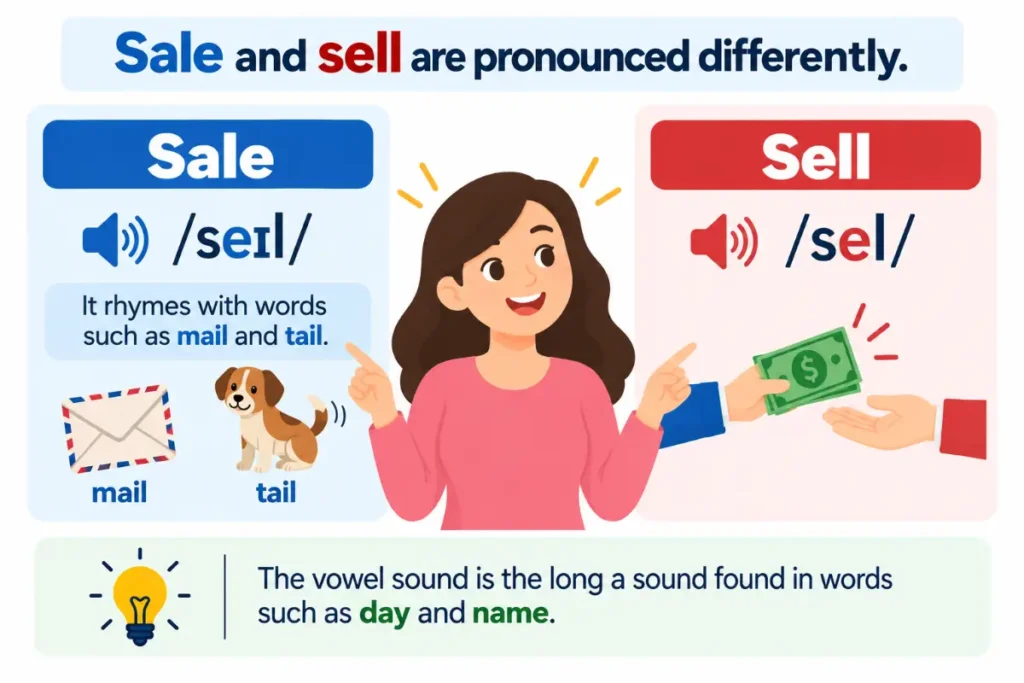
Pronunciation Guide
Sale and sell are pronounced the same in standard American English.
The IPA pronunciation is commonly represented as /seɪl/.
A simple pronunciation guide is sayl.
Both words have one syllable.
Because they are homophones, pronunciation cannot tell you which spelling to use.
For example:
The store has a sale.
The store will sell shoes.
The words sale and sell sound the same in these sentences even though their spellings and grammatical roles differ.
This is why learners sometimes write one form when they need the other. The solution is to identify the word’s role in the sentence.
Etymology And Word Origin
Sale and sell belong to the same historical word family.
Sell comes from Old English sellan, a verb connected with giving something in exchange for money or value. The word has Germanic roots and has remained part of English for many centuries.
Sale developed from a related Germanic word family associated with selling and exchange. Over time, it became the noun used for the act or transaction of selling.
Their shared history explains why their meanings remain closely connected.
English contains many word pairs like this. A noun and verb may develop from the same historical root while taking different forms and serving different grammatical roles.
The relationship between sale and sell is therefore not accidental. They belong to the same semantic family while functioning differently in modern English.
Regional Usage
American English
Both sale and sell are standard American English words. Their meanings and grammatical roles are stable across everyday conversation, retail language, business writing, advertising, education, and professional communication.
American English uses sale in expressions such as on sale, for sale, garage sale, yard sale, and clearance sale.
Sell is used in phrases such as sell a car, sell a house, sell products, sell tickets, and sell an idea.
British English
British English uses the same distinction between sale and sell. There is no major grammatical difference in their basic meanings.
Expressions such as on sale and for sale are also common, although particular retail terms can vary by context.
Australian English
Australian English follows the same noun and verb distinction. Sale is used for transactions and promotional events while sell describes the action.
Canadian English
Canadian English also uses both words in the standard way. There is no major spelling difference that changes their core meanings.
The distinction is therefore not a regional issue. It is a grammatical and semantic distinction shared across major English varieties.
Sale And Sell In Formal Writing
Both words are completely acceptable in formal writing.
You might see sale in contracts, business reports, financial documents, academic discussions, and news articles.
For example:
The sale of the property was completed in June.
Sell appears in formal writing whenever the sentence needs the corresponding verb.
The company plans to sell the property next year.
Neither word is more formal than the other. The choice depends on grammar and meaning.
A useful editing rule is to avoid changing a word simply because another form sounds more professional. Good formal writing still follows ordinary grammar.
Related And Confused Terms
Sold
Sold is the past tense and past participle of sell.
They sold their house.
It is not interchangeable with sale.
Selling
Selling is the present participle and gerund form of sell.
She is selling her car.
Seller
A seller is a person or organization that sells something.
The seller agreed to lower the price.
Buyer
A buyer is the person or organization that purchases something.
The buyer signed the agreement.
Purchase
Purchase means to buy something. It is related to selling but describes the action from the buyer’s side.
Buy
Buy is the opposite commercial action from sell.
I want to buy a new phone.
They want to sell their old phone.
Discount
A discount is a reduction in the usual price. A sale may include discounts, but sale and discount do not always mean exactly the same thing.
Price
Price refers to the amount of money required to buy something. A sale may reduce the price, but the two words describe different concepts.
These related terms form a useful vocabulary group around buying, selling, transactions, and pricing.
For Sale And On Sale
These two expressions deserve special attention because they are common sources of confusion.
For sale means something is available for purchase.
The house is for sale.
The owner wants to find a buyer.
On sale often means something is being offered at a reduced price.
The shoes are on sale.
The store has reduced their price.
The distinction is easy to remember.
For sale answers the question, Is someone offering this for purchase?
On sale usually answers the question, Is this being offered at a lower promotional price?
Context can affect the exact meaning of on sale, but the reduced price sense is extremely common in American retail language.
Sale Price And Selling Price
Sale price and selling price sound similar but have different common uses.
A sale price usually means a promotional or reduced price offered during a sale.
The sale price is $40.
A selling price is the price at which something is actually sold.
The selling price was higher than expected.
Selling price can appear in accounting, finance, business, and everyday commerce.
This distinction matters because not every selling price is a sale price. A product can have a regular selling price without being discounted.
How Native Speakers Choose The Word
Native speakers usually make the choice automatically because grammar and context provide the clue.
If they say:
I want to sell my car.
The verb naturally describes the action.
If they say:
The car is for sale.
The noun fits the expression.
The difference becomes more noticeable in writing because spelling exposes the distinction.
A useful approach for learners is to stop thinking of sale and sell as two interchangeable versions of the same word. Think of them as related words with different jobs.
Sale names the commercial event or transaction.
Sell names the action.
That mental shift makes the distinction much easier.
Real Life Usage Examples
Daily Conversation
My neighbor is having a garage sale this Saturday.
I’m going to sell my old bicycle.
These examples sound natural because sale names an event and sell describes an action.
Email And Workplace Communication
The sale of the equipment has been approved.
We plan to sell the remaining inventory before the end of the quarter.
Professional writing often uses these forms when discussing transactions and business decisions.
Academic Writing
The study examines factors that influence the sale of consumer products.
Researchers also consider how companies sell products in different markets.
Academic writing may use both forms when discussing economics, marketing, consumer behavior, or business.
News Writing
The sale of the company was announced on Monday.
The company plans to sell several properties as part of its restructuring.
News writing often uses sale to focus on a transaction and sell to describe an action.
Literature And Storytelling
He put the old house up for sale after years of living there.
She decided to sell everything and start a new life somewhere else.
In storytelling, both words can describe practical decisions while also moving the story forward.
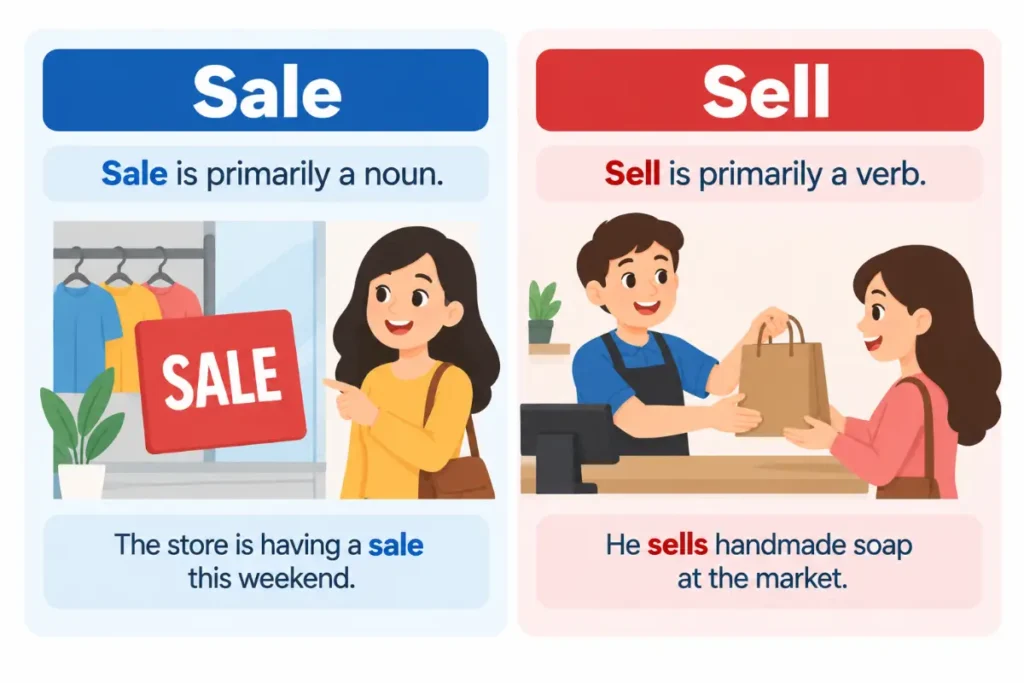
Key Takeaways
- Sale is primarily a noun.
- Sell is primarily a verb.
- A sale can refer to a commercial event or transaction.
- To sell means to offer or transfer something in exchange for money.
- The past tense of sell is sold.
- Use for sale when something is available to buy.
- Use on sale when an item is commonly offered at a reduced price.
- Use sales when talking about multiple transactions or commercial performance.
- Sale and sell are standard in American British Canadian and Australian English.
- When you’re unsure ask yourself if the sentence needs a noun or an action.
Expert Editor Insight
An experienced editor looks at the grammatical job the word needs to perform before checking spelling. If the sentence needs an action, sell is the natural choice. If it needs the name of a transaction or promotional event, sale fits. Spellcheck tools can catch some errors, but they may not catch a wrong word when both forms are valid English words. That is why proofreading should consider meaning and sentence structure rather than spelling alone. A useful editing trick is to replace the word mentally with action or event. If action fits, you probably need sell. If event fits, sale may be right.
You may also want to read gem or jem Correct Spelling Meaning And Usage.
Conclusion
sale vs sell becomes much easier once you focus on grammar rather than pronunciation. Sale is primarily a noun that describes a transaction, selling event, or promotional period. Sell is a verb that describes the action of giving something to another person in exchange for money or value.
The two words sound the same in standard American English, so listening alone cannot help you choose the spelling. Instead, look at the sentence. If you need an action, use sell or one of its forms. If you need a thing, event, or transaction, use sale.
A simple editing trick can help. Replace the word with action or event in your mind. If action makes sense, choose sell. If event makes sense, choose sale. That small check can prevent a surprisingly common writing mistake.
FAQs
What is the difference between sale and sell?
Sale is mainly a noun while sell is a verb. Sale can describe a transaction, a selling event, or a period when products are offered at reduced prices. Sell describes the action of giving something to another person in exchange for money or value. For example, The store has a sale uses the noun, while The store sells shoes uses the verb.
Is sale a verb?
No. In standard modern English, sale is primarily a noun. It names an event, transaction, or act of selling. You would say, The sale was successful, rather than The company will sale the product. When you need the verb, use sell. Its other forms include sells, sold, and selling.
Is sell a noun?
Sell can occasionally appear as a noun in specialized or informal contexts, but its normal and widely recognized grammatical role is as a verb. In ordinary sentences such as They sell cars, sell functions as a verb. For the noun referring to a commercial transaction or promotional event, sale is the standard choice.
Are sale and sell pronounced the same?
Yes. In standard American English, sale and sell are homophones and are commonly pronounced /seɪl/. Their identical pronunciation can make them confusing in writing. You cannot hear the spelling difference. Instead, look at the grammar. Sale is normally a noun, while sell is normally a verb.
What is the past tense of sell?
The past tense of sell is sold. For example, She sold her car last year. Do not use selled or sale as the past tense. Sell is an irregular verb, so its past form changes completely. The basic forms are sell, sells, selling, and sold.
What is the difference between for sale and on sale?
For sale means something is available for purchase. On sale often means something is being offered at a reduced price. For example, The house is for sale means someone wants to sell the house. The shoes are on sale usually means the shoes are available at a promotional price.
Why do people confuse sale and sell?
The words are closely related in meaning and are pronounced the same in standard American English. That makes them easy to mix up in writing. Grammar provides the strongest clue. If you need a noun that names a transaction or shopping event, use sale. If you need a verb describing the action, use sell.
Is sale or sell more appropriate in formal writing?
Both are appropriate in formal writing because they serve different grammatical functions. Use sale when discussing a transaction, event, or promotional period. Use sell when describing an action. For example, The sale of the property was completed is formal and correct, while The company plans to sell the property is also appropriate.