
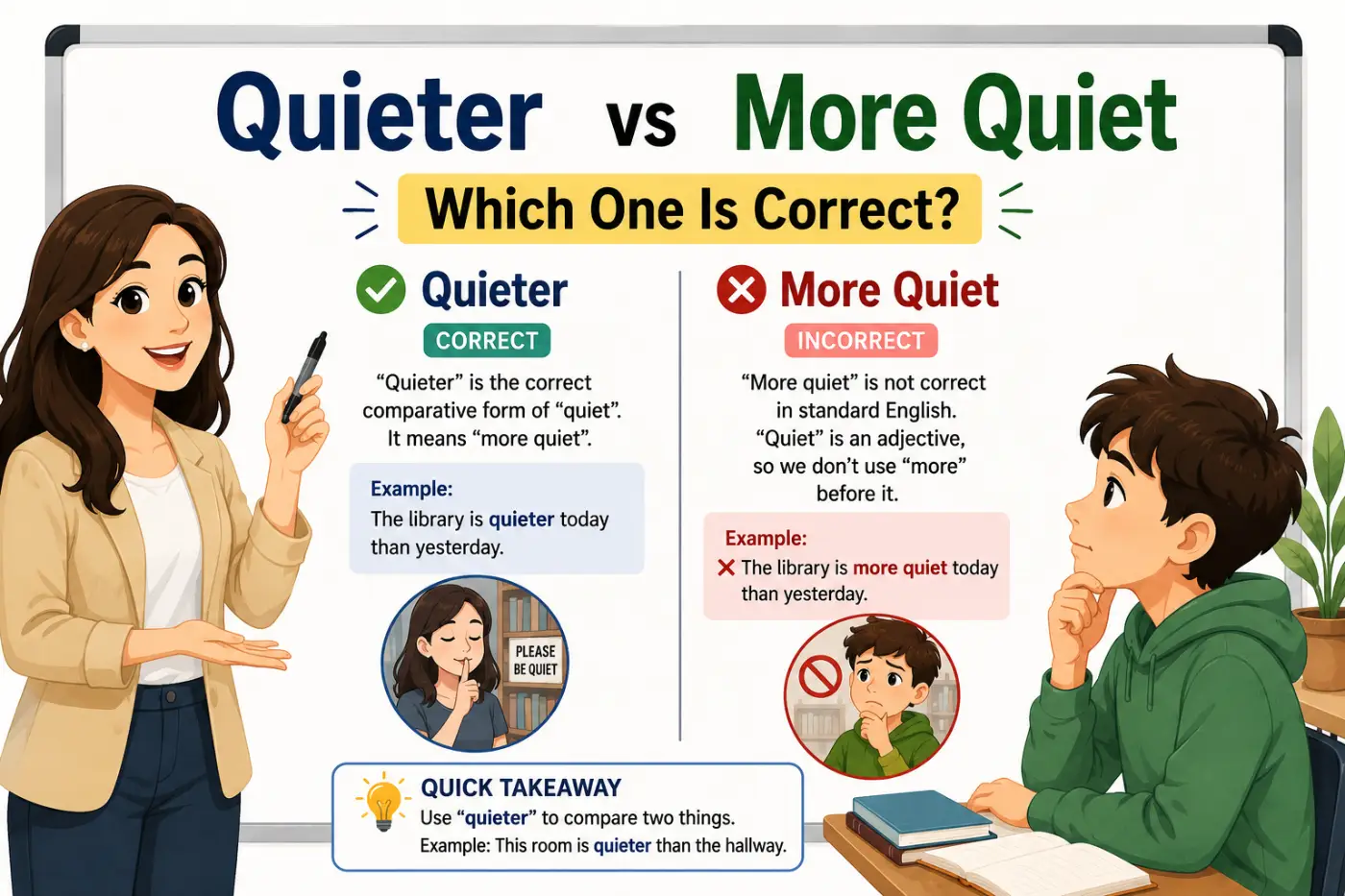
Choosing between quieter vs more quiet can be confusing because both expressions appear in English. The good news is that both are grammatically acceptable, but quieter is usually the more natural and widely preferred comparative form. More quiet can also be correct when the writer wants a particular emphasis or a slower, more deliberate rhythm.
The confusion comes from a common grammar pattern. English adjectives form comparisons in two main ways: by adding -er or by placing more before the adjective. Quiet can use either pattern, although the shorter form is generally the standard choice in everyday American English.
For example, you would usually say that a library is quieter than a busy restaurant. You might also describe a room as more quiet when you want to emphasize its calm atmosphere or create a certain style. Understanding the difference helps you choose the right expression for conversations, school assignments, emails, and formal writing.
Learn the difference in To Fast or Too Fast Which Phrase Is Correct.
Quick Answer
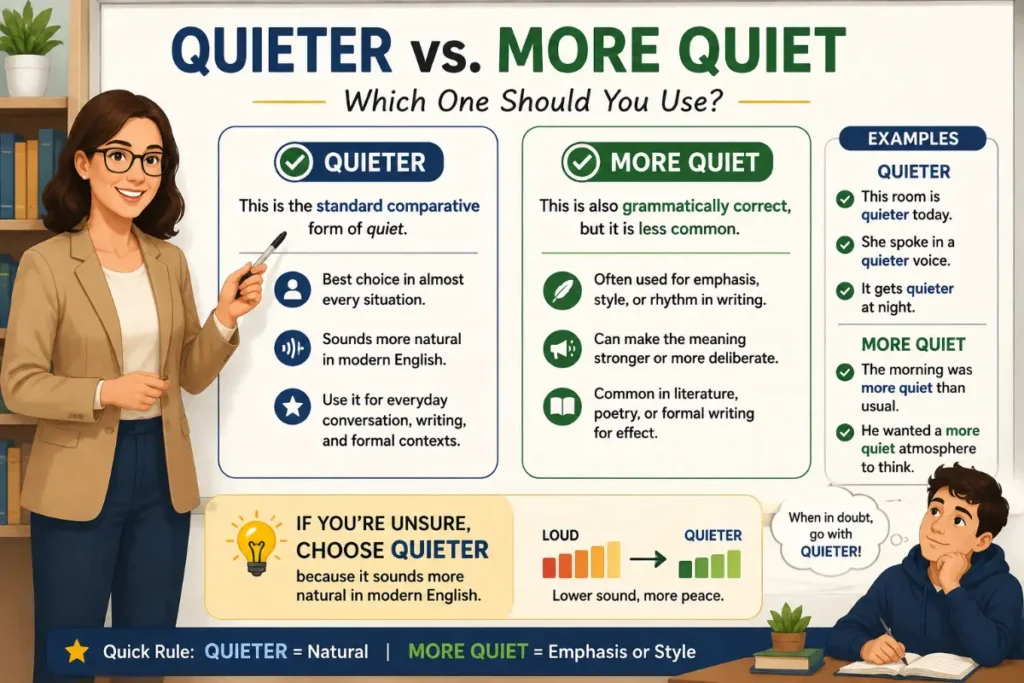
Quieter is the usual comparative form of quiet and is generally the best choice in everyday English. More quiet is also grammatically possible, but it is less common and may sound more deliberate or emphatic. Both forms compare the level of noise or calmness between two people, places, or situations.
Comparison Table
| Feature | Quieter | More Quiet |
|---|---|---|
| Meaning | Having less noise or being calmer | Having less noise or being calmer |
| Part of speech | Comparative adjective | Comparative adjective phrase |
| Base adjective | Quiet | Quiet |
| Grammar | Quiet + er | More + quiet |
| Standard usage | Common and preferred | Correct but less common |
| Formality | Natural in most contexts | Can sound more deliberate |
| Everyday conversation | Very natural | Less frequent |
| Academic writing | Usually preferred | Possible when emphasis or style supports it |
| Example | This room is quieter than the hallway. | This room is more quiet than the hallway. |
Meaning and Definition
What Does Quieter Mean?
Quieter is the comparative form of the adjective quiet. It describes a person, place, object, or situation that makes less noise or has a calmer quality than another.
For example, if one classroom has fewer conversations and less background noise than another, you can say that it is quieter. The word can also describe a person who speaks less, behaves in a more reserved way, or makes less noise.
Common examples include:
- This street is quieter at night.
- Please speak in a quieter voice.
- The library is quieter than the cafeteria.
- My younger brother has become quieter lately.
- We need a quieter place to study.
The word does not always refer to sound alone. It can also describe a peaceful mood, a less active environment, or a person who is less talkative. The surrounding sentence helps readers understand the intended meaning.
What Does More Quiet Mean?
More quiet uses the word more before the adjective quiet to create a comparative meaning. It describes something that has a greater degree of quietness than another thing.
For example, you can say that a room is more quiet than another room. The meaning is clear, and the construction is grammatically possible. However, most speakers would normally choose quieter because it is shorter and more natural in this context.
The phrase may appear when a writer wants to give special emphasis to the quality of quietness. It can also fit a sentence where the rhythm or contrast makes the longer construction sound better.
Consider these examples:
- The garden feels more quiet in the early morning.
- I wanted a more quiet place to think.
- Her voice became more quiet as the meeting continued.
- The house seemed more quiet after the guests left.
These sentences are understandable, but many editors would prefer quieter in ordinary prose. The longer phrase is not automatically wrong. It simply needs a good reason to be chosen over the usual comparative form.
What Does Quiet Mean?
Quiet is an adjective that describes something with little or no noise, activity, or disturbance. It can also describe someone who speaks very little or behaves in a calm and reserved way.
For example, a quiet room has little noise, a quiet person may not talk much, and a quiet evening may involve little activity. The word can also function as a noun or verb in certain contexts, but its role in this comparison is as an adjective.
The basic adjective is the starting point for both comparative forms. It is useful to understand its meaning before choosing how to compare it.
Key Differences Explained
1. Grammar and Word Formation
The main difference is how each comparative form is built.
Quieter follows the common pattern of adding -er to a short adjective. More quiet follows the pattern of placing more before the adjective. Both patterns can create comparisons, but English does not use them with every adjective in the same way.
For many short adjectives, adding -er is the normal choice. For example:
- Tall becomes taller.
- Small becomes smaller.
- Fast becomes faster.
- Quiet becomes quieter.
Longer adjectives often use more instead. For example, beautiful becomes more beautiful, and comfortable becomes more comfortable.
Quiet is a special case because speakers can use both comparative patterns. Even so, the -er form is generally more common and natural.
2. Meaning
There is no major difference in basic meaning. Both expressions describe a greater degree of quietness.
For example:
- The bedroom is quieter than the living room.
- The bedroom is more quiet than the living room.
Both sentences compare the noise levels of two rooms. The first is more direct and natural for most situations. The second may sound more deliberate because it uses the longer construction.
3. Naturalness and Frequency
Quieter is the form most speakers would choose in everyday American English. It is short, clear, and easy to use in conversation and writing.
More quiet is less common. It may appear in creative writing, speech, or a sentence where the writer wants to emphasize quietness. However, using it repeatedly in ordinary writing can make the language sound less natural.
If you are unsure, choose quieter. It is the safer option in most situations.
4. Formality
Quieter works in both informal and formal English. You can use it in a casual conversation, a school essay, a workplace report, or an academic description.
More quiet is not necessarily more formal. A longer expression does not automatically sound more professional. In fact, a direct comparative adjective often makes formal writing clearer.
For example, this sentence is concise:
The new office is quieter than the old one.
The longer version is also understandable:
The new office is more quiet than the old one.
Most editors would prefer the first sentence unless the longer wording serves a clear purpose.
5. Emphasis and Style
The longer phrase can sometimes place more attention on the adjective itself. A writer may choose it to create a slower rhythm or highlight the quality of quietness.
For example:
The room was not just calm; it was more quiet than anyone expected.
However, this does not mean the longer form is always stronger. In many cases, quieter communicates the same idea with fewer words. The best choice depends on the tone and rhythm of the full sentence.
6. Pronunciation
Quieter has two syllables and is pronounced /ˈkwaɪ.ə.tər/ in common American English. More quiet has three syllables when spoken naturally as /mɔːr ˈkwaɪ.ət/.
The difference is easy to hear. The shorter comparative form combines the adjective with an -er ending, while the alternative uses the separate word more.
7. Regional Usage
Both forms can appear in American, British, Canadian, and Australian English. There is no major regional spelling difference.
The preference for quieter is broadly shared across these varieties. More quiet remains possible, but its use often depends on the speaker’s style, emphasis, and sentence structure rather than a regional grammar rule.
Which Form Is Correct?
Quieter is the preferred comparative form in most situations. More quiet is also grammatically acceptable, so it should not automatically be treated as an error.
The reason is that English allows some adjectives to form comparisons in more than one way. Quiet commonly takes the -er ending, producing quieter, but it can also appear after more. The shorter form is generally more natural because quiet is a relatively short adjective and follows a familiar comparative pattern.
Use these examples as a guide:
- Preferred: The neighborhood is quieter after midnight.
- Acceptable: The neighborhood is more quiet after midnight.
- Preferred: Could you speak in a quieter voice?
- Acceptable: I would prefer a more quiet setting.
- Preferred: The classroom became quieter after the teacher arrived.
In formal writing, choose quieter unless the longer construction has a clear stylistic purpose. This keeps your sentences concise and follows the more common pattern.
Sentence Examples
Ten Natural Examples Using Quieter
- Everyday conversation: This coffee shop is quieter than the one near my office.
- Text message: Can we find somewhere quieter to talk?
- Workplace communication: The team needs a quieter space for important phone calls.
- School: The students moved to a quieter room to finish their assignments.
- Academic writing: Participants performed better in quieter testing environments.
- Formal writing: The proposed office layout will create quieter areas for focused work.
- Social situations: We chose a quieter restaurant so everyone could hear the conversation.
- Online communication: I prefer a quieter keyboard because it makes less noise while typing.
- Family conversation: The baby is finally sleeping, so please keep the house quieter.
- Travel: The small village was much quieter than the crowded city.
Five Examples Using More Quiet
These examples show how the longer form can work in sentences. The shorter alternative would often sound more natural.
- The garden feels more quiet in the early morning.
- I wanted a more quiet place to read.
- The house became more quiet after everyone went to bed.
- Her voice grew more quiet as she approached the stage.
- This part of the park seems more quiet than the area near the entrance.
The longer construction can be useful when it fits the rhythm of a sentence or gives special attention to the adjective. Still, quieter is usually the better choice for ordinary descriptions.
Comparing Both Forms in Context
Here are a few pairs that show how the two constructions work.
| With Quieter | With More Quiet |
|---|---|
| The office is quieter today. | The office is more quiet today. |
| We need a quieter room. | We need a more quiet room. |
| The street becomes quieter at night. | The street becomes more quiet at night. |
| She spoke in a quieter voice. | She spoke in a more quiet voice. |
| The park is quieter in winter. | The park is more quiet in winter. |
The meaning stays almost the same in each pair. The shorter form usually sounds smoother, while the longer form may create a different rhythm.
Common Mistakes and Usage Problems
Both comparative forms are possible, but writers can still make errors when forming or using them. The following mistakes are worth avoiding.
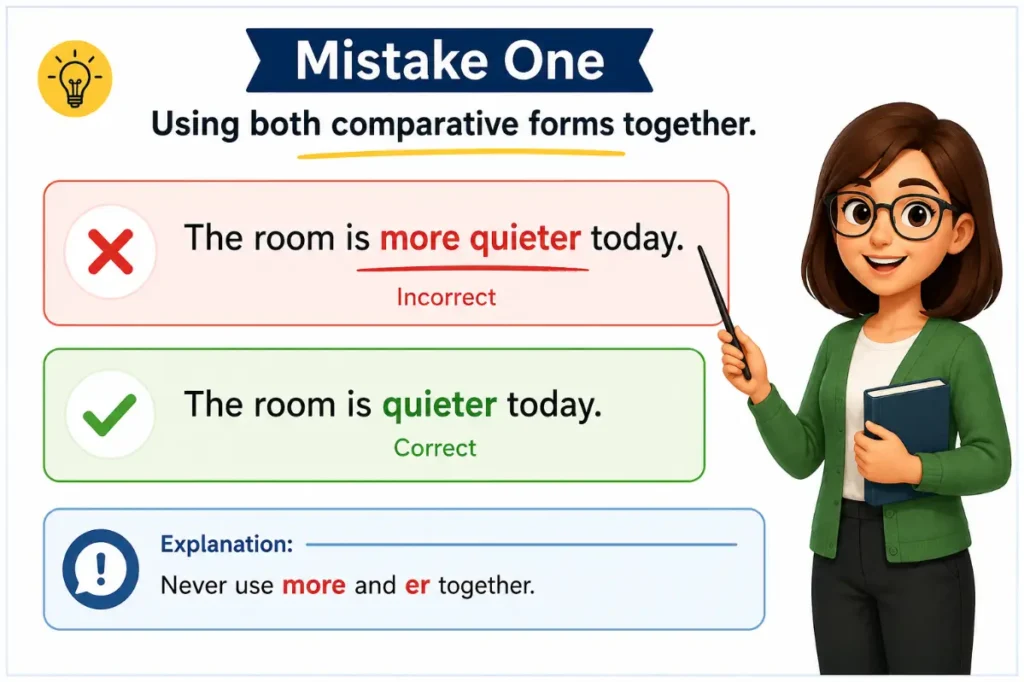
1. Using Both Comparative Forms Together
Incorrect: This room is more quieter than the other one.
Correct: This room is quieter than the other one.
The word more already creates the comparative meaning, so adding -er produces an unnecessary double comparison. Use either quieter or more quiet, not more quieter.
2. Writing Quietter
Incorrect: The library is quietter in the morning.
Correct: The library is quieter in the morning.
The adjective quiet takes -er without doubling the final t. The correct spelling has one t followed by the letters e, r. Remember that the base word remains visible in the comparative form.
3. Using More Quietest
Incorrect: This is the more quietest room in the building.
Correct: This is the quietest room in the building.
Quietest is the superlative form, used to compare one thing with a whole group. More quietest combines two superlative markers and is not standard grammar. Use quietest or, in some contexts, most quiet.
4. Confusing Comparative and Superlative Forms
Incorrect: This is the quieter room in the entire hotel.
Better: This is the quietest room in the entire hotel.
Use quieter when comparing two rooms or two options. Use quietest when identifying the one with the least noise among three or more. The exact sentence may allow other meanings, but this is the basic distinction.
5. Using a Comparative Without a Clear Comparison
Unclear: The room is quieter.
Clearer: The room is quieter than the hallway.
A comparative adjective often refers to another person, place, or thing. The comparison does not always need to be stated because the context may make it clear. However, adding the comparison can help readers understand your meaning.
A Simple Editing Test
When checking a sentence, ask yourself three questions:
- Am I comparing two things or describing the highest degree among a group?
- Have I used only one comparative marker?
- Does the shorter form sound more natural in this sentence?
For most everyday sentences, quieter will pass all three checks.
Pronunciation Guide
How Do You Pronounce Quieter?
The common American English pronunciation is /ˈkwaɪ.ə.tər/. The word has two syllables in ordinary pronunciation, with stress on the first syllable.
A simple way to say it is KWHY uh ter. Start with the sound in why, add a light unstressed vowel, and finish with the ending heard in words such as better. The exact final sound can vary across American accents.
How Do You Pronounce More Quiet?
More quiet is usually pronounced /mɔːr ˈkwaɪ.ət/ in American English. It has three syllables when spoken naturally: more, qui, and et.
The main stress falls on quiet. The word more may receive some emphasis if the speaker wants to highlight the comparison.
Common Pronunciation Mistakes
Some speakers may try to pronounce quieter as if it had three strong syllables. In normal speech, the middle vowel is usually weak, so the word sounds closer to KWHY uh ter.
Another common issue is making the final syllable too strong. The stress belongs on the first part of quieter, not the ending.
For another common grammar confusion, see Unaccessible or Inaccessible Which Spelling Is Correct.
Etymology and Word Origin
The Origin of Quiet
The word quiet entered English through Old French, from Latin quietus, which means calm, at rest, or free from disturbance. Its meaning developed around the ideas of stillness, peace, and a lack of noise or activity.
The word has been used in English for centuries. Today, it can describe a peaceful location, a person who speaks little, a period without activity, or a low level of sound.
How Quieter Developed
Quieter is formed by adding the comparative suffix -er to quiet. This is a common English way to compare adjectives.
For example:
- Quiet becomes quieter.
- Bright becomes brighter.
- Cold becomes colder.
- Soft becomes softer.
The alternative construction uses more before the base adjective. Both patterns express comparison, but English speakers tend to prefer one pattern over the other depending on the adjective.
Why the Word Origin Matters
The historical origin explains the basic meaning of quiet, while the comparative ending explains how the word changes when you compare two things. You do not need to know the Latin root to use the adjective correctly.
The most useful rule is simple: quiet usually becomes quieter when you want to show that something has less noise or activity than another thing.
Regional Usage
American English
In American English, quieter is the usual comparative form. It appears naturally in conversation, school assignments, professional writing, and news reports.
More quiet is also possible, but it is less common. Most American editors would choose quieter in a sentence such as The office is quieter today.
British English
British English follows the same basic rule. Quieter is the normal comparative form, while more quiet can appear for emphasis or stylistic reasons.
There is no major difference in spelling between the two varieties. The main difference may be pronunciation, particularly in the vowel sounds and the final r sound.
Australian English
Australian English also uses quieter as the common comparative form. More quiet is understood, but it is not usually the first choice in ordinary writing or conversation.
The comparative structure follows the same general English grammar pattern used in other major varieties.
Canadian English
Canadian English uses both expressions, with quieter as the usual and more natural option. There is no special Canadian spelling or grammar rule that changes the comparison.
For writing aimed at a broad English speaking audience, quieter is the safest choice.
Grammar Rules and Part of Speech
Quiet as an Adjective
Quiet is mainly an adjective in this comparison. It describes a person, place, or thing with little noise or activity.
Examples:
- The room is quiet.
- My neighborhood is quiet at night.
- She is a quiet student.
- We enjoyed a quiet afternoon.
The adjective can appear before a noun or after a linking verb. In both positions, it describes a quality or condition.
Quieter as a Comparative Adjective
Quieter compares two people, places, or things. It usually appears after a linking verb such as is, seems, feels, or became, or before a noun.
Examples:
- This room is quieter than the kitchen.
- We need a quieter classroom.
- The street became quieter after sunset.
- Her voice sounds quieter today.
The word than often introduces the second part of a comparison. However, it is not always necessary if the comparison is clear from the surrounding context.
More Quiet as a Comparative Phrase
More quiet uses the adverb more with the adjective quiet. The structure is grammatically possible, but it is less common than the one word form.
Examples:
- The garden is more quiet in the morning.
- We need a more quiet environment.
- The room seemed more quiet after the guests left.
In most of these examples, quieter would be the more natural choice. Use the longer construction only when it fits the sentence’s style or emphasis.
Comparative and Superlative Forms
English adjectives can have positive, comparative, and superlative forms.
| Degree | Form | Example |
|---|---|---|
| Positive | Quiet | The room is quiet. |
| Comparative | Quieter | This room is quieter than that one. |
| Comparative alternative | More quiet | This room is more quiet than that one. |
| Superlative | Quietest | This is the quietest room. |
| Superlative alternative | Most quiet | This is the most quiet room. |
The comparative form compares two things. The superlative form identifies the highest or lowest degree within a group. For ordinary writing, quieter and quietest are usually the most natural choices.
Using Than Correctly
The word than often follows a comparative adjective when the comparison is stated directly.
Correct: The library is quieter than the cafeteria.
Incorrect: The library is quieter then the cafeteria.
Than introduces a comparison. Then usually refers to time or sequence. This is a separate spelling issue, but it matters because the two words sound similar in some accents.
Avoiding Double Comparisons
Do not combine more with the -er ending.
Incorrect: more quieter.
Correct: quieter.
Also correct: more quiet.
The same rule applies to superlatives. Do not use most with quietest in ordinary standard grammar. Choose quietest or most quiet, although quietest is generally preferred.
Real Life Usage Examples
Daily Conversation
In everyday speech, quieter is natural and direct. People often use it to request less noise or describe a peaceful place.
- Could you turn the television down? I need a quieter room.
- This street is much quieter on Sunday mornings.
More quiet can also appear in casual speech, but it may sound less direct. Most speakers would choose the shorter form without thinking about the grammar rule.
Email and Workplace Communication
In professional communication, the shorter form keeps requests clear and polite.
- Could we move the meeting to a quieter room?
- The new office layout provides quieter areas for focused work.
You can use more quiet if the sentence calls for a particular style, but there is rarely a professional reason to prefer it over quieter. Simple wording usually makes workplace communication easier to understand.
Academic Writing
Academic writing may use the comparative to describe sound conditions, research environments, or changes in activity.
- Participants completed the task more accurately in quieter rooms.
- The researchers selected a quieter location to reduce background noise.
These examples use the common comparative form. In research writing, precision matters, so the comparison should be clear. If possible, explain what the environment is quieter than.
News and Journalism
News writers may use the word to describe changes in neighborhoods, public spaces, or levels of activity.
- Residents say the area has become quieter since the road closure.
- The park is quieter during the colder months.
The shorter form is useful because it communicates the comparison without adding unnecessary words.
Literature and Storytelling
In creative writing, both forms can work, depending on the mood and rhythm of the passage.
- The house grew quieter as the last guests left.
- At dawn, the garden felt more quiet, as if the whole world were waiting.
The second sentence uses the longer phrase for a slower rhythm. This is a stylistic choice rather than a rule that makes one form more correct.
Related and Confused Terms
1. Quiet
Quiet is the base adjective. It describes a low level of noise, activity, or disturbance. Use it when you are describing something without making a comparison.
Example: The classroom is quiet.
2. Quietest
Quietest is the superlative form. It identifies the person or thing with the least noise or activity in a group.
Example: This is the quietest corner of the library.
3. More Quietly
More quietly is the comparative form of the adverb quietly. It describes how an action is performed, not the quality of a person or place.
Example: Please speak more quietly.
4. Quieter Than
Quieter than is a common comparative structure. It connects the thing being described with the thing used for comparison.
Example: The countryside is quieter than the city.
5. Less Noisy
Less noisy is a useful alternative when you want to focus on the amount of sound rather than calmness.
Example: The new machine is less noisy than the old one.
6. Calmer
Calmer describes a lower level of excitement, stress, or activity. It can overlap with quiet, but it does not always refer to sound.
Example: The classroom became calmer after the teacher returned.
7. More Peaceful
More peaceful describes a place or situation with less conflict, disturbance, or stress. It often refers to mood or atmosphere rather than sound alone.
Example: The village feels more peaceful in the evening.
8. Silent
Silent means completely or almost completely without sound. It is stronger than quiet, which can allow some background noise.
Example: The room became silent when the lights went out.
These related expressions help you describe different levels and kinds of calmness. Choose the one that matches the exact meaning rather than using them as automatic replacements.
Expert Editor Insight
An experienced editor will usually choose quieter because it is the common comparative form and keeps the sentence concise. The longer phrase is not automatically wrong, but it can sound awkward if used without a clear reason. Editors look at the adjective’s length, the sentence rhythm, and the intended meaning before making a change. Grammar tools may accept both forms, so their suggestions should not replace careful reading. A useful editing habit is to read the sentence aloud. If quieter sounds smoother and communicates the same meaning, use it. Save more quiet for cases where the longer rhythm or emphasis genuinely improves the sentence.
Key Takeaways
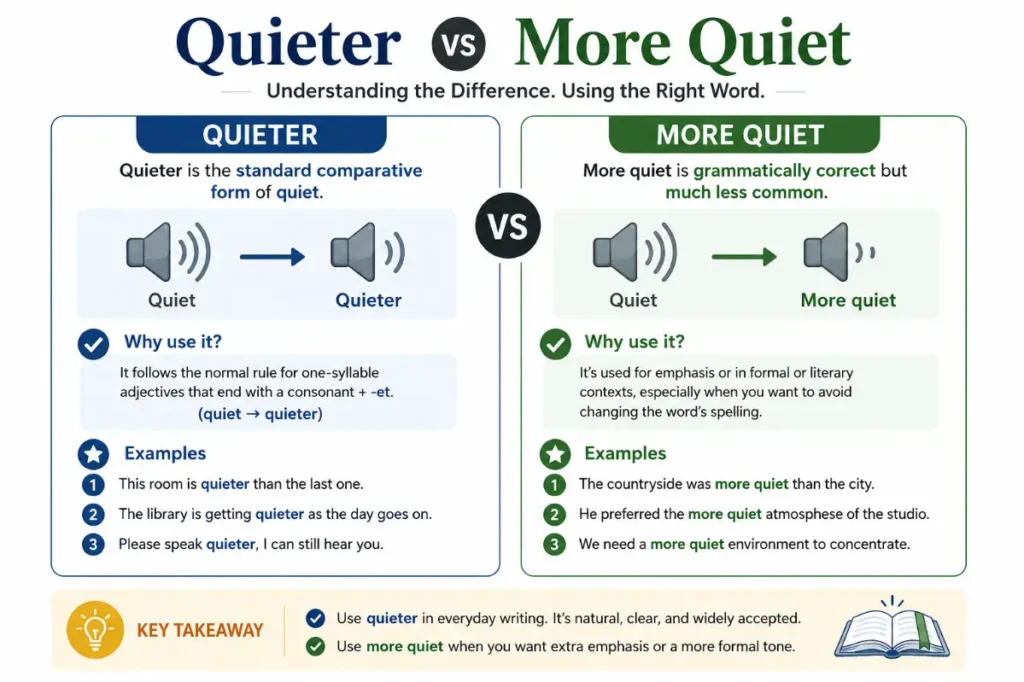
- Quieter is the standard comparative form of quiet.
- More quiet is grammatically correct but much less common.
- Both American and British English prefer quieter.
- Never write more quieter.
- Use quieter in business, academic, and everyday writing.
- Use more quiet only when emphasis or rhythm improves the sentence.
- Remember that grammar and natural usage are not always the same.
- If you’re uncertain, quieter is almost always the best choice.
A related grammar guide is Flew or Flown Which One Is Correct?.
Conclusion
The choice between Quieter vs More Quiet depends on grammar, naturalness, and sentence style. Both forms can express a lower level of noise or activity, but quieter is the usual comparative form and the better choice in most situations. More quiet remains grammatically possible when the longer construction suits the emphasis or rhythm of a sentence.
For everyday speech, school assignments, and professional writing, choose the shorter form unless you have a clear reason to do otherwise. A simple editing tip is to remember that quiet normally becomes quieter, just as tall becomes taller. This keeps your comparisons clear and natural.
FAQs
Is Quieter Grammatically Correct?
Yes. Quieter is the standard comparative form of quiet and is widely used in everyday and formal English. It describes something that has less noise or activity than another thing. For example, you can say that a library is quieter than a busy restaurant. It is usually the most natural choice when making this comparison.
Is More Quiet Also Correct?
Yes. More quiet is grammatically possible because English allows some adjectives to form comparisons with more. However, it is less common than quieter and may sound more deliberate or stylistic. In ordinary conversation and professional writing, quieter is usually the better choice unless the longer phrase creates a useful effect.
Which Is Better in American English?
Quieter is generally better in American English because it is the usual comparative form. Most speakers naturally say that a room is quieter than another room. More quiet is understood, but it appears less often. For schoolwork, emails, reports, and everyday conversation, choose the shorter form in most situations.
Can I Say More Quieter?
No. More quieter is not standard grammar because it combines two comparative markers. The ending -er already makes quiet comparative, so adding more is unnecessary. Use quieter or more quiet, but do not combine them. For example, write The library is quieter today, not The library is more quieter today.
What Is the Superlative Form of Quiet?
The usual superlative form is quietest. It describes the person, place, or thing with the least noise or activity in a group. For example, This is the quietest room in the building. Most quiet is also possible in some contexts, but quietest is generally the more natural choice.
How Do You Pronounce Quieter?
Quieter is commonly pronounced /ˈkwaɪ.ə.tər/ in American English. It has two syllables, with stress on the first part. A simple pronunciation guide is KWHY uh ter. The middle sound is usually unstressed, and the final syllable is light. Regional accents may change the exact vowel sounds slightly.
Is Quieter More Formal Than More Quiet?
Quieter is not less formal. It is a standard comparative adjective that works in both casual and professional writing. More quiet is also possible, but the longer construction does not automatically sound more formal or polished. Clear writing usually favors the shorter form unless the longer wording adds useful emphasis or improves the sentence rhythm.
Can I Use More Quiet Before a Noun?
Yes. You can say a more quiet room or a more quiet environment because more can appear before an adjective that modifies a noun. However, a quieter room and a quieter environment are usually more natural. In most writing, the shorter form is easier to read and communicates the same meaning.