
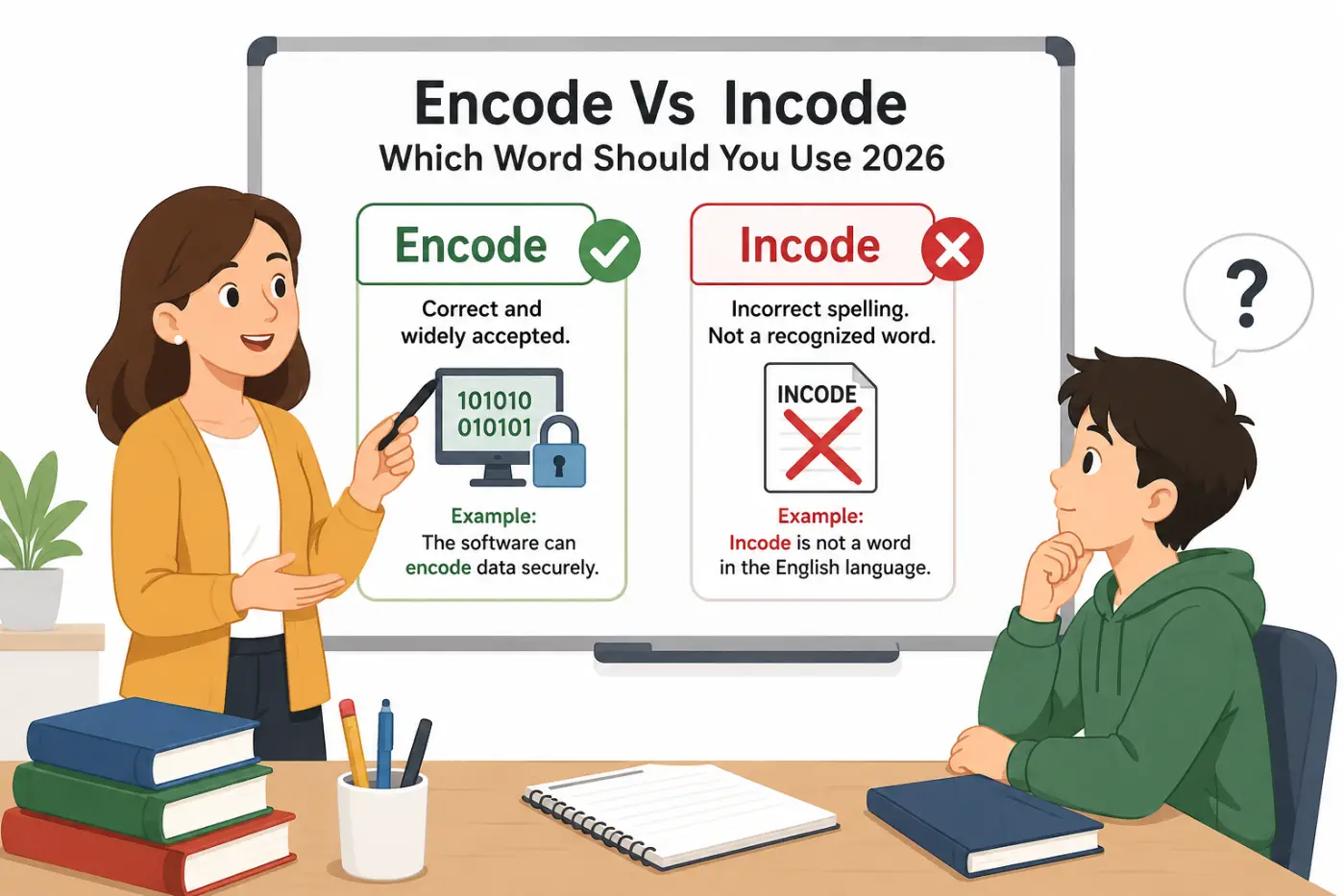
If you’ve searched for encode vs incode you’re probably trying to figure out if both words are correct or if one is simply a spelling mistake. It’s a common question because the two words look almost identical. Just one letter changes, yet that small difference can completely change the answer.
This confusion happens because many English words begin with en and in. People also mistype words quickly, and spell check doesn’t always catch every mistake, especially if a brand name exists with similar spelling.
This guide explains the difference in plain English. You’ll learn the meaning of both terms, see real examples, understand the grammar, discover their origins, avoid common mistakes, and know exactly which form to use in every situation.
Still confused? Compare jynx vs jinx Which Word Is Correct in 2026.
Quick Definition
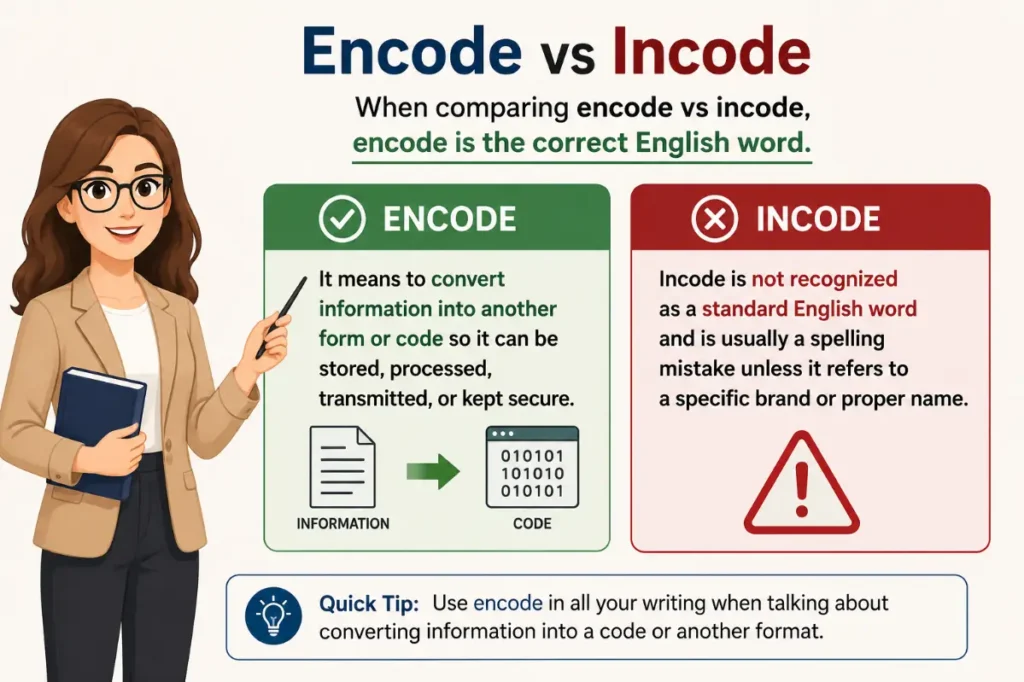
When comparing encode vs incode, encode is the correct English word. It means to convert information into another form or code so it can be stored, processed, transmitted, or kept secure. Incode is not recognized as a standard English word and is usually a spelling mistake unless it refers to a specific brand or proper name.
Quick Answer
If you’re deciding between encode vs incode, choose encode in almost every situation.
- Encode is the correct English word.
- It functions as a verb.
- It means to convert information into a coded form.
- It is widely used in computing, communication, biology, psychology, and everyday English.
- Incode is generally a misspelling.
- Incode is acceptable only when it is part of an official company, product, or brand name.
If you’re writing an email, report, article, assignment, or software documentation, encode is the correct choice.
Encode Vs Incode Comparison Table
| Feature | Encode | Incode |
|---|---|---|
| Correct English word | Yes | No in standard English |
| Part of speech | Verb | Not a standard English word |
| Meaning | Convert information into a code | Usually a misspelling or a proper name |
| Origin | From Latin through French | No recognized English word origin |
| Dictionary recognition | Yes | No as a common English word |
| Usage frequency | Very common | Extremely rare outside brand names |
| Formality | Suitable in all writing | Only for official names |
| Common contexts | Computing encryption genetics psychology communication | Company names software products business names |
| Example | Please encode the file before sending it. | Incode released a new identity verification platform. |
Meaning Of Encode Vs Incode
What Does Encode Mean
Encode is a verb that means to convert information into a different form according to a specific system or code. People often use it when talking about computers, programming, digital media, communication, genetics, and psychology. The purpose of encoding may be to store information, transmit it, protect it, or make it easier for a machine or person to understand.
For example, a computer may encode text into binary data. A video application may encode a movie before streaming it. The human brain also encodes memories so they can be stored and recalled later. Although the contexts vary, the central idea stays the same. Something is transformed into another format using a defined set of rules.
Common Meanings Of Encode
- To convert information into a coded form.
- To prepare digital data for storage or transmission.
- To represent information using symbols or numbers.
- To store memories in the brain.
- To express genetic information in DNA.
What Does Incode Mean
Incode is not a standard English word. If you see it in ordinary writing, it is almost always a spelling mistake for encode. There is one important exception. Incode may appear as a proper noun. Several companies, software products, and business services use Incode as their official name. In those cases, the spelling is intentional and should remain exactly as the organization writes it. Outside those specific names, English dictionaries do not recognize incode as a regular vocabulary word.
Encode Vs Incode Key Differences
Although the spellings look similar, they serve very different purposes.
Meaning
- Encode has a recognized meaning in English.
- Incode has no standard dictionary meaning.
Grammar
- Encode is a verb.
- Incode does not function as a normal English verb.
Usage
- Encode appears in everyday English and technical writing.
- Incode appears mainly as a company or product name.
Dictionary Status
- Encode is included in major English dictionaries.
- Incode is not listed as a standard English vocabulary word.
Professional Writing
- Use encode in reports, essays, emails, documentation, and academic work.
- Use Incode only when referring to an official brand or organization.
Which One Is Correct
The correct English word is encode. Use encode whenever you mean converting information into another form or code. This applies to programming, cybersecurity, data compression, genetics, communication, psychology, media production, and many other fields. Do not replace encode with incode in normal writing. Doing so creates a spelling error that can reduce clarity and make your writing appear less professional. The only time Incode is correct is when it is part of an official name. For example, if a company is legally named Incode, you should preserve that spelling because proper names always keep their original form.
Encode Vs Incode Examples In Sentences
Reading examples is one of the fastest ways to understand the difference between encode vs incode. Notice that encode fits naturally into every sentence because it is a real English verb. Incode appears only when it refers to an official name.
Encode Sentence Examples
- The software can encode large video files in just a few minutes.
- Please encode the document before sending it over the network.
- Scientists encode genetic information using specific sequences of DNA.
- The app will automatically encode your password for better security.
- The media player can encode audio into several file formats.
- Our system will encode customer data before storing it.
- Students learned how computers encode text into binary numbers.
- The brain helps encode new memories during sleep.
- The engineer used a script to encode the images more efficiently.
- Always encode sensitive information before sharing it online.
Incode Sentence Examples
The following examples are correct because Incode is used as an official name rather than as an English word.
- Incode launched a new identity verification platform.
- Our company selected Incode for customer authentication.
- The conference included a presentation from Incode.
- Incode announced new security features this year.
- Several banks now use Incode for digital identity checks.
- We scheduled a meeting with the Incode support team.
- Incode introduced updates to its verification software.
- Investors showed strong interest in Incode during the event.
- The company partnered with Incode to improve online security.
- Incode continues expanding its services around the world.
If these same sentences were talking about converting information into code, encode would be the correct spelling instead.
Common Mistakes With Encode Vs Incode
Many spelling errors happen because people type quickly or rely too much on autocorrect. The confusion between encode and incode is a good example.
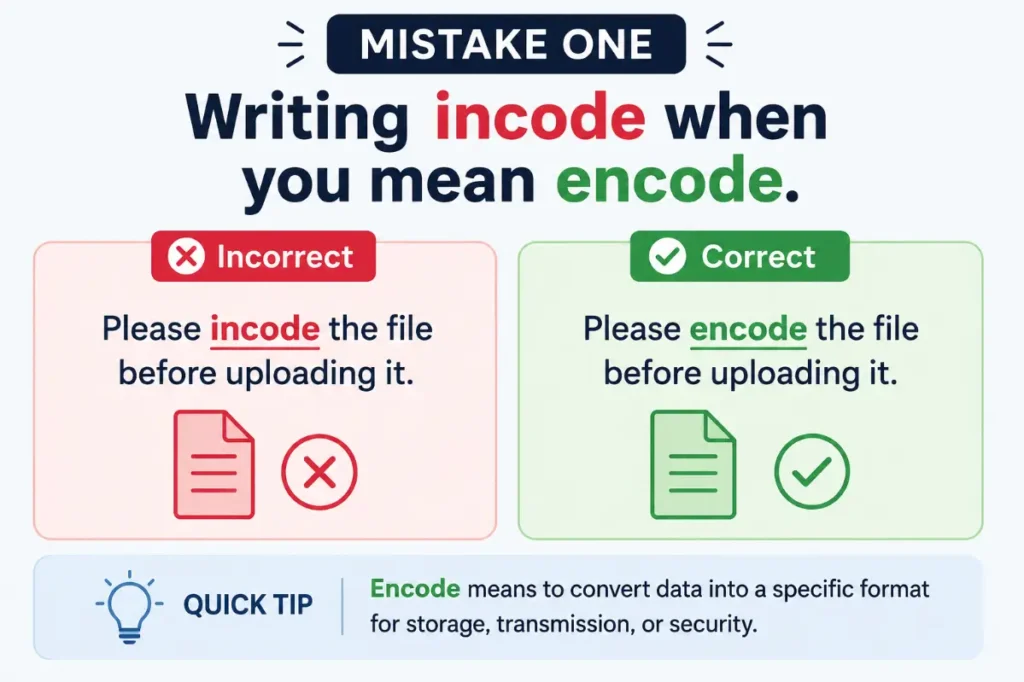
Mistake One
Writing incode when you mean encode.
Incorrect. Please incode the file before uploading it.
Correct. Please encode the file before uploading it.
Mistake Two
Assuming both spellings are interchangeable. They are not. Standard English recognizes only encode as the verb.
Mistake Three
Thinking incode is the British spelling. It is not. American English British English Canadian English and Australian English all use encode.
Mistake Four
Using Incode as a common dictionary word. When you see Incode with a capital letter it usually refers to a business or product name instead of an English vocabulary word.
Mistake Five
Ignoring context. A brand name follows different rules from ordinary vocabulary. A company may intentionally choose an unusual spelling. That choice does not change standard English.
You may also want to read Laser Or Lazer Definition, Spelling And Usage in 2026.
Encode Vs Incode Pronunciation Guide
Since encode is the recognized English word, it has a standard pronunciation used by native speakers around the world.
Encode
IPA.
American English.
/ɪnˈkoʊd/
British English.
/ɪnˈkəʊd/
Syllable breakdown.
En.
Code.
The stress falls on the second syllable.
Common Pronunciation Mistakes
- Stressing the first syllable instead of the second.
- Pronouncing the ending as cod instead of code.
- Confusing the pronunciation with unrelated words because of similar spelling.
How Native Speakers Say It
Native speakers usually pronounce encode smoothly with the second syllable receiving the strongest emphasis. Say it like this. en CODE.
How Is Incode Pronounced
When Incode is used as a company name, people generally pronounce it the same way as encode. The pronunciation depends on the organization’s preference, but in everyday conversation most speakers say it exactly like encode.
Etymology And Word Origin
Understanding a word’s history often explains why its spelling looks the way it does.
Origin Of Encode
The word encode developed from the prefix en combined with code. The prefix en comes through French and ultimately from Latin. It often means to put into or cause to be. The noun code traces back to the Latin word codex, which originally referred to a collection of written pages or a book. Over time, code came to mean a system of symbols, rules, or signals. When these parts came together, encode took on the meaning of putting information into a coded form. As computers became common during the twentieth century, the word spread rapidly into computing, telecommunications, cryptography, digital media, and information technology. Today it is part of everyday technical English.
Origin Of Incode
There is no recognized historical English word called incode. The spelling appears mainly as a modern brand name. Companies sometimes create distinctive spellings because they are easier to trademark or market. That commercial use does not make incode part of standard English vocabulary.
Encode Vs Incode Regional Usage
One advantage of encode is its consistency across major English speaking countries.
American English
American English uses encode in technical writing, education, software development, cybersecurity, medicine, psychology, and everyday communication. Incode appears only when referring to a specific company or product.
British English
British English follows exactly the same pattern. People write encode when discussing coding, digital information, genetics, or memory.
Australian English
Australian English also recognizes encode as the standard spelling. Professional writers and editors treat incode as a proper name rather than a vocabulary word.
Canadian English
Canadian English follows the same convention. There is no accepted Canadian spelling that replaces encode with incode.
Regional Preference Summary
Across the major English varieties there is remarkable agreement.
- American English uses encode.
- British English uses encode.
- Australian English uses encode.
- Canadian English uses encode.
The spelling does not change from one region to another.
Grammar Rules For Encode
Knowing how encode works in a sentence helps you use it correctly every time.
Part Of Speech
Encode is a verb. It describes an action.
Example.
The system will encode the data automatically.
Verb Forms
| Form | Example |
|---|---|
| Base form | encode |
| Third person singular | encodes |
| Present participle | encoding |
| Past tense | encoded |
| Past participle | encoded |
Common Sentence Structures
- Subject plus encode plus object.
The computer encodes every message.
- Subject plus be plus encoded.
The information was encoded before transmission.
- Modal verb plus encode.
You should encode confidential files.
- Infinitive form.
The goal is to encode the data correctly.
Is There A Noun Form
Yes. The related noun is encoding.
Example.
Video encoding takes several minutes.
Is There An Adjective Form
The most common adjective is encoded.
Example.
The encoded message could only be read with the correct key.
Is There A Plural Form
Because encode is a verb, it does not have a plural form. Related nouns such as code and encoding follow normal English grammar rules.
Real Life Usage Examples
Daily Conversation
- Please encode the file before you email it.
- The app can encode photos automatically.
- I forgot to encode the password correctly.
Academic Writing
- Researchers encode survey responses before analyzing the results.
- Students learn how computers encode information using binary systems.
- Memory studies explore how the brain encodes new experiences.
Professional Communication
- Our security policy requires employees to encode sensitive customer information.
- The development team will encode the data before deployment.
- Engineers reviewed the process used to encode video files.
Literature And Research
In psychology and neuroscience, researchers often discuss how people encode memories before storing and retrieving them. The word appears frequently in textbooks, journal articles, and university courses because it describes a key stage of human memory.
Media And Technology
Technology companies regularly use encode when describing video streaming, music compression, cybersecurity, artificial intelligence, cloud storage, and digital communication. If you read technical documentation or software guides, you’ll encounter encode far more often than most other data processing verbs because it describes a fundamental operation used across modern computing.
Encode Vs Incode Related Words And Confused Terms
The confusion doesn’t stop with encode vs incode. Several related words look or sound similar, but each has its own meaning. Knowing the differences helps you choose the right word every time.
Encode
Encode means to convert information into a coded format.
Example. The software will encode the video before uploading it.
Decode
Decode is the opposite of encode. It means to convert coded information back into a readable or understandable form.
Example. The receiver used a special program to decode the message.
Code
Code can be both a noun and a verb. As a noun, it refers to a system of symbols, rules, or programming instructions. As a verb, it means to write computer programs or assign a code.
Example. She learned to code in Python.
Encoding
Encoding is the noun form of encode. It describes the process of converting information into another format.
Example. Video encoding takes longer when the resolution is higher.
Encryption
People often confuse encoding with encryption, but they are not the same. Encoding changes the format of data so another system can read it. Encryption protects information by making it unreadable without the correct key.
Example. The company encrypted customer records before storing them.
Compression
Compression reduces file size. Some compression methods also include encoding, but the two terms are not interchangeable.
Cipher
A cipher is a specific method used to encrypt or decrypt information.
Commonly Confused Spellings
- Encode.
- Decode.
- Encoding.
- Encoded.
- Encoder.
- Encryption.
- Encrypt.
- Incode.
Among these, only incode is not a standard English vocabulary word.
Expert Language Insight
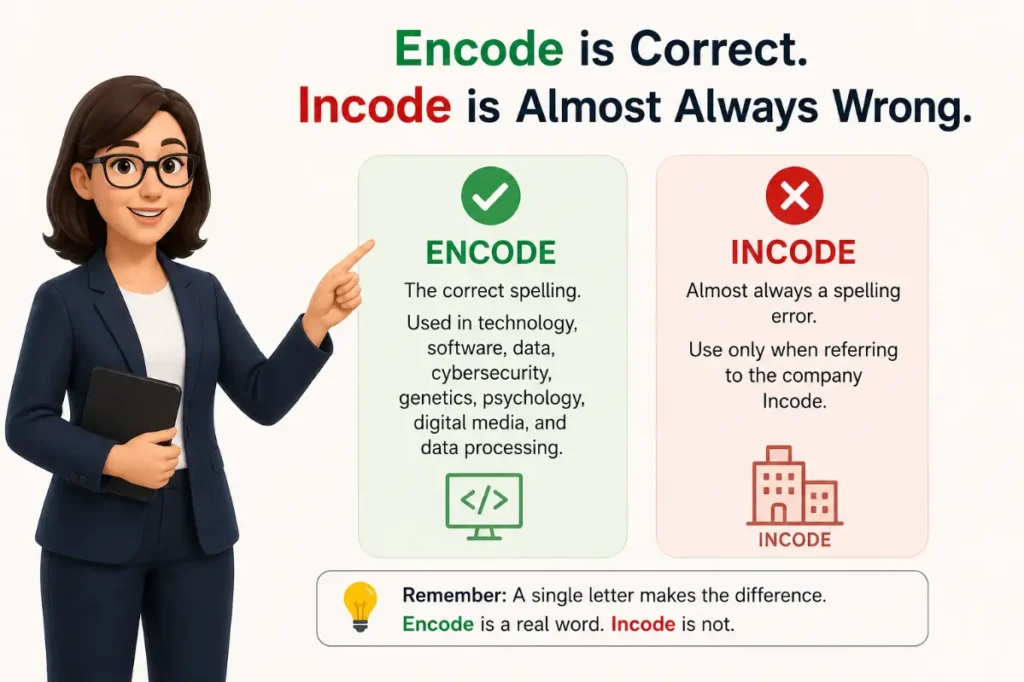
After years of editing articles, technical documents, and business communication, one pattern appears again and again. Writers rarely confuse the meaning of encode. They usually confuse the spelling. The mistake often happens because people type quickly or assume in and en can be swapped without changing the word. English doesn’t work that way. A single letter can separate a correct dictionary word from a spelling error.Native English speakers naturally use encode in conversations about technology, software, cybersecurity, genetics, psychology, digital media, and data processing. They don’t replace it with incode unless they are talking about a company whose official name is Incode.
Learn the difference in Seing Vs Seeing Which Is Correct In English in 2026.
Conclusion
If you’re comparing encode vs incode, the answer is straightforward. Encode is the correct English word. It is a recognized verb that means to convert information into another form or code. You’ll find it in dictionaries, textbooks, technical manuals, academic research, software documentation, and everyday communication.
Incode is not a standard English word. In most situations, it is simply a spelling mistake. The only common exception is when it appears as the official name of a company, product, or service.
Frequently Asked Question
Is Encode Or Incode Correct?
Encode means to convert information into another form using a specific system or code. People commonly use it when discussing computers, digital media, communications, memory, genetics, and cybersecurity.
Is Incode A Real English Word?
No. Incode is not recognized as a standard English word. Most examples found online refer to brand names, software products, or companies rather than general English vocabulary.
Is Incode The British Spelling Of Encode?
No. British English and American English both use encode. There is no regional spelling that replaces it with incode.
Can I Use Incode In Academic Writing?
No. Academic writing should use encode unless you’re referring to an organization whose official name is Incode. Using incode as a verb is considered a spelling mistake.
How Do You Pronounce Encode?
In American English, encode is pronounced /ɪnˈkoʊd/. In both accents, the stress falls on the second syllable.
What Is The Difference Between Encode And Encrypt?
Encode changes data into another format so it can be stored or transmitted more effectively. Encrypt protects information from unauthorized access by using a secret key. Encoding is not designed to provide security, while encryption is.
Why Do People Search For Encode Vs Incode?
Most people search for encode vs incode because they have seen both spellings online and want to know which one is correct. The confusion is also caused by software brand names and typing errors that make incode appear more common than it really is.