
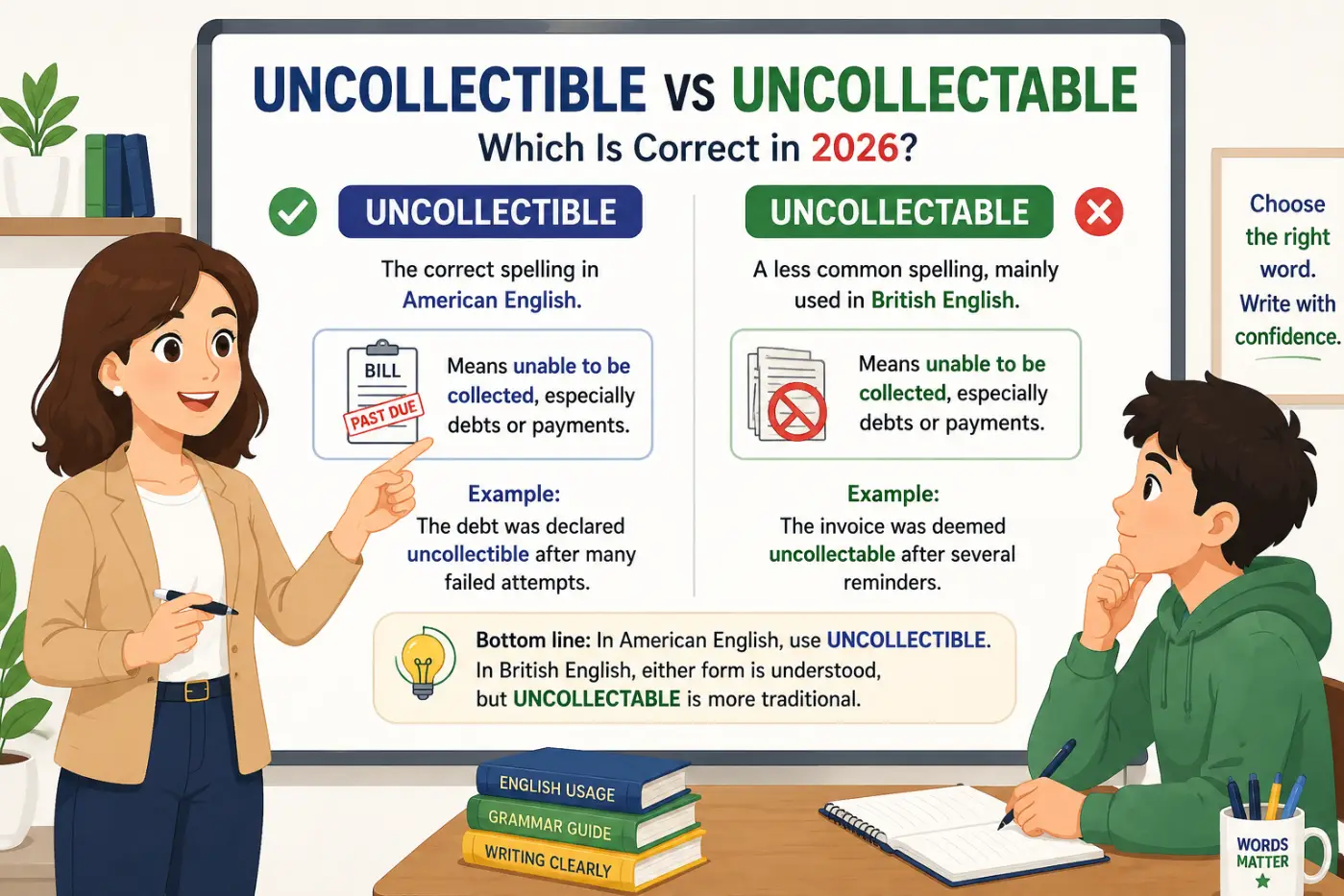
If you’ve come across uncollectible vs uncollectable, you may wonder which spelling you should use. Both forms appear in dictionaries, financial documents, and general writing, so it’s natural to question if they have different meanings or if one is incorrect.
The good news is that both uncollectible and uncollectable are correct English adjectives. They describe something that cannot be collected, recovered, or obtained. The main difference is usage and frequency. Uncollectible is much more common, particularly in American English and in accounting, finance, business, and legal writing. Uncollectable is also standard but is used less often and can appear more frequently in some British English contexts.
If you’re writing about unpaid debts, overdue bills, taxes, or accounts receivable, uncollectible is usually the more familiar choice. Still, knowing both forms helps you understand different sources and write confidently for different audiences.
For another common grammar confusion, see Kinesthesiology vs Kinesiology Simple Rules Explained 2026.
Quick Definition
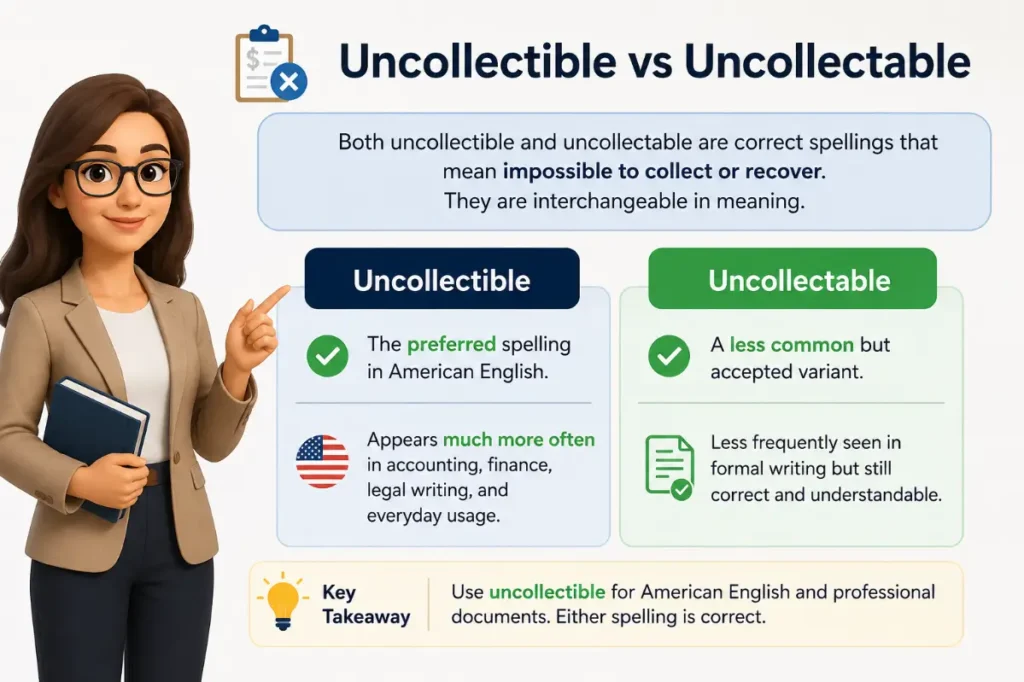
Both uncollectible and uncollectable are correct spellings that mean impossible to collect or recover. They are interchangeable in meaning. Uncollectible is the preferred spelling in American English and appears much more often in accounting, finance, legal writing, and everyday usage, while uncollectable is a less common accepted variant.
Quick Answer
If you’re writing for a general audience, choose uncollectible. It is the spelling most readers expect, especially in the United States. It dominates business documents, accounting standards, financial reports, news articles, and educational materials. Uncollectable is still correct, but it appears much less frequently.
Uncollectible Vs Uncollectable Comparison Table
| Feature | Uncollectible | Uncollectable |
|---|---|---|
| Correct spelling | Yes | Yes |
| Meaning | Impossible to collect or recover | Impossible to collect or recover |
| Part of speech | Adjective | Adjective |
| Origin | From collect plus the suffix ible | From collect plus the suffix able |
| Usage frequency | Very common | Less common |
| Formality | Standard formal English | Standard formal English |
| Common contexts | Accounting finance law banking taxes | General English some British publications |
| Preferred in American English | Yes | Rarely |
| Accepted in British English | Yes | Yes |
| Example | The debt became uncollectible after bankruptcy. | The debt became uncollectable after bankruptcy. |
Search Intent Analysis
People searching for uncollectible vs uncollectable usually want a direct spelling and usage answer. Most users are trying to learn which version looks more professional or appears more often in modern English. The dominant search intent includes the following.
- Comparing two correct spellings.
- Finding the preferred spelling.
- Learning the difference in usage.
- Understanding grammar and pronunciation.
- Seeing real sentence examples.
- Knowing regional preferences.
This article focuses on those questions first before exploring the history and grammar behind the two spellings.
Meaning Of Uncollectible And Uncollectable
Both words describe something that cannot be collected, recovered, obtained, or received. In most situations, they carry exactly the same meaning. The difference is not in definition. It is in preference and frequency.
Uncollectible Meaning
Uncollectible is an adjective that describes money, debts, taxes, invoices, loans, rent, or other amounts that cannot realistically be recovered. Businesses use this word every day because unpaid balances eventually become impossible to collect. Accountants often classify these amounts as uncollectible accounts or uncollectible debts after reasonable collection efforts fail. Examples include overdue invoices, unpaid loans after bankruptcy, abandoned receivables, and taxes that governments decide cannot be recovered.
Uncollectable Meaning
Uncollectable has the same definition. It also means impossible to collect or recover. The spelling simply uses a different adjective ending. Although it appears less often, respected dictionaries recognize it as a standard English word. Some publishers, organizations, and writers still prefer this form, especially in regions that commonly accept both adjective endings. In everyday communication, readers understand both words immediately.
Uncollectible Vs Uncollectable Meaning Differences
There is almost no difference in meaning. Both words describe the same situation and can replace each other in nearly every sentence without changing the message. The real differences appear in style, frequency, and reader expectations.
Meaning
Both words mean impossible to collect, recover, obtain, or receive.
Tone
Uncollectible sounds more familiar because readers encounter it more often. Uncollectable may appear slightly less common, but it does not sound incorrect.
Grammar
Both function as adjectives. Each modifies nouns such as debt, account, invoice, payment, tax, rent, balance, or loan.
Context
Professional writing strongly favors uncollectible, especially in accounting, finance, insurance, banking, and legal documents. General writing may use either spelling.
Regional Preference
American English overwhelmingly prefers uncollectible. British English accepts both forms, although uncollectible still appears frequently in professional writing.
Why Do Two Correct Spellings Exist
English contains many adjective pairs ending in ible and able. Over centuries, both endings became accepted for certain words, especially when language evolved through Latin and French influences.
That explains why English includes pairs such as:
- Collectible and collectable.
- Digestible and digestable in older historical texts.
- Flexible and flexible variants that appeared during earlier stages of English.
Over time, one spelling often becomes more popular than the other. In this case, uncollectible gradually became the dominant form, especially in business and financial writing. That does not make uncollectable wrong. It simply means readers encounter it less often today.
Uncollectible Vs Uncollectable Which One Is Correct
Both spellings are correct. If you must choose only one, use uncollectible. It is the spelling recommended by most editors because it appears more frequently in dictionaries, newspapers, accounting textbooks, financial statements, business reports, and professional communication.
Choosing uncollectible offers several advantages.
- It matches modern American English.
- It looks familiar to most readers.
- It appears consistently in financial writing.
- It reduces the chance that readers think it is a spelling mistake.
- It aligns with common editorial style.
Choose uncollectable only if your organization, publisher, or style guide specifically prefers that spelling or if consistency with existing documents matters.
How Native Speakers Use These Words
Native English speakers rarely stop to think about the difference because the two spellings mean exactly the same thing. Instead, they naturally use the version they see most often. Someone working in finance will almost always write uncollectible debt because that phrase appears throughout accounting software, financial reports, and business communication. Outside professional settings, many speakers have never noticed that uncollectable also exists. That makes uncollectible the safer choice for websites, articles, business emails, academic papers, and educational content.
Common Contexts Where These Words Appear
Although both spellings have the same meaning, they most often appear in financial and legal situations.
The most common contexts include the following.
- Bad debts.
- Accounts receivable.
- Outstanding invoices.
- Bank loans.
- Tax collection.
- Medical bills.
- Insurance claims.
- Government revenue.
- Rental payments.
- Bankruptcy proceedings.
In nearly all of these situations, uncollectible appears more frequently than uncollectable.
Professional Writing Preference
Editors usually value consistency more than personal preference. If you’re writing financial documents, legal agreements, accounting manuals, or educational material, staying with uncollectible throughout the document creates a more professional impression. Changing between the two spellings in the same article can distract readers even though both forms are technically correct. For that reason, experienced editors normally pick one spelling before writing and use it consistently from beginning to end.
For another common grammar confusion, see goodmorning or good morning Correct Spelling And Usage.
Examples In Sentences Using Uncollectible
Seeing a word in context is one of the fastest ways to remember it. The following examples show how uncollectible naturally appears in everyday English, business communication, and professional writing.
- The company wrote off the uncollectible debt after exhausting every collection effort.
- Several invoices became uncollectible when the customer filed for bankruptcy.
- The accountant reviewed every uncollectible account before preparing the annual report.
- Rising interest rates caused more loans to become uncollectible.
- The bank classified the balance as uncollectible after repeated payment failures.
- Some medical bills eventually become uncollectible if patients cannot pay them.
- The agency removed thousands of dollars in uncollectible taxes from its records.
- Our finance team tracks uncollectible accounts every quarter.
- The unpaid rent was declared uncollectible after the tenant disappeared.
- Investors closely examined the company’s growing amount of uncollectible receivables.
Examples In Sentences Using Uncollectable
Although this spelling appears less often, it works naturally in the same situations.
- The court ruled that the remaining balance was uncollectable.
- Several old invoices became uncollectable after the business closed.
- The lender considered the unpaid loan uncollectable.
- Some historical reports used the term uncollectable debt.
- The accountant marked the balance as uncollectable in the records.
- Years later the unpaid taxes remained uncollectable.
- The insurance company determined the amount was uncollectable.
- The publisher chose the spelling uncollectable throughout the report.
- A portion of the outstanding rent proved uncollectable.
- The remaining fees were considered permanently uncollectable.
Common Mistakes With Uncollectible Vs Uncollectable
Since both spellings are correct, the biggest mistakes involve consistency and context instead of correctness.
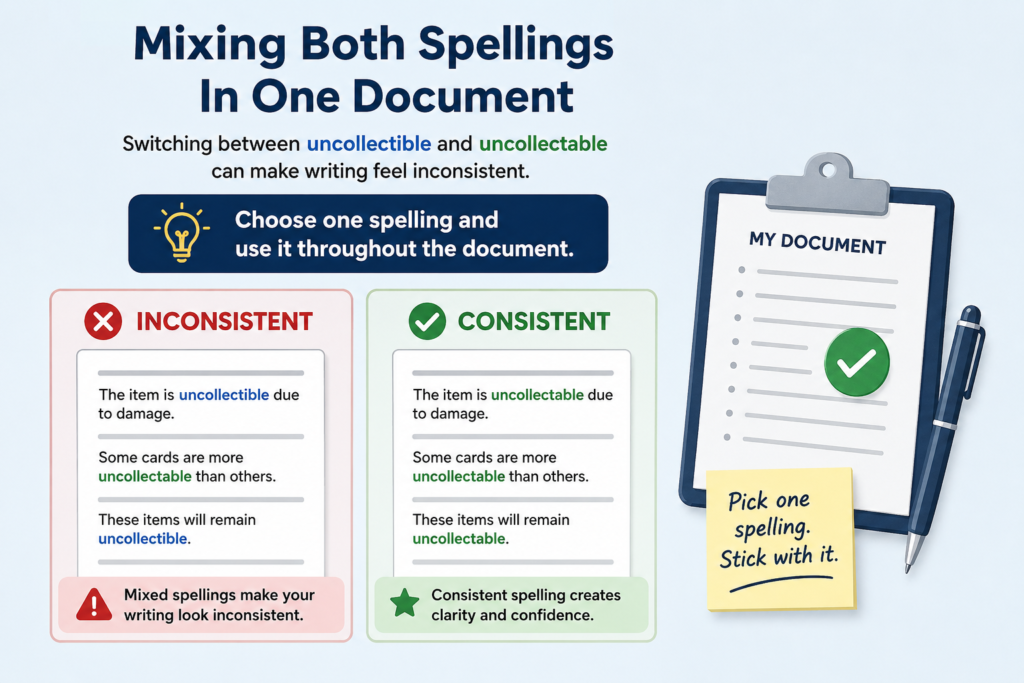
Mixing Both Spellings In One Document
Switching between uncollectible and uncollectable can make writing feel inconsistent. Choose one spelling and use it throughout the document.
Assuming One Spelling Is Wrong
Many people believe uncollectable is a misspelling. It is not. Major dictionaries recognize both spellings.
Using The Less Familiar Form Without A Reason
If your audience is primarily American, using uncollectible usually creates a smoother reading experience because it is more familiar.
Confusing Meaning With Collectible
Some readers accidentally confuse uncollectible with collectible. These words have completely different meanings. A collectible is an item valued by collectors, such as rare coins, stamps, artwork, or sports cards. An uncollectible debt is money that cannot be recovered.
Thinking The Ending Changes The Meaning
The endings ible and able do not create a meaning difference here. Both adjectives describe exactly the same situation.
Pronunciation Guide
The pronunciation stays almost identical except for the ending.
Uncollectible
IPA
/ˌʌn kəˈlek tə bəl/
Syllable breakdown
Un col lect i ble
Uncollectable
IPA
/ˌʌn kəˈlek tə bəl/
Syllable breakdown
Un col lect a ble
In everyday speech, most native speakers pronounce both words so similarly that listeners rarely notice which spelling the speaker has in mind.
Common Pronunciation Mistakes
- Stressing the first syllable instead of lect.
- Pronouncing every vowel separately.
- Adding extra emphasis to the ending.
The natural stress falls on lect in both words.
Etymology And Word Origin
Understanding the history of these spellings explains why both exist today. The verb collect comes from the Latin word collectus, which means gathered together. It entered English through French and gradually developed meanings related to gathering objects, receiving payments, and recovering money. As English evolved, two adjective endings became common. he suffix able usually suggests something can be done. The suffix ible serves a similar purpose and often appears in words influenced by Latin.
Regional Usage Of Uncollectible Vs Uncollectable
Both spellings are accepted across major English speaking countries. Still, one appears more frequently than the other.
American English
American English strongly favors uncollectible. Financial reports, accounting standards, business textbooks, government publications, and newspapers almost always use this spelling.
British English
British English accepts both forms. Some British publishers occasionally use uncollectable, although uncollectible remains common in professional writing.
Canadian English
Canadian English generally follows North American usage. As a result, uncollectible appears far more often.
Australian English
Australian English also recognizes both spellings. Professional publications generally lean toward uncollectible, although uncollectable still appears from time to time.
Grammar Rules For Uncollectible And Uncollectable
Understanding how these words function grammatically helps you use them correctly.
Part Of Speech
Both words are adjectives. They describe nouns.
Examples include:
- Uncollectible debt.
- Uncollectible invoice.
- Uncollectable balance.
- Uncollectable tax.
Comparative Forms
These adjectives are rarely compared. Instead of saying more uncollectible, writers usually rewrite the sentence.
For example: The debt became impossible to recover.
Plural Forms
Adjectives do not have plural forms in English. The noun changes instead.
Examples:
- Uncollectible account.
- Uncollectible accounts.
- Uncollectable invoice.
- Uncollectable invoices.
Common Sentence Structures
These adjectives commonly appear after linking verbs.
Examples include:
- The debt is uncollectible.
- The balance became uncollectible.
- The invoice remained uncollectable.
- The loan proved uncollectible.
They also appear directly before nouns.
Examples include:
- Uncollectible debt.
- Uncollectible balance.
- Uncollectable account.
- Uncollectable payment.
Real Life Usage Examples
These words appear in many types of writing beyond accounting textbooks.
Daily Conversation
Someone might say: That money is probably uncollectible now.
Academic Writing
Researchers often discuss uncollectible debts while studying business failures, lending practices, or financial management.
Professional Communication
Businesses regularly describe unpaid invoices as uncollectible after repeated collection attempts.
Legal Documents
Lawyers may refer to judgments, loans, or obligations that have become uncollectible because recovery is no longer realistic.
Banking And Finance
Banks routinely evaluate loans that may become uncollectible because of bankruptcy, default, or financial hardship.
Government Publications
Tax authorities sometimes classify old unpaid taxes as uncollectible after all reasonable collection efforts have failed.
News Media
Business journalists frequently report increases in uncollectible loans during economic downturns because more borrowers struggle to repay their debts.
Related Words And Confused Terms
English includes several words that look or sound similar but have different meanings. Understanding these differences helps prevent mistakes.
Collectible Vs Collectable
These adjectives describe items worth collecting, such as rare books, coins, antiques, trading cards, or artwork. Like uncollectible and uncollectable, both spellings are accepted, although collectible is generally more common in American English.
Collect
This verb means to gather, receive, recover, or obtain something. Examples include collecting money, collecting taxes, collecting stamps, or collecting information.
Collection
This noun refers to a group of gathered items or the act of gathering something.
Recover
In financial writing, recover often means successfully collecting money that was owed.
Bad Debt
A bad debt is money that a business no longer expects to collect. Many bad debts eventually become uncollectible.
Accounts Receivable
Accounts receivable are amounts customers owe a business. Some of those balances may later become uncollectible if customers fail to pay.
Expert Language Insight
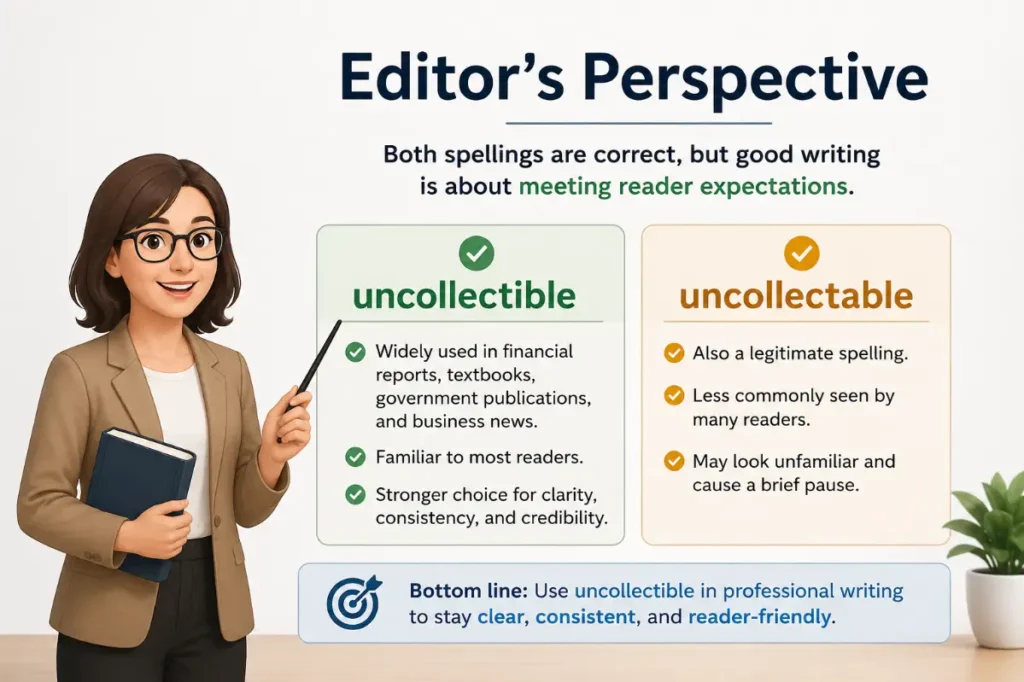
From an editor’s perspective, this choice is simple. Both spellings are correct, but good writing is about more than correctness. It is also about meeting reader expectations. Most readers have seen uncollectible countless times in financial reports, accounting textbooks, government publications, and business news. That familiarity makes the word feel natural. Uncollectable is still a legitimate spelling, yet many readers encounter it less often. Even experienced professionals may pause for a moment because it looks unfamiliar. If your goal is clarity, consistency, and credibility, uncollectible is almost always the stronger choice. It reflects current usage across most professional fields while remaining immediately recognizable to a broad audience.
Need another quick comparison? Read labour or labor Which Spelling Is Correct in 2026.
Conclusion
The difference between uncollectible vs uncollectable is mainly a matter of usage and preference. Both spellings are correct, and both mean something that cannot be collected, recovered, or obtained.
Uncollectible is the more common form, especially in American English and in accounting, finance, banking, insurance, legal, and business writing. Uncollectable is also accepted, but many readers encounter it less often.
For clear and professional writing, uncollectible is usually the better choice because it is more familiar to most readers. If you come across uncollectable in a book, report, or document, there’s no need to treat it as an error. Both forms are valid, but uncollectible is the more widely used spelling.
Frequently Asked Questions
Which Is More Common Uncollectible Or Uncollectable?
Both spellings are correct, but uncollectible is much more common. It appears frequently in American English, accounting, finance, business writing, and legal documents. If you want the form most readers are likely to recognize, uncollectible is the more familiar choice.
Is Uncollectable A Misspelling?
No. Uncollectable is a valid English adjective, not a spelling mistake. It appears in major dictionaries and is used in both British and American English, although it is less common than uncollectible.
Do Uncollectible And Uncollectable Have The Same Meaning?
Yes. Both words mean something that cannot be collected, recovered, or obtained. They can usually be used interchangeably because the difference is mainly a matter of spelling preference and frequency, not meaning.
Which Form Is Better For Business Writing?
Uncollectible is generally the safer choice for business writing. It is especially common in accounting, banking, finance, insurance, taxation, and legal contexts. Using the more familiar form can make financial documents easier for readers to understand.
Are Both Spellings Used In American English?
Yes. American English recognizes both uncollectible and uncollectable. However, uncollectible is considerably more common, particularly in professional and financial writing.
Are Both Spellings Used In British English?
Yes. Both forms are accepted in British English. Uncollectable may appear more often in some British sources, but uncollectible is also widely used, especially in professional and financial contexts.
Can Uncollectible And Uncollectable Be Used Outside Finance?
Yes. Although these words are often associated with debts, invoices, taxes, loans, and accounts receivable, they can describe anything that cannot realistically be collected or recovered. The specific meaning depends on the context.
Why Are Both Uncollectible And Uncollectable Correct?
English has developed many adjective forms with different suffixes, including -able and -ible. Over time, both uncollectible and uncollectable became established English forms. Today, they have the same basic meaning, but uncollectible is much more widely used.