
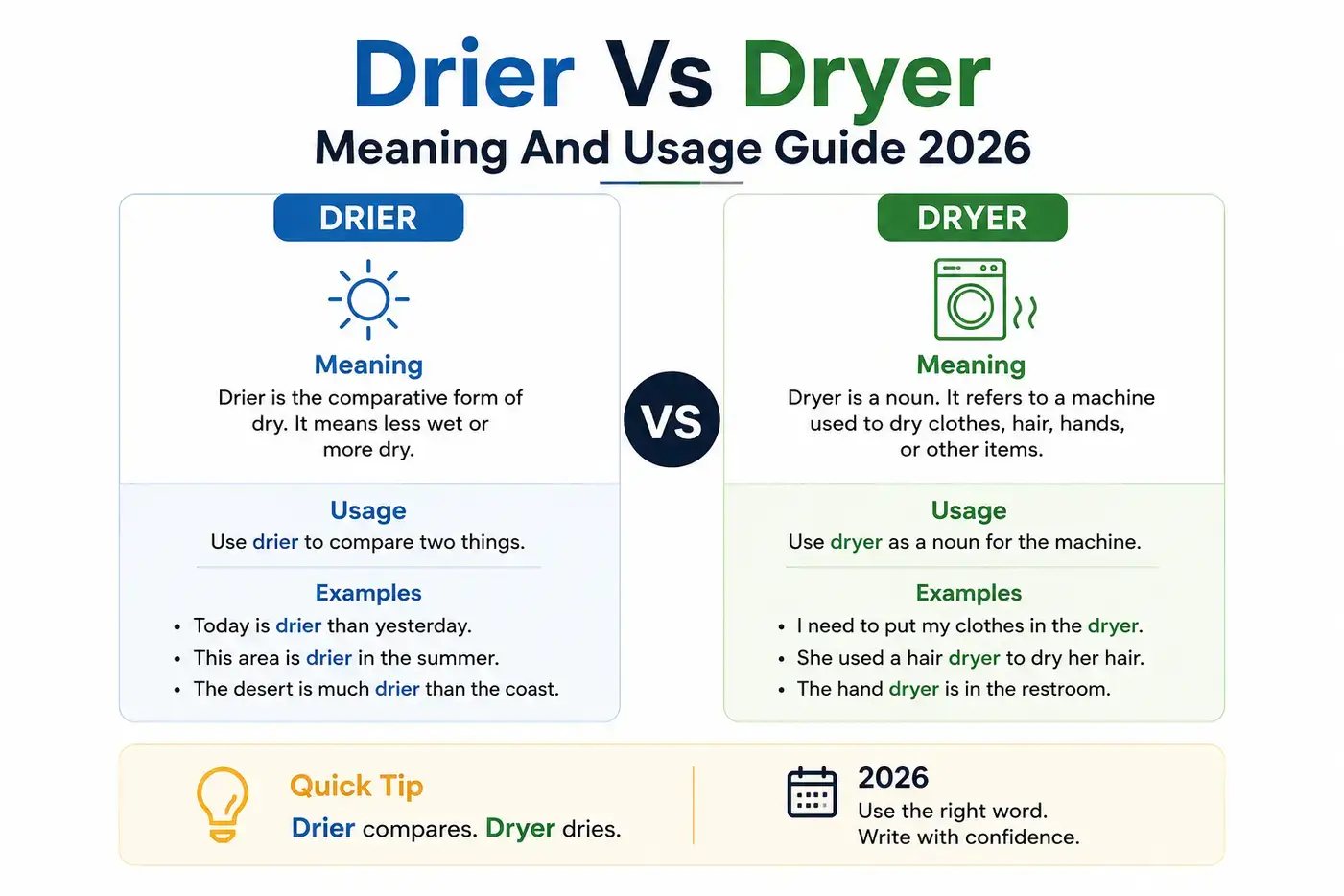
The comparison between drier vs dryer confuses many English speakers because both spellings are correct. That’s what makes this pair tricky.In some situations, drier is the preferred choice. In others, dryer is the only correct option .Generally, drier functions as the comparative form of the adjective dry. It describes something with less moisture. Dryer most often refers to a machine or device used for drying. Examples include a clothes dryer, hair dryer, or hand dryer.
The confusion exists because dryer can sometimes appear as a comparative adjective as well, particularly in informal writing. However, most style guides and editors prefer drier when comparing levels of dryness. If you’ve ever paused while writing and wondered which spelling belongs in your sentence, this guide will clear up the confusion. You’ll learn the meanings, grammar rules, examples, pronunciation, regional preferences, common mistakes, and expert editing tips that make choosing the correct word easy.
For another common grammar confusion, see Overdo vs Overdue: Meaning and Correct Usage.
Drier Vs Dryer Quick Definition
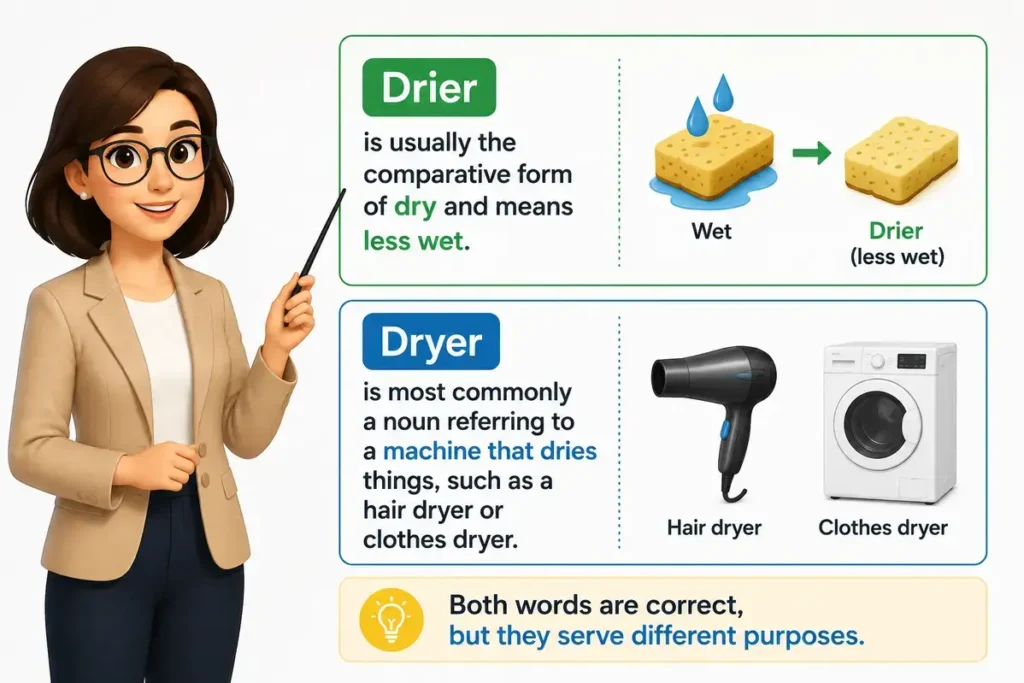
Drier is usually the comparative form of dry and means less wet. Dryer is most commonly a noun referring to a machine that dries things, such as a hair dryer or clothes dryer. Both words are correct, but they serve different purposes.
Drier Vs Dryer Quick Answer
Use drier when comparing moisture levels.
Examples:
- This towel feels drier than that one.
- Arizona has a drier climate than Florida.
- The soil became drier after several sunny days.
Use dryer when referring to a machine or appliance.
Examples:
- Put the clothes in the dryer.
- My hair dryer stopped working.
- The hand dryer is near the sink.
This simple distinction solves most usage problems.
Drier Vs Dryer Comparison Table
| Feature | Drier | Dryer |
|---|---|---|
| Correct Spelling | Yes | Yes |
| Primary Meaning | More dry or less wet | Drying machine or device |
| Part Of Speech | Adjective | Noun |
| Root Word | Dry | Dry |
| Common Usage | Comparisons | Appliances |
| Formal Writing Preference | Preferred for comparison | Preferred for machines |
| Dictionary Recognition | Yes | Yes |
| Example | The air is drier today. | The dryer is running. |
Meaning Of Drier Vs Dryer
What Does Drier Mean?
Drier is the comparative form of the adjective dry. It means having less moisture than something else.
Examples:
- The weather is drier this week.
- This sponge feels drier now.
- The desert is much drier than the forest.
- The paint became drier overnight.
- Her skin feels drier during winter.
The word is used whenever a comparison is being made.
What Does Dryer Mean?
Dryer is most commonly a noun.
It refers to a machine, device, or tool that removes moisture.
Examples:
- The dryer finished the laundry.
- She bought a new hair dryer.
- The hand dryer stopped working.
- The grain dryer operates all day.
- The industrial dryer reduced production time.
This meaning is extremely common in everyday English.
Key Differences Between Drier Vs Dryer
Meaning Difference
Drier describes a condition.
Dryer usually names a machine.
Examples:
- The towel is drier.
- Put the towel in the dryer.
Grammar Difference
Drier functions primarily as an adjective.
Dryer functions primarily as a noun.
Usage Difference
Drier appears in comparisons.
Dryer appears when discussing appliances or equipment.
Context Difference
Drier relates to moisture levels.
Dryer relates to drying devices.
Writing Difference
Professional editors generally prefer drier for comparisons and dryer for machines.
Why People Confuse Drier Vs Dryer
Several factors contribute to the confusion.
Both Words Are Correct
Unlike many spelling debates, both spellings are legitimate.
That alone creates uncertainty.
Same Pronunciation
In most accents, drier and dryer sound almost identical.
Writers often rely on sound rather than meaning when choosing a spelling.
Shared Root Word
Both words come from dry.
Because they share the same root, they look closely related.
Overlapping Historical Usage
Historically, dryer occasionally appeared as a comparative adjective.
Modern style guides increasingly prefer drier for clarity.
Everyday Exposure
People frequently see dryer on household appliances.
That familiarity sometimes causes them to use dryer when drier would be more appropriate.
Which One Is Correct In Drier Vs Dryer?
The answer depends entirely on context.
If you’re comparing levels of dryness, use drier.
Examples:
- The air became drier after the storm.
- The cloth feels drier now.
- This region is drier than the coast.
If you’re talking about a machine, use dryer.
Examples:
- The dryer needs repair.
- The clothes are still in the dryer.
- The salon purchased a new hair dryer.
Both words are correct when used appropriately.
Drier Vs Dryer Examples In Sentences
Examples Using Drier
- The weather became drier during summer.
- This towel feels drier than the other one.
- The soil grew drier each day.
- Her skin becomes drier in cold weather.
- The western region is drier than the eastern region.
- The paint looked drier after several hours.
- The climate here is noticeably drier.
- The sponge became drier overnight.
- The leaves appeared drier after the heatwave.
- The air feels much drier indoors.
Examples Using Dryer
- The dryer finished its cycle.
- Please move the clothes to the dryer.
- My hair dryer overheated.
- The hand dryer is beside the sink.
- The dryer stopped unexpectedly.
- She bought a compact dryer.
- The commercial dryer handles large loads.
- The technician repaired the dryer.
- The dryer uses less energy than older models.
- The laundry room contains a washer and dryer.
Common Usage Rule To Remember
Think of it this way:
- Drier compares.
- Dryer dries.
If the sentence involves comparison, choose drier. If the sentence involves a machine, choose dryer. That simple memory trick works in almost every situation.
Common Mistakes In Drier Vs Dryer
Even native English speakers mix up drier and dryer. Since both spellings are valid words, spelling checkers often fail to catch the error. Understanding the most common mistakes can help you avoid them.
Mistake One Using Dryer As A Comparative Adjective
Many writers use dryer when comparing moisture levels.
Example:
- The climate is dryer this year.
Although some dictionaries acknowledge this historical usage, most editors and style guides prefer drier.
Better:
- The climate is drier this year.
Using drier makes the sentence clearer and aligns with modern standard English.
Mistake Two Using Drier For A Machine
Some writers accidentally use drier when referring to an appliance.
Incorrect:
- The clothes are in the drier.
Correct:
- The clothes are in the dryer.
When talking about a machine, dryer is always the preferred spelling.
Mistake Three Assuming One Word Is Wrong
Many people think one spelling must be incorrect.
That’s not true.
Unlike pairs such as shiney and shiny or layed and laid, both drier and dryer are accepted English words. The key difference lies in usage.
Mistake Four Ignoring Context
Context determines the correct spelling.
Consider these examples:
- The towel is drier than before.
- The towel is in the dryer.
The first sentence compares dryness. The second refers to an appliance. A single letter changes the meaning completely.
Mistake Five Following Informal Internet Usage
Online content often contains inconsistent spelling. Some websites use dryer for comparisons because it looks simpler. Professional editing standards still favor drier when describing something with less moisture.
Still confused? Compare orientated vs oriented Which Form Should You Use.
Drier Vs Dryer Pronunciation Guide
One reason this word pair causes confusion is pronunciation. For most English speakers, drier and dryer sound exactly the same.
Pronunciation Of Drier
IPA:
/ˈdraɪər/
Syllable Breakdown:
Dri • er
Pronunciation:
DRY er
Examples:
- The air became drier.
- The cloth felt drier.
- The region is drier.
Pronunciation Of Dryer
IPA:
/ˈdraɪər/
Syllable Breakdown:
Dry • er
Pronunciation:
DRY er
Examples:
- The dryer stopped working.
- The dryer is running.
- The dryer needs repair.
Pronunciation Creates Confusion
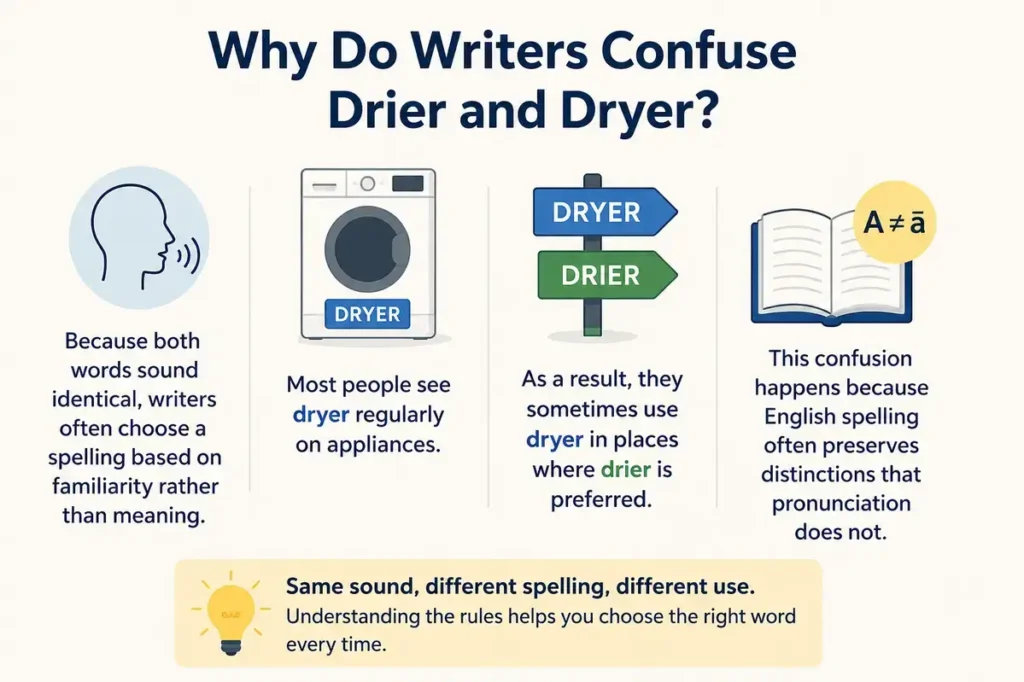
Because both words sound identical, writers often choose a spelling based on familiarity rather than meaning. Most people see dryer regularly on appliances. As a result, they sometimes use dryer in places where drier is preferred. This confusion happens because English spelling often preserves distinctions that pronunciation does not.
Etymology And Word Origin Of Drier Vs Dryer
Understanding the history of these words helps explain why both forms exist today.
Origin Of Dry
Both words originate from the adjective dry. Dry has existed in English for centuries and refers to the absence of moisture.
Examples:
- Dry clothes.
- Dry weather.
- Dry ground.
Development Of Drier
As English developed comparative adjective forms, dry became drier.
Examples:
- Dry.
- Drier.
- Driest.
This follows a common English pattern.
Examples:
- Happy.
- Happier.
- Happiest.
And:
- Busy.
- Busier.
- Busiest.
The spelling change from y to i follows standard grammar rules.
Development Of Dryer
Dryer emerged as a noun meaning a person or device that dries something.
Historically, it could refer to:
- A person who dried materials.
- A drying rack.
- Industrial drying equipment.
- Modern household appliances.
Over time, dryer became strongly associated with machines. Today, most people immediately think of a laundry appliance when they hear the word.
Why Both Spellings Survived
Since one form evolved as a comparative adjective and the other as a noun, English retained both spellings. Each serves a distinct grammatical role.
Drier Vs Dryer Regional Usage
English speaking countries generally follow similar rules for drier and dryer. Still, slight preferences appear across regions.
American English
American English strongly prefers drier for comparisons and dryer for appliances.
Examples:
- Nevada has a drier climate than Florida.
- The dryer needs maintenance.
This distinction appears in journalism, education, and business writing.
British English
British English follows the same pattern.
Examples:
- The summer was drier than usual.
- The dryer stopped working.
British editors generally favor drier as the comparative adjective.
Australian English
Australian English also distinguishes between the two forms.
Examples:
- Inland areas are drier.
- The dryer is in the laundry room.
Because much of Australia experiences arid conditions, the adjective drier appears frequently in weather discussions.
Canadian English
Canadian English mirrors both American and British usage.
Examples:
- Prairie regions are drier.
- The dryer uses less electricity.
Global English
Across major English varieties, the distinction remains remarkably consistent.
- Drier compares moisture levels.
- Dryer refers to a machine or drying device.
This consistency makes the rule easy to apply worldwide.
Drier Vs Dryer Grammar Rules
Grammar provides the clearest explanation for choosing between these words.
Drier As An Adjective
Drier functions as a comparative adjective.
It compares two or more things.
Examples:
- This towel is drier.
- The weather is drier.
- The soil became drier.
Comparative Structure
Common sentence patterns include:
Subject + Be Verb + Drier
Examples:
- The air is drier.
- The cloth is drier.
Subject + Be Verb + Drier Than
Examples:
- Arizona is drier than Florida.
- Today is drier than yesterday.
Dryer As A Noun
Dryer functions as a countable noun.
Examples:
- The dryer is running.
- We bought a dryer.
- The dryer needs repair.
Singular And Plural Forms
Singular:
- Dryer.
Plural:
- Dryers.
Examples:
- The store sells dryers.
- Several dryers were installed.
Possessive Forms
Examples:
- The dryer’s door is broken.
- The dryers’ maintenance schedule changed.
Modifier Usage
Dryer can be modified by adjectives.
Examples:
- Electric dryer.
- Industrial dryer.
- Commercial dryer.
- Compact dryer.
- Portable dryer.
Common Grammar Test
Ask yourself:
Am I describing something?
Use drier.
Am I naming an object or machine?
Use dryer.
That test works almost every time.
Drier Vs Dryer In Weather Discussions
Weather reports often use drier because comparison is involved.
Examples:
- Conditions will be drier tomorrow.
- The western states remain drier than average.
- Spring was drier this year.
- The desert climate is naturally drier.
- The forecast predicts drier air.
Meteorologists rarely use dryer in these contexts.
Drier Vs Dryer In Household Contexts
Home related discussions usually involve dryer as a noun.
Examples:
- The dryer is full of clothes.
- The dryer stopped heating.
- We replaced the old dryer.
- The dryer uses less energy.
- The technician repaired the dryer.
In appliance contexts, dryer is almost always the correct choice.
Editor’s Observation
Professional editors rarely question dryer when it refers to a machine. The real issue appears when writers compare moisture levels. In those situations, drier remains the preferred choice because it instantly signals a comparative adjective. Readers process the meaning faster, and the sentence feels more polished. Choosing drier for comparisons and dryer for appliances creates consistency, clarity, and professional quality writing.
Drier Vs Dryer In Real Life Usage
Understanding grammar is helpful, but seeing how native speakers use these words in everyday situations makes the distinction much easier to remember.
Drier Vs Dryer In Daily Conversation
People commonly use drier when comparing weather, clothing, skin, food, or environmental conditions.
Examples:
- The air feels drier today.
- My hands get drier during winter.
- This shirt is drier than the other one.
- The ground looks much drier after a week without rain.
- The climate here is drier than back home.
Dryer appears naturally when discussing appliances.
Examples:
- The dryer is still running.
- Did you empty the dryer?
- Our dryer stopped working last night.
- The dryer makes a strange noise.
- I forgot the clothes in the dryer.
Drier Vs Dryer In Academic Writing
Academic and scientific writing frequently uses drier when discussing climate, geography, agriculture, and environmental studies.
Examples:
- The region experienced drier conditions during the study period.
- Drier soil reduced crop productivity.
- The western area remained significantly drier.
- Researchers observed drier air masses.
- The ecosystem adapted to increasingly drier conditions.
Dryer may appear in technical or engineering contexts.
Examples:
- The industrial dryer improved production efficiency.
- Engineers tested a new grain dryer.
- The dryer reduced moisture content effectively.
Drier Vs Dryer In Professional Communication
Business professionals use drier when discussing conditions and dryer when discussing equipment.
Examples:
- This quarter was drier than expected for agricultural production.
- The market experienced drier demand in some sectors.
- The company purchased a new commercial dryer.
- The dryer requires scheduled maintenance.
- Production improved after replacing the dryer.
Drier Vs Dryer In Literature
Writers often use drier descriptively.
Examples:
- The landscape grew drier with every passing month.
- Her voice sounded drier than usual.
- The wind carried drier air across the valley.
- The old parchment felt drier than dust.
- The desert became even drier under the relentless sun.
Literary uses of dryer are less common unless a physical machine is part of the scene.
Drier Vs Dryer In Media And Journalism
News outlets regularly use drier in weather and environmental reporting.
Examples:
- Experts predict a drier summer.
- Farmers are preparing for drier conditions.
- The region remains drier than average.
- A drier climate has increased wildfire risks.
- Drier weather helped speed construction projects.
Dryer appears in consumer and technology reporting.
Examples:
- The company launched a new energy efficient dryer.
- Experts reviewed the latest smart dryer.
- The dryer market continues to expand.
Related Words And Confused Terms
People researching drier vs dryer often encounter several related terms. Understanding them helps build stronger vocabulary and prevents future confusion.
Dry
The base form.
Examples:
- The towel is dry.
- The ground is dry.
- The paint is dry.
Drier
Comparative form.
Examples:
- Today is drier.
- This cloth is drier.
- The region is drier.
Driest
Superlative form.
Examples:
- This is the driest month.
- The desert is one of the driest places on Earth.
- It was the driest season on record.
Drying
Present participle and adjective.
Examples:
- The clothes are drying.
- Drying paint requires time.
- The drying process takes several hours.
Dehydrate
To remove moisture completely.
Examples:
- The fruit was dehydrated.
- The machine dehydrates vegetables.
- Dehydration changes texture.
Moist
A common opposite of dry.
Examples:
- The soil is moist.
- Keep the cake moist.
- The towel feels moist.
Wet
Another opposite.
Examples:
- The clothes are wet.
- The road is wet.
- The grass remains wet.
Humid
Related to moisture in the air.
Examples:
- Florida is humid.
- The room feels humid.
- Humid weather can be uncomfortable.
These related terms frequently appear in discussions about dryness, climate, moisture levels, and household appliances.
Expert Language Insight
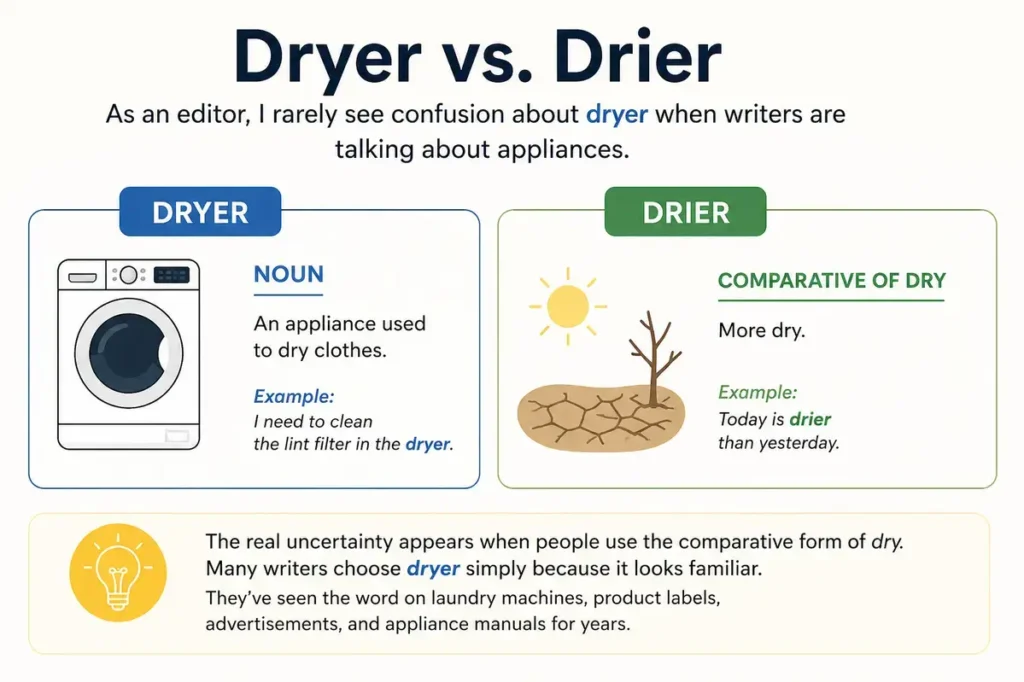
As an editor, I rarely see confusion about dryer when writers are talking about appliances. The real uncertainty appears when people use the comparative form of dry. Many writers choose dryer simply because it looks familiar. They’ve seen the word on laundry machines, product labels, advertisements, and appliance manuals for years. Familiarity often influences spelling choices. However, professional editors generally prefer drier when comparing levels of moisture.
Consider these examples:
- The climate is drier this year.
- The soil became drier after the heatwave.
- The air feels drier indoors.
Using drier immediately signals comparison and follows standard adjective formation rules. A simple memory trick helps. If you can replace the word with “more dry,” choose drier.
Examples:
- The air is more dry.
- The air is drier.
If you’re talking about a machine, choose dryer.
Examples:
- The dryer is broken.
- The dryer finished its cycle.
That distinction keeps your writing clear and professional.
Frequently Asked Questions About Drier Vs Dryer
Is drier or dryer correct?
Both are correct. Drier is usually the comparative form of dry and means less wet. Dryer is most commonly a noun referring to a machine that removes moisture, such as a clothes dryer or hair dryer.
What is the difference between drier and dryer?
Drier describes a condition and compares moisture levels. Dryer names a device or appliance used for drying. One functions mainly as an adjective, while the other functions mainly as a noun.
Why do dictionaries include both drier and dryer?
Both spellings developed from the word dry. Drier evolved as the comparative adjective, while dryer developed as a noun referring to a person, tool, or machine that dries something.
Is dryer wrong when comparing things?
Some dictionaries recognize dryer as a comparative form, but most modern editors and style guides prefer drier for comparisons. Using drier improves clarity and follows current standard usage.
Do American and British English use different forms?
No major difference exists. Both American and British English generally use drier for comparisons and dryer for appliances.
How do you pronounce drier and dryer?
Both words are usually pronounced the same way: /ˈdraɪər/. Because they sound identical, writers often rely on context to determine the correct spelling.
What is the plural of dryer?
The plural form is dryers.
Examples:
- The store sells several dryers.
- New dryers were installed in the building.
What is the superlative form of dry?
The superlative form is driest.
Examples:
- July was the driest month.
- The desert is among the driest regions on Earth.
Need another quick comparison? Read Retract vs Redact Meaning and Usage.
Conclusion
The debate around drier vs dryer becomes simple once you understand the role each word plays. Use drier when comparing levels of dryness. Examples include weather, climate, soil, clothing, skin, and environmental conditions. Use dryer when referring to a machine or appliance designed to remove moisture.
Examples include clothes dryers, hair dryers, hand dryers, and industrial dryers.Both spellings are correct. The key is choosing the one that matches your meaning. A useful rule to remember is this:
Drier compares.
Dryer dries.
Keep that distinction in mind, and you’ll choose the correct word every time.
1 thought on “Drier Vs Dryer Meaning And Usage Guide2026”