
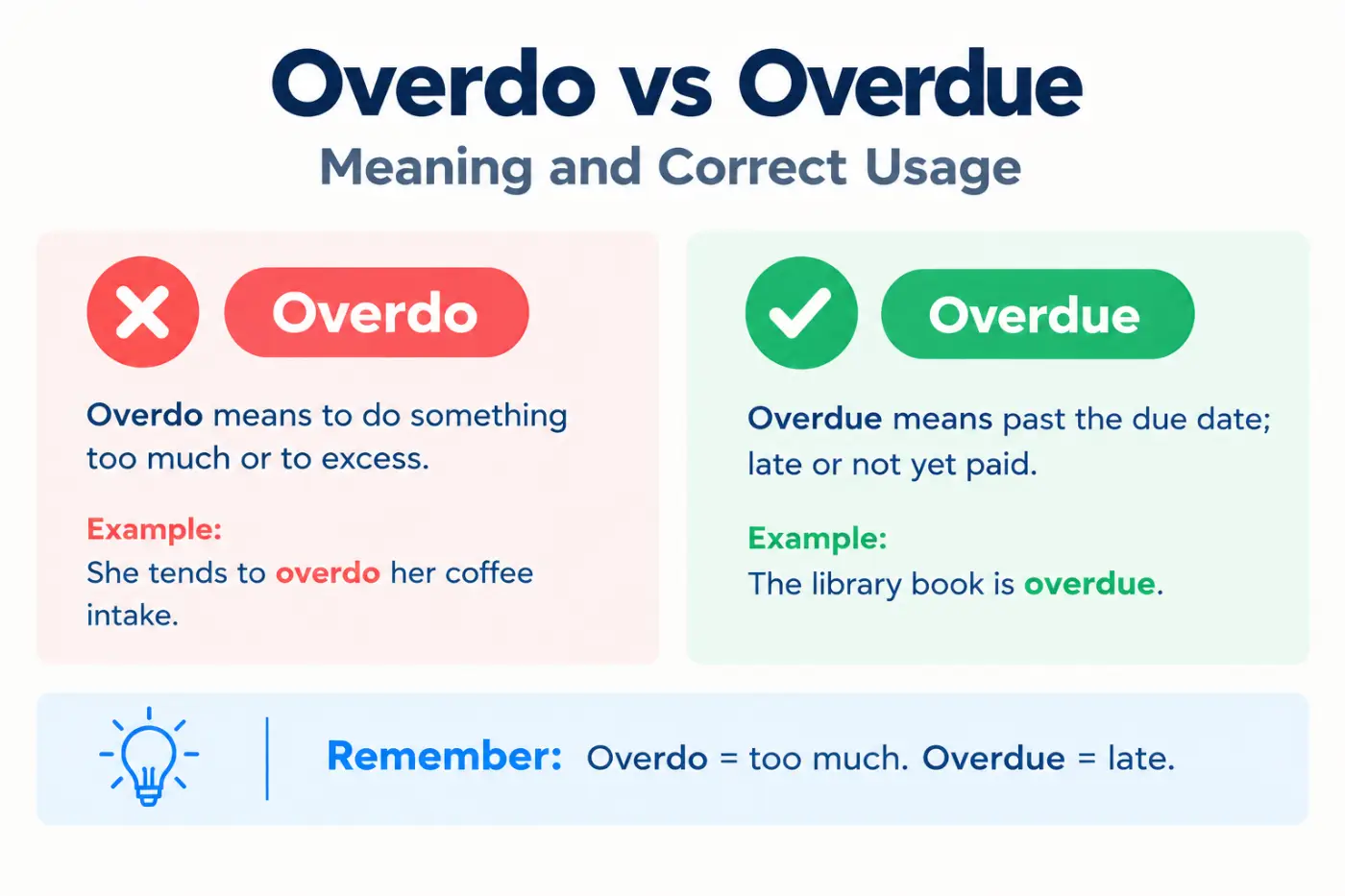
Overdo vs overdue can be confusing because the two words look almost identical. They share the letters over and have similar endings, but their meanings are quite different. One describes doing too much, while the other describes something that should have happened or been completed earlier.
Think about two everyday situations. You exercise for three hours when your body needs a break, so you overdo your workout. Then you forget to return a library book by its deadline, so the book becomes overdue. The spelling difference is small, but it changes the meaning of the sentence.
Learning the distinction helps you write clearer emails, school assignments, workplace messages, and everyday conversations. It also makes it easier to recognize common expressions such as overdo it, overdue payment, overdue library book, and long overdue apology. This guide explains the meanings, grammar rules, pronunciation, word origins, and common mistakes so you can choose the right word with confidence.
Need another quick comparison? Read Theater or Theatre Which Should You Use in 2026.
Quick Answer
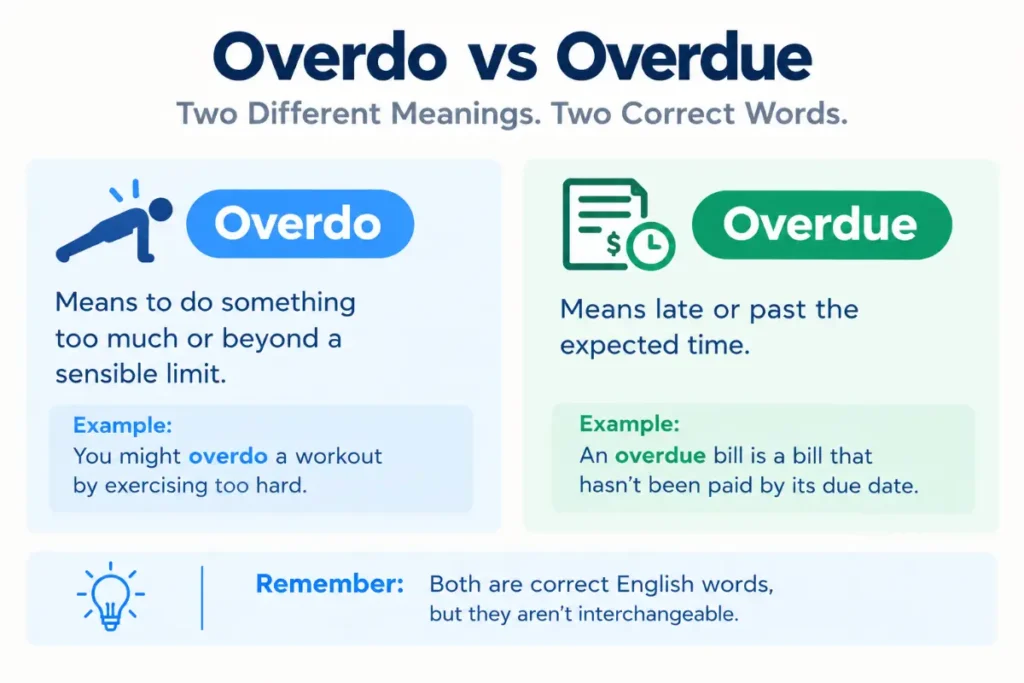
Overdo means to do something too much or beyond a sensible limit. Overdue means late or past the expected time. Both are correct English words, but they aren’t interchangeable. You might overdo a workout by exercising too hard, while an overdue bill is a bill that hasn’t been paid by its due date.
What Does Overdo Mean
Overdo is a verb that means to do something excessively or beyond what is reasonable, necessary, or appropriate. It often describes an action that goes too far in amount, effort, intensity, or style.
For example, someone might overdo a workout, overdo the decorations for a party, or overdo the seasoning in a meal. In each case, the person does more than the situation calls for.
The word can also describe excessive effort or an exaggerated effect. An actor might overdo a dramatic scene by making the emotions seem unnatural. A writer might overdo descriptive language by adding so many details that the main point gets lost.
Here are a few examples.
- I think I overdid it at the gym yesterday.
- Don’t overdo the salt in the soup.
- She tends to overdo her makeup for casual events.
- The comedian overdid the joke and made it less funny.
- You can make the room look festive without overdoing the decorations.
In all five sentences, the word describes an action that exceeds a sensible limit.
The Main Meaning of Overdo
The central idea is excess. You perform an action, but you do more than you should.
The amount doesn’t always have to be physically large. You can overdo a joke by repeating it too often, overdo an apology by explaining yourself repeatedly, or overdo a presentation by including too many effects.
The word often suggests that the extra effort has a negative result. However, the result doesn’t have to be serious. Overdoing something might cause discomfort, waste time, weaken a message, or simply make an activity less enjoyable.
For instance, a cook who adds too much chili may overdo the seasoning. The meal is still food, but the flavor becomes unbalanced.
Common Forms of Overdo
Overdo follows the usual pattern for many regular English verbs.
| Verb Form | Example |
|---|---|
| Base form | overdo |
| Third person singular | overdoes |
| Simple past | overdid |
| Past participle | overdone |
| Present participle | overdoing |
These forms are useful because the word doesn’t keep the same spelling in every tense.
- I sometimes overdo my workouts.
- He overdoes the jokes during meetings.
- She overdid the decorations last weekend.
- You have overdone the explanation.
- They are overdoing the changes to the design.
Notice that the simple past is overdid, not overdoed. The verb follows the irregular pattern of do.
What Does Overdo It Mean
The phrase overdo it is a common expression that means to do too much or push beyond a reasonable limit.
For example, someone might say, I need to rest because I overdid it yesterday. The speaker means they did too much, perhaps by exercising, working, or taking part in an activity.
The expression can apply to physical effort, spending, eating, joking, decorating, and many other actions.
- Don’t overdo it with the hot sauce.
- I overdid it while cleaning the house.
- He overdid it with the birthday decorations.
- You don’t need to overdo it to impress your guests.
The word it refers to the activity or behavior being discussed. It makes the expression natural and conversational.
What Does Overdue Mean
Overdue is an adjective that means late or past the time something was expected, required, or scheduled. It often describes bills, payments, assignments, books, reports, appointments, and other things that have passed their deadline.
For example, an overdue payment hasn’t been made by the required date. An overdue library book hasn’t been returned on time. An overdue assignment hasn’t been submitted by the deadline.
The word can also describe something that should have happened earlier. An overdue apology is an apology that someone should have offered before now. An overdue change is a change that has been needed for some time.
Consider these examples.
- My electricity bill is overdue.
- The library book is three days overdue.
- She submitted her overdue assignment this morning.
- The company finally announced an overdue policy change.
- He gave his colleague a long overdue apology.
The shared meaning in these examples is lateness or delay.
The Main Meaning of Overdue
The central idea is that the expected time has passed. Something should have been paid, returned, delivered, completed, or done already.
Overdue doesn’t always mean that someone has made a mistake. A project can become overdue because an unexpected problem delayed the work. A payment can become overdue because the customer forgot the deadline. The word identifies the delay, not necessarily its cause.
It also doesn’t always refer to something negative. An overdue thank you, an overdue celebration, or an overdue conversation can describe something positive that should have happened earlier.
For example, the team finally received an overdue thank you from its manager. The word suggests that the appreciation was deserved and should have been expressed sooner.
Common Expressions With Overdue
Overdue appears in many everyday expressions.
- Overdue payment. A payment that hasn’t been made by the required date.
- Overdue bill. A bill that remains unpaid after its due date.
- Overdue assignment. Schoolwork submitted or still expected after the deadline.
- Overdue library book. A book that hasn’t been returned by the return date.
- Overdue report. A report that hasn’t been delivered on schedule.
- Long overdue apology. An apology that should have been offered much earlier.
- Overdue change. A change that has been needed for some time.
- Overdue maintenance. Maintenance that should have been performed earlier.
These expressions are common in personal, academic, and professional communication.
The Difference Between Overdo and Overdue
The simplest distinction is that overdo describes excessive action, while overdue describes lateness.
| Feature | Overdo | Overdue |
|---|---|---|
| Part of speech | Verb | Adjective |
| Main meaning | Do too much | Late or past the expected time |
| Typical use | Actions and behavior | Bills, tasks, items, and expected events |
| Example | Don’t overdo the exercise. | The assignment is overdue. |
| Common phrase | Overdo it | Long overdue |
| Grammar pattern | Can change tense | Usually stays the same form |
| Past form | Overdid | No regular past tense as an adjective |
| Related expression | Do too much | Past the deadline |
The difference becomes clear when you look at what each word does in a sentence.
In the sentence, I overdid the workout, the word describes an action performed excessively.
In the sentence, My payment is overdue, the word describes the payment’s status. The payment date has passed.
One word focuses on how much someone does. The other focuses on when something should happen.
Which Form Is Correct
Both forms are correct English words. Neither is a misspelling of the other.
Use overdo when you mean to do too much, exaggerate, or go beyond a sensible limit. Use overdue when something is late or has passed its expected time.
The correct choice depends on the meaning of your sentence.
Incorrect: My rent is overdo.
Correct: My rent is overdue.
The sentence refers to rent that hasn’t been paid by the deadline. The adjective overdue expresses that meaning.
Incorrect: Don’t overdue the decorations.
Correct: Don’t overdo the decorations.
The sentence gives advice about using too many decorations. The verb overdo expresses excessive action.
Both words can appear in formal and informal writing. The important point is to match the word to the intended meaning.
Comparison Examples in Everyday English
Here are ten natural examples that show how the two words work in different settings.
- Exercise: I overdid my workout and now my muscles are sore. The verb describes exercising beyond a sensible limit.
- Bills: Your phone bill is overdue because the payment date has passed. The adjective describes a late payment.
- Cooking: You overdid the garlic, so its flavor is too strong. The verb describes adding more than the dish needs.
- School: My science project is overdue because I missed the submission deadline. The adjective describes unfinished work that should have been submitted earlier.
- Work: Don’t overdo the slides in your presentation. The verb advises against adding too many effects or details.
- Library: I need to return this overdue book today. The adjective describes a book that hasn’t been returned by its due date.
- Social life: He overdid the joke and made everyone uncomfortable. The verb describes behavior that went too far.
- Relationships: She offered a long overdue apology to her friend. The adjective suggests the apology should have happened sooner.
- Shopping: I overdid my spending during the holiday sale. The verb describes spending more than intended or considered reasonable.
- Office tasks: The report is overdue, so the manager asked for an update. The adjective describes work that missed its expected completion time.
These examples show why the words can’t replace each other. Their sentence roles and meanings are different.
Common Mistakes and Misspellings
Writers often confuse these forms because their spelling is so similar. The following mistakes are easy to avoid once you understand the grammar.
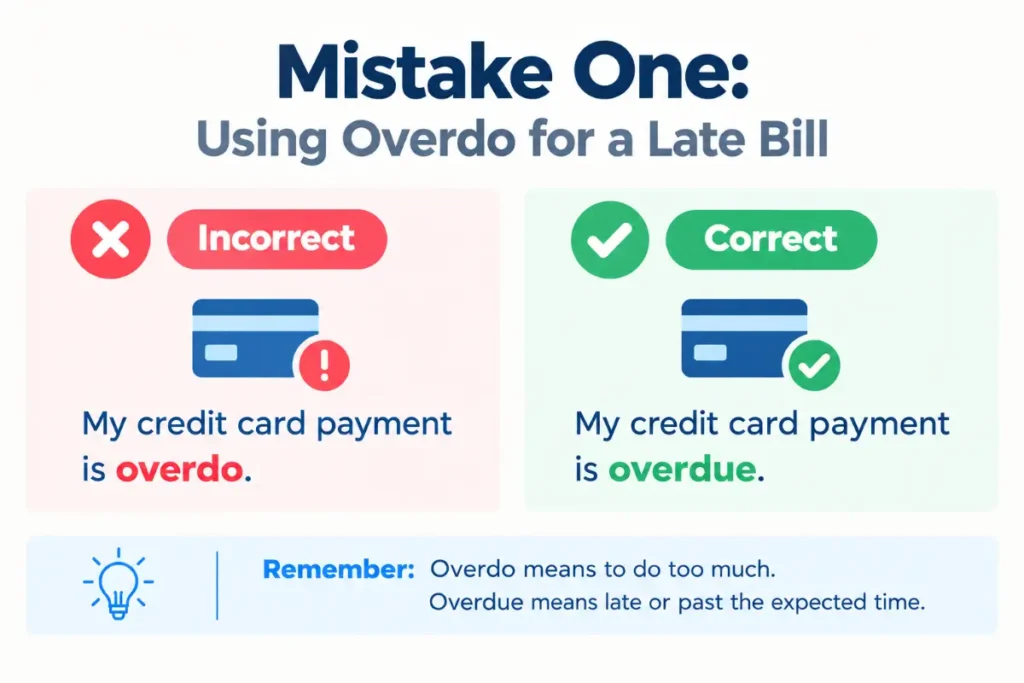
Mistake One: Using Overdo for a Late Bill
Incorrect: My credit card payment is overdo.
Correct: My credit card payment is overdue.
A payment becomes overdue when its due date passes without payment. The sentence describes the payment’s status, so it needs an adjective.
Mistake Two: Using Overdue for Excessive Behavior
Incorrect: Don’t overdue the makeup.
Correct: Don’t overdo the makeup.
The sentence refers to using too much makeup. It needs a verb that describes an action.
Mistake Three: Writing Overdoed Instead of Overdid
Incorrect: I overdoed my workout yesterday.
Correct: I overdid my workout yesterday.
Overdo follows the irregular verb pattern of do. Its simple past form is overdid, and its past participle is overdone.
Mistake Four: Confusing Overdue With Past Due
Incorrect: The invoice is past overdue by three days.
Better: The invoice is three days overdue.
Past due and overdue can express the same basic idea. Combining them in this way is usually unnecessary. Choose one clear expression.
Mistake Five: Treating Overdue as a Verb
Incorrect: I overdue my library books every month.
Correct: My library books are overdue every month.
If you mean that you regularly return books late, you could write, I return my library books late every month. Overdue normally describes an item or obligation rather than naming the act of missing a deadline.
Learn the difference in Realist vs Realest Dictionary Meaning and Usage 2026.
Pronunciation Guide
The words look alike, but their pronunciation helps distinguish them.
How to Pronounce Overdo
The American English pronunciation of overdo is commonly represented as /ˌoʊvərˈduː/.
It has three syllables: o ver do. The strongest stress falls on the final syllable.
A simple pronunciation guide is oh ver DOO.
The final sound is like the word do.
How to Pronounce Overdue
The American English pronunciation of overdue is commonly represented as /ˌoʊvərˈduː/.
It also has three syllables: o ver due. The strongest stress falls on the final syllable.
A simple pronunciation guide is oh ver DOO.
The two words are generally pronounced alike in American English. Their spelling and meaning distinguish them in writing, while context usually makes their meaning clear in speech.
Why Pronunciation Can Be Misleading
Since both words sound alike in common American pronunciation, listening alone may not tell you which spelling a writer intends. A sentence about an unpaid bill points to overdue, while a sentence about excessive effort points to overdo.
For example, I might overdo it and My payment might be overdue sound similar at the word level, but the surrounding sentence gives each word a different role.
When writing, focus on the meaning rather than trying to hear a difference that may not exist in your accent.
Etymology and Word Origin
Both words contain over, a word that can express excess or a position beyond something. However, the second parts help explain their different meanings.
The Origin of Overdo
Overdo combines over with do. The verb do has long been used to describe carrying out an action or performing a task. Adding over creates the sense of doing something too much or beyond the proper limit.
This pattern appears in other English verbs, including overeat, overwork, and overuse. In each case, the prefix suggests excess.
The connection is easy to understand. Overeat means to eat too much, overwork means to work too much, and overuse means to use something too much. Overdo follows the same general pattern.
The Origin of Overdue
Overdue combines over with due. The word due refers to something expected, owed, required, or scheduled at a particular time.
When the expected time passes, the item or obligation becomes overdue. The word is commonly used for payments, deadlines, returns, and actions that should have happened earlier.
For example, an overdue invoice is an invoice whose payment deadline has passed. An overdue apology is an apology that should have been offered before now.
The word’s structure supports its modern meaning. Something is due by a particular time, and once that time has passed, it is overdue.
Regional Usage in American and British English
Both words are standard in American and British English. Their core meanings remain the same across these varieties.
American English
In the United States, overdo is common in everyday conversation. People use it to describe excessive exercise, spending, cooking, decorating, or effort.
For example, I overdid it at the gym is a natural way to say that a workout was too intense.
Overdue is also common in American English. It frequently appears in billing notices, school reminders, library policies, and workplace messages.
For example, your payment is overdue is a standard phrase in a billing context.
British English
British English uses both words with the same basic meanings. A person can overdo an activity, and a bill can become overdue.
The spelling distinction does not change in British English. Writers should still use the verb for excessive action and the adjective for lateness.
Canadian and Australian English
Canadian and Australian English also use both words with these meanings. There is no major regional spelling difference that changes the central rule.
The safest approach is to choose the word based on its meaning and grammatical role rather than the variety of English being used.
Grammar Rules and Part of Speech
Understanding the grammar makes the distinction more reliable.
Overdo Is a Verb
A verb expresses an action or state. Overdo describes the action of doing too much.
It can take a direct object.
- She overdid the seasoning.
- He overdoes the jokes.
- I overdid my workout.
In each sentence, the verb describes an action performed excessively. The object identifies what the person did too much.
It can also appear in the phrase overdo it.
For example, You should rest instead of overdoing it. The phrase refers to excessive activity.
Overdue Is an Adjective
An adjective describes a noun. Overdue describes something that is late or past its expected time.
For example.
- The invoice is overdue.
- Her assignment became overdue.
- We received an overdue notice.
The word describes the invoice, assignment, or notice.
It can appear before a noun or after a linking verb.
Before a noun: The overdue payment caused a problem.
After a linking verb: The payment is overdue.
Both structures are standard.
Using Overdue With Time Expressions
You can use overdue with phrases that show how late something is.
- The payment is two weeks overdue.
- The library book is three days overdue.
- The report is several months overdue.
The time phrase tells the reader how much time has passed beyond the deadline.
You can also use long overdue when something should have happened much earlier.
For example, The team received a long overdue raise. The phrase suggests that the raise was deserved and had been delayed for too long.
Real Life Usage Examples
Daily Conversation
People often use overdo when discussing food, exercise, or everyday activities.
- I overdid it at dinner and ate too much.
- Don’t overdo the decorations because the room is already colorful.
The first example describes excessive eating. The second advises someone to avoid excessive decoration.
People use overdue when talking about missed deadlines or delayed actions.
- My library book is overdue.
- That thank you note is long overdue.
The first sentence concerns a missed return date. The second suggests the note should have been sent earlier.
Email and Workplace Communication
At work, overdo can describe excessive effort or unnecessary detail.
- Don’t overdo the formatting in the report.
- I think we overdid the number of slides in the presentation.
Both sentences describe doing more than needed.
Overdue often appears in reminders.
- Your invoice is now overdue.
- The project update is overdue, so please send it by noon.
The word communicates that a deadline has passed.
Academic Writing
Students and teachers may use both words in school related situations.
- I overdid the research and included details that weren’t relevant to my argument.
- The student received a reminder about an overdue assignment.
The first sentence describes excessive research. The second identifies work that missed its deadline.
In formal academic writing, use overdo for excessive action and overdue for delayed work. Avoid replacing either word with the other simply because their spelling looks similar.
News and Journalism
News writing may use overdo to describe an excessive response or action.
- The campaign may have overdone its advertising, causing viewers to lose interest.
- The chef said the restaurant had overdone the seasoning in the original recipe.
These sentences describe excess rather than lateness.
Journalists may use overdue to describe delayed reports, long awaited changes, or unpaid obligations.
- The agency released an overdue report on public spending.
- Residents welcomed an overdue improvement to the local road.
The first sentence describes a report released later than expected. The second describes a change that should have happened earlier.
Literature and Storytelling
Writers may use overdo when a character exaggerates an action or emotion.
- He overdid his confidence, and the others began to suspect he was nervous.
- She didn’t want to overdo the sadness in her speech.
The first sentence describes exaggerated behavior. The second describes the risk of making an emotion seem forced.
Overdue can add a sense of delay or expectation.
- Their reunion was long overdue.
- The apology arrived years overdue.
Both examples suggest that something meaningful should have happened earlier.
Related and Confused Terms
Several related words can help you express these ideas more precisely.
Overeat
Overeat means to eat too much. It is more specific than overdo.
Example: I overate at the family dinner.
Overwork
Overwork means to work too much or make someone work excessively.
Example: The team began to overwork itself before the deadline.
Overuse
Overuse means to use something too often or in excessive amounts.
Example: Overuse of bold text can make a document difficult to read.
Exaggerate
Exaggerate means to make something seem greater, worse, or more important than it really is.
Example: Don’t exaggerate the problem in your report.
Unlike overdo, it focuses on overstating or making something appear excessive.
Late
Late means happening after the expected time.
Example: The package arrived late.
It is a simple alternative to overdue in many contexts, though the two words don’t fit every sentence in the same way.
Past Due
Past due means that a deadline or payment date has passed.
Example: Your account is past due.
This expression often appears in billing and collection notices. It is close in meaning to overdue.
Delayed
Delayed means that something has been held back or made to happen later than planned.
Example: The delayed flight arrived after midnight.
A delayed event may not have reached its new deadline yet, while an overdue obligation is already past its expected time.
Behind Schedule
Behind schedule means that progress is slower than planned.
Example: The construction project is behind schedule.
This phrase often describes ongoing work. Overdue more directly identifies a task or obligation that has passed its deadline.
Expert Editor Insight
An experienced editor checks meaning before changing either word. Because the two forms sound alike in common American pronunciation, a spellchecker may accept both even when one doesn’t fit the sentence. Editors look at the surrounding words and the intended message. A bill is overdue, while someone can overdo a task. Reading the sentence aloud can help with context, but checking the grammatical role is more reliable because pronunciation alone may not distinguish the words.
Need another quick comparison? Read Uninclined vs Disinclined Which Word Should You Use? 2026.
Conclusion
The difference between these two words comes down to action and time. Overdo is a verb that means to do too much, while overdue is an adjective that describes something late or past its expected date. Both forms are correct, but they cannot replace each other. Use the verb for excessive effort, behavior, or amounts, and use the adjective for delayed payments, assignments, returns, or actions that should have happened earlier.
For an easy memory trick, remember that you can overdo an activity, but a deadline can become overdue. Check the meaning of the sentence before choosing the spelling.
FAQs
Is overdo a real word?
Yes. Overdo is a standard English verb meaning to do too much or go beyond a sensible limit. You can overdo exercise, seasoning, decoration, spending, or an explanation. Its past tense is overdid, and its past participle is overdone. It isn’t an incorrect version of overdue. The two words have separate meanings and grammatical functions.
Is overdue a real word?
Yes. Overdue is a standard English adjective that describes something late or past its expected time. It commonly appears in phrases such as overdue payment, overdue assignment, overdue library book, and long overdue apology. The word is correct in both American and British English. It doesn’t mean doing too much, which is the meaning of the verb overdo.
Which is correct for an unpaid bill?
Use overdue for an unpaid bill that has passed its payment deadline. For example, The electricity bill is overdue. The word describes the bill’s status. Overdo would be incorrect in this sentence because it refers to performing an action excessively rather than missing a payment deadline.
How do you use overdo in a sentence?
Use overdo when someone does too much of an activity or adds more than necessary. For example, Don’t overdo the seasoning. You can also say, I overdid it at the gym. Remember that the past tense is overdid, not overdoed. The phrase overdo it is especially common in everyday conversation.
Can overdue describe a person?
Yes, but it usually describes an action or obligation associated with that person rather than the person directly. You might say that someone has an overdue assignment or owes a long overdue apology. Calling a person overdue without context can sound unclear because the word normally describes something expected or required by a certain time.
What is the difference between overdue and past due?
Both expressions can mean that a deadline has passed. Overdue is a single adjective, while past due is a two word expression that is especially common in payment notices and account statements. For example, The payment is overdue and The account is past due communicate similar ideas. The best choice depends on the sentence and context.
Is overdo appropriate in formal writing?
Yes. Overdo is standard English and works in formal writing when its meaning fits. A reviewer might write that an author overdid the descriptive language, or a report might explain that a campaign overdid its advertising. In very formal contexts, phrases such as used excessively may sometimes be more precise, but the verb itself isn’t informal or incorrect.
What is an easy way to remember the difference?
Connect overdo with doing too much and overdue with a deadline that has passed. You can overdo a workout, but a payment can become overdue. The pronunciation may be identical in American English, so focus on the meaning and grammar of the sentence rather than relying on sound alone.