
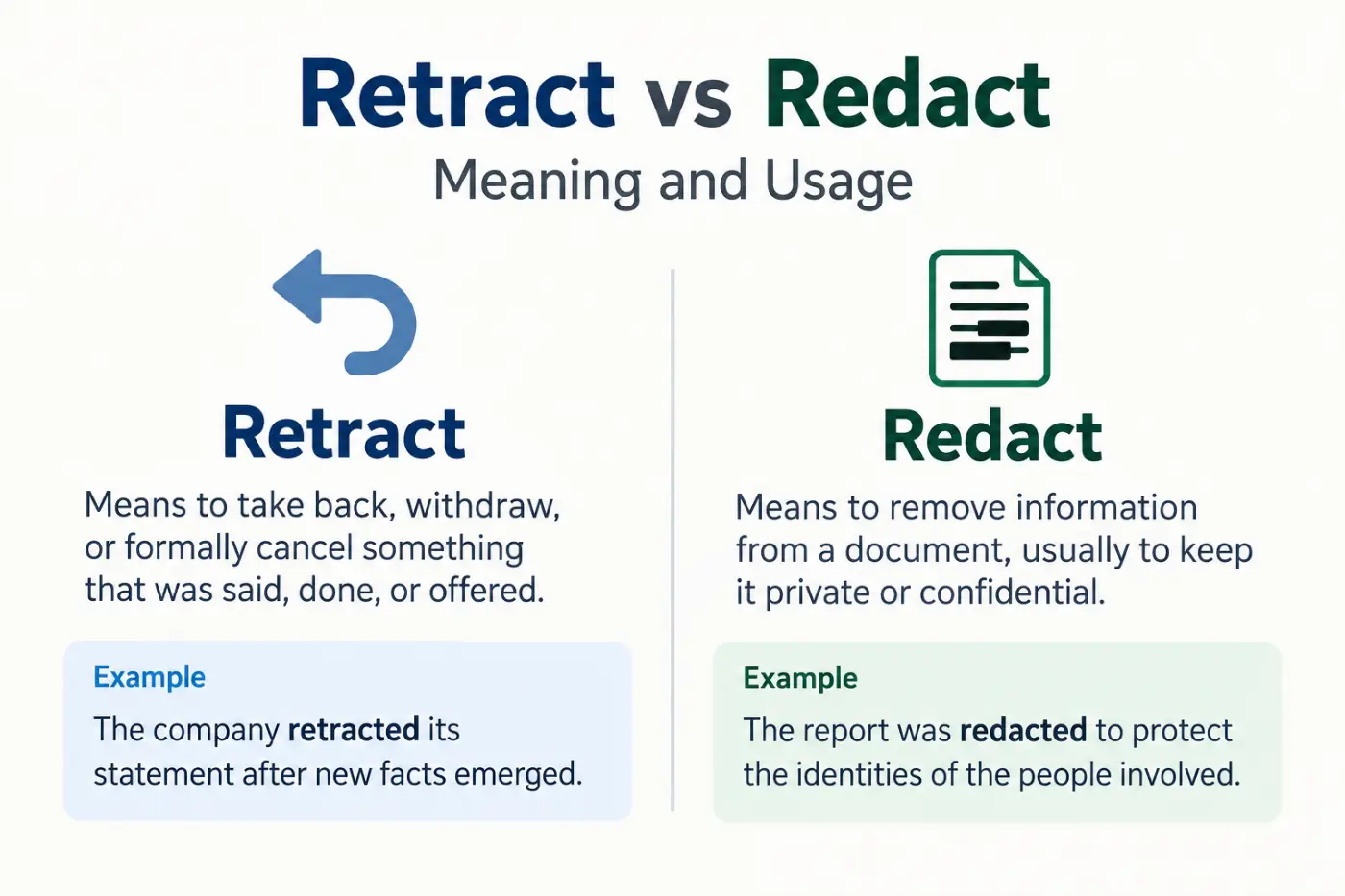
Retract vs redact is a common word choice problem because the two verbs look and sound remarkably similar. Both begin with the letters r, e, and t or d, and both appear often in formal writing, journalism, law, government, and professional communication. Their meanings, however, are quite different.
Retract means to take something back. You might retract a claim after discovering that it was wrong, retract an accusation after learning new facts, or retract a statement you no longer want to stand behind. Redact means to remove or hide specific information from a document while leaving the rest of the document available to readers.
The easiest way to remember the difference is to focus on the action. If you take back your words, you retract them. If you cover, remove, or obscure sensitive words in a document, you redact them. This article explains the meanings, grammar, pronunciation, origins, common mistakes, professional usage, and practical examples so you can choose the right word with confidence.
A related grammar guide is Clutz or Klutz Meaning, Usage and Correct Form 2026.
Quick Answer
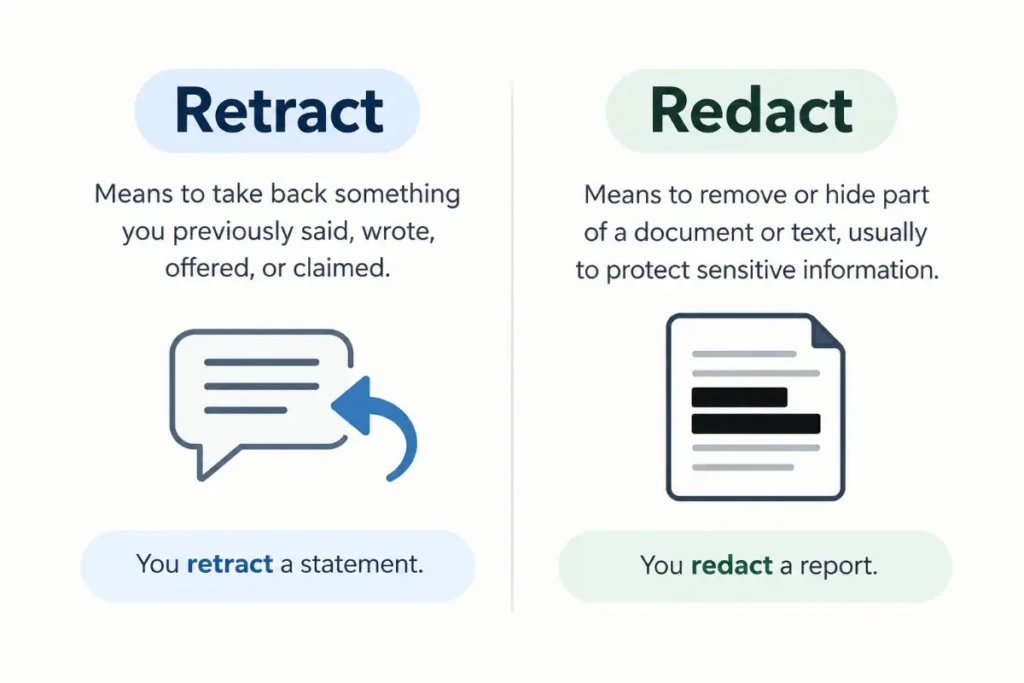
Retract means to take back something you previously said, wrote, offered, or claimed. Redact means to remove or hide part of a document or text, usually to protect sensitive information. You retract a statement. You redact a report. The words are both verbs, but they describe completely different actions.
What Retract Means
Retract is a verb that means to take back something that has been said, written, offered, or previously presented as true.
The word often appears when someone changes their position after making a statement. A person might retract an accusation, a claim, an allegation, an offer, or a statement.
For example:
- The newspaper retracted the claim after discovering an error.
- The witness retracted her earlier statement.
- The company retracted its announcement.
- He refused to retract his accusation.
- The politician was asked to retract the statement.
In each example, something previously communicated is being taken back.
Retract does not normally mean to erase individual words from a document. That is where redact comes in.
The word can also have a physical meaning. In that use, retract means to draw something back or pull it inward.
For example:
- The cat retracted its claws.
- The landing gear retracts into the aircraft.
- The telescope can retract into its housing.
This physical meaning is different from the communication related meaning, but both uses share the idea of pulling something back.
What Redact Means
Redact is a verb that means to remove, conceal, or obscure parts of a document or text before it is released to other people.
Redaction is usually done because some information is private, confidential, legally protected, classified, or otherwise unsuitable for public release.
For example:
- The agency redacted the names of the witnesses.
- The report was redacted before it was released.
- Lawyers redacted confidential information from the document.
- The public received a heavily redacted version of the report.
- The records were redacted to protect private information.
The important idea is that the document still exists. Only certain information has been hidden or removed.
A redacted document may contain blacked out names, numbers, addresses, passages, or other sensitive material. Modern digital documents can also use software to remove or conceal selected information.
Redact is therefore strongly associated with documents, records, reports, legal materials, government files, and other written information.
The Main Difference
The simplest distinction is this.
Retract means take back.
Redact means remove or hide part of a written document.
You retract a statement because you no longer want to stand behind it.
You redact a statement or passage because you need to hide specific information from readers.
Compare these sentences:
The reporter retracted the accusation.
The reporter redacted the name of the source.
The first sentence says the reporter took back an accusation.
The second says the reporter removed or concealed a name in a document.
That difference is the key to the entire word pair.
| Form | Meaning | Part of Speech | Typical Context | Example |
|---|---|---|---|---|
| Retract | Take back something previously said, written, offered, or claimed | Verb | Statements, claims, accusations, offers, physical objects | The company retracted its claim. |
| Redact | Remove or conceal part of a document or text | Verb | Reports, records, legal files, private information | The agency redacted the names. |
Both forms are standard English. Neither is a misspelling of the other.
Retract In More Detail
Retract often involves communication.
You retract something that has already been put forward. That could be an opinion, statement, accusation, claim, promise, offer, or allegation.
The word often suggests that the speaker or writer is correcting, withdrawing, or abandoning a previous position.
Consider this example:
The scientist retracted the claim after finding an error in the data.
The scientist originally made the claim. Later, the scientist decided that the claim could no longer be supported. The claim was therefore retracted.
The word can also appear in formal public communication.
The magazine retracted the article.
The company retracted its previous announcement.
The attorney asked the witness to retract the allegation.
In each case, the original statement or claim is being withdrawn.
Retract can also take an object.
She retracted her statement.
He retracted his accusation.
They retracted the offer.
The company retracted the warning.
The grammatical pattern is simple.
Subject + retract + object.
You can also use the passive form.
The statement was retracted.
The accusation was retracted.
The offer was retracted.
This form is common in news reports and formal writing.
Redact In More Detail
Redact usually concerns written or recorded information.
The object of redact is often a document, report, file, record, passage, name, address, or other piece of information.
For example:
The court redacted the victim’s address.
The agency redacted several pages from the report.
The lawyer redacted confidential financial information.
The editor redacted the private phone number.
The sentence structure is similar to the structure used with retract.
Subject + redact + object.
The important difference is the kind of action being described.
When you redact something, you do not necessarily reject or deny the information. You simply remove or hide it from the version being shared.
That distinction matters in legal and professional writing.
Suppose a government report contains a person’s home address. The agency may release the report but redact the address. The agency has not necessarily said the address is false. It has simply removed it from the public version.
Why The Words Are Confused
The confusion comes mainly from form rather than meaning.
Both words contain the letters r, e, and t.
Both are verbs.
That overlap can make them easy to mix up when writing quickly.
There is also a semantic connection between the two words. Both can involve changing something that has already been communicated. The difference is what happens to that information.
With retract, you take the communication back.
With redact, you hide or remove part of the communication from the version being shared.
That distinction is small in form but large in meaning.
Which Form Should You Use
Choose retract when someone takes back a statement, claim, accusation, offer, promise, or similar communication.
Choose redact when someone removes or conceals information from a document or text.
Use these quick patterns:
- Retract a statement.
- Retract a claim.
- Retract an accusation.
- Retract an allegation.
- Retract an offer.
- Redact a name.
- Redact an address.
- Redact confidential information.
- Redact a report.
- Redact a document.
These patterns are not rigid rules for every possible sentence, but they cover many common uses.
If the action involves taking back your words, retract is usually the right choice.
If the action involves hiding information inside a document, redact is usually the right choice.
Spelling Differences
The spelling difference is easy to miss.
Retract contains the letters r, e, t, r, a, c, and t.
Redact contains the letters r, e, d, a, c, and t.
The middle consonant is the major spelling clue.
Retract has tr.
Redact has d.
The words also come from different historical roots and developed with different meanings. Their similar appearance does not mean one is a variation of the other.
A useful spelling check is to connect each word with a familiar related noun.
Retract connects with retraction.
Redact connects with redaction.
If you are talking about a retraction, you are taking something back.
If you are talking about a redaction, you are removing or hiding information.
This noun connection can make the distinction easier to remember.
Grammar And Part Of Speech
Both retract and redact are verbs.
That means they describe actions.
They can appear in several grammatical forms.
For retract:
- Retract.
- Retracts.
- Retracted.
- Retracting.
- Retraction.
For redact:
- Redact.
- Redacts.
- Redacted.
- Redacting.
- Redaction.
The past tense of both verbs ends in ed.
For example:
The editor retracted the statement.
The editor redacted the name.
The passive forms are also common.
The statement was retracted.
The name was redacted.
Do not confuse the verb with its related noun.
Retract is the verb.
Retraction is the noun.
Redact is the verb.
Redaction is the noun.
For example:
The newspaper issued a retraction.
The newspaper retracted the claim.
The agency completed the redaction.
The agency redacted the report.
This distinction becomes especially useful in formal writing.
Pronunciation Guide
Retract and redact have different vowel sounds and stress patterns in standard American English.
Retract is commonly pronounced /rɪˈtrækt/. It has two syllables, with the stronger stress on the second syllable.
Redact is commonly pronounced /rɪˈdækt/. It also has two syllables, with the stronger stress on the second syllable.
The easiest pronunciation distinction is the consonant after the first syllable.
Retract begins the second syllable with the tr sound.
Redact begins the second syllable with the d sound.
You can practice the contrast slowly.
Retract.
Redact.
Then place each word in a sentence.
The editor retracted the statement.
The editor redacted the name.
Pronunciation alone may not always make the words easy to distinguish in fast speech. Context is often the stronger clue.
Etymology And Word Origin
Retract comes from Latin roots associated with drawing back. The English verb developed from Latin retractare and related forms built from the idea of pulling or drawing back.
That history fits both major modern meanings. When you retract a statement, you pull it back in a figurative sense. When something physical retracts, it moves back or inward.
Redact also comes from Latin. It traces to the Latin verb redigere, meaning to bring back, drive back, or reduce to a particular condition. English later developed redact as a term connected with editing and preparing written material.
The modern document related sense became especially established in formal and legal contexts.
The historical paths are different, even though both words have Latin roots and both can describe a kind of withdrawal or removal.
American English Usage
Both words are standard in American English.
Retract is common in journalism, business writing, legal communication, academic discussion, and everyday speech.
For example:
The company retracted the statement.
I take that back.
The second sentence is much more casual, but it can express a similar basic idea in everyday conversation.
Redact is more specialized. Americans commonly encounter it in news reports, legal documents, government records, privacy notices, and discussions about public records.
For example:
Several names were redacted from the report.
The government released a redacted copy.
In casual conversation, people may say hide, remove, or black out instead of redact.
Still, redact is the standard formal term for the document editing process.
British English Usage
The distinction remains essentially the same in British English.
Retract means to withdraw or take back something previously stated or offered.
Redact means to edit or remove information from a document, especially information that should not be publicly disclosed.
There is no major American and British spelling difference between these two verbs.
The same basic rule works in both varieties.
Retract a claim.
Redact confidential information.
Australian And Canadian English
Australian and Canadian English also use both words with the same core meanings.
A speaker in Canada or Australia can retract a statement and redact a document just as an American speaker can.
The main difference is not regional spelling. It is context.
Redact belongs more strongly to formal document language, while retract has a wider range of everyday and professional uses.
Many readers also check halfday or half-day: Correct Spelling and Usage.
Formal And Informal Usage
Retract works in both formal and informal contexts, although the exact wording changes with the situation.
In casual conversation, someone might say:
I take that back.
In formal writing, the same idea might be expressed as:
I retract my earlier statement.
That makes retract a useful word when you need precise or professional language.
Redact is more formal by nature.
A person might say:
They blacked out the names.
A formal report might say:
The names were redacted before publication.
Both sentences describe a similar action, but the second uses the standard professional term.
Sentence Examples
The following examples show how the two verbs work in natural settings.
- The newspaper retracted the story after discovering that one of its key facts was wrong.
The newspaper had already published the story and later withdrew it.
- The witness retracted her earlier accusation after reviewing the evidence.
She changed her position and took back the accusation.
- The company retracted its product claim after an internal review.
The company no longer stood behind the claim.
- The professor retracted the statement during the next lecture.
The professor withdrew something previously said.
- The magazine issued a retraction after publishing incorrect information.
The noun retraction names the act of taking back the earlier information.
- The lawyer redacted the client’s home address from the public filing.
The address was removed or hidden from the version available to the public.
- The agency redacted several names before releasing the report.
The agency kept the report but concealed selected information.
- The editor redacted confidential financial details from the document.
Only the sensitive details were removed.
- The court released a redacted version of the records.
The public received a version with some information concealed.
- The company retracted the announcement but did not remove the old document from its internal files.
The company withdrew the announcement rather than simply hiding information inside a document.
Common Mistakes
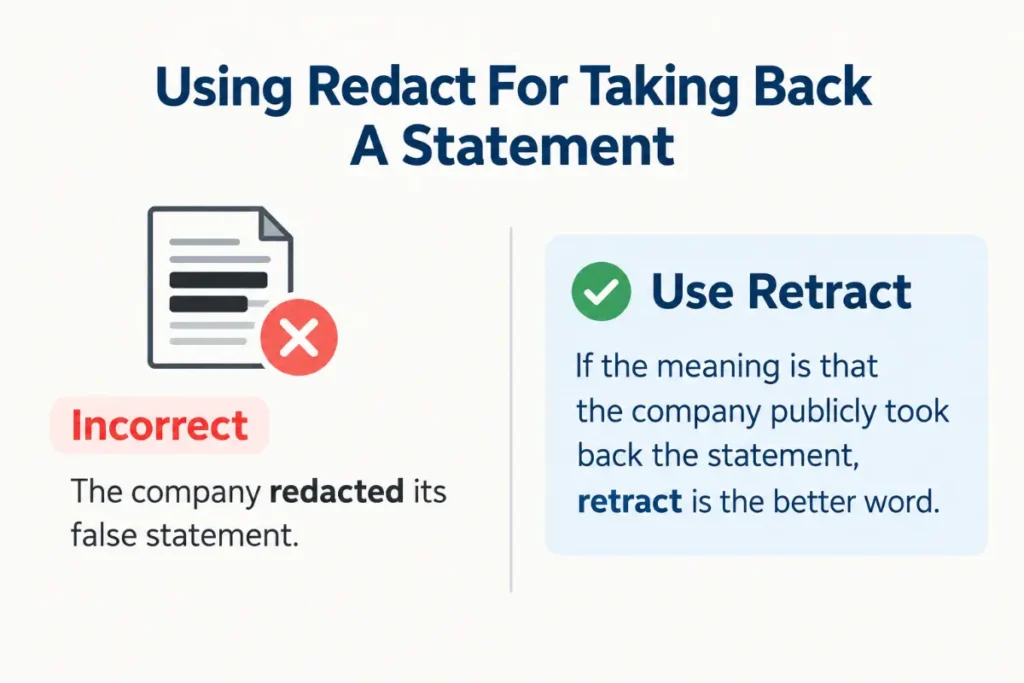
Using Redact For Taking Back A Statement
Incorrect:
The company redacted its false statement.
If the meaning is that the company publicly took back the statement, retract is the better word.
Correct:
The company retracted its false statement.
Using Retract For Hiding A Name
Incorrect:
The agency retracted the witness’s name from the report.
If the agency removed or concealed the name, redact is appropriate.
Correct:
The agency redacted the witness’s name from the report.
Assuming Redact Means Delete Everything
Redact does not usually mean destroying an entire document.
A redacted document remains available with selected information removed or concealed.
For example:
The report was released with several pages redacted.
The goal is selective removal rather than necessarily destroying the whole record.
Confusing Retraction And Redaction
Retraction is the noun related to retract.
Redaction is the noun related to redact.
A newspaper may issue a retraction.
A government agency may publish a redaction.
These nouns describe different actions.
Choosing The Word From Spelling Alone
Similar spelling does not mean similar meaning.
Instead of looking only at the letters, identify the action.
Ask yourself what happened.
Did someone take back a statement.
Use retract.
Did someone hide or remove information from a document.
Use redact.
Real Life Usage
Daily Conversation
Retract appears naturally when people discuss statements or opinions.
- I retract what I said earlier.
- He refused to retract his accusation.
The word is somewhat formal in casual speech. Many people simply say take that back.
Redact is much less common in ordinary conversation.
A person might say:
They blacked out the address.
In a formal setting, the same action may be described as redacting the address.
Workplace Communication
Retract is useful when discussing company statements, announcements, claims, or public communications.
The company retracted its earlier announcement.
Redact is useful when handling sensitive employee or business information.
Please redact customer account numbers before sending the file.
Both words can therefore appear in the same workplace, but they describe different tasks.
Academic Writing
Retract has an important role in academic publishing.
Researchers can retract a published paper when serious problems are discovered. The related noun is retraction.
Redact can appear when researchers prepare documents that contain private participant information.
For example:
The researcher removed identifying information before sharing the records.
A formal description could say that the identifying information was redacted.
News Writing
News organizations frequently use retract when reporting corrections.
The newspaper retracted the claim after confirming that the source was unreliable.
Redact also appears in reporting about government documents and court records.
The released documents contained several redacted sections.
Legal Writing
Both words are common in legal contexts.
A lawyer may ask a person to retract an allegation.
A court filing may contain redacted information.
For example:
The witness later retracted the accusation.
The filing contained redacted personal information.
The legal context makes precise word choice especially important because taking back a statement is different from removing information from a record.
Storytelling
Retract can also describe physical movement.
The turtle retracted its head into its shell.
The cat retracted its claws.
Redact generally stays connected to written or recorded information.
That gives you another useful clue. If something physical is moving inward, retract may be the word you need.
Related Words And Expressions
Several related words can help you understand the distinction more deeply.
Retraction
A retraction is the act of taking back a statement, claim, or publication.
The newspaper issued a retraction.
Redaction
A redaction is the act of removing or concealing information from a document.
The report contains several redactions.
Withdraw
Withdraw can mean to remove something or step back from a position.
The candidate withdrew the proposal.
It can overlap with retract in some contexts, but the two words are not always interchangeable.
Revise
Revise means to change or improve written material.
The editor revised the article.
Revision does not necessarily mean taking back a claim or hiding information.
Delete
Delete means to remove something entirely from a digital system or text.
The user deleted the file.
Redact is more specific when selected information is removed or hidden for privacy or confidentiality.
Conceal
Conceal means to hide something.
The document concealed the identity of the witness.
Redact is more specific when the hiding is done through editing a document.
Remove
Remove is a broad verb meaning to take something away.
The editor removed the address.
Redact can be a more precise choice when the information is deliberately concealed from the released version of a document.
Black out
Black out can mean to cover written information so readers cannot see it.
The agency blacked out the names.
This is less formal than redact and is often used when describing visible document censorship or concealment.
Retract And Withdraw
Both words sometimes overlap, but they are not identical.
Retract strongly suggests taking back something previously said, written, claimed, or offered.
Withdraw has a broader range of meanings.
A person can withdraw a statement, an application, an offer, a proposal, or participation in an activity.
For example:
The company withdrew its proposal.
The company retracted its claim.
The first sentence says the proposal was removed from consideration.
The second says a claim was taken back.
The exact choice depends on the action being described.
Retract And Correct
Retract and correct are also different.
To correct something means to provide accurate information or fix an error.
To retract something means to take it back.
A newspaper might correct a minor factual error without retracting the entire article.
In a more serious case, it might retract a claim that cannot be supported.
For example:
The editor corrected the date.
The editor retracted the accusation.
The first action fixes a detail.
The second withdraws a previous statement.
This distinction is useful in journalism, academic writing, and professional communication.
Redact And Delete
Redact and delete are not exact synonyms.
Delete generally means removing something from a file, system, message, or document.
Redact usually means removing or concealing selected information from a version that will be shared.
Imagine a report contains ten pages. If an editor deletes the entire report, readers may receive nothing. If the editor redacts two names and one address, readers can still access the remaining content.
That is why redact is especially useful for public records and sensitive documents.
Redact And Censor
Both words can overlap, but they carry different shades of meaning.
Redact is commonly used for removing specific information from a document.
Censor is broader and can involve suppressing material because it is considered unacceptable, restricted, offensive, secret, or otherwise unsuitable for publication.
For example:
The agency redacted the names of minors.
The broadcaster censored offensive language.
The first sentence focuses on protecting specific information.
The second focuses on restricting content.
Expert Editor Insight
An experienced editor usually makes this distinction by identifying the action before choosing the word. If the writer means that someone changed their position and took back a previous statement, retract is precise. If the writer means that information was removed from a document before distribution, redact is precise. Editors also watch for vague uses of remove, delete, and withdraw because those words can hide the exact action being described. In professional writing, precision matters more than choosing the word that merely sounds formal.
A Simple Memory Trick
The fastest memory trick is to connect each verb with its noun.
Retract gives you retraction.
Redact gives you redaction.
Now attach a simple meaning to each one.
Retraction means taking something back.
Redaction means hiding or removing part of a document.
You can also remember two practical phrases.
Retract a statement.
Redact a document.
If you memorize those two combinations, many other examples will fall into place.
Another useful trick is to picture the actions.
Imagine a speaker pulling their words backward. That is retract.
Now imagine an editor covering a name with a black box in a document. That is redact.
The mental pictures are simple, but they make the difference easier to recall.
How To Choose The Right Word
When writing quickly, use this short decision process.
- Identify the object.
If the object is a statement, claim, accusation, allegation, offer, or similar communication, consider retract.
- Identify the action.
If someone is taking back what they previously said or claimed, use retract.
3. Look for sensitive information.
Names, addresses, phone numbers, financial details, confidential passages, and identifying information are common objects of redaction.
- Ask what remains.
After a retraction, the speaker has withdrawn the earlier claim.
After a redaction, the document remains available with selected information hidden or removed.
This final question often settles the issue.
Why Precision Matters
The difference between these verbs can affect the meaning of an entire sentence.
Consider:
The agency retracted the report.
This suggests that the agency withdrew the report or its contents from its previous position or use.
Now compare:
The agency redacted the report.
This means the agency removed or concealed selected information from the report.
Those actions are not the same.
A writer who uses the wrong word can make a reader think that a statement was withdrawn when only a name was hidden. In legal, academic, journalistic, and government writing, that difference can matter a great deal.
Clear writing does not always require complicated vocabulary. In this case, it requires choosing the simple word that describes the exact action.
Key Takeaways
- Retract and redact are both correct English verbs.
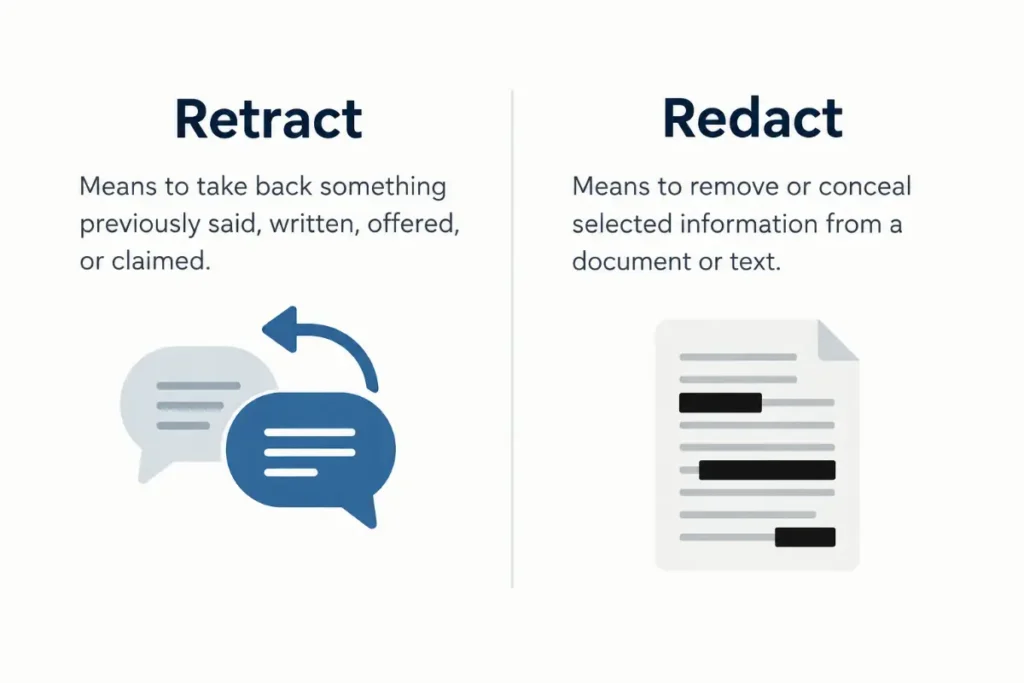
- Retract means to take back something previously said, written, offered, or claimed.
- Redact means to remove or conceal selected information from a document or text.
- You can retract a statement, claim, accusation, allegation, or offer.
- You can redact a name, address, report, record, or confidential detail.
- Retract can also describe physical movement inward, such as a cat retracting its claws.
- Redact is strongly associated with formal document handling.
- The noun form of retract is retraction.
- The noun form of redact is redaction.
- The simplest memory rule is take back for retract and hide information for redact.
A related grammar guide is Eccentric vs Eclectic Meaning and Usage (2026).
Conclusion
Retract vs redact becomes much easier once you focus on the action rather than the similar spelling. Retract means to take back something previously said, written, offered, or claimed. Redact means to remove or conceal selected information from a document or text. Both words are standard English, but they cannot normally replace each other.
Use retract for statements, claims, accusations, allegations, and offers. Use redact for names, addresses, confidential details, reports, records, and other written information that needs to be hidden or removed.
The easiest editing tip is to ask one question: Is someone taking back a message, or is someone hiding part of a document? Taking it back calls for retract. Hiding selected information calls for redact. That simple distinction will keep your word choice accurate in both everyday and professional writing.
FAQs
Is retract or redact the correct word?
Both are correct English words, but they have different meanings. Retract means to take back something previously said, written, offered, or claimed. Redact means to remove or conceal selected information from a document or text. The correct choice depends on the action you want to describe.
Is redact a real English word?
Yes. Redact is a standard English verb. It is commonly used when information is removed or concealed from documents, records, reports, legal filings, and other written material. Its noun form is redaction.
What does retract mean?
Retract means to take back something that was previously stated, written, offered, or claimed. It can refer to a statement, accusation, allegation, claim, offer, or similar communication. It can also describe physically pulling something inward, as when an animal retracts its claws.
What does redact mean?
Redact means to remove or conceal part of a document or text, often to protect private, confidential, classified, or sensitive information. A redacted document still contains the remaining material. Common examples include redacted names, addresses, financial details, and confidential passages.
Can you retract a document?
Yes, but the meaning depends on the context. You can retract a document when you mean withdrawing it from circulation or formally taking it back. If you mean removing selected information from the document while keeping the rest available, redact is the more precise verb.
Can you redact a statement?
Yes. A statement can be redacted if specific information inside a written statement needs to be removed or concealed. For example, an editor can redact a person’s address from a statement before releasing it. If the entire statement is being taken back, retract is the better choice.
How do you pronounce retract and redact?
In standard American English, retract is commonly pronounced /rɪˈtrækt/ and redact is commonly pronounced /rɪˈdækt/. Both have two syllables and stress the second syllable. The main sound difference is the consonant cluster in retract compared with the d sound in redact.
What is the noun form of retract?
The noun form is retraction. It refers to the act of taking back a statement, claim, accusation, or similar communication. For example, a newspaper may publish a retraction after discovering that a previously published claim was inaccurate.
What is the noun form of redact?
The noun form is redaction. It refers to the act of removing or concealing information from a document. You may also see the plural form redactions when several portions of a document have been removed or hidden.
Is redact formal English?
Yes. Redact is standard English and has a formal tone. It is especially common in legal, government, academic, journalistic, and professional writing. In casual conversation, people may use simpler expressions such as remove, hide, or black out, depending on the context.
Is retract used in everyday English?
Retract is standard English and can be used in everyday conversation, but it often sounds more formal than take back. In casual speech, someone might say I take that back. In professional writing, retract can provide a more precise and formal description.
What is an easy way to remember the difference?
Think of retract as taking words back and redact as hiding words in a document. You retract a claim or statement. You redact a name or address. The related nouns make the distinction even easier: retraction means taking something back, while redaction means removing or concealing information.