
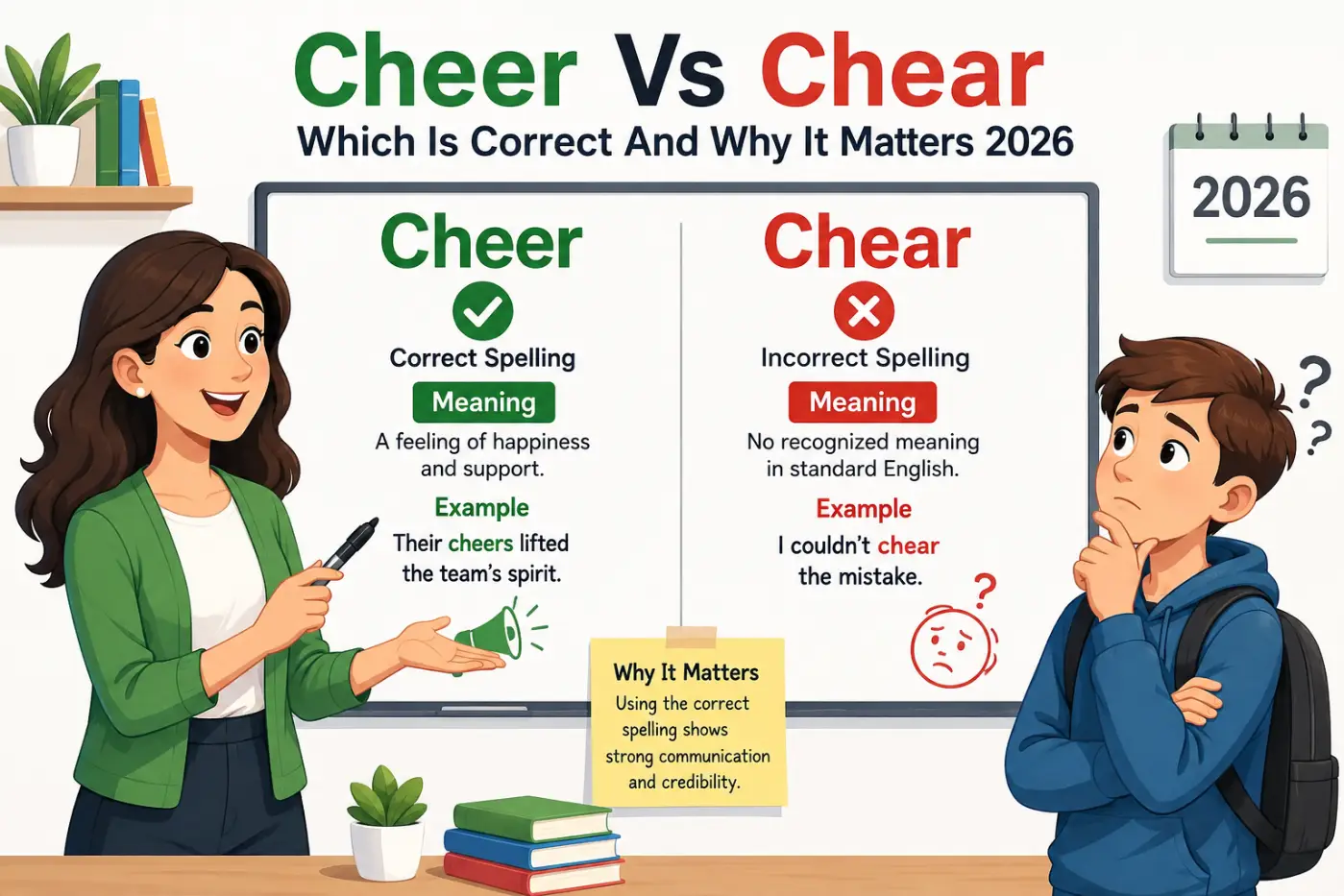
If you’ve searched Cheer Vs Chear, you’re probably wondering which spelling is correct. The short answer is simple. Cheer is the correct English word, while chear is considered an obsolete spelling that disappeared from standard English centuries ago. Today, you’ll almost never see chear outside historical texts, old books, or discussions about the history of English.
The confusion exists because English spelling has changed over time. Many words looked different in the seventeenth and eighteenth centuries than they do today. Older writers sometimes used chear where modern English uses cheer. If you come across the older spelling in a classic novel or historical document, it does not mean it is correct for modern writing.
This guide explains everything you need to know about Cheer Vs Chear. You’ll learn the meaning of each form, why one spelling became standard, how dictionaries treat the words, common mistakes people make, pronunciation, grammar, usage examples, and expert writing tips. By the end, you’ll know exactly which spelling belongs in modern English and when the historical form may still appear.
Need another quick comparison? Read Noteable or Notable Which Spelling Is Correct 2026.
Quick Definition
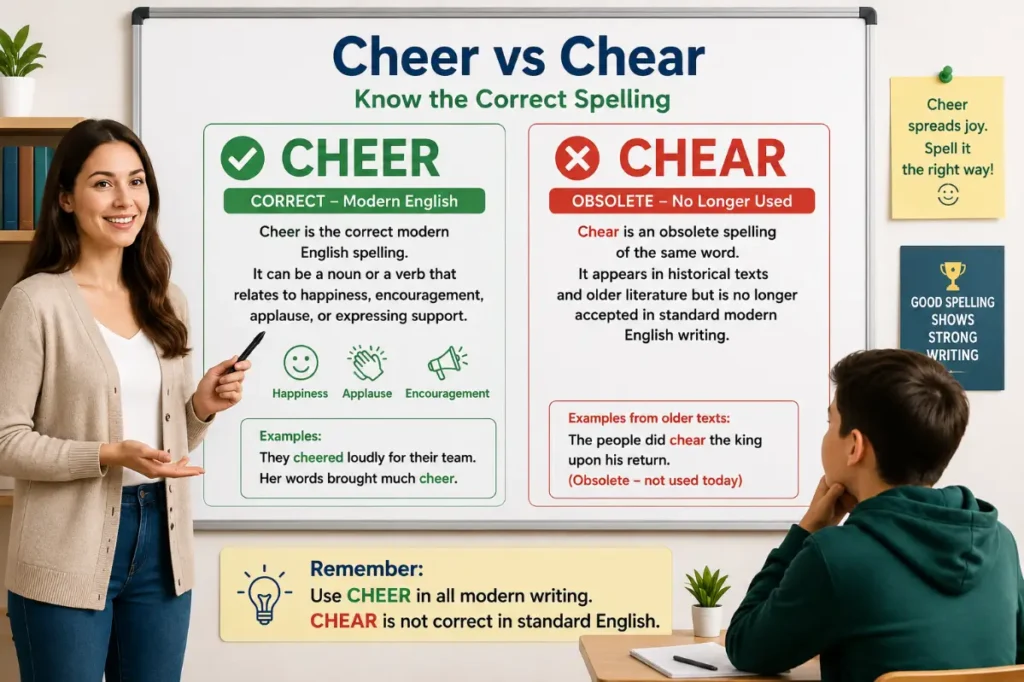
Cheer is the correct modern English spelling. It can be a noun or a verb that relates to happiness, encouragement, applause, or expressing support. Chear is an obsolete spelling of the same word. It appears in historical texts and older literature but is no longer accepted in standard modern English writing.
Quick Answer
If you’re deciding between cheer and chear, always choose cheer for modern English.
- Cheer is the standard spelling recognized by major dictionaries.
- Chear is an obsolete spelling found mainly in historical documents and classic literature.
- In school, business, journalism, academic writing, and everyday communication, cheer is always the correct choice.
Cheer Vs Chear Comparison Table
| Feature | Cheer | Chear |
|---|---|---|
| Correct modern spelling | Yes | No |
| Meaning | Happiness, encouragement, applause, support | Historical spelling of cheer |
| Part of speech | Noun and verb | Noun and verb in historical English |
| Origin | Middle English from Old French | Earlier spelling of cheer |
| Usage frequency | Extremely common | Extremely rare |
| Formality | Suitable for every writing style | Limited to historical quotations |
| Common contexts | Sports, celebrations, encouragement, greetings | Historical books, archived documents, language research |
| Dictionary status | Standard English word | Obsolete spelling |
| Recommended for modern writing | Yes | No |
| Example | The fans gave the team a loud cheer. | The old manuscript used the spelling chear. |
Meaning Of Cheer
Cheer is a common English word with several closely related meanings. It can describe a feeling, an action, or an expression of support. As a noun, cheer commonly means happiness, optimism, encouragement, or a shout of approval.
Examples include:
- The crowd erupted in a loud cheer.
- Holiday decorations filled the town with cheer.
- Her cheerful attitude lifted everyone’s spirits.
As a verb, cheer means to encourage someone, applaud them, or make them happier.
Examples include:
- Friends gathered to cheer the runners.
- The good news cheered everyone.
- The audience cheered after the final performance.
Etymology
The word comes from Middle English and traces back to Old French chiere, which originally referred to a person’s face, expression, or mood. Over time, its meaning expanded to include joy, encouragement, and expressions of approval. The spelling gradually settled into the modern form cheer.
Common Contexts
You will regularly see cheer in contexts such as:
- Sports events.
- Holiday celebrations.
- Graduation ceremonies.
- Everyday conversations.
- Business motivation.
- School activities.
- Entertainment.
- News reporting.
Meaning Of Chear
Chear is not a separate English word with its own modern meaning. Instead, it is an older spelling of cheer that appeared in Early Modern English. Centuries ago, English spelling was far less standardized than it is today. Writers often spelled the same word in several different ways. During that period, chear and cheer could represent the same word.
Today, chear survives mainly in:
- Historical documents.
- Classical literature.
- Old dictionaries.
- Academic discussions about language history.
- Digitized manuscripts.
Modern dictionaries generally label chear as obsolete or archaic. It should not be used in contemporary writing unless you are quoting an original historical source.
Historical Context
You may encounter chear while reading works printed in the seventeenth or eighteenth century. In those texts, the spelling reflects the conventions of the period rather than modern English rules. For today’s readers and writers, cheer is always the expected spelling.
Cheer Vs Chear Key Differences
Although cheer and chear share the same historical origin, they differ significantly in modern English.
1. Modern Acceptance
Cheer is accepted in every variety of modern English.
Chear is obsolete and not accepted as a standard spelling.
2. Dictionary Recognition
Modern dictionaries list cheer as the standard entry.
Chear appears only as an obsolete or historical variant in specialized references.
3. Everyday Usage
People use cheer every day in speech and writing. You are very unlikely to encounter chear outside historical materials.
4. Professional Writing
Editors, teachers, publishers, and proofreaders expect cheer. Using chear in modern documents will usually be treated as a spelling mistake.
5. Search Frequency
Search engines return millions of results for cheer because it is widely used. Searches for chear are much less common and usually relate to old books, genealogy, or language history.
Which One Is Correct
The correct choice in modern English is cheer.
Use cheer in:
- Essays.
- Emails.
- Business documents.
- Academic writing.
- Books.
- Websites.
- Social media.
- Newspapers.
- Professional communication.
- Everyday conversation.
Avoid chear unless you are:
- Quoting an old document exactly as it was written.
- Discussing the history of English spelling.
- Analyzing historical literature.
- Studying language evolution.
Expert Editorial Insight
From an editor’s perspective, chear should almost always be corrected to cheer in modern writing. The only exception is when preserving the original spelling in a historical quotation. Professional editors do not modernize quoted historical text without a clear editorial reason, but they also would not allow chear to appear as a normal spelling in contemporary content.
In practical terms, if your goal is accurate, natural English, remember this simple rule: Use cheer every time. Treat chear as a historical spelling that belongs to older English, not modern writing.
Cheer Vs Chear Examples In Sentences
Seeing a word in context is one of the easiest ways to remember the correct spelling. Since cheer is the accepted modern form, almost every sentence you read today will use it. Chear appears only in historical writing or when someone is quoting an old source.
10 Sentences Using Cheer
- The crowd gave the winning team a loud cheer.
- Her kind words helped cheer me after a difficult day.
- We gathered to cheer our friends during the marathon.
- The children filled the classroom with holiday cheer.
- Fans continued to cheer until the final whistle.
- A simple smile can cheer someone who feels discouraged.
- The audience broke into a joyful cheer after the performance.
- Good news always seems to cheer the entire office.
- Everyone joined together to cheer the graduates.
- The festival brought music, laughter, and plenty of cheer.
10 Sentences Using Chear
The following examples reflect historical or scholarly usage. They are not appropriate models for modern writing.
- The seventeenth century manuscript used the spelling chear.
- The editor preserved chear to match the original document.
- Readers noticed chear throughout the old printed sermon.
- The archive contains several letters written with chear instead of cheer.
- Linguists explained that chear was once a common spelling variation.
- The museum displayed a diary that repeatedly used chear.
- Students compared chear with the modern spelling cheer in a language history class.
- The digital transcription retained chear exactly as it appeared in the source.
- Researchers found chear in several eighteenth century publications.
- The historical edition kept chear to preserve the author’s original spelling.
Learn the difference in Sapphire or Saphire Which Spelling Is Correct 2026.
Common Mistakes In Cheer Vs Chear
People usually confuse these forms because English spelling has changed over time. Here are the mistakes editors see most often.
1. Using Chear In Modern Writing
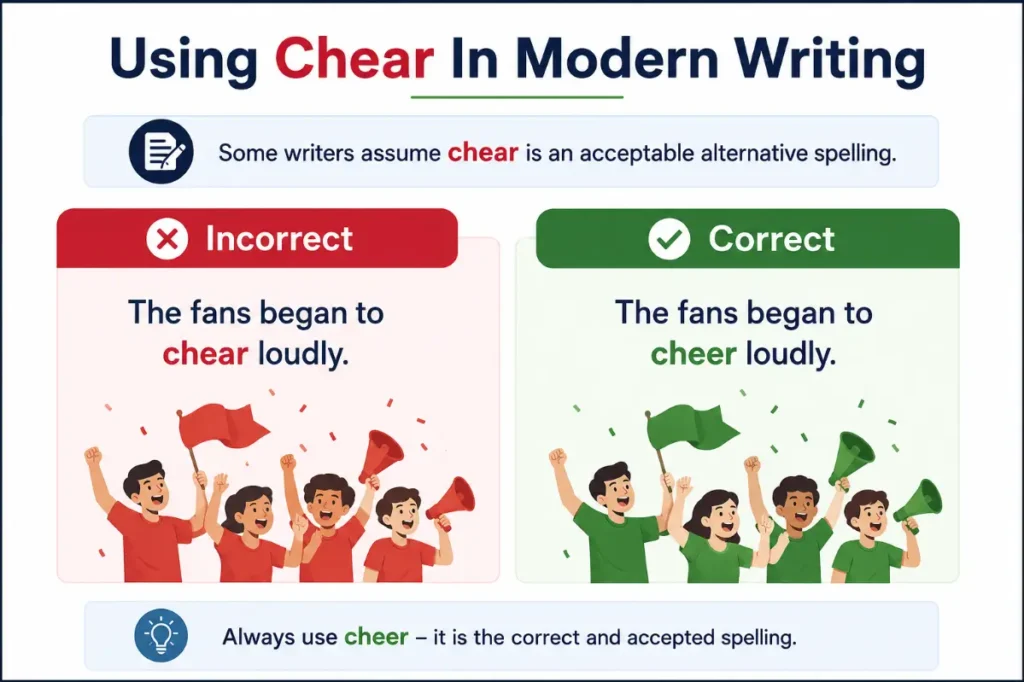
Some writers assume chear is an acceptable alternative spelling.
Incorrect
The fans began to chear loudly.
Correct
The fans began to cheer loudly.
2. Assuming Both Spellings Are Standard
Unlike some British and American spelling differences, cheer and chear are not equal modern variants. Only cheer is standard English today.
3. Copying Historical Spellings
Older books often preserve original spellings. Copying them into modern writing without explanation can create unnecessary errors.
4. Confusing Cheer With Similar Looking Words
Some learners accidentally mix cheer with words such as:
- Chair.
- Sheer.
- Cheerful.
- Cheery.
- Cheerleader.
Although these words look similar, each has its own meaning and spelling.
5. Assuming Spell Check Missed Something
Modern spelling checkers flag chear because it is obsolete, not because they are incomplete. In most cases, accepting the correction to cheer is the right decision.
Pronunciation Guide
One reason people confuse cheer and chear is that they represent the same pronunciation.
Cheer
IPA
/tʃɪr/
Syllables
Cheer has one syllable.
Pronunciation
It begins with the ch sound, followed by the short eer sound, ending with r in rhotic accents such as American English.
Chear
When it appeared historically, chear was generally pronounced the same as cheer.
Common Pronunciation Mistakes
- Pronouncing it like chair.
- Adding an extra vowel sound.
- Stressing the ending too heavily.
- Confusing cheer with cheerful, which has two syllables.
Etymology And Word Origin
Understanding a word’s history helps explain why two spellings exist. The modern word cheer traces its history to the Old French word chiere, meaning face, expression, or appearance. It entered Middle English with a similar meaning, describing a person’s facial expression or emotional state. Over time, English speakers began associating a pleasant facial expression with happiness, encouragement, and good spirits. As the language evolved, the meaning gradually expanded to include joy, applause, encouragement, and expressions of support. During the Middle English and Early Modern English periods, spelling was not standardized. Writers often spelled words according to personal preference or local custom.
Regional Usage
Unlike some English words that differ across countries, cheer is consistent throughout the English speaking world.
| Region | Preferred Form | Notes |
|---|---|---|
| American English | Cheer | Standard spelling in all contexts. |
| British English | Cheer | Standard spelling in modern English. |
| Canadian English | Cheer | Used in schools, media, and publishing. |
| Australian English | Cheer | Accepted modern spelling. |
| New Zealand English | Cheer | Standard usage across formal and informal writing. |
Does Any Country Use Chear?
No major English speaking country recognizes chear as the standard modern spelling. You may still encounter it in:
- Historical archives.
- Antique books.
- Literary research.
- Museum collections.
- Digitized manuscripts.
Its appearance reflects the age of the document rather than a regional preference.
Grammar Rules
Understanding how cheer functions grammatically makes it easier to use correctly.
Cheer As A Noun
As a noun, cheer refers to happiness, encouragement, or a shout of approval.
Examples:
- A loud cheer echoed through the stadium.
- Holiday cheer filled the neighborhood.
- Their cheer inspired the entire team.
Cheer As A Verb
As a verb, cheer means to encourage, applaud, or make someone happier.
Examples:
- Fans cheered throughout the match.
- We tried to cheer our friend.
- The surprise gift cheered everyone.
Verb Forms
| Base Form | Past Tense | Past Participle | Present Participle |
|---|---|---|---|
| Cheer | Cheered | Cheered | Cheering |
Common Sentence Structures
- Cheer someone.
- Cheer for someone.
- Cheer someone up.
- Give a cheer.
- Burst into cheers.
Plural Form
The plural noun is cheers.
Examples:
- Loud cheers filled the arena.
- The audience responded with enthusiastic cheers.
Grammar Note About Chear
Modern English grammar guides do not treat chear as a separate vocabulary word. Since it is an obsolete spelling, it follows the same grammatical role as cheer only when quoted from historical sources.
Real Life Usage Examples
Daily Conversation
- Let’s cheer them on during the game.
- Your message really cheered me today.
- Everyone gave a huge cheer when she arrived.
Academic Writing
- Historians note that chear appears in several early English manuscripts.
- Modern editors replace chear with cheer only when producing updated editions.
- Language change explains why chear eventually disappeared from standard English.
Professional Communication
- The manager tried to cheer the team after a challenging week.
- The announcement brought renewed cheer to the department.
- Employees gathered to cheer the award recipients.
Literature
Modern novels almost always use cheer, while historical editions may preserve chear as part of the original text. Editors usually keep the historical spelling when authenticity is important.
News And Media
Sports reporting, entertainment journalism, and lifestyle articles consistently use cheer.
Examples include:
- Thousands of supporters gathered to cheer the champions.
- The crowd responded with a loud cheer.
- Volunteers spread holiday cheer throughout the community.
Related Words And Confused Terms
Many English learners search for Cheer Vs Chear because the words look similar. They may also confuse cheer with other words that share a similar spelling or sound. Understanding these related terms helps you avoid common writing mistakes.
| Word | Meaning | Common Confusion |
|---|---|---|
| Cheer | Happiness, encouragement, or applause | Correct modern spelling |
| Chear | Obsolete spelling of cheer | Historical form only |
| Cheerful | Full of happiness or optimism | Adjective derived from cheer |
| Cheery | Bright, happy, and pleasant | Similar meaning to cheerful |
| Cheerleader | A person who leads cheers at sporting events | Derived from cheer |
| Cheers | Plural of cheer or an informal expression of thanks or a toast | Modern English |
| Chair | A piece of furniture or the person leading a meeting | Similar spelling but unrelated meaning |
| Sheer | Complete or very steep | Similar pronunciation in some accents |
| Chant | Repeated rhythmic shouting | Often heard alongside cheering at sporting events |
| Applaud | To clap in approval | Similar meaning to the verb cheer |
Semantic And NLP Related Terms
Search engines associate Cheer Vs Chear with many closely related language topics. These include:
- Correct spelling.
- English spelling rules.
- Modern English.
- Obsolete words.
- Archaic spelling.
- Dictionary meaning.
- Word origin.
- Grammar.
- Pronunciation.
- Usage examples.
- Common spelling mistakes.
- English vocabulary.
- Language evolution.
- Historical English.
- Writing tips.
These related terms help readers understand the topic more completely while matching the questions people commonly ask online.
Expert Language Insight
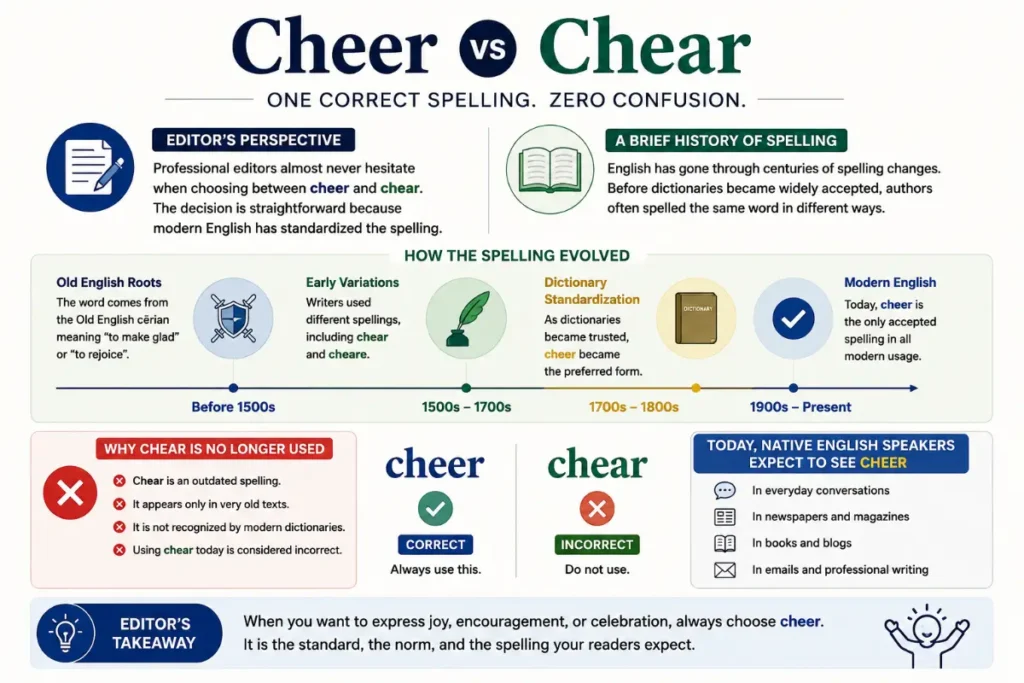
Professional editors almost never hesitate when choosing between cheer and chear. The decision is straightforward because modern English has standardized the spelling. English has gone through centuries of spelling changes. Before dictionaries became widely accepted, authors often spelled the same word in different ways. That explains why you may see forms such as chear, cheare, and cheer in very old books. Those spellings reflected the writing practices of their time rather than different meanings. Today, native English speakers expect to see cheer in every form of communication.
Need another quick comparison? Read Missle or Missile Correct Spelling and Meaning.
Conclusion
The answer to Cheer Vs Chear is clear. Cheer is the correct spelling for modern English, while chear is an obsolete form that belongs to earlier stages of the language. Although both spellings share the same historical roots, only cheer appears in current dictionaries, style guides, schools, workplaces, and everyday communication.
If you encounter chear in an old manuscript, classic novel, or historical record, remember that it reflects the spelling conventions of its time rather than modern usage. Outside those specialized contexts, using chear will usually be treated as a spelling mistake.
For clear, accurate, and professional writing, always choose cheer. It is the form readers expect, editors recommend, and dictionaries recognize. Keeping this simple rule in mind will help you write with confidence and avoid one of the more unusual spelling questions in English.
FAQs
Is cheer or chear correct?
Cheer is the correct spelling in modern English. It is recognized by major dictionaries and used in everyday speech, education, publishing, journalism, and professional writing. Chear is an obsolete spelling that survives mainly in historical documents and older literature.
Why do I sometimes see chear in old books?
Older English texts were written before spelling became standardized. Writers often used different spellings for the same word. Chear was one of those historical spellings that eventually gave way to the modern form cheer.
Is chear a real English word?
Yes, but only in a historical sense. Chear is an obsolete spelling of cheer rather than a separate modern English word. It appears in historical texts but is not considered correct in contemporary writing.
Do British and American English spell it differently?
No. Both British English and American English use cheer as the standard spelling. There is no regional preference that makes chear correct in modern English.
Can I use chear in academic writing?
Only if you are quoting a historical source exactly as it was originally written or discussing the history of English spelling. In all other academic writing, cheer is the correct choice.
How do you pronounce cheer?
Cheer is pronounced /tʃɪr/ in the International Phonetic Alphabet. It has one syllable and sounds the same as the historical spelling chear.
What part of speech is cheer?
Cheer functions as both a noun and a verb. As a noun, it refers to happiness, encouragement, or applause. As a verb, it means to encourage, applaud, or make someone happier.
How can I remember the correct spelling?
A simple memory tip is to think of familiar words such as cheerful, cheering, and cheers. All of these use cheer, which reinforces the standard modern spelling. If you see chear, it is almost certainly part of a historical text.