
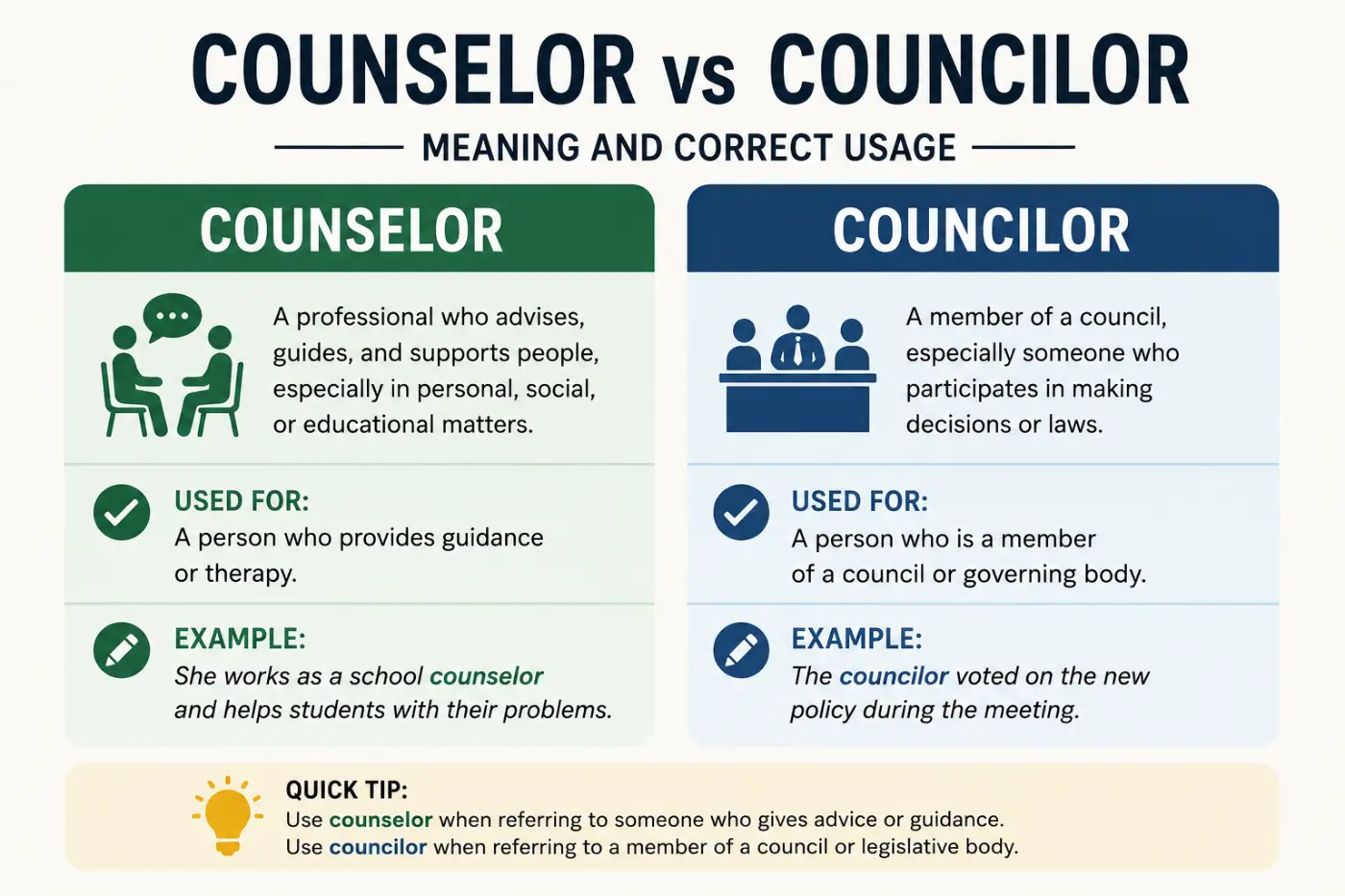
If you’re unsure about counselor vs councilor, you’re not alone. The two words sound the same in standard English, and their spellings differ by only a few letters. However, they refer to two completely different roles. Counselor means a person who gives advice, guidance, or support, while councilor means a member of a council or local governing body.
The confusion comes from the words counsel and council. These words are homophones, so pronunciation doesn’t tell you which spelling to use. The easiest way to remember the difference is to connect each word with its meaning. A counselor provides counsel or advice, while a councilor serves on a council.
In this guide, you’ll learn the meanings, grammar, pronunciation, origins, regional spelling differences, common mistakes, and sentence examples for counselor and councilor. You’ll also learn a simple memory trick that makes the difference easier to remember in everyday and professional writing.
Still confused? Compare Finaly or Finally Spelling Meaning and Usage Guide(2026).
Quick Definition
A counselor is a person who gives advice or professional guidance. A councilor is a member of a council who takes part in decisions or represents a local community. The words sound alike but have different meanings and spellings. The easiest clue is simple: counselor connects with counsel while councilor connects with council.
Quick Answer
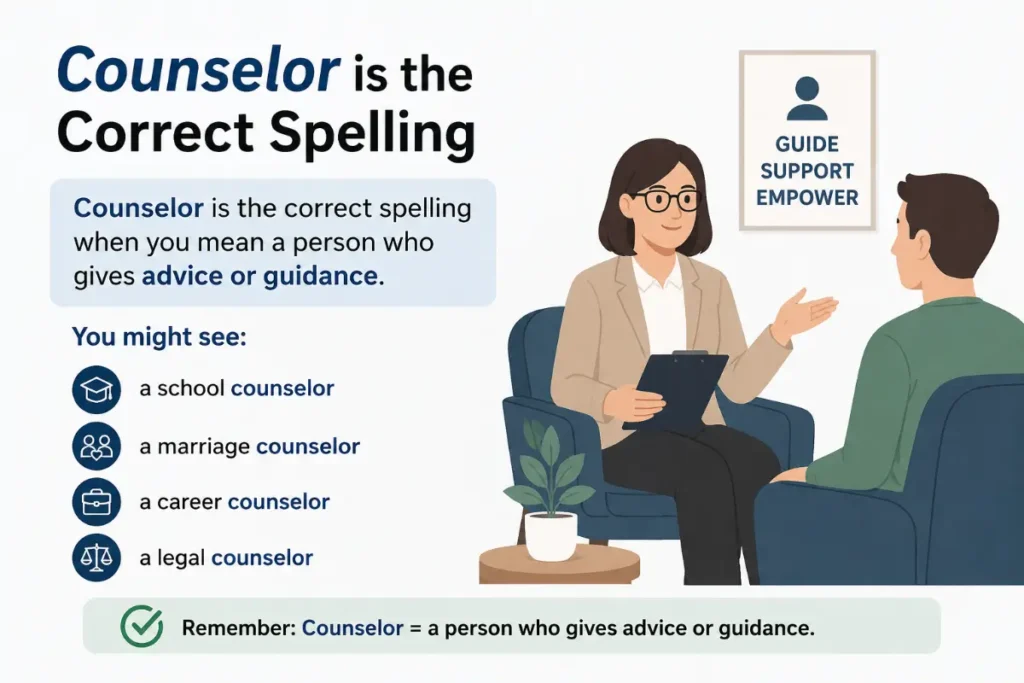
Counselor is the correct spelling when you mean a person who gives advice or guidance. You might see a school counselor a marriage counselor a career counselor or a legal counselor.
Councilor is correct when you mean a person who serves on a council. A city councilor may vote on local policies budgets public services and community matters.
A useful memory trick is to look at the middle of each word. Counselor contains counsel which means advice or guidance. Councilor contains council which means a group that makes decisions or gives advice. Once you remember those two roots the spelling becomes much easier.
Comparison Table: counselor vs councilor
| Correct Form | Meaning | Part of Speech | Origin | Usage Frequency | Formality | Common Contexts | Example |
|---|---|---|---|---|---|---|---|
| counselor | A person who gives advice or guidance | Noun | Old French and Latin roots connected with counsel | Very common | Neutral to formal | Schools therapy law camps careers | The school counselor helped Maya choose her courses. |
| councilor | A member of a council | Noun | Developed from council and related historical forms | Common | Neutral to formal | Local government politics public administration | The councilor supported the new community center. |
The distinction isn’t just a spelling preference. The words point to different roles. Merriam Webster defines counselor as a person who gives advice and also recognizes meanings connected with law and summer camps. Its entry for councilor defines the word as a member of a council.
Meaning and Definition
Meaning of Counselor
A counselor is someone who provides advice guidance support or professional assistance. The word can describe several types of professionals.
A school counselor helps students with academic planning career decisions and personal concerns. A marriage counselor works with couples who want help with relationship problems. A career counselor helps people make decisions about education employment and professional goals.
The word also has legal uses. In American English a lawyer may be addressed as counselor in a courtroom or legal setting. Merriam Webster lists counselor as a person who gives advice a lawyer and a supervisor at a summer camp.
The basic idea stays consistent. A counselor is connected with counsel. Counsel means advice guidance or professional legal representation depending on context. Cambridge Dictionary also uses counselor for someone trained to listen and provide advice about personal or other problems.
For example:
- I spoke with my guidance counselor about college applications.
- The marriage counselor helped the couple communicate more clearly.
- Our camp counselor organized the afternoon activities.
- The attorney served as legal counsel for the company.
These examples show why the spelling matters. The person is offering guidance or performing a counseling role.
Meaning of Councilor
A councilor is a person who belongs to a council. In American English the word commonly describes an elected member of a local government.
A councilor might serve on a city council town council county council or another governing body. The person’s responsibilities can include voting on policies reviewing budgets discussing public services and representing residents.
Cambridge Dictionary defines councilor as an elected member of local government and lists councillor as the UK form.
For example:
- The councilor proposed improvements to the public park.
- Residents asked the councilor to address traffic problems.
- The councilor voted against the proposed tax increase.
- Several councilors attended the community meeting.
The key connection is council. A council is a group of people chosen or elected to make decisions or represent a particular community or organization.
That connection gives you a reliable spelling clue. If the person belongs to the group called a council then councilor is the word you need.
Key Differences Explained
- Spelling. Counselor contains counsel while councilor contains council. That extra i changes the visual link between the word and its root.
- Meaning. A counselor gives advice or guidance. A councilor serves as a member of a council.
- Grammar role. Both words are nouns. They name people rather than actions qualities or objects.
- Tone. Both can appear in everyday speech professional writing academic work and formal documents. Neither spelling is inherently more formal than the other.
- Context. Counselor commonly appears in education mental health careers law and summer camps. Councilor usually appears in local government politics civic affairs and public administration.
- Root word. Counselor comes from counsel. Councilor comes from council. This is the most useful distinction to remember.
- Pronunciation. In standard English the two words are generally pronounced alike or nearly alike. That makes them homophones for many speakers and explains why spelling errors are common.
- Regional spelling. American English uses counselor and councilor. British English generally uses counsellor and councillor. Cambridge identifies counselor as the US spelling and councilor as the US spelling.
Which Spelling Is Correct?
Both counselor and councilor are correct English words. The right choice depends entirely on what you mean. Use counselor for someone who gives advice or professional guidance. Use councilor for a member of a council.
This isn’t a case where one spelling is American and the other is British. That distinction applies to a different pair of forms. American English uses counselor while British English commonly uses counsellor. American English uses councilor while British English commonly uses councillor.
Merriam Webster treats counselor as an established English noun with a first known use in the 13th century. Its councilor entry gives the meaning of a member of a council and traces its first known use to the 15th century.
The dictionary evidence gives editors a straightforward rule. Don’t choose the spelling based on how the word sounds. Identify the meaning first and then choose the word that matches that meaning.
If you’re talking about someone who helps students make decisions you need counselor.
If you’re talking about someone elected to a city council you need councilor.
Sentence Examples
The fastest way to make the distinction stick is to see both words in natural sentences.
Examples With Counselor
- The school counselor helped me plan my final year of classes.
- I made an appointment with a career counselor before applying for new jobs.
- The camp counselor taught the children how to stay safe near the lake.
- Her counselor encouraged her to think carefully about her next step.
- The college counselor explained the admission process in simple terms.
- We spoke with a financial counselor before making a major purchase.
- The marriage counselor gave the couple practical ways to improve communication.
- The student asked the guidance counselor for help with scholarship applications.
- The counselor listened carefully before offering any advice.
- The lawyer was addressed as counselor during the court hearing.
These examples share one idea. The person has a role connected with advice guidance support or professional counsel. That meaning points you toward counselor.
Examples Showing Councilor
- The councilor met with residents to discuss the proposed road project.
- Our local councilor answered questions about the new housing plan.
- The councilor voted in favor of funding for the library.
- Several councilors attended the public meeting.
- The councilor promised to raise the issue at the next council meeting.
These examples connect the person with a governing council. That’s the signal you need.
Common Misspelling Examples
- Incorrect: I spoke with my school councilor about my classes.Correct: I spoke with my school counselor about my classes.
- Incorrect: The marriage councilor recommended several communication exercises.Correct: The marriage counselor recommended several communication exercises.
- Incorrect: The city counselor voted on the budget.Correct: The city councilor voted on the budget.
- Incorrect: The councilor helped the student choose a college.Correct: The counselor helped the student choose a college.
- Incorrect: The counselor introduced the new zoning proposal.Correct: The councilor introduced the new zoning proposal.
The mistakes happen because the two words sound so similar. The surrounding context usually tells you which meaning the writer intended.
Common Mistakes and Misspellings
Several spelling mistakes appear because writers remember the sound rather than the root.
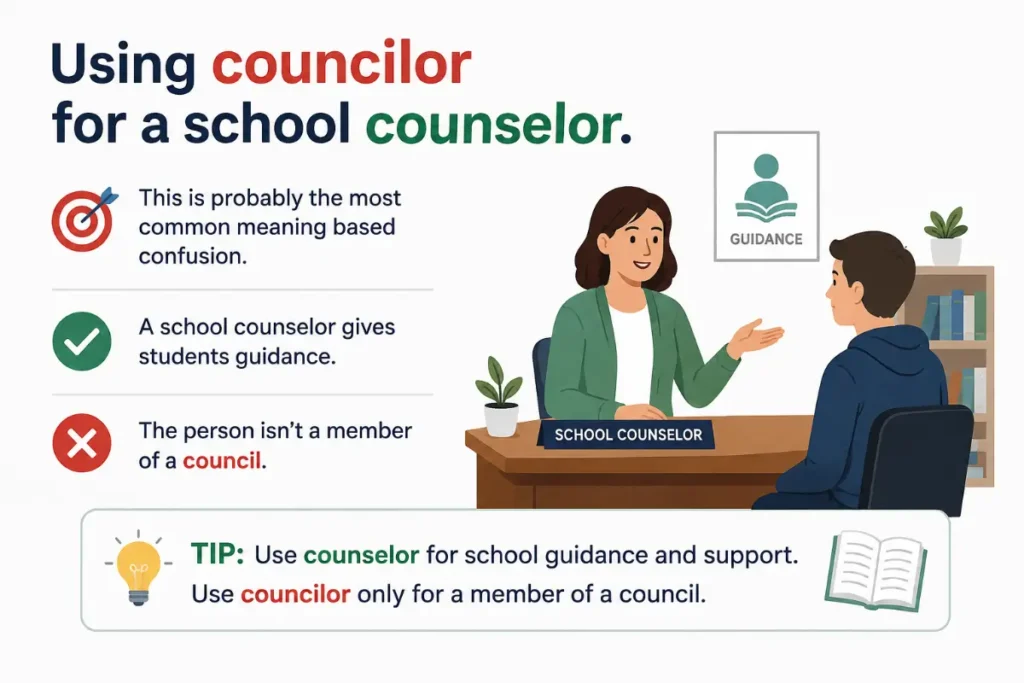
- Using councilor for a school counselor. This is probably the most common meaning based confusion. A school counselor gives students guidance. The person isn’t a member of a council.
- Using counselor for an elected official. A local government member is a councilor in American English. The word comes from council.
- Writing councelor. This spelling replaces the s with c. It can happen because the pronunciation doesn’t clearly reveal the spelling.
- Writing counsilor. This version blends the sounds and spelling patterns of counsel and council. It isn’t the standard spelling.
- Adding an unnecessary extra l. Writers familiar with British spelling may write counsellor in an American English document. British English does use counsellor so the form isn’t universally wrong. It simply doesn’t match standard American spelling.
There is also an interesting NLP angle here. Human language processing relies heavily on sound patterns context and familiar word shapes. Since counselor and councilor are pronounced the same for many speakers the brain can recognize the intended concept before the writer consciously selects the letters.
That creates a classic homophone problem. Your brain hears the right word but spelling requires you to identify the underlying meaning.
A simple semantic check solves it.
Think advice and choose counselor.
Think government group and choose councilor.
This approach works better than trying to memorize the spelling as an isolated string of letters.
Pronunciation Guide
In American English counselor is commonly pronounced /ˈkaʊn.sə.lɚ/. Cambridge gives this US pronunciation in its dictionary entry.
A simple syllable breakdown is:
coun sel or
An audio style approximation is:
KOWN suh ler
The first part sounds like count without the final t. The middle vowel is usually weak and unstressed. The final sound resembles the ending in words such as teacher or worker.
Councilor has essentially the same pronunciation in standard American English:
KOWN suh ler
That shared pronunciation explains the spelling confusion.
British English commonly uses the forms counsellor and councillor and Cambridge gives the corresponding British pronunciation as /ˈkaʊn.sə.lə/.
One common pronunciation mistake is to make the middle part too strong. Native speakers usually don’t pronounce every letter with equal force. The first syllable carries the main stress while the middle syllable is reduced.
If you’re learning English as a second language don’t worry if the two words sound identical. That’s normal. Focus on meaning when you write them.
Etymology and Word Origin
The history of these words explains why their spelling is so close.
Counselor dates back to Middle English. The Online Etymology Dictionary traces it to Middle English forms such as counseiler and to Old French conseillier meaning a counselor or adviser. The deeper root is Latin consilium which carried meanings related to plan opinion advice and deliberation.
The word counsel itself entered English from Old French and ultimately connects to Latin consilium. Its early meanings involved advice instruction consultation and deliberation. Over time the noun also developed a legal sense referring to a lawyer or lawyers representing someone in court.
Councilor has a different historical path even though the words are closely related. The Online Etymology Dictionary dates councilor to the early 15th century and describes it as an alteration of counselor influenced by the word council. The distinction between councilor as a member of a council and counselor as someone who counsels became established in modern English.
The word council is older. It entered English in the early 12th century through Anglo French and Old French forms related to Latin concilium meaning a meeting or gathering of people. The central idea was a group called together for consultation or deliberation.
So the modern distinction has a useful semantic pattern.
Counsel means advice or guidance.
Counselor means a person who gives counsel.
Council means an organized group that meets to deliberate or govern.
Councilor means a person who belongs to that council.
The spelling isn’t random. It reflects the meaning connection.
Regional Usage: US
American English normally uses counselor for someone who provides advice and councilor for a member of a council. These forms are standard in American dictionaries. Cambridge specifically labels counselor as the US spelling of counsellor and councilor as the US form of councillor.
This means an American school typically has a school counselor. A local government typically has a city councilor.
If you’re writing for a US audience these are the forms you should normally choose.
Need another quick comparison? Read Inbalance Or Imbalance Which Spelling Is Correct? (2026).
Regional Usage: UK
British English generally adds an extra l to both words. The usual forms are counsellor for someone who provides advice and councillor for a member of a council. Cambridge lists counsellor as mainly UK and identifies counselor as the usual US form. It likewise identifies councillor as the UK form of councilor.
The meaning doesn’t change simply because the spelling changes. The extra letter reflects regional spelling conventions.
So an American reader may write school counselor while a British reader may write school counsellor.
Regional Usage: AU
Australian English generally follows British spelling conventions in many words. The Australian Government Style Manual recommends using an Australian English dictionary consistently and explains that Australian spelling generally follows British spelling although exceptions exist.
For this word family Australian usage commonly favors counsellor and councillor. Australian government writing should follow the chosen approved dictionary and maintain consistency throughout a document.
The larger lesson is useful for editors. Regional spelling isn’t a mistake simply because it differs from American English. The audience and style guide determine the preferred form.
Regional Usage: CA
Canadian English is a little more complicated because it combines British and American spelling traditions. Canadian sources recognize the distinction between councilor and counselor and also use the British influenced forms counsellor and councillor. The Government of Canada specifically teaches the difference between council and counsel and between councillor and counsellor.
Canadian editorial guidance can favor counsellor and councillor in formal Canadian writing. Other Canadian sources recognize variation and recommend checking the style guide or dictionary used by the organization.
For a Canadian publication the safest editorial practice is consistency. Pick the spelling supported by the publication’s established Canadian style and use it throughout.
Grammar Rules and Part of Speech
Both counselor and councilor are nouns.
A noun names a person place thing or idea. These two nouns name people who have different roles.
Counselor can be used as the subject of a sentence.
The counselor helped the student.
It can also appear after a verb.
She became a counselor after completing her training.
It can take modifiers that explain the type of counselor.
The school counselor met with the parents.
The career counselor reviewed his resume.
The financial counselor explained the options.
Councilor works in the same basic grammatical way.
The councilor spoke at the meeting.
She became a councilor after winning the election.
The city councilor proposed a new transportation plan.
The word can also appear in titles or forms of address depending on the institution’s style.
When you use either word in a sentence don’t choose the spelling based on grammar. Both follow ordinary noun grammar. The meaning determines the spelling.
Punctuation doesn’t normally change the choice either.
You don’t need a comma simply because the word is counselor or councilor. Punctuation depends on the sentence structure.
For example:
The counselor met with the student.
The councilor met with residents.
Both sentences are grammatically simple. The only difference is the person’s role.

Real Life Usage Examples
Daily Talk
- I need to talk to my counselor before I choose my classes.
- The councilor stopped by the neighborhood meeting last night.
These examples show how naturally the words appear in everyday conversation. One person gives guidance while the other represents a council.
- Please contact your academic counselor if you need help selecting courses.
- The councilor will attend the community meeting on Thursday.
Professional email requires extra care because spelling errors can make a job title look careless. If you’re writing to an elected official use councilor when that is the official American spelling of the person’s role.
Academic Writing
- The school counselor helped students understand the college application process.
- The city councilor presented the findings during the public hearing.
Academic writing benefits from precise terminology. Using the wrong word can change the meaning of a sentence even when the grammar remains correct.
News Writing
- The counselor said students needed more support during the transition.
- The councilor said the proposal would improve public transportation.
News writers need to distinguish professional roles and political positions clearly. A counselor and a councilor may appear in the same story but they aren’t interchangeable.
Literature
- The young counselor listened patiently to the troubled traveler.
- The councilor entered the chamber before the debate began.
Literary writers can use both words to establish a character’s role. Context usually makes the distinction obvious even before the reader notices the spelling.
Related and Confused Terms
- At last. This phrase often describes something that happens after a long wait. It can overlap with finally but doesn’t refer to a counselor or councilor.
- Eventually. This means something happens after some time or after a series of events. It often focuses on the passage of time.
- Ultimately. This points to the final result or conclusion after considering several stages or factors.
- At the end. This phrase refers more directly to the final point of a period event or sequence.
- Conclusively. This means in a way that settles an issue or establishes something firmly.
- In the end. This phrase often introduces the final outcome of a situation.
- Lastly. This usually introduces the final item in a sequence or list.
- Finally. This can mean after a long wait at the last stage of a process or as the final point in a sequence.
These words belong to a different semantic field from counselor and councilor. They are useful here because language learners sometimes notice the similar opening sound of counselor and unrelated words such as finally. Sound similarity alone isn’t enough to establish meaning or spelling.
Expert Editor Insight
As a senior editor would tell you the most reliable way to distinguish these words is to stop listening to them and start looking at the concept behind them. If the person gives counsel then write counselor. If the person belongs to a council then write councilor. Professional dictionaries support this semantic distinction rather than treating the two forms as interchangeable. Merriam Webster separately defines the words while Cambridge clearly identifies their different roles and regional forms.
An especially useful editing technique is the root word test. Replace counselor mentally with adviser. If the sentence still makes sense then counselor may be correct. Replace councilor mentally with council member. If that replacement fits then councilor is probably the intended word.
Spellcheckers can help but they aren’t perfect semantic editors. A spellchecker may accept both forms because both are legitimate English words. Grammar software can also miss the error when the sentence is grammatically sound. The final check should come from meaning and context.
That is why this pair can slip past automated correction. The problem isn’t always spelling in the narrow sense. It’s word selection.
A Simple Memory Trick
If you still mix up these words the easiest trick is to remember their roots.
Counselor equals counsel.
Councilor equals council.
Now attach a meaning to each root.
Counsel means advice.
Council means a group.
So a counselor is a person connected with advice.
A councilor is a person connected with a council.
Picture a school office with a counselor helping a student choose classes. Then picture a city hall meeting where a councilor votes on a new proposal. The two mental pictures are completely different. That makes the spelling difference easier to remember.
Another useful test is to substitute a simpler phrase.
If you can replace the word with adviser then counselor is probably correct.
If you can replace it with council member then councilor is probably correct.
This trick is especially useful because it relies on meaning rather than memorization.
Why This Confusion Happens
The English language has many pairs that sound alike but carry different meanings. Counsel and council are classic examples. Their derivatives counselor and councilor inherit that problem.
The words also share a long historical connection. Their histories overlap through French and Latin roots and later English spelling changes. The Online Etymology Dictionary notes that councilor developed as an alteration of counselor under the influence of council.
That history helps explain why the words look so similar. English spelling wasn’t designed from scratch as a perfectly organized system. It developed over centuries through contact between languages regional traditions pronunciation changes and spelling habits.
So don’t feel bad if this pair makes you pause. Even experienced writers can hesitate when two legitimate words have nearly identical pronunciation.
The solution isn’t to memorize hundreds of spelling rules. Learn the semantic relationship.
Counsel gives advice.
Council makes decisions.
Once that distinction becomes automatic the spelling usually follows.
Final Practical Check
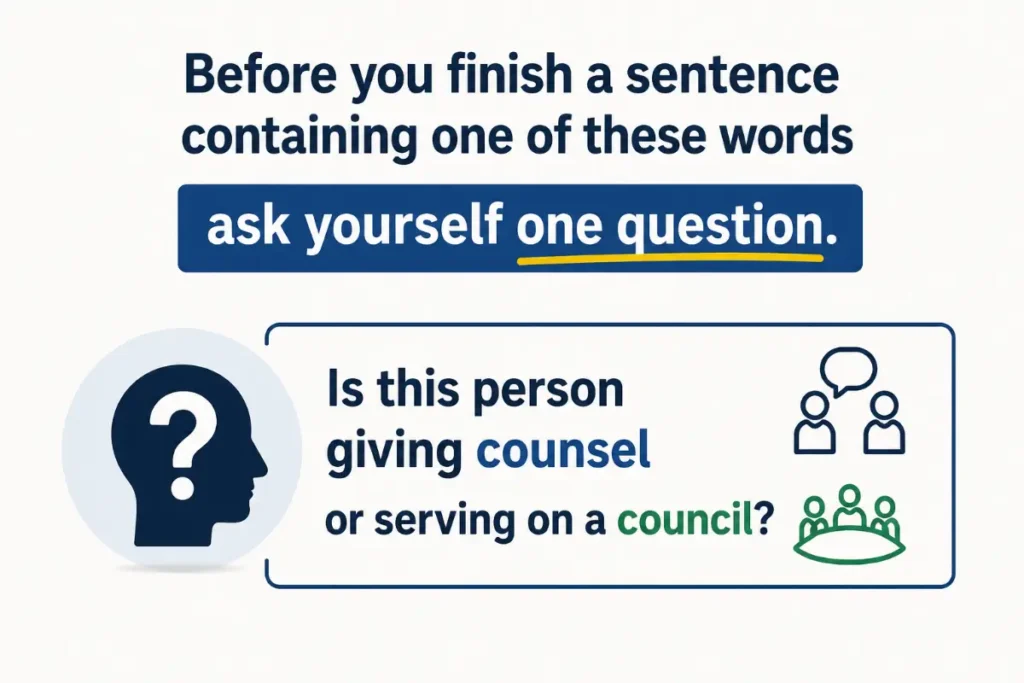
Before you finish a sentence containing one of these words ask yourself one question.
Is this person giving counsel or serving on a council?
If the answer is advice guidance therapy career help legal advice or another form of counsel then choose counselor.
If the answer is membership in a city town county or other council then choose councilor.
This small check can prevent a surprisingly noticeable spelling mistake. It also works better than relying on spellcheck because both words are legitimate dictionary entries.
Many readers also check Pentoxide vs Pentaoxide Which Spelling Is Correct? 2026.
Conclusion
The difference between counselor vs councilor is mainly about meaning, not pronunciation. A counselor is someone who provides advice, guidance, or professional support, while a councilor is a member of a council, often an elected local government representative. Both spellings are correct in American English, but they aren’t interchangeable. British English commonly uses counsellor and councillor.
A simple memory trick can make the difference easy to remember. Think counsel = advice and council = governing group. When proofreading, focus on the person’s role first. Once you identify what the person does, choosing the correct spelling becomes much easier.
FAQs
What Is the Difference Between Counselor and Councilor?
Counselor refers to someone who gives advice, guidance, or support. Councilor refers to a person who serves on a council and helps make decisions or create policies.
Is Counselor Correct for a School Advisor?
Yes. Counselor is the correct spelling for someone who provides guidance and support to students at a school.
Does Councilor Mean a Member of a Council?
Yes. Councilor refers to someone who serves as a member of a council or governing body.
How Can You Remember Counselor and Councilor?
Remember counselor with counsel, which means advice or guidance. Remember councilor with council, which refers to a group that makes decisions or governs.
Can Counselor Refer to a Mental Health Professional?
Yes. Counselor can refer to a professional who provides counseling and emotional or psychological support.
Can Counselor and Councilor Be Used Interchangeably?
No. These words have different meanings, so you shouldn’t use them interchangeably. Use counselor for someone who provides advice or counseling and councilor for a member of a council.
Which Spelling Should You Use for Someone Who Gives Advice?
Use counselor when you mean someone who provides advice, guidance, or counseling.
Which Spelling Refers to a Government Official?
Use councilor for a member of a city, town, or other governing council.