
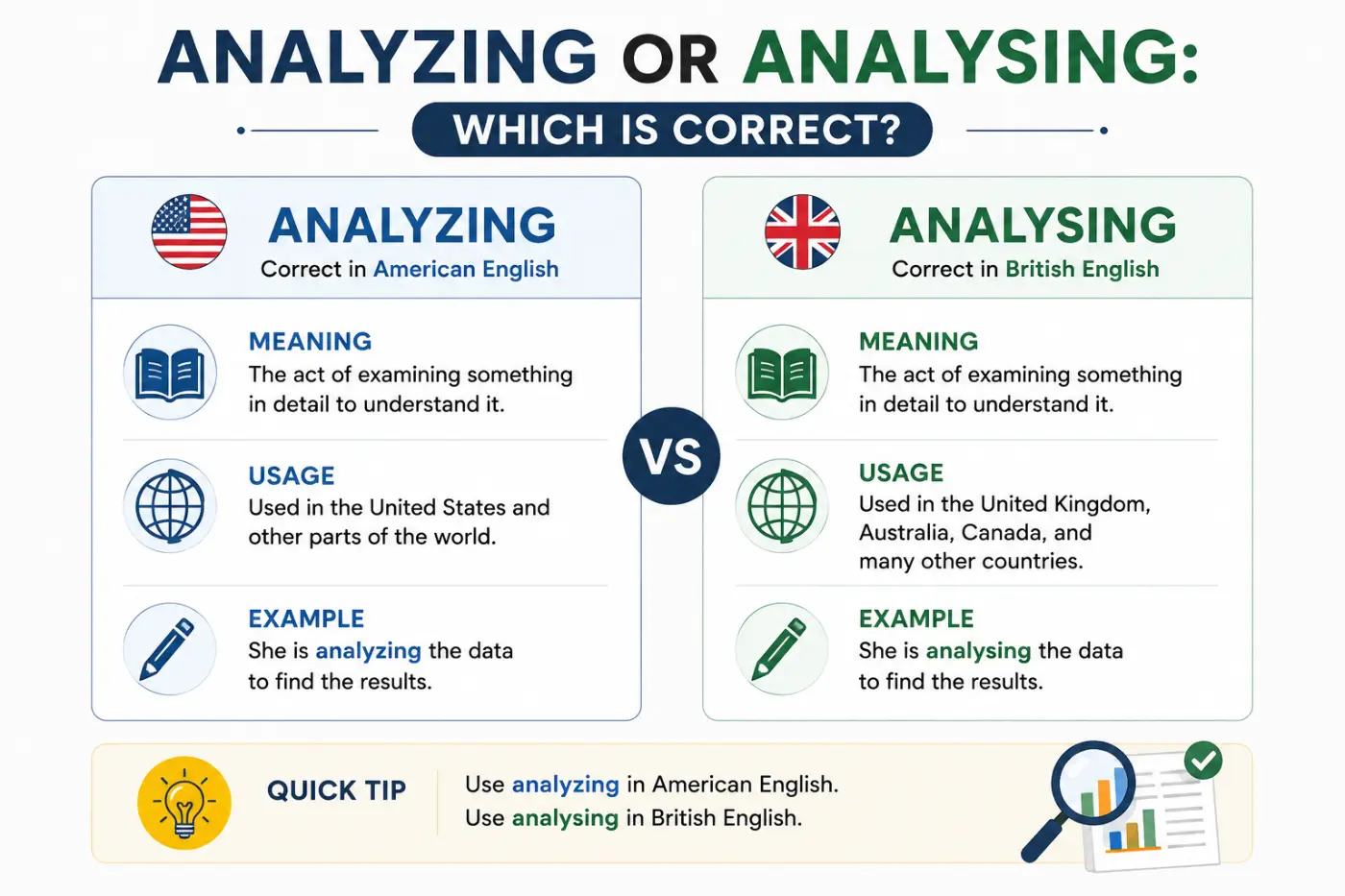
Have you ever typed a word and stopped because two spellings looked right? Analyzing or analysing is a classic example. The good news is that both spellings are correct. The difference comes from regional English rather than meaning or grammar. Analyzing is the standard American English spelling. Analysing is the standard British English spelling and is also common in other varieties that follow British conventions.
The confusion happens because English uses different spelling systems across countries. Words such as analyze and analyse follow the same pattern. The same regional difference appears in analyzing and analysing. You aren’t choosing between a correct word and a wrong word. You’re choosing the spelling that fits your variety of English.
This guide explains the difference in plain English. You’ll learn what each form means, how to pronounce it, where each spelling is used, how the verb works in a sentence, and why the spelling changes from one form of English to another. You’ll also see practical examples that show how native speakers use the word in everyday writing.
For another common grammar confusion, see Thank You For The Information Correct Usage And Meaning.
Quick Definition
Analyzing and analysing are both correct forms of the verb analyze or analyse. Analyzing follows American English spelling rules. Analysing follows British English spelling rules and is common in British, Australian, and Canadian English. The meaning is the same in both forms: examining something carefully to understand it.
Quick Answer
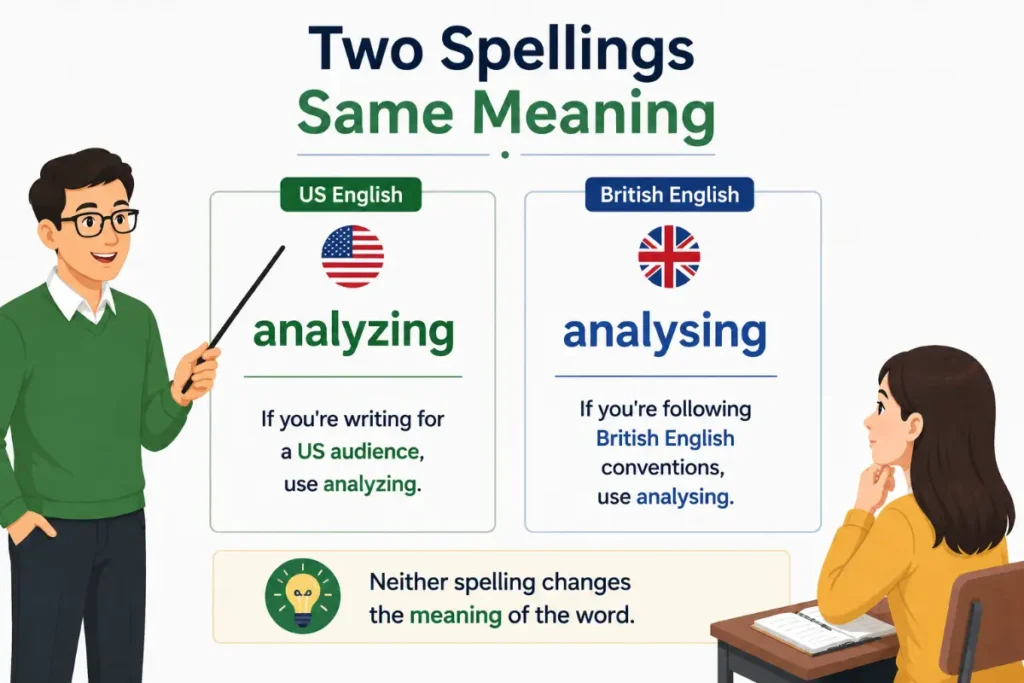
If you’re writing for a US audience, use analyzing. If you’re following British English conventions, use analysing. Neither spelling changes the meaning of the word.
Cambridge identifies analyze as the US spelling of analyse and identifies analysing as the present participle of analyse.
Comparison Table Analyzing or Analysing
| Correct Form | Meaning | Part of Speech | Origin | Usage Frequency | Formality | Common Contexts | Example |
|---|---|---|---|---|---|---|---|
| Analyzing | Examining something carefully to understand it | Verb present participle | From analyze | Very common in American English | Neutral | US writing research business education | She is analyzing the survey results. |
| Analysing | Examining something carefully to understand it | Verb present participle | From analyse | Very common in British English | Neutral | UK writing research business education | She is analysing the survey results. |
The two forms have the same meaning and grammatical function. The spelling difference reflects the regional forms of the base verb. Cambridge lists analyze as the American spelling of analyse. Its grammar guidance also identifies analyse and analyze as a standard British and American spelling pair.
Meaning and Definition
Meaning of Analyzing
Analyzing means examining something carefully and systematically. The goal is usually to understand its parts, meaning, causes, patterns, or significance. For example, a student might be analyzing a poem to understand its themes. A scientist might be analyzing a sample to identify its contents. A business analyst might be analyzing sales data to find a useful pattern.
The word describes an activity that is happening now or around a particular time. It is the present participle form of analyze. In American English, the spelling uses z in the base verb and continues with analyzing.
Meaning of Analysing
Analysing has exactly the same meaning as analyzing. It means studying or examining something carefully to understand it better. The only difference is the spelling. British English normally uses analyse rather than analyze. When the verb takes the ing ending, the result is analysing.
Cambridge defines analyse as studying or examining something in detail to discover or understand more about it. So these sentences communicate the same idea.
She is analyzing the evidence.
She is analysing the evidence.
The first sentence follows American spelling. The second follows British spelling.
Meaning of Analyze and Analyse
The difference becomes easier when you look at the base verb.
American English uses analyze.
British English uses analyse.
The present participle follows the same regional pattern.
American English uses analyzing.
British English uses analysing.
This pattern also appears in related forms such as analyzed and analysed. The spelling system stays consistent throughout the word family.
Key Differences Explained
Spelling
The main difference is the letter z versus s.
American English writes analyze and analyzing.
British English writes analyse and analysing.
The difference isn’t a pronunciation difference. Native speakers generally pronounce both forms the same way.
Grammar Role
Both forms are present participles of the verb analyze or analyse. They can work with forms of be to create continuous tenses.
For example:
The researcher is analyzing the data.
The researcher was analysing the data.
They can also function as participles that describe an activity.
The team spent hours analyzing the results.
Meaning
There is no difference in meaning. Both forms describe careful examination. A person can analyze information. A researcher can analyze evidence. A student can analyze an argument. A doctor can analyze test results. The spelling changes by regional convention but the underlying meaning remains stable.
Tone
Neither form is more intelligent, formal, academic, or sophisticated. Some writers mistakenly assume that the spelling with s sounds more formal because British English is often associated with formal academic writing. That isn’t a reliable rule.
American academic writing uses analyzing all the time. British academic writing uses analysing.
Context
Your audience should guide the spelling.
If you’re writing for readers in the United States, analyzing is normally the better choice.
If you’re writing for readers in the United Kingdom, analysing fits the expected spelling system.
For international publications, consistency matters more than choosing one form as universally superior.
Which Spelling Is Correct?
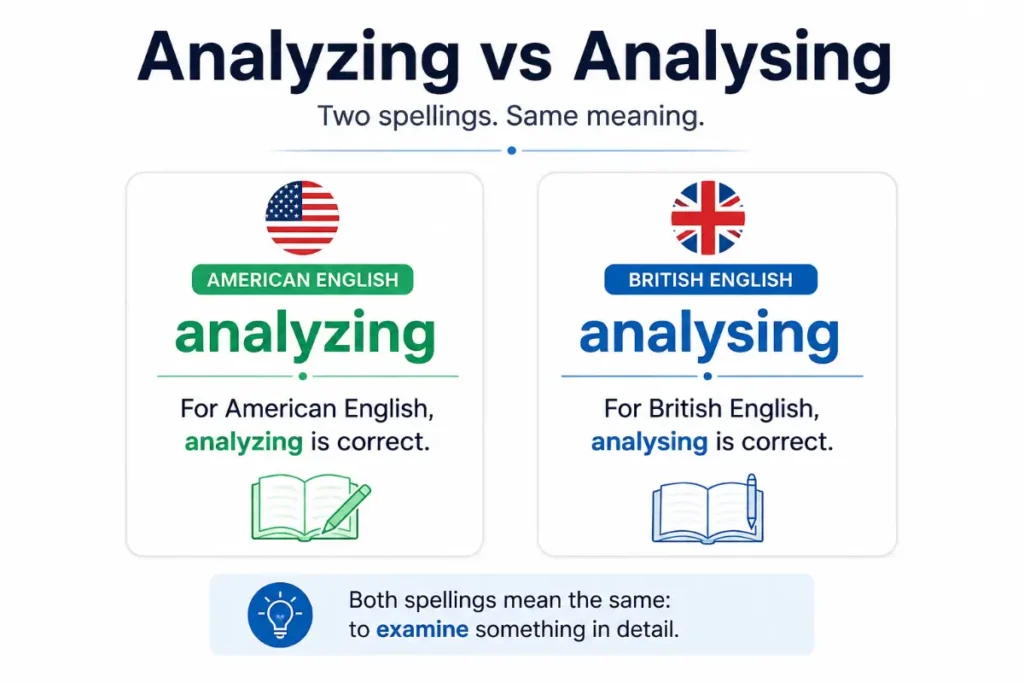
Both spellings are correct.
For American English, analyzing is correct.
For British English, analysing is correct.
This distinction follows the established spelling difference between analyze and analyse. Cambridge explicitly describes analyze as the US spelling of analyse. Its spelling guidance gives analyse as the British form and analyze as the American form. That dictionary evidence gives you a reliable editorial rule. Don’t treat the s spelling as an error in British writing or the z spelling as an error in American writing.
The bigger mistake is mixing regional conventions without a reason. For example, an American article that uses analyze in one paragraph and analyse in another looks inconsistent. The same problem occurs in British writing that switches between analyzing and analysing. A professional editor usually chooses one spelling system and applies it consistently.
Sentence Examples
Here are natural examples using the American form.
- The researcher is analyzing the survey results.
- We spent the afternoon analyzing the financial data.
- She is analyzing the poem for her English class.
- The doctor is analyzing the patient’s test results.
- Our team is analyzing customer feedback.
- He was analyzing the problem when the manager called.
- The scientists are analyzing samples from the river.
- I’m analyzing the report before I make a recommendation.
- The students are analyzing the author’s argument.
- The company is analyzing its sales figures to understand the decline.
Now compare the same idea in British English.
- The researcher is analysing the survey results.
- We spent the afternoon analysing the financial data.
- She is analysing the poem for her English class.
- The doctor is analysing the patient’s test results.
- Our team is analysing customer feedback.
Notice something useful here. Nothing else needs to change. You don’t need a different grammar structure. You don’t need a different pronunciation.
Examples of the Common Misspelling Finaly
The spelling finaly does not represent a standard form of analyze or analyse. It is also unrelated to the correct forms analyzing and analysing.
People often create incorrect spellings by dropping a letter or relying too heavily on how a word sounds. Similar mistakes appear throughout English because spelling and pronunciation don’t always match perfectly.
- Incorrect: The team is finaly analyzing the report.
- Correct: The team is finally analyzing the report.
- Incorrect: She is finaly ready to analyze the results.
- Correct: She is finally ready to analyze the results.
- Incorrect: We are finaly analysing the evidence.
- Correct: We are finally analysing the evidence.
The important distinction is that finaly is not a regional spelling of finally. It is simply a misspelling.
Common Mistakes and Misspellings
English learners and native speakers alike can make spelling mistakes with words that contain repeated letters or unusual letter patterns. The problem becomes more noticeable when a word is typed quickly.
Mistake 1 Using Analyse in American Writing
An American writer may use analysing because they have encountered British sources or international publications. The form isn’t wrong in itself. It simply doesn’t match standard American spelling.
If you’re writing specifically for a US audience, analyzing is the natural choice.
Mistake 2 Using Analyze in British Writing
The reverse can happen in British writing. Analyze is widely understood and is standard American English. British editorial conventions normally prefer analyse.
The key isn’t to label one form correct and the other incorrect. The key is to match your chosen variety.
Mistake 3 Mixing S and Z Spellings
A writer might use analyze in one paragraph and analyse in another. This creates an inconsistent style.
The same issue can appear with analyzed and analysed or analyzing and analysing.
Choose a system and stick with it.
Mistake 4 Confusing Analysis With Analyze
Analysis is a noun. Analyze and analyse are verbs.
For example:
The analysis was detailed.
The researcher will analyze the data.
The British version would be:
The analysis was detailed.
The researcher will analyse the data.
The noun analysis keeps the same spelling in both major varieties. The regional difference appears in the verb.
Mistake 5 Treating Pronunciation as a Spelling Guide
Many English words don’t sound exactly as they look. Trying to spell every word according to sound can lead to errors.
The pronunciation of analyzing and analysing is essentially the same. The spelling difference comes from established English conventions rather than a difference in speech.
Many readers also check How To Spell Koozie in 2026.
Pronunciation Guide
The pronunciation of analyzing and analysing is essentially identical.
Cambridge gives the pronunciation of analyze as /ˈæn.ə.laɪz/.
A useful syllable breakdown is:
AN uh lyze ing.
The strongest stress falls on the second part of the base verb.
You can think of the word as:
AN + uh + LYZE + ing.
The ending sounds like ing as in reading or writing.
The z sound belongs to the spoken form of the final part of analyze and analyse. The spelling difference between z and s doesn’t create a different pronunciation here.
A common mistake is to pronounce the word as if the spelling difference must change the sound. It doesn’t.
Another mistake is placing too much stress on the first syllable. Natural English pronunciation keeps the main stress around the lyze part.
Etymology and Word Origin
The history of analyze is much older than modern American and British spelling differences.
The word is connected to Greek analysis. Etymonline traces analysis to Greek analysis meaning a breaking up or loosening. The Greek verb analyein carried the idea of loosening or taking something apart.
That original idea fits the modern meaning surprisingly well. When you analyze something you often break a complicated subject into smaller parts so you can understand it more clearly.
The English verb analyze appeared around the beginning of the seventeenth century. Etymonline dates it to about 1600 and connects it with French analyser and the noun analyse. The general sense of examining something closely developed later.
British English retained the spelling analyse. American English developed and standardized the spelling analyze.
This is part of a broader pattern. English has many spelling pairs in which British English uses s while American English uses z.
Examples include:
analyse and analyze.
criticise and criticize.
organise and organize.
realise and realize.
These patterns aren’t random mistakes. They reflect different spelling conventions that developed within English.
Regional Usage
United States
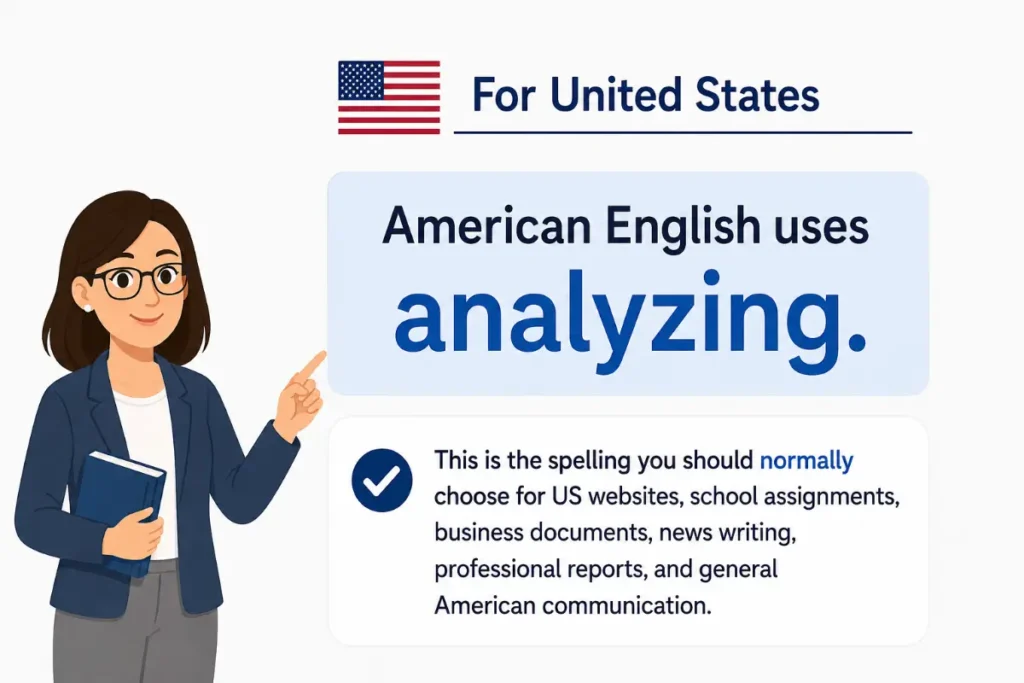
American English uses analyzing. This is the spelling you should normally choose for US websites, school assignments, business documents, news writing, professional reports, and general American communication.
American dictionaries and style systems generally follow the z spelling in analyze and related forms. If your target reader is American, analyzing is the safest and most natural choice.
United Kingdom
British English uses analysing. You will commonly see it in British newspapers, universities, government writing, books, and professional documents. Cambridge identifies analyse as the UK form of analyze and analysing as its present participle. The meaning and pronunciation remain the same.
Australia
Australian English generally follows British spelling conventions in words such as analyse and analysing. That means analysing is the expected form in most Australian professional and educational writing. Individual publications can have their own style guides, but the British based spelling is the normal starting point.
Canada
Canadian English can show variation because Canadian spelling has influences from both British and American English. Analyse and analysing appear in Canadian usage. At the same time, American forms can appear in some contexts. For a Canadian publication, follow its established style guide. Consistency should guide the final decision.
Grammar Rules and Part of Speech
Analyzing and analysing are present participles. They come from the verbs analyze and analyse. A present participle can appear in several grammatical structures.
Continuous Tenses
The most common use involves a form of be.
She is analyzing the report.
They were analysing the evidence.
We have been analyzing the results.
The participle describes an action in progress or an activity connected to a particular period.
After Certain Verbs
The form can also appear after verbs that naturally take an activity as their object.
They spent the morning analyzing the data.
She continued analysing the results.
He kept analyzing every detail.
As a Participial Modifier
The word can describe an activity performed by someone or something.
The team analyzing the survey found an unexpected trend.
The researchers analysing the samples discovered a pattern.
The placement should make the relationship clear. Avoid putting the participle so far from its subject that the reader has to guess who is doing the analyzing.
Punctuation
You don’t need a comma simply because the word is analyzing or analysing.
Use normal punctuation based on the structure of the entire sentence.
For example:
The researchers are analyzing the evidence carefully.
There is no special punctuation rule attached to the word.
If a sentence begins with a participial phrase, normal sentence punctuation applies.
Analyzing the data carefully, the researchers found several errors.
The comma belongs to the introductory phrase structure rather than to the word analyzing itself.
Real Life Usage Examples
Daily Talk
People often use the word when talking about decisions, situations, or information.
- I’m analyzing what happened before I decide what to do next.
- She’s been analyzing every detail of the conversation.
In casual speech, the word can sometimes suggest that someone is thinking too deeply about something.
You don’t need to analyze every little thing.
That usage is perfectly natural.
Professional emails often use analyzing when discussing reports or information.
- We’re analyzing the latest sales numbers and will share the results soon.
- I’m analyzing the customer feedback before recommending any changes.
In British English, the same sentences would use analysing.
Academic Writing
Academic writing frequently uses the word because researchers study evidence and information systematically.
- The researchers are analyzing the results of the experiment.
- The study examines how students are analyzing complex texts.
The word works naturally in research papers because it describes a core part of academic investigation.
News Writing
News reports often describe experts or organizations examining information.
- Officials are analyzing the available evidence.
- Investigators are analyzing data collected from the site.
The British version would use analysing.
Literature
Literary criticism also uses the verb regularly.
- The essay is analyzing the novel’s treatment of memory.
- The critic spends several pages analyzing the character’s motivations.
The word works well because literary criticism often involves examining details and interpreting their significance.
Related and Confused Terms
Understanding nearby words can help you choose the right expression.
At Last
At last usually emphasizes that something happened after a long wait.
After months of searching, they finally found the missing document.
At last, they found the missing document.
The two expressions can overlap, but at last often carries stronger emotional relief.
Eventually
Eventually means something happened after some time or after a series of events.
She eventually accepted the offer.
It focuses on the outcome rather than simply marking the final stage of a process.
Ultimately
Ultimately refers to the final result or conclusion.
The decision ultimately depends on cost.
It often sounds more analytical or formal than finally.
At The End
At the end refers to the final point in a sequence or period.
It often needs a noun or noun phrase after it.
Conclusively
Conclusively means in a way that settles an issue with strong evidence.
The evidence conclusively proved the claim.
It is more formal and stronger than finally.
In The End
In the end often introduces the final result after considering events or choices.
It can suggest that the outcome came after uncertainty or discussion.
Lastly
Lastly usually introduces the final item in a list or series.
It doesn’t have exactly the same function as finally.
Analysis
Analysis is the noun related to analyze and analyse.
The analysis revealed several problems.
Keeping the noun and verb distinction clear will prevent many grammar mistakes.
Expert Editor Insight
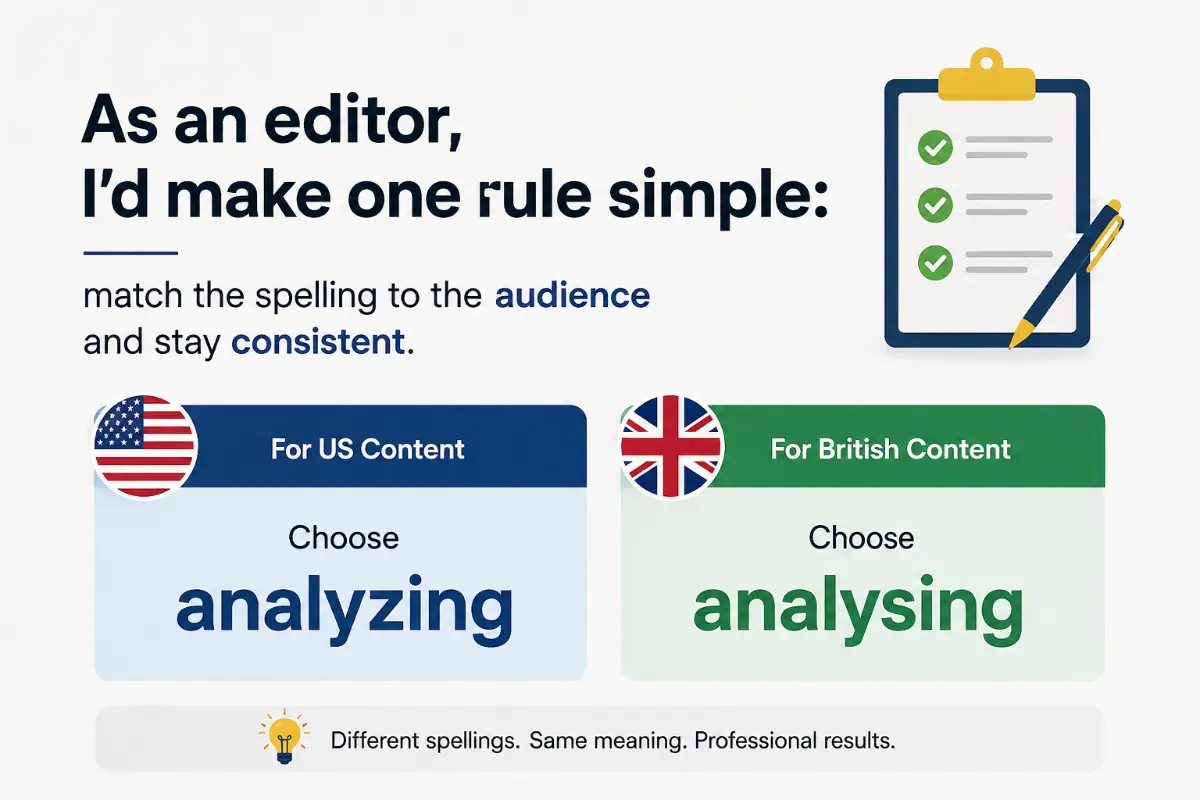
As an editor, I’d make one rule simple: match the spelling to the audience and stay consistent. For US content, choose analyzing. For British content, choose analysing. Don’t switch between them just because your source material uses a different variety. Professional spellcheckers and grammar tools may flag one form based on the language setting of the document. If a US English setting flags analysing, that doesn’t automatically mean the word is wrong. It can simply mean the software expects American spelling. The same principle works in reverse for British English.
An especially useful editorial check is to inspect the whole word family. If your document uses analyze, then analyzing and analyzed should normally follow the same American pattern. If it uses analyse, then analysing and analysed should follow the British pattern. Consistency across related forms is a stronger sign of careful editing than trying to decide which regional spelling looks more correct.
Many readers also check Attornies or Attorneys Which Spelling Is Correct in 2026.
Conclusion
Analyzing and analysing are both correct. The difference comes from regional spelling rather than meaning or grammar. American English uses analyzing while British English uses analysing. Australian English generally follows the British pattern, while Canadian usage can show influence from both systems.
The two forms mean the same thing and are pronounced essentially the same way. They both function as the present participle of analyze or analyse.
The practical rule is simple. If you’re writing for a US audience, use analyzing. If you’re following British spelling conventions, use analysing. Then check related forms such as analyze and analyzed so your spelling stays consistent. That small editorial habit can make your writing look much more polished.
FAQs
Is finaly a real word?
No. Finaly isn’t a standard English spelling. It is normally a misspelling of finally. The correct spelling contains two l letters before the y. This mistake is easy to make because English spelling doesn’t always match pronunciation perfectly. If you mean the word that describes something happening at the end of a process or after a delay, use finally.
What does finally mean?
Finally is an adverb that commonly means at last or after a period of time. It can describe the final event in a sequence or introduce the last point in an argument. For example, you might say that the train finally arrived. You can also say finally when presenting the last item in a series.
Analyzing or analysing which is correct?
Both are correct. Analyzing is the standard American English spelling. Analysing is the standard British English spelling and is also common in other varieties that follow British conventions. The two forms have the same meaning, grammar, and pronunciation. Your choice should depend on the English variety used by your audience and publication.
How do you pronounce analyzing?
Analyzing is pronounced approximately AN uh lyze ing. Cambridge gives analyze as /ˈæn.ə.laɪz/. The pronunciation of analysing is essentially the same. The difference between the two written forms doesn’t create a meaningful pronunciation difference. The main stress falls on the lyze part of the word.
Can analyzing start a sentence?
Yes. Analyzing can begin a sentence when it introduces a participial phrase. For example, Analyzing the evidence carefully, the researchers found a major error. The opening phrase describes what the researchers were doing. Make sure the grammatical subject that follows the comma is also the person or thing performing the action.
What is a synonym for analyzing?
Depending on the context, synonyms include examining, studying, evaluating, assessing, reviewing, interpreting, investigating, and breaking down. The best choice depends on what kind of analysis you mean. Examining is broad and natural. Evaluating suggests judging quality or value. Investigating suggests looking for facts or causes. Interpreting focuses more on explaining meaning.
Why do people misspell analyzing?
People can misspell analyzing because the word has several syllables and because the pronunciation doesn’t provide a perfect spelling guide. Regional spelling also creates confusion. Someone familiar with British English may expect analyse and analysing while an American writer expects analyze and analyzing. Typing quickly can add another layer of error.
Is analyzing suitable for formal writing?
Yes. Analyzing is completely appropriate in formal American English. It appears naturally in academic research, business reports, scientific writing, journalism, professional communication, and government documents. The British equivalent analysing is equally suitable in formal British English. The important editorial rule is consistency. Choose the spelling system that fits your audience and apply it throughout the document.