
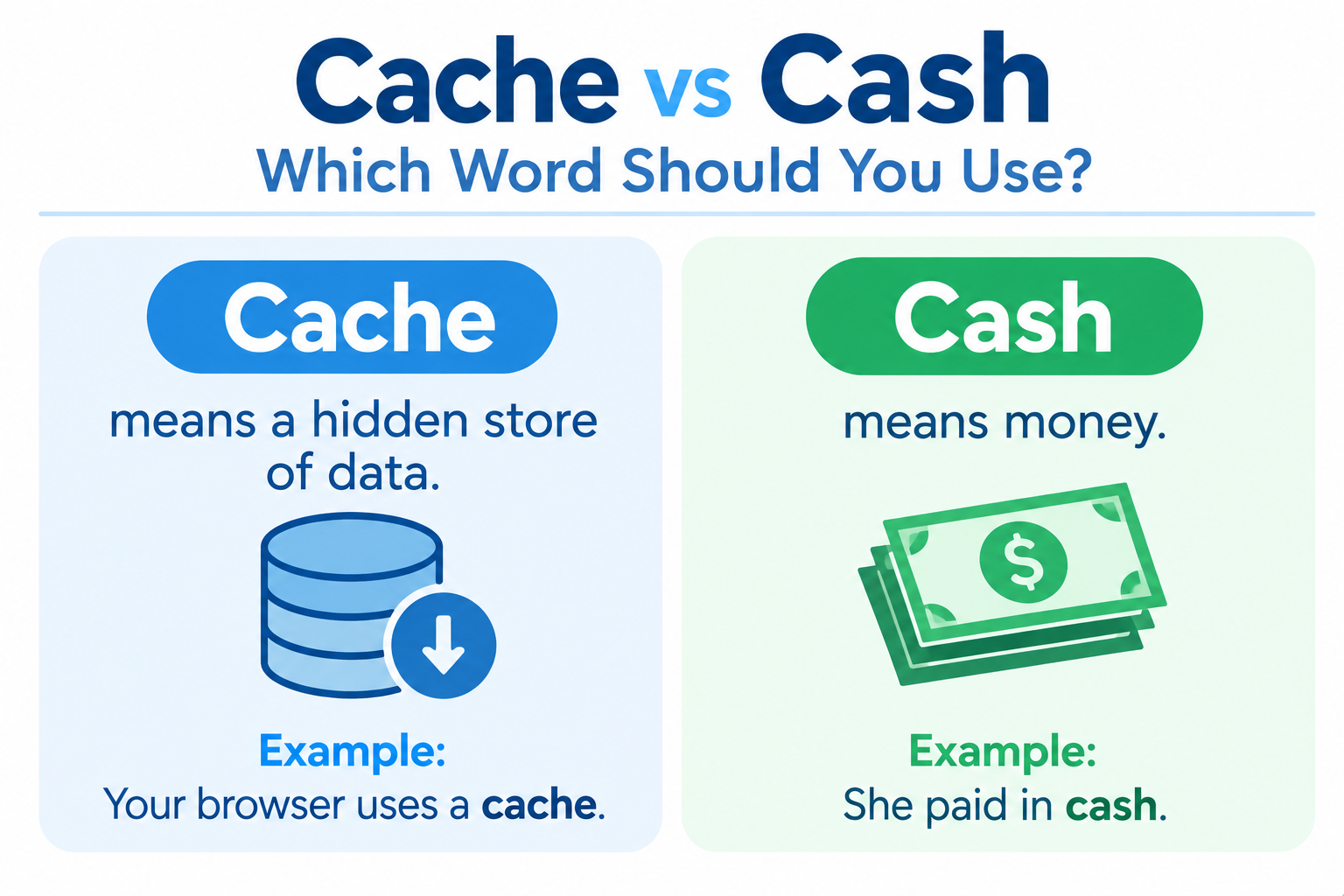
If you have ever paused while writing cache vs cash, you are not alone. These two words sound exactly alike, but they have very different meanings. One usually refers to stored items or saved computer data, while the other means money in the form of bills and coins. Choosing the wrong spelling can change the meaning of your sentence completely.
The confusion comes from pronunciation. Both words are commonly pronounced like “cash,” so you cannot rely on sound alone to decide which spelling belongs in your sentence. You need to look at the context. Are you talking about money, a hidden supply of goods, or information saved by a computer? Each situation points to a different word.
This guide explains both meanings, their origins, pronunciation, grammar, and everyday uses. You will also find clear examples, common mistakes, and simple ways to remember the difference. By the end, you should be able to choose the right spelling with confidence in emails, schoolwork, business writing, and casual conversations.
Need another quick comparison? Read Successfully or Succesfully Which Spelling Is Correct.
Quick Answer
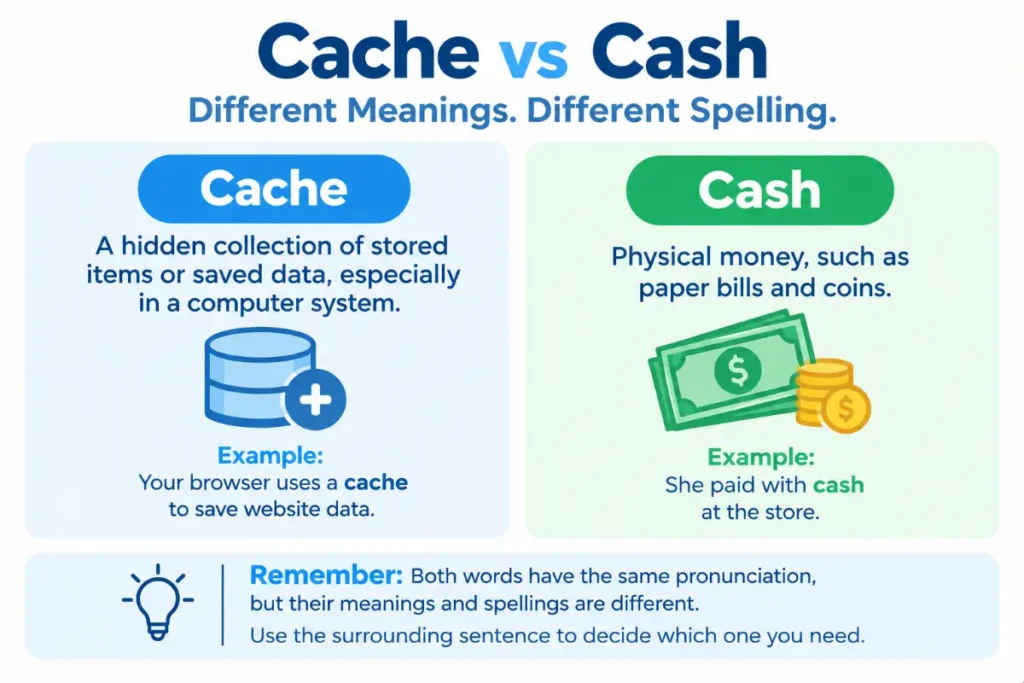
Cache means a hidden collection of stored items or saved data, especially in a computer system. Cash means physical money, such as paper bills and coins. Both words have the same pronunciation, but their meanings and spellings are different. Use the surrounding sentence to decide which one you need.
Comparison Table
| Feature | Cache | Cash |
|---|---|---|
| Meaning | A stored collection of items or data | Money in bills and coins |
| Part of speech | Noun and verb | Noun and verb |
| Pronunciation | /kæʃ/ | /kæʃ/ |
| Origin | French, from a word meaning hiding place | French, from a word associated with a money box |
| Main context | Computing, storage, hidden supplies | Shopping, banking, payments |
| Formality | Standard English | Standard English |
| Common phrase | Browser cache | Cash payment |
| Example | Clear your browser cache. | I paid in cash. |
Both spellings are correct English words. Neither is a misspelling of the other. The difference lies entirely in meaning and context.
Meaning and Definition
What Does Cache Mean?
A cache is a collection of things stored for future use. The word often describes a hidden supply of useful items, such as food, equipment, money, or weapons. It also has a major role in computing, where it refers to temporary storage that helps a device or program access information faster.
As a noun, it identifies the stored collection or the place where something is kept. As a verb, it means to store something in a hidden or convenient place.
Here are a few examples:
- The hikers discovered a cache of food near the mountain trail.
- Your browser stores website information in a cache.
- The team created a cache of emergency supplies.
- The application uses cached data to load pages faster.
In technology, the term usually refers to data saved so a computer does not need to retrieve the same information repeatedly. For example, your browser may save images, page elements, and other website files. When you revisit a site, the browser can use those saved files instead of downloading everything again.
This can make websites load faster and reduce repeated requests to a server. However, old or damaged stored information can sometimes cause display problems. That is why support teams may ask users to clear their browser storage.
What Does Cash Mean?
Cash refers to money that people can use directly for purchases and payments. In everyday American English, it usually means physical bills and coins rather than credit cards, checks, or electronic transfers.
As a noun, it describes money itself. As a verb, it can mean exchanging a check for money or receiving money from a financial instrument.
Examples include:
- I keep some cash in my wallet.
- The store accepts cash and credit cards.
- She paid cash for the used bicycle.
- He went to the bank to cash his check.
The word also appears in many financial expressions. You may see phrases such as cash flow, cash payment, cash register, cash withdrawal, and cash balance. These expressions relate to money, payments, or the movement of funds.
In business, cash can also describe available money that a person or company can use. For example, a company may have enough cash to cover its monthly expenses.
Is Cache a Real Word?
Yes. It is a standard English word with established meanings in general language and computing. It is not simply a technical spelling or a modern internet term.
The word can describe a hidden supply of objects or a stored collection of information. Dictionaries recognize both the noun and verb forms. Its use in technology has become especially common because computers and online services rely on temporary data storage.
Is Cash a Real Word?
Yes. It is a standard English word used in everyday conversation, business, banking, and financial writing. It refers mainly to money available for direct use.
The word has several common grammatical uses. You can have cash, pay cash, carry cash, deposit cash, or cash a check. These expressions all relate to money and financial transactions.
Key Differences Explained
Although the two words sound the same, their meanings are not interchangeable. Understanding a few basic differences will help you choose the right spelling.
1. Spelling
The first word contains the letters C, A, C, H, and E. The second contains C, A, S, and H.
The extra letters in the first word do not change its pronunciation. This is why people sometimes type one spelling when they mean the other.
2. Meaning
The first word relates to storage. It may describe a hidden collection of objects or temporary computer data.
The second relates to money. It usually describes bills and coins, although it can also refer more broadly to money available for immediate use.
3. Grammar
Both words can function as nouns and verbs.
For example:
- Noun: The cache contains old photographs.
- Verb: They cache information for later use.
- Noun: She withdrew cash from the bank.
- Verb: He needs to cash the check.
Their grammatical roles are similar, but their meanings remain distinct.
4. Pronunciation
Both words are pronounced /kæʃ/. They rhyme with words such as dash, flash, and splash.
This makes them homophones. Homophones are words that sound alike but have different meanings and often different spellings.
5. Formality
Both forms are appropriate in formal and informal writing. You can use them in academic papers, business reports, technical documents, emails, and everyday messages.
The key is to match the spelling to the intended meaning.
6. Context
Context usually makes the correct choice clear.
If a sentence mentions a browser, website, processor, server, or saved information, the storage related term is likely correct. If it mentions a wallet, bank, payment, purchase, or financial transaction, the money related term is usually needed.
7. Regional Usage
There is no major spelling difference between American and British English for these words. Both forms are standard in the United States, the United Kingdom, Canada, and Australia.
8. Standard vs. Nonstandard Usage
Neither word is nonstandard. Both are recognized English words. The mistake happens when someone uses one in place of the other.
For example, writing “I paid by cache” in a sentence about a store payment is incorrect because the sentence requires the word for money.
Which Form Is Correct?
Both spellings are correct. Your intended meaning determines which one belongs in the sentence.
Use the storage related word when discussing:
- Saved computer information.
- Temporary files.
- Hidden supplies.
- Stored collections of objects.
- Data kept for faster access.
Use the money related word when discussing:
- Paper bills and coins.
- Payments made directly.
- Money kept in a wallet.
- Bank withdrawals.
- Financial transactions.
English dictionaries treat these as separate words with different definitions. Their identical pronunciation does not make them interchangeable.
A useful editing habit is to read the entire sentence before choosing a spelling. If the sentence describes stored information or a hidden collection, select the first form. If it describes money or payment, select the second.
Sentence Examples
Here are ten natural examples showing how each word works in different situations.
Examples Using Cache
1. Everyday conversation: I found a cache of old family photos while cleaning the attic.
2. Text message: My browser is acting strangely, so I am going to clear its cache.
3. Workplace communication: Please clear the application cache before testing the updated version.
4. School assignment: The researchers discovered a cache of historical documents inside the building.
5. Academic writing: The processor uses a cache to reduce the time required to access frequently used data.
Examples Using Cash
6. Everyday conversation: Do you have enough cash to pay for lunch?
7. Text message: I will bring cash so we can split the bill easily.
8. Workplace communication: The store manager counted the cash at the end of the shift.
9. Formal writing: The business maintains enough cash to cover its short term operating costs.
10. Social situation: We decided to pay in cash because the restaurant’s card machine was not working.
These examples show how context determines the spelling. You do not need to memorize a complicated rule. Simply identify the subject of the sentence.
Common Mistakes and Misspellings
The most common problem is confusing the two words because they sound identical. Other mistakes involve incorrect phrases, missing context, or misunderstanding technical language.
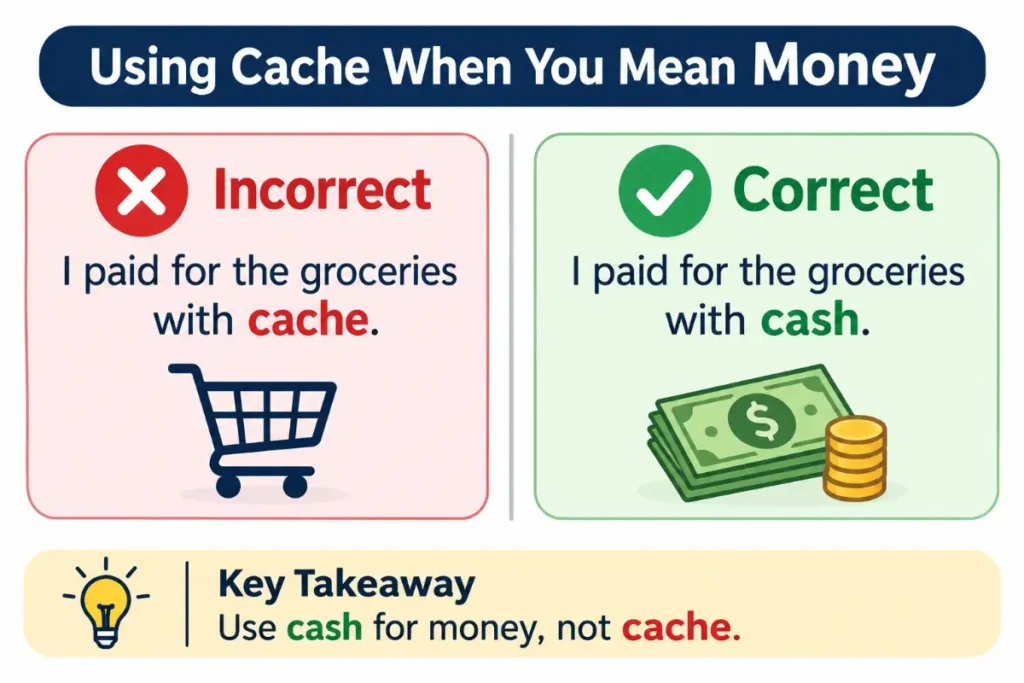
1. Using Cache When You Mean Money
Incorrect: I paid for the groceries with cache.
Correct: I paid for the groceries with cash.
The sentence describes a payment, so it needs the word for money. The storage related term does not fit.
2. Using Cash When You Mean Stored Data
Incorrect: Clear your browser cash.
Correct: Clear your browser cache.
A browser saves website information to help pages load faster. The correct spelling is the one associated with storage.
3. Treating Both Words as Interchangeable
Incorrect: The company keeps a cash of backup files.
Correct: The company keeps a cache of backup files.
A stored collection of files is a cache. The other word refers to money.
4. Misunderstanding the Verb Form
Incorrect: The developer cashed the website files for faster loading.
Correct: The developer cached the website files for faster loading.
The verb associated with data storage means saving information for later use. The verb associated with money has a financial meaning.
5. Confusing Cash With a Hidden Supply
Incorrect: The hikers discovered a cash of food in the forest.
Correct: The hikers discovered a cache of food in the forest.
A hidden collection of supplies is described by the storage related word. The money related word does not express that meaning.
A Simple Way to Avoid These Mistakes
Before writing either word, ask yourself what the sentence describes.
- Is it about money? Write cash.
- Is it about saved data or a hidden supply? Write cache.
This quick check works in most everyday situations.
Many readers also check Breath vs Breathe Which Word Should You Use.
Pronunciation Guide
Both words have the same pronunciation in standard American English.
/kæʃ/
Sounds like: cash
Syllables: One.
Stress: The entire word is one stressed syllable.
Rhymes with: Dash, flash, crash, and splash.
How to Pronounce Them
Break the sound into three parts:
- Start with the hard K sound, as in cat.
- Add the short A sound, as in hat.
- Finish with the SH sound, as in ship.
Put the sounds together smoothly: KASH.
There is no extra spoken syllable at the end of the first spelling. The final E is silent. This is one reason the two forms can be difficult to distinguish in speech.
Common Pronunciation Mistakes
Some learners try to pronounce the final E as a separate sound. Others may pronounce the first word with a longer vowel because of its spelling. Neither approach matches the usual pronunciation.
The best way to remember the sound is to say both words aloud. They should sound identical.
Etymology and Word Origin
The histories of these words help explain why their spellings and meanings differ.
Origin of Cache
The word entered English from French. It is connected to the French word cacher, meaning to hide. This history reflects its original association with hidden or concealed supplies.
English speakers have used it to describe a collection of items kept in a hidden place. Over time, the word gained a technical meaning in computing.
In modern technology, a cache stores data for quick access. The basic idea remains connected to keeping something available for later use, even though the information may not be physically hidden.
Origin of Cash
The word cash also came into English through French, with a history connected to a money box or container for coins. Its earlier development is linked to terms associated with keeping money.
Today, it refers to money available for immediate use, especially physical currency. Its meaning has expanded into common financial phrases and business language.
Although the words share a similar sound, they developed through different paths and have separate meanings.
Regional Usage
The spellings remain the same across major varieties of English. There is no widely accepted American, British, Canadian, or Australian spelling rule that changes one into the other.
American English
Both words are standard in the United States.
The storage related term is common in technology discussions, particularly in phrases such as browser cache, cached files, and cache memory. The money related term is common in everyday speech and financial writing.
Americans may say:
- I need to clear the cache on my phone.
- The store only accepts cash for small purchases.
British English
British English uses both spellings with the same basic meanings. The pronunciation is also generally the same.
A British computer user might talk about clearing a browser cache, while someone shopping may ask to pay in cash.
There is no special British spelling variation that changes the distinction.
Australian English
Australian English follows the same standard usage. Both words appear in technology, business, education, and daily conversation.
For example, an Australian office worker may clear a computer cache before troubleshooting a program. A shopper may carry cash for a purchase.
Canadian English
Canadian English also uses both forms in the same way. The distinction is based on meaning rather than regional preference.
The same spelling rules apply in Canadian schools, workplaces, technical writing, and everyday communication.
Grammar Rules and Part of Speech
Both words can act as nouns and verbs. Their grammatical function depends on how they appear in a sentence.
Cache as a Noun
As a noun, it identifies a stored collection of things or data.
Examples:
- The cache contains several important files.
- The hikers found a cache of supplies.
- The computer uses a small cache to improve performance.
It can appear as a subject, direct object, or object of a preposition.
Cache as a Verb
As a verb, it means to store something for later use, often in a hidden or convenient location.
Examples:
- The software caches frequently used images.
- The team cached food before the journey.
- The browser cached the page automatically.
The past tense and past participle are cached. The present participle is caching.
Cash as a Noun
As a noun, it refers to money.
Examples:
- I need cash for the parking meter.
- The cashier counted the cash twice.
- She keeps emergency cash at home.
It is generally an uncountable noun when referring to money as a general amount. You would normally say “some cash” or “a lot of cash,” rather than “many cash.”
However, the word can appear in specific expressions such as cash payments and cash reserves.
Cash as a Verb
As a verb, it commonly means to exchange a check or similar financial instrument for money.
Examples:
- I need to cash this check.
- She cashed the payment at the bank.
- He plans to cash the check tomorrow.
Its common forms include cash, cashes, cashed, and cashing.
Common Grammatical Patterns
Both words appear in familiar expressions.
| Expression | Meaning |
|---|---|
| Browser cache | Stored website data |
| Cache memory | Fast storage used by a computer |
| Cache files | Saved temporary files |
| Cache data | Information kept for later access |
| Cash payment | Payment made with money |
| Cash balance | Amount of money available |
| Cash flow | Money moving into and out of an organization |
| Cash withdrawal | Money taken from an account |
Capitalization and Punctuation
Both words are normally lowercase unless they begin a sentence or appear in a title that follows title case rules. Neither needs special punctuation.
For example:
- The browser cache is full.
- Cash is accepted at the counter.
In formal writing, choose the word that matches the meaning and keep the spelling consistent throughout the document.
Real Life Usage Examples
The following situations show how these words appear in different types of communication.
Daily Conversation
People use the money related word when talking about shopping, bills, or personal spending.
- I do not carry much cash because I usually pay with my phone.
- Can you lend me some cash for the bus?
The storage related word is more common in conversations about computers and hidden supplies.
- Try clearing your browser cache if the page does not load properly.
- We found a cache of blankets in the storage room.
Email and Workplace Communication
In an office, both words may appear in the same message but refer to different things.
- Please clear your browser cache before logging into the updated system.
- The finance team has prepared a report showing the company’s available cash.
A technical support message may use the first term when discussing saved files. An accounting message may use the second when discussing money.
Academic Writing
Students and researchers may use the storage related term in computer science, archaeology, or history.
- The processor relies on cache memory to improve access speed.
- Archaeologists discovered a cache of tools at the excavation site.
The money related term appears in economics, accounting, and business studies.
- The report examines how cash availability affects small businesses.
- Researchers analyzed the relationship between cash reserves and operating costs.
News and Journalism
News reports use both words in different subject areas.
- The technology company released an update designed to improve cache management.
- Police reported finding a cache of stolen goods during the investigation.
- The retailer announced new cash payment options for customers.
- The business reported stronger cash flow during the final quarter.
The surrounding topic usually makes the intended meaning clear.
Literature and Storytelling
Writers may use the storage related word to describe hidden objects, secret supplies, or valuable collections.
- Beneath the old floorboards, the children discovered a cache of letters.
- The travelers left a cache of food near the mountain pass.
The money related word often appears in stories about shopping, travel, business, or personal wealth.
- He counted his cash before leaving the market.
- She tucked a little cash into her coat pocket for emergencies.
Related and Confused Terms
Several English words and expressions are connected to these two terms. Learning them can make their meanings easier to understand.
1. Cached
Cached is the past tense and past participle of the verb used for storing information or objects.
Example: The browser cached the images during the first visit.
It is commonly used in computing and technical support.
2. Caching
Caching describes the process of saving data so it can be accessed more quickly later.
Example: Caching can reduce repeated requests to a server.
It is a common term in software development and computer systems.
3. Cache Memory
Cache memory is a type of fast computer storage. It keeps frequently needed data close to the processor so the system can access it quickly.
Example: The processor uses cache memory to reduce delays.
4. Browser Cache
A browser cache stores copies of website resources on a device. These may include images, scripts, and other files.
Example: Clearing the browser cache may fix certain website display problems.
5. Currency
Currency refers to the money used in a country or economic system. It includes physical money and, depending on the context, forms of money represented electronically.
Example: The US dollar is the official currency of the United States.
Cash is one form of currency, but the two terms do not mean exactly the same thing.
6. Coins
Coins are small pieces of metal used as money. They are one common form of physical cash.
Example: I found a few coins in the bottom of my bag.
Coins are different from paper bills, but both can be included in cash.
7. Banknotes
Banknotes are printed pieces of paper or polymer that represent money. In the United States, people commonly call them bills.
Example: The cashier checked the banknotes before accepting the payment.
Banknotes are another form of physical cash.
8. Hidden Stash
A hidden stash is a supply of items kept in a secret or private place.
Example: The campers discovered a hidden stash of food.
This expression is close in meaning to a hidden collection, though it is more informal.
Expert Editor Insight
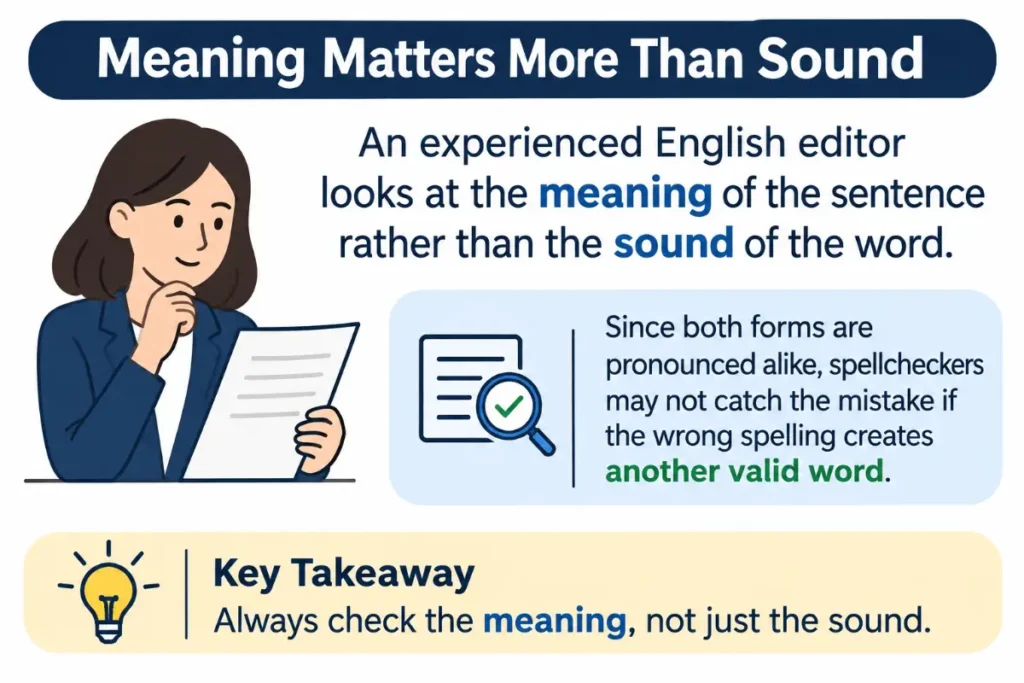
An experienced English editor looks at the meaning of the sentence rather than the sound of the word. Since both forms are pronounced alike, spellcheckers may not catch the mistake if the wrong spelling creates another valid word. A grammar tool may also miss the problem when the sentence remains grammatically correct. The best editing method is to check the context: money calls for cash, while stored information or a hidden collection calls for cache. Reading the sentence aloud will not reveal this particular error, so a quick meaning check is more useful.
You may also want to read Who vs Whom Explained With Simple Grammar Rules.
Conclusion
The difference between cache vs cash comes down to meaning, not pronunciation. Both words sound the same, but one describes stored information or a hidden collection, while the other refers to money. Neither spelling is incorrect on its own. The right choice depends on what you want to say.
Remember this simple rule: use the storage related spelling for saved data or hidden supplies, and use the money related spelling for bills, coins, and payments. Before submitting an email, report, or assignment, check the meaning of the sentence instead of relying on sound alone. That small habit can prevent an easy but noticeable writing mistake.
FAQs
Is Cache a Real English Word?
Yes. It is a standard English word used in everyday language and computing. It can describe a hidden collection of objects or data stored for future use. The word is also used as a verb meaning to store something. It is not an informal substitute for the word that refers to money.
What Does Cash Mean?
Cash means money that is available for direct use, especially physical bills and coins. People use it when discussing shopping, payments, banking, and personal finances. It can also function as a verb, as in cashing a check. In most everyday situations, it refers to money rather than saved computer information.
Which Spelling Should I Use for Computer Data?
Use cache when you are talking about stored computer information. A browser cache, for example, contains saved website resources that help pages load faster. The spelling for money does not fit this meaning. If you are discussing temporary files, saved website content, or cache memory, choose the storage related form.
Are Cache and Cash Pronounced the Same Way?
Yes. Both are pronounced /kæʃ/ in standard American English. They have one syllable and rhyme with words such as dash, flash, and crash. The final E in the storage related spelling is silent. Because their sounds are identical, you need to rely on meaning and context to choose the correct spelling.
Can Cache Be Used as a Verb?
Yes. It means to store something for later use, often in a hidden place or a computer system. For example, a browser caches website images so it can load them more quickly during a future visit. Its common verb forms include caches, cached, and caching.
Can Cash Be Used as a Verb?
Yes. As a verb, it commonly means to exchange a check or similar payment instrument for money. For example, you might visit a bank to cash a check. The verb also has forms such as cashes, cashed, and cashing. This meaning is separate from storing computer data or hiding supplies.
Why Do People Confuse These Two Words?
People confuse them because they sound exactly alike. When someone hears the word in conversation, pronunciation alone cannot show which spelling is intended. The problem often appears in typing, emails, and online messages. Both are valid words, so basic spellcheck tools may accept the wrong choice instead of flagging it.
Is It Appropriate to Use Both Words in Formal Writing?
Yes. Both are standard English words and are suitable for formal writing. You can use the storage related form in technical reports, research papers, and computer documentation. The money related form belongs in financial reports, business letters, and general writing about payments. Just make sure the spelling matches the intended meaning.