
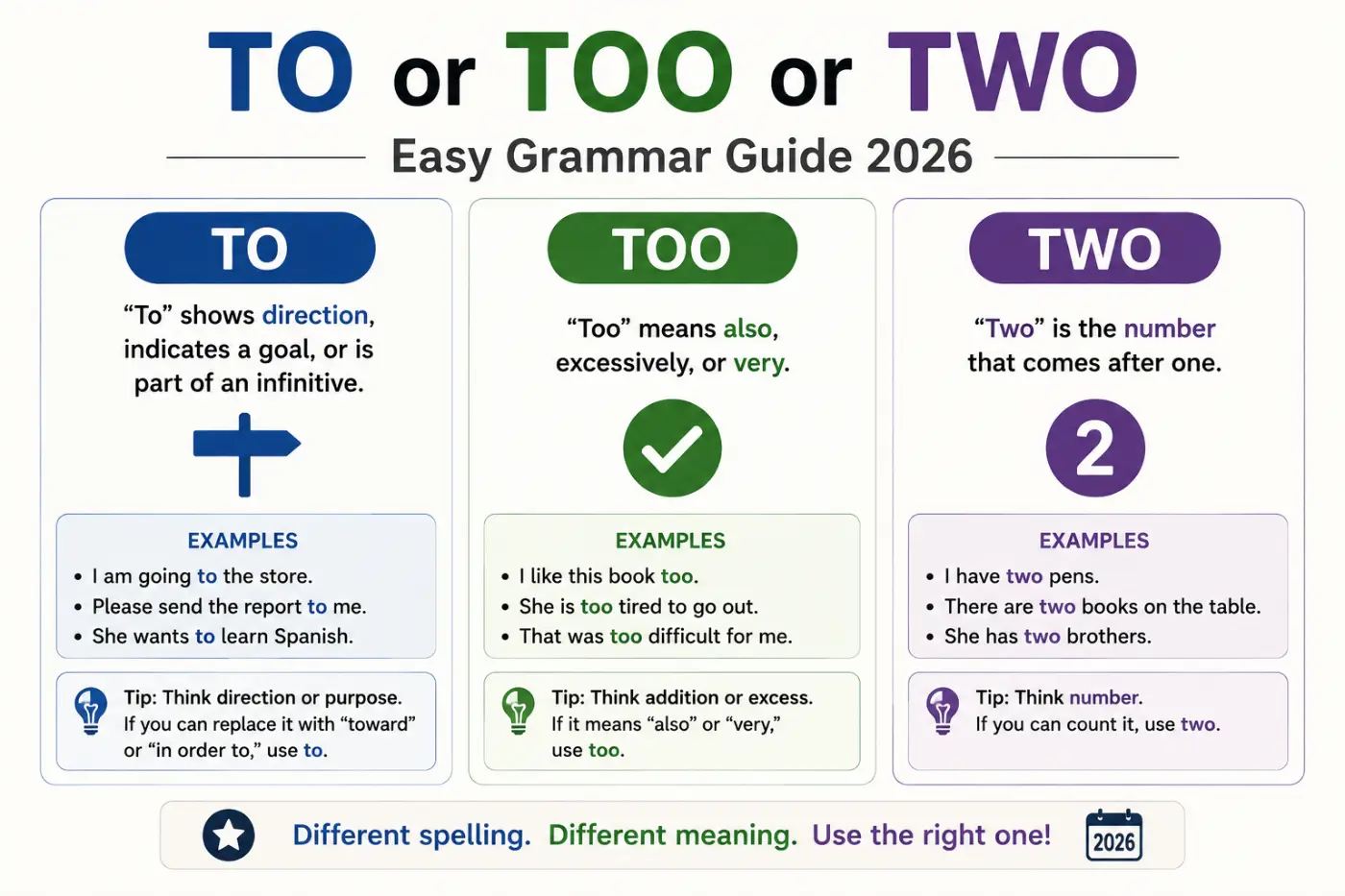
Confusing to, too, and two is a common English writing mistake because all three words sound exactly alike in standard pronunciation. However, they have different meanings and grammatical jobs. To is usually a preposition or part of an infinitive verb, too means also or more than needed, and two is the number 2. All three spellings are correct, but you cannot use them in place of one another.
The confusion often happens when people write quickly, rely on sound instead of meaning, or forget how each word works in a sentence. For example, you might write I want too go when you mean I want to go. You might also write I have to books instead of I have two books. These small errors can change the meaning of a sentence or make it look careless.
The easiest way to remember the difference is to connect each spelling with its main purpose. This guide explains their meanings, grammar rules, pronunciation, common mistakes, and real life examples so you can choose the right form with confidence.
Need another quick comparison? Read begun or began The Simple Grammar Rule 2026.
Quick Answer
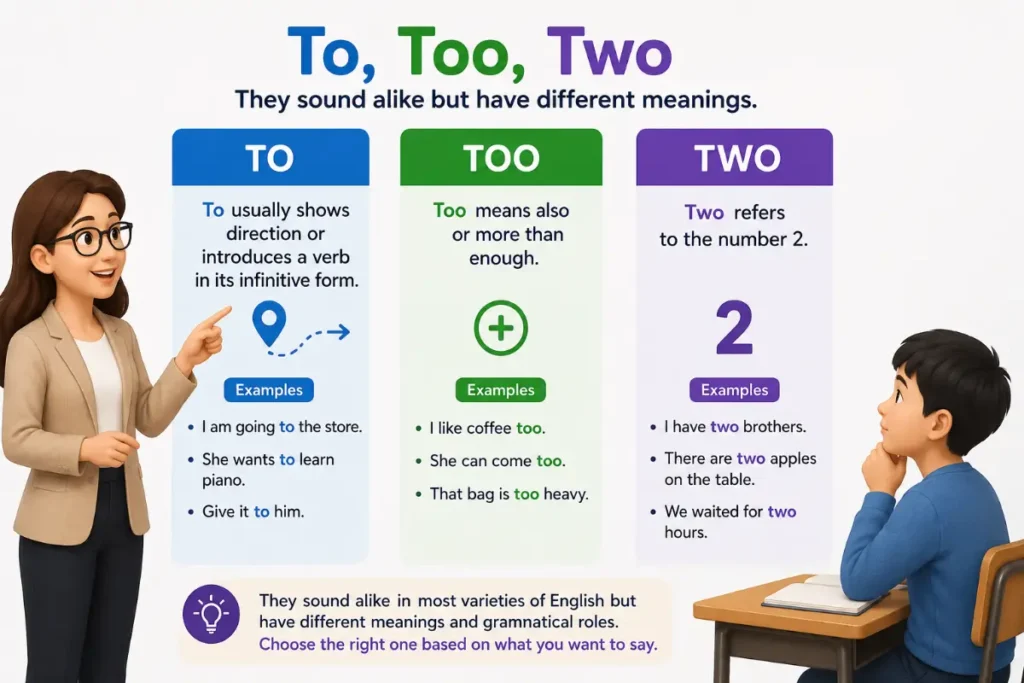
To shows direction, connection, or purpose and also helps form infinitive verbs. Too means also, very, or more than is needed. Two is the number 2. All three words are correct English, but their meanings and grammatical roles are different.
Comparison Table
| Word | Meaning | Part of Speech | Main Function | Common Contexts | Example |
|---|---|---|---|---|---|
| To | Direction, destination, connection, or purpose | Preposition; infinitive marker | Shows a relationship or introduces a verb | Movement, time, purpose, infinitives | I want to learn English. |
| Too | Also, excessively, or more than enough | Adverb | Adds information or expresses excess | Agreement, degree, quantity, emphasis | I want to come too. |
| Two | The number 2 | Number; determiner or pronoun | Identifies a quantity | Counting, age, time, measurement | She has two brothers. |
Meaning and Definition
What Does To Mean?
To is one of the most common words in English. It mainly works as a preposition or as a marker that introduces an infinitive verb. Its meaning changes depending on the sentence, but it often expresses direction, destination, connection, purpose, or a relationship between people and things.
As a preposition, it can show where someone or something is going. For example, in the sentence She walked to the store, the word connects the action of walking with the destination. It can also show the person receiving something, as in I gave the book to my friend.
The word also appears in expressions of time and range. You might say from Monday to Friday, ten minutes to six, or a temperature of five to ten degrees. In these examples, it shows an endpoint or relationship between two points.
Another major use is the infinitive form of a verb. An infinitive consists of to followed by the base form of a verb, such as to read, to write, to sleep, or to understand. For example, I want to improve my writing uses the word to before the verb improve.
Common uses include:
- Direction: We drove to the airport.
- Destination: She went to school.
- Recipient: He sent a message to his manager.
- Purpose: I came to help you.
- Time: The meeting runs from nine to eleven.
- Infinitive: They plan to travel next year.
- Comparison: I prefer tea to coffee.
The word does not always translate neatly into one word in another language. Its function depends on the grammar and meaning of the full sentence.
What Does Too Mean?
Too is an adverb with two main uses. It can mean also or in addition, and it can mean more than is needed or desirable. The surrounding sentence usually makes the intended meaning clear.
In the first sense, too adds another person, action, or fact. For example, I want to come too means I also want to come. It often appears near the end of a sentence, although it can appear in other positions for emphasis.
In the second sense, too expresses excess. For example, This coffee is too hot means the coffee is hotter than desired. The word often appears before an adjective or adverb, as in too expensive, too slowly, or too difficult.
Common uses include:
- Addition: My sister wants to join us too.
- Agreement: I think so too.
- Excessive degree: The room is too cold.
- Excessive quantity: There is too much sugar in the tea.
- Excessive frequency: He talks too loudly.
- Excessive difficulty: The question was too hard for me.
A useful point is that too much and too many follow different grammar rules. Use too much with uncountable nouns, such as too much water or too much noise. Use too many with plural countable nouns, such as too many books or too many people.
What Does Two Mean?
Two is the written form of the number 2. It represents a quantity of one more than one and is used when counting people, objects, events, or units.
For example, I bought two apples tells the reader the exact number of apples. We have two meetings today identifies the number of meetings. The word can also describe age, time, measurements, and positions in a sequence.
Common uses include:
- Quantity: She has two cats.
- Age: My son is two years old.
- Time: The train leaves at two.
- Measurement: The table is two feet wide.
- Number of people: Two students were absent.
- Position in a pair: The two teams played well.
Two can function as a number word before a noun, as in two chairs. It can also stand alone as a pronoun, as in I ordered five cookies, but only two arrived.
Unlike the other two forms, this word always refers to the number 2. It does not show direction, purpose, addition, or excess.
Key Differences Explained
1. Meaning
The most important difference is what each word communicates.
To usually connects an action with a destination, person, purpose, or verb. Too adds the meaning of also or more than enough. Two identifies a quantity.
Compare these examples:
- I want to buy a new phone.
- I want a new phone too.
- I bought two new phones.
The first sentence describes an intention. The second says that the speaker also wants a phone. The third tells us how many phones were purchased.
2. Part of Speech
The three forms also differ in grammar.
To works as a preposition or an infinitive marker. Too is an adverb. Two is a number word that can function as a determiner or pronoun.
These roles affect where each word can appear. For example, to can come before a noun or base verb in different structures. Too often modifies an adjective, adverb, or verb phrase. Two usually appears before a countable noun or stands alone to represent a quantity.
3. Sentence Position
To often appears before a destination, recipient, or base verb. Examples include She went to work and He wants to study.
Too often appears at the end of a sentence when it means also. It can also come before an adjective or adverb when it expresses excess. Examples include I want to go too and The bag is too heavy.
Two usually comes before a countable noun, as in two cars, or stands alone when the noun is already clear. For example, I invited six friends, but only two came.
4. Pronunciation
All three words are homophones. This means they have the same pronunciation but different spellings and meanings.
In American English, each is commonly pronounced /tuː/. The sound is similar to the word blue without the starting /b/ sound. Because pronunciation does not help distinguish them, readers and writers must rely on meaning and grammar.
5. Formality
All three words are standard in formal and informal English. None is a casual or incorrect spelling of another.
You can use to in an academic paper, too in a business email, and two in a legal document. The important point is selecting the spelling that matches the intended meaning.
6. Context
Context is the strongest clue when choosing the correct word. Look at the sentence and decide what information it needs.
If the sentence describes movement, purpose, or an infinitive verb, you probably need to. If it adds another person or expresses excess, you probably need too. If it gives a quantity of 2, use two.
For example, in I have two tickets too, both two and too are correct. Two tells us the number of tickets, while too means the speaker has them in addition to someone else.
7. Standard Usage
All three forms are accepted in standard American English, British English, Canadian English, and Australian English. There is no regional spelling difference that changes their meanings.
Some accents may pronounce the words with slightly different vowel sounds, but the spelling rules remain the same. The distinction is based on grammar and meaning rather than location.
Which Form Is Correct?
All three spellings are correct. The right choice depends on what you want to say, so there is no single winner.
Use to for direction, connection, purpose, and infinitive verbs. Use too when you mean also or excessively. Use two when you mean the number 2.
Here are some examples that show the difference clearly:
- Correct: I need to finish my homework.
- Correct: My friend needs to finish hers too.
- Correct: We have two assignments due tomorrow.
- Correct: The soup is too hot to eat.
- Correct: She gave two books to her brother.
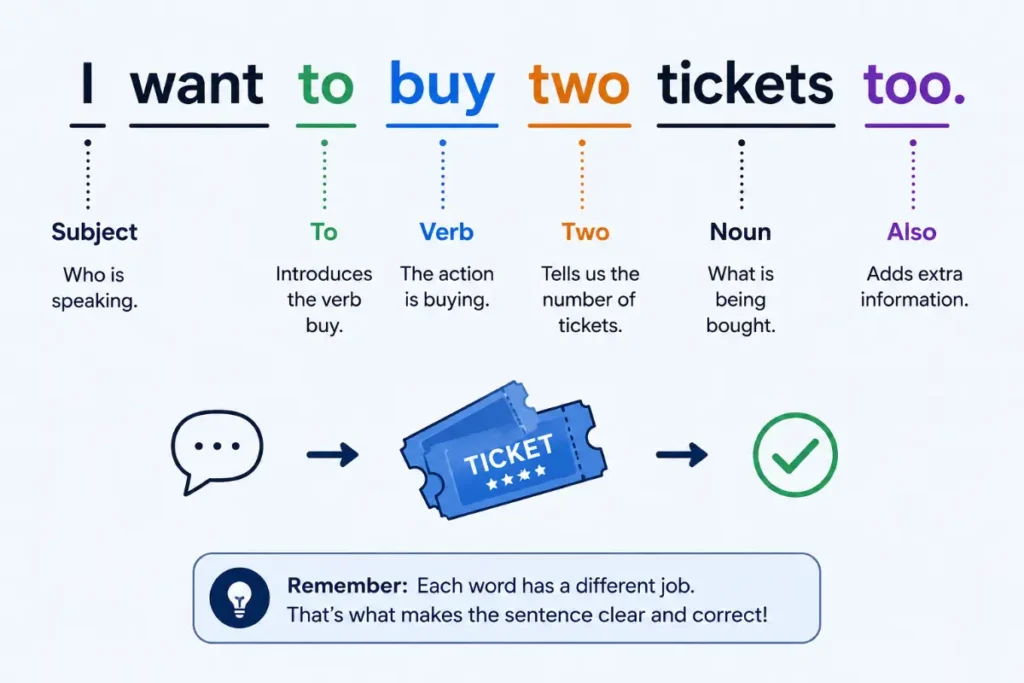
Notice that a single sentence can contain more than one of these words. In The two children want to play too, each spelling has a separate job. Two identifies the children, to introduces the verb play, and too means also.
A reliable editing method is to replace the word with its meaning. If you can replace it with also, use too. If you mean the number 2, use two. If the sentence needs a preposition or infinitive marker, use to.
Sentence Examples
The following examples show how each form works in everyday and professional communication.
Ten Natural Example Sentences
- Everyday conversation: I am going to the grocery store after work.
- Text message: Do you want to come with us too?
- Workplace communication: Please send the final report to the department manager.
- School: The teacher gave two examples to explain the rule.
- Academic writing: The researchers aimed to understand how children develop language skills.
- Formal writing: All applicants must submit two copies of the completed form.
- Social situations: My cousin is coming to dinner too.
- Online communication: I need to learn how to update my profile.
- Shopping: These shoes are too expensive for my budget.
- Travel: We have two hours to reach the airport.
These sentences show why the words cannot be used interchangeably. Each one has a clear grammatical purpose, and changing the spelling can change the meaning.
Five Examples Showing How One Sentence Can Use All Three
- I need to buy two tickets to the concert, and my brother wants to come too.
- The two students stayed after class to ask a question too.
- We have two days to finish the project, and the deadline is too close.
- She gave two books to her friend, who wanted to read them too.
- The two children were too excited to go to sleep.
These examples are useful because they show that the three forms can appear close together without repeating the same function. Each word contributes a different piece of information.
Common Mistakes and Misspellings
Most errors happen because the words sound alike. Writers may choose the wrong spelling when typing quickly, relying on pronunciation, or failing to check the sentence meaning.
1. Writing Too Instead of To Before a Verb
Incorrect: I want too learn Spanish.
Correct: I want to learn Spanish.
The verb learn needs the infinitive marker to. Too cannot introduce a base verb in this structure because it means also or excessively.
A simple check is to look at the word after the disputed form. If it is a base verb and the sentence expresses an intention or action, to is often needed.
2. Writing To Instead of Too to Mean Also
Incorrect: I would like to come to.
Correct: I would like to come too.
The final word means also, so the correct spelling is too. This mistake often happens in short messages because writers type the sound they hear without thinking about its meaning.
3. Writing To Instead of Two for a Quantity
Incorrect: I have to sisters.
Correct: I have two sisters.
The sentence gives the number of sisters, so it needs the number word two. To cannot express a quantity in this context.
4. Writing Two Instead of Too to Express Excess
Incorrect: The coffee is two hot.
Correct: The coffee is too hot.
Here, the sentence describes an excessive degree of heat. Too modifies the adjective hot and means more than is comfortable or desirable.
5. Confusing Too Much and Too Many
Incorrect: There are too much people in the room.
Correct: There are too many people in the room.
Use too many with plural countable nouns, such as people, books, and cars. Use too much with uncountable nouns, such as water, sugar, and noise.
Examples:
- There is too much traffic today.
- There are too many cars on the road.
This error is related to the grammar of quantity rather than the spelling alone. Learning the noun pattern helps you avoid it.
A Simple Memory Trick
You can remember the three words with these short clues:
- To has one o and often points toward an action or destination.
- Too has an extra o, just like the extra meaning of also or more than enough.
- Two begins with tw, like twelve and twenty, and represents the number 2.
The trick is not a replacement for grammar, but it gives you a quick reminder when you are writing.
Pronunciation Guide
How Do You Pronounce To, Too, and Two?
In standard American English, all three words are pronounced /tuː/. Each has one syllable and uses the long u sound heard in words such as blue and food.
The pronunciation is the same, so you cannot identify the correct spelling by sound alone. You must look at the meaning and grammatical role of the word in the sentence.
Syllable Breakdown
| Word | IPA | Syllables | Easy Pronunciation |
|---|---|---|---|
| To | /tuː/ | One | Too |
| Too | /tuː/ | One | Too |
| Two | /tuː/ | One | Too |
The words are homophones because they share the same pronunciation but have different meanings and spellings.
Stress and Natural Speech
In connected speech, to may have a weak form, especially when it appears before an infinitive verb. For example, in I want to go, the word to is often pronounced with a reduced vowel, making it sound closer to /tə/ in natural conversation.
The words too and two usually keep their full vowel sound when spoken. However, stress can change depending on the speaker’s emphasis. In a sentence such as I want to go too, a speaker may stress too to emphasize that they also want to go.
Common Pronunciation Mistakes
A common misunderstanding is to assume that a difference in spelling must create a difference in sound. It does not. The words may sound identical in the same accent, even though their meanings are separate.
Some English learners may pronounce the vowel differently because of their first language. Practicing the long u sound and listening to natural speech can help. Still, correct spelling requires understanding the sentence, not simply repeating the pronunciation.
Still confused? Compare Up to Date vs Up-to-Date Which Form Is Correct?.
Etymology and Word Origin
The three words have different histories, even though they sound alike today. Their shared pronunciation developed through changes in English sounds over time, while their spellings and meanings remained distinct.
The Origin of To
To comes from Old English tō, which was used as a preposition expressing direction, movement, or relationship. It developed into the modern English form and retained many of its basic functions.
Over time, it also became a standard marker for infinitive verbs. Today, it appears in expressions of direction, purpose, time, and connection. Its many grammatical uses explain why it appears so frequently in English sentences.
The Origin of Too
Too developed from an Old English form associated with the meaning also or in addition. It later came to express excess or an amount beyond what is needed.
The modern spelling includes two letter o characters, which helps distinguish it visually from the shorter form. Its meanings are now closely connected with addition and excessive degree.
The Origin of Two
Two comes from Old English twā and related forms used for the number 2. Its history goes back further through Germanic language forms and is related to number words in other languages.
The spelling and pronunciation changed over time, but the word continued to represent the same basic number. The letter w remains in the spelling even though it is not pronounced in modern English.
Why Their Spellings Are Different
The three words developed from different historical forms. Their identical modern pronunciation does not mean they share the same origin or meaning.
English contains many words that sound alike but have different spellings. These are called homophones. Learning their individual meanings and grammatical roles is more useful than trying to connect them through sound alone.
Regional Usage
American English
In American English, all three words are standard and used in the same way described above. To introduces destinations and infinitive verbs, too means also or excessively, and two represents the number 2.
American speakers pronounce all three alike in most ordinary speech. The difference is clear in writing because each spelling performs a separate grammatical job.
British English
British English follows the same spelling and grammar rules. Speakers use to for direction and infinitives, too for addition or excess, and two for the number 2.
Pronunciation may vary slightly among British accents, but the words remain homophones in many varieties. There is no standard British spelling change for these words.
Australian English
Australian English uses the same three spellings and meanings. A person may say I want to go too or I have two tickets, following the same grammar found in American and British English.
Accent differences can affect the sound of vowels, but they do not change the written distinction.
Canadian English
Canadian English follows the same standard usage. Writers use to for direction and infinitives, too for also or excess, and two for a quantity of 2.
The spelling rules do not change between Canadian and American English. The most reliable way to choose the right form is to identify the meaning required by the sentence.
Grammar Rules and Part of Speech
Understanding the grammatical role of each word makes the distinction easier to remember. Although they sound alike, they do not perform the same function in a sentence.
How To Works as a Preposition
As a preposition, to connects a noun or pronoun with another part of the sentence. It often shows direction, destination, movement, or the person receiving something.
Examples include:
- She walked to the library.
- I sent an email to my teacher.
- We drove from the office to the airport.
- The gift belongs to my sister.
In each example, the word introduces a relationship between different parts of the sentence.
How To Introduces an Infinitive
To also appears before the base form of a verb to create an infinitive. Common examples include to eat, to study, to write, and to sleep.
Examples:
- I want to learn French.
- They decided to leave early.
- She hopes to become a doctor.
- We need to finish the report.
Do not add an s, ed, or ing ending to the verb immediately after the infinitive marker in a standard infinitive construction. For example, write to study rather than to studies.
There are also cases where English uses a bare infinitive without to, such as after most modal verbs. You say I can swim, not I can to swim. This is a separate grammar rule and does not change the meaning of the word itself.
How Too Works as an Adverb
Too can modify an adjective, an adverb, or a verb phrase. It can express addition or an excessive degree.
Examples:
- I want to come too.
- The box is too heavy.
- He drives too quickly.
- We arrived too late.
When too means also, it often appears at the end of a sentence. When it expresses excess, it usually appears before the adjective or adverb it modifies.
How Two Works as a Number Word
Two identifies a quantity. It usually comes before a plural countable noun, but it can also stand alone.
Examples:
- I bought two notebooks.
- Two people called this morning.
- We need two more chairs.
- I ordered three drinks, but only two arrived.
Use two with plural countable nouns. Do not use it to describe an uncountable quantity. For example, write two cups of water rather than two waters in ordinary usage, unless you mean two separate servings or types of water.
Common Grammar Patterns
| Pattern | Correct Example | Reason |
|---|---|---|
| To + base verb | She wants to read. | Introduces an infinitive. |
| To + destination | We went to school. | Shows direction. |
| Too + adjective | The bag is too heavy. | Expresses excess. |
| Too at sentence end | I want to go too. | Means also. |
| Two + plural noun | They own two cars. | Gives a quantity. |
| Two used alone | Only two arrived. | Replaces a known noun. |
Punctuation and Sentence Position
None of the three words requires special punctuation. Use commas, periods, and question marks according to the sentence structure.
For example, I want to go too is a statement and ends with a period. Do you have two tickets is a direct question and needs a question mark. The punctuation depends on the sentence, not the word choice.
Real Life Usage Examples
Daily Conversation
People use these words constantly in ordinary speech. Because they sound alike, context helps listeners understand the intended meaning.
- I need to get home before dinner.
- Would you like to come too?
- We have two seats left.
The first sentence describes a destination or purpose, the second adds another person, and the third gives a quantity.
Email and Workplace Communication
Professional messages often contain all three forms. Correct spelling helps make instructions, requests, and deadlines easy to understand.
- Please send the documents to the finance team.
- I would like to invite you too.
- We need two copies of the signed agreement.
In workplace writing, a small spelling mistake can distract readers or create confusion. Reviewing the meaning of each word before sending a message helps keep communication clear.
Academic Writing
Students and researchers use these forms when describing aims, quantities, and additional points.
- The researchers aimed to compare two learning methods.
- The second group received the same treatment too.
The first sentence uses to before an infinitive and two to identify the number of methods. The second uses too to add another group to the statement.
News and Journalism
News reports use these words in descriptions of events, numbers, and additional developments.
- Officials traveled to the affected area to inspect the damage.
- Two people were taken to the hospital.
- The mayor said other communities were affected too.
These examples show how the words can appear naturally in a single report. Their correct spelling helps readers understand the facts being reported.
Literature and Storytelling
Writers use these forms to describe movement, emotions, numbers, and additional details.
- The two travelers wanted to reach the village before sunset.
- The old dog followed them too, even though the road was too steep.
In storytelling, these words help express action and detail without drawing attention to themselves. Correct usage allows the reader to focus on the scene rather than the spelling.
Related and Confused Terms
These eight terms are useful to understand because they connect with number words, homophones, and common English spelling mistakes.
1. Three
Three is the number 3, one more than two. It is a number word and can appear before a plural noun, as in three books. Like two, it expresses quantity, but it has a different numerical value.
2. Also
Also is an adverb that means in addition or too. For example, I also want to join the meeting has a similar meaning to I want to join the meeting too. The position differs, but both sentences express an additional idea.
3. As Well
As well is another expression meaning also. It often appears at the end of a sentence, much like too. For example, She wants to come as well means she wants to come in addition to someone else.
4. To Be
To be is an infinitive form of the verb be. It appears in sentences such as I want to be a teacher. The word to introduces the verb be, so it is not interchangeable with too or two.
5. Too Much
Too much expresses an excessive amount of something that is usually uncountable. For example, There is too much noise in this room. Use too many for plural countable nouns, as in too many people.
6. Too Many
Too many describes a quantity that is greater than needed or wanted. For example, We have too many boxes to carry. It combines the adverb too with many, which is used with plural countable nouns.
7. Homophones
Homophones are words that sound the same but have different meanings, spellings, or grammatical roles. To, too, and two are common examples. Other familiar examples include their, there, and they’re, as well as your and you’re.
8. Number Words
Number words represent quantities or positions. Two is a cardinal number, which tells us how many. Second is an ordinal number, which tells us a position in a sequence. For example, two students arrived, but the second student arrived first.
Expert Editor Insight
An experienced editor does not choose among these words by sound because their pronunciation is identical in standard English. The editor checks the sentence meaning and grammatical role. If the word introduces a destination or infinitive, it is usually to. If it means also or excessively, it is too. If it represents the number 2, it is two. Spelling tools may catch some mistakes, but they can miss errors when the wrong word is still a valid English spelling. A useful editing habit is to replace too with also and two with the number 2. If the sentence still makes sense, you have probably chosen correctly.
Key Takeaways
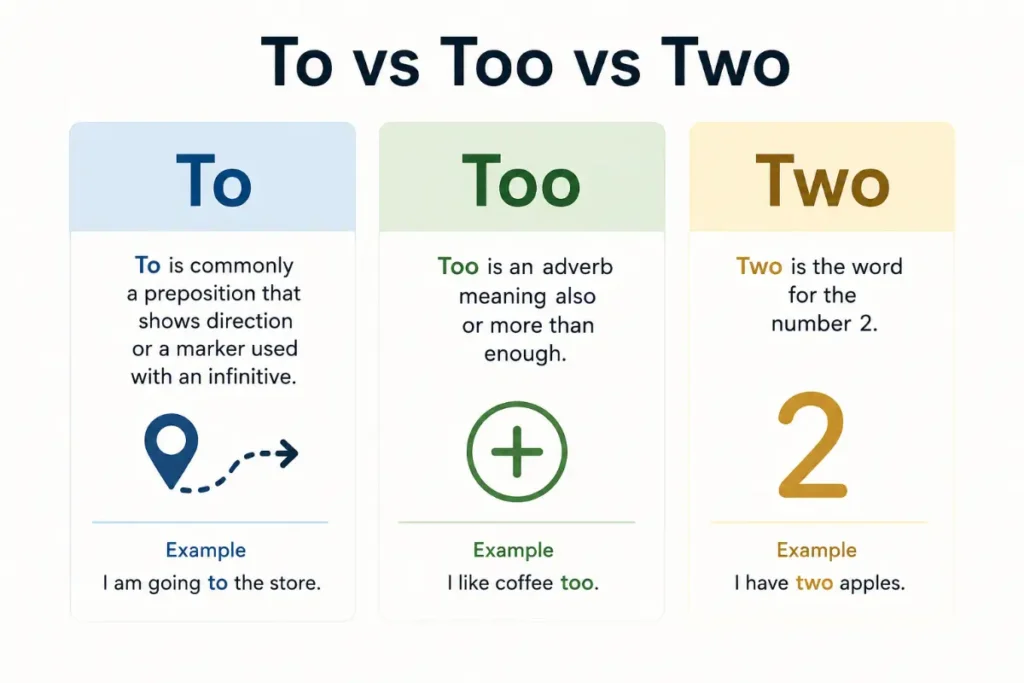
- To is commonly a preposition that shows direction or a marker used with an infinitive.
- Too is an adverb meaning also or more than enough.
- Two is the word for the number 2.
- To often appears before a base verb such as to eat or to study.
- Too can mean also as in I want one too.
- Too can show excess as in The coffee is too hot.
- Two identifies a quantity as in two books.
- The three words often sound alike so pronunciation alone cannot determine the spelling.
- Context and grammatical function provide the best clues.
- A spell checker may miss an error because all three forms are legitimate English words.
A related grammar guide is Skull or Scull Which Spelling Is Correct..
Conclusion
The difference between To or Too or Two becomes simple once you understand the job each word performs. To shows direction, purpose, or an infinitive verb. Too means also or more than necessary. Two represents the number 2. All three are correct English words, but they cannot replace one another.
Before choosing a spelling, check the meaning of your sentence. A useful memory trick is to connect two with the number 2, too with an extra meaning, and to with direction or action. This quick check can help you avoid one of the most common English writing mistakes.
FAQs
What Is the Difference Between To, Too, and Two?
To shows direction, connection, or purpose and introduces infinitive verbs. Too means also or more than is needed. Two is the number 2. All three words sound alike, but their meanings and grammar are different. For example, I want to buy two books too uses each form correctly for a separate purpose.
Is It To Much or Too Much?
Too much is correct when you mean an excessive amount. Too is an adverb that expresses excess, while much describes an amount of something. For example, There is too much sugar in this coffee means the coffee contains more sugar than desired. To much is incorrect in this expression.
Is It To or Too When You Mean Also?
Use too when you mean also or in addition. For example, I want to come too means that you also want to come. To cannot express this meaning. A helpful test is to replace the word with also. If the sentence still makes sense, too is usually the correct spelling.
Is It Two or Too for the Number 2?
Use two when you mean the number 2. For example, I have two brothers tells the reader how many brothers you have. Too means also or excessively, so it cannot represent a number. Remember that two is the number word, just like one, three, and four.
How Do You Pronounce To, Too, and Two?
In standard American English, all three words are pronounced /tuː/. They have one syllable and sound like the word too. Since their pronunciation is the same, you must use the meaning and grammar of the sentence to select the correct spelling.
Can To, Too, and Two Appear in One Sentence?
Yes. For example, The two friends want to travel too contains all three words correctly. Two identifies the number of friends, to introduces the infinitive travel, and too means also. Each word has a different grammatical role, even though the pronunciation is the same.
Why Do People Confuse These Three Words?
People confuse them because they are homophones, meaning they sound alike but have different spellings and meanings. When writing quickly, it is easy to choose the wrong form based on sound alone. Learning their grammatical roles and checking the meaning of the sentence helps prevent these mistakes.
Are To, Too, and Two All Correct in Formal Writing?
Yes. All three are standard English words and are appropriate in formal writing when used correctly. To introduces destinations and infinitives, too expresses addition or excess, and two represents the number 2. The problem is not the formality of the words but choosing a spelling that does not match the intended meaning.