
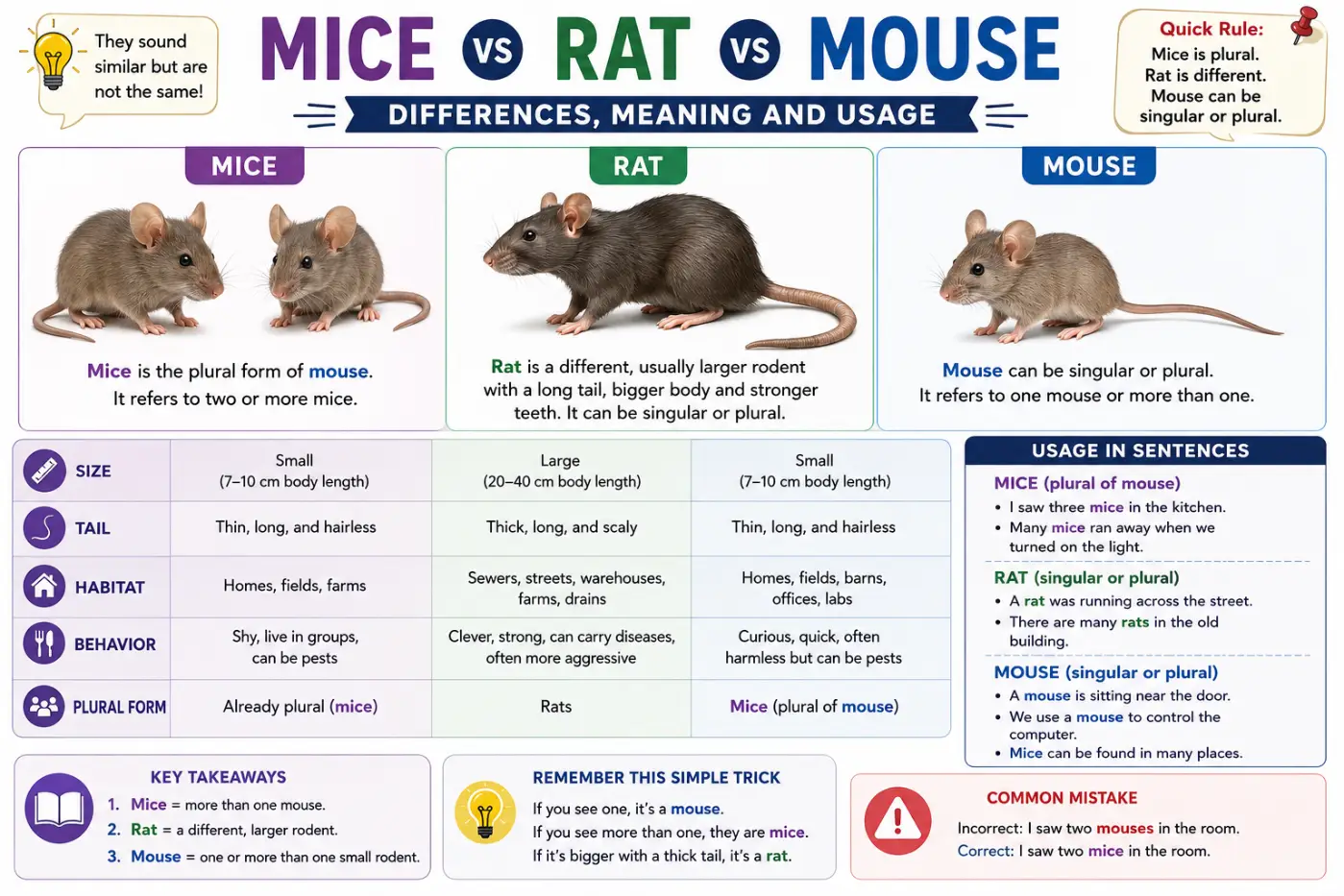
The words mice vs rat vs mouse are closely related, but they do not mean exactly the same thing. A mouse is a small rodent, mice is the plural form of mouse, and rat is the name of a different type of rodent. The main language difference is simple: one mouse becomes two mice, while one rat becomes two rats.
The confusion often comes from the fact that mice and rats look alike. Both have long tails, small ears, sharp teeth, and similar body shapes. However, they differ in size, physical features, behavior, and common uses. Their names also follow different plural rules, which can cause mistakes in everyday writing.
Understanding these differences helps you identify the animals and use their names correctly. You will learn what each word means, how the plural forms work, how to pronounce them, and how to recognize common grammar mistakes. The examples also show how these terms appear in everyday conversation, schoolwork, science, and formal writing.
You may also want to read Ask vs Pose Which Word Should You Use?.
Quick Answer
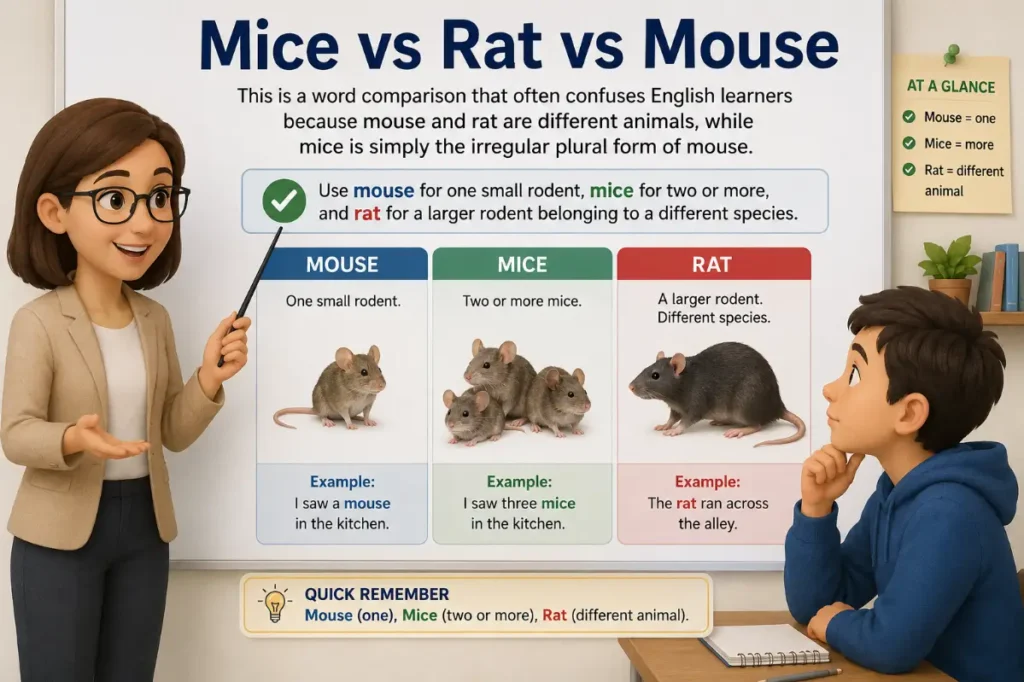
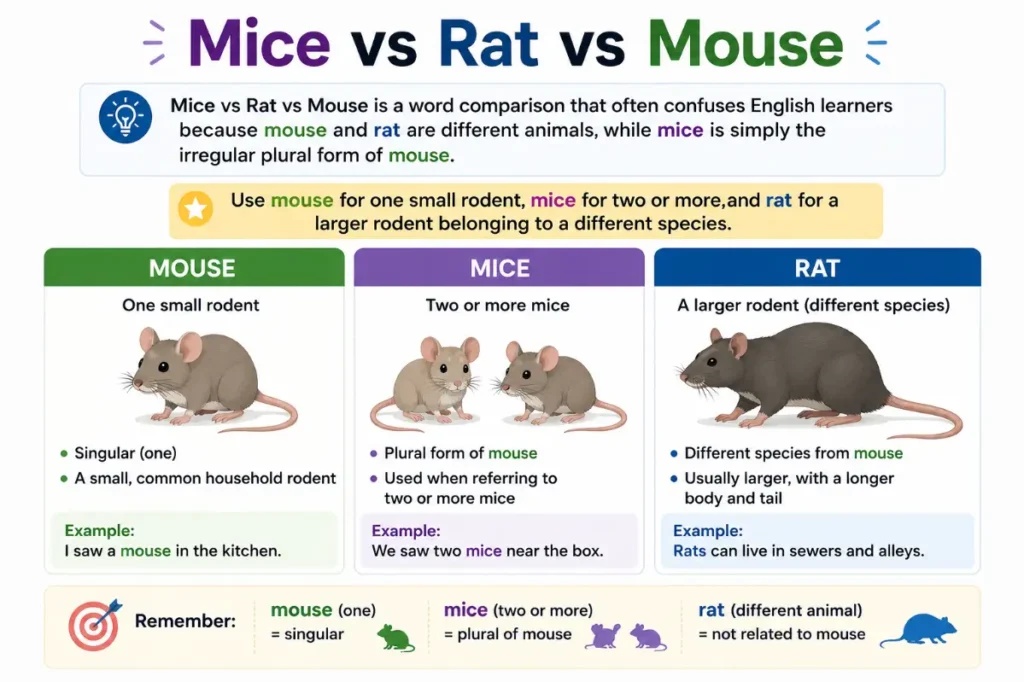
A mouse is a small rodent, and mice is its irregular plural form. A rat is a different rodent, usually larger than a mouse, and its plural form is rats. Use mouse for one animal, mice for two or more, rat for one rat, and rats for more than one.
Comparison Table
| Word | Meaning | Part of Speech | Number | Pronunciation | Example |
|---|---|---|---|---|---|
| Mouse | A small rodent | Noun | Singular | /maʊs/ | A mouse ran across the floor. |
| Mice | More than one mouse | Noun | Plural | /maɪs/ | Two mice were hiding behind the cabinet. |
| Rat | A rodent generally larger than a mouse | Noun | Singular | /ræt/ | A rat entered the storage room. |
| Rats | More than one rat | Noun | Plural | /ræts/ | Several rats were seen near the trash cans. |
Meaning and Definition
What Does Mouse Mean?
Mouse is a singular noun that names a small rodent. A typical mouse has a pointed nose, rounded ears, a long tail, small paws, and a compact body. Mice live in many environments, including fields, forests, buildings, farms, and homes.
The word usually refers to a small animal in the rodent family. The house mouse is one familiar example. It often lives near people because buildings can provide food, warmth, and shelter.
The noun can also have other meanings. A computer mouse is a handheld device used to control a pointer on a computer screen. In this sense, the word refers to a piece of technology rather than an animal.
Examples:
- A mouse ran under the kitchen table.
- The farmer found a mouse in the grain storage area.
- My computer mouse stopped working during the meeting.
In the animal sense, mouse is singular. If you are talking about more than one of these animals, the correct plural is mice, not mouses.
What Does Mice Mean?
Mice is the irregular plural form of mouse. It refers to two or more animals of the kind called a mouse. The spelling changes instead of adding the usual plural ending s.
Examples:
- One mouse was sitting near the wall.
- Three mice were hiding in the cupboard.
- The farmer noticed several mice in the barn.
This change from mouse to mice is part of an older English plural pattern. It is similar to other irregular forms such as man and men, woman and women, and foot and feet.
In standard English, use mice when referring to more than one animal. The word also appears in scientific writing, news reports, stories, and everyday conversation.
The same plural form is used for computer mice. For example, if a person owns three computer pointing devices, the standard plural is three mice. In some technical or product contexts, writers may use mouses, but mice is the established general plural.
What Does Rat Mean?
Rat is a singular noun that names a rodent generally larger and heavier than a typical mouse. Rats often have thicker bodies, larger feet, longer faces, and thicker tails. Their appearance varies by species, but they are usually more robust than mice.
The word commonly refers to animals such as the brown rat and the black rat. These animals live in cities, farms, sewers, fields, and other places where they can find food and shelter.
Rats are highly adaptable. They can survive in many environments and often live close to human settlements. Some are wild, while others are kept as pets or used in carefully controlled scientific research.
Examples:
- A rat entered the basement through a small opening.
- The pet rat rested inside its wooden shelter.
- The farmer noticed a rat near the feed containers.
Rat is singular. The standard plural is rats, formed by adding s. Unlike mouse, it does not change its internal spelling to form the plural.
What Does Rats Mean?
Rats is the regular plural form of rat. It refers to two or more animals of the same general group.
Examples:
- Rats were found near the old warehouse.
- The city introduced measures to control rats.
- Several rats were living beneath the abandoned building.
The plural follows the normal English rule of adding s to many nouns. You do not write rat as the plural when describing several animals.
The word can also appear in informal expressions. For example, someone might say rats as an expression of disappointment. In that use, it is an interjection rather than a reference to multiple animals. The meaning depends on the sentence.
Key Differences Explained
1. Singular and Plural Forms
The most important grammar difference is the way the words form their plurals.
| Singular | Plural | Rule |
|---|---|---|
| Mouse | Mice | Irregular plural |
| Rat | Rats | Regular plural |
English has both regular and irregular plural nouns. Most nouns form the plural by adding s or es, but some older words change their spelling.
Mouse belongs to the irregular group. Rat follows the regular pattern. This is why one mouse becomes two mice, while one rat becomes two rats.
2. Physical Appearance
Mice and rats share many physical features, but they are not identical. A typical mouse is smaller, lighter, and more delicate. It usually has a narrower head, relatively large ears compared with its body, and a thin tail.
A typical rat has a larger and heavier body. Its head and feet are often more substantial, and its tail is usually thicker. These differences can help people tell them apart, although size alone is not always enough to identify a species.
3. Size and Weight
Most common house mice are much smaller than adult brown rats. A house mouse often has a body length of around 2.5 to 4 inches, not counting its tail. Adult brown rats commonly have a body length of around 7 to 10 inches, also excluding the tail.
These are general ranges, not fixed rules. Different species, ages, and living conditions can affect an animal’s size. A young rat may be smaller than a fully grown mouse, so size should not be the only clue.
4. Ears and Head Shape
Mice often have relatively large ears in proportion to their heads. Their noses tend to look pointed, and their faces are usually narrow.
Rats generally have smaller looking ears in proportion to their larger heads. Their faces can appear broader and less delicate. These features become easier to notice when you compare adult animals side by side.
5. Tails
Both animals have long tails, but their appearance can differ. A mouse usually has a thin tail that looks delicate compared with its small body. A rat often has a thicker and more muscular tail.
Tail length and thickness vary among species. These details can help with identification, but they should be considered alongside body size, head shape, ears, and other features.
6. Behavior
Mice and rats are both intelligent and adaptable rodents. They can learn routes, remember locations, and respond to changes in their surroundings. However, their behavior can differ depending on the species and environment.
House mice often explore small spaces and may nest inside walls, cupboards, and storage areas. Rats are often cautious around unfamiliar objects and may avoid new food sources or changes in their environment. This cautious behavior is sometimes called neophobia.
Neither animal behaves exactly the same way in every situation. Age, access to food, shelter, and contact with people can all affect behavior.
7. Habitat
Mice live in many habitats, including grasslands, forests, farms, fields, and homes. House mice are especially known for living near people because buildings provide shelter and easy access to food.
Rats also live in a wide range of environments. Brown rats are often associated with cities, sewers, farms, and areas near water. Black rats are commonly associated with buildings, ports, and places where they can climb and find food.
Both groups can adapt to human environments. Their presence in a building may point to gaps in walls, stored food, rubbish, or other sources of shelter.
8. Diet
Mice and rats are omnivores. They can eat plant material and animal based food, although their diets vary with species and surroundings.
House mice often eat grains, seeds, and food scraps. Rats may eat grains, fruit, insects, meat, and discarded food. Both animals can damage stored food and contaminate surfaces when they enter homes or food storage areas.
Their feeding habits make proper food storage important. Sealed containers and clean storage spaces can help reduce access to food.
9. Lifespan
The lifespan of a rodent depends on its species, health, environment, and access to care. Wild mice and rats often face predators, disease, food shortages, and other dangers. Pet animals may live longer because they receive regular food, shelter, and veterinary care.
A common house mouse often lives around one to two years, although individual lifespans vary. Many pet rats live around two to three years. These are general estimates, not guarantees for every animal.
10. Scientific Classification
Mice and rats belong to the order Rodentia, which includes animals such as squirrels, beavers, hamsters, and porcupines. They are both rodents, but the everyday words mouse and rat do not each describe one single species.
The house mouse belongs to the species Mus musculus. The brown rat belongs to Rattus norvegicus, while the black rat belongs to Rattus rattus. These scientific names help researchers identify specific animals more accurately than common names alone.
Which Word Is Correct?
All three words are correct, but they have different grammatical functions and meanings.
- Use mouse when you mean one small rodent.
- Use mice when you mean two or more mice.
- Use rat when you mean one rat.
- Use rats when you mean two or more rats.
The word mice is not a spelling mistake. It is the standard irregular plural of mouse. Likewise, rats is the correct regular plural of rat.
Here are some examples:
| Incorrect | Correct | Reason |
|---|---|---|
| Two mouse | Two mice | Mouse has an irregular plural. |
| Three mouses in the kitchen | Three mice in the kitchen | Mice is the usual animal plural. |
| One mice | One mouse | Mouse is singular. |
| Two rat | Two rats | Rat needs the plural ending s. |
| A rats entered the room | A rat entered the room | The article a takes a singular noun. |
One special point concerns computer equipment. Mice is the usual plural of computer mouse, too. In some technical writing, mouses may appear, but it is less common in general English.
Sentence Examples
The following sentences show how to use the singular and plural forms naturally.
Ten Natural Example Sentences
- A mouse ran across the kitchen floor while we were preparing dinner.
- The farmer found two mice inside a bag of grain.
- A rat entered the garage through a gap beneath the door.
- Several rats were seen near the old storage building.
- My computer mouse stopped working, so I replaced its batteries.
- The science teacher showed the class pictures of mice and rats.
- The wildlife researcher studied how mice responded to changes in their habitat.
- The city introduced a new program to control rats near public waste areas.
- We heard a mouse moving behind the kitchen cabinets at night.
- The pet owner cleaned the rat’s cage and provided fresh bedding.
These examples show the difference between singular and plural forms as well as the difference between the two animals. Notice that the verb also changes to match the noun. One mouse runs, while several mice run. One rat enters, while several rats enter.
Five Examples of Common Mistakes
1. Incorrect: Two mouses were hiding behind the box.
Correct: Two mice were hiding behind the box.
2. Incorrect: I saw three mouse near the fence.
Correct: I saw three mice near the fence.
3. Incorrect: A mice was eating the grain.
Correct: A mouse was eating the grain.
4. Incorrect: Several rat entered the storage room.
Correct: Several rats entered the storage room.
5. Incorrect: One rats was sitting near the drain.
Correct: One rat was sitting near the drain.
These mistakes usually happen when writers apply regular plural rules to an irregular noun or forget to match the noun with the correct article and verb.
Common Grammar Mistakes
1. Writing Mouses Instead of Mice
Incorrect: The farmer found two mouses in the barn.
Correct: The farmer found two mice in the barn.
The error happens because most English nouns form their plurals by adding s. However, mouse follows an older irregular pattern. Remember that the standard plural for the animal is mice.
2. Using Mouse After a Number Greater Than One
Incorrect: Three mouse were in the cupboard.
Correct: Three mice were in the cupboard.
A number greater than one normally requires a plural noun. Since mouse has an irregular plural, you need to change it to mice instead of simply adding a number before it.
3. Using Mice as a Singular Noun
Incorrect: A mice entered the room.
Correct: A mouse entered the room.
The article a indicates one animal, so the noun must be singular. Use mice only when referring to more than one.
4. Forgetting the S in Rats
Incorrect: Five rat were found near the warehouse.
Correct: Five rats were found near the warehouse.
Unlike mouse, rat uses the regular plural rule. Add s when referring to more than one rat. Also make sure the verb agrees with the plural subject: five rats were, not five rats was.
5. Confusing the Animal Names
Incorrect: The small mouse was larger and heavier than the adult rat.
Correct: The adult rat was larger and heavier than the small mouse.
This example shows how confusing the names can affect the meaning of a sentence. A typical adult rat is larger than a typical adult house mouse, but age and species can affect size. Use physical details and context instead of relying on the name alone when identifying an animal.
Pronunciation Guide
How Do You Pronounce Mouse?
Mouse is pronounced /maʊs/ in American English. It has one syllable and rhymes with house, blouse, and louse. The vowel sound begins with an open sound and moves toward an oo sound.
A simple way to say it is to start with the sound in now and finish with s. The word has one syllable, so you should not break it into separate parts.
How Do You Pronounce Mice?
Mice is pronounced /maɪs/. It also has one syllable and rhymes with nice, rice, and twice. The vowel sound is the same as the long i sound in time.
The spelling changes from mouse to mice, and the vowel sound changes too. This is part of the irregular pattern that makes the plural form different from the singular.
How Do You Pronounce Rat?
Rat is pronounced /ræt/ in American English. It has one syllable and rhymes with cat, hat, and bat. The vowel is the short a sound.
The plural rats is pronounced /ræts/. It keeps the same vowel sound and adds the /s/ sound at the end.
Common Pronunciation Mistakes
Some learners pronounce mice as if it rhymed with piece or miss. The correct vowel is the long i sound, as in nice. Others may pronounce mouse with the same vowel as mice, but the two words have different vowel sounds.
Practice the pairs slowly:
- Mouse and mice.
- Rat and rats.
- House and mice.
- Cat and rat.
The goal is to hear the vowel change between the singular and irregular plural, then recognize the regular plural pattern in the other pair.
For another common grammar confusion, see Here Is or Here Are Which Form Is Correct.
Etymology and Word Origin
The Origin of Mouse
The word mouse comes from Old English mūs. It has much older roots in the Germanic language family and is related to similar words in other Indo European languages.
The plural mice developed through an older English sound change. In early forms of English, certain nouns changed their internal vowel to form the plural. This pattern is sometimes called an umlaut plural because the vowel changed under the influence of a sound in an earlier form of the word.
Over time, the original sound that caused the change disappeared, but the different vowel remained in the plural. That is why modern English has mouse and mice instead of mouse and mouses as the normal animal forms.
The Origin of Rat
The English word rat appeared in the language during the Middle English period. Its exact earlier origin is uncertain, and its history is not as clear as that of mouse.
The word became the standard name for several related rodents, especially the brown rat and black rat. Modern English forms the plural regularly by adding s, giving rats.
Why the Plurals Are Different
The difference between mice and rats comes from the history of the two nouns. Mouse belongs to a group of older words that developed irregular plural forms. Rat follows the regular plural pattern that applies to most English nouns.
You do not need to know the full history to use the words correctly. Remember the forms as pairs: mouse and mice, rat and rats.
Regional Usage
American English
In American English, mouse is the standard singular form and mice is its standard plural. Rat and rats follow the regular singular and plural pattern.
These words are used in everyday speech, school materials, animal care, pest control, and scientific writing. The same forms apply to computer equipment, where one device is a mouse and several are mice.
British English
British English follows the same spelling and grammar rules. A single animal is a mouse, and multiple animals are mice. One rat becomes two rats.
There is no major difference between American and British English in these forms. Pronunciation may vary by accent, but the standard spellings remain the same.
Australian English
Australian English uses the same singular and plural forms. Mouse and mice refer to the smaller rodent, while rat and rats refer to the larger group of rodents commonly called rats.
The words are also used in scientific and everyday contexts. No special Australian spelling rule changes the plural forms.
Canadian English
Canadian English follows the same standard forms. Writers use mice as the plural of mouse and rats as the plural of rat.
As in other major English varieties, the main challenge is remembering the irregular plural rather than learning a regional spelling difference.
Grammar Rules and Parts of Speech
Mouse as a Singular Noun
Mouse is a countable noun. You can use it with a, an, the, or a number when you are referring to one animal.
Examples:
- A mouse is hiding behind the cupboard.
- The mouse ate a small piece of food.
- One mouse entered the building.
Because the noun is singular, it usually takes a singular verb. Write “The mouse is small,” not “The mouse are small.”
Mice as a Plural Noun
Mice is also a countable noun, but it refers to more than one animal. It usually takes plural verbs and does not need a plural s ending.
Examples:
- The mice are hiding under the table.
- Several mice entered the storage room.
- These mice have different coat colors.
Do not write “mices” in standard English. The word is already plural.
Rat as a Singular Noun
Rat is a regular countable noun. Use it with singular articles and singular verbs.
Examples:
- A rat lives near the drainage area.
- The rat is looking for food.
- One rat entered the shed.
The word can also appear as part of a compound noun, such as rat trap, rat poison, or rat behavior.
Rats as a Plural Noun
Rats refers to more than one rat. Add s to the singular form and use a plural verb.
Examples:
- The rats are hiding beneath the floor.
- Several rats were seen near the market.
- These rats have damaged the stored food.
The regular plural form is simple, but writers sometimes forget the s or use a singular verb by mistake.
Articles and Quantifiers
Use singular forms after words such as one, each, and a. Use plural forms after numbers greater than one and quantifiers such as many, several, and a few.
| Expression | Correct Form |
|---|---|
| One | One mouse |
| Two | Two mice |
| A single | A single rat |
| Several | Several rats |
| Many | Many mice |
| A few | A few rats |
| Each | Each mouse |
| Both | Both mice |
The noun must agree with the number or quantifier. This rule helps prevent common errors in school assignments, reports, and everyday writing.
Possessive Forms
You can also show ownership using apostrophes.
- The mouse’s tail was thin. This refers to one mouse.
- The mice’s hiding place was behind the cabinet. This refers to several mice.
- The rat’s cage was clean. This refers to one rat.
- The rats’ food was stored in a sealed container. This refers to several rats.
The apostrophe comes before s for a singular noun and after s for a regular plural noun. Since mice already ends in an s sound but is not spelled with s, its possessive form is mice’s.
Real Life Usage Examples
Daily Conversation
These words often appear when people talk about animals in homes, gardens, or neighborhoods.
- I think there is a mouse in the kitchen because I heard something moving behind the cabinets.
- We saw two rats near the trash bins while walking home.
In casual speech, people may use the animal names without knowing the exact species. The surrounding details usually make the meaning clear.
Email and Workplace Communication
In workplaces, these terms may appear in maintenance reports, pest control requests, or food safety messages.
- Please inspect the storage room because a mouse may have entered through the wall opening.
- The maintenance team found signs of rats near the waste disposal area.
Clear wording helps workers understand the problem and take the right steps. If the exact animal is unknown, you can say rodent rather than guessing.
Academic Writing
Scientific and school writing often uses these words to describe animal behavior, habitat, and research.
- The house mouse is a small mammal that can adapt to many human environments.
- Researchers observed how rats responded to changes in their surroundings.
For scientific accuracy, use a species name when the exact animal matters. Common names can refer to different species, so a scientific name may be needed in detailed research.
News and Journalism
News reports may use these terms when describing public health, pest control, or damage to buildings and food supplies.
- Local officials reported an increase in rat activity near the market.
- Several mice were discovered in a food storage area during an inspection.
Journalists should avoid calling every rodent a rat or a mouse when the species has not been identified. A general term such as rodent may be more accurate.
Literature and Storytelling
Writers use these animals in stories to create suspense, describe a setting, or build a character.
- A tiny mouse crept across the floor while everyone slept.
- The old warehouse seemed empty until a rat darted behind a broken crate.
The words can also carry symbolic meanings. A mouse may suggest something small or timid, while a rat may be used in stories as a symbol of betrayal or dirt. These are literary associations, not fixed descriptions of real animals.
Related and Confused Terms
1. Rodent
A rodent is a mammal from the order Rodentia. Mice and rats are both rodents, but the group also includes squirrels, beavers, hamsters, and guinea pigs. The term is useful when you are not sure which animal you have seen.
2. House Mouse
The house mouse is a common species known scientifically as Mus musculus. It often lives near people and can enter homes, shops, farms, and storage buildings. It is one of the best known animals referred to by the word mouse.
3. Brown Rat
The brown rat, scientifically called Rattus norvegicus, is a large rat species found in many cities and other human environments. It is also called the Norway rat. It often lives near buildings, waste areas, and places where food is easy to find.
4. Black Rat
The black rat, known scientifically as Rattus rattus, is generally more slender than the brown rat and is known for its climbing ability. It is also called the roof rat. It is often associated with buildings, ports, and places where it can find elevated shelter.
5. Vole
A vole is a small rodent that may look similar to a mouse, but it belongs to a different group. Voles often have rounder bodies, shorter tails, and smaller ears. Many live in grasslands and other outdoor habitats.
6. Shrew
A shrew is a small mammal that can be mistaken for a mouse because it has a pointed nose and a small body. However, shrews are not rodents. They belong to a different mammal group and often have different teeth and feeding habits.
7. Hamster
A hamster is a small rodent often kept as a pet. It usually has a compact body, short tail, and cheek pouches that help it carry food. Although it belongs to the same broad order as mice and rats, it is a different kind of animal.
8. Gerbil
A gerbil is a small rodent with long hind legs and a furry tail. It is often kept as a pet and may look somewhat like a mouse, but it belongs to a different group. Gerbils are known for digging and jumping.
Expert Editor Insight
An experienced editor checks both number and meaning before choosing among these words. The most common grammar mistake is writing mouses instead of mice when referring to animals. Another frequent problem is using a singular noun after a plural number, as in two mouse. Grammar tools may catch some of these errors, but they may not recognize the intended animal or notice a mistaken identification. A useful editing tip is to check the number first, then check the animal: one mouse, several mice, one rat, and several rats. If the species is unknown, rodent is often the safer word.
Key Takeaways
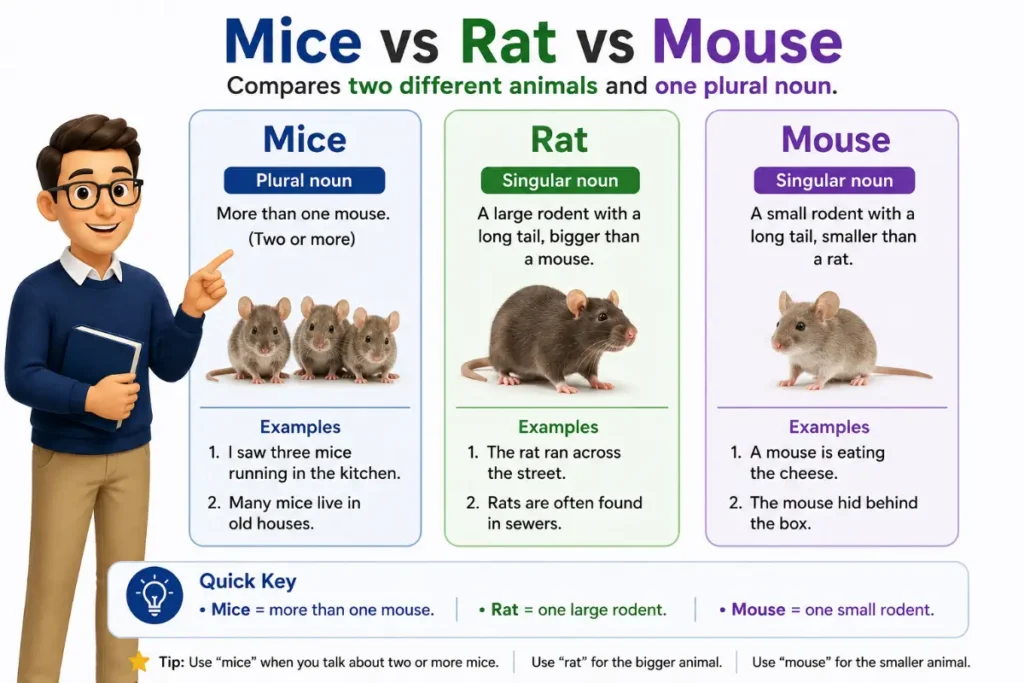
- Mice vs Rat vs Mouse compares two different animals and one plural noun.
- Mouse refers to one small rodent.
- Mice is the irregular plural of mouse.
- Rat is a different and generally larger rodent.
- The plural of rat is rats.
- Never use mouses for animals.
- Never use mices.
- The same grammar rules apply in American and British English.
- Mouse also refers to a computer pointing device.
- Context makes it easy to determine whether mouse refers to an animal or a computer accessory.
Learn the difference in Lay vs Lie Explained With Grammar Rules and Examples.
Conclusion
The difference among Mice vs Rat vs Mouse is both grammatical and biological. Mouse is the singular form for one small rodent, while mice is its irregular plural. Rat names a different rodent, and rats is its regular plural. Although mice and rats share several features, they are not the same animal.
To avoid mistakes, remember the four forms together: one mouse, many mice, one rat, and many rats. Check the number in your sentence before choosing the noun. This simple habit will help you use the correct word in conversations, schoolwork, reports, and formal writing.
FAQs
Is Mice the Plural of Mouse?
Yes. Mice is the standard irregular plural of mouse. Use mouse when referring to one animal and mice when referring to two or more. For example, one mouse entered the room, while three mice were hiding behind the cupboard. The spelling changes because mouse follows an older English plural pattern rather than the usual rule of adding s.
Is Mouses Ever Correct?
Mouses is uncommon for the animal and is not the standard plural in ordinary English. The correct plural is mice. However, mouses sometimes appears in technical contexts when writers want to distinguish different computer devices or models. For general writing, use mice for both the animal and the computer device.
What Is the Difference Between a Mouse and a Rat?
A mouse is generally smaller and lighter than a rat. It often has relatively large ears, a pointed nose, and a thin tail. A rat usually has a heavier body, larger feet, and a thicker tail. Both are rodents, but they belong to different groups and can differ in behavior and habitat.
Are Mice and Rats the Same Animal?
No. Mice and rats are different types of rodents, although they share several physical features. They both have long tails, sharp teeth, and adaptable diets. Their size, body shape, behavior, and species classification can differ. The names should not be used as exact synonyms, especially in scientific or educational writing.
What Is the Plural of Rat?
The plural of rat is rats. It follows the regular English rule of adding s to a singular noun. For example, one rat may enter a building, while several rats may live near the same area. Unlike mouse, the word rat does not change its internal vowel when it becomes plural.
How Do You Pronounce Mouse and Mice?
Mouse is pronounced /maʊs/ and rhymes with house. Mice is pronounced /maɪs/ and rhymes with nice. Both words have one syllable, but their vowel sounds are different. Mouse uses the sound in now, while mice uses the long i sound in time. Practicing the pair helps you remember the spelling and pronunciation.
Can You Use Mice for Computer Equipment?
Yes. Mice is the standard plural of computer mouse in general English. For example, a computer lab may have several mice connected to different computers. The form mouses sometimes appears in technical settings, but mice is the more familiar and widely accepted plural for ordinary writing.
Why Does Mouse Become Mice Instead of Mouses?
Mouse becomes mice because it follows an old English irregular plural pattern. Earlier forms of the word changed their vowel sound when forming the plural. Although the historical sound that caused the change disappeared, the different vowel remained. Modern English preserves this pattern in mouse and mice, just as it preserves man and men.