
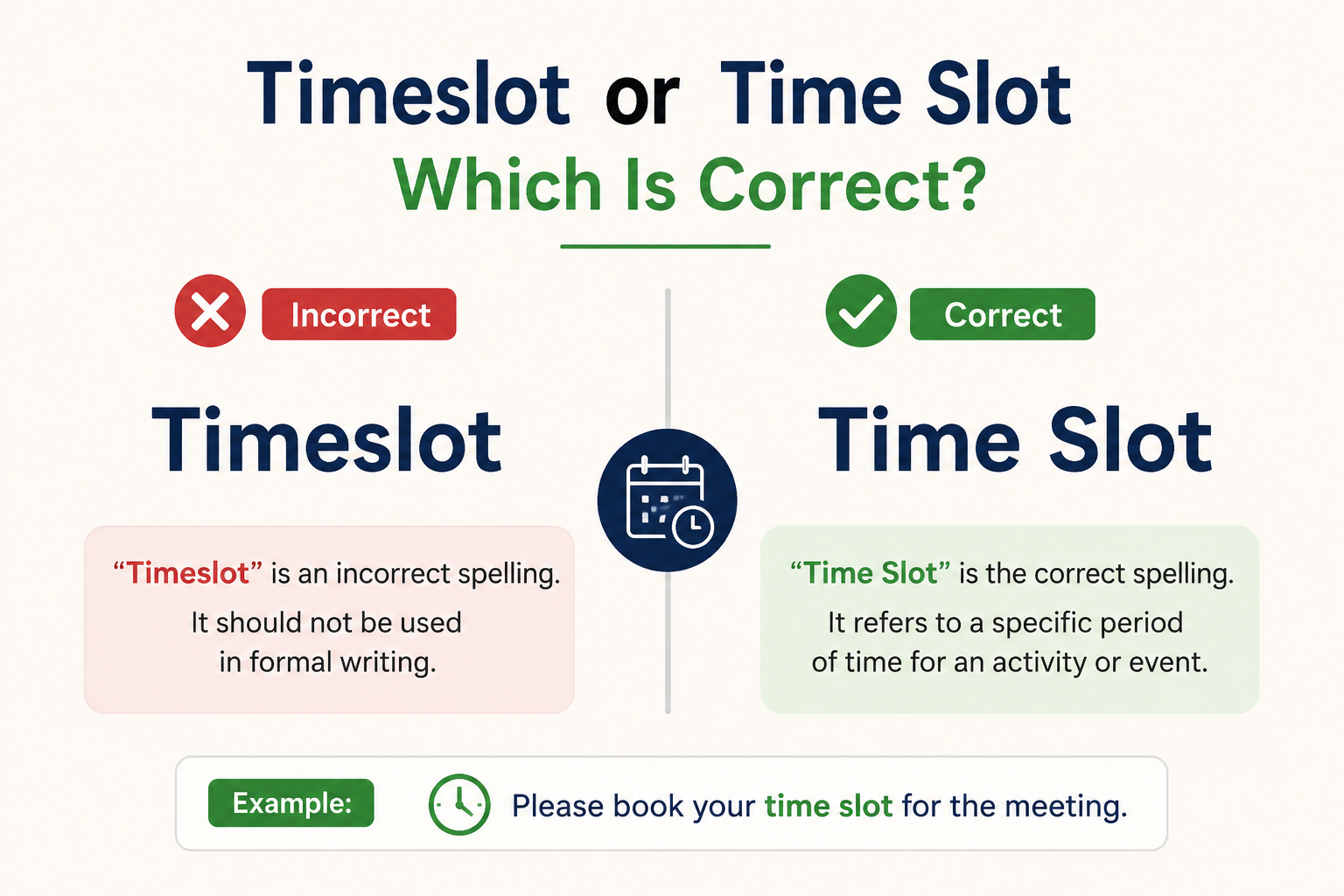
If you are writing about an available appointment, meeting period, or scheduled block of time, you may wonder if you should use timeslot or time slot. The standard spelling in general English is time slot, written as two separate words. The closed form, timeslot, is also used, especially in some technical and scheduling contexts, but it is less widely preferred in edited general writing.
The confusion makes sense because English often combines words over time. Expressions such as website, notebook, and bedroom are now commonly written as single words, while other combinations remain open. The spelling of this expression can also vary across booking platforms, calendars, and workplace systems.
The good news is that the meaning stays the same in both forms. A time slot is a specific period set aside for an activity, appointment, meeting, broadcast, or service. This guide explains the standard spelling, how to use it in a sentence, when the closed form may appear, and how to avoid common grammar and formatting mistakes.
Learn the difference in alot or a lot: Correct Spelling Meaning and Usage.
Quick Answer
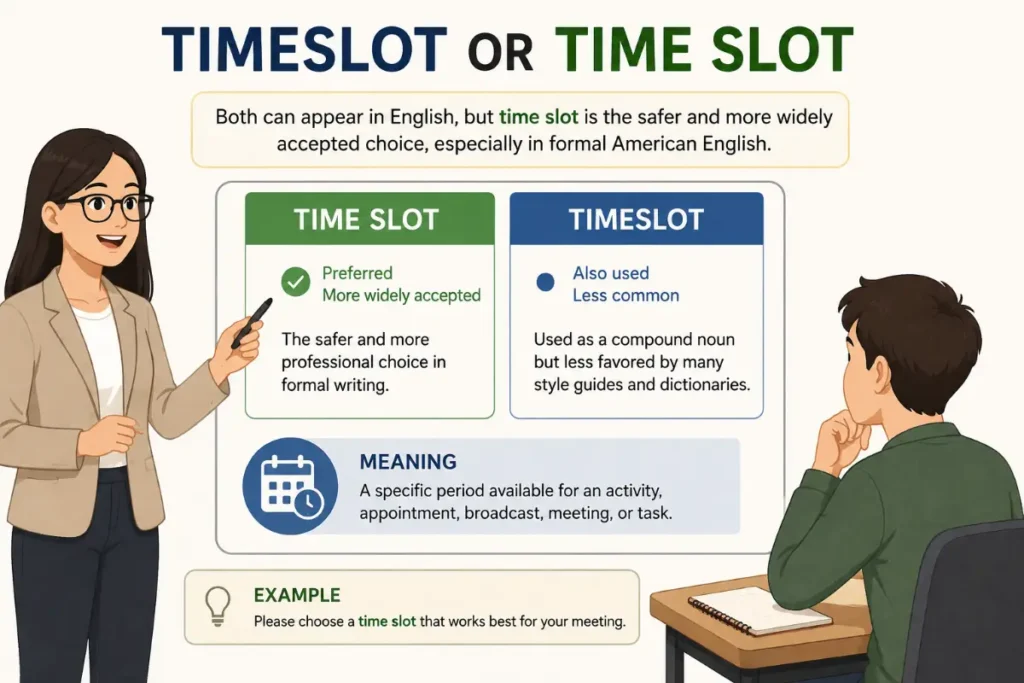
Time slot is the preferred spelling in standard general English. It means a specific period reserved or available for an activity, such as an appointment, meeting, or delivery. Timeslot is a closed variant found in some technical and scheduling contexts, but the two word form is the safer choice for most professional and everyday writing.
Comparison Table
| Feature | Time Slot | Timeslot |
|---|---|---|
| Spelling | Two words | One word |
| Status | Standard open compound | Closed variant |
| Meaning | A scheduled or available period | The same general meaning |
| Part of speech | Compound noun | Compound noun |
| Common contexts | Appointments, meetings, calendars, broadcasts | Scheduling software, technical interfaces, internal systems |
| General writing | Preferred | Less common |
| Formality | Suitable for formal and informal writing | Depends on the organization or system |
| Pronunciation | /ˈtaɪm ˌslɑːt/ | /ˈtaɪmˌslɑːt/ |
| Example | I booked a time slot for Friday. | The system displays each available timeslot. |
Meaning and Definition
What Does Time Slot Mean?
A time slot is a specific period assigned, reserved, or made available for an activity. It gives an activity a place within a schedule and helps people organize their time. The period can last a few minutes, an hour, or several hours, depending on the situation.
For example, a dentist may offer a 30 minute time slot for an appointment. A teacher may assign each student a time slot for a presentation. A delivery company may provide a morning time slot so customers know when to expect a package.
The expression is useful because it refers to both the period itself and its place in a larger schedule. It can describe a fixed appointment, an available opening, or a planned period for a particular task.
Common examples include:
- A doctor’s appointment time slot.
- A meeting time slot.
- A delivery time slot.
- A television program time slot.
- A time slot for an online interview.
- A time slot for a school activity.
- A gym class time slot.
- A customer service time slot.
In each case, the expression identifies a defined period that belongs to a schedule.
What Does Timeslot Mean?
Timeslot is a closed spelling of the same compound noun. It generally refers to a scheduled or available period, just like the two word version.
You may see it in appointment software, calendar tools, booking websites, technical documentation, or internal company systems. A software developer might use timeslot as a field name in a database, while a booking platform might display Available Timeslots as a heading.
The closed spelling is understandable and appears in real usage. However, its presence in a software interface or company document does not mean it is the preferred spelling in all forms of English. Some organizations choose closed compounds to keep labels short or maintain consistent naming conventions.
For ordinary prose, emails, reports, articles, and general business communication, time slot is the more reliable choice.
Is Timeslot a Misspelling?
Not necessarily. Timeslot is a recognized closed variant in some usage, especially in technical and scheduling contexts. However, it is less established as the general preferred form than time slot.
This distinction matters. It would be inaccurate to claim that every use of the closed form is simply a spelling error. At the same time, writers should not assume that a software label or company preference establishes a universal spelling rule.
If you are writing for a general audience, choose the two word form. If you are working with a product, database, or organization that consistently uses the closed spelling, follow its established style when referring to that specific system.
What Does the Word Slot Mean?
The word slot refers to an assigned position, opening, space, or place for something. In a schedule, it describes a period available for an activity. In other settings, it can refer to a physical opening or a position in a list.
For example, a parking slot is a space for a vehicle, while a time slot is a period for an activity. The shared idea is that something has a defined place or position.
The word time identifies the type of slot. Together, the words create a compound noun that refers to a place in a schedule measured by time.
Key Differences Explained
1. Spelling
The main difference is how the compound is written.
- Time slot has two separate words.
- Timeslot joins the same words into one.
The two word spelling is the standard choice for general writing. The closed spelling appears in some specialized settings, but it is not necessary to join the words to make the meaning clear.
English compounds can be written as open compounds, closed compounds, or hyphenated compounds. Their spelling depends on established usage, and not every combination follows the same pattern.
2. Meaning
There is no important difference in meaning between the two spellings. Both refer to a period assigned or available for an activity.
For example:
- The clinic has an open time slot at 10 a.m.
- The clinic has an open timeslot at 10 a.m.
Both sentences communicate the same basic information. The difference is spelling preference rather than meaning.
3. Grammar
Both forms function as compound nouns. They can act as the subject or object of a sentence and can appear after a preposition.
Examples:
- The time slot is still available.
- I selected a time slot.
- We need to reserve a time slot.
- The software displays the available timeslots.
The grammar does not change simply because the compound is written as one word or two.
4. Part of Speech
In both spellings, the expression is a noun. It names a period assigned to an activity or reserved within a schedule.
You can use it as the subject of a sentence: The time slot begins at noon. You can also use it as the object: She booked a time slot for Monday.
It can also appear before another noun to describe a related item, as in time slot availability or time slot selection. In these combinations, the expression helps identify the kind of availability or selection being discussed.
5. Pronunciation
Both spellings are pronounced in essentially the same way. The first word, time, carries the main stress, while slot follows it.
In ordinary speech, people do not pause between the words. The spelling difference does not create a meaningful pronunciation difference.
6. Formality
Time slot is suitable for casual conversation, business emails, formal documents, academic writing, and published material. It is clear and familiar to a wide audience.
Timeslot may be suitable in a technical product or a workplace that uses it as an established term. However, using it in general writing can look inconsistent or less familiar to readers who expect the open form.
7. Context
The open form works naturally in almost every context:
- Booking an appointment.
- Arranging a meeting.
- Planning a delivery.
- Scheduling a job interview.
- Assigning a class presentation.
- Planning a television broadcast.
The closed form is more likely to appear in labels, software fields, or internal technical language. Even there, the choice often reflects a style decision rather than a different definition.
8. Regional Usage
There is no major spelling difference between American and British English for this expression. Time slot is widely understood in the United States, the United Kingdom, Canada, and Australia.
The closed form can appear in different English speaking regions, especially in digital systems and technical material. However, regional spelling rules do not require writers to use timeslot instead of time slot.
9. Standard Versus Less Common Usage
The safest general rule is simple: write time slot as two words unless a specific organization, publication, or software system requires the closed spelling.
This approach keeps your writing familiar and consistent. It also avoids unnecessary questions about style when the open compound already communicates the meaning clearly.
Which Form Is Correct?
Time slot is the preferred spelling in standard general English. It is an open compound made from the noun time and the noun slot. Together, the words describe a defined period assigned to an activity.
The closed form, timeslot, is also used, particularly in technical and scheduling contexts. It is not useful to label every occurrence as an error, but it is less suitable as the default choice in general prose.
Consider these examples:
- Preferred: I booked a time slot for my annual checkup.
- Preferred: Please choose a time slot for your interview.
- Preferred: The delivery company offers a two hour time slot.
- Less common: The website shows each available timeslot.
- Less common: The application stores the selected timeslot.
The first three examples use the standard open spelling. The last two show how the closed form may appear in software or technical writing.
For everyday use, choose the two word version. It is easy to read, widely understood, and suitable for both formal and informal communication.
Sentence Examples
Here are ten natural examples that show how to use the preferred spelling in different situations.
- Everyday conversation: I need to find a time slot that works for everyone.
- Text message: Can you send me your available time slots for tomorrow?
- Workplace communication: Please reserve a time slot for the project review.
- School: Each student will receive a time slot for the oral presentation.
- Academic writing: Participants were assigned a time slot for each interview.
- Formal writing: Applicants must select a time slot before submitting the registration form.
- Social planning: We found a time slot for dinner after everyone finished work.
- Online booking: The website shows the available time slots for next week.
- Customer service: A representative will contact you during your selected time slot.
- Healthcare: The clinic confirmed my time slot for the follow up appointment.
These examples show that the expression works with many verbs, including book, reserve, select, assign, confirm, and schedule. It can refer to a period that has already been chosen or one that remains available.
Examples in Different Sentence Positions
The compound noun can appear in different parts of a sentence.
At the beginning:
The time slot you selected is no longer available.
In the middle:
We reserved a time slot for the training session.
At the end:
Please choose an available time slot.
After a preposition:
The appointment is scheduled within the morning time slot.
With an adjective:
I selected an early time slot for the consultation.
These structures show that the expression does not need a special sentence position. It behaves like an ordinary noun phrase.
Common Mistakes and Spelling Problems
Writers sometimes make mistakes because they are unsure how English compound nouns should be written. Other errors involve plural forms, articles, modifiers, and the use of related scheduling terms.
1. Using the Closed Form in General Writing
Less preferred: I booked a timeslot for Tuesday.
Preferred: I booked a time slot for Tuesday.
The closed version appears in some systems and technical settings, but the open form is more suitable for general writing. If you are preparing an email, article, report, or public notice, use the two word spelling.
2. Adding an Unnecessary Hyphen
Incorrect for standard general usage: time-slot.
Preferred: time slot.
The expression is normally written as an open compound. A hyphen is not needed between the two words. Do not add one simply because the expression describes a single idea.
3. Writing the Plural Incorrectly
Incorrect: time slotses.
Correct: time slots.
The plural is formed by adding s to slot, not by changing both words. The word time remains unchanged because it modifies slot.
Examples:
- One time slot.
- Two time slots.
- Several available time slots.
4. Using the Wrong Article
Incorrect: I booked an time slot.
Correct: I booked a time slot.
The article depends on the sound at the beginning of the following word. Since time begins with a consonant sound, use a, not an.
5. Confusing a Time Slot With a Deadline
Incorrect: My time slot is Friday at 5 p.m. when I must finish the project.
Clearer: My deadline is Friday at 5 p.m.
A time slot is a period assigned to an activity. A deadline is the latest time by which something must be completed. They may relate to the same schedule, but they do not mean the same thing.
6. Using an Unclear Time Range
Unclear: My time slot is 9 to 10.
Clearer: My time slot is from 9 a.m. to 10 a.m.
A time period should be clear enough for the reader to understand its start and end. Include a.m. or p.m. when the time could be misunderstood, especially in booking messages and appointment confirmations.
Pronunciation Guide
How Do You Pronounce Time Slot?
Time slot is pronounced /ˈtaɪm ˌslɑːt/ in many American English pronunciation guides. It has two spoken parts, time and slot, with the main stress on time.
A simple pronunciation guide is:
- Time: sounds like thyme.
- Slot: sounds like slot in the phrase parking slot.
- Together: TIME slot.
The two words flow naturally together. You do not need to pause between them.
Syllable Breakdown
The expression has two syllables:
- Time.
- Slot.
The first syllable carries the stronger stress. The second syllable is spoken clearly but with less emphasis.
Common Pronunciation Mistakes
Some speakers may pronounce the first part too quickly or place equal stress on both words. Others may confuse the vowel in slot with the vowel in similar words from their first language.
For clear American English, pronounce time with the long i sound and slot with the short o sound. The pronunciation remains the same for the open and closed spellings.
Still confused? Compare Persue or Pursue Which Spelling Is Correct?.
Etymology and Word Origin
Origin of Time
The word time has a long history in English. It developed from Old English tīma, which referred to a period or appointed time. The word has Germanic roots and is related to words in other Germanic languages that refer to time or periods.
Over many centuries, its meaning expanded to cover moments, durations, occasions, schedules, and measured periods. Today, it is used in countless expressions, including free time, travel time, opening time, and time limit.
Origin of Slot
The word slot entered English through earlier European language forms, including Old French and related Scandinavian influences. Its historical meanings included a narrow opening, groove, or place into which something could fit.
The modern word can refer to a physical opening, a position in a system, or an assigned place. This sense of an assigned position helps explain its use in scheduling.
How the Compound Developed
The expression combines time and slot to describe a position within a schedule. Instead of a physical space, the slot represents a period available for an activity.
This is a common way English creates compound nouns. Two familiar words work together to form a more specific meaning, as seen in expressions such as meeting room, parking space, and appointment date.
The exact date when the expression became common is not necessary for understanding its modern use. Its meaning follows naturally from the two words that form it.
Regional Usage
American English
In American English, time slot is the standard general spelling. It is common in appointment systems, medical offices, schools, business schedules, delivery services, and event planning.
Examples include:
- Choose a time slot for your interview.
- The doctor has an open time slot on Thursday.
- Each speaker will receive a 15 minute time slot.
American writers may encounter the closed form in software interfaces or company systems, but the open spelling remains the safer choice for ordinary prose.
British English
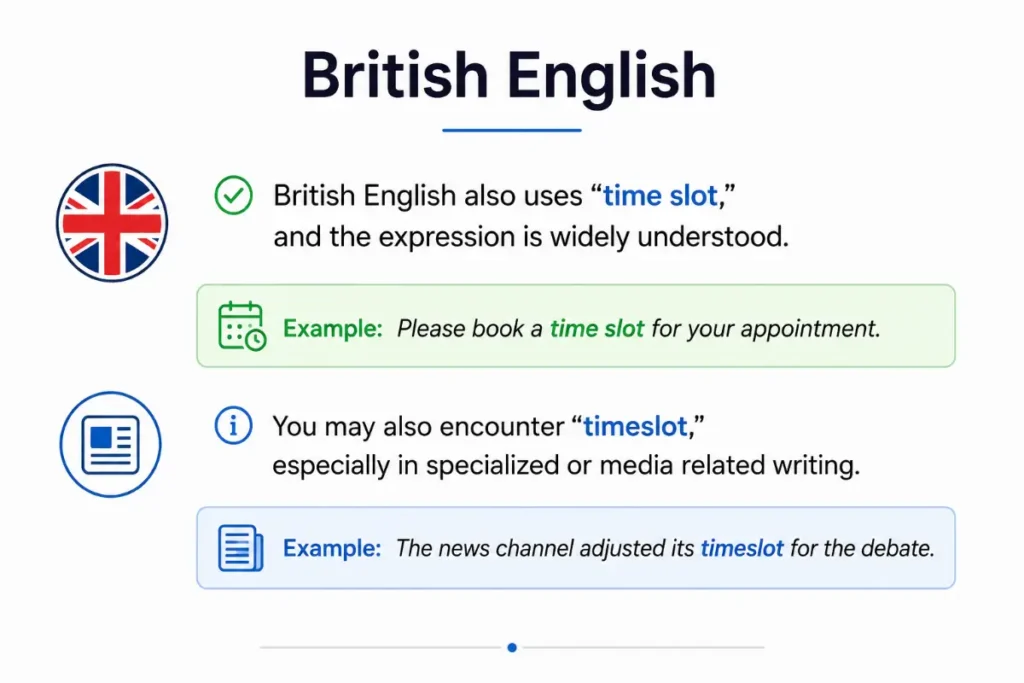
British English also uses time slot as an open compound. The meaning and basic grammar are the same as in American English.
For example, a British office might ask an employee to book a time slot for a meeting. There is no special British spelling rule that requires the compound to be written as one word.
Australian English
Australian English uses the same open spelling in general writing. The expression is common in appointment scheduling, education, workplace planning, and public services.
There is no major regional distinction that changes its meaning or grammar.
Canadian English
Canadian English follows the same general pattern. Time slot is the natural spelling for appointments, meetings, and other scheduled activities.
The closed version may appear in software or organization specific material, but it does not replace the open form as the safest general choice.
Grammar Rules and Part of Speech
Time slot is a compound noun. It names a period set aside for an activity and follows ordinary noun rules in English.
Singular and Plural Forms
Use time slot when referring to one scheduled period. Use time slots when referring to more than one.
| Number | Form | Example |
|---|---|---|
| Singular | Time slot | I booked a time slot. |
| Plural | Time slots | Three time slots are available. |
Only slot takes the plural ending. The word time stays singular because it functions as a modifier.
Using Articles
Use a or the according to the meaning of your sentence.
- A time slot: one available or unspecified period.
- The time slot: a particular period already known to the reader.
- An available time slot: one period that can still be selected.
- My time slot: the period assigned to you.
Examples:
- I need a time slot for next week.
- The time slot begins at 2 p.m.
- She confirmed her time slot by email.
Using Adjectives
Adjectives can appear before the compound noun to describe its length, position, or availability.
Examples include:
- An early time slot.
- A late time slot.
- A short time slot.
- A flexible time slot.
- A convenient time slot.
- An available time slot.
- A 30 minute time slot.
These modifiers help readers understand the type of period being discussed.
Using Numbers and Durations
You can describe a period by stating its length. In a sentence, a compound modifier before a noun is often hyphenated for clarity.
For example:
- The meeting has a 30 minute time slot.
- We reserved a two hour time slot.
- Each guest receives a 15 minute time slot.
The hyphens in 30 minute and two hour join the number and unit when they work together as a modifier before a noun. They do not change the spelling of time slot itself.
When the duration follows the noun, the construction changes:
- The time slot lasts 30 minutes.
- The reserved period is two hours long.
Using Prepositions
The expression commonly appears after prepositions that describe timing and scheduling.
Examples:
- In the morning time slot.
- During the selected time slot.
- Within the available time slot.
- For the afternoon time slot.
- At the end of the time slot.
Choose the preposition that matches the intended relationship. During emphasizes the period in which something happens, while for often identifies the period selected or reserved.
Formal and Informal Usage
The open compound works in both formal and informal writing. You can use it in a quick text message, a business email, an academic report, or an official appointment notice.
It is clear and neutral, so you do not need a more complex phrase to sound professional. In many cases, direct wording is easier for readers to understand.
Real Life Usage Examples
Daily Conversation
People use the expression when arranging plans or discussing availability.
- I can meet after lunch, but I need to check my time slot first.
- There is an open time slot at the gym around six.
These sentences sound natural because the expression clearly identifies a period in a schedule.
Email and Workplace Communication
In professional messages, the compound noun helps make scheduling requests specific.
- Please select a time slot for your performance review.
- I have reserved a time slot for our discussion on Thursday.
It is useful in emails because it tells the reader that a particular period must be selected, assigned, or confirmed.
Academic Writing
Schools, universities, and researchers often need to assign specific periods for presentations, interviews, exams, and studies.
- Each participant received a time slot for the interview.
- Students were assigned a time slot for their final presentations.
In academic writing, the expression is neutral and precise. It can describe a planned period without adding unnecessary detail.
News and Journalism
News writers may use the expression when reporting on television schedules, public appointments, or service availability.
- The station moved the program to a later time slot.
- The city introduced additional time slots for public consultations.
The phrase helps readers understand where an event or service fits into a schedule.
Literature and Storytelling
In stories, the expression can help establish a character’s routine or create a scheduling conflict.
- She had a short time slot to speak with the director before the train arrived.
- His interview time slot overlapped with the final round of the competition.
These examples show how a scheduling term can also help build a realistic scene.
Related and Confused Terms
The following terms are closely connected to scheduling, appointments, and the organization of time. They are useful alternatives in some situations, but they do not all mean exactly the same thing.
1. Appointment
An appointment is an arrangement to meet someone or receive a service at a particular time. A time slot is the period reserved for that appointment.
For example, you may book a doctor’s appointment for a 30 minute time slot. The appointment is the planned visit, while the slot is its scheduled period.
2. Time Frame
A time frame is a period within which an activity is expected to happen or be completed. It can cover a much wider period than a single scheduled opening.
For example, a project may have a six month time frame. A time slot for a meeting may last only 30 minutes.
3. Time Window
A time window is a period during which something can happen. It may offer more flexibility than a fixed appointment.
For example, a delivery company may provide a delivery time window between 10 a.m. and noon. A time slot may refer to a more specific period within that window.
4. Schedule
A schedule is a plan that lists activities and the times assigned to them. It may contain many time slots.
For example, a teacher’s schedule may include a separate time slot for each student meeting. The schedule is the complete plan, not just one period.
5. Booking Slot
A booking slot is a period available for someone to reserve. It is very close in meaning to a time slot, especially on appointment websites and reservation systems.
For example, the website may show three booking slots for Friday. Each one represents a period that a customer can select.
6. Time Period
A time period is a general length or section of time. It does not always need to be reserved or assigned to an activity.
For example, the phrase a difficult time period describes a stretch of time. A time slot usually refers to a defined place within a schedule.
7. Availability
Availability refers to the periods when a person, service, or resource can be used or accessed. It is broader than a single scheduled opening.
For example, a doctor’s availability may include several open time slots during the week. Availability describes the overall options, while each slot is one specific option.
8. Deadline
A deadline is the latest time or date by which something must be completed. It is not the same as a scheduled period.
For example, a writer may have a time slot from 9 a.m. to 10 a.m. to work on a report, but the deadline may be Friday afternoon. The first is a planned work period; the second is the final completion point.
Expert Editor Insight
An experienced editor generally uses time slot as two words in articles, reports, emails, and public information. The confusion comes from the way English compounds can appear open, closed, or hyphenated, along with the closed spelling used by some software systems. Grammar tools may accept both versions, so a spelling check alone may not settle the style question. Editors look at the audience, publication style, and consistency across the document. A useful editing habit is to choose the open spelling at the start of a document and use it consistently unless a product name or required technical label uses the closed form.
Key Takeaways
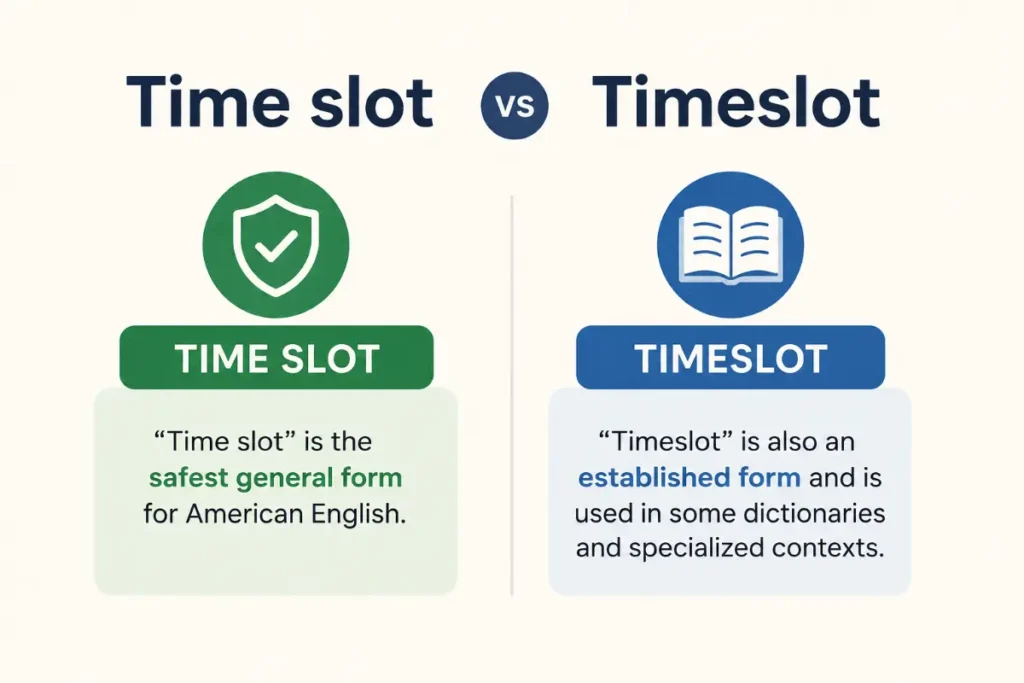
- “Time slot” is the safest general form for American English.
- “Timeslot” is also an established form and is used in some dictionaries and specialized contexts.
- Both forms refer to a specific period allocated for an activity or event.
- “Time slot” is usually preferable in general professional writing.
- The plural of “time slot” is “time slots.”
- A hyphen is normally unnecessary when the expression functions as a noun.
- Context and house style can influence the preferred spelling.
- The expression works in appointments, meetings, broadcasting, education, deliveries, work schedules, and online booking.
- “Time slot” and “timeslot” generally have the same basic meaning.
- If you’re unsure which form to choose, use “time slot.”
You may also want to read Sleave or Sleeve Which Spelling Is Correct? 2026.
Conclusion
The preferred spelling is time slot, written as two separate words. It describes a specific period reserved or available for an appointment, meeting, delivery, class, or other activity. The closed form, timeslot, also appears in technical and scheduling contexts, but it is not the safest default for general writing.
Both forms carry the same basic meaning, so the main difference is spelling preference rather than definition. To keep your writing clear, use the open form in emails, reports, and everyday communication. A simple memory tip is to treat time and slot as two separate words that work together to name one scheduled period.
FAQs
Is Time Slot One Word or Two?
Time slot is generally written as two words in standard English. It refers to a specific period reserved or available for an activity. Timeslot is also seen as a closed variant, especially in technical systems, but the open form is the safer choice for emails, reports, articles, and everyday writing.
Is Timeslot a Correct Word?
Timeslot is used as a closed spelling of the compound noun, particularly in some scheduling and software contexts. However, it is less common as the preferred form in general edited writing. If you are unsure which version to use, choose time slot. It is clear, widely understood, and suitable for both formal and informal communication.
What Does Time Slot Mean?
A time slot is a specific period assigned, reserved, or made available for an activity. It may refer to an appointment, meeting, interview, delivery, class, or broadcast period. For example, a clinic may offer a 20 minute time slot for a consultation, allowing patients to choose an available appointment time.
Should I Write Time Slot or Timeslot in an Email?
Use time slot in most emails. It is the standard open spelling and works naturally in professional messages, appointment confirmations, meeting requests, and scheduling instructions. Use timeslot only if you are following the established spelling of a specific company system, product, or internal style guide.
Is Time Slot Hyphenated?
No. The standard general spelling is time slot, with a space between the words and no hyphen. A hyphen may appear in a separate compound modifier, such as a 30 minute time slot, where 30 minute describes the length of the period. The noun itself remains two words.
What Is the Plural of Time Slot?
The plural is time slots. Only the second word takes the plural ending because slot is the main noun and time describes the type of slot. For example, one time slot is available, but three time slots are open. Do not write times slots or time slotses.
Is Time Slot Appropriate in Formal Writing?
Yes. Time slot is a neutral expression suitable for formal reports, business emails, academic work, appointment notices, and official schedules. It communicates a specific scheduled period without sounding overly casual. You can use it in professional writing without replacing it with a longer phrase such as scheduled period.
What Is Another Word for Time Slot?
Useful alternatives include appointment period, booking slot, scheduled period, available window, and meeting time. The best choice depends on the context. Appointment period works for a planned visit, while available window suggests a period during which something can happen. Time slot remains a clear general term for a reserved period in a schedule