
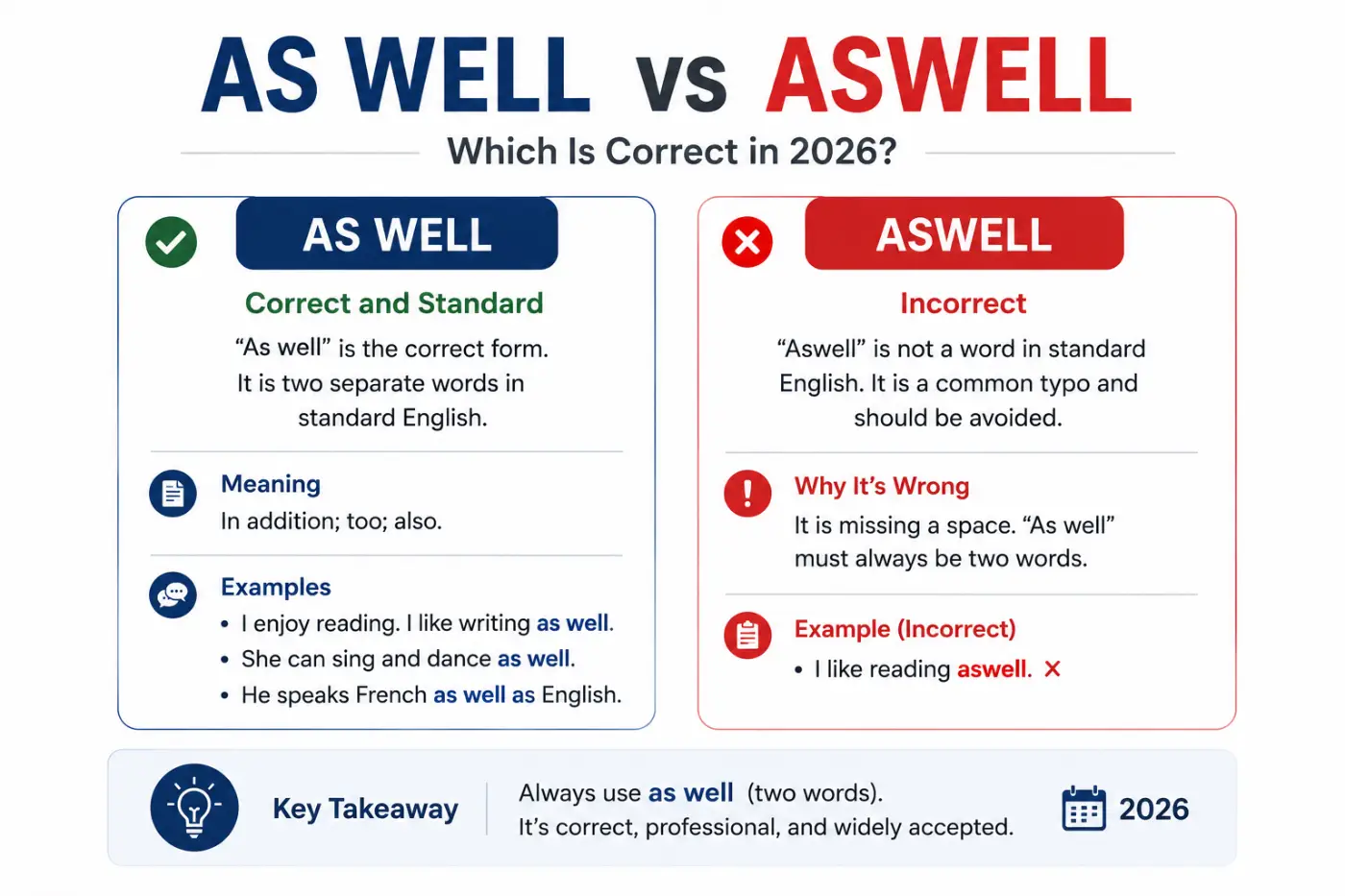
Aswell vs as well is a common spelling and grammar question because the phrase sounds like one smooth unit when people say it aloud. The correct form is as well with two separate words. The closed form aswell is generally a spelling error in standard English.
The confusion happens for a good reason. English contains many expressions that started as separate words and later developed fixed meanings. When you hear as well in fast speech the words can blend together so closely that writing them as one word may feel natural. Digital communication can make the problem even more common because people often type based on sound.
Once you know the basic rule the choice becomes easy. This guide explains the meaning grammar pronunciation sentence position formal usage regional patterns common mistakes and related expressions. You’ll also see why as well can mean also in one sentence and have a different meaning when it describes something done equally well.
Learn the difference in Seal Vs Seel Which Is Correct Meaning Differences And Examples.
Short Answer
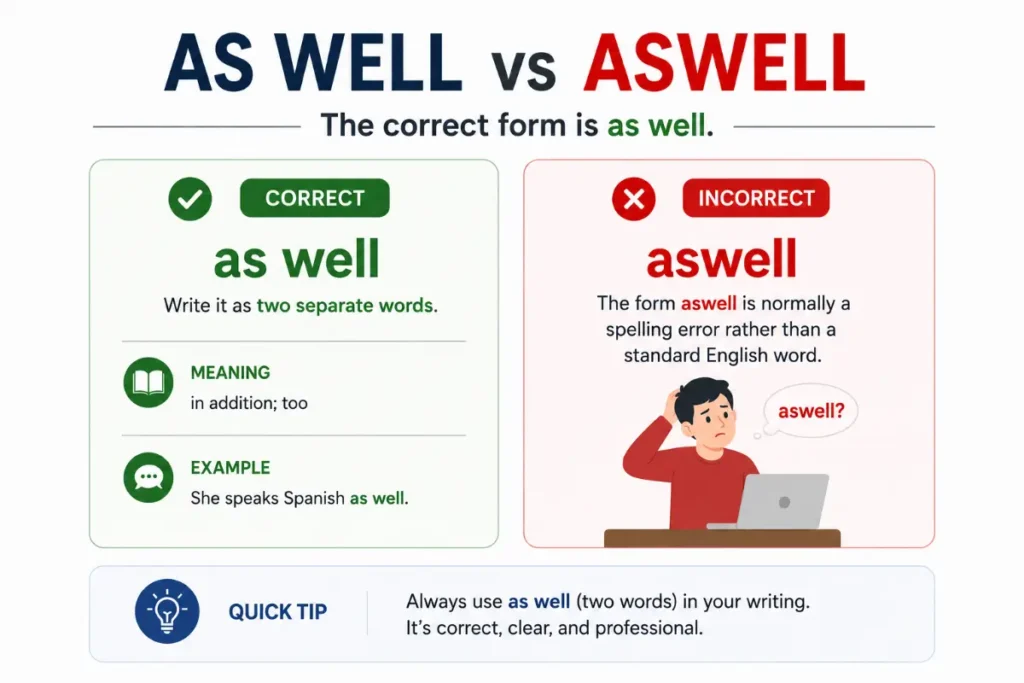
Aswell vs as well has a simple answer. As well is the correct standard form when you mean also or in addition. Aswell is not normally accepted as a standard English spelling. The two words should stay separate in American English and British English.
Table of Contents
- Quick Answer
- Meaning and Definition
- Key Differences
- Why The Words Stay Separate
- How To Use The Phrase Correctly
- Sentence Examples
- Common Mistakes
- Pronunciation
- Grammar And Sentence Position
- Formal And Informal Usage
- Regional Usage
- Related Expressions
- Memory Tips
- Real Life Usage
- Expert Editor Insight
- FAQs
- Key Takeaways
- Conclusion
Quick Answer
Use as well when you mean also or in addition.
For example:
I want coffee as well.
She speaks Spanish as well.
They invited my brother as well.
The spelling aswell is not the standard form for this meaning. In careful English writing you should keep the two words separate.
There’s also another use worth knowing. As well can describe how successfully something is done.
She sings as well as her sister.
In that sentence the phrase doesn’t simply mean also. It forms part of the comparison as well as.
Meaning And Definition
Meaning Of As Well
As well is a two word expression that most commonly means also or in addition.
If someone says:
I’m going to the party as well.
They mean:
I’m also going to the party.
The phrase adds information that connects the speaker or subject with something already mentioned.
Consider this short exchange:
I’m ordering pizza.
I’ll have a salad as well.
The second speaker isn’t saying that the salad is prepared equally well. The phrase means the speaker wants an additional item.
As well can also appear in longer expressions. The most important related structure is as well as.
For example:
She plays tennis as well as soccer.
Here as well as connects two activities.
Another example is:
He works as well as studies.
The exact meaning can depend on the sentence structure and context.
Meaning Of Aswell
Aswell is generally not the standard spelling of the expression. In ordinary English prose it is treated as a spelling error rather than a separate word with its own established meaning. You may encounter it in social media posts comments text messages or other informal online writing. Seeing it repeatedly doesn’t make it a standard spelling. A word can become familiar through frequent mistakes. That doesn’t automatically give the spelling a place in standard edited English. If you’re writing an email school assignment report article résumé or professional document use the two word form.
Comparison Of The Two Forms
The distinction is straightforward. The standard expression consists of two words.
Key Differences
Spelling
The biggest difference is the space.
The standard form is:
as well
The nonstandard form is:
aswell
English treats the first as the normal written expression. The second usually represents a spelling mistake.
Meaning
As well most often means also or in addition.
For example:
I bought bread as well.
The phrase adds bread to something already mentioned.
As well can also participate in comparisons.
She writes as well as she speaks.
That structure has a different grammatical role from the simple meaning of also.
Grammar
As well functions as an adverbial expression. It can add information to a sentence or indicate an additional action or person. The words can also appear within the larger expression as well as. That expression has its own grammar and deserves separate attention.
Pronunciation
In natural speech the two words often blend together. That makes them sound like one unit. This is one reason people sometimes write the phrase as one word. Spelling should follow the established written form rather than the way the phrase sounds during fast conversation.
Formality
As well is perfectly acceptable in formal writing. It appears in academic work business communication professional correspondence journalism and general prose.
The closed spelling should be avoided in edited writing.
Context
The phrase works in casual speech and polished writing.
You can say:
I’d like one as well.
You can also write:
The report examines cost as well as long term performance.
The expression is flexible and common across many forms of English.
Why The Words Stay Separate
A useful way to understand the spelling is to look at the meaning of the individual words. As and well are both established English words. Together they form a phrase with several related functions. English has many expressions built from separate words that speakers pronounce smoothly as one unit.
For example:
at least
of course
in fact
as soon
These expressions don’t become single words simply because speakers blend their sounds. The same principle applies here. Written English preserves the two word structure of as well. This is also why pronunciation isn’t a reliable guide to spelling. Spoken language often compresses sounds while written language preserves word boundaries. If you learn the phrase as a fixed expression rather than as a single sound you’re much less likely to close the space accidentally.
How To Use The Phrase Correctly
Using It To Mean Also
The most common use is to add another person thing action or idea.
For example:
I’m tired as well.
The meaning is close to:
I’m also tired.
Another example is:
She wants to join us as well.
The phrase adds she to a group of people who already want to join.
Using It At The End Of A Sentence
In American English as well often appears near the end of a sentence.
For example:
I’d like some water as well.
He wants to come with us as well.
We need more time as well.
This position sounds natural in everyday speech.
Using It For Emphasis
Sometimes as well can add emphasis to an additional fact.
For example:
He apologized and offered to pay as well.
The phrase tells the reader that offering to pay was another action beyond apologizing.
Using As Well As
The larger expression as well as connects related ideas.
For example:
She teaches English as well as history.
This means she teaches both subjects.
Another example is:
The package includes a charger as well as a protective case.
The expression introduces an additional item.
As well as has its own grammatical patterns. It shouldn’t always be replaced mechanically with also.
Sentence Examples
Here are natural examples that show the standard expression in different situations.
- I’d like to come as well.
- She ordered dessert as well.
- We need to invite Mark as well.
- He knows the answer as well.
- I’m planning to study tonight as well.
- They bought a new table as well.
- She wants to learn French as well.
- I enjoyed the movie as well.
- We should check the second file as well.
- He decided to apply for the scholarship as well.
Each sentence adds information to something already understood from the context.
Now compare these incorrect examples.
- I’d like to come aswell.
- She ordered dessert aswell.
- We need to invite Mark aswell.
- He knows the answer aswell.
- I enjoyed the movie aswell.
In each case the space should be restored.
Common Mistakes
Writing Aswell As One Word
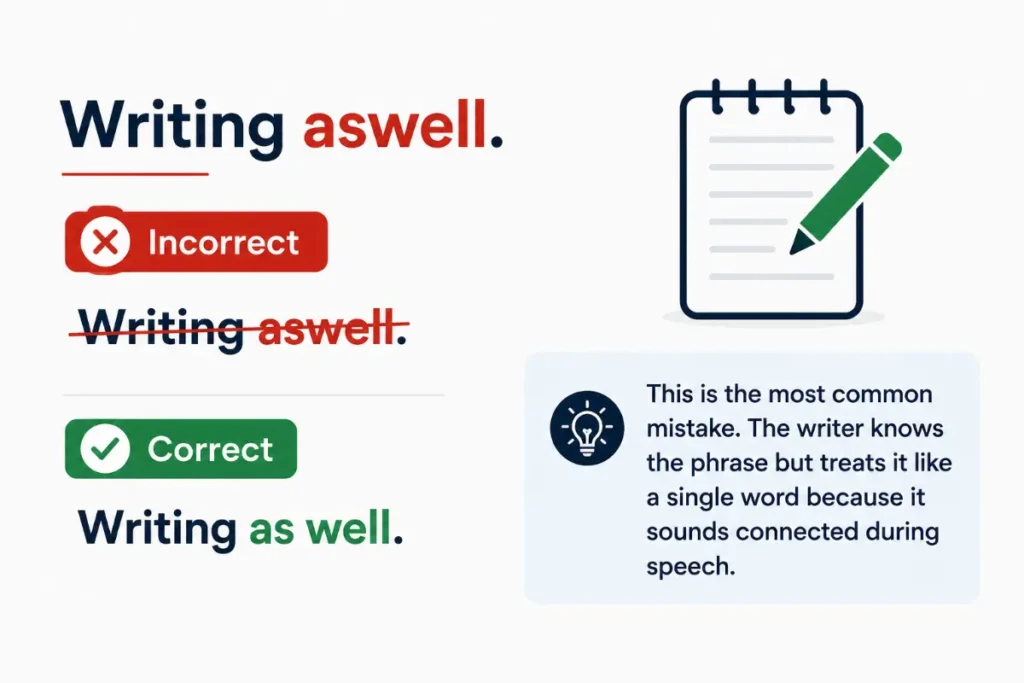
This is the most common error.
Incorrect:
I want to go aswell.
Correct:
I want to go as well.
The mistake usually comes from treating the phrase as a single sound.
Confusing As Well With Also
As well and also can often express the same basic idea but they don’t always occupy the same position naturally.
Compare:
I also want coffee.
I want coffee as well.
Both work but their sentence positions differ.
Also commonly appears before the main verb while as well often appears at the end.
Misusing As Well As
Some writers treat as well as as a simple replacement for and in every sentence. That can lead to awkward or unclear constructions.
For example:
She likes reading as well as writing.
This works because the two activities are connected.
But longer sentences may need careful attention to parallel structure.
Forgetting The Space In Fast Typing
Typing quickly encourages the brain to treat familiar phrases as single units. This is especially common in messages written from sound rather than from visual memory. A quick proofreading pass can catch it.
Adding Unnecessary Words
Writers sometimes use both also and as well in the same simple sentence.
For example:
I also want to come as well.
That sentence can sound repetitive because both expressions add the same idea.
A cleaner version is:
I also want to come.
Or:
I want to come as well.
Pronunciation Guide
The standard phrase is commonly pronounced with the sounds of both words connected in natural speech. For American English the approximate pronunciation is: uhz well The exact sound can vary slightly depending on the surrounding words and the speed of speech. The phrase has two written words but they can form one smooth rhythmic unit when spoken. The word well contains the familiar vowel sound found in words such as tell and help. The word as may be pronounced with a reduced vowel in connected speech. That reduction can make the phrase sound more compact than it looks on the page. nThis is another reason spelling by sound can cause trouble. If you hear the phrase quickly you may feel that it behaves like one word. Written English still keeps the two word structure.
Grammar And Sentence Position
As well is generally used as an adverbial phrase.
Its most common function is to add information.
Consider:
I want to go as well.
The phrase modifies the whole idea by adding the speaker to the group of people who want to go.
Position At The End
This is perhaps the most natural position in everyday American English. She wants to come as well. They bought tickets as well., I need a copy as well.
Position Before A Verb
As well can sometimes appear in other positions depending on the construction and style. However the end position is usually the easiest choice when the phrase means also. If you want a sentence to sound natural and conversational place it near the end unless the structure calls for something different.
As Well As
As well as works differently.
For example:
He studies biology as well as chemistry.
The phrase connects two nouns.
It can also connect other grammatical units.
She works as well as studies.
Here the connected elements are verbs.
Parallel structure matters. If you connect two ideas with as well as they should fit naturally into the same grammatical pattern.
Punctuation
As well normally doesn’t need special punctuation when it appears at the end of a sentence.
For example:
I’ll come as well.
No comma is needed before the phrase.
Punctuation becomes a separate issue when as well as introduces a longer phrase or clause. The surrounding sentence structure determines the punctuation.
As Well Compared With Also
As well and also are close in meaning but their placement often differs.
Consider these examples:
I also want to go.
I want to go as well.
Both mean that the speaker wants to go in addition to something already mentioned.
Also can appear in several positions.
As well often appears at the end.
This gives writers a useful practical rule.
If you already have a sentence ending with an additional idea you can often use as well naturally.
For example:
She wants to attend the meeting as well.
If you want to place the additional idea before the main verb you may prefer also.
For example:
She also wants to attend the meeting.
Neither expression is automatically more formal. The best choice depends on sentence rhythm and emphasis.
You may also want to read Stich Vs Stitch Which Spelling Is Correct in 2026?.
As Well Compared With Too
Too is another close synonym.
Compare:
I want to come too.
I want to come as well.
The meanings are nearly identical.
Too is shorter and very common in conversation.
As well can sound slightly more deliberate depending on the sentence but it remains completely natural in everyday English.
Both forms can be used in professional writing.
For example:
Please send the revised file to me too.
Please send the revised file to me as well.
The second version can sound slightly more formal or polished in some contexts but both are grammatically acceptable.
Formal And Informal Usage
As well belongs to standard English and works across levels of formality.
In casual speech:
I’m coming as well.
In a workplace message:
Please send the updated schedule to the finance team as well.
In academic writing:
The study considers environmental factors as well.
In formal prose:
The policy affects employees as well as external contractors.
The phrase doesn’t need to be avoided simply because you’re writing formally.
The main issue is spelling. The closed form should not replace the standard two word expression in professional writing.
American English
American English uses as well as a standard expression. It appears frequently in conversation writing workplace communication education journalism and general prose. The meaning also remains stable across contexts.
For example:
I’d like to order one as well.
The company provides training as well.
The report examines costs as well as benefits.
The closed spelling isn’t a recognized standard American alternative.
British English
British English also uses as well. There is no major regional spelling difference here. British writers keep the two words separate. The phrase can mean also or appear in as well as constructions.
For example:
She wants to come as well.
The report discusses safety as well as cost.
The same basic rules apply.
Australian English
Australian English follows the same standard spelling. The expression is written as two words and works naturally in everyday conversation professional communication education and publishing.There is no established Australian spelling that closes the phrase into one word.
Canadian English
Canadian English also uses the two word form. The expression is common in Canadian speech and writing and doesn’t have a special Canadian spelling variation. For standard writing in Canada use as well.
Real Life Usage
Daily Conversation
As well is extremely common in everyday speech.
- I’m hungry as well.
This adds the speaker to an existing statement about hunger.
- Can I come as well?
This means the speaker wants to join another person or group.
Workplace Communication
The expression works well in professional communication.
- Please send the invoice to the accounting team as well.
The phrase adds another recipient.
- We should review the final figures as well.
The writer is adding another task to the discussion.
Academic Writing
Academic prose often uses the expression to add another factor or topic.
- The study considers age as well as education.
The phrase connects two areas considered by the study.
- Researchers examined social factors as well as economic conditions.
The structure adds a second category to the analysis.
News Writing
Journalistic writing can use the phrase to add another event detail.
- Officials discussed transportation as well as housing.
- The storm affected roads as well as local businesses.
The phrase helps connect related topics without repeating also.
Literature And Storytelling
In storytelling the phrase can add a character action or detail.
- She smiled as well.
- He knew the secret as well.
These short examples show how naturally the expression can fit into narrative prose.
Memory Tips
The easiest way to remember the spelling is to think of the phrase as two separate ideas.
As is one word.
Well is another word. Together they form as well. You can also replace it mentally with also. If the sentence works with also the phrase may be functioning as the two word expression.
For example:
I want to come as well.
I also want to come.
The meaning stays close.
Another useful test is to ask yourself if you’re using the familiar expression that means in addition. If the answer is yes keep the space.
Don’t let pronunciation decide the spelling. Spoken English often blends words that remain separate in writing.
Related Grammar And Usage Notes
As Well As And And
As well as can sometimes connect ideas in a way similar to and.
For example:
She bought apples as well as oranges.
This tells us that she bought both items.
Still the two constructions aren’t always interchangeable in longer sentences. The writer should pay attention to emphasis and grammatical agreement.
As Well As A Comparison
As well can also appear in comparisons. For example: She sings as well as her sister. This sentence can have more than one possible interpretation depending on context. It may mean she sings equally well compared with her sister. The phrase therefore deserves careful attention when the intended meaning depends on comparison.
As Well As An Addition
In another sentence: She sings and plays guitar as well. Here as well means also. The distinction comes from sentence structure.
Also At The End Of A Sentence
Also can sometimes appear near the end of a sentence but this can sound less natural in some forms of American English. As well often fits more comfortably in that position.
For example:
I want one as well.
That sentence sounds natural and clear.
Why Aswell Looks Familiar
There’s a psychological reason spelling mistakes can become visually convincing. When you repeatedly see an incorrect form your brain may become familiar with its shape. Familiarity can create the feeling that something looks right even when it doesn’t follow standard usage. Online writing increases exposure to informal spelling. People often type quickly and don’t proofread short messages. The same process affects many common expressions. A writer may recognize the intended meaning immediately and never stop to examine the word boundary. This is why visual proofreading matters. If you’re preparing polished content search specifically for the closed form and replace it with the standard expression where appropriate.
Professional Writing Tip
If you’re editing an article or business document don’t rely only on spellcheck. A spelling tool may identify a closed form as an error but it may not explain why the space matters. Read the sentence naturally and ask what role the phrase plays. If it means also or in addition use the two word form. If it appears in as well as check the larger grammatical structure. This approach catches more than a simple spelling mistake because it checks meaning and grammar at the same time.
Expert Editor Insight
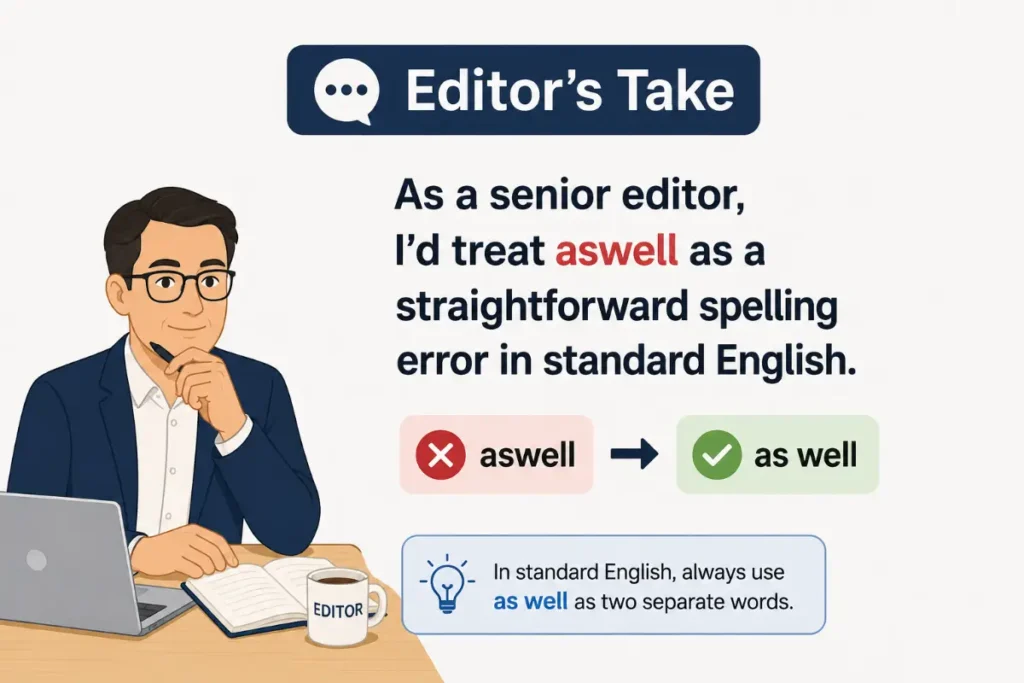
An experienced editor sees this as a word boundary issue rather than a difficult vocabulary problem. Native speakers usually understand the intended meaning immediately but standard written English still requires the two words to remain separate. The mistake often comes from connected speech fast typing or visual familiarity with incorrect online forms. Professional editing tools can help flag the error but context still matters. The strongest editing habit is to read the phrase as part of the sentence and confirm that it means also or forms the established expression as well as.
Key Takeaways
- As well is the standard English form.
- Aswell is normally a spelling error.
- As well commonly means also or in addition.
- The phrase contains two separate words.
- As well often appears near the end of a sentence.
- As well as is a related expression with its own grammatical structure.
- Also and too can often replace as well but sentence position may change.
- The same standard spelling is used in American British Australian and Canadian English.
- The phrase is appropriate in both informal and formal writing.
- A simple proofreading trick is to check the space whenever the phrase means also.
Learn the difference in Seing Vs Seeing Which Is Correct In English in 2026.
Conclusion
Aswell vs as well has a clear answer. The standard form is as well with two separate words. It commonly means also or in addition and works naturally in conversation academic writing workplace communication journalism and formal prose. The closed form is normally a spelling mistake rather than an accepted alternative.
The confusion mainly comes from pronunciation and fast typing. When people speak naturally the two words can blend together and sound almost like one unit. That sound can make the incorrect spelling feel natural even though standard written English keeps the words apart.
For an easy memory trick connect the phrase with also. If you can replace the expression with also without changing the basic meaning you’re probably using as well in its common adverbial sense. Keep the space and your spelling will stay on solid ground.
FAQs
Is aswell a correct English word?
Aswell is not normally accepted as the standard spelling of the expression meaning also or in addition. The correct written form is as well with two separate words. You may see the closed form in informal online writing or typing mistakes but that doesn’t make it a standard English alternative. Use the two word form in school work professional writing and edited content.
What does as well mean?
As well commonly means also or in addition. It adds another person thing action or idea to information already mentioned. For example I want to come as well means I also want to come. The phrase can also appear in as well as constructions where it connects two ideas or forms part of a comparison.
Which is correct aswell vs as well?
Aswell vs as well has a clear standard answer. As well is correct when you mean also or in addition. The words should remain separate. The closed form is generally a spelling error. This rule applies in American English British English Canadian English and Australian English.
Can I use as well in formal writing?
Yes. As well is standard English and works in formal writing. You can use it in academic papers reports professional emails business documents and journalism. It can mean also or form part of as well as. The phrase isn’t limited to casual speech. The main point is to preserve the space between the two words.
Is as well the same as also?
As well and also often have the same basic meaning but they usually occupy different positions in a sentence. Also commonly appears before the main verb while as well often appears at the end. For example I also want coffee and I want coffee as well express nearly the same idea.
Is as well the same as too?
As well and too can both mean also or in addition. Compare I want to come too with I want to come as well. The meaning is nearly identical. Too is often shorter and very common in conversation while as well can sound slightly more deliberate in some sentences. Both are standard English.
Why do people write aswell?
People often write the phrase as one word because the two words blend together in natural speech. Fast typing can also cause writers to remove the space. Online exposure to other people’s spelling mistakes may make the closed form look familiar. The best way to prevent the error is to remember that the standard expression contains two separate words.
How do you use as well as?
As well as can connect two related ideas. For example She studies English as well as history connects two subjects. It can also connect actions or other grammatical elements. The surrounding sentence determines the exact meaning. In some contexts as well as means in addition to while in others it forms part of an equal comparison.