
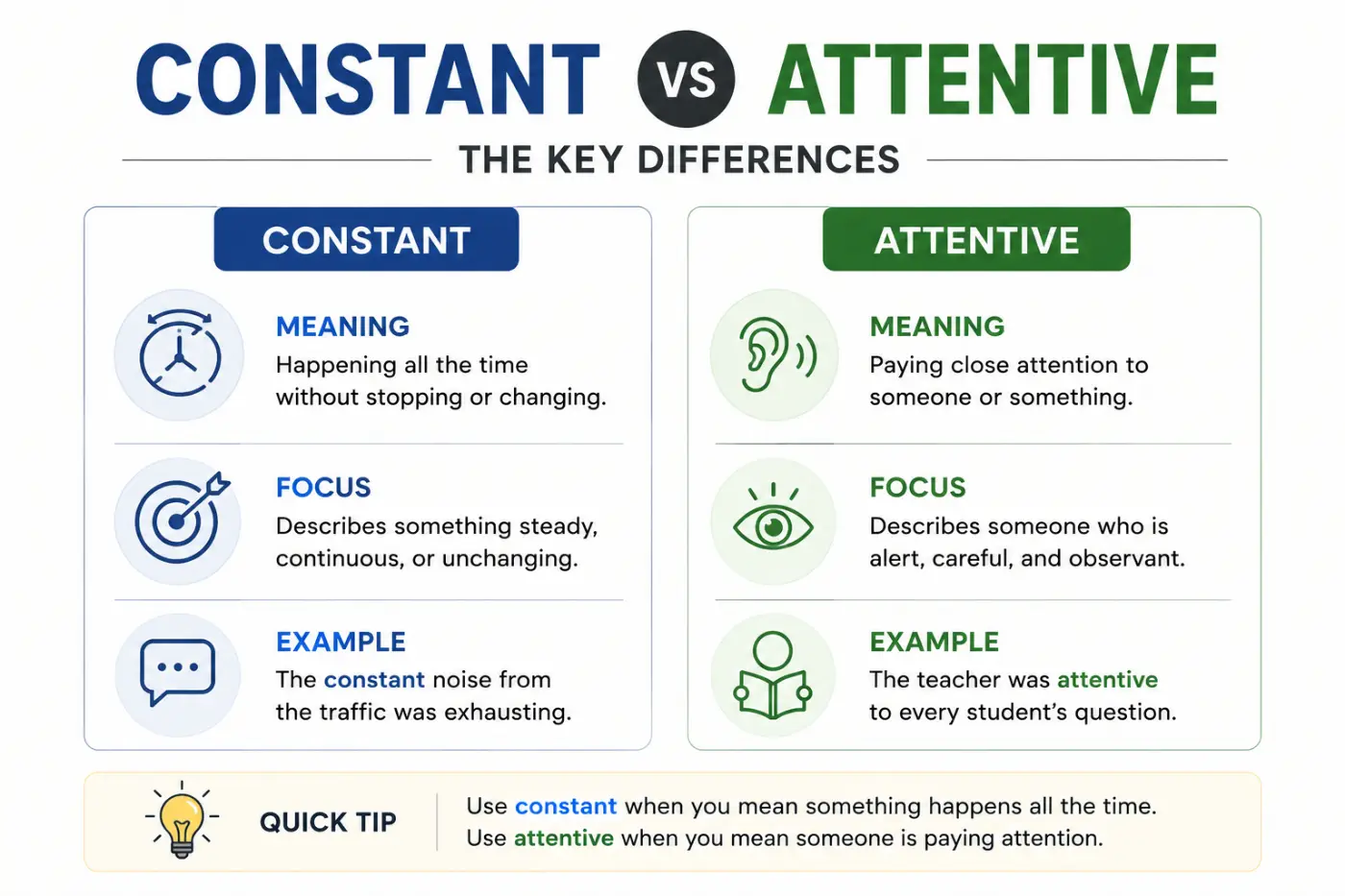
Choosing between constant vs attentive can be confusing because both words may describe someone who shows steady involvement or care. However, they do not mean the same thing. Constant describes something that continues or remains steady, while attentive describes someone who listens carefully, notices details, or gives another person their full attention.
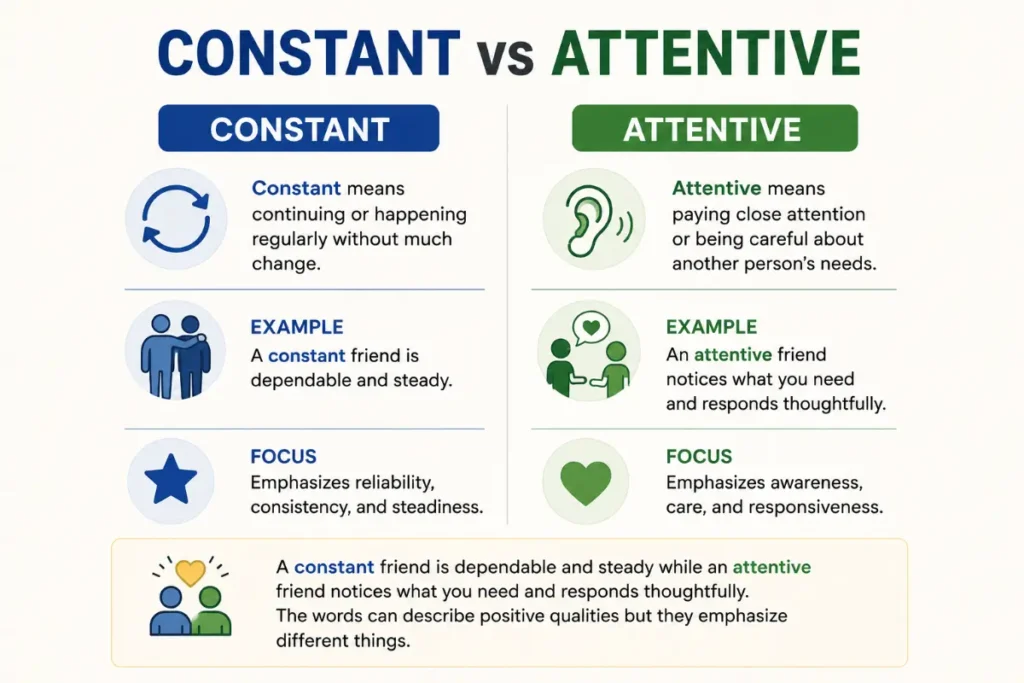
For example, a constant friend may stay in touch regularly, but an attentive friend listens closely when you need support. A constant noise continues without stopping, while an attentive student follows the lesson and responds to the teacher. The difference becomes clear when you look at what each word describes and the action or quality you want to express.
Understanding these adjectives helps you choose more accurate language in everyday conversations, workplace messages, school assignments, and formal writing. This guide explains their definitions, grammatical roles, pronunciation, word origins, and common expressions. You will also find practical examples that show how to use each word naturally without confusing steady behavior with careful attention.
You may also want to read Mice vs Rat vs Mouse Meaning and Key Differences.
Quick Answer
Constant means continuing without stopping or changing much over time. Attentive means paying close attention, listening carefully, or showing concern for another person. Use constant to describe something steady or ongoing, and use attentive to describe a person who notices details and responds thoughtfully.
Comparison Table
| Feature | Constant | Attentive |
|---|---|---|
| Main meaning | Continuing or staying the same | Paying close attention |
| Part of speech | Adjective; also a noun in specific contexts | Adjective |
| Pronunciation | /ˈkɑːn.stənt/ | /əˈten.tɪv/ |
| Main idea | Continuity and stability | Awareness and careful focus |
| Common subjects | Noise, pressure, change, support, effort | People, students, listeners, caregivers |
| Typical phrases | Constant pressure, constant change, constant support | Attentive listener, attentive student, attentive service |
| Formality | Neutral and widely used | Neutral and widely used |
| Everyday use | Describes something ongoing | Describes someone who pays attention |
| Positive meaning | Steady, reliable, consistent | Thoughtful, alert, considerate |
| Negative meaning | Unwanted, repeated, or excessive | Can suggest excessive focus in some contexts |
| Example | The constant noise kept me awake. | The attentive nurse noticed the change. |
Meaning and Definition
What Does Constant Mean?
Constant is an adjective that describes something that continues over time, remains steady, or changes very little. It can refer to an action, condition, feeling, sound, amount, or situation that happens regularly or does not stop.
For example, constant rain means rain that continues for a long period. Constant support means help that remains available over time. A constant effort describes work that continues steadily rather than happening only once.
The word can have positive, negative, or neutral meanings depending on the situation. Constant encouragement may help someone feel supported, while constant interruptions can make it difficult to concentrate.
Common expressions include:
- Constant change.
- Constant pressure.
- Constant attention.
- Constant support.
- Constant communication.
- Constant improvement.
- Constant noise.
- Constant effort.
The word does not always mean something happens every second without a break. In everyday English, it can also describe something that occurs so often or regularly that it feels continuous.
For example, constant phone notifications may arrive at frequent intervals rather than every moment. The key idea is that the activity or condition keeps happening or remains present over time.
What Does Attentive Mean?
Attentive is an adjective that describes someone who pays close attention, listens carefully, or notices what is happening around them. It can also describe behavior that shows care, interest, and awareness of another person’s needs.
An attentive student follows a lesson and notices important details. An attentive listener focuses on the speaker instead of becoming distracted.
The word is often used to describe people, although it can also describe service, care, or behavior. For example, attentive customer service means service that responds carefully to customers and their concerns.
Common expressions include:
- Attentive listener.
- Attentive student.
- Attentive employee.
- Attentive caregiver.
- Attentive service.
- Attentive audience.
- Attentive partner.
- Attentive response.
Being attentive does not simply mean staying near someone or spending time with them. It means noticing, listening, and responding with care. A person can spend hours with a friend without being attentive if they ignore what the friend says.
Are Constant and Attentive Synonyms?
No. They are not direct synonyms because they describe different qualities. Constant focuses on time, continuity, or stability. Attentive focuses on awareness, focus, and careful listening.
Consider these examples:
- A constant employee arrives at work regularly and maintains steady effort.
- An attentive employee listens to instructions and notices important details.
One person can have both qualities. An employee may provide constant support while remaining attentive to a customer’s needs. In that sentence, the first adjective describes how consistently the support is provided, while the second describes the care shown during the interaction.
Key Differences Explained
1. Meaning and Purpose
The most important difference is the idea each adjective communicates. Constant describes something that continues, remains steady, or happens repeatedly. Attentive describes someone who pays close attention and responds carefully.
For example, constant practice means practicing regularly over time. Attentive practice means paying close attention to technique and correcting mistakes. Both qualities can improve performance, but they describe different parts of the process.
Think about a teacher. A constant teacher may provide regular lessons and ongoing support. An attentive teacher notices when a student is confused and changes the explanation to help them understand.
2. Time Versus Attention
Constant is mainly connected with duration, repetition, and stability. It tells the reader that something keeps happening or remains present.
Attentive is connected with focus and awareness. It tells the reader that someone is noticing details or giving care to a task or person.
Compare these sentences:
- The constant rain flooded the street.
- The attentive driver noticed the water on the road.
The first describes an ongoing weather condition. The second describes a person who notices something important. The adjectives cannot be exchanged without changing the meaning.
3. Grammar and Sentence Structure
Both words are adjectives, so they can appear before nouns or after linking verbs such as is, was, seems, and became.
Examples:
- The constant noise was distracting.
- The student was attentive during the lesson.
- She made a constant effort to improve.
- The nurse remained attentive throughout the night.
Their grammatical roles are similar, but the nouns they describe are often different. Constant commonly modifies conditions, actions, and repeated events. Attentive commonly modifies people, groups, service, or behavior.
4. Positive and Negative Meanings
Constant can express something positive, neutral, or negative. Constant encouragement is helpful, constant improvement is desirable, and constant criticism may be upsetting. The surrounding words determine the emotional meaning.
Attentive usually carries a positive meaning because it suggests care, awareness, and interest. An attentive parent, teacher, or colleague is generally seen as thoughtful and responsible. However, the word can describe a level of focus that feels excessive in certain situations.
For example, someone may become so attentive to minor details that they lose sight of the main goal. The word itself remains neutral, but the wider sentence can suggest a problem.
5. Formality and Context
Both adjectives are standard in everyday and formal English. Neither is limited to academic or professional writing.
Constant appears in science, business, education, and ordinary conversation. Writers use it to describe steady values, ongoing conditions, repeated activity, or regular change.
Attentive appears in education, healthcare, customer service, personal relationships, and workplace communication. It often describes how someone behaves toward another person or performs a task.
6. Pronunciation
The words have different syllable patterns and stress.
Constant has two syllables: CON-stant. The main stress falls on the first syllable.
Attentive has three syllables: uh-TEN-tiv. The main stress falls on the second syllable.
The difference is easy to hear when you say each word slowly. Pronunciation does not affect their grammatical role, but clear stress helps listeners recognize them.
7. Regional Usage
Both adjectives are standard in American, British, Canadian, and Australian English. There is no major spelling difference between these varieties.
Their meanings also remain largely the same across regions. Differences are more likely to involve personal style or the situation in which the words appear rather than regional grammar.
8. Standard Versus Nonstandard Usage
Neither word is incorrect. The problem occurs when a writer uses one in a sentence that needs the meaning of the other.
For example, attentive pressure is not a natural replacement for constant pressure. Likewise, constant listener does not normally mean someone who listens carefully. Use the adjective that describes the quality you intend to express.
Which Word Is Correct?
Both constant and attentive are correct English adjectives. The right choice depends on what you want to describe.
Choose constant when you mean:
- Continuing over time.
- Happening repeatedly.
- Remaining steady or unchanged.
- Staying present as an ongoing condition.
- Occurring so often that it seems continuous.
Choose attentive when you mean:
- Listening carefully.
- Paying close attention.
- Noticing important details.
- Showing care toward someone.
- Responding thoughtfully to another person’s needs.
Here are some examples:
- Correct: The constant traffic made the journey longer.
- Correct: The attentive driver followed the road signs carefully.
- Correct: Her constant support helped me through a difficult year.
- Correct: Her attentive response made me feel heard.
- Correct: The team worked under constant pressure.
- Correct: The manager remained attentive to employee concerns.
The difference is based on meaning, not spelling. If you are describing something that continues over time, use constant. If you are describing someone who notices and responds carefully, use attentive.
Sentence Examples
The following examples show how both adjectives work in realistic situations.
Ten Natural Examples Using Constant
- Everyday conversation: The constant rain ruined our plans for the weekend.
- Text message: Sorry for the late reply; I’ve had constant calls at work today.
- Workplace communication: Constant communication helps the team avoid confusion.
- School: The student made constant progress throughout the semester.
- Academic writing: Constant exposure to a language can support vocabulary development.
- Formal writing: The organization must maintain constant oversight of its safety procedures.
- Social situations: Her constant encouragement helped me feel more confident.
- Online communication: Constant notifications can distract people from important tasks.
- Health and daily life: Constant tiredness can make it harder to focus during the day.
- Technology: The system requires a constant power supply to operate correctly.
These examples show that the word can describe many kinds of ongoing conditions. Some are positive, such as support and progress. Others are negative, such as noise, interruptions, and tiredness.
Ten Natural Examples Using Attentive
- Everyday conversation: My sister is an attentive listener who remembers small details.
- Text message: Thanks for being so attentive when I explained the problem.
- Workplace communication: An attentive manager notices when employees need support.
- School: The attentive student took notes and asked useful questions.
- Academic writing: Attentive observation helped the researchers identify changes in behavior.
- Formal writing: The staff provided attentive service throughout the event.
- Social situations: An attentive host makes guests feel welcome.
- Online communication: The support team gave an attentive response to my complaint.
- Healthcare: The attentive nurse noticed that the patient seemed uncomfortable.
- Family life: Parents need to be attentive to changes in their children’s behavior.
These examples show that the adjective often describes people and the way they respond to others. It can also describe service, observation, and communication that show careful attention.
Using Both Words in One Sentence
Both adjectives can appear together when a sentence describes continuity and care at the same time.
For example:
- The teacher provided constant support and remained attentive to each student’s needs.
- The nurse gave constant care while staying attentive to changes in the patient’s condition.
- The manager maintained constant communication and remained attentive to employee feedback.
- The coach offered constant encouragement and was attentive to the players’ progress.
These examples show that the words complement each other rather than compete. One describes how consistently something happens, while the other describes the quality of attention shown.
Common Mistakes and Usage Problems
Writers sometimes confuse these adjectives because both can describe positive behavior. The best way to avoid errors is to focus on the exact quality being described.
1. Using Constant to Describe Careful Listening
Incorrect: The constant student listened closely to the teacher.
Better: The attentive student listened closely to the teacher.
The first sentence suggests that the student is continuous or steady, but it does not clearly describe listening ability. Attentive is the better choice because the sentence focuses on careful listening.
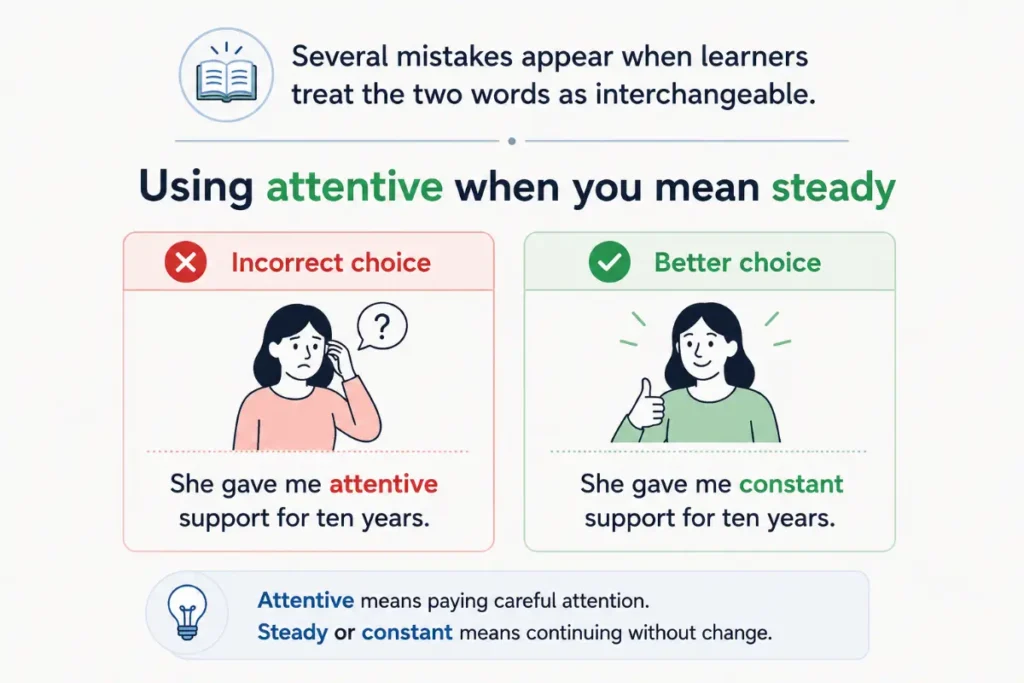
2. Using Attentive to Describe Something Ongoing
Incorrect: We experienced attentive rain throughout the afternoon.
Correct: We experienced constant rain throughout the afternoon.
Rain does not listen or pay attention. The intended meaning is that it continued for a long period, so constant is the correct adjective.
3. Treating Constant as a Synonym for Reliable
Incorrect assumption: A constant person is always reliable.
Better explanation: A constant person or behavior is steady or continuing, but that does not automatically mean it is dependable or trustworthy.
For example, constant complaints may happen regularly without being helpful. Use reliable when you specifically mean that someone or something can be trusted to perform as expected.
4. Treating Attentive as a Synonym for Present
Incorrect assumption: Someone who is physically present is always attentive.
Better explanation: A person can be in the room without paying attention. Attentive means actively noticing, listening, or responding.
For example, an employee may attend every meeting but still fail to listen carefully. The word describes the quality of attention, not simply attendance.
5. Using Both Words Without Checking the Noun
Awkward: The attentive pressure made the workers uncomfortable.
Correct: The constant pressure made the workers uncomfortable.
The noun determines which adjective makes sense. Pressure can continue over time, so constant is suitable. A person can be attentive to pressure or attentive to a problem, but pressure itself is not normally attentive.
A Simple Editing Test
Before choosing between these adjectives, ask what quality your sentence describes.
- If something continues, repeats, or stays steady, use constant.
- If someone listens, notices, or responds carefully, use attentive.
- If you mean someone can be trusted, consider reliable.
- If you mean someone keeps working toward a goal, consider persistent.
- If you mean someone notices small details, consider observant.
This test helps you select a word that expresses your meaning without making the sentence sound forced.
Still confused? Compare principal vs principle Which Word Is Correct.
Pronunciation Guide
How Do You Pronounce Constant?
In American English, constant is commonly pronounced /ˈkɑːn.stənt/. It has two syllables:
- CON.
- stant.
The stress falls on the first syllable. The first vowel has the sound heard in words such as cot in accents that use the same vowel. Some American accents pronounce this sound differently due to regional vowel patterns.
A simple way to say it is KON-stuhnt. Keep the second syllable short and avoid adding an extra syllable at the end.
How Do You Pronounce Attentive?
Attentive is pronounced /əˈten.tɪv/ in American English. It has three syllables:
- uh.
- TEN.
- tiv.
The stress falls on the second syllable. The middle sound is similar to the word ten, which makes the pronunciation easier to remember.
Say it as uh-TEN-tiv. Avoid stressing the first syllable because the main emphasis belongs on TEN.
Common Pronunciation Mistakes
Some speakers place the stress on the wrong syllable or make the final syllable too long. In attentive, the middle syllable should receive the strongest stress. In constant, the first syllable carries the main stress.
The best way to practice is to say each word slowly, separate its syllables, and then repeat it at a normal speaking pace. You can also use the words in short sentences to practice their natural rhythm.
Etymology and Word Origin
The Origin of Constant
Constant comes through Old French from Latin constantem, the accusative form of constans. The Latin word is related to constare, meaning to stand firm or remain steady.
The historical idea of standing firm connects closely with the modern meaning. Something constant stays in place, continues over time, or remains relatively unchanged. This sense appears in expressions such as constant support, constant pressure, and constant temperature.
The word entered English through historical language changes and became a common adjective. It is now used in everyday speech as well as in mathematics, science, business, and formal writing.
The Origin of Attentive
Attentive comes from French attentif and is connected to Latin attendere, meaning to direct the mind toward or give attention to something. The English verb attend also has a related history.
The modern adjective describes someone who directs their attention carefully toward a person, activity, or detail. This meaning appears in phrases such as attentive listening, attentive service, and attentive care.
The historical roots help explain why the word is connected with focus and awareness rather than duration. It describes the way someone directs their mind toward something.
Why Their Origins Matter
The word histories reflect the basic difference between the adjectives. Constant carries the idea of standing firm or continuing, while attentive carries the idea of directing attention toward something.
You do not need to memorize their Latin or French roots to use them correctly. The modern meanings and examples are enough for everyday writing.
Regional Usage
American English
Both adjectives are standard in the United States. Constant is commonly used to describe ongoing conditions, repeated events, stable values, and steady effort.
Examples include constant traffic, constant pressure, and constant improvement. Attentive is common when describing people who listen carefully or respond thoughtfully, as in attentive parents, attentive students, and attentive service.
British English
British English uses the same basic meanings and spelling. Constant describes something continuing or remaining steady, while attentive describes someone who pays close attention.
There is no major difference in grammar or meaning between American and British English. Some pronunciation details vary by accent, but the words remain the same.
Australian English
Australian English follows the same standard usage. Speakers use constant for ongoing situations and attentive for careful listening, observation, and personal care.
There is no widely recognized regional spelling change that affects these adjectives. Their meanings remain consistent with other major English varieties.
Canadian English
Canadian English also uses both words in the same way. Constant can describe steady communication or ongoing pressure, while attentive can describe a careful listener or a thoughtful service provider.
For readers in Canada, the United States, the United Kingdom, and Australia, the same basic distinction applies. Choose according to meaning rather than location.
Grammar Rules and Part of Speech
Both words are adjectives, but constant can also function as a noun in specific fields, especially mathematics and science. Attentive is primarily an adjective in standard everyday English.
Constant as an Adjective
As an adjective, constant usually appears before a noun or after a linking verb.
Examples:
- The constant noise disturbed the neighbors.
- She faced constant pressure at work.
- The temperature remained constant.
- His effort was constant throughout the season.
The word can describe something that continues or stays unchanged. It may modify physical conditions, behavior, effort, feelings, or repeated activity.
Constant as a Noun
In mathematics and science, a constant can be a fixed value that does not change within a particular system or equation.
For example, in the equation y = 2x + 5, the number 5 is a constant because it has a fixed value in that expression. In a scientific model, a constant may represent a value treated as fixed under the conditions being studied.
This noun use is different from the everyday adjective meaning, but it follows the same general idea of something fixed or unchanging.
Attentive as an Adjective
Attentive generally appears before a noun or after a linking verb.
Examples:
- The attentive child listened to the story.
- The staff remained attentive throughout the event.
- She is attentive to small details.
- The teacher seemed attentive to the students’ concerns.
A common pattern is attentive to something. It means that a person notices, considers, or responds carefully to that subject.
For example, “The manager is attentive to employee needs” means the manager notices those needs and takes them seriously.
Comparative and Superlative Forms
Constant and attentive can both use more and most to form comparisons.
| Form | Constant | Attentive |
|---|---|---|
| Base form | Constant | Attentive |
| Comparative | More constant | More attentive |
| Superlative | Most constant | Most attentive |
Examples:
- Her attendance became more constant during the second semester.
- The more attentive student noticed the error first.
- This is the most constant source of noise in the building.
- He is the most attentive listener in our group.
Using more or most is more natural than adding endings such as -er or -est to these longer adjectives.
Common Grammar Patterns
Some expressions are especially useful to remember.
With constant:
- Constant change.
- Constant effort.
- Remain constant.
- Stay constant.
- A constant supply of something.
With attentive:
- Attentive to detail.
- Attentive to someone’s needs.
- Remain attentive.
- An attentive listener.
- Attentive service.
The expression attentive to is particularly useful. Avoid writing attentive of when you mean someone is paying attention to a person or issue.
Punctuation and Sentence Position
Neither adjective requires special punctuation. They can appear in simple sentences, longer descriptions, and compound sentences.
For example, “The constant noise was annoying, but the attentive guard quickly found its source.” The comma separates two independent clauses joined by but. It has nothing to do with the adjectives themselves.
Real Life Usage Examples
Daily Conversation
In everyday speech, constant often describes something that keeps happening, while attentive describes a person who listens or responds carefully.
- My phone makes a constant sound whenever I receive notifications.
- She is an attentive friend who always remembers what I tell her.
These examples show the difference between repeated activity and personal awareness. Both adjectives sound natural because each describes the right kind of quality.
Email and Workplace Communication
At work, constant can describe ongoing contact, pressure, or effort. Attentive can describe how a manager or employee responds to other people.
- We need constant communication during the project to avoid delays.
- Thank you for being attentive to the client’s concerns during the meeting.
The first sentence focuses on regular communication. The second praises careful listening and response.
Academic Writing
In academic writing, constant may describe a fixed value or repeated condition. Attentive may describe careful observation or a researcher’s approach.
- The experiment maintained a constant temperature throughout the testing period.
- Attentive observation allowed the researchers to identify changes in behavior.
The first example describes a controlled condition. The second explains how careful observation helped the research process.
News and Journalism
News writing often uses constant to describe ongoing public conditions. Attentive may describe how a person or organization responds to an issue.
- Residents complained about the constant traffic near the school.
- The emergency team remained attentive to reports of changing weather conditions.
Both adjectives provide useful detail without changing the main facts of the report.
Literature and Storytelling
In stories, constant can describe an ongoing feeling or condition, while attentive can reveal how a character treats others.
- A constant fear followed him through the empty streets.
- The attentive shopkeeper noticed the worried look on the young visitor’s face.
The first sentence creates a sense of something that continues. The second shows a character’s ability to notice another person’s feelings.
Related and Confused Terms
Several words share part of the meaning of these adjectives, but each has its own use. Understanding these distinctions can help you choose more precise language.
1. Consistent
Consistent means acting or happening in a steady and dependable way. It is close to constant, but it often emphasizes regularity and reliability rather than uninterrupted continuation.
For example, consistent practice means practicing regularly and maintaining a similar level of effort. Constant practice may suggest that the activity continues very frequently.
2. Continuous
Continuous describes something that continues without interruption. It is often more specific than constant when the writer wants to emphasize that there are no breaks.
For example, continuous rainfall suggests rain that does not stop. Constant rainfall may describe frequent or ongoing rain, even if there are short breaks.
3. Steady
Steady means firm, stable, or regular. It can describe progress, movement, effort, or behavior.
For example, steady progress means improvement that happens at a regular pace. Constant progress also describes ongoing improvement, but steady emphasizes a stable rate.
4. Persistent
Persistent describes someone or something that continues despite difficulty, delay, or opposition. It often suggests determination.
For example, a persistent student keeps working after making mistakes. A constant student is not a natural expression if you mean someone who refuses to give up. Persistent is the better choice for that meaning.
5. Focused
Focused describes someone who directs their attention toward a particular goal or activity. It is closely related to attentive, but it often emphasizes concentration on one task.
For example, a focused employee works toward a deadline without becoming distracted. An attentive employee also notices details and responds carefully to instructions or people.
6. Observant
Observant describes someone who notices details, changes, or things that others may miss. It is closely related to attentive but places more emphasis on noticing.
For example, an observant teacher may notice that a student is struggling even before the student asks for help.
7. Considerate
Considerate means thinking about other people’s feelings, needs, and comfort. It overlaps with attentive when someone shows care through thoughtful behavior.
For example, a considerate neighbor keeps noise low at night. An attentive neighbor may notice that another resident needs help and respond.
8. Reliable
Reliable means dependable and trustworthy. It can describe a person who does what they promise or something that works as expected.
For example, a reliable employee completes tasks on time. Constant effort may help someone become reliable, but the words do not mean exactly the same thing.
Expert Editor Insight
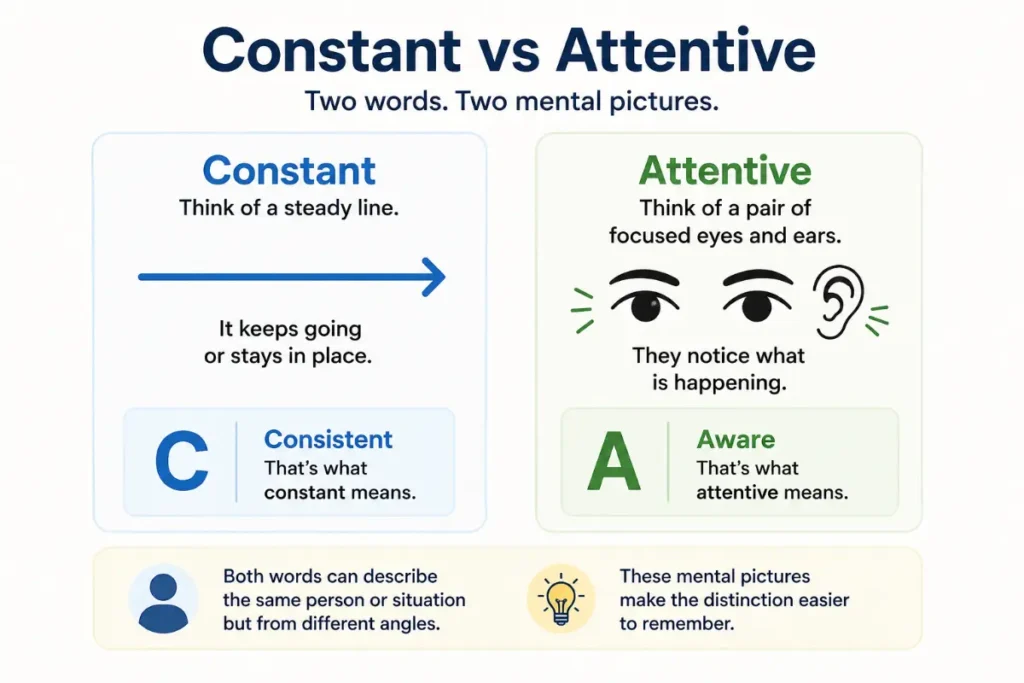
An experienced editor looks at the noun being described and the exact meaning the writer wants to express. Constant is a good choice for ongoing conditions, steady behavior, or fixed values. Attentive works best for people and actions that show careful focus or concern. Confusion happens because both words can appear in positive descriptions of people, but their meanings remain distinct. Grammar tools may accept both in a sentence without recognizing that one sounds unnatural. A useful editing habit is to replace the adjective with a short explanation. If you mean keeps happening, choose constant. If you mean pays close attention, choose attentive.
Learn the difference in What Happen or What Happened Which Is Correct.
Conclusion
The difference between constant and attentive is simple once you focus on the quality each word describes. Constant refers to something that continues, repeats, or stays steady, while attentive describes someone who listens carefully, notices details, and responds with care. Both adjectives are correct, but they cannot replace each other in every sentence.
Remember this practical tip: use constant for something that keeps happening and attentive for someone who pays close attention. Checking the noun and the intended meaning before choosing an adjective will help you write more clearly in everyday, academic, and professional situations.
FAQs
What Is the Main Difference Between Constant and Attentive?
Constant describes something that continues, happens repeatedly, or stays steady over time. Attentive describes someone who pays close attention, listens carefully, or notices details. For example, constant support means help that continues, while an attentive friend listens carefully and responds to your needs. The two words describe different qualities and are not direct synonyms.
Can Constant and Attentive Be Used Together?
Yes. They can appear together when a sentence describes ongoing effort and careful attention. For example, a teacher may provide constant support while remaining attentive to each student’s needs. The first adjective describes how consistently the support is given. The second describes how carefully the teacher notices and responds to individual concerns.
Is Constant a Synonym for Consistent?
The words are related, but they are not always interchangeable. Constant often emphasizes continuation or something that remains present. Consistent usually emphasizes regularity, stability, or dependable behavior. Constant noise may continue for a long time, while consistent performance suggests a similar level of quality across different occasions.
What Does It Mean to Be an Attentive Person?
An attentive person listens carefully, notices details, and responds thoughtfully to people or situations. For example, an attentive friend remembers important details about your life and listens when you need support. At work, an attentive employee follows instructions, notices problems, and responds carefully to questions or concerns.
Is Constant Positive or Negative?
Constant can have a positive, negative, or neutral meaning depending on the noun it describes. Constant support and constant improvement are usually positive and Constant noise, constant criticism, and constant interruptions often have negative meanings. The adjective itself simply describes continuation or repetition, while the surrounding words create the emotional meaning.
What Is Another Word for Attentive?
Useful alternatives include observant, focused, alert, considerate, and watchful. The best choice depends on the intended meaning. Observant emphasizes noticing details, focused emphasizes concentration, and considerate emphasizes concern for other people. Attentive is a broad choice that can describe both careful listening and thoughtful responses.
Can Attentive Describe a Thing Instead of a Person?
Yes, although it most often describes people. It can also describe service, care, behavior, or an approach that shows careful attention to needs and details. For example, attentive customer service means service that responds thoughtfully to customers. However, you would not normally describe a noise, temperature, or repeated event as attentive.
Are Constant and Attentive Used Differently in American and British English?
No major difference separates their meanings in American and British English. Both varieties use constant for ongoing or steady conditions and attentive for careful listening, observation, and concern. The spelling is also the same. Differences may occur in pronunciation or personal writing style, but the basic grammar and usage remain consistent.