
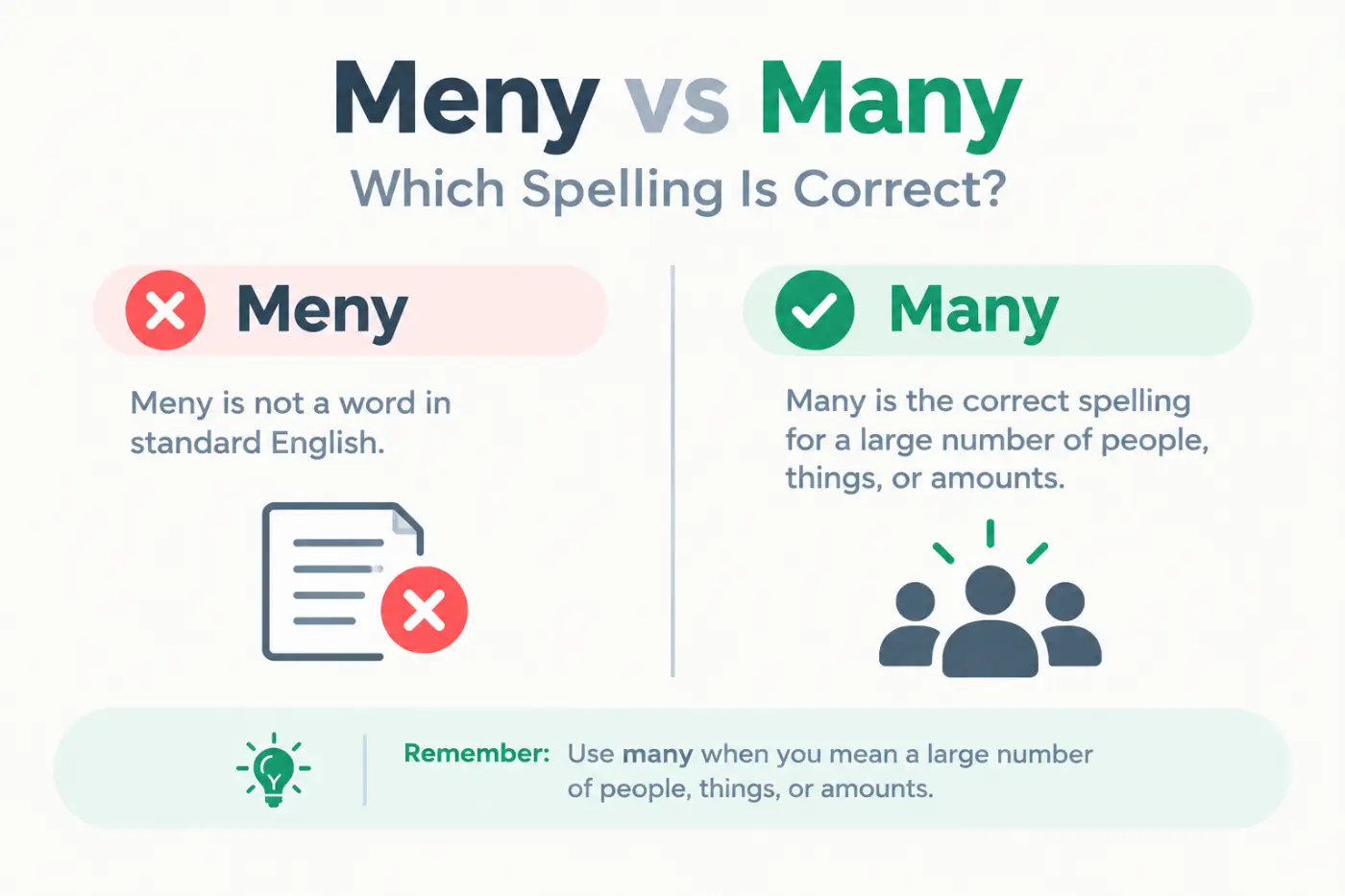
If you are unsure whether to write meny or many, the correct spelling in standard English is many. The word many means a large number of people, animals, objects, or other countable things. Meny is generally a spelling mistake, not an accepted alternative for this meaning.
The confusion often comes from pronunciation. In some accents, the vowel in many may sound close to a short e, which can lead people to type meny instead. Fast typing, unfamiliar spelling patterns, and autocorrect can also contribute to the mistake. However, standard English spelling keeps the letter a in many.
Using the correct form matters in school assignments, emails, reports, social media posts, and professional documents. A small spelling error can distract readers or make your writing look less polished. This guide explains the meaning of the standard word, why the other spelling is incorrect in ordinary writing, how to pronounce it, and how to use it naturally in different sentences.
Still confused? Compare To or Too or Two Which Word Is Correct?.
Quick Answer
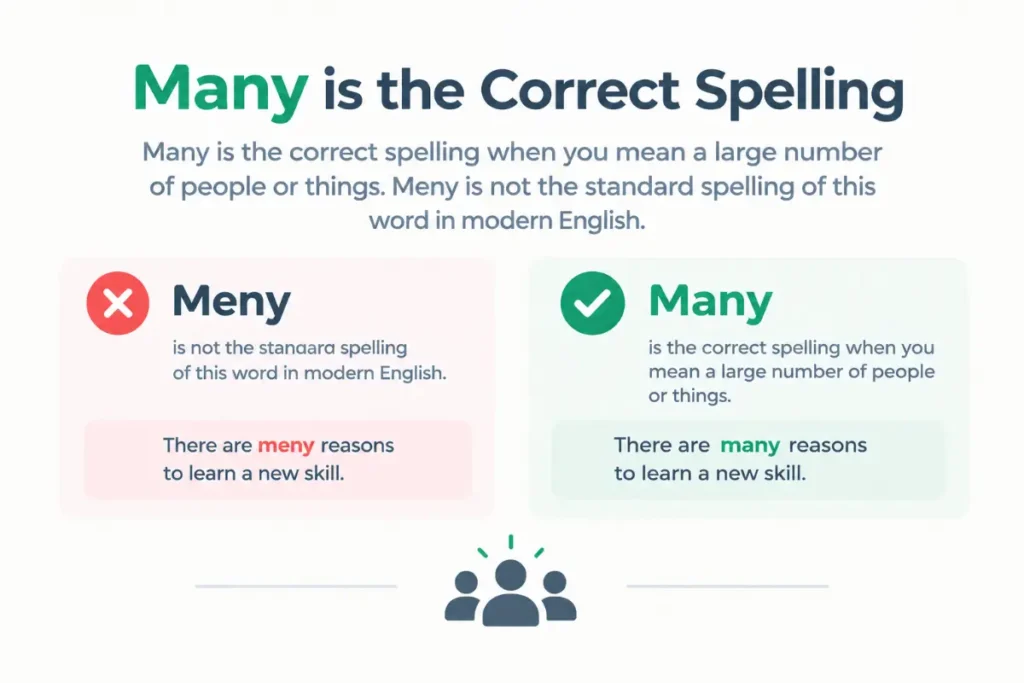
Many is the correct spelling in standard English. It is a determiner or pronoun used to describe a large number of countable people or things, as in many students or many ideas. Meny is not a standard spelling of this word and should generally be corrected to many.
Comparison Table
| Feature | Many | Meny |
|---|---|---|
| Standard spelling | Yes | No, not for the intended meaning |
| Meaning | A large number of countable people or things | No standard English meaning as a replacement for many |
| Part of speech | Determiner or pronoun | Not a standard form of this English word |
| Pronunciation | /ˈmɛni/ | Not applicable as a standard spelling |
| Formality | Suitable for formal and informal writing | Generally treated as a spelling error |
| Common contexts | Many people, many books, many reasons | Usually a typing or spelling mistake |
| Grammar | Used with plural countable nouns or alone as a pronoun | Does not follow the standard grammar of many |
| Example | Many people attended the event. | Write many people, not meny people. |
Meaning and Definition
What Does Meny Mean?
Meny is generally an incorrect spelling when someone intends to write many. It is not the standard English word used to describe a large number of countable things or people.
For example, a person might type meny books instead of many books. The intended meaning is usually clear, but the spelling is still incorrect in standard English. In schoolwork, business writing, professional communication, and edited publications, the word should be corrected.
There is one useful distinction: a spelling that looks incorrect in an ordinary sentence may appear as a name, username, brand, or word from another language. A business, product, or person could use Meny as a proper name. That special use does not make it an accepted spelling of the English quantity word.
If you encounter this form, consider the context. If the sentence is about a large number of people or things, the writer almost certainly means many.
What Does Many Mean?
Many means a large number of people or things. It is used with plural countable nouns, such as books, students, cars, questions, and ideas.
Examples include:
- Many students joined the school club.
- We visited many places during our vacation.
- Many people enjoy listening to music.
- There are many ways to solve this problem.
The word can also stand alone as a pronoun when the noun is already clear from the context.
For example:
- Many were invited, but only a few attended.
- I have read several of those books, but many are still on my list.
In the first sentence, many refers to people. In the second, it refers to books. The noun does not need to be repeated because readers can understand what the word represents.
Is Many a Noun or an Adjective?
In traditional grammar, many is often described as an adjective when it comes before a noun. Modern grammar commonly classifies it as a determiner in that position. It can also function as a pronoun when it replaces a noun phrase.
Consider these examples:
- Many children enjoy outdoor games.
- Many of the children enjoy outdoor games.
In the first sentence, many comes directly before the plural noun children. In the second, many is followed by of and refers to a particular group.
You do not need to memorize different grammar labels to use the word correctly. The practical rule is simple: use it to refer to a large number of countable people or things.
Key Differences Explained
1. Spelling
The main difference is spelling. Many is the standard form, with the letters m, a, n, and y in that order. Meny changes the second letter from a to e, creating a form that is not accepted as the ordinary English quantity word.
This is not a choice between two equally correct spellings. If you are writing about a large number of items, people, or events, use many.
Correct: Many customers visited the store.
Incorrect: Meny customers visited the store.
The spelling remains the same in American, British, Canadian, and Australian English.
2. Meaning
Many has a clear meaning: a large number of countable people or things. It can describe a group without giving an exact number.
For example, many employees attended the meeting tells readers that a large number of employees were present. It does not state the exact number.
Meny does not carry this standard meaning. When readers see it in a sentence such as meny employees attended the meeting, they will usually recognize it as a spelling mistake.
3. Grammar
Many works with plural countable nouns. These are nouns that can be counted individually, such as:
- Books.
- Houses.
- Teachers.
- Questions.
- Apples.
- Children.
- Opportunities.
You can say many books, many houses, or many opportunities. You generally cannot use many directly before an uncountable noun in standard English when referring to its quantity.
For example, much water is standard, while many water is not. If you want to use many with an uncountable idea, you may need a countable expression such as many bottles of water.
Meny does not follow these grammar patterns because it is not the standard form.
4. Pronunciation
Many is commonly pronounced /ˈmɛni/ in American English. It has two syllables, with stress on the first syllable. The vowel sound in the first syllable is similar to the one in met.
This pronunciation can explain why some people write the wrong vowel. The spoken sound may not seem to match the letter a, especially to learners who expect English vowels to have one consistent sound.
However, English spelling does not always match pronunciation in a simple way. The correct written form remains many.
5. Formality
Many is suitable for every level of writing. You can use it in a text message, school essay, business report, academic paper, or formal letter.
Meny is not an accepted informal alternative. It may appear in casual messages because of typing errors, but that does not make it correct. If you want your writing to look clear and professional, correct it before sending or publishing your message.
6. Context
The correct spelling applies across different subjects and situations. You might write about many people at a concert, many changes in a company, many questions in an exam, or many benefits of exercise.
The word is not limited to one topic or type of sentence. Its meaning stays the same, although the noun that follows it changes.
7. Regional Usage
There is no standard regional spelling difference. American English uses many, and so do British, Canadian, and Australian English.
Pronunciation can vary slightly from speaker to speaker, but the accepted spelling does not change. Writers should use many regardless of the English variety they are following.
8. Standard and Nonstandard Usage
Many is the standard English form. Meny is nonstandard when used as a substitute for many.
A nonstandard spelling may still be understood, especially when the intended meaning is obvious. However, readers should not confuse understanding with correctness. A reader may understand a typing error without accepting it as standard spelling.
Which Form Is Correct?
Many is correct when you want to describe a large number of countable people or things. Meny is an incorrect spelling for this meaning and should be changed to many in standard English writing.
The reason is straightforward: English spelling follows established word forms, not only the way a word sounds. Although many is pronounced with a vowel that may sound like the e in met, its standard spelling uses the letter a.
The correct form appears in ordinary expressions such as many people, many books, many questions, and many opportunities. It also works in formal expressions such as many factors, many studies, and many possible explanations.
Use these examples as a guide:
- Correct: Many students passed the exam.
- Correct: Many families attended the festival.
- Correct: Many businesses offer online services.
- Correct: Many questions remain unanswered.
- Correct: Many people prefer clear instructions.
If you see meny in an ordinary sentence, correct it unless the word is being used as a specific name or another special form.
Sentence Examples
Here are ten natural sentences showing how to use the standard spelling in everyday and professional communication.
- Everyday conversation: Many people enjoy spending time with their friends on weekends.
- Text message: I have many things to finish before dinner.
- Workplace communication: Many employees requested additional training.
- School: Many students joined the science competition this year.
- Academic writing: Many studies have examined the relationship between sleep and learning.
- Formal writing: Many factors should be considered before making a final decision.
- Social situations: We met many interesting people at the wedding.
- Online communication: Many users shared their opinions in the discussion.
- Shopping: The store offers many options for customers with different budgets.
- Travel: We visited many beautiful towns during our trip.
Each sentence uses many before a plural countable noun. The word gives a general idea of quantity without requiring an exact number.
Five Examples of the Common Spelling Error
The following examples show the incorrect form only to help you recognize and correct it.
1. Incorrect: Meny people attended the event.
Correct: Many people attended the event.
2. Incorrect: I have meny questions about the lesson.
Correct: I have many questions about the lesson.
3. Incorrect: There are meny books on the shelf.
Correct: There are many books on the shelf.
4. Incorrect: Meny students use computers for schoolwork.
Correct: Many students use computers for schoolwork.
5. Incorrect: She has meny ideas for the project.
Correct: She has many ideas for the project.
In each example, the intended meaning is a large number. The correction is the same: replace the incorrect vowel with the standard spelling.
Common Mistakes and Misspellings
The most common problem is replacing the a in many with an e. However, other errors can occur when writers confuse quantity words, use the wrong noun form, or rely too heavily on how a word sounds.
1. Writing Meny Instead of Many
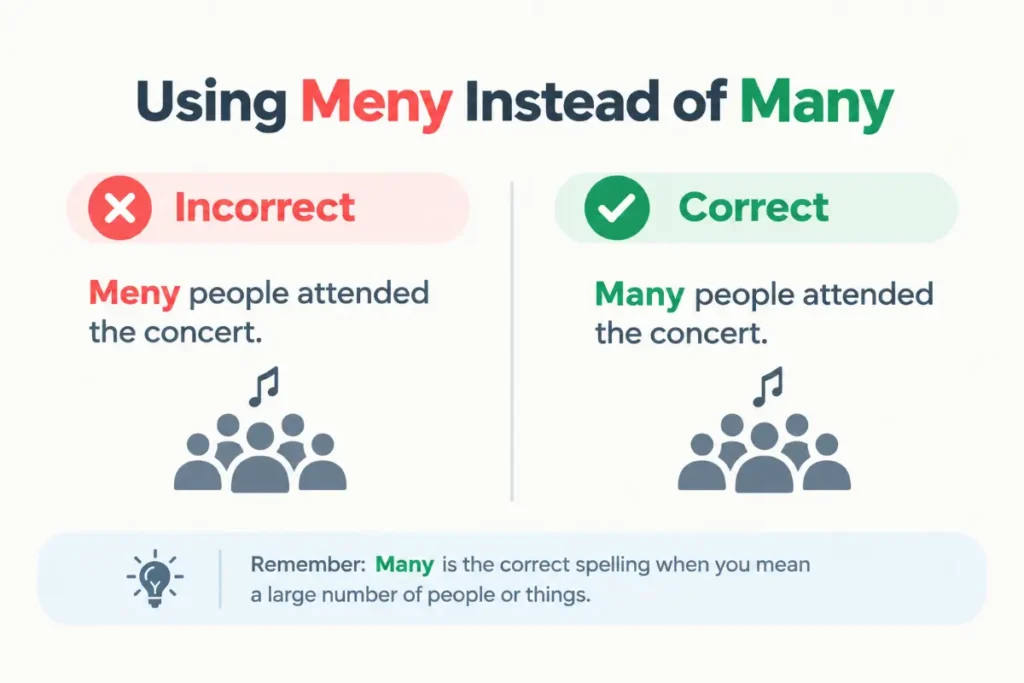
Incorrect: Meny people joined the program.
Correct: Many people joined the program.
This mistake often comes from pronunciation. The first vowel in many sounds like the vowel in met for many American English speakers, so a writer may choose e instead of a. The standard spelling still uses a.
2. Writing Manny Instead of Many
Incorrect: Manny students attended the lecture.
Correct: Many students attended the lecture.
Manny is a legitimate personal name, but it is not the standard spelling of the quantity word. The extra n changes the word. If you are describing a large number, write many.
3. Using Many With an Uncountable Noun
Incorrect: Many information is available online.
Correct: Much information is available online.
Information is an uncountable noun in standard English. You cannot normally count it as individual items using many directly. You can, however, use many pieces of information because pieces is countable.
4. Using Many With a Singular Countable Noun
Incorrect: Many student joined the club.
Correct: Many students joined the club.
Many usually refers to more than one countable item, so the noun that follows it normally takes the plural form. Remember to add the appropriate plural ending to regular nouns, while checking the spelling of irregular plurals.
5. Confusing Many With Much
Incorrect: How many money do you need?
Correct: How much money do you need?
Use many with plural countable nouns and much with uncountable nouns. You can ask how many dollars, how many coins, or how many bills, but you normally ask how much money.
A Quick Way to Avoid These Errors
Before submitting your writing, check two things.
- Confirm that the word is spelled many when you mean a large number.
- Check that the noun after it is plural and countable.
For example, many books is correct because books are countable and plural. Many advice is incorrect because advice is uncountable in standard English. You can write much advice or many helpful suggestions instead.
Still confused? Compare arial vs aerial Which Word Should You Use.
Pronunciation Guide
How Do You Pronounce Many?
The standard American English pronunciation is /ˈmɛni/. The word has two syllables:
- First syllable: men.
- Second syllable: ee.
The stress falls on the first syllable. A simple guide is MEN-ee. Say the first part clearly, then finish with a short, relaxed ee sound.
The word is not normally pronounced to rhyme with words such as pay or day. Its first vowel is the short e sound heard in met, bed, and pen.
Why Does the Pronunciation Cause Spelling Confusion?
English vowels can represent different sounds in different words. The letter a does not always sound like the a in apple. In many, it represents a sound similar to the e in met.
This difference between spelling and sound can confuse children, English learners, and people typing quickly. Someone may hear the word correctly but choose the wrong vowel when writing it.
The best approach is to remember the spelling as a complete word rather than trying to spell it only by sound. Reading it often and using it in sentences can help make the correct form familiar.
Is the Pronunciation Different in British English?
The word is also pronounced with two syllables in British English, and the main stress falls on the first syllable. The exact vowel quality can vary by accent, but the spelling remains many.
You do not need to change the pronunciation or spelling for formal writing in different English speaking countries.
Etymology and Word Origin
Many has a long history in English. It developed from Old English forms such as manig and monig, which were used to describe a large number or quantity. These forms are connected with older Germanic words that carried a similar meaning.
Over time, the spelling and pronunciation changed as English developed. The modern form became many, and the word kept its central meaning of a large number of people or things.
The word is related historically to forms found in other Germanic languages. These connections reflect the shared roots of English and its language family.
The incorrect spelling meny does not represent a separate historical form of the standard English quantity word. It is usually a modern spelling mistake caused by confusion about the vowel sound.
Understanding the history is useful, but the practical spelling rule is easier: write many when you mean a large number.
Regional Usage
American English
Many is the standard spelling in American English. It appears in everyday expressions such as many people, many times, many choices, and many reasons. It is appropriate for casual conversation, school assignments, business documents, and formal writing.
Meny is not an accepted alternative spelling in the United States when referring to a large number. A spell checker will generally identify it as an error unless it appears as a recognized name or a custom term.
British English
British English also uses many. There is no spelling difference between the American and British forms. The word is common in both spoken and written communication.
British speakers may have different accent patterns, but these do not create a different standard spelling. Writers should use many in formal and informal contexts.
Australian English
Australian English follows the same spelling convention. Many is used with plural countable nouns, as in many people, many schools, and many opportunities. Meny is generally an error when used in its place.
Canadian English
Canadian English also uses many. The spelling and grammar follow the same general rules used in American and British English. There is no special Canadian spelling that replaces the standard form.
Does the Meaning Change by Region?
No meaningful regional difference changes the basic meaning of the word. Across these varieties, many describes a large number of countable people or things.
Some expressions may be more common in one region than another, but the spelling and core grammar stay consistent. You can safely use many in writing intended for readers in the United States, United Kingdom, Canada, and Australia.
Grammar Rules and Part of Speech
Many is used mainly as a determiner before plural countable nouns. It can also function as a pronoun when the noun it refers to is understood. Knowing these patterns helps you avoid errors beyond spelling.
Many Before a Plural Countable Noun
The most common structure is:
Many + plural countable noun.
Examples:
- Many children enjoy reading.
- Many cars were parked outside.
- Many questions came from the audience.
- Many opportunities are available to new graduates.
A countable noun is something that can be counted as one, two, three, and so on. Most regular countable nouns form their plural by adding s or es, although some have irregular plural forms.
Many as a Pronoun
Many can stand alone when the noun is clear from the sentence or earlier discussion.
Examples:
- Many were waiting outside the building.
- Many have already completed the assignment.
- Many of us enjoy spending time outdoors.
In these sentences, many refers to people or things already understood from context. You do not need to repeat the noun.
Using Many With Of
You can use many of before a determiner or pronoun to refer to a particular group.
Examples:
- Many of the students passed the exam.
- Many of my friends live nearby.
- Many of them agreed with the decision.
The noun or pronoun after of identifies the group. This pattern is common in both conversation and formal writing.
Many in Questions
Many often appears in questions about quantity.
Examples:
- How many books have you read?
- How many people are coming to dinner?
- How many days will the project take?
The phrase how many is used with plural countable nouns. For uncountable nouns, use how much instead.
Many in Negative Sentences
Many can appear in negative statements, although the most natural wording may depend on the sentence.
Examples:
- I do not have many free hours this week.
- There are not many seats left.
- She does not have many close friends in the city.
The word often appears with not to describe a small quantity or a limited number.
Many in Formal and Informal Writing
Many works well in all writing styles. It is not too casual for a business report or too formal for a text message.
In academic writing, you may want to replace it with a more precise number when the data supports one. For example, many participants completed the survey is less specific than 248 participants completed the survey. The best choice depends on the level of detail your reader needs.
Punctuation
Many does not require special punctuation. It follows the normal rules of the sentence.
For example:
- Many people attended the event.
- Did many people attend the event?
- Although many people attended, the hall still had empty seats.
The punctuation depends on the sentence type, not on the quantity word.
Real Life Usage Examples
Daily Conversation
People use many in everyday speech to describe groups, choices, events, and experiences. It helps communicate quantity without giving an exact number.
- We have many things to discuss before the trip.
- There are many good restaurants in this neighborhood.
These sentences sound natural in casual conversation. They are also suitable for messages and everyday writing.
Email and Workplace Communication
In the workplace, the word can describe tasks, clients, employees, requests, or business concerns. It works well in direct messages and formal emails.
- Many employees have requested access to the new training program.
- We received many customer questions about the updated policy.
If you are writing a report, consider using an exact figure when one is available. A precise number can make your point clearer than a general quantity word.
Academic Writing
Many is common in essays, research discussions, and educational material. It helps writers describe broad patterns or refer to a large number of examples.
- Many researchers have studied the effects of regular exercise.
- Many students find that short study sessions improve their focus.
Avoid using the word to make a claim sound stronger than the evidence allows. If you have a specific number or a clear source, include that information when it improves accuracy.
News and Journalism
Journalists use many to describe large groups, repeated events, or several reasons behind a situation.
- Many residents attended the public meeting.
- Many businesses reported delays after the storm.
The word is useful when an exact count is unavailable or not necessary. However, reporting a verified figure is often more informative when the number matters to the story.
Literature and Storytelling
Writers use many to describe crowds, memories, experiences, and possibilities. It can help establish scale without interrupting the flow of a story.
- Many years had passed since the family last visited the old house.
- She had many questions, but the stranger had already disappeared.
In storytelling, the word can create a sense of scale or leave details open to the reader’s imagination.
Related and Confused Terms
These eight words and expressions are useful when discussing quantity. They are related to the meaning of many, but they do not all work in the same grammatical way.
1. Much
Much describes a large amount of something that is not normally counted as separate items. Use much water, much time, or much information. Use many with countable plural nouns, such as many bottles, many hours, or many facts.
2. Several
Several means more than two but not a large or exact number. It is used with plural countable nouns, as in several students or several books. Many usually suggests a larger or less specific number, although the exact amount depends on context.
3. A Lot Of
A lot of is a common expression meaning a large amount or number. It can be used with both countable and uncountable nouns. For example, a lot of books is correct, and so is a lot of water. It often sounds more conversational than many or much.
4. Numerous
Numerous means many or a large number of. It is often used in formal writing, reports, and academic discussions. For example, numerous studies have examined the issue. It usually sounds more formal than many and is not always necessary when a simpler word works.
5. Plenty Of
Plenty of means enough or more than enough. It can be used with countable and uncountable nouns, as in plenty of chairs and plenty of time. Unlike many, it often suggests that the quantity is sufficient or generous.
6. Few
Few refers to a small number of countable people or things. For example, few students arrived early means that only a small number arrived. Many has the opposite general meaning, but few can also carry a negative sense of not enough.
7. A Number Of
A number of means several or many, depending on context. It is followed by a plural countable noun, as in a number of people attended the event. In standard usage, the phrase usually takes a plural verb because it refers to the people or things being counted.
8. More
More indicates a greater amount or number than before or than another amount. It works with both countable and uncountable nouns, as in more books and more time. Many describes a large number, while more makes a comparison.
Expert Editor Insight
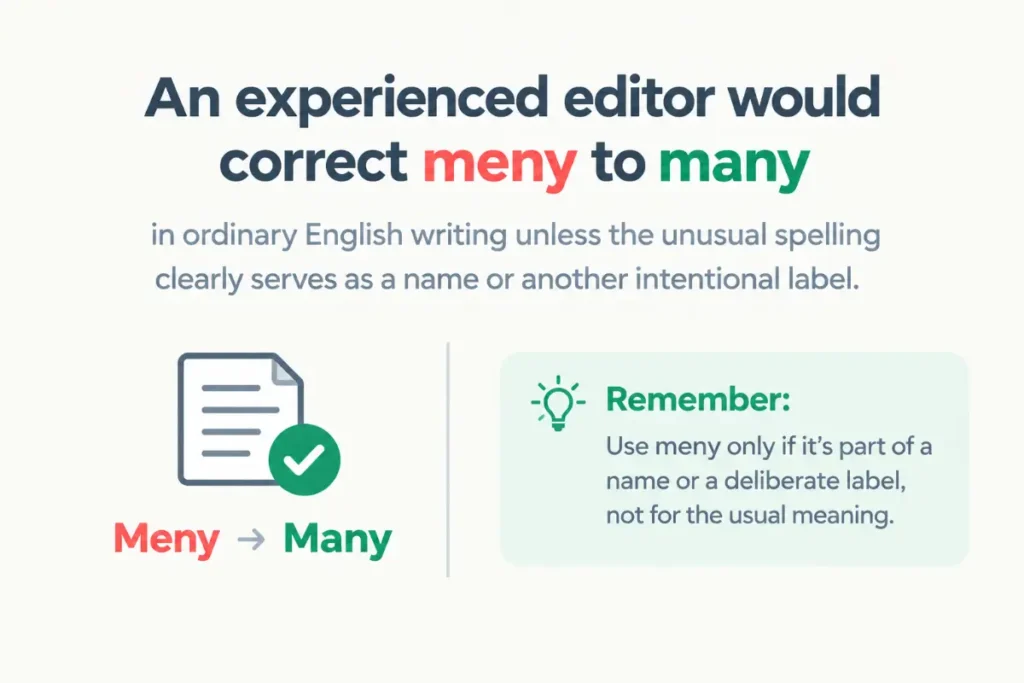
An experienced editor treats many as the only standard spelling for the ordinary quantity word. The confusion usually comes from the sound of its first vowel, which can lead writers to choose e instead of a. Professional editing checks both spelling and grammar: the word must be written correctly, and the noun that follows it should normally be plural and countable. Spell checkers often catch meny, but they may not catch a sentence such as many information because every word is spelled correctly. A useful editing habit is to check the spelling and the noun together.
Still confused? Compare Swap vs Swop Which Spelling Is Correct..
Conclusion
The correct spelling in standard English is many, not meny. Many describes a large number of countable people or things and works in everyday conversation, school assignments, business communication, and formal writing. The other spelling is generally a typing or spelling mistake when used with this meaning.
Remember that the first vowel in many sounds like the e in met, but the word is still spelled with an a. Before submitting your writing, check the spelling and make sure the following noun is plural and countable. This simple habit will help keep your sentences accurate and clear.
FAQs
Is Meny a Real English Word?
Meny is not a standard English spelling of the word used to describe a large number. In ordinary writing, it is usually a misspelling of many. It could appear as a personal name, username, or brand name, but those special uses do not make it an accepted replacement for the standard quantity word.
What Does Many Mean?
Many means a large number of people or things that can be counted. It is commonly used before plural nouns, as in many books, many students, and many opportunities. It can also stand alone as a pronoun when the noun is clear from the context, as in many were invited.
Which Spelling Is Correct for a Large Number?
Many is the correct spelling when you mean a large number of countable people or things. Meny is generally a spelling mistake in this context. The standard form uses the letter a, even though the first vowel is pronounced like the e sound in met in common American English pronunciation.
How Do You Pronounce Many?
Many is commonly pronounced /ˈmɛni/ in American English. It has two syllables, with the stress on the first syllable. A simple way to say it is MEN-ee. The first vowel sounds like the e in met, which helps explain why some writers mistakenly spell the word with an e.
Can Many Be Used at the Beginning of a Sentence?
Yes. Many can begin a sentence when it comes before a plural noun or functions as a pronoun. For example, Many students joined the club is correct. You can also write Many were surprised by the announcement when the word clearly refers to a group already mentioned.
What Is Another Word for Many?
Common alternatives include numerous, several, a lot of, and a large number of. The best choice depends on the meaning and tone. Numerous often sounds more formal, several usually suggests a smaller number, and a lot of works with both countable and uncountable nouns in everyday English.
Why Do People Spell Many as Meny?
People often make this mistake because the first vowel in many sounds like the e in met. English spelling does not always match pronunciation in a simple way, so writers may choose the wrong letter when typing quickly or spelling from sound. Reading the word often and remembering its standard form can help prevent the error.
Is Many Appropriate in Formal Writing?
Yes. Many is standard in formal and informal English. You can use it in reports, essays, business emails, academic discussions, and professional documents. However, if an exact number is available and relevant, using that figure may provide more precise information than a general word such as many.