
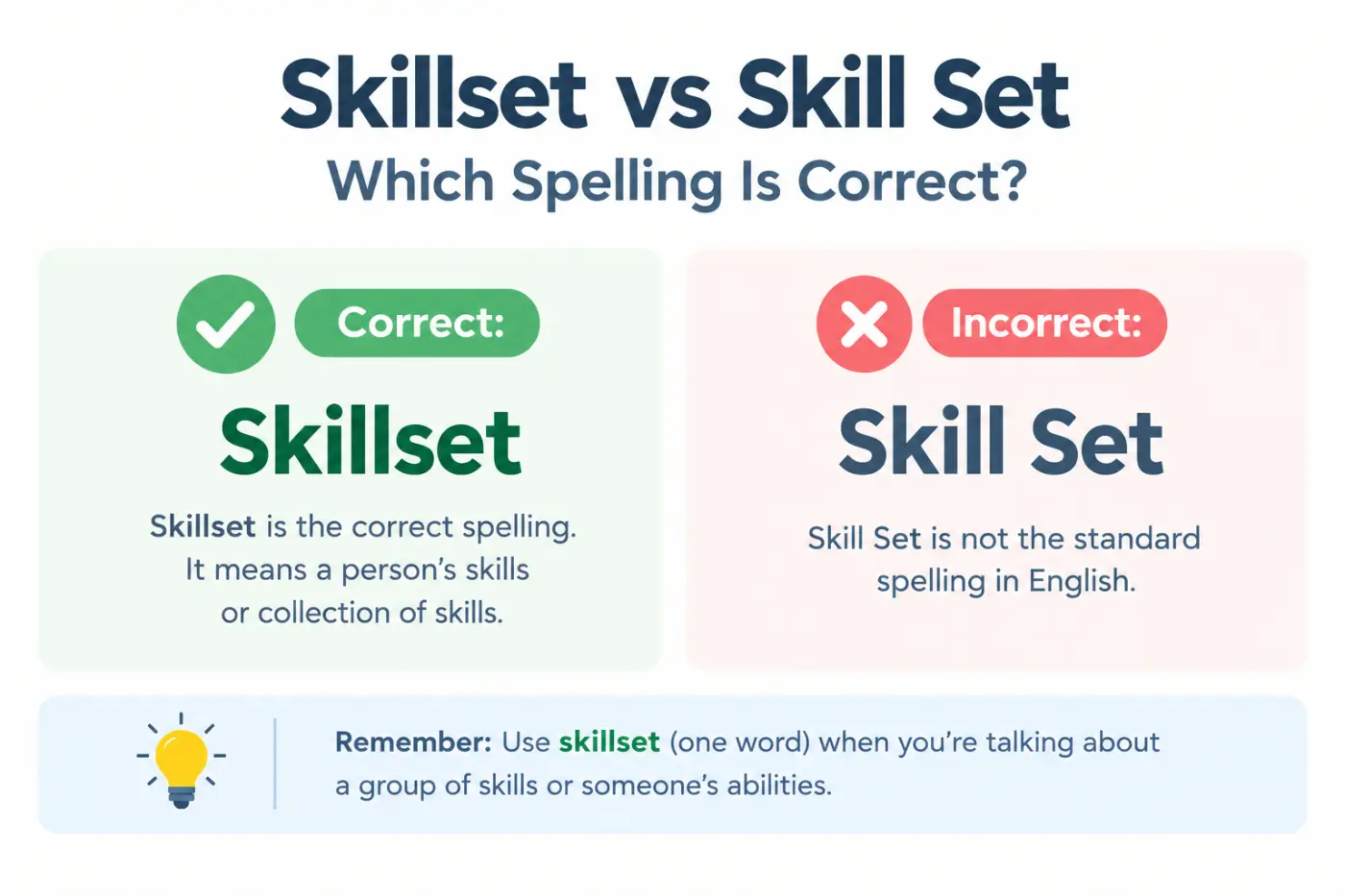
You may see skillset and skill set used in job descriptions, resumes, business articles, and everyday writing. That can make it hard to know which spelling belongs in your own work. The good news is that both forms are used in English, and the two spellings generally express the same idea: a person’s collection of abilities, knowledge, and practical skills.
However, skill set, written as two words, is the more traditional and widely recommended form in careful general writing. Skillset, written as one word, is also an established closed compound, especially in business, employment, and informal professional communication. The choice often depends on the style guide, publication, or employer you are writing for.
Understanding this small spelling difference can help you polish a resume, write a clear job description, or prepare a professional report. This guide explains the meaning of the term, how both spellings work, where each appears, and how to choose the most suitable version for your audience.
You may also want to read Undecisive or Indecisive Which Is Correct.
Quick Answer
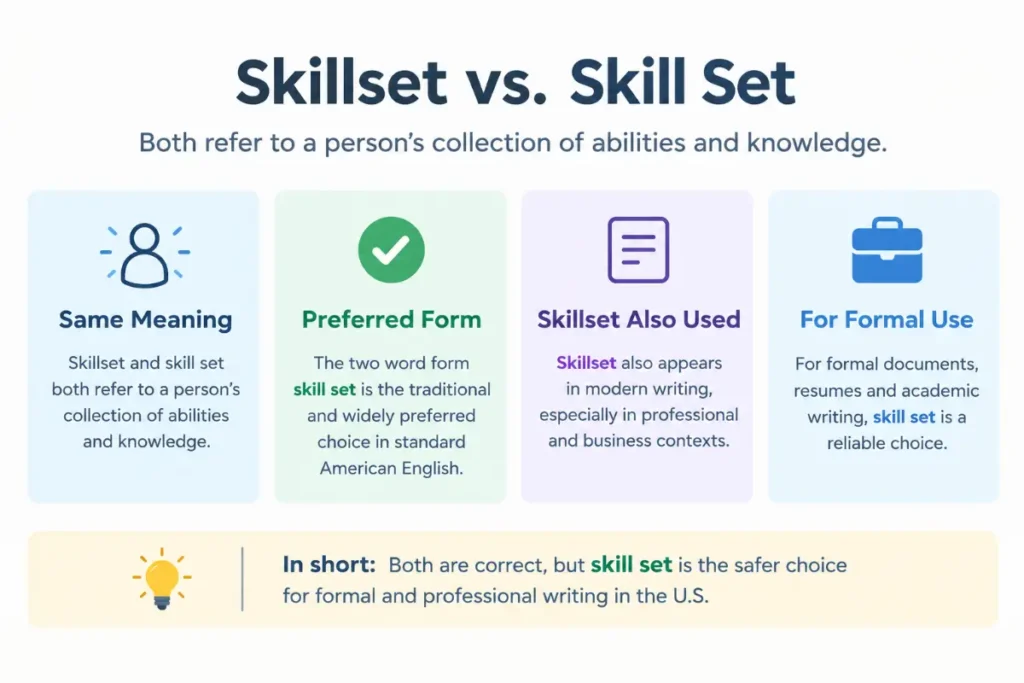
Skill set, written as two words, is the traditional and safest choice in formal writing. Skillset, written as one word, is also an accepted spelling used in modern professional and business English. Both refer to a person’s collection of skills and abilities. Follow your organization’s style guide and use one form consistently.
Comparison Table
| Feature | Skill Set | Skillset |
|---|---|---|
| Spelling | Two words | One word |
| Meaning | A collection of skills and abilities | A collection of skills and abilities |
| Part of speech | Noun | Noun |
| Word type | Open compound | Closed compound |
| Usage | Traditional and widely accepted | Established modern alternative |
| Formality | Suitable for formal and informal writing | Common in professional and business contexts |
| Common contexts | Resumes, education, reports, job descriptions | Business writing, recruitment, workplace communication |
| Example | She has a strong skill set. | She has a strong skillset. |
Meaning and Definition
What Does Skill Set Mean?
A skill set is a group of abilities, talents, and areas of knowledge that a person uses to perform tasks or complete work. It can include practical abilities, technical knowledge, communication skills, problem solving, and personal strengths.
For example, a graphic designer may have a skill set that includes visual design, image editing, typography, and creative thinking. A project manager may have a different collection of abilities, such as planning, budgeting, communication, and team leadership.
The term is useful because most jobs require more than one ability. Employers often look at a person’s overall combination of strengths rather than judging them by a single skill.
A skill set can include:
- Technical skills, such as coding, data analysis, or operating equipment.
- Communication skills, such as writing, listening, and presenting ideas.
- Leadership skills, such as managing people and making decisions.
- Creative skills, such as design, storytelling, and problem solving.
- Practical skills, such as repairing machines or preparing financial reports.
- Interpersonal skills, such as teamwork, negotiation, and conflict management.
The term is a noun. It usually appears as the subject or object of a sentence.
Examples:
- Her skill set includes customer service and sales.
- The company needs someone with a strong technical skill set.
- He developed a new skill set after completing the training program.
In each sentence, the phrase describes a collection of abilities rather than one individual talent.
What Does Skillset Mean?
Skillset is the closed form of the same compound noun. It refers to a person’s combined skills, knowledge, and abilities. It does not normally have a separate meaning from the two word version.
You may see this spelling in recruitment advertisements, workplace discussions, business articles, and professional profiles. For example, a company might describe a candidate as having a broad skillset or say that employees need to expand their skillset as technology changes.
The closed spelling reflects a common pattern in English. Some combinations of words gradually become joined into a single word through regular use. This process is known as compound word formation.
Although the one word version is used in modern English, the two word form remains a safe choice when a publication or workplace expects traditional spelling.
Examples:
- The position requires a diverse skillset.
- Her skillset makes her a strong candidate for the role.
- The training program helps employees expand their skillset.
These sentences have the same basic meaning as their two word versions.
Is Skillset a Real Word?
Yes. Skillset is a recognized spelling in modern English usage. It is not simply a typing error or an invented term. It functions as a closed compound noun and carries the same general meaning as skill set.
However, recognition does not mean every editor or style guide prefers it. Some publications continue to use the two word form because it follows the traditional spelling. Others accept the closed form, particularly in business and workplace writing.
The important point is to understand the difference between an incorrect spelling and a less preferred style choice. In this case, the closed form is used in established English, but the open form is often the more conservative editorial choice.
Key Differences Explained
The two spellings are close in meaning, pronunciation, and grammar. Their main difference is how they are written and the style preferences of different writers and publications.
1. Spelling
The clearest difference is the space.
- Skill set is written as two separate words.
- Skillset is written as one joined word.
Both spellings are used to describe a collection of abilities. The choice does not normally change the meaning of the sentence.
For formal documents, the two word form is a reliable option. If your workplace or publication has a style guide that prefers the closed form, follow that instruction instead.
2. Meaning
There is no important difference in meaning between the two forms. Both describe a combination of skills that someone possesses or develops.
For example:
- She has a strong skill set in digital marketing.
- She has a strong skillset in digital marketing.
Both sentences communicate the same idea. The spelling changes, but the reader understands that the person has several abilities related to digital marketing.
3. Grammar
Both forms function as nouns. They can act as subjects, direct objects, or objects of prepositions.
Examples:
- Skill set is important for career growth.
- Employers value a diverse skillset.
- She wants to improve her skill set.
- The course helps students build a useful skillset.
The surrounding grammar does not change just because the compound is written as one word instead of two.
4. Part of Speech
Both spellings are nouns. They do not normally function as verbs or adjectives.
You can say:
- He has an impressive skill set.
- The company wants to improve its employees’ skillsets.
You would not normally write that someone is skillsetting or that a person is skillsetful. Use established expressions such as developing skills, building expertise, or having a strong range of abilities instead.
5. Pronunciation
Both forms are pronounced in the same way. The space in the two word version does not create an extra syllable or change the stress pattern.
The usual pronunciation is /ˈskɪl sɛt/. The first part sounds like skill, and the second sounds like set. The main stress falls on skill.
6. Formality
Skill set is often preferred in traditional formal writing. It is a familiar spelling in academic documents, professional reports, resumes, and publications that follow conservative editorial standards.
Skillset is common in modern workplace communication. You may encounter it in recruitment content, business writing, and professional profiles. It is not automatically unprofessional, but some editors may prefer the open form.
If you are unsure, use skill set. It is a clear and widely accepted choice.
7. Context
The two forms can appear in almost identical contexts.
For example, a resume may describe a candidate’s technical skill set, while a business article may discuss the changing skillset of modern workers. Both expressions refer to a collection of abilities.
The main factor is the preferred spelling of the organization or publication. A company may use one form throughout its website and internal documents. Matching that choice helps maintain consistency.
8. Regional Usage
There is no major difference in meaning between American and British English. Both forms are understood in the United States, the United Kingdom, Canada, and Australia.
Individual dictionaries, publishers, and organizations may differ in their preferred spelling. These are editorial preferences rather than separate regional meanings.
9. Standard and Alternative Usage
The two word form is the traditional choice and works well in almost any type of writing. The closed form is also used in modern English, especially in professional settings.
Neither should be confused with skillset’s plural form, skillsets. Both spellings can form a plural, although the singular is more common when describing one person’s overall collection of abilities.
Which Form Is Correct?
Both spellings are used in modern English, but skill set is the safest choice for formal and general writing. Skillset is an established alternative, not a simple misspelling.
The reason is that English compounds can appear in three common forms:
- Open compounds, written as separate words, such as skill set.
- Closed compounds, written as one word, such as skillset.
- Hyphenated compounds, written with a hyphen, such as well known in certain uses.
Compound spelling can change over time. A phrase may begin as two separate words, become hyphenated in some settings, and eventually appear as a closed compound. Not every compound follows this path, and different dictionaries or style guides may retain different preferences.
For this term, the two word version remains a strong editorial choice. It is easy to read and familiar to a wide audience. The closed version is also common enough that readers generally understand it without difficulty.
What Should You Use in Formal Writing?
Use skill set if you are preparing a document and have no specific style instruction. It is especially suitable for:
- Academic papers and school assignments.
- Professional resumes and cover letters.
- Business proposals and reports.
- Job descriptions and recruitment documents.
- Government or organizational publications.
- Formal presentations and training materials.
If your employer or publication consistently uses skillset, follow that house style. Consistency matters more than switching between forms without a reason.
Sentence Examples
The following examples show how the two spellings work in natural sentences. The first group uses the traditional two word form, while the second shows the closed alternative.
Ten Examples Using Skill Set
- Everyday conversation: My new job requires a different skill set than my previous role.
- Text message: I think your skill set would be perfect for this project.
- Workplace communication: The team needs a wider skill set to manage the new system.
- School: The course helps students develop a useful skill set before graduation.
- Academic writing: A strong skill set can support success in several professional fields.
- Resume: My skill set includes project management, customer service, and data analysis.
- Social situation: Her skill set makes her a valuable member of the volunteer group.
- Online communication: The article explains how to build a skill set for remote work.
- Business: The company is looking for applicants with a broad technical skill set.
- Career development: Learning a new language can add an important ability to your skill set.
These examples show that the phrase works in personal, academic, and professional contexts. It can describe a person’s current abilities or the skills they need to develop.
Five Examples Using Skillset
- The candidate has a strong skillset in software development.
- Our team needs to expand its skillset to meet future demands.
- Her creative skillset makes her suitable for the design position.
- The training program helps workers update their skillset.
- Employers often look for a skillset that combines technical and communication abilities.
Each example could also use the two word spelling without changing its meaning. The main consideration is consistency with the chosen writing style.
Common Mistakes and Misspellings
Although both main forms are used, writers sometimes create unnecessary variations or use the phrase in ways that make the sentence unclear.
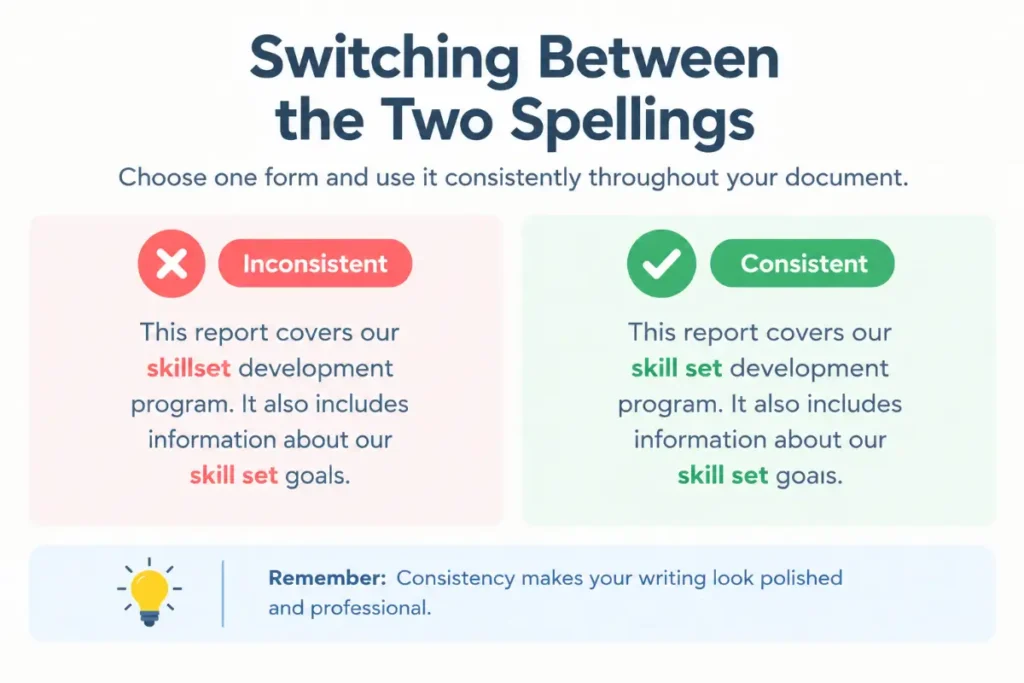
1. Mixing Both Spellings in One Document
Inconsistent: The job requires a strong skill set. Candidates must also develop their skillset.
Better: The job requires a strong skill set. Candidates must also develop their skill set.
The meaning is clear in both versions, but switching between spellings without a reason can make a document look poorly edited. Choose one form and use it throughout the same piece of writing.
2. Writing Skill-Set Without a Style Reason
Less preferred: She has a broad skill-set.
Preferred: She has a broad skill set.
The hyphenated form is not usually necessary in this expression. The standard open spelling is simple and clear. If a specific publication uses a hyphenated form, follow its style guide, but do not add one automatically.
3. Treating Skillset as a Different Concept
Incorrect assumption: Skill set means a group of abilities, but skillset means technical abilities only.
Correct understanding: Both forms generally describe a collection of abilities and knowledge.
The closed spelling does not create a separate definition. The surrounding sentence determines the type of skills being discussed.
4. Using an Unnecessary Plural
Awkward: She has many skill sets in customer service.
Better: She has a broad skill set in customer service.
The plural can be correct when referring to several distinct groups of abilities. However, if you mean one person’s overall collection of skills, the singular is usually clearer.
For example, a person may have one professional skill set that includes writing, planning, and communication. A company may need several different skill sets across its departments.
5. Confusing Skill Set With Skill
Incorrect: Communication is a complete skill set.
Better: Communication is an important skill.
A skill set contains multiple abilities. A single skill is one specific ability. Communication may be a broad area that includes listening, speaking, and writing, but the sentence should make clear whether you mean one ability or a group.
6. Using the Term Without Specific Examples
Vague: I have a great skill set.
Clearer: I have a strong skill set in customer service, scheduling, and conflict resolution.
The term is useful, but it can become empty when a writer does not explain which abilities it includes. In resumes and professional profiles, naming specific skills gives readers a clearer picture of what you can do.
Pronunciation Guide
How Do You Pronounce Skill Set?
The phrase is pronounced /ˈskɪl sɛt/. It has two syllables:
- Skill.
- Set.
The main stress falls on the first syllable. Say the phrase naturally as skill set, with a short pause only if the sentence requires one. The closed spelling is pronounced exactly the same way.
Easy Pronunciation Guide
You can break the phrase into familiar words:
- Skill rhymes with fill and still.
- Set rhymes with get and let.
Say skill first, followed by set. Keep both syllables clear, and avoid adding another vowel between them.
Common Pronunciation Mistakes
Some speakers may place too much stress on the second part or pronounce the two words as one long syllable. Others may reduce the vowel in skill too much, making it difficult to recognize.
The simplest approach is to pronounce each part clearly. The written space does not create a different pronunciation, and the closed version does not require a faster or shorter sound.
You may also want to read Swap vs Swop Which Spelling Is Correct..
Etymology and Word Origin
The Origin of Skill
The word skill has a long history in English. It developed from older forms associated with knowledge, understanding, and the ability to do something well. Its meaning gradually became closely linked with practical ability, expertise, and learned competence.
Today, skill can refer to a physical ability, a mental ability, or a learned area of knowledge. Examples include writing, cooking, programming, negotiation, and operating machinery.
The Origin of Set
The word set has several meanings and a long history in English. In this expression, it carries the sense of a group or collection of related things. A set of tools, a set of instructions, and a set of skills all describe items considered together.
How the Compound Developed
The phrase combines skill and set to describe a collection of abilities. The open form, skill set, makes the relationship between the two words clear. The closed form, skillset, reflects the way some English compounds become joined through repeated use.
The two spellings are now used with the same general meaning. The history of compound words helps explain why English sometimes allows more than one written form for a familiar expression.
Regional Usage
American English
In the United States, skill set is a familiar spelling in resumes, job descriptions, academic writing, and professional communication. It is a safe choice for formal documents and general audiences.
Skillset also appears in American business writing, recruitment content, and online professional profiles. Some companies use the closed form in their brand voice or internal style guides.
For a US audience, either spelling will usually be understood. If you do not have a style guide to follow, the two word form is a dependable choice.
British English
British English uses the same basic meaning. Both forms refer to a collection of abilities, and neither has a separate British definition.
A British publisher or employer may prefer one spelling over the other. Follow the style used in the rest of the document rather than assuming that the closed form is required in the United Kingdom.
Australian English
Australian English also uses the expression to describe a person’s combined abilities. Both open and closed spellings may appear in professional communication, although individual publications can have their own preferences.
There is no special Australian meaning or pronunciation that changes the basic usage.
Canadian English
Canadian English follows the same general pattern. The phrase appears in education, employment, and business writing, and the meaning remains consistent across both spellings.
The best approach is to follow the style guide used by your school, employer, or publisher. If no guidance exists, choose the two word form for a traditional and widely understood presentation.
Grammar Rules and Part of Speech
Both forms function as nouns. They refer to a collection of abilities and can appear in several positions within a sentence.
As a Subject
The phrase can be the subject of a sentence when it describes the abilities being discussed.
Examples:
- Her skill set includes writing and public speaking.
- A diverse skillset helps the team handle different tasks.
The noun phrase performs the action or serves as the main topic of the sentence.
As a Direct Object
It can also receive the action of a verb.
Examples:
- The course helped him improve his skill set.
- The company wants to expand its employees’ skillset.
In these sentences, the phrase identifies the abilities being developed or expanded.
After a Preposition
The term often follows prepositions such as in, with, and of.
Examples:
- She has experience in a wide skill set of business activities.
- The position requires someone with a strong technical skill set.
- His skillset is made up of several practical abilities.
Some combinations sound more natural than others. For example, with a strong skill set is a common and clear construction.
Singular and Plural Forms
The open form can become skill sets, while the closed form can become skillsets.
| Number | Open Form | Closed Form |
|---|---|---|
| Singular | Skill set | Skillset |
| Plural | Skill sets | Skillsets |
Use the singular when discussing one collection of abilities. Use the plural when referring to several separate collections.
Examples:
- Each employee has a different skill set.
- The two departments require different skill sets.
Possessive Forms
You can make the phrase possessive by adding an apostrophe to the final noun.
Examples:
- The employee’s skill set needs further development.
- The company’s skillset includes strong technical and creative abilities.
- The candidates’ skill sets vary widely.
The apostrophe rules are the same for both spellings.
Using the Phrase as a Modifier
The noun can describe another noun, as in skill set assessment or skillset development. In many cases, a clearer phrase is available, such as skills assessment or professional skills development.
Avoid adding a hyphen just because the expression appears before another noun. The best choice depends on the structure and the style guide, but the usual open form does not need a hyphen in ordinary use.
Real Life Usage Examples
Daily Conversation
People often use the phrase when talking about work, education, or personal growth.
- My current skill set is different from the one I had five years ago.
- You have the right skill set to help with this project.
These sentences sound natural because they describe a person’s combined abilities without unnecessary technical language.
Email and Workplace Communication
The phrase is common in professional messages about hiring, training, and team responsibilities.
- We are looking for someone whose skill set matches the needs of the department.
- The training session will help employees develop the skill set required for the new software.
In workplace writing, it is useful to name the actual abilities when possible. This makes job requirements and development goals easier to understand.
Academic Writing
Students and researchers may use the phrase when discussing education, learning outcomes, and professional preparation.
- The program helps students develop a skill set that supports independent research.
- The findings suggest that a broad skill set can help graduates adapt to different career paths.
In academic work, the term should be supported by specific examples or a clear explanation of the abilities being discussed.
News and Journalism
News articles may use the expression when reporting on employment trends, education, or changes in the workplace.
- Employers are seeking candidates with a skill set that combines technical knowledge and communication.
- New technology is changing the skill set required in many industries.
Journalists often use the phrase to summarize a broader group of abilities without listing every skill in the sentence.
Literature and Storytelling
In storytelling, the term can describe what makes a character useful, capable, or suited to a particular task.
- Her unusual skill set helped the group escape the dangerous situation.
- The detective relied on a skill set built through years of careful observation.
These examples show that the phrase is not limited to business writing. It can describe the abilities of fictional characters, too.
Related and Confused Terms
The following terms are closely connected to the meaning of a collection of abilities. They can help you write more precisely and avoid repeating the same phrase.
1. Skills
Skills are individual abilities that a person has learned or developed. Writing, coding, cooking, and public speaking are examples. A skill set is the collection of several skills considered together.
2. Competencies
Competencies are the abilities, knowledge, and behaviors needed to perform a task or role successfully. Employers often use this term in performance reviews and job descriptions. It can include skills as well as judgment and professional behavior.
3. Expertise
Expertise means a high level of knowledge or ability in a particular area. Someone may have expertise in accounting or software development. A skill set can include areas of expertise, but the two expressions are not identical.
4. Abilities
Abilities are the things a person can do. They may be natural, learned, or developed through practice. The term is broad and can include physical, mental, creative, and technical strengths.
5. Qualifications
Qualifications are the education, training, certificates, or experience that show someone is suitable for a role. A person may have the right skill set but lack a required qualification, such as a professional license.
6. Strengths
Strengths are areas in which a person performs well. They may include practical abilities, personal qualities, or ways of thinking. A skill set can contain several strengths, but it usually focuses more directly on usable abilities.
7. Technical Skills
Technical skills are specific abilities related to tools, systems, equipment, or professional tasks. Examples include programming, database management, and machine operation. They may form one part of a broader professional collection of abilities.
8. Soft Skills
Soft skills are personal and interpersonal abilities such as communication, teamwork, adaptability, and problem solving. They often support technical knowledge and help people work effectively with others.
Expert Editor Insight
An experienced editor treats skill set as the safer traditional spelling for general and formal writing, while recognizing that skillset is also used in modern professional English. The confusion exists because English compounds do not all follow one fixed spelling pattern. Grammar and spelling tools may accept both forms, so an automatic correction is not always necessary. Editors look at the publication’s style guide, the audience, and consistency across the document. For a resume or business report, the strongest approach is to choose one spelling, name the specific abilities involved, and avoid using the term as a vague substitute for real examples.
Key Takeaways
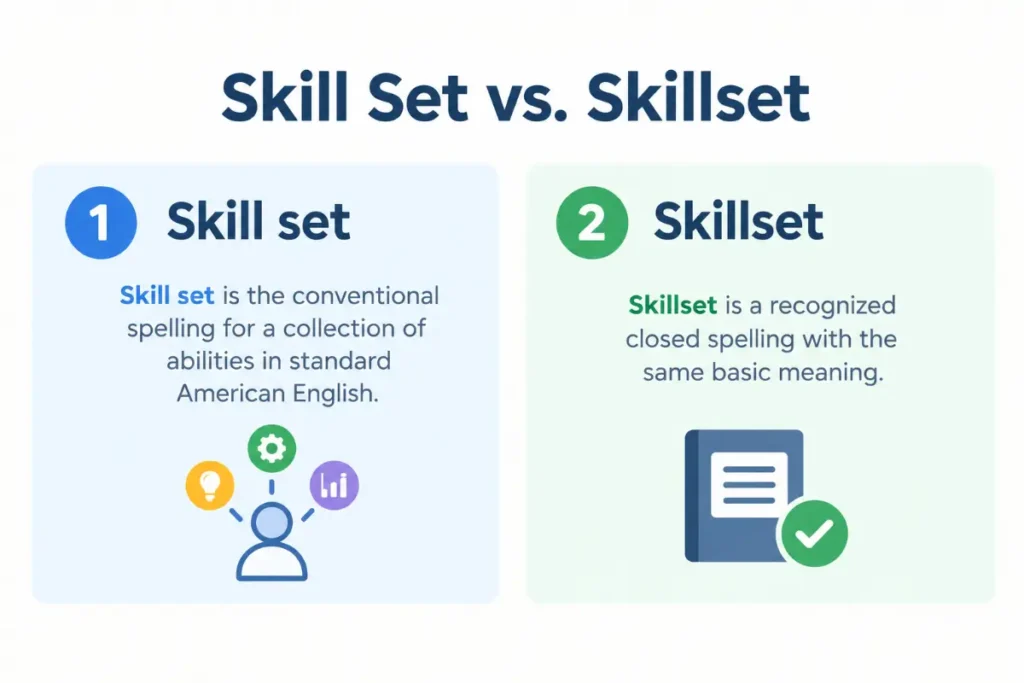
1. Skill set is the conventional spelling for a collection of abilities in standard American English.
2. Skillset is a recognized closed spelling with the same basic meaning.
3. Use skill set in resumes and professional documents when no specific style guide says otherwise.
4. Use skills when listing individual abilities and skill set when describing those abilities as a group.
Still confused? Compare Me Either Vs Me Neither Examples and Meanings 2026.
Conclusion
The spelling choice in skillset vs skill set is mainly a matter of compound word style, not a difference in meaning. Both forms describe a collection of abilities, knowledge, and practical skills. However, skill set remains the safest and more traditional option for formal documents, resumes, academic work, and general writing.
The closed form is also used in modern professional English, so it is not automatically wrong. Choose one version and use it consistently throughout your document. A useful editing tip is to follow your employer’s or publisher’s style guide before making a final spelling decision.
FAQs
Is Skillset One Word or Two?
Both spellings are used in modern English. Skill set is the traditional two word form and a safe choice for formal writing. Skillset is a recognized closed compound that appears in business and professional communication. The two forms generally have the same meaning, so follow your style guide and keep the spelling consistent.
Is Skillset a Real Word?
Yes. Skillset is an established closed compound noun used to describe a collection of abilities, knowledge, and practical skills. It is not simply a typing error. However, some editors and publications prefer skill set, the traditional open form. If you are unsure which spelling to use, the two word version is a dependable choice.
What Does Skill Set Mean?
A skill set is a group of abilities and areas of knowledge that someone uses to perform tasks or do a job. It may include technical skills, communication, leadership, problem solving, and practical experience. For example, a marketing professional may have a skill set that includes writing, research, data analysis, and campaign planning.
Is Skill Set Hyphenated?
No hyphen is normally needed in the standard open form. Write skill set as two words or skillset as one word, depending on the style you follow. The form skill-set is generally unnecessary in ordinary writing. Check your publication’s style guide if it specifies a different treatment.
Which Spelling Is Better for a Resume?
Skill set is a safe choice for a resume because it is traditional, clear, and widely accepted. You can use skillset if the employer or organization’s preferred style uses the closed form. More important, avoid vague claims. List specific abilities such as project management, customer service, data analysis, or software development.
What Is the Plural of Skill Set?
The plural of skill set is skill sets. The plural of skillset is skillsets. Use the plural when discussing several separate collections of abilities. For example, two departments may require different skill sets. If you are describing one person’s overall collection of abilities, the singular form is usually more suitable.
Is Skill Set Formal or Informal?
The two word form is appropriate for both formal and informal writing. It works in resumes, reports, academic assignments, job descriptions, and everyday conversation. The closed form also appears in professional communication, but some style guides prefer the traditional spelling. The best choice depends on your audience and the spelling rules you have been asked to follow.
What Is Another Word for Skill Set?
Useful alternatives include abilities, competencies, capabilities, professional skills, and areas of expertise. The best choice depends on what you mean. Competencies may include knowledge and behavior, while expertise suggests a high level of ability in a specific field. Skills is often the simplest alternative when you want a shorter expression.