
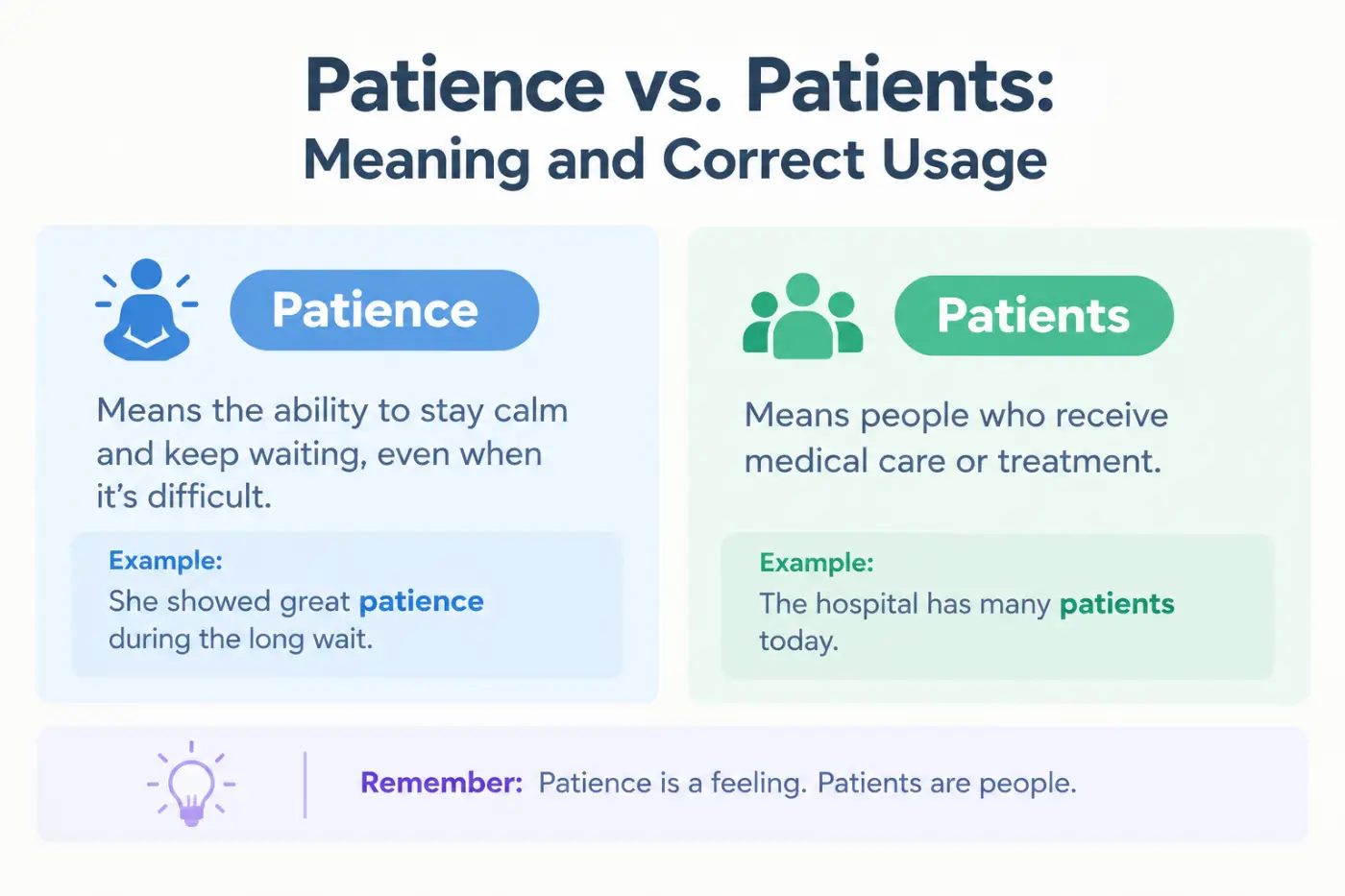
Have you ever written about a doctor who needs patience vs patients and wondered which word is correct? These words look almost identical, but they have very different meanings. Patience describes the ability to wait calmly or handle difficult situations without getting upset. Patients refers to people who receive medical care from doctors, nurses, or other healthcare professionals. The correct choice depends on the meaning you want to express.
The confusion makes sense because both words share similar letters and have nearly identical pronunciations. However, patience is an abstract noun, while patients is the plural form of the noun patient. Paying attention to their endings and the words around them can help you choose the right spelling.
Understanding the difference between patience vs patients will help you write clearly in emails, school assignments, workplace documents, medical reports, and everyday messages. You will also learn how to pronounce both words, avoid common spelling mistakes, recognize related terms, and remember which word to use in any sentence.
A related grammar guide is emersion vs immersion: Correct Meaning and Usage.
Quick Answer
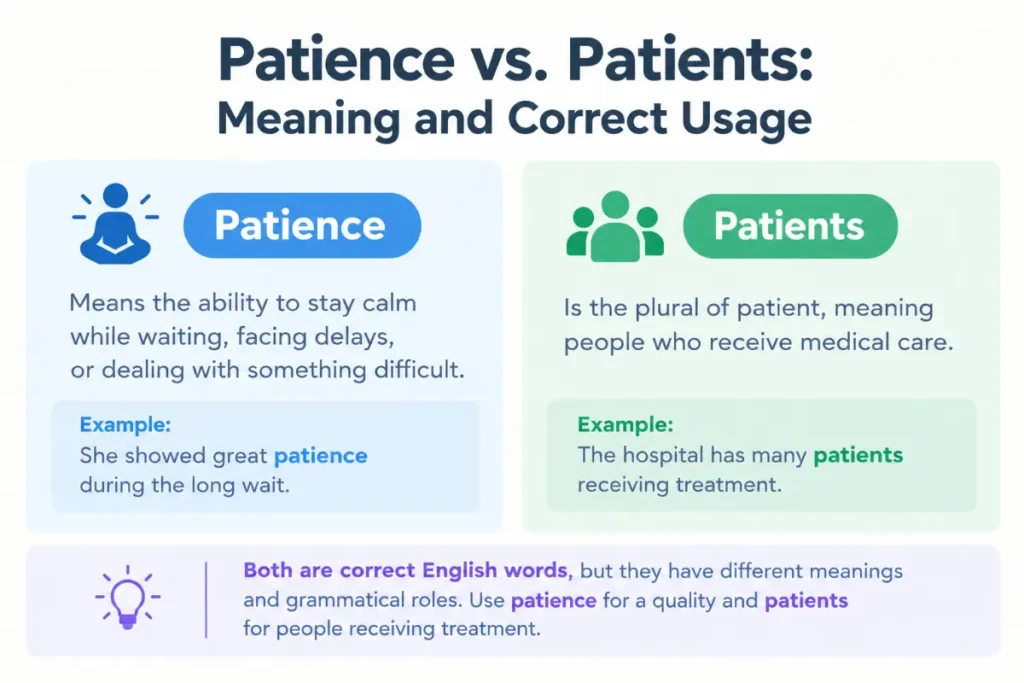
Patience means the ability to stay calm while waiting, facing delays, or dealing with something difficult. Patients is the plural of patient, meaning people who receive medical care. Both are correct English words, but they have different meanings and grammatical roles. Use patience for a quality and patients for people receiving treatment.
Meaning and Definition
What Patience Means
Patience is a noun that describes the ability to remain calm while waiting, facing delays, or dealing with problems. It can also mean the willingness to keep trying when something takes time or requires effort.
For example, a teacher may need patience when helping a student learn a difficult subject. A parent may show patience when teaching a child to tie their shoes. In both situations, the word describes a quality rather than a person.
Consider these examples.
1. Learning a new language takes patience.
This means that learning requires time and a willingness to keep practicing.
2. Thank you for your patience while we fix the problem.
The speaker appreciates the other person’s calm response during a delay.
3. She showed great patience with her younger brother.
She stayed calm while dealing with his behavior.
4. I have little patience for rude behavior.
The speaker has limited tolerance for people who behave rudely.
The word can describe calmness, tolerance, persistence, and self control. Its exact meaning depends on the situation, but the central idea is the ability to handle waiting or difficulty without becoming easily upset.
What Patients Means
Patients is the plural form of the noun patient. A patient is a person who receives medical care, treatment, or attention from a healthcare professional. Patients are the people being treated rather than the people providing the treatment.
For example, a doctor may examine several patients during one shift. A nurse may help patients recover after surgery. A hospital may admit new patients throughout the day.
Consider these examples.
1. The doctor examined three patients this morning.
Patients refers to the three people who received medical examinations.
2. The hospital needs more beds for patients.
The sentence refers to people receiving care at the hospital.
3. Nurses explained the treatment to their patients.
Patients identifies the people under the nurses’ care.
4. The clinic treats patients of all ages.
The word refers to people who receive treatment at the clinic.
Although the word often appears in medical settings, it can also refer to people receiving treatment from dentists, therapists, or other healthcare providers.
Comparison Table
| Feature | Patience | Patients |
|---|---|---|
| Part of speech | Noun | Plural noun |
| Basic meaning | Ability to wait calmly or tolerate difficulty | People receiving medical care |
| Singular form | Patience has no ordinary plural in this meaning | Patient |
| Pronunciation | PAY shuhns | PAY shuhnts |
| Main context | Waiting, tolerance, persistence | Hospitals, clinics, healthcare |
| Example | Please have patience. | The patients are waiting. |
| Common phrase | Thank you for your patience. | Care for patients |
| Grammar | Usually an uncountable noun | Countable plural noun |
| Spelling clue | Ends in ence | Ends in ents |
The most useful difference is the meaning. Patience is a quality that someone can show or develop. Patients are people who receive care.
Key Differences Explained
The Meaning Is Different
The simplest distinction is that patience describes a quality, while patients identifies people.
A person can have patience while waiting to see a doctor. The people sitting in the waiting room are patients.
For example, consider this sentence.
The doctor showed patience while explaining the diagnosis to the patients.
The first word describes the doctor’s calm and understanding behavior. The second refers to the people receiving medical care.
Both words can appear in the same sentence because they perform different jobs.
The Grammar Is Different
Patience is an abstract noun. It names a quality rather than a physical object or individual. In its usual meaning, it is uncountable, so you generally do not say a patience or three patiences.
Instead, you can say that someone has patience, shows patience, or needs more patience.
Patients is a plural countable noun. The singular form is patient, and the plural form is patients. You can refer to one patient, two patients, or many patients.
This grammar difference helps you choose the right form.
1. The teacher needs patience.
2. The teacher helps several patients.
The first sentence names a quality. The second identifies people.
The Spelling Is Different
The final letters provide a useful clue.
Patience ends in ence.
Patients ends in ents.
The spelling of patience follows the noun pattern used in words such as confidence and difference. The spelling of patients follows the regular plural pattern of patient, which adds the letter s.
The words share most of their letters, so typing quickly can lead to mistakes. Reading the full sentence before sending it can help you catch the wrong ending.
The Pronunciation Is Similar
Both words have three syllables in ordinary pronunciation, and both begin with the same stressed sound. However, their final sounds differ.
Patience ends with a sound like the final part of science. Patients ends with a clear final consonant cluster that includes the t sound.
In normal American speech, the distinction is often clear from context. Still, careful pronunciation can help when you are reading aloud or explaining a sentence to someone.
The Context Usually Reveals the Correct Word
You rarely need to memorize a complicated grammar rule to choose between these forms. The surrounding words often tell you what the sentence means.
If the sentence includes words such as waiting, calm, delay, tolerance, or practice, patience may be the right choice.
If the sentence includes words such as doctor, nurse, clinic, treatment, hospital, or medical care, patients may be the right choice.
These are useful clues, not absolute rules. A medical sentence can discuss a doctor’s patience, and a sentence about patients can mention waiting. Always consider the complete meaning.
Which Form Is Correct
Both forms are correct English words. Neither is a misspelling of the other. The correct choice depends on the meaning you intend to express.
Use patience when you mean the ability to wait calmly or handle difficulty without losing your temper.
Use patients when you mean people who receive medical care.
For example, the sentence The nurse showed patience with her patients uses both words correctly. The nurse displayed calmness and understanding, and the patients were the people receiving care.
If you replace one word with the other, the meaning changes. Writing The nurse showed patients with her patience does not express the intended idea. The nouns occupy different grammatical roles, and they cannot be exchanged just because they look similar.
When editing your work, focus on the meaning first and the spelling second. Ask yourself what the sentence is trying to describe. That simple check usually settles the choice.
Sentence Examples
The following examples show how both words work in everyday and professional English.
Examples Using Patience
1. Please have patience while the website loads.
Patience means staying calm during a delay.
2. My father taught me patience when I was learning to drive.
The word describes the calm and understanding he showed during the learning process.
3. Finishing this project will take patience and careful planning.
Here patience refers to the ability to keep working without giving up.
4. The customer thanked the support team for its patience.
The customer appreciates the team’s calm response while handling a problem.
5. You need patience when learning to play the piano.
The sentence explains that musical skills develop through repeated practice.
Examples Using Patients
6. The doctor saw twelve patients before noon.
Patients refers to the people who received medical care.
7. The clinic asks patients to arrive fifteen minutes early.
The sentence gives instructions to people visiting the clinic for treatment.
8. Nurses helped the patients understand their medication schedules.
Patients refers to the people receiving care from the nurses.
9. The hospital opened a new room for patients recovering from surgery.
The word identifies people who are recovering under medical supervision.
10. The dentist explained the procedure to all her patients.
Patients means the people receiving dental care.
These examples demonstrate a reliable pattern. Patience describes a quality, while patients refers to people.
Common Mistakes and Misspellings
Using Patients When You Mean Calmness
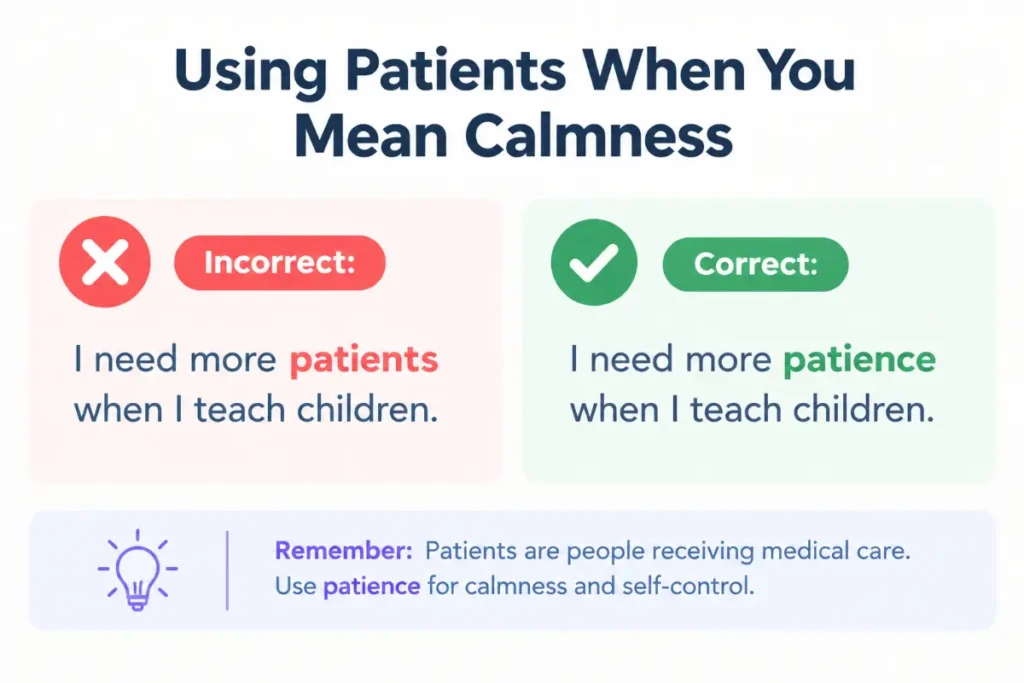
Incorrect: I need more patients when I teach children.
Correct: I need more patience when I teach children.
The incorrect sentence suggests that the speaker needs additional people receiving medical care. The intended meaning is the ability to remain calm while teaching.
Using Patience When You Mean People Receiving Care
Incorrect: The doctor treated several patience today.
Correct: The doctor treated several patients today.
Patience is an abstract noun and cannot be counted as individual people in this sentence. Patients is the correct plural noun.
Confusing Patient With Patience
Incorrect: She is a patience teacher.
Correct: She is a patient teacher.
The adjective patient describes someone who can wait calmly or tolerate difficulty. Patience is the noun for that quality.
Adding an Unnecessary Plural Ending
Incorrect: He has many patiences.
Correct: He has a lot of patience.
In its usual meaning, patience is uncountable. To describe different examples of calm behavior, you can use a phrase such as acts of patience, but you generally should not pluralize the word itself.
Using Patients as an Adjective for Calm Behavior
Incorrect: The nurse was very patients with the child.
Correct: The nurse was very patient with the child.
Patient is the adjective needed to describe the nurse’s behavior. Patients is the plural noun for people receiving care.
Pronunciation Guide
Pronunciation can help you recognize the difference when speaking, listening, or reading aloud.
How to Pronounce Patience
The standard American pronunciation is /ˈpeɪ.ʃəns/.
A simple guide is PAY shuhns.
The word has three syllables, with the strongest stress on the first syllable. The middle syllable has a reduced vowel, and the final sound resembles the ending in science.
Say it naturally rather than stressing every syllable equally. The first part should be the clearest and strongest.
How to Pronounce Patients
The standard American pronunciation is /ˈpeɪ.ʃənts/.
A simple guide is PAY shuhnts.
The first syllable receives the strongest stress. The final syllable ends with a ts sound, which helps distinguish the word from patience.
The two words are very similar in speech, but the final consonant cluster in patients provides a useful clue.
Common Pronunciation Errors
1. Giving the final syllable too much stress.
Both words normally have their strongest stress at the beginning.
2. Dropping the final t sound in patients.
The final consonant cluster helps distinguish the plural noun in careful speech.
3. Pronouncing the middle vowel too strongly.
In natural American English, the middle syllable is usually reduced.
4. Assuming similar pronunciation means identical meaning.
Words can sound alike or nearly alike while serving different grammatical purposes. Context remains essential.
A related grammar guide is tonite or tonight Which Spelling Is Correct.
Etymology and Word Origin
The two words share a historical connection to the idea of enduring or suffering, but their modern meanings have developed in different directions.
The Origin of Patience
Patience entered English through Old French, with roots in Latin patientia. The Latin term is connected with pati, meaning to suffer or endure.
This origin fits the modern meaning. Patience involves enduring delays, discomfort, or difficulty without giving up or becoming angry too quickly.
The same historical family includes patient, the adjective describing someone who can wait calmly. Over time, patience became the noun used to name that quality.
The Origin of Patients
Patients is the plural of patient. The noun patient developed from a word associated with suffering or enduring and came to describe a person receiving medical treatment.
That connection makes sense because people receiving care may be dealing with illness, injury, or another health concern.
Although the words share a historical root, their current meanings are distinct. Their origins can help explain the relationship, but modern grammar and context determine how each word should be used.
Regional Usage
American English
Both words are standard in American English. Patience refers to calmness and the ability to tolerate delays, while patients refers to people receiving medical care.
Americans use expressions such as thank you for your patience, please be patient, and care for patients in everyday and professional settings. There is no special American spelling rule that changes the distinction between the two words.
British English
British English uses both forms with the same basic meanings. The spelling and grammatical distinction remain the same.
A British writer would use patience to describe someone’s ability to wait calmly and patients to refer to people receiving treatment. The difference is not a matter of American versus British spelling.
Canadian English
Canadian English also follows the same distinction. Both forms are standard, and their meanings do not change simply because the writer is in Canada.
Australian English
Australian English uses patience for the quality of staying calm and patients for people receiving medical care. There is no established regional spelling difference between these forms.
The practical rule is consistent across these major English varieties. Choose the word based on its meaning, not the country where you are writing.
Grammar Rules and Part of Speech
Understanding each word’s grammatical role makes it easier to use the correct form without second guessing yourself.
Patience Is an Uncountable Noun
Patience is an abstract noun because it names a quality rather than a person or physical object. It is generally uncountable in its ordinary meaning.
It can be written as:
- She showed patience during the interview.
- We need more patience.
- His patience impressed the team.
- Thank you for your patience.
You generally would not write a patience or many patiences when referring to the quality of remaining calm.
You can use expressions such as a great deal of patience, some patience, or a little patience to describe how much of the quality someone has.
Patients Is a Countable Plural Noun
Patients is the plural form of patient. Because individual people can be counted, this noun follows ordinary plural grammar.
You can write:
- One patient arrived early.
- Two patients arrived early.
- Several patients are waiting.
- The patients have received their test results.
The singular form is patient, while the plural form is patients. Use a number or a word such as several when you need to specify how many people you mean.
Patient Can Also Be an Adjective
The word patient has two common grammatical uses. It can be a noun for someone receiving medical care, or an adjective describing someone who can tolerate delays calmly.
Compare these sentences.
1. The patient needs medication.
Patient is a noun because it names the person receiving care.
2. The teacher is patient with her students.
Patient is an adjective because it describes the teacher’s behavior.
3. The patients are waiting outside.
Patients is a plural noun referring to people receiving care.
4. The teacher’s patience helped the students.
Patience is an abstract noun naming the quality the teacher showed.
These examples also show why it is useful to learn the word family rather than memorize only two spellings.
Real Life Usage Examples
Daily Conversation
Patience often appears in everyday conversations about waiting, learning, or dealing with frustration.
- Please have patience with me while I learn this new app.
- I don’t have much patience for people who interrupt others.
The first sentence asks someone to remain understanding during a learning process. The second describes the speaker’s low tolerance for a particular behavior.
Patients appears in daily conversations about medical visits.
- The doctor is seeing patients this afternoon.
- Some patients prefer morning appointments.
Both sentences refer to people receiving medical care.
Workplace Communication
Patience is useful when discussing customer service, teamwork, or delays.
- Thank you for your patience while we resolve the billing issue.
- Managers need patience when training new employees.
In the first sentence, patience expresses appreciation for someone waiting calmly. In the second, it describes a useful workplace quality.
Patients appears in healthcare communication.
- Please remind patients to bring their insurance information.
- The clinic will contact patients about their appointment times.
The word identifies the people who receive services from the clinic.
Academic Writing
Students and researchers may use patience when discussing learning, practice, or long term work.
- Developing strong writing skills requires patience and regular practice.
- The experiment required patience because the results took several weeks to appear.
In both examples, the word describes the ability to continue working without rushing.
In medical or healthcare research, patients refers to the people involved in treatment or care.
- The study included patients receiving treatment at the clinic.
- Researchers collected information from patients who agreed to participate.
The word identifies the people being studied. In research writing, authors should also follow the relevant ethical and privacy requirements when discussing patient information.
News and Journalism
News reports may use patience when describing a public response to a delay or a difficult situation.
- Officials asked residents for patience while road repairs continued.
- Customers showed patience as the airport worked to restore normal service.
Patients commonly appears in reports about hospitals and healthcare systems.
- The hospital transferred several patients to nearby facilities.
- Medical teams treated patients injured in the accident.
These examples show how context determines the intended meaning.
Literature and Storytelling
Writers often use patience to describe a character’s personality or personal growth.
- Her patience helped her rebuild trust after the argument.
- He learned that patience could accomplish more than anger.
In these sentences, patience represents calmness and self control.
Patients can appear in stories about hospitals, doctors, or recovery.
- The doctor visited her patients before the clinic closed.
- The nurse comforted patients during the long night.
The word refers to the people receiving care rather than a character’s personality.
Related and Confused Terms
Several related words can help you understand this word family more clearly.
Patient
Patient can be a noun or an adjective. As a noun, it means a person receiving medical care. As an adjective, it means able to wait calmly or tolerate difficulty.
Example: The patient was patient while waiting for the results.
The first use names a person. The second describes that person’s behavior.
Impatient
Impatient is the opposite of patient when patient describes calmness and tolerance. An impatient person may become annoyed when waiting or dealing with delays.
Example: He became impatient after waiting for an hour.
Impatience
Impatience is the noun form related to impatient. It describes the lack of patience or the tendency to become annoyed by delays.
Example: Her impatience made the conversation more difficult.
Tolerance
Tolerance means the ability or willingness to accept something difficult, unpleasant, or different without reacting harshly.
Example: The teacher showed tolerance when students made mistakes.
Tolerance overlaps with patience, but the words are not identical in every context.
Perseverance
Perseverance means continuing to work toward a goal despite problems or setbacks.
Example: Learning to play the violin requires perseverance.
Patience focuses more on calmness and waiting, while perseverance emphasizes continued effort.
Endurance
Endurance is the ability to withstand physical or mental difficulty over time.
Example: The long race tested the runners’ endurance.
Patience and endurance can overlap, but endurance often emphasizes lasting through hardship.
Calmness
Calmness describes a peaceful state of mind or behavior without strong agitation.
Example: Her calmness helped the team handle the emergency.
Patience often includes calmness, especially during a delay, but calmness can exist without waiting or difficulty.
Client
A client is someone who receives professional services. The word is common in fields such as law, consulting, and business.
Example: The lawyer explained the options to her client.
A client is not automatically a patient. The correct term depends on the service being provided and the professional setting.
Expert Editor Insight
An experienced editor checks the meaning of the sentence before checking the final letters. If the sentence describes waiting calmly, patience is the right choice. If it refers to people receiving medical care, patients is correct. The mistake often happens because the words look alike and the final sounds are similar. Spellcheck tools may catch some errors, but they can miss a wrong word that is spelled correctly. Reading the sentence aloud and replacing the word with its intended meaning is a quick way to catch the problem.
Key Takeaways
- Patience is an abstract noun meaning the ability to wait calmly or handle difficulty.
- Patients is the plural of patient and refers to people receiving medical care.
- Patient can be a noun for someone receiving treatment or an adjective describing calm behavior.
- Patience is generally uncountable in its usual meaning.
- Patients is a countable plural noun.
- Both words are standard in American, British, Canadian, and Australian English.
- Patience ends in ence, while patients ends in ents.
- The easiest memory trick is to connect patience with a quality and patients with people.
For another common grammar confusion, see Sentence Or Sentance 2026 Which Spelling Is Correct?.
Conclusion
The difference between patience vs patients comes down to meaning and grammar. Patience describes the ability to remain calm during delays or difficulties, while patients refers to people receiving medical care. Both are correct English words, so the right choice depends on what your sentence needs to express.
Use patience in phrases such as show patience and thank you for your patience. Use patients when talking about people visiting a doctor, receiving treatment, or recovering in a hospital. For a quick editing check, ask yourself if the word describes a quality or names people. That simple question will help you choose the correct spelling with confidence.
FAQs
Is patience the same as patients?
No. Patience is the ability to wait calmly or tolerate difficulty, while patients refers to people receiving medical care. Both words are correct, but they serve different grammatical roles. Use patience when describing a quality and patients when referring to a group of people being treated by healthcare professionals.
What does patience mean in simple words?
Patience means staying calm while waiting or dealing with something difficult. It also means continuing to try when progress takes time. For example, a student shows patience by practicing a difficult skill instead of giving up after one mistake. The word is an uncountable noun in its usual meaning.
What is the plural of patient?
The plural of patient is patients when the word refers to people receiving medical care. For example, one patient may visit a doctor, while several patients may wait in the clinic. When patient describes someone who stays calm, it is an adjective, so it does not become plural in the same way.
How do you pronounce patience and patients?
In standard American English, patience is pronounced /ˈpeɪ.ʃəns/, while patients is pronounced /ˈpeɪ.ʃənts/. Both words have the strongest stress on the first syllable. The final t sound in patients helps distinguish it from patience, although the words can sound very similar in casual speech.
Can patience be used as an adjective?
No. Patience is a noun, not an adjective. The adjective is patient. You can say that a teacher is patient or that a teacher shows patience. The first sentence describes the teacher, while the second names the quality the teacher demonstrates. Keeping these forms separate prevents many common grammar mistakes.
Why do people confuse these two words?
People confuse them because they share most of their letters and sound similar when spoken. Their meanings are also connected through the word family associated with patient. However, their grammatical roles differ. Remembering that patience is a quality and patients are people makes the spelling distinction easier to recognize.
Is patience appropriate in formal writing?
Yes. Patience is standard in formal and informal English. It appears in business emails, academic writing, customer service messages, and everyday conversation. Expressions such as thank you for your patience are common in professional communication. The word works well whenever you need to describe calmness, tolerance, or the ability to wait.
What is a good synonym for patience?
Useful alternatives include tolerance, forbearance, calmness, and perseverance, depending on the context. Tolerance emphasizes accepting something difficult, while perseverance focuses on continuing despite obstacles. Calmness describes a peaceful state of mind. None of these words replaces patience perfectly in every sentence, so choose the one that best matches your intended meaning.