
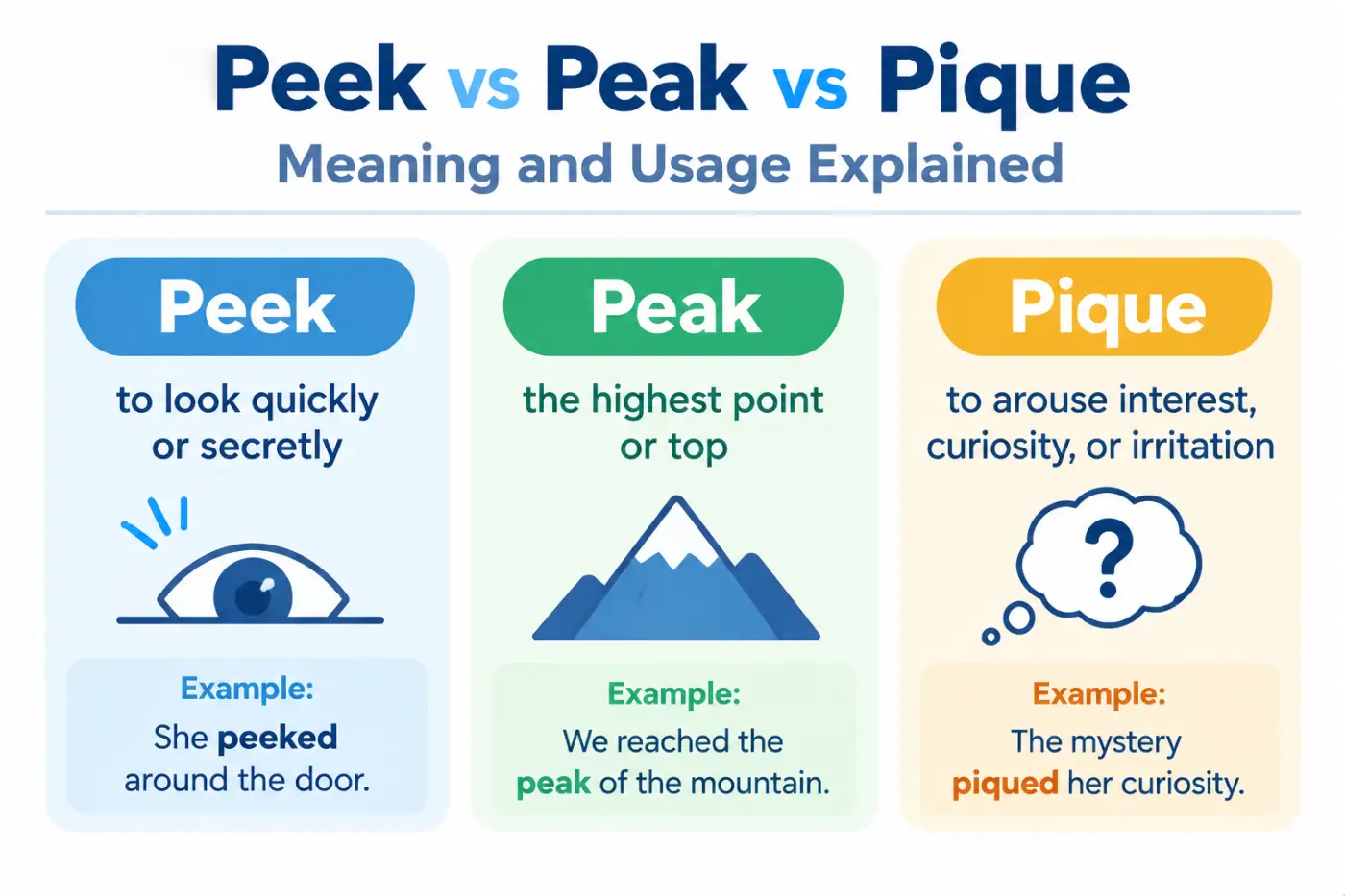
Confusing peek vs peak vs pique is easy because all three words share the same pronunciation, but they have very different meanings. One describes a quick look, another refers to the highest point, and the third means to stimulate interest or cause irritation.
Choosing the wrong one can change the meaning of an entire sentence. For example, you might peek through a window, reach the peak of a mountain, or pique someone’s curiosity. The words are homophones, which means they sound alike but have different spellings and meanings.
That shared pronunciation is the main reason people mix them up in everyday writing, emails, school assignments, and online conversations. The good news is that each word has a distinct meaning and a few simple usage patterns that make it easier to remember. Once you understand the difference, you can choose the right word with confidence and avoid common spelling mistakes.
Still confused? Compare Mute Point or Moot Point Which Is Correct.
Quick Answer
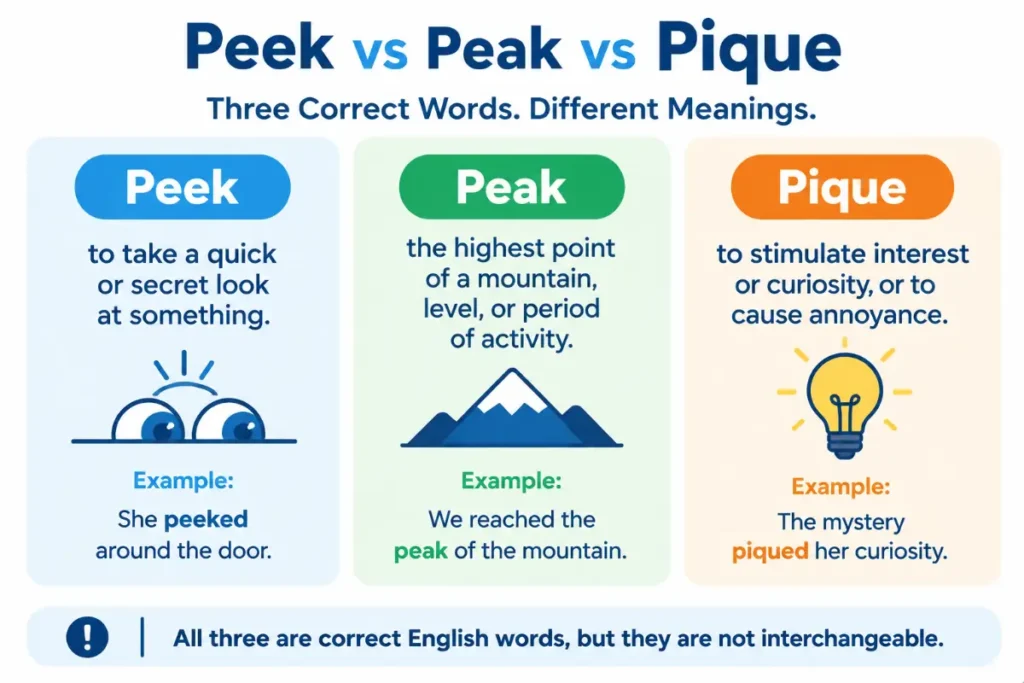
Peek means to take a quick or secret look at something. Peak means the highest point of a mountain, level, or period of activity. Pique means to stimulate interest or curiosity, or to cause annoyance. All three are correct English words, but they are not interchangeable.
Peek vs Peak vs Pique Comparison Table
| Word | Main Meaning | Part of Speech | Common Contexts | Example |
|---|---|---|---|---|
| Peek | A quick or secret look | Noun and verb | Looking, observing, curiosity | She took a peek inside. |
| Peak | The highest point or maximum level | Noun, verb, and adjective | Mountains, performance, demand | Sales reached their peak. |
| Pique | To stimulate interest or cause irritation | Verb and noun | Curiosity, interest, annoyance | The mystery piqued his curiosity. |
The main difference is the idea each word expresses. A peek involves looking, a peak involves reaching a high point, and pique involves creating a reaction in someone’s mind or feelings.
Meaning and Definition of Each Word
What Does Peek Mean?
Peek means to look at something quickly, secretly, or carefully, often without being noticed. It can describe a brief glance through a door, a quick look at a surprise, or an attempt to see something hidden.
It works as both a noun and a verb.
As a verb, it describes the action of looking briefly.
Example: The child peeked through the curtains.
As a noun, it describes the quick look itself.
Example: He took a peek at the birthday presents.
The word often suggests curiosity, secrecy, or a desire to see something before the right time. However, it does not always imply that someone is doing something wrong. A parent might peek into a child’s bedroom to check if the child is asleep, while a guest might peek inside a gift bag out of excitement.
Common expressions include:
- Take a peek.
- Peek inside.
- Peek through the window.
- Peek around the corner.
- Sneak a peek.
In everyday American English, the phrase take a peek is especially common. It offers a friendly way to ask someone to look at something.
For example, a coworker might say, Please take a peek at the updated report before the meeting.
What Does Peak Mean?
Peak refers to the highest point of something. It can describe the top of a mountain, the greatest level of performance, the busiest period of a day, or the maximum amount of activity.
It functions as a noun, verb, and adjective.
As a noun, it identifies the highest point or level.
Example: The mountain’s peak was covered in snow.
As a verb, it describes reaching the highest level.
Example: Tourist activity usually peaks during the summer.
As an adjective, it describes a time of maximum activity, demand, or performance.
Example: The store gets crowded during peak hours.
The word is common in many areas of life, including business, sports, education, science, travel, and everyday conversation. You might hear someone talk about peak performance, peak season, peak traffic, or peak demand.
It can also describe the most successful or intense period in someone’s life or career.
For example, a singer might have reached the peak of her career after winning a major music award.
Some common expressions include:
- At its peak.
- Peak performance.
- Peak season.
- Peak hours.
- Reach a peak.
- Peak demand.
A useful way to remember this word is to connect it with the pointed top of a mountain. The top represents the highest point, which is the central meaning of the term.
What Does Pique Mean?
Pique means to stimulate someone’s interest, curiosity, or attention. It can also mean to cause irritation, resentment, or wounded pride.
It is most often used as a verb in modern English, especially in the expression pique someone’s curiosity.
Example: The unusual title piqued my interest.
In this sentence, the title created interest and encouraged someone to learn more.
The word can also describe annoyance or hurt feelings.
Example: His pride was piqued by the criticism.
As a noun, pique can refer to a feeling of irritation or resentment, often caused by wounded pride.
Example: She left the room in a fit of pique.
This noun usage is more formal or literary than the common verb use.
Common expressions include:
- Pique someone’s curiosity.
- Pique someone’s interest.
- Pique someone’s imagination.
- In a fit of pique.
- Out of pique.
The word often appears in journalism, professional writing, literature, and thoughtful conversation. It can make a sentence more precise when something sparks a person’s curiosity.
For example, a strange discovery might pique a scientist’s interest and encourage further research.
Key Differences Explained
Although these words sound identical, their meanings, grammatical roles, and sentence patterns are different. Understanding these differences helps you choose the right form without relying on pronunciation alone.
1. Spelling
Each word has five letters, but the final letters create different written forms.
- Peek ends with double e.
- Peak contains ea in the middle.
- Pique ends with que.
The spelling patterns are not interchangeable. English contains many words with similar sounds but different letter combinations, and these three are a good example.
2. Meaning
The simplest distinction comes from their central meanings.
- Peek means a quick look.
- Peak means the highest point.
- Pique means to stimulate interest or cause irritation.
Consider these examples:
- I took a peek at the invitation.
- We climbed to the mountain’s peak.
- The invitation piqued my curiosity.
Each sentence communicates a different action or idea.
3. Part of Speech
All three can work in more than one grammatical role, but their uses differ.
| Word | Noun | Verb | Adjective |
|---|---|---|---|
| Peek | Yes | Yes | No |
| Peak | Yes | Yes | Yes |
| Pique | Yes | Yes | No |
The noun form of pique is less common in everyday conversation. The verb form is much more familiar, especially in expressions about interest and curiosity.
4. Pronunciation
All three words have the same pronunciation in standard American English.
Their IPA pronunciation is /piːk/. The vowel sound is the long e sound found in words such as see and meet.
This makes them homophones. You cannot identify the correct spelling by listening to the word alone. You must use the sentence’s meaning.
5. Formality
Peek and peak are common in both casual and formal communication. They appear in everyday conversations, workplace emails, news reports, academic writing, and professional documents.
Pique is also correct in formal writing, but it can sound more polished or literary. In casual conversation, people often choose simpler alternatives such as interest, excite, or annoy.
6. Context
The surrounding words usually reveal the intended meaning.
For example:
- If someone takes a look, use peek.
- If something reaches its highest level, use peak.
- If something sparks curiosity or causes irritation, use pique.
Learning common phrases is one of the easiest ways to recognize the correct form.
7. Standard and Nonstandard Usage
All three spellings are standard English words. None is a misspelling of the others.
The mistake happens when a writer uses a legitimate word in the wrong context. Writing The news peaked my interest, for example, is incorrect if the intended meaning is that the news stimulated interest. The correct form is piqued.
Which Word Is Correct?
All three are correct. The right choice depends on what you want to communicate.
Use peek when describing a quick or secret look. Use peak when referring to the highest point, maximum level, or moment of greatest success and Use pique when describing something that stimulates interest or causes irritation.
Established English dictionary usage recognizes these as separate words with distinct meanings and grammatical functions. Their identical pronunciation does not make them interchangeable.
Here is a simple way to choose:
- Can you replace the word with look? Use peek.
- Can you replace it with highest point or maximum? Use peak.
- Can you replace it with stimulate interest or irritate? Use pique.
For example, if a headline makes you curious, it piques your interest. If a business reaches its highest sales level, sales peak. If you briefly look at a message on someone’s phone, you take a peek.
10 Natural Sentence Examples
The following examples show how each word works in realistic situations.
Examples With Peek
- Everyday conversation: I took a quick peek inside the kitchen to see if dinner was ready.
- Text message: Can you take a peek at the photo I just sent you?
- Workplace communication: Please peek at the revised schedule before sharing it with the team.
- School: The student peeked at the answer sheet before the teacher collected it.
- Social situation: She sneaked a peek at the surprise gift when nobody was watching.
Examples With Peak
- Travel: We reached the mountain’s peak just before sunset.
- Business: Online orders usually peak during the holiday season.
- Sports: The athlete hopes to reach peak performance before the championship.
- Work: Traffic is usually heaviest during peak commuting hours.
- Academic writing: The research found that demand reached its peak during the final quarter.
With Pique
Here are five additional examples to show its distinctive meaning.
- The documentary’s opening scene immediately piqued my curiosity.
- Her unusual question piqued the professor’s interest.
- The unexpected announcement piqued everyone’s attention.
- His pride was piqued when his colleague questioned his decision.
- The mystery surrounding the old house piqued the children’s imagination.
Notice that the verb often appears before a noun describing a feeling or mental response. This pattern makes it easier to recognize in writing.
Common Mistakes and Misspellings
Writers often confuse these words because they sound exactly alike. The problem usually comes from choosing a spelling based on sound instead of meaning.
Here are five common mistakes and how to correct them.
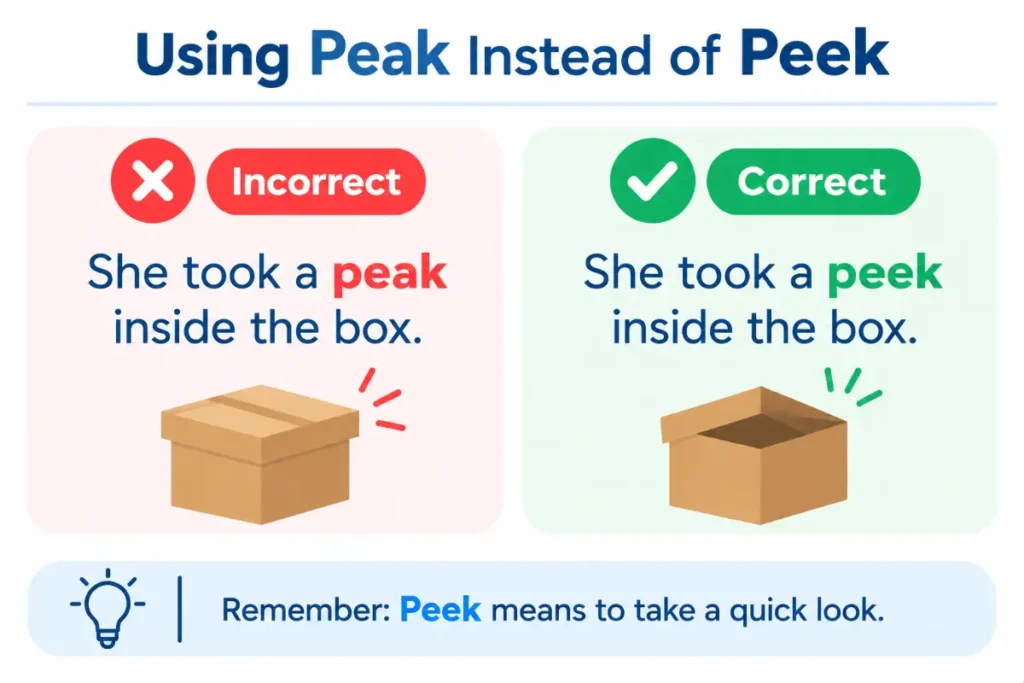
1. Using Peak Instead of Peek
Incorrect: She took a peak inside the box.
Correct: She took a peek inside the box.
The sentence describes looking inside something, not reaching a high point. The correct expression is take a peek.
2. Using Peek Instead of Peak
Incorrect: The mountain’s peek was covered in snow.
Correct: The mountain’s peak was covered in snow.
The sentence refers to the highest point of a mountain. The word peak is the correct choice.
3. Writing Peaked My Interest Instead of Piqued My Interest
Incorrect: The article peaked my interest.
Correct: The article piqued my interest.
This is one of the most common errors involving these words. The intended meaning is that the article stimulated interest, so the correct verb is piqued.
4. Using Pique Instead of Peak
Incorrect: The company’s profits reached their pique last year.
Correct: The company’s profits reached their peak last year.
The sentence describes the highest level of profit. Pique does not mean maximum or highest point.
5. Confusing Piqued With Peaked
Incorrect: The strange story peaked her curiosity.
Correct: The strange story piqued her curiosity.
The story stimulated her interest, so the correct past tense is piqued. Peaked would suggest that something reached its highest level.
Why These Errors Happen
There are several reasons these words cause confusion.
- Identical pronunciation: All three sound the same, so listening does not reveal the spelling.
- Different spelling patterns: English uses several letter combinations to represent similar sounds.
- Unfamiliar vocabulary: Some writers use peak and peek often but rarely encounter pique.
- Autocorrect limitations: A spelling tool may accept the wrong word because the selected form is a valid English word.
- Memory and typing habits: People often choose the spelling they have seen most recently rather than the one that fits the sentence.
The best solution is to check the meaning before selecting the spelling.
A related grammar guide is Arised or Arose Which Is Correct.
Pronunciation Guide
All three words are pronounced exactly alike in standard American English.
Pronunciation
/piːk/
One syllable · Long E sound · Final K sound
Easy pronunciation: peek
Similar sound: Speak, seek, week, and cheek.
Syllable Breakdown
Each word contains one syllable.
- Peek: one syllable.
- Peak: one syllable.
- Pique: one syllable.
The pronunciation begins with the consonant sound p, followed by a long e vowel, and ends with a hard k sound.
Stress Pattern
Because each word has only one syllable, the entire word receives the main stress.
There is no difference in stress among the three forms.
Common Pronunciation Mistakes
Some learners may try to pronounce pique as two syllables because of its French-looking spelling. In standard English, it is pronounced as one syllable, just like peek and peak.
The letters que do not create an extra syllable. They represent the final k sound.
Etymology and Word Origin
The different spellings reflect separate histories. Their shared pronunciation developed through the sound patterns of English and French, but the words do not have the same origin or meaning.
Origin of Peek
Peek is recorded in English from the 14th century. Its early history is uncertain, although it may be connected with words describing looking or peering. Its modern meaning developed around the idea of taking a brief or cautious look.
The word remains common in everyday English, especially in expressions such as take a peek and peek through.
Origin of Peak
Peak entered English in the 16th century. It is commonly traced to Middle French pic, meaning a pointed summit or mountain peak, with possible connections to related Romance forms.
Its meaning developed around the idea of a pointed top or highest point. Over time, it gained wider uses beyond geography, including business, sports, economics, and personal achievement.
Origin of Pique
Pique comes from French piquer, meaning to prick, sting, or irritate. It entered English in the 16th century.
Its meaning expanded to include stimulating interest or curiosity. The sense of irritation also remains in expressions such as a fit of pique, which describes a reaction caused by wounded pride or annoyance.
The French spelling helps explain why this word looks different from the other two, even though all three share the same pronunciation in English.
Regional Usage
The meanings and standard spellings remain consistent across major varieties of English. There is no major American, British, Australian, or Canadian spelling difference among these three words.
American English
All three are standard in the United States.
American speakers commonly use peek in expressions such as take a peek, peak in phrases such as peak season, and pique in expressions such as pique someone’s interest.
The phrase piqued my interest is especially useful in professional writing, articles, reviews, and everyday conversation.
British English
British English uses the same spellings and meanings.
A British writer would use peek for a quick look, peak for a summit or maximum level, and pique for stimulated interest or irritation.
There is no standard British spelling that replaces one of these forms.
Australian English
Australian English follows the same distinctions.
For example, someone might take a peek at a document, discuss peak holiday traffic, or say that a news story piqued their curiosity.
No special Australian spelling variation applies.
Canadian English
Canadian English also uses all three words in the same way.
The meanings and grammatical functions do not change across Canadian and American usage. Writers should select the spelling based on meaning rather than regional preference.
Grammar Rules and Part of Speech
Understanding the grammar behind each word makes it easier to use the correct form in a sentence. Pay attention to the word’s function and the phrases that usually appear around it.
How to Use Peek
Peek can be a noun or a verb.
As a verb, it describes the act of looking briefly.
Common patterns include:
- Peek at something.
- Peek through something.
- Peek inside something.
- Peek around something.
- Peek into something.
Examples:
- She peeked through the window.
- He peeked inside the envelope.
- The dog peeked around the door.
As a noun, it refers to the brief look itself.
The noun often appears after take or get.
Examples:
- Take a peek at my new phone.
- I got a peek at the final design.
- The preview gives readers a sneak peek.
The expression sneak peek is common in advertising, entertainment, and casual communication. It refers to an early or limited look at something.
How to Use Peak
Peak can function as a noun, verb, or adjective.
As a noun, it identifies the highest point or maximum level.
Examples:
- The climbers reached the peak.
- Sales reached their peak in December.
- Her confidence was at its peak.
As a verb, it means to reach the highest point or greatest level.
Examples:
- Demand peaks during the summer.
- The athlete peaked at the right time.
- Temperatures usually peak in the afternoon.
The verb is often followed by a time expression or a description of the level reached.
As an adjective, it describes a period of maximum activity or demand.
Examples:
- We traveled during peak season.
- Avoid driving during peak hours.
- The company hired extra staff for peak demand.
How to Use Pique
Pique is mainly used as a verb, though it also has a noun form.
As a verb, it means to stimulate interest, curiosity, or attention.
A common grammatical pattern is:
Pique + someone’s + interest or curiosity.
Examples:
- The question piqued her interest.
- The discovery piqued their curiosity.
- The headline piqued public attention.
The past tense and past participle are both piqued.
Examples:
- The story piqued my interest yesterday.
- My curiosity was piqued by the unusual photograph.
Pique can also describe causing annoyance or wounded pride.
Examples:
- The remark piqued his pride.
- Her criticism piqued his temper.
As a noun, it refers to irritation or resentment.
Examples:
- He left in a fit of pique.
- She refused to respond out of pique.
Common Grammar Errors
A few simple rules can prevent many mistakes.
- Do not use peak as a substitute for the verb pique. Write The story piqued my curiosity, not The story peaked my curiosity.
- Do not use peek to describe a maximum level. Write Demand reached its peak, not Demand reached its peek.
- Use the phrase take a peek when describing a brief look. The noun form commonly follows take.
- Remember that piqued is the past tense of pique. It does not mean that something reached its highest point.
- Use peak as an adjective only when it describes maximum activity or demand, as in peak hours.
Punctuation does not change the spelling or meaning of these words. Choose the correct form first, then punctuate the sentence according to its structure.
Real Life Usage Examples
These words appear in different settings, from casual conversations to formal reports. Looking at real situations can help you understand which one sounds natural.
Daily Conversation
In everyday speech, peek and peak are common, while pique often appears in familiar expressions about interest.
- I took a peek at the menu before we ordered.
- My curiosity was piqued when she mentioned the surprise.
The first example describes looking at something briefly. The second describes becoming interested in something.
Email and Workplace Communication
Professional writing often uses these words to describe reviews, business activity, and interest.
- Please take a peek at the attached presentation before tomorrow’s meeting.
- Customer demand tends to peak during the holiday shopping season.
The first is a friendly request to review something. The second describes a period of maximum demand.
Academic Writing
Academic writers may use peak to describe maximum values and pique to explain interest or curiosity.
- The experiment recorded peak temperatures during the final stage.
- The unexpected result piqued the researchers’ interest and led to further investigation.
These examples show how the words can describe measurable outcomes and intellectual responses.
News and Journalism
Journalists often use peak when reporting maximum levels and pique when describing public interest.
- City officials reported that traffic reached its peak shortly before the holiday weekend.
- A surprising discovery piqued public interest in the historic building.
The meaning comes from the surrounding details, not the pronunciation.
Literature and Storytelling
Writers can use peek to create suspense, peak to describe a turning point, and pique to show a character’s curiosity.
- She took a cautious peek through the half open door.
- The mysterious letter piqued his curiosity and changed the course of the story.
These choices help create clear images and emotional reactions for readers.
Related and Confused Terms
Several words and expressions are closely connected to these three forms. Learning their meanings can improve your vocabulary and help you express ideas more precisely.
1. Glance
A glance is a quick look at something.
Example: She glanced at the clock before leaving.
Unlike peek, glance does not usually suggest secrecy or trying to see something hidden.
2. Glimpse
A glimpse is a brief or incomplete view of something.
Example: We caught a glimpse of the celebrity as she entered the building.
A glimpse often happens quickly or unexpectedly. A peek is more likely to involve deliberately looking.
3. Sneak Peek
A sneak peek is an early or limited look at something that has not been fully revealed.
Example: The company shared a sneak peek of its upcoming product.
This expression is common in entertainment, marketing, product announcements, and social media.
4. Summit
A summit is the highest point of a mountain or a meeting involving important people.
Example: The climbers finally reached the summit.
When discussing mountains, summit and peak can have similar meanings. However, summit also commonly refers to a formal meeting.
5. Pinnacle
Pinnacle means the highest or most successful point of something.
Example: Winning the award marked the pinnacle of her career.
It is often used figuratively to describe achievement, success, or excellence.
6. Maximum
Maximum refers to the greatest amount or highest possible level.
Example: The machine operates at maximum capacity.
It is a useful alternative to peak when discussing numbers, limits, or measurable quantities.
7. Interest
Interest is a feeling of curiosity or attention toward something.
Example: The documentary sparked my interest in history.
Pique can describe the action of creating that interest. Interest is the feeling itself.
8. Intrigue
Intrigue means to attract someone’s attention through mystery or unusual details.
Example: The strange message intrigued the detective.
It is close to pique in sentences about curiosity, but it often suggests mystery or fascination.
Expert Editor Insight
An experienced editor checks the meaning of these words rather than relying on how they sound. The phrase piqued my interest deserves special attention because writers often replace pique with peak or peek. Both alternatives are real words, so basic spell checkers may not catch the error. A useful editing habit is to replace the selected word with a simple definition. If you mean a quick look, choose peek. If you mean the highest point, choose peakn and If you mean stimulated curiosity or caused irritation, choose pique.
For another common grammar confusion, see Bailer or Baler Meaning and Correct Usage.
Conclusion
Understanding peek vs peak vs pique becomes simple once you connect each spelling with its meaning. Peek refers to a quick look, peak describes the highest point or level, and pique means to stimulate interest or cause irritation. All three are correct English words, so the main challenge is choosing the one that fits your sentence.
Remember this simple editing trick: peek is about looking, peak is about reaching the top, and pique is about creating a reaction. Before submitting an email, report, or assignment, check the meaning rather than trusting pronunciation or spell check alone. That small habit can prevent a common writing mistake.
FAQs
Is Peek a Real Word?
Yes. Peek is a standard English word that means to take a quick, brief, or secret look at something. It works as both a noun and a verb. For example, you can peek through a window or take a peek at a document. It is not a misspelling of peak or pique.
What Does Peak Mean?
Peak means the highest point or greatest level of something. It can describe a mountain summit, maximum business activity, or the most successful period in someone’s career. It also works as a verb, as in Sales peak during December, and as an adjective, as in peak hours.
What Does Pique Mean in English?
Pique means to stimulate someone’s interest or curiosity. It can also mean to cause irritation or wounded pride. For example, an unusual question might pique your curiosity, while an insulting remark might pique your pride. The noun form describes a feeling of annoyance or resentment, as in a fit of pique.
Which Is Correct: Piqued My Interest or Peaked My Interest?
Piqued my interest is correct when you mean that something made you curious or interested. Peaked my interest is incorrect in that context because peak means to reach the highest point or level. For example, The unusual headline piqued my interest is the correct sentence.
How Do You Pronounce All Three Words?
All three have the same standard English pronunciation: /piːk/. Each contains one syllable and uses the long e sound, as in see or week, followed by a hard k sound. The spelling does not change the pronunciation, so you must use the meaning and sentence context to identify the intended word.
Can Peek, Peak, and Pique Start a Sentence?
Yes. All three can begin a sentence when the grammar and meaning support their use. For example, Peek through the window before you enter is an instruction. Peak demand usually occurs in December begins with the noun phrase, while Pique his curiosity with a surprising question uses the verb as an instruction.
Why Do People Confuse These Three Words?
People confuse them because they sound identical but have different spellings and meanings. This makes it difficult to identify the correct form by listening alone. Familiar expressions also contribute to mistakes, especially the phrase piqued my interest. Writers may choose a more familiar spelling even when another word fits the meaning better.
Is Pique Appropriate in Formal Writing?
Yes. Pique is appropriate in formal and professional writing when used correctly. Expressions such as piqued the researchers’ interest or piqued public curiosity can communicate ideas clearly. However, the noun phrase in a fit of pique is less common in everyday conversation and may sound more literary. Choose the word based on the intended meaning and audience.