
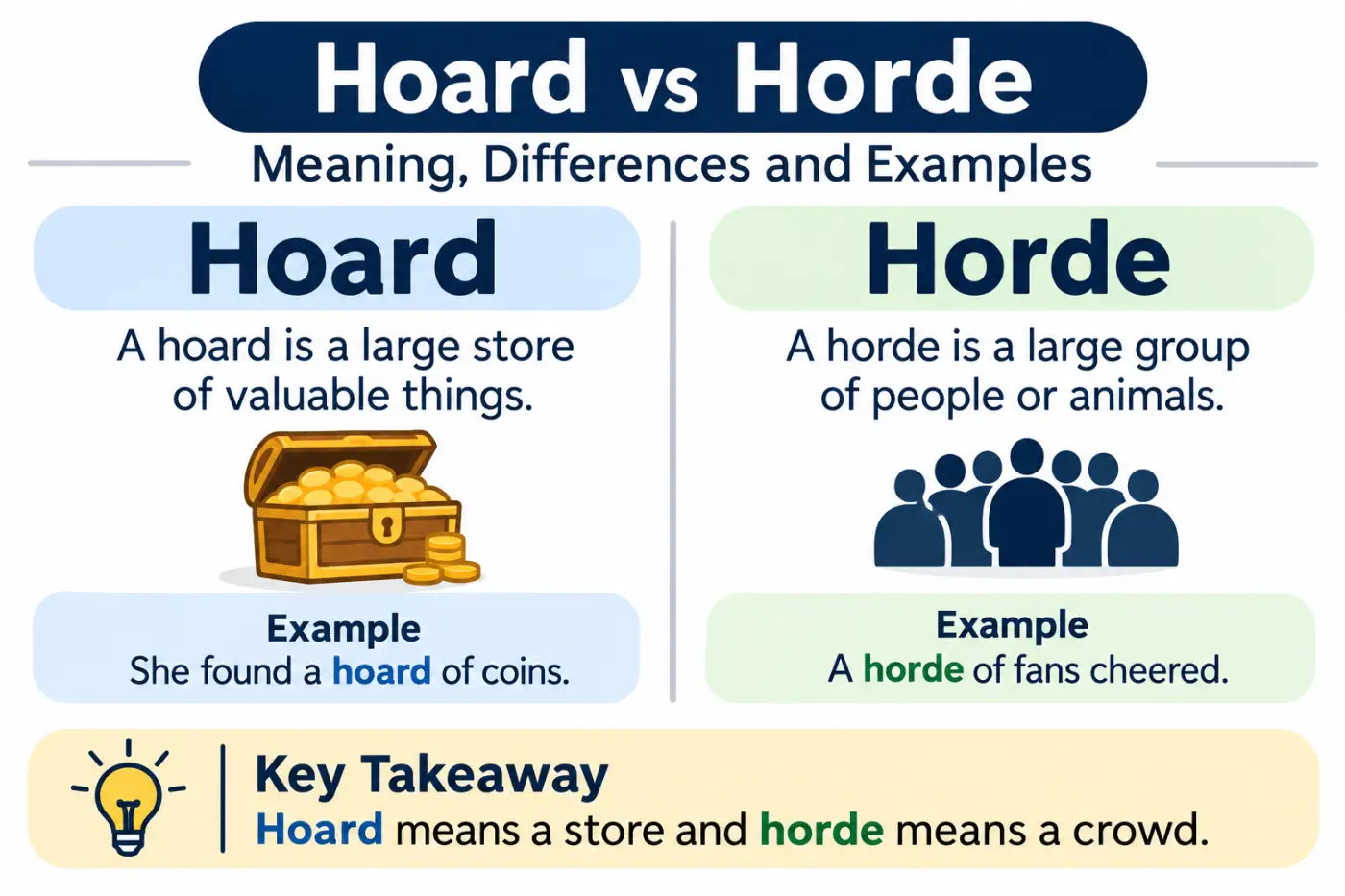
Hoard vs horde is a common spelling and vocabulary question because these two words look almost identical and sound exactly the same. However, they describe very different things. A hoard is a collection of items someone saves or stores, often in large quantities. A horde is a large crowd or group of people, animals, or other living things.
The difference becomes easier to remember when you connect each word with its meaning. Think of a hoard as a pile of stored belongings and a horde as a crowd moving together. One usually describes things collected or kept, while the other describes a large group. Both words can appear as nouns, and one also works as a verb. In this guide, you’ll learn how to spell, pronounce, and use each term correctly. You’ll also see practical examples, common mistakes, grammar rules, and memory tips to help you choose the right word in everyday conversation and formal writing.
A related grammar guide is Lended vs Lent Which Form Is Correct.
Quick Answer
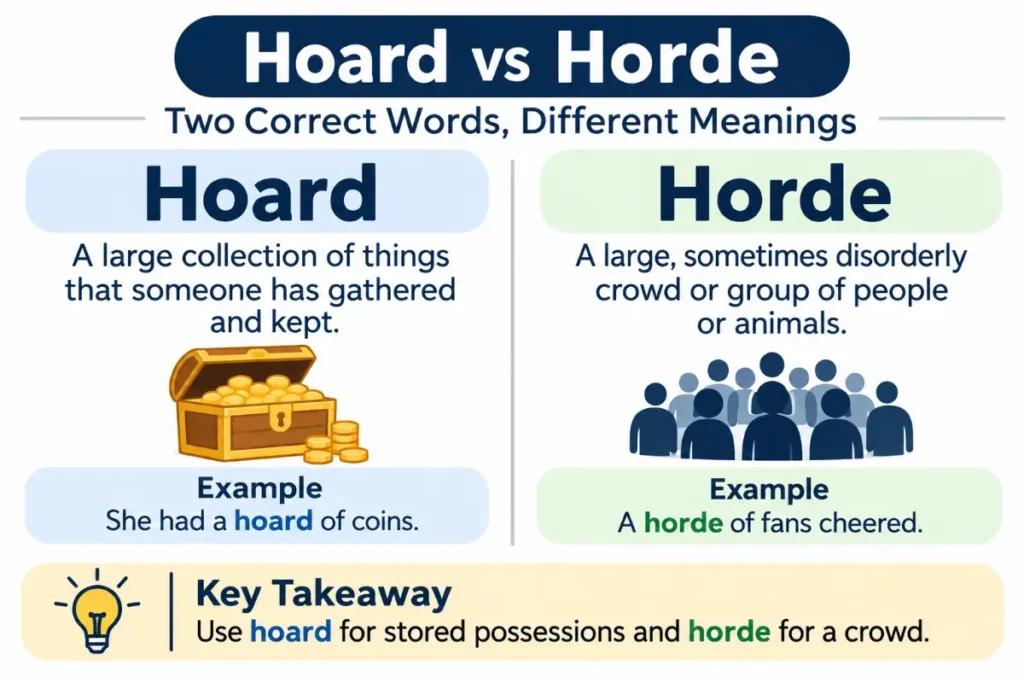
A hoard is a large collection of things that someone has gathered and kept, often secretly or for future use. A horde is a large, sometimes disorderly crowd or group of people or animals. Both words are correct, but they have different meanings. Use hoard for stored possessions and horde for a crowd.
Comparison Table
| Feature | Hoard | Horde |
|---|---|---|
| Main meaning | A stored collection of items | A large group or crowd |
| Part of speech | Noun and verb | Noun |
| Pronunciation | /hɔːrd/ | /hɔːrd/ |
| Number of syllables | One | One |
| Word origin | Old English | Turkic language roots through French |
| Common contexts | Money, food, supplies, valuables | People, animals, crowds, fictional armies |
| Formality | Standard English | Standard English |
| Example | She kept a hoard of old coins. | A horde of fans gathered outside. |
| Common association | Saving or storing | Crowding or gathering |
Meaning and Definition
Although the two terms share the same pronunciation, their meanings are not interchangeable. The easiest way to understand them is to focus on what each one describes.
What Does Hoard Mean?
A hoard is a large collection of items that someone has gathered and stored. These items may have financial value, personal importance, practical use, or no obvious value to anyone else. The word often suggests that the owner keeps the items rather than using, sharing, or getting rid of them.
As a noun, it describes the collection itself.
Examples:
- The archaeologists discovered a hoard of ancient coins.
- My grandfather kept a hoard of old photographs in his attic.
- The family found a hidden hoard of gold beneath the floorboards.
The word can also work as a verb. To hoard means to collect and keep large quantities of something, often because you fear running out or want to save it for later.
Examples:
- Some people hoard food during emergencies.
- He tends to hoard old newspapers and magazines.
- The residents began to hoard bottled water before the storm.
The verb can carry a negative meaning when someone keeps far more than they need or refuses to share useful resources. However, the meaning depends on context. Saving supplies for a difficult time does not always suggest selfish behavior.
What Does Horde Mean?
A horde is a large group or crowd of people, animals, or other living creatures. The word often suggests that the group is moving together, gathering in one place, or appearing in overwhelming numbers.
Examples:
- A horde of tourists filled the narrow street.
- A horde of wild horses crossed the open field.
- The concert attracted a horde of excited fans.
The term can sometimes suggest disorder, noise, or a lack of control. For instance, a writer might describe a large crowd leaving a stadium as a horde if the people are pushing through the exits together.
However, it does not always carry a negative meaning. In fiction, fantasy, and historical writing, it may simply describe a large army or group.
Examples:
- The village prepared for an approaching horde of invaders.
- The game features a horde of monsters attacking the castle.
Unlike its sound-alike counterpart, this word is not normally used as a verb in standard modern English.
Why the Meanings Are Different
The difference comes down to the thing being described.
A collection of objects that someone has saved is a hoard. A large gathering of living creatures is a horde. The words can appear in similar sentences, but replacing one with the other changes the meaning.
Compare these examples:
- The museum displayed a hoard of ancient weapons. This describes a stored collection.
- A horde of soldiers marched toward the city. This describes a large group of people.
The spelling changes by only one letter, but the meaning changes completely.
Key Differences Explained
Understanding the main differences will help you select the right word without stopping to think about the spelling.
1. Spelling
The first word ends with ard, while the second ends with orde.
- Hoard: H O A R D.
- Horde: H O R D E.
Both contain five letters and begin with the same three letters, which makes them easy to mix up. The final two letters provide a useful visual clue.
2. Meaning
The most important difference is what each word represents.
A hoard refers to stored items or a collection of possessions. A horde refers to a large group or crowd.
For example, a person might have a hoard of books, but a horde of readers could visit a book fair.
3. Part of Speech
The first term works as both a noun and a verb.
- Noun: The family discovered a hoard of silver.
- Verb: The family continued to hoard silver.
The second term is primarily a noun.
– Noun: A horde of visitors entered the building.
This grammatical difference matters when you build a sentence. You can say that someone hoards supplies, but you would normally say that a crowd forms a horde or that a horde gathers.
4. Pronunciation
Both words are homophones. That means they sound the same even though their spellings and meanings differ.
In most American English accents, both are pronounced like “hord.” The vowel and final consonant sounds are identical.
You cannot reliably choose the spelling by listening alone. You need to understand the sentence.
5. Formality
Both words are accepted in standard English and can appear in formal writing.
Hoard is common in discussions about personal belongings, saving supplies, money, and archaeology. Horde is common in descriptions of crowds, groups, animals, and fictional forces.
Neither word is automatically informal. The context determines its suitability.
6. Context
Use the first word when discussing things that are gathered and kept.
Use the second when discussing large groups of living creatures.
Compare:
- A hoard of emergency supplies.
- A horde of emergency workers.
The first describes stored resources. The second describes a large group of people.
7. Emotional Tone
The words also create different impressions.
Hoard can suggest secrecy, excessive saving, or reluctance to share. However, it can describe a valuable historical collection without criticism.
Horde can suggest a crowd that feels overwhelming, noisy, or difficult to control. In storytelling, it can also create a sense of danger or excitement.
Which Form Is Correct?
Both spellings are correct English words. Neither is a misspelling of the other. The right choice depends on the meaning you want to express.
Use hoard when you mean a collection of possessions or the act of collecting and storing items.
Use horde when you mean a large group of people, animals, or other living creatures.
English dictionaries recognize both forms as separate words. Their similar pronunciation does not make them interchangeable. They belong to the same group of commonly confused words as other homophones, where context helps readers understand the intended meaning.
A useful editing method is to replace the word temporarily with a simple explanation. If you mean a stored collection, choose hoard. If you mean a crowd, choose horde.
For example:
- She has a hoard of vintage toys. You could replace the word with collection.
- A horde of shoppers entered the store. You could replace the word with crowd.
If the replacement makes sense, you’ve probably chosen the correct spelling.
10 Natural Sentence Examples
Here are ten examples that show how both words work in everyday and professional English.
- Everyday conversation: My brother has a hoard of old video games that he refuses to sell.
- Home and family: We found a small hoard of family photographs while cleaning the garage.
- Text messages: I have a hoard of snacks in my desk drawer if you want something to eat.
- Workplace communication: The company discovered a hoard of unused office supplies in its storage room.
- School writing: The researchers studied a hoard of bronze objects found near the ancient settlement.
- Formal writing: The report explains how the organization stored its emergency supplies instead of allowing individuals to hoard them.
- Social situations: A horde of excited children gathered around the performer after the show.
- Online communication: A horde of viewers joined the livestream within the first few minutes.
- News style: A horde of shoppers filled the shopping center during the holiday sale.
- Storytelling: As the sun disappeared, a horde of creatures emerged from the forest.
Notice how the context makes the meaning clear. Stored objects take the first spelling, while crowds and groups take the second.
Common Mistakes and Spelling Confusion
People often mix up these words because they share the same pronunciation and differ by only one letter. Here are five mistakes to watch for.
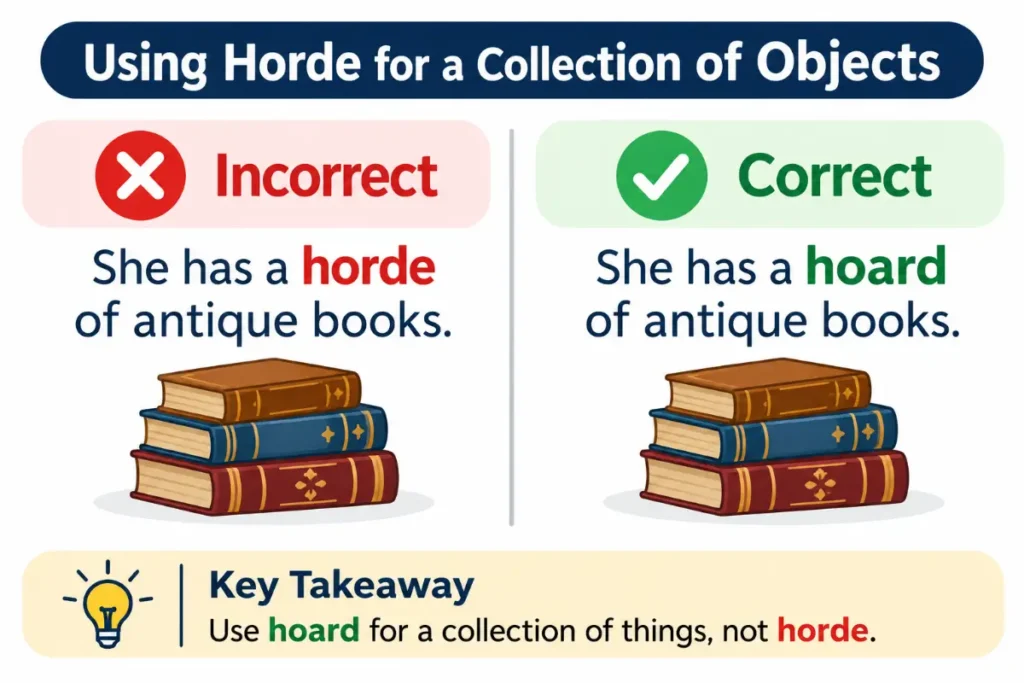
1. Using Horde for a Collection of Objects
Incorrect: She has a horde of antique books.
Correct: She has a hoard of antique books.
The sentence describes a collection of possessions, not a crowd. The first spelling is the correct choice.
2. Using Hoard for a Crowd
Incorrect: A hoard of tourists gathered outside the museum.
Correct: A horde of tourists gathered outside the museum.
Tourists are people forming a large group. The second spelling communicates that meaning.
3. Treating Both Words as Interchangeable
Incorrect: The company discovered a horde of stored supplies.
Correct: The company discovered a hoard of stored supplies.
The words may sound identical, but their meanings are not the same. A stored collection requires the first form.
4. Forgetting the Verb Form
Incorrect: He hordes food in the basement.
Correct: He hoards food in the basement.
The verb comes from hoard. Adding an s for the third person singular gives hoards, not hordes.
This is a particularly easy mistake because the incorrect form is also a real English word.
5. Choosing the Spelling by Sound Alone
Incorrect: I heard a large group outside, so I wrote that there was a hoard of people.
Correct: I heard a large group outside, so I wrote that there was a horde of people.
Pronunciation cannot tell you which spelling to use because both words sound alike. Focus on the meaning instead.
Learn the difference in Moral vs Morale Meaning and Usage Explained.
Pronunciation Guide
Both words have the same pronunciation in standard American English.
| Feature | Hoard | Horde |
|---|---|---|
| IPA | /hɔːrd/ | /hɔːrd/ |
| Syllables | One | One |
| Easy guide | HORD | HORD |
| Stress | Entire word | Entire word |
| Sound type | Homophone | Homophone |
How to Say Them
Start with the breathy h sound, as in house. Follow it with the vowel sound in words such as more in many American accents. Finish with the r and d sounds.
Both are one syllable, so there is no separate stress pattern to learn.
Common Pronunciation Mistakes
- Adding an extra syllable. Neither word needs an additional vowel sound at the end.
- Pronouncing the final e in horde. The final e is silent.
- Trying to distinguish the words through speech alone. Their pronunciation is the same, so meaning provides the clue.
Regional accents can change the exact vowel quality, but they do not create a meaningful pronunciation distinction between these two spellings.
Etymology and Word Origin
The words have different historical roots, which helps explain why they developed separate meanings.
Origin of Hoard
Hoard comes from Old English hórd, which referred to a treasure, valuable store, or hidden collection. The word has Germanic roots and is related to similar forms in other Germanic languages.
Its original sense involved keeping valuable objects together, often in a safe or hidden place. That meaning developed into the modern noun used for a collection of stored items.
The verb developed from the same word. It describes the act of gathering and keeping possessions or supplies.
Today, the term can refer to anything from a collection of old coins to large amounts of food stored for future use.
Origin of Horde
Horde entered English through French and is associated with Turkic language roots. It became known in European languages through historical descriptions of large groups, particularly nomadic communities and military forces.
Over time, its meaning broadened. Modern English uses it for large groups of people, animals, and fictional creatures.
The word often appears in historical accounts, fantasy stories, games, and descriptions of crowded public events.
Why Their Origins Matter
The two terms did not develop as spelling variations of one original English word. They have separate histories and meanings. Their similar modern pronunciation is largely a coincidence, which is why remembering their meanings is more useful than trying to connect their origins.
Regional Usage
There is no major spelling difference between American, British, Australian, and Canadian English for these terms. Both forms are recognized across these varieties.
American English
In the United States, both words are standard.
Hoard commonly appears in discussions about saving food, collecting valuables, personal possessions, and historical discoveries. Horde is used for crowds, large groups, and fictional armies.
Examples:
- The family kept a hoard of antique furniture.
- A horde of fans waited outside the arena.
British English
British English uses the same spellings and basic meanings.
The words appear in newspapers, books, academic writing, and everyday conversation. The difference is semantic rather than regional.
Australian English
Australian English also follows the same distinction. A collection of saved objects is a hoard, while a large crowd is a horde.
There is no special Australian spelling rule that changes either form.
Canadian English
Canadian English uses both words in the same way as American and British English. The choice depends on the meaning of the sentence, not the writer’s location.
Grammar Rules and Part of Speech
Understanding how each word functions in a sentence makes the distinction even clearer.
Hoard as a Noun
As a noun, it refers to a collection of stored items.
Common patterns include:
- A hoard of something.
- A hidden hoard.
- An ancient hoard.
- A valuable hoard.
- Someone’s personal hoard.
Examples:
- A hoard of silver was found underground.
- The collector displayed his hoard of rare stamps.
The noun can be singular or plural.
- Singular: The hoard was discovered in a cave.
- Plural: Several hoards were found near the old settlement.
Hoard as a Verb
The verb describes gathering and keeping things, usually in large quantities.
Its common forms are:
| Verb Form | Example |
|---|---|
| Base form | hoard |
| Third person singular | hoards |
| Past tense | hoarded |
| Present participle | hoarding |
| Past participle | hoarded |
Examples:
- Some families hoard canned food before severe storms.
- He hoarded old magazines for years.
- They are hoarding supplies in the storage room.
The verb often takes a direct object. In other words, you can hoard something.
Horde as a Noun
This word functions primarily as a countable noun. It refers to a large group.
Common patterns include:
- A horde of people.
- A horde of animals.
- A horde of fans.
- A horde of invaders.
- Several hordes.
Examples:
- A horde of visitors entered the exhibition.
- The villagers watched a horde of wild dogs approach.
The word can be singular or plural.
- Singular: A horde approached the village.
- Plural: Several hordes appeared in the distance.
Subject Verb Agreement
Both nouns follow ordinary subject verb agreement rules.
When the subject is singular, use a singular verb.
- A horde of visitors is waiting outside.
- The hoard of coins was placed in a secure case.
When the subject is plural, use a plural verb.
- The hordes of visitors are waiting outside.
- The hoards of coins were displayed in the museum.
Remember that the main noun determines the verb form. In the phrase a horde of visitors, horde is the subject, so the verb is singular.
Articles and Modifiers
Both words can take articles and descriptive words.
Examples:
- A hidden hoard of jewelry.
- The ancient hoard was carefully examined.
- A massive horde of people.
- The approaching horde frightened the villagers.
The article and adjective do not change the basic distinction.
Punctuation and Formal Writing
Neither word requires special punctuation. Use ordinary sentence punctuation based on the sentence structure.
Both are appropriate in professional and academic writing when their meanings fit. In formal work, however, consider the tone of the surrounding sentence. Horde can sound dramatic or negative, so crowd or group may be a better choice when you want a neutral description.
Real Life Usage Examples
The following situations show how these words appear in different types of communication.
Daily Conversation
In everyday speech, the words often describe things people own or crowds they encounter.
- My aunt has a hoard of old kitchen tools in her garage.
- A horde of children ran toward the ice cream truck.
The first sentence describes stored belongings. The second describes a group of children.
Email and Workplace Communication
In a professional setting, the first word can describe stored resources, while the second can describe a large gathering.
- We found a hoard of unused paper and office supplies in the storage area.
- A horde of customers arrived shortly after the store opened.
For a neutral business report, you could replace horde with a large group of customers if the dramatic tone is not suitable.
Academic Writing
Academic writing may use the first term in archaeology, history, and studies of human behavior. The second can appear in historical or social descriptions.
- The research team examined a hoard of bronze objects recovered from the excavation site.
- The historian described the movement of a horde of warriors across the region.
In academic work, make sure the wording reflects the evidence. A collection of objects and a group of people are different subjects.
News and Journalism
News reports may use both terms, depending on the story.
- Archaeologists uncovered a hoard of coins during construction work.
- A horde of spectators gathered near the stadium before the final match.
Journalists should consider tone carefully. Horde can make a crowd sound threatening or uncontrolled. A neutral term may be more appropriate for straightforward reporting.
Literature and Storytelling
Writers often use these terms to create clear images.
- The old king guarded a secret hoard of jewels beneath his castle.
- A horde of warriors emerged from the mist and surrounded the fortress.
The first creates an image of hidden treasure. The second creates an image of a large approaching force.
Related and Confused Terms
Several English words are connected to the meanings of these terms. Some are synonyms, while others describe related ideas.
1. Collection
A collection is a group of items gathered because they share a purpose, category, or personal value.
Unlike a hoard, a collection does not necessarily suggest excessive storage or secrecy.
Example: She has a collection of vintage postcards.
2. Stockpile
A stockpile is a supply of goods or materials stored for future use.
It is close in meaning to hoard, but it often sounds more organized and practical.
Example: The town created a stockpile of emergency food.
3. Cache
A cache is a hidden or carefully stored supply of items.
It often refers to resources kept for later use, especially in outdoor, military, or technical settings.
Example: The hikers found a cache of supplies near the shelter.
4. Stash
A stash is a collection of things kept in a particular place, often out of sight.
It is generally more informal than hoard.
Example: He keeps a stash of snacks in his office drawer.
5. Crowd
A crowd is a large gathering of people in one place.
It is a useful neutral alternative to horde when you do not want to suggest disorder or danger.
Example: A crowd gathered outside the theater.
6. Mob
A mob is a large group of people, often acting in an angry, disorderly, or aggressive way.
It has a stronger negative meaning than crowd.
Example: A mob gathered outside the government building.
7. Swarm
A swarm usually describes a large moving group of insects, such as bees or locusts. It can also describe people moving together in large numbers.
Example: A swarm of bees settled in the garden.
8. Horde
This term itself is useful when describing a large group, particularly one that appears overwhelming or moves together.
Example: A horde of fans rushed toward the stage.
The best alternative depends on the image you want to create. Collection and stockpile work for stored objects. Crowd, mob, and swarm describe different kinds of groups.
Expert Editor Insight
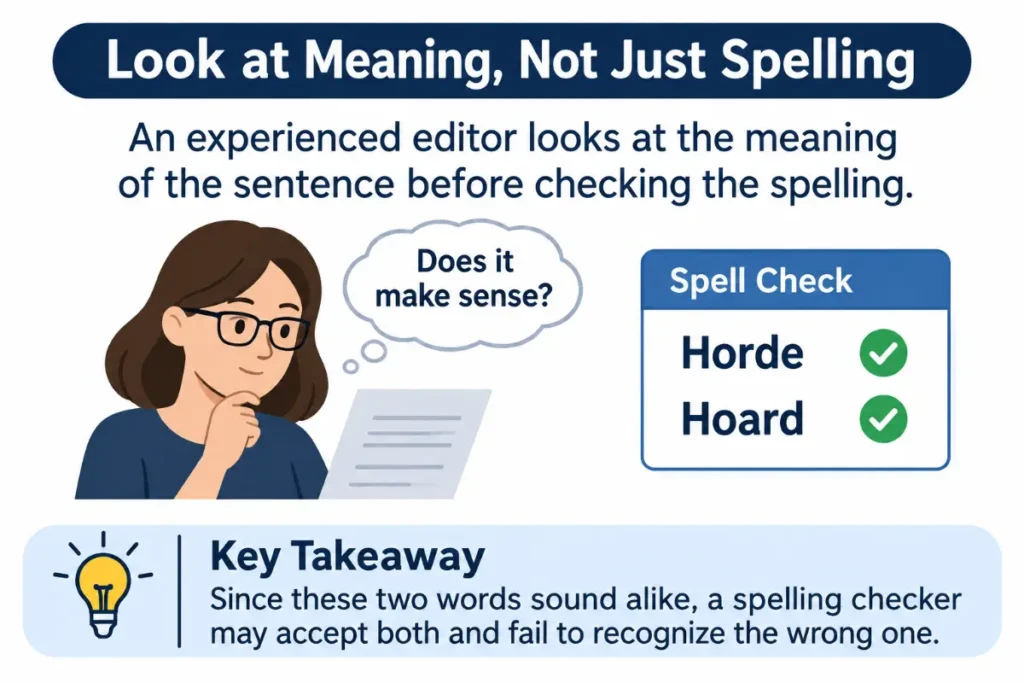
An experienced editor looks at the meaning of the sentence before checking the spelling. Since these two words sound alike, a spelling checker may accept both and fail to recognize that the wrong one has been used. A useful editing trick is to replace the word with collection or crowd. If collection fits, use hoard. If crowd fits, use horde. Also check the verb form: hoard becomes hoards, hoarded, and hoarding, while horde normally remains a noun.
Need another quick comparison? Read Stationary vs Stationery The Easy Way To Tell Them Apart.
Conclusion
The difference between hoard vs horde is simple once you connect each spelling with its meaning. A hoard is a collection of things that someone gathers and keeps, or the act of storing those things. A horde is a large group of people or animals. Both words are correct, and both sound the same, so context matters more than pronunciation.
Remember this practical editing tip: replace the word with collection or crowd. If collection fits, write hoard. If crowd fits, write horde. This quick check can help you avoid confusion in emails, school assignments, reports, and everyday writing.
FAQs
Are hoard and horde pronounced the same way?
Yes. Both words are pronounced /hɔːrd/ in standard American English. They have one syllable and the same vowel and consonant sounds. Because they are homophones, you cannot identify the correct spelling by hearing the word alone. You must use the meaning and context of the sentence to decide which form belongs there.
Is hoard a noun or a verb?
Hoard can be both a noun and a verb. As a noun, it means a collection of items that someone has gathered and kept. As a verb, it means to collect and store things, often in large amounts. For example, someone may have a hoard of books or hoard books for years.
Is horde a noun or a verb?
Horde is primarily a noun in standard modern English. It describes a large group of people, animals, or other living creatures. You can say a horde of visitors entered a building or a horde of wolves crossed a field. For the action of storing items, use the verb hoard instead.
Can you use hoard to describe people?
Usually, no. The word describes a collection of stored items or the act of keeping possessions. If you want to describe a large group of people, horde is the more suitable term. For a neutral tone, crowd or group may be even better, especially in professional writing or news reports.
What is a synonym for hoard?
Useful alternatives include collection, stockpile, cache, and stash. The best choice depends on the context. Collection is a broad, neutral term, while stockpile suggests supplies kept for future use. Cache often refers to something stored or hidden, and stash is usually informal. None of these words fits every use of hoard.
What is a synonym for horde?
Crowd, mass, throng, and mob can describe large groups of people, but their meanings are slightly different. Crowd is usually neutral, throng suggests a dense gathering, and mob often suggests disorder or anger. Horde can sound dramatic or overwhelming, especially in storytelling and descriptions of large moving groups.
Why do people confuse these two words?
People confuse them because they have the same pronunciation, similar spelling, and nearly identical letter patterns. They are also both used to describe large quantities in some contexts. The key difference is the type of thing being described. One refers to stored possessions, while the other refers to a large group of living creatures.
Is it appropriate to use these words in formal writing?
Yes. Both are standard English words and can appear in formal writing. Hoard is suitable for discussions about stored resources, collections, and archaeological discoveries. Horde can describe large groups in historical or descriptive writing. If you want a neutral description of people, crowd or group may be a better choice.