
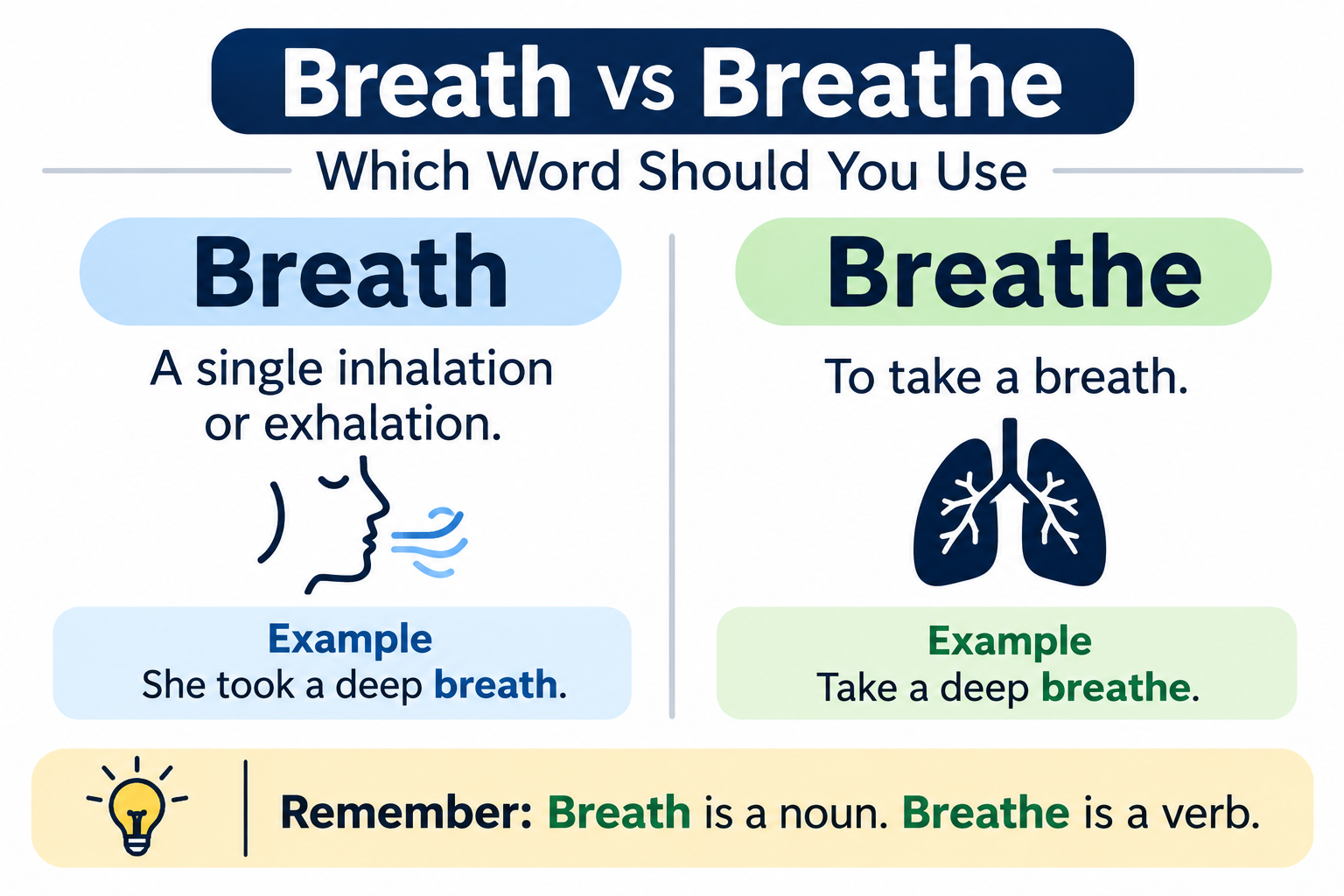
Have you ever paused while writing because you weren’t sure which word to use in breath vs breathe? These two words look almost identical, sound similar, and relate to the same action. However, they have different meanings and grammatical roles. The simple rule is that breath is a noun, while breathe is a verb.
Use the noun when referring to the air you take into your lungs or a single cycle of inhaling and exhaling. Use the verb when describing the action of taking air in and releasing it. That small difference in spelling changes how each word works in a sentence.
This distinction matters in everyday conversations, school assignments, emails, professional documents, and creative writing. A spelling mistake can make an otherwise clear sentence grammatically incorrect. Once you understand how each word functions, choosing the right one becomes much easier.
Still confused? Compare My vs Mine Which One Is Correct?.
Quick Answer
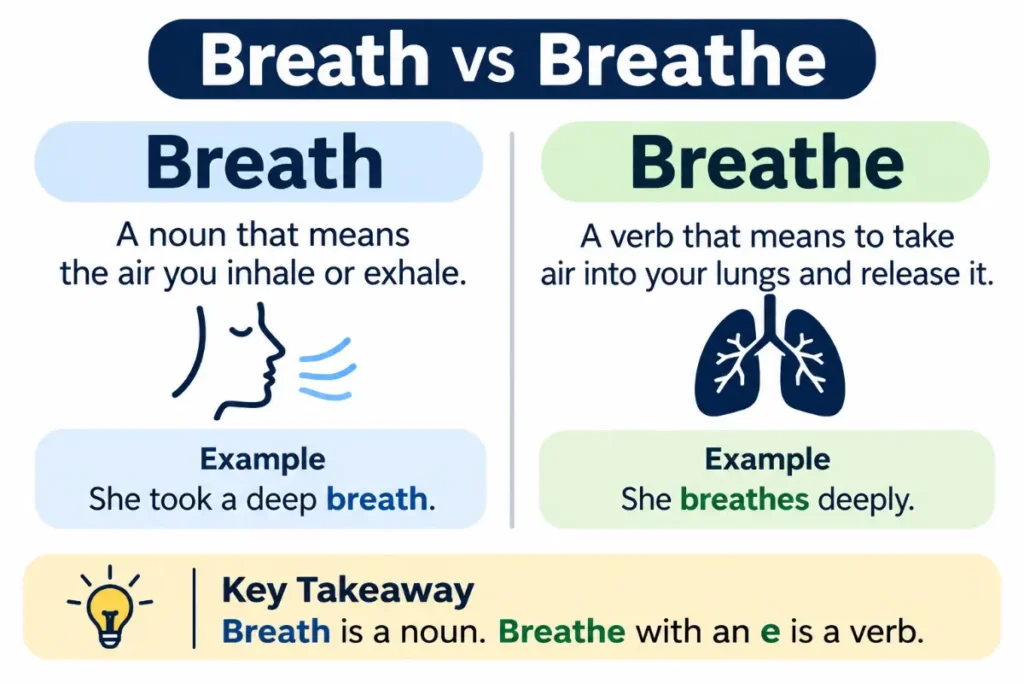
Breath is a noun that means the air you inhale or exhale. Breathe is a verb that means to take air into your lungs and release it. For example, you take a deep breath, but you breathe deeply. The spelling with the final e describes the action.
Comparison Table
| Feature | Breath | Breathe |
|---|---|---|
| Part of speech | Noun | Verb |
| Meaning | Air taken into or released from the lungs | To take air in and release it |
| Pronunciation | /brɛθ/ | /briːð/ |
| Syllables | One | One |
| Final sound | Unvoiced th | Voiced th |
| Formality | Standard English | Standard English |
| Common contexts | Breathing, health, emotions, speech | Physical actions, instructions, descriptions |
| Example | Take a deep breath. | Remember to breathe slowly. |
Both spellings are correct English words. The choice depends on the meaning and grammatical role you need in your sentence.
Meaning and Definition
The easiest way to understand these words is to look at what each one does in a sentence. One names something, while the other describes an action.
What Does Breath Mean?
Breath is a noun. It refers to the air that enters and leaves your lungs when you breathe. It can describe one complete cycle of inhaling and exhaling, the air itself, or a short pause taken to recover.
Here are some common meanings:
- Air from the lungs: The air you release when you exhale.
- A single breathing cycle: One act of taking air in and letting it out.
- A short pause: A brief moment of rest or relief.
- A sign of life: Breathing as evidence that someone is alive.
- A smell or scent: The air coming from someone’s mouth.
The word also appears in figurative expressions. For example, a person might say that a new idea gave them a breath of fresh air. This does not mean the idea provided actual oxygen. It means the idea felt new, refreshing, or different.
Another common expression is to hold your breath. It can describe stopping your breathing for a short time, but it can also mean waiting anxiously for something to happen.
Example: She took a slow breath before answering the difficult question.
In this sentence, the word names a single breathing action. It does not describe the action itself.
What Does Breathe Mean?
Breathe is a verb. It describes the physical action of drawing air into your lungs and releasing it. It can also describe how someone or something lives, functions, or operates.
Common meanings include:
- To inhale and exhale: The natural process of moving air in and out of the lungs.
- To recover or relax: To pause and regain calm after stress or effort.
- To stay alive: To remain alive through the ability to take in air.
- To allow air to pass through: To describe materials that let air move through them.
- To show or express something: A figurative use that describes a quality or feeling.
The verb can appear in several forms, including breathes, breathed, and breathing. Each form still describes an action.
Example: Try to breathe slowly when you feel nervous.
Here, the word tells someone what action to perform. It works as the main verb in the sentence.
Why the Final E Matters
The final e changes the pronunciation as well as the grammatical role. The noun ends with an unvoiced th sound, like the sound at the end of the word bath. The verb ends with a voiced th sound, like the sound in the word this.
The difference is small, but it helps distinguish the two words when spoken. In writing, the final e is the clearest spelling clue.
Key Differences Explained
These words share a common meaning, but they are not interchangeable. Understanding their differences will help you avoid errors in both casual and formal writing.
1. Difference in Spelling
The noun has six letters and ends in th. The verb has seven letters and ends in the silent letter e.
- Breath: B R E A T H.
- Breathe: B R E A T H E.
The extra letter does not create a separate sound by itself. Instead, it is part of the established spelling of the verb and helps signal its different pronunciation.
2. Difference in Meaning
The noun refers to air or a breathing cycle. The verb describes the action of moving air in and out of the lungs.
Compare these sentences:
- He took a deep breath.
- He began to breathe deeply.
The first sentence names something he took. The second describes what he did.
3. Difference in Grammar
A noun can act as a subject or object. A verb expresses an action or state and can form the main part of a predicate.
For example:
- Her breath smelled like peppermint.
- She breathes through her nose.
In the first sentence, the noun is the subject. In the second, the verb describes the subject’s action.
4. Difference in Pronunciation
The words differ in their vowel and final consonant sounds.
- Breath sounds like breth, rhyming with death.
- Breathe sounds like breeth, rhyming with seethe.
The final consonant is also different. The noun uses an unvoiced sound, while the verb uses a voiced sound.
5. Difference in Sentence Structure
The noun often follows an article or adjective.
Examples include:
- A deep breath.
- One breath.
- A quiet breath.
The verb usually follows a subject or a helping verb.
Examples include:
- I breathe.
- She can breathe.
- They were breathing.
Recognizing these patterns makes it easier to identify the right form.
6. Difference in Context
The noun appears in expressions about air, rest, smell, and emotional reactions. The verb appears in instructions, descriptions of physical actions, and statements about how something functions.
For instance, a doctor may ask a patient to take a deep breath. A fitness instructor may tell someone to breathe steadily during exercise.
7. Difference in Formality
Neither form is more formal than the other. Both are standard English words used in professional, academic, and casual writing.
The important point is grammatical accuracy. Using the noun in place of the verb creates an error, even in an informal text message.
8. Difference in Regional Usage
American, British, Australian, and Canadian English use the same spelling distinction. There is no standard regional variation that makes one form a substitute for the other.
Some accents may pronounce the words slightly differently, but the grammatical rule remains the same.
Which Form Is Correct?
Both words are correct. The right choice depends on the sentence.
Use the noun when you mean air, a breathing cycle, or a short pause. Use the verb when you mean the action of inhaling and exhaling.
Consider these examples:
- Correct: I need to catch my breath.
- Incorrect: I need to catch my breathe.
- Correct: Please breathe slowly.
- Incorrect: Please breath slowly.
The reason is grammatical, not a matter of personal preference. A verb is needed after the phrase to breathe, while the object of catch is a noun.
Established English dictionaries recognize both spellings as separate entries with different grammatical functions. The distinction is part of standard English, not a regional preference or informal writing rule.
10 Natural Sentence Examples
The following examples show how both forms work in everyday and professional situations.
1. Everyday conversation: I had to stop and catch my breath after running up the stairs.
2. Text message: Take a deep breath and relax before your presentation.
3. Workplace communication: Please breathe calmly and take a moment before responding to the client.
4. School writing: The human body needs oxygen, and breathing helps deliver it to the cells.
5. Academic writing: The study examined how changes in breathing patterns affect physical performance.
6. Formal writing: The patient reported shortness of breath after climbing several flights of stairs.
7. Social situations: I could hardly breathe because everyone was laughing so hard.
8. Online communication: Just breathe. You have plenty of time to finish the assignment.
9. Creative writing: She held her breath as the door slowly opened.
10. News style: Emergency workers instructed residents to breathe through clean cloths while leaving the area.
Notice how the noun appears after words such as a, my, and her. The verb appears after subjects, modal verbs, and instructions.
Common Mistakes and Misspellings
Many people confuse these spellings because they look similar and share the same basic meaning. The following errors are easy to avoid once you recognize the grammatical pattern.
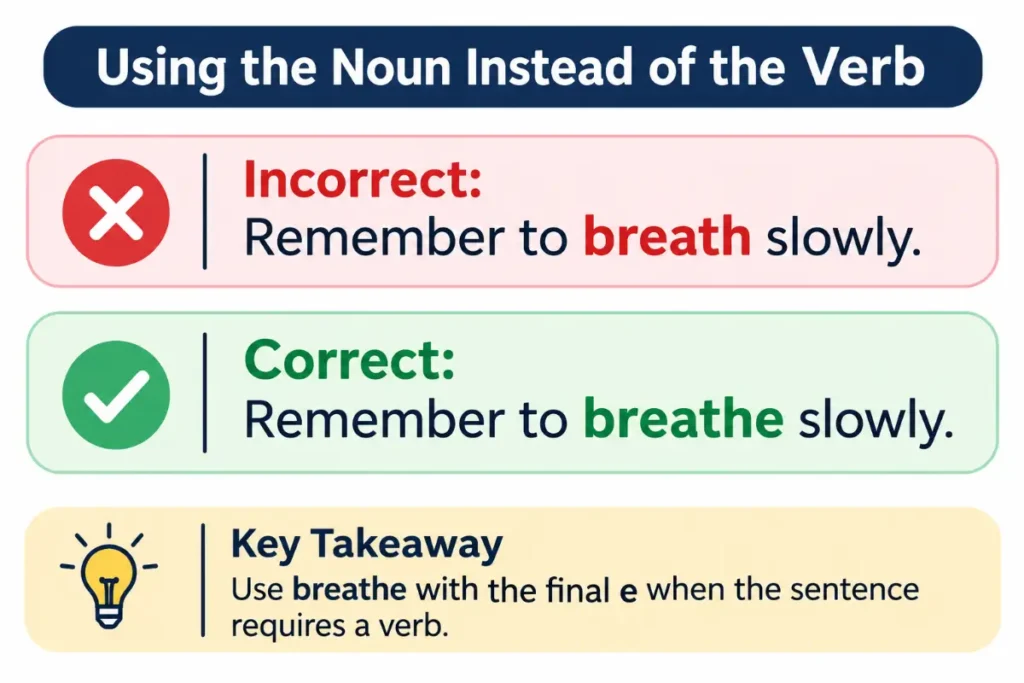
1. Using the Noun Instead of the Verb
Incorrect: Remember to breath slowly.
Correct: Remember to breathe slowly.
The phrase remember to requires a verb when it introduces an action. The sentence tells someone what to do, so the final e is necessary.
2. Using the Verb Instead of the Noun
Incorrect: Take a deep breathe.
Correct: Take a deep breath.
The word after a deep needs to be a noun. The sentence refers to one breathing cycle, not the action itself.
3. Writing Catch Your Breathe
Incorrect: I need to catch my breathe.
Correct: I need to catch my breath.
The phrase catch your breath is an established expression. It means to pause and recover after physical effort, excitement, or stress.
4. Writing Hard to Breath
Incorrect: It was hard to breath after the race.
Correct: It was hard to breathe after the race.
The phrase hard to introduces an action in this sentence. The verb form is required.
5. Confusing the Related Verb Forms
Incorrect: She breathes heavily yesterday.
Correct: She breathed heavily yesterday.
The problem here is tense rather than the basic noun and verb distinction. Breathes is the present tense form used with he, she, or it. Breathed is the past tense form.
Pronunciation Guide
Although the two words look almost identical, they do not sound exactly the same.
| Word | IPA | Simple Sound | Final Sound |
|---|---|---|---|
| Breath | /brɛθ/ | Breth | Unvoiced th |
| Breathe | /briːð/ | Breeth | Voiced th |
How to Pronounce the Noun
The noun is pronounced /brɛθ/. It has one syllable and rhymes with words such as death, left, and mesh only approximately, depending on the final consonant.
To say it:
- Start with the br sound.
- Use the short e sound heard in bed.
- Finish with an unvoiced th sound, like the ending of bath.
How to Pronounce the Verb
The verb is pronounced /briːð/. It also has one syllable, but its vowel is longer.
To say it:
- Start with the br sound.
- Use the long ee sound heard in see.
- Finish with a voiced th sound, like the beginning of the word this.
Understanding the Two Th Sounds
English has two common th sounds.
The first is unvoiced. You make it by placing your tongue lightly between your teeth and pushing air out without vibrating your vocal cords.
The second is voiced. You use a similar tongue position, but your vocal cords vibrate. You can test the difference by touching your throat while saying both words and You should feel more vibration during the final sound of the verb.
Common Pronunciation Mistakes
Some speakers use the same vowel sound for both words. Others pronounce the final consonant incorrectly. These differences may occur because of regional accents or language backgrounds.
The best approach is to practice the words in short phrases:
- Take a breath.
- Breathe deeply.
- Hold your breath.
- Remember to breathe.
Practicing them together helps you connect the sound with the meaning.
A related grammar guide is former vs latter Explained With Clear Examples.
Etymology and Word Origin
Both words come from the same historical root. Their connection explains why their meanings are so closely related.
The noun developed from Old English brǣth, which referred to breath, odor, or vapor. The verb developed from Old English brēathian, meaning to breathe or exhale.
These forms belong to the same family of Germanic words. Over time, English spelling and pronunciation changed, creating the modern distinction between the noun and the verb.
The final e in the modern verb is part of its established spelling. It is not an optional decoration, and removing it changes the word into the noun.
The shared history also explains why the two words appear in many related expressions. Both connect to the basic human process of moving air in and out of the lungs.
Regional Usage
The grammatical distinction remains consistent across major varieties of English. There is no accepted regional spelling rule that allows writers to use the two forms interchangeably.
American English
In the United States, both spellings are standard. Writers use the noun for the air or a breathing cycle and the verb for the action.
Examples:
- Take a breath before you answer.
- Breathe through your nose.
American pronunciation typically follows the distinction between the short vowel and unvoiced ending in the noun and the longer vowel and voiced ending in the verb.
British English
British English follows the same spelling and grammar rules. Both words appear in everyday speech, books, newspapers, and formal writing.
Some British accents may use different vowel qualities or sound patterns, but the words still have separate meanings and grammatical roles.
Australian English
Australian English also uses both forms according to standard English grammar. The distinction does not change in school writing, workplace communication, or everyday conversation.
Pronunciation can vary across Australian accents, but the noun and verb remain separate words.
Canadian English
Canadian English follows the same convention. Writers use the noun for a breathing cycle and the verb for the action.
In all four varieties, the safest rule is simple: check the grammatical role of the word rather than relying on regional pronunciation.
Grammar Rules and Part of Speech
Understanding how each word fits into a sentence is the most reliable way to choose the correct spelling. The noun names something, while the verb expresses an action.
Breath as a Noun
A noun can act as a subject, direct object, or object of a preposition.
As a subject:
Her breath smelled of fresh mint.
The noun is the subject of the sentence. It tells us what smelled of mint.
As a direct object:
He took a deep breath.
The noun receives the action of the verb took.
After a preposition:
She spoke in one breath.
The noun follows the preposition in.
Is Breath Countable or Uncountable?
The noun can be countable or uncountable depending on its meaning.
When it refers to a single inhalation or exhalation, it is countable.
Examples:
- Take three deep breaths.
- He held his breath for a few seconds.
When it refers to air or breathing in a general sense, it can be uncountable.
Examples:
- The cold air formed a visible cloud of breath.
- The room smelled of stale breath.
The context tells you how the noun functions.
Breathe as a Verb
The verb describes the action of taking air in and releasing it. It can be used in different sentence structures.
Simple present:
I breathe slowly when I feel anxious.
Third person singular:
She breathes deeply during meditation.
Past tense:
He breathed a sigh of relief.
Present participle:
They were breathing heavily after the workout.
Infinitive:
It is difficult to breathe in a room filled with smoke.
Common Verb Forms
The main forms of this verb are:
| Form | Example |
|---|---|
| Base form | Breathe |
| Third person singular | Breathes |
| Past tense | Breathed |
| Past participle | Breathed |
| Present participle | Breathing |
Notice that breathes and breathed contain the extra e from the base form. The spelling remains consistent as the verb changes form.
Common Grammar Patterns
The verb often appears in these patterns:
- Breathe + adverb: Breathe slowly or breathe deeply.
- Breathe + preposition: Breathe through your nose.
- Can or should + breathe: You should breathe calmly.
- To + breathe: She tried to breathe normally.
- Breathe in or out: Breathe in slowly and breathe out gently.
The noun commonly appears in these patterns:
- Take a breath: Take a breath before speaking.
- Hold your breath: He held his breath underwater.
- Catch your breath: She stopped to catch her breath.
- Out of breath: I was out of breath after running.
- A breath of fresh air: The new approach was a breath of fresh air.
These patterns provide useful clues when editing a sentence.
Real Life Usage Examples
The distinction becomes clearer when you see the words in different situations. The following examples show how people use them naturally.
Daily Conversation
In everyday speech, the noun often appears in expressions about exercise, rest, and emotions. The verb is common in instructions and descriptions of physical actions.
- I need a minute to catch my breath.
- Just breathe slowly and try not to panic.
These sentences sound natural because each word has the correct grammatical function.
Email and Workplace Communication
Workplace messages often use the words in discussions about health, stress, or instructions.
- Please take a deep breath before presenting your report.
- Remember to breathe steadily during the demonstration.
The first sentence refers to a short pause. The second gives an instruction about an action.
Academic Writing
Academic and scientific writing may discuss respiration, breathing patterns, or the effect of physical activity on the body.
- The participants were asked to record their breathing rate during exercise.
- Each breath carries air into the respiratory system.
In technical writing, the related term respiration may be more precise when discussing biological processes. However, both everyday words remain useful in clear explanations.
News and Journalism
News reports may use these words when describing emergencies, sports, health, or human experiences.
- The runner struggled to catch his breath after crossing the finish line.
- Rescue workers advised residents to breathe through clean cloths while leaving the building.
The examples show how the noun and verb fit naturally into factual reporting.
Literature and Storytelling
Writers often use these words to build tension, describe emotions, or create a sense of relief.
- She held her breath as the footsteps approached the door.
- He tried to breathe quietly while hiding behind the old wall.
The noun can suggest suspense, while the verb can describe a character’s physical reaction.
Related and Confused Terms
Several English words and expressions connect to this topic. Learning their meanings can help you choose more precise language.
1. Breathing
Breathing is the present participle and gerund form of the verb. It can describe the action itself or function as a noun in a sentence.
Example: Deep breathing can help some people relax.
2. Respiration
Respiration is a biological term for the process through which living organisms exchange gases and use oxygen in cellular processes.
It is more technical than the everyday verb. In medical and scientific writing, the exact meaning depends on the context.
3. Inhale
Inhale means to draw air into the lungs. It describes only the inward movement of air.
Example: Inhale slowly through your nose.
4. Exhale
Exhale means to release air from the lungs. It describes the outward movement.
Example: Exhale gently after holding your breath.
5. Gasp
A gasp is a sudden, quick intake of air, often caused by surprise, fear, pain, or difficulty breathing.
Example: She let out a gasp when the lights suddenly went out.
6. Sigh
A sigh is a long, audible breath that people often release when they feel tired, disappointed, relieved, or frustrated.
Example: He gave a sigh of relief after hearing the good news.
7. Pant
To pant means to breathe quickly and heavily, often after exercise or during hot weather.
Example: The dog began to pant after running across the field.
8. Choke
To choke means to have difficulty breathing because the airway is blocked or restricted. It can also describe being unable to speak clearly because of strong emotion.
Example: He began to choke on a piece of food.
These related terms describe different types of breathing actions or experiences. They are useful alternatives, but they do not always carry the same meaning.
Common Expressions and Idioms
English uses the noun in several familiar expressions. These phrases often have meanings beyond the physical act of breathing.
Take a Deep Breath
This means to inhale deeply, often to relax or prepare for something difficult.
Example: Take a deep breath before you start your speech.
Hold Your Breath
This can mean to stop breathing temporarily. It can also describe waiting anxiously for an outcome.
Example: We held our breath as the final score appeared.
Catch Your Breath
This means to recover normal breathing after exercise, excitement, or stress.
Example: Give me a moment to catch my breath.
Out of Breath
This expression describes someone who is breathing hard after physical effort.
Example: I was out of breath after climbing the hill.
A Breath of Fresh Air
This figurative expression describes something new, pleasant, or refreshing.
Example: Her honest approach was a breath of fresh air.
Breathe a Sigh of Relief
This phrase describes the act of relaxing after a stressful situation has ended.
Example: The family breathed a sigh of relief when the missing child returned safely.
Breathe Life Into Something
This means to make something more active, interesting, or successful.
Example: The new director breathed life into the old theater.
Not Have a Breath to Spare
This expression suggests having no time or energy to waste.
Example: I was so busy that I didn’t have a breath to spare.
Learning these phrases helps you understand how the words work in both literal and figurative English.
Expert Editor Insight
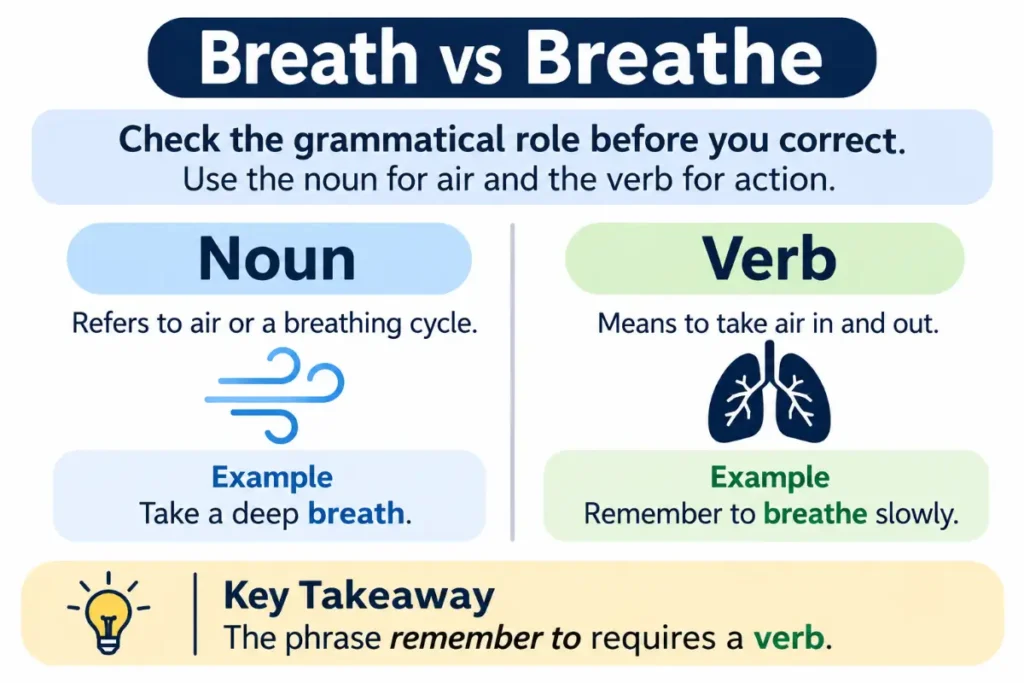
Professional editors usually check the word’s grammatical role before making a correction. If the sentence names air or a breathing cycle, the noun is appropriate. If it describes an action, the verb is needed. Spelling tools can catch many mistakes, but they may miss errors when both forms are valid words. For example, a sentence can contain a correctly spelled word in the wrong grammatical position. A useful editing habit is to read the sentence aloud and ask what the word is doing. Is it naming something, or describing an action? That quick check catches many errors.
Still confused? Compare Smoothe vs Smooth Which Spelling Is Correct.
Conclusion
The difference between breath vs breathe comes down to one simple grammar rule. The noun refers to air or a breathing cycle, while the verb describes the action of taking air in and releasing it. Both forms are correct, and neither should replace the other.
You can remember the distinction by thinking of the final e as a clue to the action word. You take a breath, but you breathe deeply. Apply this simple test whenever you write, and you’ll avoid one of the most common spelling and grammar mix-ups in English.
FAQs
Is Breath a Verb or a Noun?
Breath is a noun. It refers to the air that enters or leaves your lungs or to one cycle of inhaling and exhaling. The related verb is breathe, which describes the action. For example, you take a breath, but you breathe deeply. The grammatical role determines which spelling belongs in your sentence.
Is Breathe a Real Word?
Yes, breathe is a standard English verb. It means to draw air into your lungs and release it. It can also describe how something allows air to pass through it or how a person expresses a particular quality. The spelling includes a final e, which helps distinguish it from the related noun.
Which Is Correct: Breath or Breathe?
Both are correct, but they have different grammatical functions. Use breath when you need a noun, as in take a deep breath. Use breathe when you need a verb, as in breathe slowly. Neither word is a misspelling of the other. The correct choice depends on what your sentence means and how it is structured.
How Do You Pronounce Breath and Breathe?
The noun is pronounced /brɛθ/, with a short e sound and an unvoiced th ending. The verb is pronounced /briːð/, with a longer ee sound and a voiced th ending. Both have one syllable. Practicing phrases such as take a breath and breathe deeply can help you hear the difference.
Can You Start a Sentence With Breathe?
Yes. The verb can begin a sentence when you are giving an instruction or command. For example, Breathe slowly and relax your shoulders. This sentence uses the base form of the verb. The noun can also start a sentence, as in Breath is essential for human life, although this structure may sound more formal.
What Is a Synonym for Breath?
The best synonym depends on the meaning. Air, inhalation, and exhalation may work in specific contexts. A pause or moment can replace the word in some figurative expressions. However, these alternatives are not exact matches in every sentence. For example, a breath of fresh air has a figurative meaning that the word air alone does not fully express.
Why Do People Confuse These Two Words?
People confuse them because they share almost the same letters and refer to closely related ideas. Their pronunciation is also similar, especially for speakers who do not clearly distinguish the two th sounds. Another reason is that English spelling does not always make grammatical differences obvious. Learning the noun and verb roles is the simplest way to avoid confusion.
Is This Spelling Difference Important in Formal Writing?
Yes. Both forms are standard, and professional writing requires the correct one in each sentence. Using the noun where a verb is needed can make a sentence grammatically incorrect. The same applies in academic papers, business emails, reports, and applications. A proofreading tool can help, but checking the sentence’s meaning and structure is more reliable.