
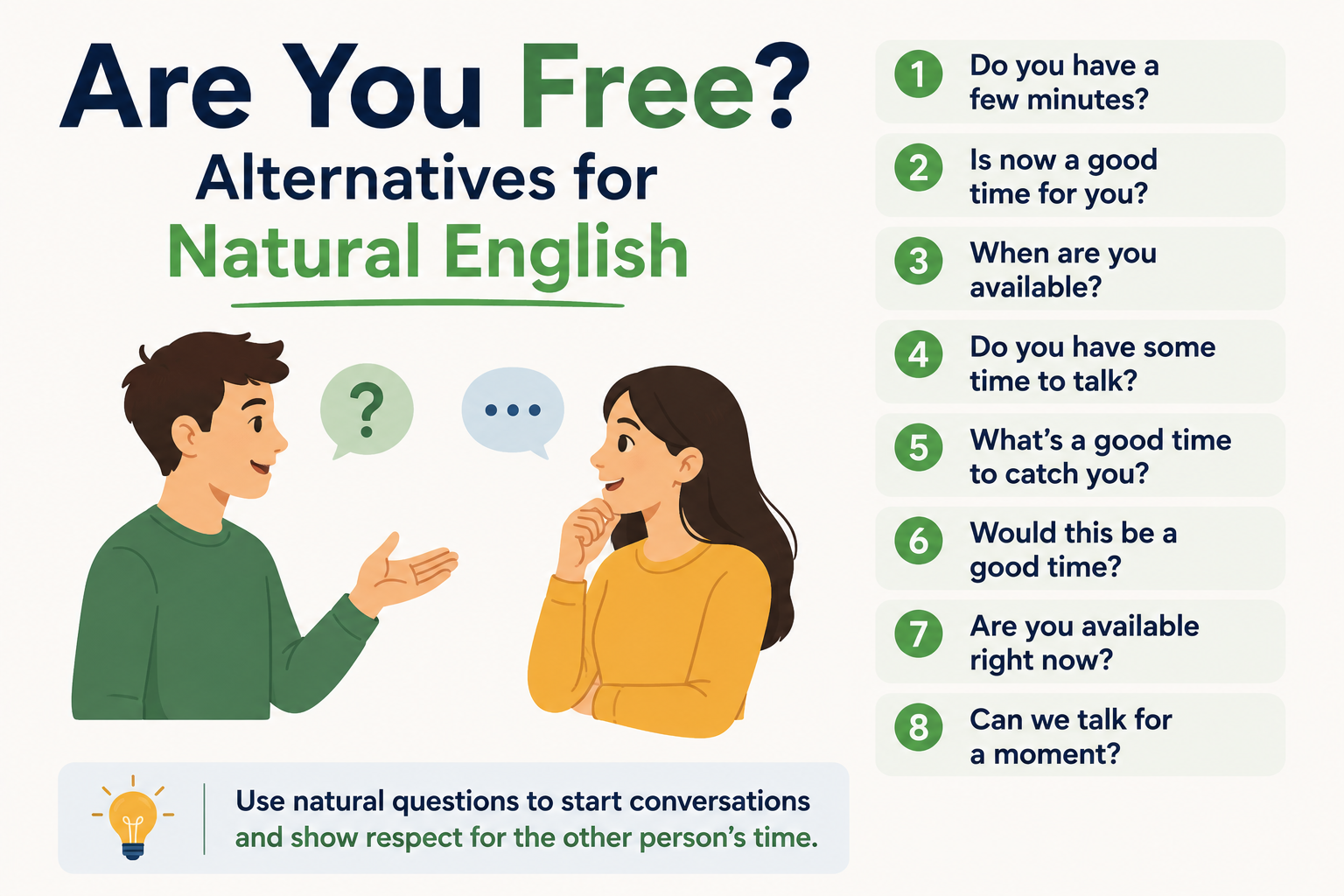
Are you free alternatives can help you sound more natural and thoughtful when asking someone about their availability. The phrase are you free is correct and very common in American English. Still you may want a different expression when you are talking to a coworker texting a friend making plans or asking someone for a quick conversation.
The best alternative depends on the situation. You might ask Do you have a minute when you need a short conversation. You could say Are you available when you want a more professional tone. With a friend you might simply ask Are you doing anything later. Each option carries a slightly different feeling even though the basic idea stays the same.
This guide explains the most useful alternatives with natural examples and simple grammar notes. You’ll learn which expressions work best in casual conversation professional settings texts emails and more formal situations. You’ll also learn how native English speakers choose between available free busy open and other related expressions.
Still confused? Compare Glad to hear that alternatives for natural English.
Quick Answer
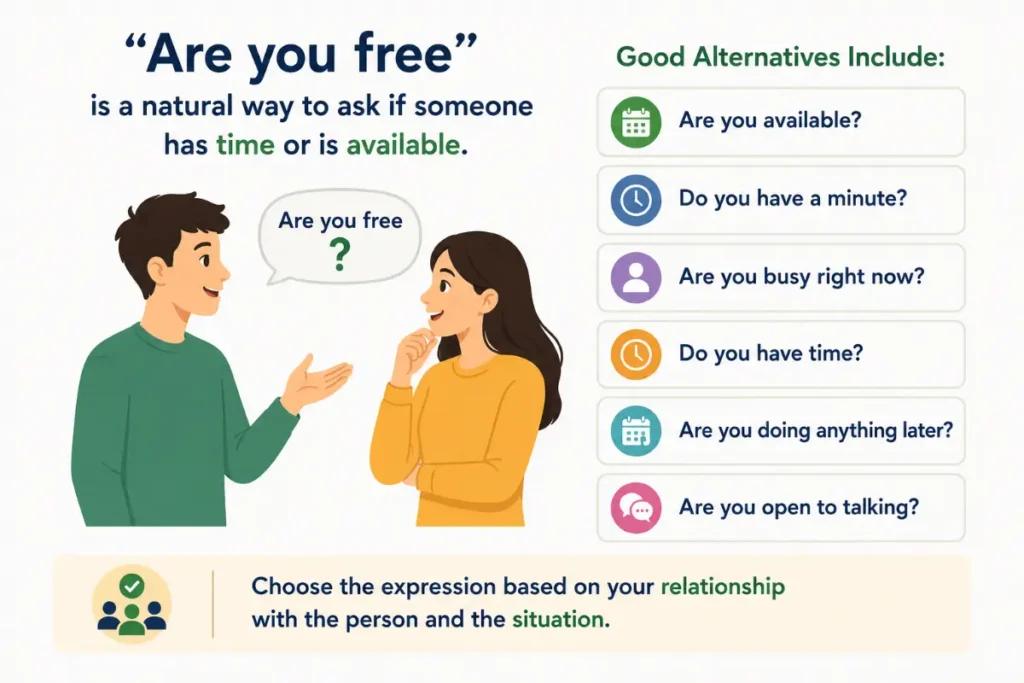
Are you free is a natural way to ask if someone has time or is available. Good alternatives include Are you available Do you have a minute Are you busy right now Do you have time Are you doing anything later and Are you open to talking. Choose the expression based on your relationship with the person and the situation.
Quick Answer For Everyday Use
The most natural replacement depends on what you actually want to ask.
If you want to know if someone has time right now say Do you have a minute.
If you want a professional expression say Are you available.
If you want to make casual plans say Are you doing anything later.
If you need to know if someone can meet say Are you available to meet.
If you want to ask about a specific time say Does 5 PM work for you.
If you want to start a conversation without sounding demanding say Do you have a moment.
The phrase are you free is not wrong. It is simply broad. A more specific question can make your meaning clearer and can also sound more polite.
Are You Free Meaning
Are you free usually means Do you have time or Are you available.
The word free has several meanings in English. It can describe something that costs nothing. It can also describe a person who has no current commitment. In the phrase are you free the second meaning applies.
For example you might ask a friend Are you free tonight. You are asking if your friend already has plans.
You might also ask a coworker Are you free for a quick call. Here you are asking if the coworker has enough time for a short conversation.
The phrase works in both casual and professional English. However the tone can change depending on the context. With a close friend it sounds relaxed. With a client or senior colleague a more specific phrase such as Are you available may sound more polished.
Best Alternatives To Are You Free
Here are the most useful alternatives and the situations where they fit best.
Are You Available
Are you available is one of the closest alternatives.
It sounds slightly more professional than are you free. You can use it at work when speaking with a customer or when making an appointment.
For example.
Are you available for a quick meeting tomorrow.
Are you available this afternoon.
Are you available to talk for a few minutes.
The phrase works well because available clearly refers to a person’s time or ability to do something.
Do You Have A Minute
Do you have a minute is ideal when you need a short conversation.
It does not always mean exactly one minute. In normal conversation it often means Do you have a little time.
For example.
Do you have a minute. I need to ask you something.
Do you have a minute to look at this report.
Do you have a minute before you leave.
This expression sounds friendly and natural. At work it is very common. It can also work with friends and family.
Do You Have A Moment
Do you have a moment is similar to Do you have a minute. The word moment can sound slightly softer and more polite. It is useful when you want to ask for someone’s attention without sounding demanding.
For example.
Do you have a moment to talk.
Do you have a moment after the meeting.
Do you have a moment to help me with this.
This expression is especially useful in professional communication.
Do You Have Time
Do you have time is direct and flexible.
You can use it when you want to know if someone has enough time for something.
For example.
Do you have time for lunch.
Do you have time to talk today.
Do you have time to review this document.
The phrase does not automatically sound formal or informal. The rest of the sentence determines the tone.
Are You Busy
Are you busy is another simple alternative.
It asks about the opposite condition. Instead of asking if someone is free you ask if they are occupied.
For example.
Are you busy right now.
Are you busy this afternoon.
Are you busy tonight.
This phrase is natural in everyday conversation. However it can sometimes sound more direct than Are you free. If you are speaking to someone at work you may want to soften it.
You could say Do you have a moment instead.
Can You Talk
Can you talk is useful when you specifically want a conversation.
For example.
Can you talk right now.
Can you talk after lunch.
Can you talk for a few minutes.
It is short and natural. In a text message it can be perfectly normal. In some situations though it can sound serious. A message such as Can you talk may make someone wonder if something is wrong.
If you want a softer version say Do you have a minute to talk.
Do You Have Plans
Do you have plans works especially well when you are asking about someone’s availability for a future activity.
For example.
Do you have plans tonight.
Do you have plans this weekend.
Do you have plans after work.
This question often invites the other person to share their schedule. It is especially common when making social plans.
Are You Doing Anything Later
Are you doing anything later is a natural casual expression.
It often suggests that you may want to invite someone somewhere.
For example.
Are you doing anything later.
Are you doing anything after work.
Are you doing anything this weekend.
The phrase sounds relaxed and friendly. It works especially well with friends family members and people you know well.
Can We Talk
Can we talk is direct and clear.
It tells the listener that you want a conversation. It does not necessarily ask if they are free in general.
For example.
Can we talk after lunch.
Can we talk for a few minutes.
Can we talk about the project tomorrow.
The phrase can sound serious if used without context. A message that only says Can we talk may make the recipient worry. Adding a little context can make it feel more relaxed.
For example.
Can we talk about the new schedule when you have a minute.
Does This Time Work For You
Does this time work for you is useful when you already have a specific time in mind.
For example.
Does 3 PM work for you.
Does tomorrow morning work for you.
Does Friday afternoon work for you.
This is often better than asking Are you free because it gives the other person a clear option.
Comparison Of Common Expressions
| Expression | Meaning | Part of Speech | Formality | Common Contexts | Example |
|---|---|---|---|---|---|
| Are you free | Asking about general availability | Question phrase | Casual to neutral | Friends work plans | Are you free tonight. |
| Are you available | Asking about availability | Question phrase | Neutral to formal | Work appointments meetings | Are you available tomorrow. |
| Do you have a minute | Asking for brief time | Question phrase | Casual to neutral | Work conversation daily talk | Do you have a minute. |
| Do you have a moment | Asking for brief attention | Question phrase | Neutral to polite | Work and personal situations | Do you have a moment to talk. |
| Do you have time | Asking if someone has enough time | Question phrase | Neutral | General use | Do you have time for lunch. |
| Are you busy | Asking if someone is occupied | Question phrase | Casual to neutral | Conversation and texts | Are you busy right now. |
| Do you have plans | Asking about future commitments | Question phrase | Casual | Social plans | Do you have plans tonight. |
| Are you doing anything later | Asking about future activities | Question phrase | Casual | Friends and family | Are you doing anything later. |
| Can you talk | Asking about ability to talk | Question phrase | Casual to neutral | Calls and messages | Can you talk for a minute. |
| Does this time work for you | Asking if a specific time is suitable | Question phrase | Neutral to formal | Meetings and appointments | Does 2 PM work for you. |
Which Alternative Sounds Most Natural
There is no single replacement that works in every situation.
The best expression depends on your goal.
If you simply want to know if someone has time use Are you free.
If you want to sound professional use Are you available.
If you need a quick conversation use Do you have a minute.
If you want to make social plans use Do you have plans or Are you doing anything later.
If you have a specific time in mind use Does this time work for you.
This small difference matters because natural English often depends on context rather than grammar alone.
Formal Alternatives For Work
Professional communication often benefits from specific language.
Are you available is usually the safest choice.
For example.
Are you available for a meeting tomorrow afternoon.
Could you let me know if you’re available at 10 AM.
Are you available to discuss the proposal.
You can also use Could we schedule a time to talk.
This expression is useful when you want to sound organized and respectful.
Another option is Do you have a few minutes.
For example.
Do you have a few minutes to discuss the report.
This sounds professional without becoming stiff.
If you are contacting someone you do not know well you can also ask When would be a convenient time to talk.
That question gives the other person control over the schedule.
Casual Alternatives For Friends
With friends you usually do not need formal language.
Are you free tonight.
Are you doing anything later.
Do you have plans this weekend.
Are you around this evening.
Want to grab dinner later.
Can you hang out tonight.
These expressions sound natural because they match the relaxed tone of everyday conversation.
Are you around is especially useful when you want to know if someone will be nearby or available.
For example.
Are you around this afternoon.
Are you around tonight.
It can mean Are you nearby or Are you available depending on context.
Alternatives For Text Messages
Text messages usually favor short expressions.
Are you free tonight.
Free later.
Are you around.
You busy.
Got a minute.
Can you talk.
Are you available later.
Do you have plans tonight.
The choice depends on your relationship with the person.
You might text a close friend Free later.
With a coworker you might write Are you available for a quick call.
The first feels casual. The second feels professional.
Polite Ways To Ask Someone For Time
Sometimes you want to ask for someone’s time without putting pressure on them.
Do you have a moment to talk.
Would you have a few minutes to discuss this.
Could I speak with you when you have a moment.
When would be a good time to talk.
Would now be a convenient time.
These expressions are useful because they recognize that the other person may already have something to do.
For professional situations this small adjustment can make your communication feel more considerate.
Alternatives For Asking About A Specific Time
A broad question can sometimes create unnecessary back and forth.
Instead of asking Are you free tomorrow you can suggest a time.
For example.
Are you available at 2 PM tomorrow.
Would 2 PM work for you.
Can we meet at 2 PM.
Would tomorrow afternoon be convenient.
Are you open to meeting at 2 PM.
These questions make scheduling easier because the other person can accept the proposed time or suggest another one.
For another common grammar confusion, see As Well As Alternatives for Clearer English.
Grammar And Sentence Structure
Are you free follows a basic English question pattern.
Are + subject + adjective.
In this sentence are is the verb. You is the subject. Free is an adjective.
The same structure appears in questions such as.
Are you ready.
Are you busy.
Are you available.
Are you tired.
Are you interested.
The adjective describes the current state of the person.
Free can describe availability.
Available has a similar function. That is why Are you available is such a close alternative.
The Difference Between Free And Available
Free and available overlap but they do not always feel identical.
Free is often more conversational.
Are you free tonight.
Available can sound more professional or specific.
Are you available for a meeting tomorrow.
There is also a subtle difference in meaning.
Free can suggest that someone has no plans or obligations.
Available can suggest that someone has the time or ability to do something.
For example.
I’m free tonight.
This sounds like I have no plans.
I’m available tonight.
This can sound more like I can make time.
Both are correct. The context determines the better choice.
Pronunciation Guide
Are you free is usually pronounced naturally as one connected phrase rather than as three separate words.
The approximate pronunciation is.
Are you free.
The main stress normally falls on free when the speaker wants to emphasize availability.
For example.
Are you FREE tonight.
In relaxed American speech are you can become very light and connected.
Available is pronounced uh VAY luh bul.
The stress falls on the second syllable.
Minute is pronounced MIN it when it means a short period of time.
Moment is pronounced MOH ment.
Do you have a minute and Do you have a moment are both easy expressions once you become familiar with their natural rhythm.
Common Mistakes
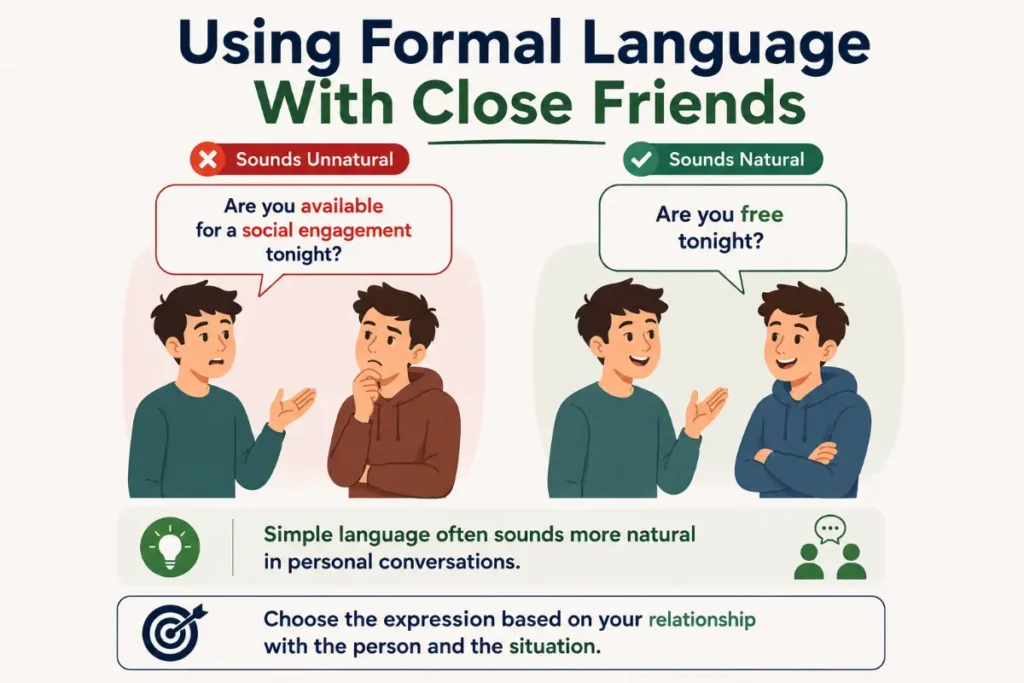
Using Formal Language With Close Friends
A sentence such as Are you available for a social engagement tonight can sound unnatural with a close friend.
Say Are you free tonight instead.
Simple language often sounds more natural in personal conversations.
Using Free When You Mean A Specific Time
Are you free tomorrow is correct but it may create a long conversation about schedules.
If you already have a time in mind say Are you free at 3 PM.
This gives the listener a clear question.
Asking Can You Talk Without Context
Can you talk is grammatically correct. Yet it can sound serious in a text message.
A friend may wonder why you need to talk.
Adding context helps.
Can you talk for a few minutes about dinner plans.
Treating Available And Free As Perfect Matches
The words overlap but their tone differs.
Available often sounds more professional.
Free often sounds more casual.
Choosing the right one helps your message fit the situation.
Saying Are You Free For A Time Period Without Meaning
Sometimes learners say Are you free for tomorrow.
That structure is not natural.
Use Are you free tomorrow.
Use Are you free on Friday.
Use Are you available for tomorrow’s meeting.
The preposition depends on the structure and meaning.
Real Life Usage Examples
Daily Conversation
Are you free tonight. I’m thinking about getting dinner.
Are you doing anything after work. We could grab coffee.
Do you have time to help me move this weekend.
Are you around this afternoon.
Do you have plans for Saturday.
These expressions sound natural because everyday English tends to be direct and relaxed.
Workplace Communication
Are you available for a quick meeting this afternoon.
Do you have a few minutes to discuss the report.
Would you have a moment to review this document.
Does 11 AM work for you.
Could we schedule a time to talk about the project.
These forms give professional communication a polite and focused tone.
Academic Writing And School
Do you have a moment to discuss the assignment.
Are you available after class.
Could we meet tomorrow to review the presentation.
Do you have time to help me understand this topic.
Would Friday afternoon work for you.
Students often use these expressions when speaking with teachers classmates or academic staff.
Social Situations
Are you doing anything tonight.
Do you have plans this weekend.
Are you free for dinner.
Are you around later.
Want to meet for coffee.
The final example is not a direct substitute for Are you free but it can perform the same conversational job. Instead of asking about availability directly it moves straight toward the plan.
Email And Professional Messages
Are you available to meet next Tuesday.
Do you have a few minutes to discuss the proposal.
Could you let me know a convenient time to talk.
Would Thursday afternoon work for you.
Please let me know when you’re available.
These expressions are clear and respectful without sounding overly formal.
Related Expressions You Should Know
Are You Around
Are you around can mean Are you nearby or Are you available.
For example.
Are you around tonight.
The exact meaning comes from the context.
Are You Open To
Are you open to is useful when you want to know if someone is willing to consider an idea or plan.
For example.
Are you open to meeting tomorrow.
This asks about willingness as well as availability.
Can You Make It
Can you make it asks if someone can attend an event or meeting.
For example.
Can you make it to dinner tonight.
It focuses on attendance rather than general free time.
Would You Be Available
Would you be available sounds polite and professional.
For example.
Would you be available for a meeting next week.
This works well in formal communication.
When Are You Available
When are you available asks the person to provide a suitable time.
For example.
When are you available for a call.
This is useful when you do not want to suggest a specific time.
When Would Be A Good Time
When would be a good time is a polite scheduling expression.
For example.
When would be a good time to call you.
It gives the other person freedom to choose.
Do You Have Any Free Time
Do you have any free time is useful when you are asking about a longer period.
For example.
Do you have any free time this week.
This can sound slightly more formal than Are you free.
Can We Find A Time
Can we find a time focuses on scheduling.
For example.
Can we find a time to discuss the project.
It works especially well when both people have busy schedules.
How Native Speakers Choose The Right Expression
Native speakers rarely choose an alternative based only on grammar.
They also consider relationship context purpose urgency and tone.
A friend might receive a message saying Are you free tonight.
A coworker might receive Are you available for a quick call.
A manager might receive Would you have a few minutes to discuss this.
A client might receive When would be a convenient time to meet.
All four questions ask about time. Their tone changes because the social setting changes.
That is one of the most useful lessons in natural English. Correct grammar is only part of effective communication. Good word choice also considers the person listening and the reason for the question.
American English Usage
In American English Are you free is very common.
People use it in conversations texts phone calls and informal messages.
Are you available is also common and tends to appear more often in professional situations.
Do you have a minute is extremely useful in everyday American speech. It can sound natural at work and at home.
There is no major spelling difference to worry about here between American and British English. The main difference comes from tone and context rather than regional grammar.
Australian Canadian and British speakers also use these expressions. You do not need a special regional version for ordinary communication.
When To Use Free And When To Use Available
Use free when you want a relaxed and conversational tone.
I’m free tonight.
Are you free after work.
Are you free this weekend.
Use available when the situation calls for a more neutral or professional tone.
Are you available tomorrow.
Are you available for a meeting.
Please let me know when you’re available.
A simple rule can help.
Free sounds personal.
Available sounds practical.
The distinction is not absolute. Both words can appear in many situations. Still this guideline works well for most everyday communication.
Expert Editor Insight
An experienced editor would usually choose the shortest natural expression that matches the relationship and purpose. If you are texting a friend there is little reason to replace Are you free with a formal phrase. If you are writing to a client Are you available may be a better fit. Editors also look at what the question actually needs. If you already know the desired time then asking Does 3 PM work for you is clearer than asking a broad question about availability.
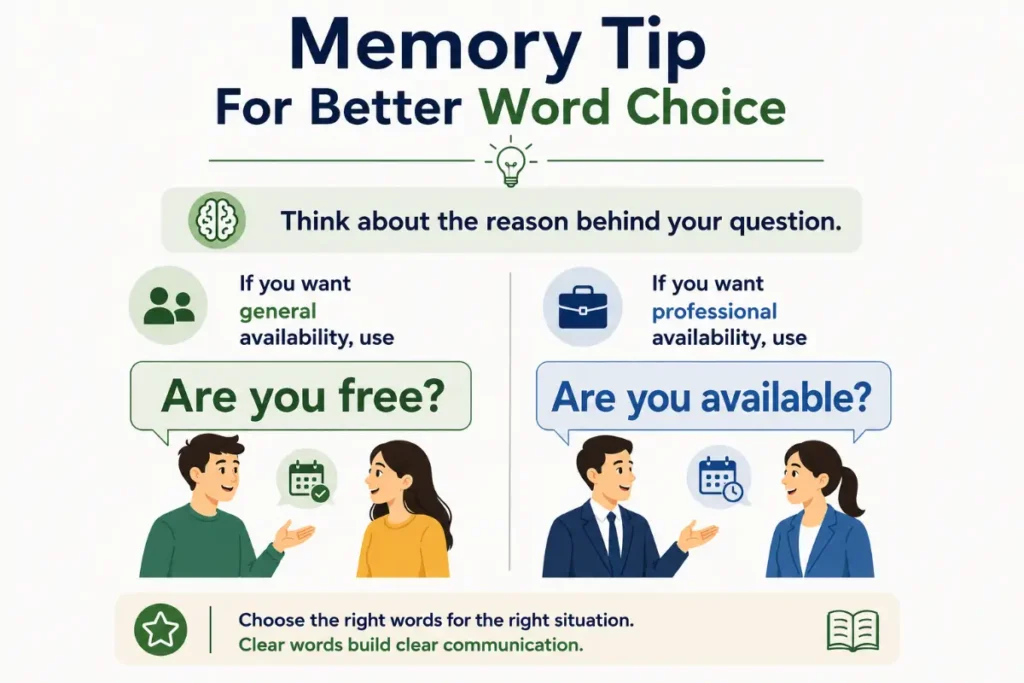
Memory Tip For Better Word Choice
Think about the reason behind your question. If you want general availability use Are you free. If you want professional availability use Are you available. If you want a short conversation use Do you have a minute. If you want social plans use Do you have plans. If you want to suggest a time use Does this time work for you. This simple approach helps you choose naturally without memorizing a long list of expressions.
A related grammar guide is First Come First Serve Alternatives For Clear Writing.
Final Takeaway
Are you free alternatives give you more control over tone and meaning. Are you free remains the easiest choice for casual conversations. Are you available works especially well in professional settings while Do you have a minute is ideal when you need a short conversation.
For social plans Do you have plans and Are you doing anything later sound natural. When a specific time matters ask Does this time work for you. The best approach is simple. Match the expression to the person the setting and the purpose of your question. If you’re unsure keep your wording short clear and natural.
FAQs
Is Are You Free Grammatically Correct?
Yes. Are you free is grammatically correct and very common in American English. Here free works as an adjective describing someone’s availability. The phrase can refer to the present or a future time. For example you can say Are you free now or Are you free tomorrow.
What Is The Most Polite Alternative?
Are you available is a polite and professional alternative. You can also say Do you have a moment or Would you have a few minutes. For more formal scheduling When would be a convenient time to talk is a respectful choice because it allows the other person to choose a suitable time.
What Is A Casual Alternative For Are You Free?
Are you doing anything later is a very natural casual alternative. You can also say Are you around or Do you have plans tonight. With close friends you can use shorter expressions such as Free later. The best choice depends on your relationship and what you want to do.
Is Are You Available More Formal Than Are You Free?
Usually yes. Are you available often sounds more professional and is common in workplace messages meetings appointments and business communication. Are you free feels more conversational. Both are correct though and either can work outside its usual setting.
What Can I Say Instead Of Are You Free In A Text?
You can write Are you around. Do you have a minute. Are you doing anything later. Are you free tonight. Can you talk. Or Do you have plans. With a close friend short messages are completely natural. With a coworker use a clearer and more polite expression.
How Do You Ask Someone About Their Availability Politely?
You can say Are you available for a quick conversation. Do you have a moment to talk. Would you have a few minutes to discuss this. Or When would be a good time to talk. These expressions sound polite because they recognize that the other person may already have commitments.
What Is A Good Alternative For Professional Emails?
Are you available is one of the safest choices. You can write Are you available to meet next Tuesday. You can also ask Would Thursday afternoon work for you or Could you let me know a convenient time to talk. These forms are clear professional and easy for the reader to answer.
Why Do People Use Are You Free To Mean Available?
English uses free in several ways. One meaning relates to cost while another relates to freedom from obligations. In Are you free the intended meaning is available or not occupied. Context makes that meaning clear. This use is standard English and does not mean the person has no responsibilities at all.