
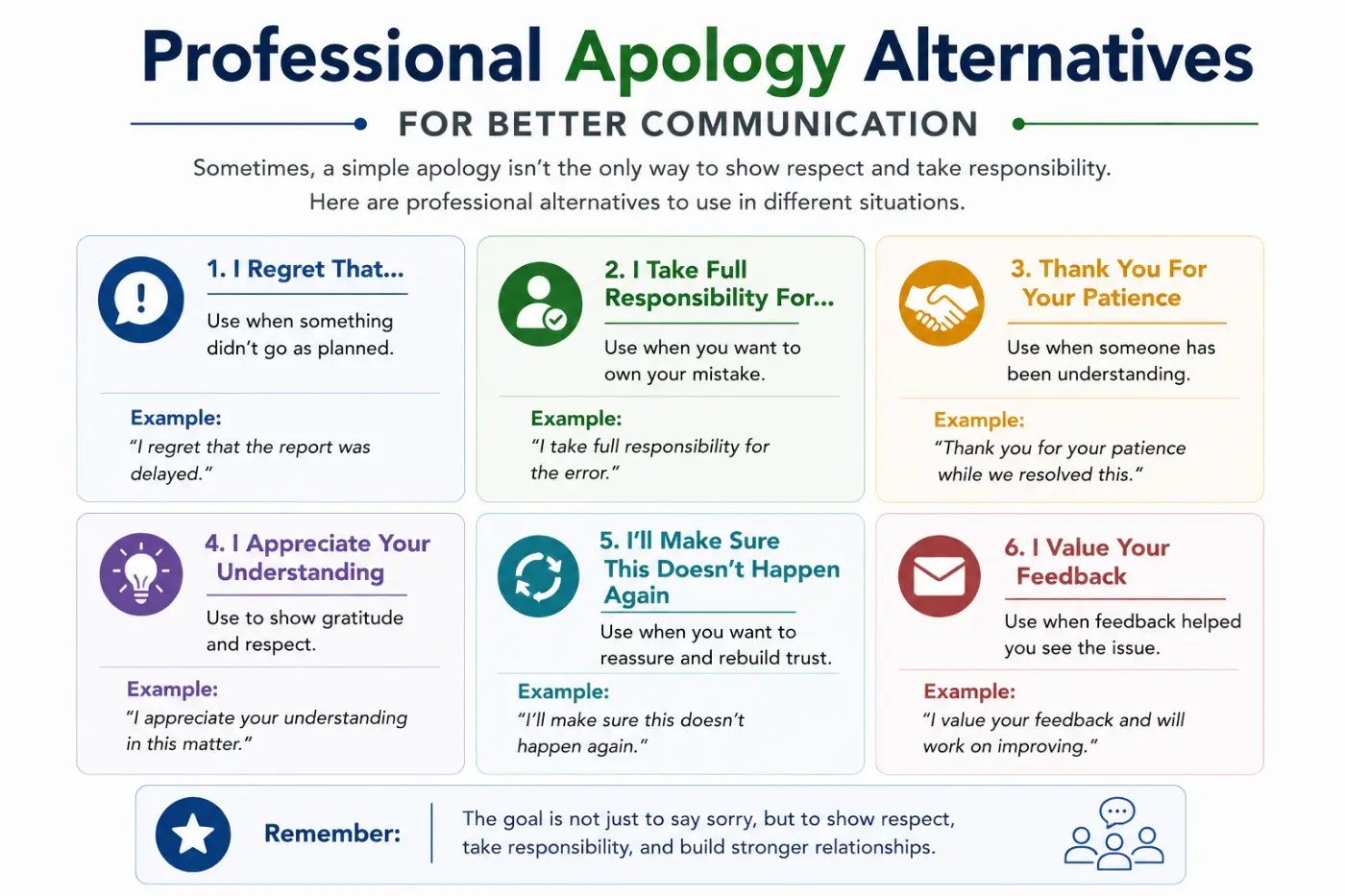
Professional apology alternatives can help you sound sincere without repeating the same phrase in every email or workplace conversation. A simple apology can work well but the right wording depends on what happened. A missed deadline may need a different response from a small misunderstanding or an inconvenience caused to a customer.
The best apology usually does more than say you are sorry. It acknowledges the problem and shows that you understand its effect. In many cases it also tells the other person what you’ll do next. That makes the message feel responsible rather than automatic.
If you need a professional way to apologize without sounding stiff or overly formal then you have plenty of natural options. You can say that you regret the mistake. You can acknowledge the inconvenience and You can also thank someone for their patience while you fix the problem.
A related grammar guide is email closings instead of sincerely: Better Options.
Quick Answer
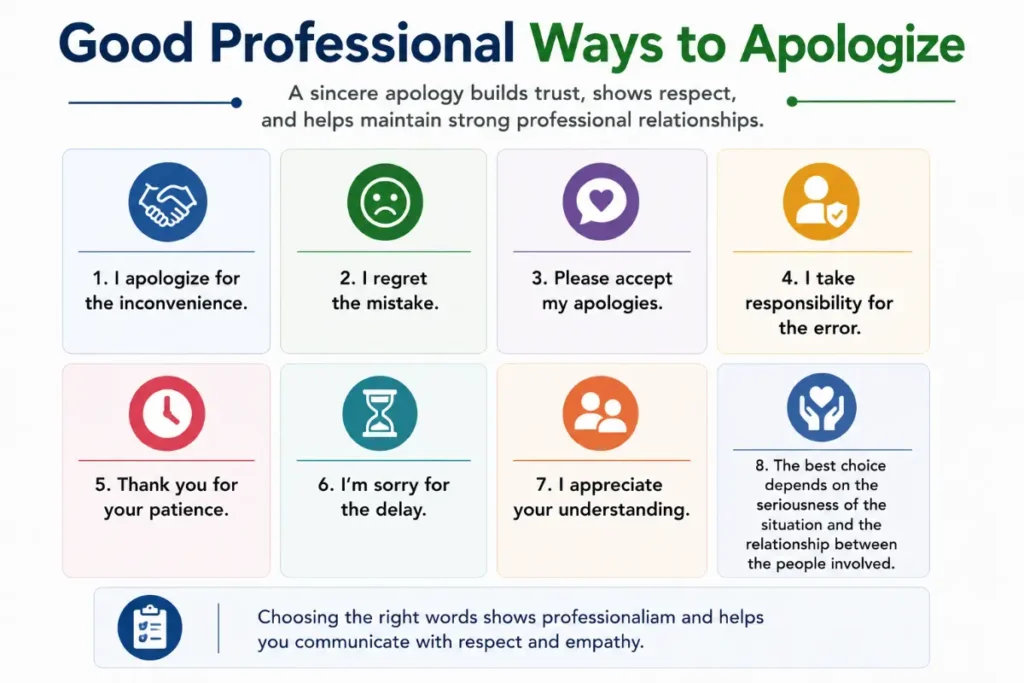
Good professional ways to apologize include I apologize for the inconvenience. I regret the mistake. Please accept my apologies. I take responsibility for the error. Thank you for your patience. I’m sorry for the delay. I appreciate your understanding. The best choice depends on the seriousness of the situation and the relationship between the people involved.
Quick Answer For Workplace Writing
The strongest workplace apology is usually short and specific. State what went wrong. Take responsibility when appropriate. Then explain the action you’re taking to correct it.
For example:
I apologize for the delay. I’ve completed the revised report and attached it to this email. Thank you for your patience.
This sounds more useful than a vague apology because it recognizes the problem and gives the reader a clear next step.
Comparison Of Common Apology Expressions
| Expression | Meaning | Part of Speech | Formality | Common Contexts | Example |
|---|---|---|---|---|---|
| I apologize | Directly expresses regret | Verb phrase | Formal | Work and business | I apologize for the delay. |
| I’m sorry | Expresses regret | Phrase | Neutral | Everyday and professional situations | I’m sorry for the confusion. |
| I regret | Shows sincere regret | Verb phrase | Formal | Serious mistakes and formal writing | I regret the error in the report. |
| Please accept my apologies | Offers a formal apology | Phrase | Very formal | Business letters and serious issues | Please accept my apologies for the oversight. |
| I take responsibility | Accepts accountability | Verb phrase | Professional | Mistakes and workplace problems | I take responsibility for the mistake. |
| Thank you for your patience | Acknowledges inconvenience | Phrase | Neutral to formal | Delays and service issues | Thank you for your patience while we resolved the issue. |
| I appreciate your understanding | Recognizes the other person’s response | Phrase | Neutral to formal | Workplace and customer communication | I appreciate your understanding regarding the delay. |
| I regret the inconvenience | Expresses regret about an effect | Verb phrase | Formal | Customer and business communication | I regret the inconvenience this caused. |
What Makes A Professional Apology Effective
A good apology has three basic qualities. It is clear. It is sincere and It also fits the situation.
The first quality is clarity. The reader should understand what you’re apologizing for. Saying I’m sorry without any context can sound automatic. Saying I’m sorry for missing the meeting gives the message a clear purpose.
The second quality is sincerity. Avoid exaggerated language when the problem is minor. A small scheduling mistake usually doesn’t need a dramatic apology. Simple words often feel more genuine.
The third quality is context. A message to a coworker can sound warmer than a formal letter to a client. The relationship matters. So does the seriousness of the mistake.
A strong apology also avoids unnecessary excuses. You can explain what happened when the explanation helps. However an explanation shouldn’t sound like an attempt to escape responsibility.
Compare these two examples.
I’m sorry I missed the deadline because I had too many other things to do.
I apologize for missing the deadline. I should have allowed more time for the final review. I’ve completed the work now and will make sure future deadlines include enough review time.
The second version sounds more responsible because it acknowledges the problem and focuses on a solution.
The Best Alternatives To I’m Sorry
I Apologize For The Delay
This is one of the safest choices for professional communication. It works well in emails and business messages.
I apologize for the delay in sending the documents.
The expression sounds formal without becoming cold. It’s especially useful when someone has been waiting for information or a completed task.
I Regret The Mistake
I regret the mistake has a more serious tone. Use it when the error matters and you want to show genuine regret.
I regret the mistake in the financial report. I’ve corrected the figures and reviewed the remaining entries.
This wording puts attention on the error rather than creating a vague apology.
Please Accept My Apologies
This expression is more formal. It can work well in a letter or a serious business situation.
Please accept my apologies for the confusion caused by the earlier message.
It may sound too formal for a quick message to a close coworker. In everyday workplace communication a simpler expression often feels more natural.
I Take Responsibility For The Error
This is useful when accountability matters. It doesn’t simply express regret. It directly accepts responsibility.
I take responsibility for the error and I’ve already corrected the information.
This can be especially effective after a mistake that affected a team project or customer.
Thank You For Your Patience
Sometimes the strongest response focuses on the other person rather than repeating an apology.
Thank you for your patience while we worked through the issue.
This works especially well during delays. It recognizes the inconvenience while keeping the tone positive.
I Appreciate Your Understanding
This expression can soften a difficult message while showing respect for the reader.
I appreciate your understanding while we complete the necessary revisions.
It works well when a situation involves an unavoidable delay or change. Use it carefully when you are clearly at fault because gratitude shouldn’t replace accountability.
I Regret The Inconvenience
This phrase fits customer service and formal business communication.
I regret the inconvenience caused by the scheduling change.
It focuses on the effect of the problem. That can be useful when the other person has experienced disruption.
Thank You For Bringing This To My Attention
Not every problem requires a direct apology. Sometimes acknowledging the issue and showing that you’ll act on it is more useful.
Thank you for bringing this to my attention. I’ve reviewed the issue and corrected the information.
This response works particularly well when someone points out an error that you hadn’t noticed.
How To Choose The Right Expression
The right wording depends on four factors. Consider the seriousness of the issue. Think about your relationship with the reader. Consider the communication channel. Then decide how much responsibility you need to show.
For a small mistake you can keep things simple.
I’m sorry for the confusion.
For a meaningful workplace error you can be more direct.
I apologize for the error. I’ve corrected the document and checked the remaining figures.
For a serious issue you may need stronger accountability.
I take responsibility for the mistake. I understand the impact it caused and I’m taking steps to prevent it from happening again.
For a delay you can combine an apology with appreciation.
I apologize for the delay and appreciate your patience.
This approach keeps the message focused. You don’t need five different ways to say sorry in the same paragraph.
Apologies For Different Workplace Situations
When You Miss A Deadline
A missed deadline deserves a clear acknowledgment.
I apologize for missing the deadline. I underestimated the time needed for the final review. I’ve completed the remaining work and will send the final version today.
Avoid blaming other people or adding a long list of reasons. The reader usually cares more about what happens next.
When You Make A Mistake
Own the mistake directly.
I apologize for the error in the report. I’ve corrected the figures and reviewed the full document to make sure there are no other issues.
This approach shows responsibility and action.
When You Send Incorrect Information
Accuracy matters in professional communication. If you send incorrect information then correct it quickly.
I apologize for the incorrect information in my earlier email. The correct figures are included below.
A short correction is often better than a long explanation.
When You Miss A Meeting
You can keep this kind of apology brief.
I’m sorry I missed the meeting. I should have communicated earlier. Please let me know a convenient time to catch up on what I missed.
The final sentence matters because it shows that you want to repair the situation.
When You Cause Confusion
Use language that recognizes the lack of clarity.
I apologize for the confusion. My earlier message wasn’t clear enough. The correct information is below.
This is better than saying the other person misunderstood. It keeps the focus on clear communication.
When You Reply Late
A delayed response usually doesn’t need a dramatic apology.
I apologize for the delayed response. I needed some additional time to confirm the details before replying.
You can also use a warmer option.
Thanks for your patience. I’m sorry for the delayed reply.
When You Need To Correct Someone
Be careful here. You can correct information without making the other person feel embarrassed.
I apologize if my earlier message caused confusion. I wanted to clarify one detail in the report.
This keeps the tone respectful and avoids turning a simple correction into a confrontation.
When A Customer Has Experienced A Problem
Customer communication requires empathy and accountability.
I apologize for the inconvenience. I understand how this delay affected your schedule and we’re working to resolve the issue as quickly as possible.
Avoid empty promises. Only mention actions that you can actually take.
Formal And Informal Choices
Professional communication doesn’t always need formal language. In fact overly formal wording can sometimes make a simple message sound unnatural.
For example a coworker might prefer:
I’m sorry I missed your message.
A client might receive:
I apologize for the delayed response.
A formal business letter might use:
Please accept my apologies for the inconvenience caused.
All three expressions can be correct. The difference lies mainly in tone and context.
A useful rule is to match your wording to the relationship. The closer the relationship and the smaller the mistake the simpler your language can be. The more serious the issue the more direct your acknowledgment should become.
How To Apologize Without Sounding Weak
Some people avoid apologizing because they think an apology makes them look unprofessional. Usually the opposite is true. A clear apology can show maturity and accountability.
The key is to avoid overexplaining.
Instead of writing:
I’m extremely sorry and I honestly feel terrible about this and I hope you can understand that I never intended for this to happen.
Try:
I apologize for the mistake. I understand the inconvenience it caused and I’ve corrected the issue.
The second version sounds calm and responsible.
You should also avoid apologizing for things that aren’t actually your fault simply to keep the peace. If a delay resulted from a system outage outside your control then you can acknowledge the inconvenience without falsely accepting blame.
For example:
I’m sorry for the inconvenience caused by the system outage. We’re working with the technical team to restore normal service.
That recognizes the impact without making an inaccurate admission of responsibility.
When Not To Use I’m Sorry
I’m sorry is perfectly acceptable English. It isn’t wrong or unprofessional.
The problem appears when you use it for every situation. Repetition can make your messages sound automatic.
You might write:
I’m sorry for the delay.
I’m sorry for the inconvenience.
Each sentence works on its own. If you use the same phrase repeatedly across many messages then your writing can start to feel mechanical.
Using a small range of natural expressions gives you more control over tone. You can apologize directly when needed. You can accept responsibility when appropriate and You can also thank someone for their patience when that better reflects the situation.
Ten Natural Sentence Examples
- I apologize for the delay in sending the revised proposal.
- I’m sorry for the confusion caused by my earlier email.
- I regret the error in the report and have corrected the affected figures.
- Please accept my apologies for the inconvenience.
- I take responsibility for the mistake and will make sure it doesn’t happen again.
- Thank you for your patience while we resolved the issue.
- I appreciate your understanding as we work through the remaining details.
- I apologize for missing the meeting and would be happy to review the discussion with you.
- I’m sorry for the late response. I wanted to confirm the information before replying.
- Thank you for bringing this issue to my attention. I apologize for the oversight and have corrected it.
Notice that each example does something slightly different. Some acknowledge a mistake. Some address a delay. Others focus on accountability or appreciation. That variation makes professional communication sound more natural.
Common Apology Mistakes
Giving Too Many Excuses
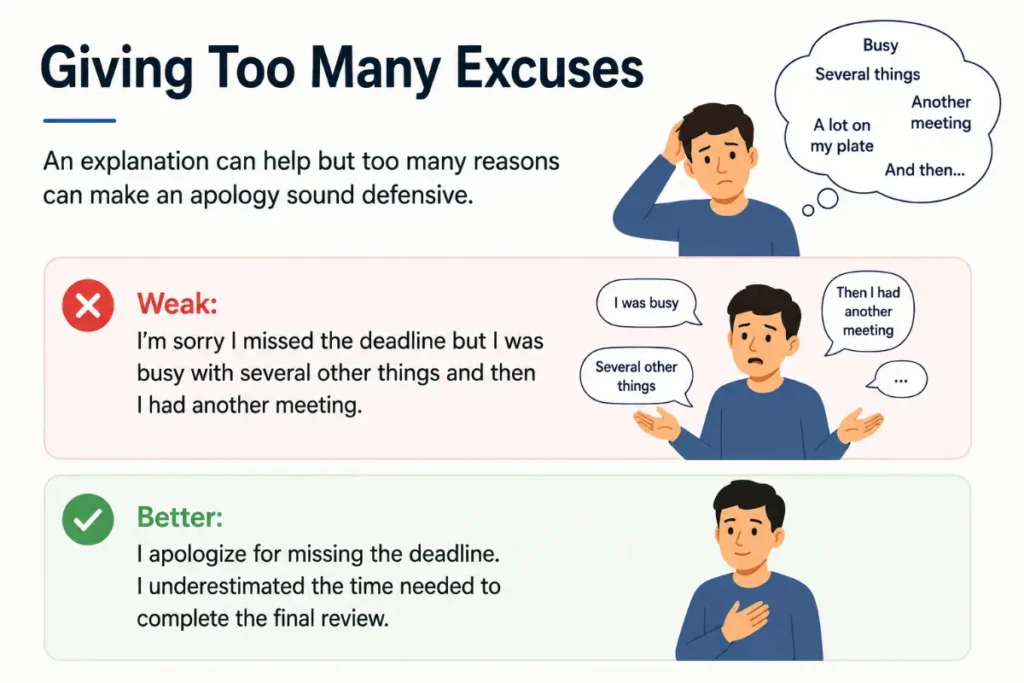
An explanation can help but too many reasons can make an apology sound defensive.
Weak:
I’m sorry I missed the deadline but I was busy with several other things and then I had another meeting.
Better:
I apologize for missing the deadline. I underestimated the time needed to complete the final review.
The second version accepts responsibility without turning the message into a list of excuses.
Using An Apology That Is Too Strong
Not every mistake needs a formal statement.
Please accept my deepest and most sincere apologies for the terrible inconvenience caused by my minor scheduling error.
This sounds exaggerated.
A better choice would be:
I’m sorry for the scheduling mix up. I’ve updated the calendar.
Good professional writing uses the right amount of emotion.
Saying Sorry Without Taking Action
An apology can feel empty if the same problem continues.
I apologize for the mistake.
That may be enough for a very minor issue. For a meaningful problem add the next step.
I apologize for the mistake. I’ve corrected the report and added a review step before future versions are sent.
Blaming The Other Person
Avoid statements such as:
I’m sorry you misunderstood my email.
This can sound like the problem belongs entirely to the reader.
Try:
I apologize for the lack of clarity in my email. I should have explained the change more clearly.
This takes ownership of communication.
Apologizing Repeatedly
One sincere apology is usually stronger than several repeated apologies.
I’m sorry. I really apologize. I’m very sorry about this. Please accept my apology.
This can make a message feel anxious rather than professional.
State the apology once and then focus on the solution.
Pronunciation Guide
The phrase professional apology alternatives contains several common English sounds.
Professional is commonly pronounced pruh FESH uh nul. The main stress falls on FESH.
Apology is commonly pronounced uh POL uh jee. The stress falls on POL.
Apologize is commonly pronounced uh POL uh jyz. The final sound is similar to eyes.
Apologies is commonly pronounced uh POL uh jeez.
American English speakers generally use a clear z sound at the end of apologize. In British English the pronunciation follows the same basic pattern although accents can change the vowel sounds.
The most useful pronunciation tip is to stress the middle syllable in apology and apologize. Saying every syllable with equal force can make the words sound less natural.
Need another quick comparison? Read Are You Free Alternatives for Natural English used in 2026.
Etymology And Word Origin
The word apology has an interesting history. It comes from the Greek word apologia which originally referred to a speech made in defense of someone or something.
The meaning developed over time. In modern English an apology usually means an expression of regret for an offense or mistake.
The related verb apologize developed from the same word family. English speakers now use it in everyday conversation as well as formal and professional communication.
The historical meaning is useful because it shows how words can change over time. A word that once focused on a defense or explanation can develop into an expression of regret.
Regional Usage
American English
In American English both apologize and apologise can be understood but apologize is the standard spelling in US English. Professional communication in the United States commonly uses phrases such as I apologize for the delay and I’m sorry for the confusion.
American workplace writing generally favors clear direct language. Formality still matters but overly elaborate apologies can sound unnatural.
British English
British English commonly uses apologise with an s. The meaning remains the same.
British professional communication can use more formal apology expressions depending on the situation. The core grammar and purpose remain similar.
Australian English
Australian English generally follows British spelling conventions in many contexts. Apologise is commonly used.
The tone still depends on the relationship and situation. Workplace communication often favors a straightforward apology rather than highly formal wording.
Canadian English
Canadian English uses both American and British influences. Apologize and apologise can both appear depending on the style used by an organization or writer.
The important point is consistency. If you are writing for a US audience then apologize is the natural standard spelling.
Grammar Rules And Word Function
Apologize is a verb. It normally takes for when you name the thing that caused the apology.
I apologize for the delay.
I apologize for missing the meeting.
The pattern is simple.
Apologize for plus noun.
Apologize for plus gerund.
A common mistake is using to after apologize when for is needed.
Incorrect:
I apologize to the delay.
Correct:
I apologize for the delay.
You can use apologize to when identifying the person receiving the apology.
I apologized to my manager for the mistake.
Here to identifies the person and for identifies the reason.
The noun apology works differently.
I offered an apology for the mistake.
Please accept my apology.
The plural form apologies is common in formal expressions.
Please accept my apologies for the inconvenience.
You can also use sorry as an adjective.
I’m sorry for the delay.
I’m sorry that the report was late.
The grammatical structure changes slightly but the communicative purpose remains similar.
Real Life Usage In Conversation
Daily Conversation
Professional language doesn’t always have to sound formal.
I’m sorry I forgot to send that file. I’ll send it now.
I’m sorry for the mix up. I thought the meeting started at three.
These expressions sound natural between coworkers who communicate regularly.
Workplace Email
Emails often benefit from a direct apology followed by an action.
I apologize for the delayed response. I’ve reviewed your request and included the information you need below.
This style respects the reader’s time.
Customer Communication
Customer messages usually need empathy and clarity.
I apologize for the inconvenience caused by the delayed delivery. We’ve contacted the shipping team and will update you as soon as we have more information.
The important part is that the message doesn’t stop at an apology.
Academic Writing
Academic writing tends to use formal and precise language.
The author acknowledges the error in the original analysis and provides the corrected calculation.
In formal academic contexts you may not always need a personal apology. Sometimes objective wording is more appropriate.
Journalism
News writing often uses concise language.
The company apologized for the service disruption and said it was investigating the cause.
This style reports the apology without adding unnecessary emotion.
Storytelling
A narrative may use more emotional language.
She paused before apologizing for the harsh words she had spoken.
The context determines the tone. Professional communication usually needs more restraint.
Related Terms And Expressions
Regret
Regret expresses sadness or disappointment about something that happened. It can sound more formal than I’m sorry.
I regret the error in the original document.
Accountability
Accountability focuses on accepting responsibility for an action or result.
I take responsibility for the mistake.
This is especially useful when the reader needs reassurance that someone is addressing the problem.
Remorse
Remorse expresses deep regret. It is stronger than ordinary workplace apology language.
The word can sound too emotional for a minor business mistake.
Excuse
An excuse attempts to explain or justify a mistake. It isn’t the same as an apology.
I apologize for the delay.
I was delayed because of traffic.
The first sentence expresses regret. The second gives an explanation.
Explanation
An explanation tells someone why something happened. It may accompany an apology but it doesn’t replace one.
I apologize for the delay. The shipment was held for an additional inspection.
Forgiveness
Forgiveness is the response someone may give after receiving an apology.
An apology and forgiveness are connected but they aren’t interchangeable.
Acknowledgment
An acknowledgment recognizes that an issue occurred.
I understand the concern and I’m reviewing the problem now.
This can be useful when you need to respond quickly while investigating the full situation.
Appreciation
Appreciation recognizes the other person’s patience or cooperation.
Thank you for your patience.
This is particularly effective when someone has waited through a delay.
How To Write A Strong Apology Email
A professional apology email doesn’t need to be long. A useful structure contains four parts.
- State the apology.
I apologize for the delay.
- Name the issue.
The report was sent later than the agreed deadline.
- Take responsibility when appropriate.
I should have allowed more time for the final review.
- Explain the next step.
I’ve attached the completed report and will build additional review time into future deadlines.
Together the message becomes:
I apologize for the delay in sending the report. I should have allowed more time for the final review. I’ve attached the completed version and will build additional review time into future deadlines.
That is concise but complete. It doesn’t ask the reader to guess what happened or what you plan to do next.
How To Apologize To A Customer
Customer apologies require a careful balance. You want to show empathy without making promises you can’t keep.
Start by acknowledging the inconvenience.
I apologize for the inconvenience caused by the delayed order.
Then give useful information.
Your order has now been processed and is scheduled for delivery tomorrow.
If necessary add a reasonable next step.
Please contact us if the order doesn’t arrive within the stated delivery window.
Avoid phrases that sound dismissive.
I’m sorry you feel that way.
That sentence focuses on the customer’s feelings instead of the actual issue. It can sound as if you don’t accept that a problem occurred.
A stronger version is:
I understand your concern and apologize for the delay. We’re reviewing the shipment status now.
How To Apologize To A Manager
When apologizing to a manager keep the message factual.
I apologize for missing the deadline. I underestimated the time needed for the final review. The completed report is ready now and I’ll plan additional review time for similar projects in the future.
You don’t need to sound frightened or overly submissive. Professional accountability is stronger than excessive emotion.
How To Apologize To A Coworker
A coworker usually doesn’t need a highly formal apology.
I’m sorry I missed your message. I was away from my desk and didn’t see it until this afternoon.
If your mistake affected their work then add an action.
I’m sorry I sent the wrong file. I’ve attached the correct version now.
Simple language often works best between colleagues.
How To Apologize Without Overusing The Word Sorry
The easiest way to avoid repetition is to focus on the specific purpose of the message.
Use I apologize when you need a direct professional apology.
Use I regret when the situation is more serious or formal.
Choose thank you for your patience when someone has experienced a delay.
Use I appreciate your understanding when the situation requires cooperation.
Use thank you for bringing this to my attention when someone identifies a problem.
These expressions aren’t identical. That’s why they can’t always replace one another. The best wording depends on what you want the reader to understand.
Expert Editor Insight
An experienced editor usually looks beyond the apology itself. The real question is what the sentence communicates after the apology is removed. If the message only says sorry then it may feel empty. Strong workplace writing identifies the issue and gives the reader confidence that someone is handling it. Editors also watch for defensive language and excessive explanations. A short statement such as I apologize for the error. I’ve corrected the report. often sounds more professional than a long emotional paragraph. The goal isn’t to sound formal. The goal is to sound responsible clear and sincere.
A Simple Formula For Better Apologies
You can remember a simple four part pattern.
- Acknowledge the problem.
- Express regret.
- Accept responsibility when appropriate.
- Explain the next action.
For example:
I apologize for the delay. I should have confirmed the final details earlier. I’ve now completed the review and sent the updated document.
This formula works because it moves the conversation forward. It doesn’t leave the reader with an apology and no solution.
When An Apology Is Not Enough
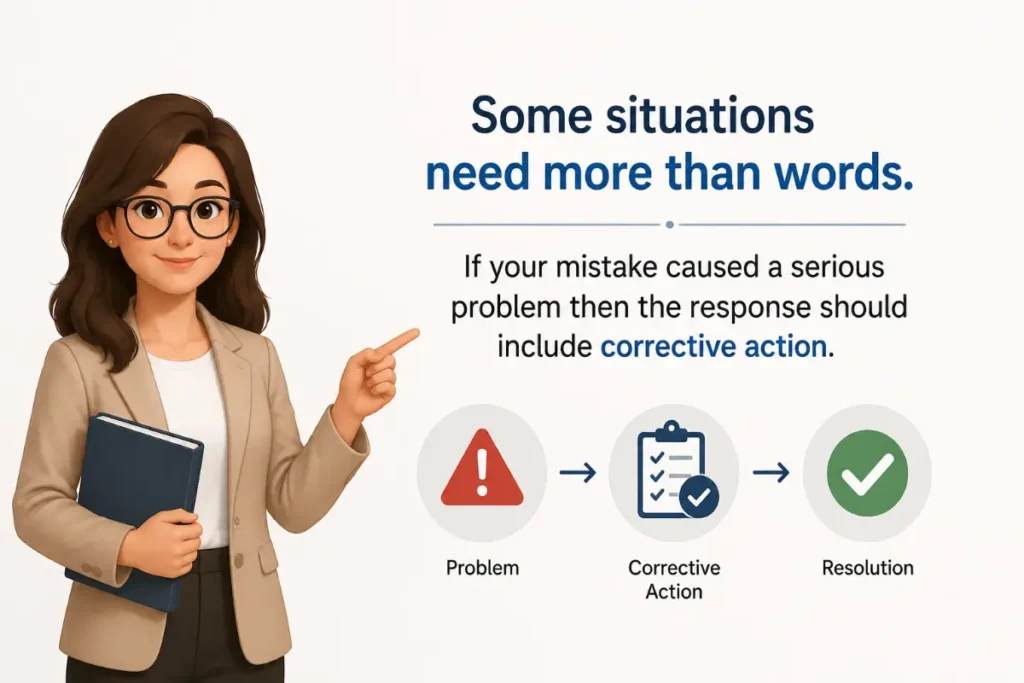
Some situations need more than words. If your mistake caused a serious problem then the response should include corrective action. Imagine that an employee sends a customer the wrong contract. Saying I apologize for the mistake is a reasonable start. It isn’t the complete response. A better message might say: I apologize for sending the incorrect contract. I’ve removed the outdated version from the communication thread and sent the correct document for review. The action gives the apology weight. This principle applies across professional communication. Words matter but behavior gives those words credibility.
Still confused? Compare Glad to hear that alternatives for natural English.
Conclusion
Professional apology alternatives give you more control over tone and meaning. You don’t need to repeat I’m sorry every time something goes wrong. I apologize works well in formal workplace communication while I regret can express deeper concern. I take responsibility highlights accountability. Thank you for your patience can be better for a delay. I appreciate your understanding can work when cooperation matters.
The most effective apology is usually simple. Name the issue. Accept responsibility when it belongs to you. Then explain what you’re doing to fix it. Avoid long excuses and avoid dramatic language for small mistakes. A calm apology shows confidence because it doesn’t hide from the problem.
A useful editing tip is to read your message once after writing it and remove anything that sounds defensive. Keep the apology clear and give the reader a reason to trust the next step. That small change can turn an ordinary apology into professional communication that feels sincere and respectful.
FAQs
What are professional apology alternatives?
Useful options include I apologize for the delay. I regret the mistake. Please accept my apologies. I take responsibility for the error. Thank you for your patience. I appreciate your understanding. The best choice depends on the seriousness of the issue and the relationship with the reader.
Is I’m sorry professional?
Yes. I’m sorry is completely appropriate in many professional situations. It sounds natural and works well for everyday workplace communication. You may choose I apologize for more formal situations. The key is not the phrase itself but the clarity and sincerity of the message.
What is a polite way to apologize at work?
A simple option is I apologize for the mistake. I’ve corrected the issue and will make sure the same problem doesn’t happen again. This works because it expresses regret while showing responsibility and action. For a minor issue you can use I’m sorry for the confusion.
How do you apologize professionally for a mistake?
State the mistake clearly and accept responsibility when it belongs to you. Then explain what you’ve done to correct it. For example you can say I apologize for the error in the report. I’ve corrected the figures and reviewed the document again.
What can I say instead of sorry for the inconvenience?
You can say I apologize for the inconvenience. I regret the disruption this caused. Thank you for your patience. I appreciate your understanding. The best expression depends on the situation. For customer communication a direct acknowledgment of the inconvenience usually works well.
Is I apologize too formal for work emails?
Not usually. I apologize is common in professional emails and sounds appropriately formal in many situations. However it can feel more distant than I’m sorry when writing to a close coworker. Match the tone to your relationship and the seriousness of the issue.
How do you apologize without making excuses?
Acknowledge what happened and focus on your responsibility and next step. For example say I apologize for missing the deadline. I underestimated the review time and have completed the report now. This gives useful context without shifting blame to other people.
What is the best professional apology?
There isn’t one phrase that works for every situation. A strong apology is specific sincere and appropriate to the context. It should identify the problem when useful and explain the corrective action. I apologize for the delay followed by a clear solution is often a strong choice for workplace communication.