
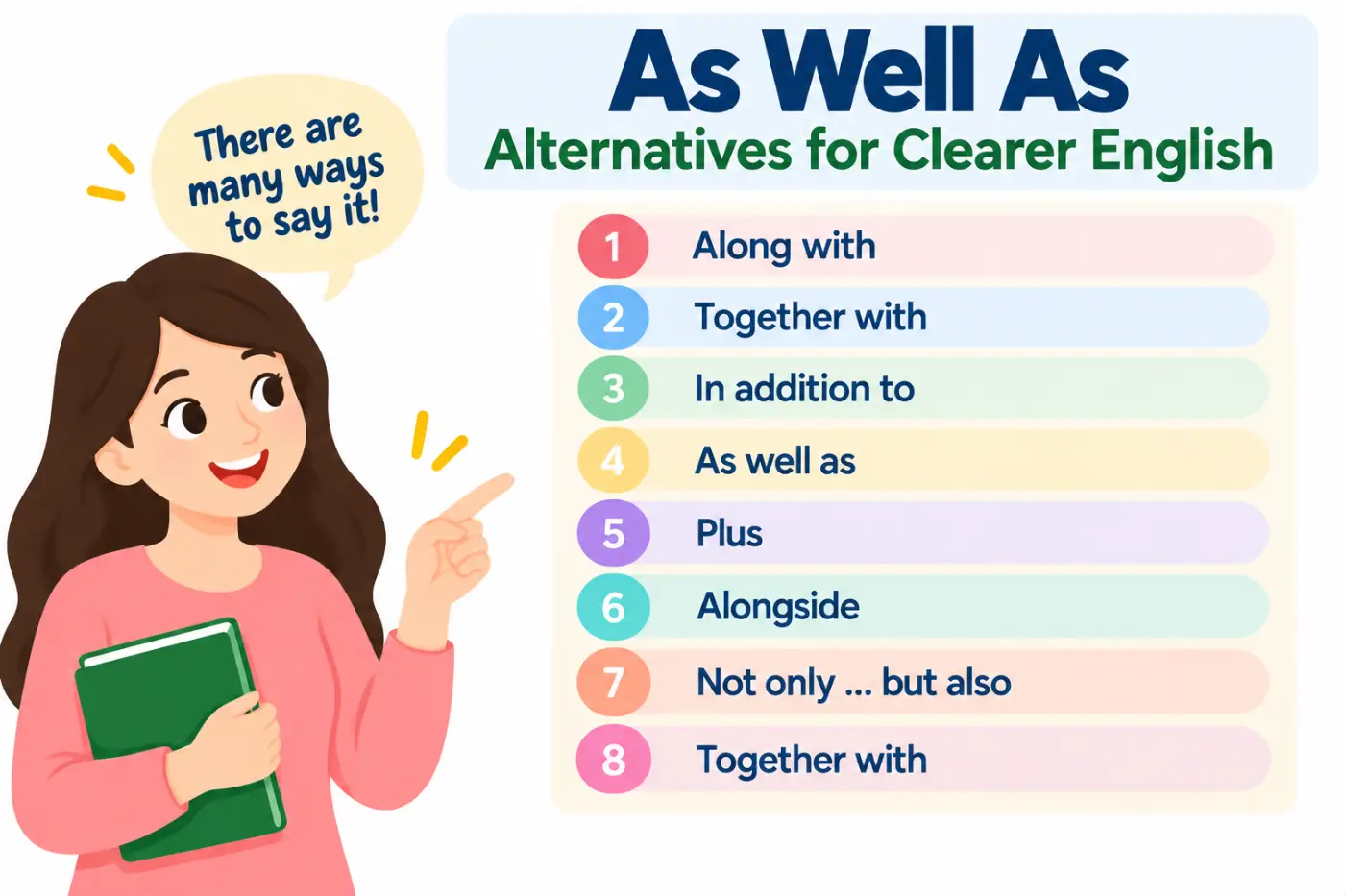
As well as alternatives can help your writing sound more natural when the same phrase starts appearing again and again. The phrase as well as is perfectly correct in English, but it doesn’t fit every sentence equally well. Sometimes you need a simple word such as and. In other cases you may want along with, in addition to, besides, or together with.
The tricky part is that these expressions aren’t always exact replacements. Each one carries a slightly different shade of meaning and can affect the grammar of the sentence. A good writer chooses the expression that matches the relationship between the ideas instead of swapping phrases mechanically.
This guide explains the most useful alternatives and shows how they work in real English. You’ll learn the difference between close synonyms, understand common grammar mistakes, see natural examples, and discover which choices work best in conversation, business writing, academic work, and formal communication. The goal is simple. You should finish knowing exactly which expression sounds right for the sentence in front of you.
Still confused? Compare Professional Apology Alternatives For Better Communication.
Quick Definition
As well as alternatives are words and phrases that can replace as well as when the context allows it. Common choices include and, along with, in addition to, besides, together with, plus, and also. The best choice depends on meaning, grammar, emphasis, and the level of formality you want.
Quick Answer
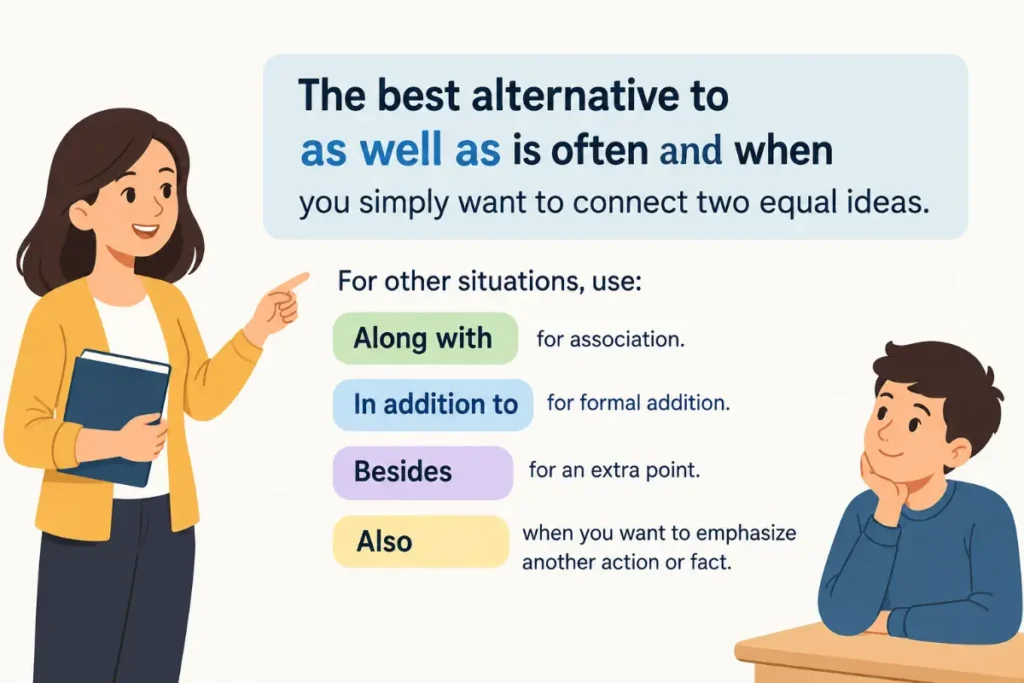
The best alternative to as well as is often and when you simply want to connect two equal ideas. For other situations, use along with for association, in addition to for formal addition, besides for an extra point, or also when you want to emphasize another action or fact.
Comparison Table for As Well As Alternatives
| Expression | Main Meaning | Part of Speech | Formality | Best Context | Example |
|---|---|---|---|---|---|
| And | Adds an equal idea | Conjunction | Neutral | Everyday and professional writing | She bought bread and milk. |
| Along with | Shows association or addition | Prepositional phrase | Neutral | Conversation and workplace writing | She came along with her sister. |
| In addition to | Adds another item or fact | Prepositional phrase | Formal | Academic and professional writing | In addition to teaching she researches. |
| Besides | Adds another point | Preposition or adverb | Neutral | Conversation and general writing | Besides English he speaks Spanish. |
| Together with | Shows things or people acting in association | Prepositional phrase | Neutral | Formal and everyday contexts | She worked together with the team. |
| Plus | Adds information or an item | Preposition or conjunction | Informal to neutral | Conversation and casual writing | The plan is affordable plus it is simple. |
| Also | Adds another fact or action | Adverb | Neutral | Most types of writing | She also teaches music. |
| Additionally | Adds supporting information | Adverb | Formal | Reports and academic writing | Additionally the study found higher engagement. |
Meaning and Definition
What As Well As Means
As well as usually adds one person thing action or idea to another. In many contexts it has a meaning close to and.
For example:
She speaks French as well as English.
The sentence tells us that she speaks both languages. The phrase connects French and English while adding a little emphasis to the second item.
The expression can also introduce an activity.
He enjoys reading as well as writing.
Here the speaker presents reading and writing as activities that he enjoys.
The phrase can also mean in addition to.
As well as working full time she studies at night.
This sentence adds a second activity to the first one.
The important point is that as well as doesn’t always behave exactly like and. Its grammatical structure can affect the verb form and the emphasis of the sentence. That’s why replacing it with a random synonym can sometimes create an awkward sentence.
Why Writers Look for Alternatives
There are several good reasons to choose another expression.
First repetition can make prose feel flat. If several sentences contain the same phrase the reader may notice the pattern instead of the message.
Second some alternatives fit formal writing better. In addition to and additionally can sound more suitable in a report than plus.
Third the meaning can change slightly. And normally presents two elements as equal. Along with can put more focus on one main subject and treat the other as an accompanying element.
Finally shorter alternatives can improve readability. Sometimes replacing a longer phrase with and makes the sentence cleaner.
The Best Alternatives Explained
And
And is usually the simplest choice.
Consider this sentence:
Maria brought a notebook as well as a pen.
You can write:
Maria brought a notebook and a pen.
The second version is shorter and completely natural. And works especially well when two things have equal grammatical importance.
It is also useful in conversation because people naturally rely on it to connect ideas.
I bought coffee and breakfast.
We talked and laughed.
The main caution is that and can remove some of the emphasis found in other expressions. If you want to stress that something is an additional point rather than an equal item you may prefer another option.
Along With
Along with works well when you want to show that someone or something accompanies another person or thing.
For example:
The manager attended the meeting along with two assistants.
This puts the manager at the center of the sentence and presents the assistants as accompanying participants.
Compare that with:
The manager and two assistants attended the meeting.
The meaning is close but the focus changes slightly.
Along with is especially useful when describing people joining an activity or things appearing together.
The package arrived along with a handwritten note.
She traveled along with her friends.
The phrase sounds natural in both everyday and professional English.
In Addition To
In addition to is a strong choice for formal and academic writing.
For example:
In addition to teaching English she writes language textbooks.
The phrase clearly signals that one activity is being added to another.
You’ll often see it in reports essays business documents and research writing.
In addition to the main survey the researchers conducted interviews.
This choice is slightly more formal than and. It also makes the relationship between the ideas very clear.
One grammar point deserves attention. When a verb follows in addition to the verb normally appears in the ing form.
Correct:
In addition to studying she works part time.
Incorrect:
In addition to study she works part time.
The phrase to here belongs to the prepositional expression rather than functioning like the infinitive marker in to study.
Besides
Besides can introduce an additional person thing or reason.
For example:
Besides English she speaks French.
It can also introduce a reason.
I don’t want to go. Besides I’m tired.
The meaning changes slightly depending on the structure.
As a preposition besides means in addition to.
As an adverb it can mean also or apart from that.
Besides is common in conversation and general writing. It can sound more direct and conversational than in addition to.
Together With
Together with emphasizes association.
For example:
The director attended the event together with several members of the board.
This suggests that the director attended accompanied by those people.
It can also appear in formal descriptions.
The report was prepared together with the finance department.
The expression is useful when the relationship between people or groups matters more than simple addition.
Plus
Plus is common in informal and conversational English.
For example:
The apartment is affordable plus it is close to work.
You might also say:
The course includes lectures plus practical exercises.
Plus can make writing feel relaxed and direct. It works particularly well in conversation advertising casual explanations and informal online communication.
It isn’t always the best choice for highly formal academic prose. In that setting additionally or in addition to may sound more appropriate.
Also
Also is one of the most flexible choices.
For example:
She teaches English. She also writes books.
It can appear in several positions depending on the sentence.
She also speaks Spanish.
She is also a talented musician.
Also is especially useful when you want to avoid repeating a longer phrase. It keeps the writing compact without changing the basic meaning.
Additionally
Additionally is more formal and often appears in reports essays presentations and professional documents.
For example:
The program improves writing skills. Additionally it helps students build confidence.
It works best when you are adding another complete point rather than simply connecting two nouns.
Using additionally in casual conversation can sound stiff. In everyday speech people usually prefer also, and, or besides.
Key Differences Between These Alternatives
- And is usually the simplest replacement when two ideas have equal weight.
- Along with emphasizes association or accompaniment.
- In addition to clearly signals an added element and suits formal writing.
- Besides often sounds conversational and can introduce an extra reason or idea.
- Together with emphasizes people or things acting in association.
- Plus has a casual and direct tone.
- Also works naturally when adding another fact or action.
- Additionally is useful for formal transitions between ideas.
The important lesson is that synonyms are rarely identical twins. They’re more like close relatives. They share a family resemblance but each has its own personality.
Which Alternative Should You Choose?
Choose and when you want the cleanest and most natural connection.
Choose along with when one person or thing accompanies another.
Choose in addition to when you want a clear and somewhat formal expression of addition.
Choose besides when you’re adding another idea or reason in a conversational way.
Choose together with when association or joint participation matters.
Choose plus for casual communication.
Choose also when you want to add another action or fact without making the sentence heavy.
Choose additionally when you’re connecting formal points in a report or academic discussion.
The best editor doesn’t ask which synonym sounds most impressive. The better question is which expression communicates the relationship most clearly.
Sentence Examples
Here are natural examples showing how these alternatives work.
- And: She bought a notebook and a new pen.
- Along with: The teacher arrived along with three students.
- In addition to: In addition to her regular job she volunteers at a local school.
- Besides: Besides mathematics he enjoys studying history.
- Together with: The company worked together with local organizations.
- Plus: The phone is affordable plus it has a strong battery.
- Also: She also helps new employees learn the system.
- Additionally: Additionally the report identifies several areas for improvement.
- And: We need more time and better information before making a decision.
- Along with: The letter arrived along with several important documents.
These examples show why context matters. Simply replacing the original expression with the first synonym you remember can change the tone or focus.
Common Mistakes
Replacing Every Use With And
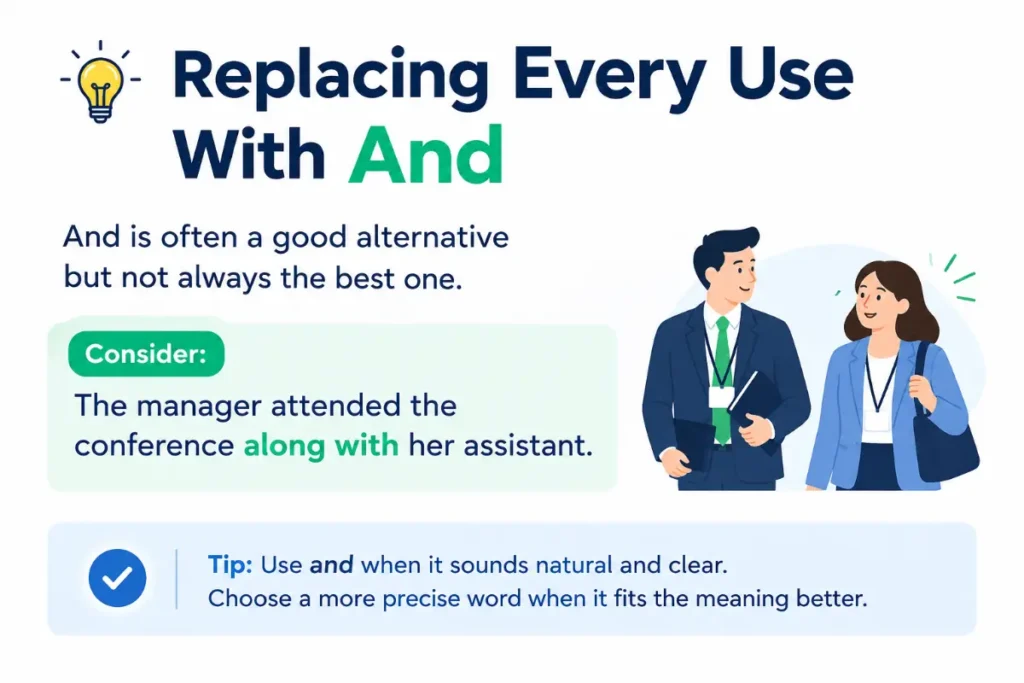
And is often a good alternative but not always the best one.
Consider:
The manager attended the conference along with her assistant.
Changing this to:
The manager and her assistant attended the conference.
is grammatically fine. However the second sentence presents both people more equally.
If the manager is the main subject and the assistant is accompanying her the original structure communicates that relationship more clearly.
Using In Addition To With the Wrong Verb Form
A common mistake is using the base form after in addition to.
Incorrect:
In addition to study she works.
Correct:
In addition to studying she works.
The same pattern applies to many prepositional phrases ending in to.
Using Plus in Formal Academic Writing
Plus isn’t grammatically wrong in every formal context but it can sound too casual for a research paper or formal report.
Instead of:
The method is simple plus it saves time.
A formal writer might use:
The method is simple and it also saves time.
Or:
Additionally the method saves time.
Confusing Also With Additionally
Both expressions add information but their style differs.
Also is highly flexible and natural across many contexts.
Additionally sounds more formal and often works as a sentence level transition.
Using formal transitions in every sentence can make otherwise simple writing feel stiff. Good prose needs rhythm too.
Creating Unbalanced Comparisons
When connecting two elements make sure they have matching grammatical forms.
For example:
She enjoys reading and writing.
Both elements are gerunds.
A less polished structure might mix forms unnecessarily:
She enjoys reading and to write.
Keeping the structure parallel makes the sentence easier to read.
Need another quick comparison? Read email closings instead of sincerely: Better Options.
Pronunciation Guide
The pronunciation of the original phrase is straightforward.
As well as is commonly pronounced something like:
az well az
In natural American speech the word as can become weaker and sound closer to uhz.
The phrase contains three main sound groups.
as
well
as
The word well receives the clearest stress in ordinary speech.
Most of the alternatives are equally easy to pronounce.
And sounds like and although the vowel can become very short in rapid speech.
Along with sounds like uh long with.
In addition to has four main parts and usually carries stress on addition.
Besides sounds like bih sides.
Together with sounds like tuh geth er with.
Additionally is commonly pronounced uh dish uh nul ee.
Pronunciation usually isn’t the main source of confusion with these expressions. Meaning and grammar create more problems than sound.
Etymology and Word Origin
The phrase as well as developed from ordinary English words that have long histories.
The word well comes from Old English and has been used for centuries to express ideas related to being in a good or satisfactory manner. The word as also has deep Germanic roots and serves many grammatical roles in modern English.
The expression eventually developed as a way to add one element to another while retaining the sense of also or in addition.
The alternatives have different histories.
And comes from Old English and has remained one of the most basic connecting words in English.
Along combines the word long with the prefix a and developed into a word expressing movement or position alongside something.
Besides comes from the idea of being by or at the side of something else.
Additionally comes from the word addition which traces back through French to Latin roots connected with adding something to something else.
These histories explain why several alternatives share the same broad concept while still carrying different grammatical and stylistic functions.
Regional Usage
American English
American English uses all of the major alternatives discussed here. And, also, along with, besides, and plus are especially natural in everyday communication. In addition to and additionally appear more often in formal writing.
There is no major American spelling difference that changes the basic use of these expressions.
British English
British English uses the same core expressions. The grammatical distinctions remain largely the same. Writers in Britain may choose slightly different expressions based on personal style but the underlying rules don’t change.
The phrase as well as is fully standard in British English.
Australian English
Australian English also uses these expressions naturally. Everyday communication tends to favor short choices such as and and also while professional and academic writing may use in addition to and additionally.
No major regional distinction makes one of these expressions uniquely Australian.
Canadian English
Canadian English follows the same general patterns. Writers can use and, along with, besides, in addition to, also, and additionally according to context.
The key differences come from tone and sentence structure rather than Canadian spelling.
Grammar Rules and Part of Speech
Understanding grammar helps you choose the right alternative.
And
And is a coordinating conjunction. It connects words phrases or clauses that have an equal grammatical relationship.
She bought apples and oranges.
The two nouns are parallel.
Along With
Along with is a prepositional phrase.
The manager arrived along with her assistant.
The main subject is the manager. Her assistant is presented as an accompanying element.
This distinction can matter with verb agreement.
The manager along with her assistants is attending the meeting.
The main subject is manager which is singular. The phrase along with her assistants doesn’t change that basic agreement.
In Addition To
In addition to is a prepositional phrase.
In addition to working she studies.
The noun or gerund after to should fit the prepositional structure.
Also
Also is an adverb.
She also works on weekends.
It often appears before the main verb but after a form of the verb be.
She also teaches.
She is also available.
Additionally
Additionally is an adverb that commonly modifies a complete statement.
Additionally the company plans to expand.
A comma can be used after an introductory additionally when appropriate for clarity and style.
Besides
Besides can work as a preposition or adverb.
Besides English she speaks German.
Besides I don’t have enough time.
Its grammatical role depends on how it appears in the sentence.
Real Life Usage Examples
Daily Conversation
In conversation people usually favor short natural expressions.
I bought bread and milk.
She came along with her brother.
These sentences sound direct and effortless. Conversation rarely needs a formal phrase simply because a formal phrase exists.
Workplace Email
Professional writing often benefits from clarity without sounding stiff.
The report includes sales figures along with customer feedback.
In addition to the meeting notes I’ve attached the updated schedule.
These structures work well because they communicate additional information clearly.
Academic Writing
Academic writing often needs precise relationships between ideas.
In addition to examining test scores the researchers reviewed attendance records.
Additionally the analysis identified a strong connection between the two factors.
The formal alternatives can help organize information without relying on repetitive sentence structures.
News Writing
Journalistic writing tends to favor concise language.
The mayor attended the event along with several community leaders.
The new policy affects businesses and local residents.
Short constructions help news writing stay clear and efficient.
Literature and Storytelling
Storytelling gives writers more freedom to shape emphasis.
She walked into the room along with her closest friend.
He wanted answers. Besides he knew something was wrong.
In creative writing the choice depends heavily on rhythm and voice. Sometimes the shortest expression creates the strongest sentence.
Related and Confused Terms
Also
Also is one of the closest alternatives when you’re adding another action or fact.
Too
Too can mean also.
She speaks Spanish too.
It often appears at the end of a sentence in everyday English.
In Addition
In addition is a useful sentence level expression for introducing another point.
The course is affordable. In addition it offers flexible scheduling.
Moreover
Moreover is more formal and often used to introduce supporting information. It can sound too formal for casual conversation.
Furthermore
Furthermore is another formal connector. It is common in academic and professional writing but should be used with restraint.
Besides
Besides often introduces another reason or point and tends to sound more conversational.
Alongside
Alongside means next to or together with. It can sometimes replace along with but the exact sentence structure matters.
Plus
Plus adds information in a casual and direct way. It’s useful in speech and informal writing.
When As Well As Is Better Than an Alternative
You don’t always need to replace the original phrase.
Sometimes it is the most natural option.
Consider:
She enjoys cooking as well as gardening.
This sentence sounds perfectly normal. Replacing it with a more formal phrase could make the sentence heavier without improving it.
You should also keep the original when it creates the exact emphasis you want.
He works as well as studies.
The structure highlights two activities performed by the same person.
Good writing isn’t about replacing familiar phrases with fancy synonyms. It’s about choosing the expression that fits the sentence.
That distinction matters in editing. A sentence can be grammatically correct and still become worse after an unnecessary rewrite.
How to Avoid Repetition Naturally
If you’re writing a long article essay or report and notice the phrase appearing too often use variation based on meaning.
Start with and when the relationship is simple.
Use also when adding another action.
Use along with when showing accompaniment.
Use in addition to when making a formal addition.
Use besides when introducing an extra point or reason.
Use additionally when connecting complete formal ideas.
This creates natural variation without turning your writing into a thesaurus exercise.
A useful editing trick is to read the paragraph aloud. Repeated phrases become much easier to notice when you hear the rhythm instead of simply scanning the page.
Expert Editor Insight
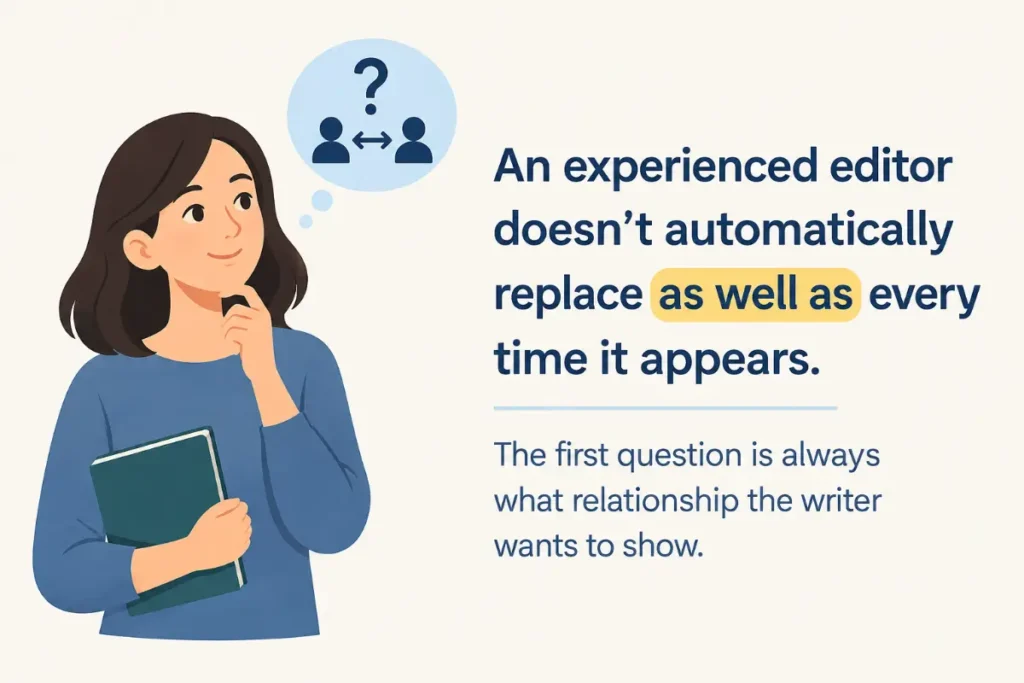
An experienced editor doesn’t automatically replace as well as every time it appears. The first question is always what relationship the writer wants to show. If two ideas are equal then and may be the cleanest choice. If one element accompanies another then along with may be better. For formal addition in a report in addition to can provide useful precision. Grammar tools may suggest alternatives based on sentence structure but they can’t always judge the writer’s intended emphasis. Read the sentence for meaning first and style second.
Many readers also check it means a lot alternatives for Natural English.
Conclusion
As well as alternatives give you more control over tone clarity and sentence structure. The simplest choice is often and when two ideas have equal weight. Along with works well for accompaniment while in addition to gives formal writing a clear sense of addition. Also and besides are useful in everyday English while additionally fits more formal contexts.
The important point is that these expressions aren’t perfect substitutes in every sentence. Each one has its own grammatical role and shade of meaning. Choosing the right expression can make a sentence cleaner without making it sound forced.
A practical editing tip is to read your paragraph aloud after drafting it. If the same phrase keeps appearing listen for places where and, also, along with, or another natural alternative would express the idea more directly. Good variation should improve the writing rather than simply change words for the sake of change.
FAQs
What is the best alternative to as well as?
The best alternative depends on the sentence. And is usually the simplest choice when two ideas have equal importance. Along with works well for accompaniment. In addition to suits formal writing. Also is useful for adding another action or fact. Besides works well for an additional point or reason. The right option depends on meaning and tone rather than vocabulary alone.
Is and always the same as as well as?
And and as well as can have similar meanings but they aren’t identical in every sentence. And normally presents two elements as equal. As well as can place more emphasis on the first element or introduce an additional activity. For simple noun lists they may be interchangeable. For more complex structures the grammatical difference becomes more noticeable.
Can I use in addition to instead of as well as?
Yes. In addition to can replace the phrase in many sentences when the meaning involves adding another person thing action or idea. It has a more formal tone and works particularly well in academic and professional writing. Remember that a verb following in addition to normally takes the ing form because to functions as part of the prepositional phrase.
Is along with a good alternative?
Along with is an excellent alternative when you want to show that someone or something accompanies another person or thing. It doesn’t always create exactly the same emphasis as and. For example the manager arrived along with her assistant makes the manager the main subject while presenting the assistant as an accompanying person. That distinction can be useful in careful writing.
Is as well as formal English?
Yes. As well as is standard English and works in both formal and informal contexts. You can use it in everyday conversation academic writing business communication and professional documents. The key issue isn’t formality. It’s sentence structure and meaning. In some formal contexts in addition to may provide a more explicit sense of addition but the original phrase remains completely acceptable.
What is a simple synonym for as well as?
And is usually the simplest synonym when you are connecting two equal ideas. Also can work when adding another action or fact. Along with is useful for people or things appearing together. In addition to is a stronger choice for formal writing. There isn’t one universal synonym because each expression creates a slightly different relationship between the ideas.
Which alternative sounds most natural in conversation?
And and also usually sound the most natural in everyday American conversation. Besides and plus are also common in relaxed speech. Along with works naturally when talking about people or things that accompany something else. More formal choices such as additionally and in addition to are correct but may sound unnecessarily formal in casual conversation.
How can I avoid repeating as well as in an article?
First decide what the sentence actually means. Use and for equal ideas. Use also for another action or fact. Choose along with for accompaniment. Use in addition to for formal addition. Try besides when introducing another point. The goal isn’t to avoid one phrase at all costs. The goal is to create clear sentences with natural rhythm and accurate meaning.