

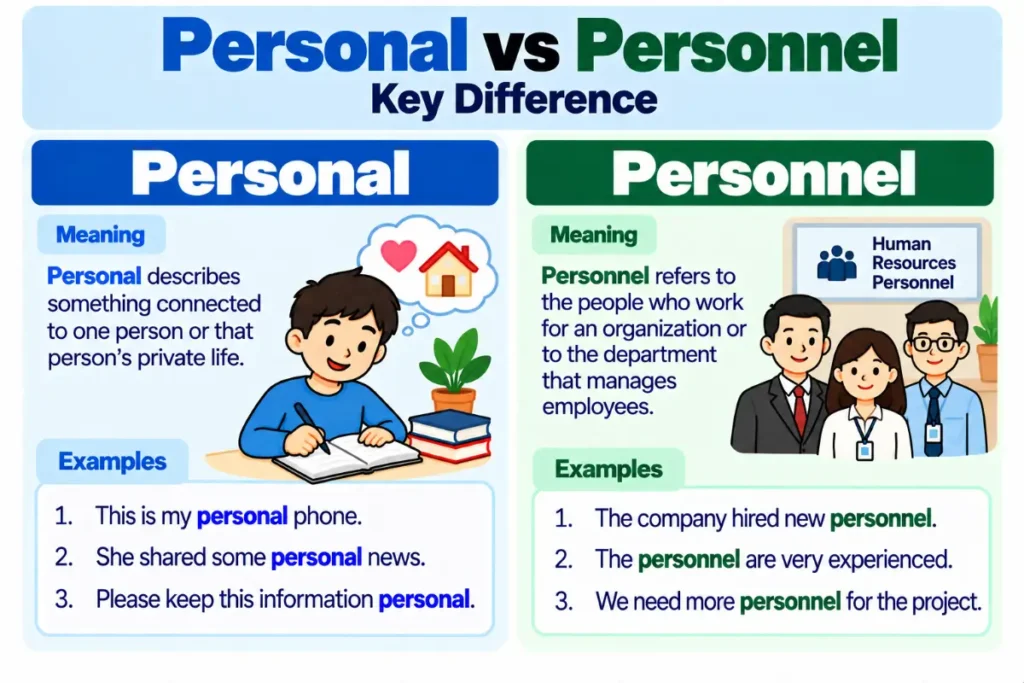
The words personal and personnel look similar, but they mean different things. Personal describes something related to an individual, such as personal information, personal space, or a personal opinion. Personnel refers to the people who work for an organization, such as company employees, military staff, or hospital workers.
The confusion often starts with spelling and pronunciation. Both words share the same opening letters, and both relate to people in some way. However, using one in place of the other can change the meaning of a sentence. For example, personal records are records about an individual, while personnel records are employment records maintained by an organization.
Knowing the difference helps you write clearer emails, complete job applications, prepare reports, and avoid embarrassing mistakes in professional communication. The good news is that you don’t need to memorize a complicated grammar rule. You only need to understand what each word describes and recognize the context in which it belongs.
This guide explains their meanings, pronunciation, grammar, origins, regional usage, and common mistakes. You’ll also find practical examples and editing tips to help you choose the right word with confidence.
For another common grammar confusion, see According to Alternatives for Clearer Writing.
Short Answer
Personal is an adjective that describes something belonging to, relating to, or affecting an individual. Personnel is a noun that refers to the employees or staff of an organization. For example, a personal phone call concerns an individual, while personnel management involves managing employees. Both words are correct, but they aren’t interchangeable.
Comparison Table
| Feature | Personal | Personnel |
|---|---|---|
| Meaning | Related to an individual or private life | Employees or staff in an organization |
| Part of speech | Adjective | Noun |
| Pronunciation | PUR suh nul | PUR suh NEL |
| Main function | Describes a person or something connected to them | Names a group of workers |
| Common contexts | Personal opinions, personal space, personal details | Personnel files, personnel policies, military personnel |
| Formality | Used in formal and informal English | Common in professional and official English |
| Example | She shared her personal opinion. | The hospital hired additional personnel. |
What Does Personal Mean?
Personal is an adjective that describes something connected to a particular person. It can refer to their private life, individual views, belongings, relationships, feelings, or direct involvement in a matter.
You use this word when you want to show that something belongs to an individual or concerns them directly. A personal email, for example, is meant for private communication rather than general business use. A personal opinion expresses what one person thinks instead of presenting a statement as an established fact.
The word can also describe direct involvement. If a manager takes a personal interest in an employee’s progress, the manager pays individual attention to that person’s development.
Common Uses of Personal
- Private matters. Personal information includes details such as your home address, phone number, and private records.
- Individual opinions. A personal opinion reflects someone’s own beliefs or judgment.
- Relationships. Personal relationships include connections with friends, relatives, and other people in someone’s private life.
- Individual belongings. Personal belongings are items owned or used by an individual.
- Direct involvement. Personal attention means giving someone individual care or consideration.
- Individual needs. Personal preferences describe what someone likes or chooses for themselves.
Consider the sentence, I need some personal time after work. The word describes time set aside for the individual’s own needs. It doesn’t refer to a group of employees.
What Does Personnel Mean?
Personnel is a noun that refers to the people employed by an organization or assigned to a particular service. You might see it in businesses, hospitals, schools, government departments, emergency services, and the military.
For example, a company may hire more personnel during a busy season. A hospital may need additional medical personnel during an emergency. In both cases, the word refers to people performing work or duties.
The term can also refer to a department that manages employment matters. A personnel department may handle hiring, employee records, workplace policies, and other staff related tasks. Many modern organizations use human resources or HR for this department, although personnel remains common in established expressions and official language.
Common Uses of Personnel
- Company employees. The company needs additional personnel to meet customer demand.
- Military staff. Military personnel may include service members working in different roles.
- Medical workers. Medical personnel help deliver patient care and support hospital operations.
- School staff. School personnel may include teachers, administrators, and support workers.
- Employment records. Personnel files contain work related information about employees.
- Staff management. Personnel policies set out rules and procedures for employees.
The key point is that personnel refers to a group of people in a work or service setting. It doesn’t describe something private or individual.
Key Differences Explained
Meaning and Purpose
The clearest difference is the job each word performs. Personal describes something connected to an individual, while personnel identifies a group of workers.
Compare these sentences.
- The manager reviewed my personal goals.
- The manager reviewed the personnel schedule.
In the first sentence, the goals belong to or concern an individual. In the second, the schedule relates to staff members and their work arrangements.
Grammar and Part of Speech
Personal is an adjective. It normally appears before a noun or after a linking verb.
Examples include personal account, personal decision, and the matter is personal.
Personnel is a noun. It can act as the subject or object of a sentence.
For example, Personnel are available to help visitors. Here, the noun identifies the workers who can provide assistance.
Spelling
The words share several letters, but their endings differ.
- Personal ends with al.
- Personnel ends with nel.
This small spelling difference carries a major change in meaning. Adding or removing letters can turn a description of private life into a reference to an organization’s workforce.
Pronunciation
The words also differ in their final sounds and stress.
Personal is commonly pronounced with three syllables and stress on the first syllable. Personnel also has three syllables, but the final syllable receives the main stress.
That change in stress can help you identify the intended word during conversation.
Formality and Context
Both words appear in formal writing and everyday speech. However, personnel is more common in workplace policies, official reports, military communication, and organizational documents.
Personal appears across a much wider range of situations, from casual conversations to academic writing and legal documents.
Regional Usage
The distinction remains the same in American and British English. Both varieties use personal for individual matters and personnel for employees or staff. The words aren’t regional alternatives for each other.
Which Word Is Correct?
Both words are correct. The right choice depends on what you want to say.
Use personal when describing an individual’s private life, preferences, property, feelings, or direct involvement. Use personnel when referring to employees, staff members, or a group of workers within an organization.
For example, personal records might include private details about someone’s life. Personnel records usually concern employment, such as job history, training, performance reviews, or workplace information.
The grammar offers another useful clue. If you need an adjective to describe a noun, personal may fit. If you need a noun referring to a workforce, personnel is usually the right choice.
English dictionaries treat these as separate words with separate definitions. Neither spelling is an incorrect version of the other.
Ten Natural Example Sentences
The following examples show how each word works in everyday and professional situations.
- Please keep your personal belongings in the locker provided.
- I don’t share personal information with people I don’t know.
- Her personal opinion differs from the view held by the rest of the team.
- He uses his personal laptop for freelance projects.
- The teacher asked students to write a personal reflection about the book.
- The hospital needs more personnel to support the emergency department.
- All military personnel must follow the safety procedures.
- The company hired additional personnel before the holiday season.
- Please contact the personnel department if you have questions about your employment records.
- Airport personnel helped passengers find the correct departure gate.
Notice how the meaning changes with the context. The first five examples describe individual matters or experiences. The remaining examples refer to people working in an organization or service.
Common Mistakes and Misspellings
Using Personnel Instead of Personal
Incorrect: I need to discuss a personnel matter about my private life.
Better: I need to discuss a personal matter about my private life.
The first sentence suggests a workplace staffing issue. The second clearly refers to a private concern.
Using Personal Instead of Personnel
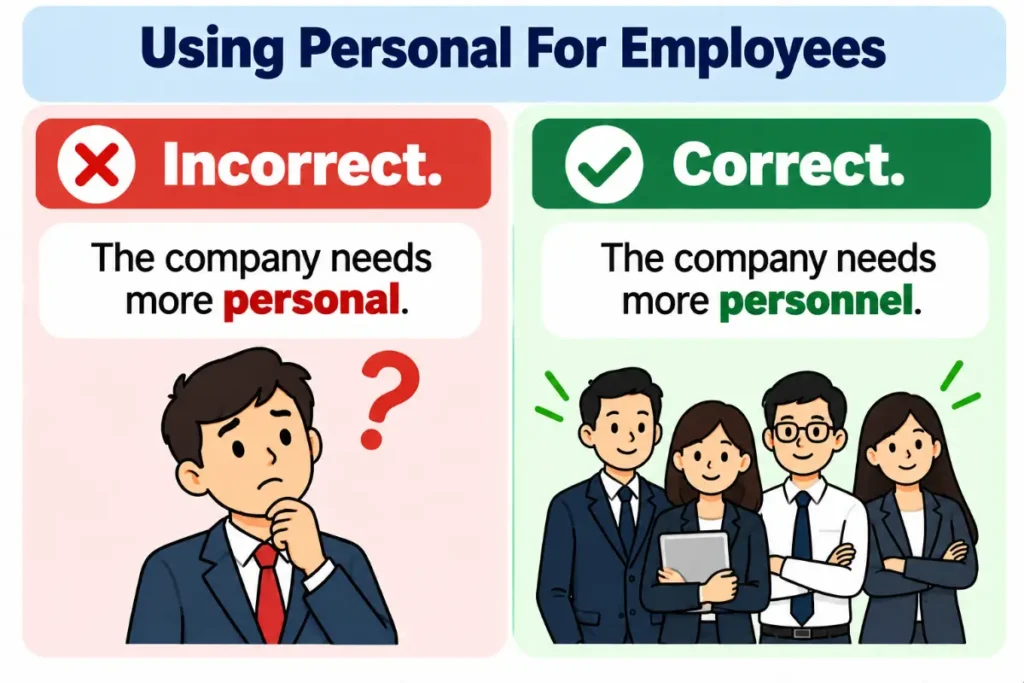
Incorrect: The hospital hired more personal for the night shift.
Correct: The hospital hired more personnel for the night shift.
Here, the sentence refers to workers. The noun personnel expresses that meaning, while personal is an adjective.
Confusing Personal Files With Personnel Files
These phrases look similar, but they don’t mean the same thing.
- Personal files are files belonging to or maintained by an individual. Their contents depend on the context.
- Personnel files are employment records kept about staff members.
A personnel file might contain work history, training records, or performance reviews. A personal file might contain an individual’s own documents.
Treating Personnel as an Adjective
Because personnel appears before nouns in phrases such as personnel office and personnel records, some readers assume it functions as an adjective. In these expressions, it generally acts as a noun used to modify another noun.
For example, personnel records means records related to employees. The word remains a noun even though it appears before records.
Forgetting the Final Syllable Stress
Some speakers pronounce both words too similarly. This can make them harder to distinguish in conversation, especially in noisy settings.
Practice saying personal with stress at the beginning and personnel with stress at the end. The difference in rhythm helps separate their meanings.
Learn the difference in every day vs everyday: Meaning and Correct Usage.
Pronunciation Guide
The two words share a similar opening sound, but their stress patterns differ.
How to Pronounce Personal
IPA: /ˈpɝːsənəl/ in a common American English transcription.
Syllables: per • son • al.
Easy guide: PUR suh nul.
The main stress falls on the first syllable. Say the opening syllable clearly, then let the remaining sounds flow naturally.
Example: That is my personal choice.
How to Pronounce Personnel
IPA: /ˌpɝːsəˈnɛl/ in a common American English transcription.
Syllables: per • son • nel.
Easy guide: pur suh NEL.
The main stress falls on the final syllable. The last part should sound stronger than the opening.
Example: The personnel arrived before the event began.
A Simple Pronunciation Practice
Say these pairs aloud.
- Personal information.
- Personnel information.
The first phrase usually refers to information about an individual. The second is less common on its own and may refer to information about staff. In employment contexts, personnel records is a more natural phrase.
Don’t rely on sound alone. Pronunciation can vary slightly among speakers, so use the sentence’s meaning and grammar as additional clues.
Etymology and Word Origin
The words have related historical roots, which helps explain their similar appearance. However, their modern meanings have developed along different paths.
The Origin of Personal
Personal entered English through French and Latin forms associated with a person. Its history is linked to the Latin word persona, which referred to a person, character, or role.
Over time, the adjective came to describe matters connected to an individual. Modern English uses it for private information, individual preferences, direct involvement, and other person related ideas.
This history fits the word’s present function. A personal choice is a choice made by or relevant to a particular person.
The Origin of Personnel
Personnel came into English through French personnel, a term associated with people employed or serving in an organization. Its modern use focuses on the workforce rather than the private life of one individual.
The word became established in administrative, military, and business language. Today, it remains useful in phrases involving staff, employment records, workforce planning, and organizational management.
Why the Words Look Similar
Both words are connected to the idea of a person, but their grammatical roles differ. One describes a person related quality or matter. The other names a group of people serving or working in an organization.
The shared historical connection explains the resemblance. It doesn’t make the words interchangeable in modern English.
Regional Usage
American English
Both words are standard in the United States. Personal is widely used in daily conversation, education, business, and formal documents. Common expressions include personal information, personal space, and personal responsibility.
Personnel appears frequently in workplaces and official settings. Americans may use staff or employees in everyday speech because those terms often sound more direct.
For example, an office manager might say, We need more staff for the afternoon shift. A formal report might instead say, Additional personnel are required for the afternoon shift.
British English
British English uses the same distinction. Personal describes individual matters, while personnel refers to workers or staff.
The main difference is often a matter of style rather than meaning. A British organization might use staff in everyday communication and personnel in a formal policy or administrative document.
Neither word becomes incorrect simply because the speaker is British.
Australian English
Australian English follows the same standard distinction. Personal relates to an individual, and personnel refers to employees or workers.
The preferred wording can vary by workplace and situation. In ordinary conversation, staff is often simpler than personnel, but the meaning of each of the two main words remains stable.
Canadian English
Canadian English also follows the same distinction. Writers use personal for individual matters and personnel for an organization’s workforce.
There is no special Canadian spelling rule that makes one word a replacement for the other. Choose the word based on meaning and sentence structure.
Grammar Rules and Part of Speech
Understanding the grammatical role of each word makes the choice easier.
How to Use Personal in a Sentence
Because personal is an adjective, it usually modifies a noun.
Common patterns include:
- Personal + noun. Personal details, personal choice, personal account.
- Be + personal. The discussion became personal.
- Seem or feel + personal. The criticism felt personal.
- Adverb + personal. Deeply personal, highly personal.
The word can describe something private, individual, or directly connected to a person. The exact meaning depends on the noun and the wider sentence.
For example, She took the criticism personally uses the related adverb personally, not the adjective personal. This distinction matters because adjectives and adverbs perform different grammatical jobs.
How to Use Personnel in a Sentence
Personnel is a noun that refers to employees or staff. It can function as a subject, object, or part of a longer noun phrase.
Examples include:
- Subject. Personnel are preparing the building for inspection.
- Object. The company recruited new personnel.
- Noun modifier. The personnel office handles staff records.
- Formal organizational language. All personnel must complete the required training.
In American English, personnel is generally treated as a collective plural noun referring to the workers who make up a group. A plural verb is common when the sentence emphasizes the individual people involved, as in The personnel are ready.
If you want a simpler sentence, use employees or staff members. These alternatives can make the intended meaning clearer to a broad audience.
Can Personnel Be Singular?
The word personnel usually refers to a group of people, not one employee. If you mean one worker, use employee, staff member, worker, or a more specific job title.
For example, write One employee is responsible for the report, rather than One personnel is responsible for the report.
This is a useful distinction in formal writing. It keeps the sentence grammatical and avoids making a group noun stand for a single person.
Can Personal Be Used as a Noun?
In ordinary modern English, personal is mainly an adjective. It also appears in established expressions where a noun is understood, such as personals in certain classified advertising contexts. That use is specialized and shouldn’t be confused with its usual adjective function.
For everyday writing, use personal to describe something and use a suitable noun to name the thing itself.
Real Life Usage Examples
The best way to understand the difference is to see how the words work in different settings.
Daily Conversation
Personal: I don’t want to discuss my personal life at dinner.
Personnel: The event personnel showed us where to sit.
The first example concerns someone’s private life. The second identifies people working at an event.
Email and Workplace Communication
Personal: Please update your personal contact information in the employee portal.
Personnel: Contact the personnel office if you need help with your employment records.
These sentences show why context matters. Contact information may belong to an individual, while employment records relate to the organization’s relationship with its workers.
Academic Writing
Personal: The essay explains how personal experience can shape a person’s view of history.
Personnel: The study examined how hospital personnel responded to changes in workplace procedures.
The first sentence uses an adjective to describe experience. The second uses a noun for a group of workers.
News and Journalism
Personal: The public figure released a statement about a personal decision.
Personnel: Officials sent emergency personnel to assist residents after the storm.
News reports often use personnel when describing emergency response teams, military units, or government workers. The adjective personal appears when the story concerns an individual’s own affairs.
Literature and Storytelling
Personal: She kept the letter because it held personal meaning for her.
Personnel: The captain called the personnel together before the ship departed.
In storytelling, the first example highlights an individual’s emotional connection. The second describes a group of people gathered for a shared duty.
Related and Confused Terms
Several related words can help you express the same ideas more precisely.
Personal Information
Information connected to an identifiable individual. Examples include a person’s address, phone number, or other private details.
Personnel Records
Employment documents about a worker. These may include training history, performance reviews, and job related records.
Staff
A general term for the people working for an organization. In everyday American English, staff often sounds more natural than personnel.
Employees
People who work for an employer. This is a clear alternative when you want to refer directly to people who have jobs with a company or organization.
Human Resources
The business function that manages hiring, employee support, training, workplace policies, and related matters. Many organizations use HR instead of personnel department.
Person
An individual human being. This noun is closely related to both words, but it doesn’t carry the same meaning as a workforce.
Personally
An adverb meaning in one’s own view, in person, or with direct individual involvement. For example, I personally reviewed the application.
Private
An adjective describing something not meant for public access or general knowledge. Private information and personal information can overlap, but they aren’t always identical in meaning.
Expert Editor Insight
An experienced editor checks the meaning of the sentence before changing either spelling. If a writer describes a private opinion, individual choice, or personal experience, personal usually fits. If the sentence refers to employees, staffing, or an organizational workforce, personnel is the likely choice. Spelling tools may catch a typo, but they can miss a wrong word that is spelled correctly. Reading the sentence for meaning is the best final check.
Key Takeaways
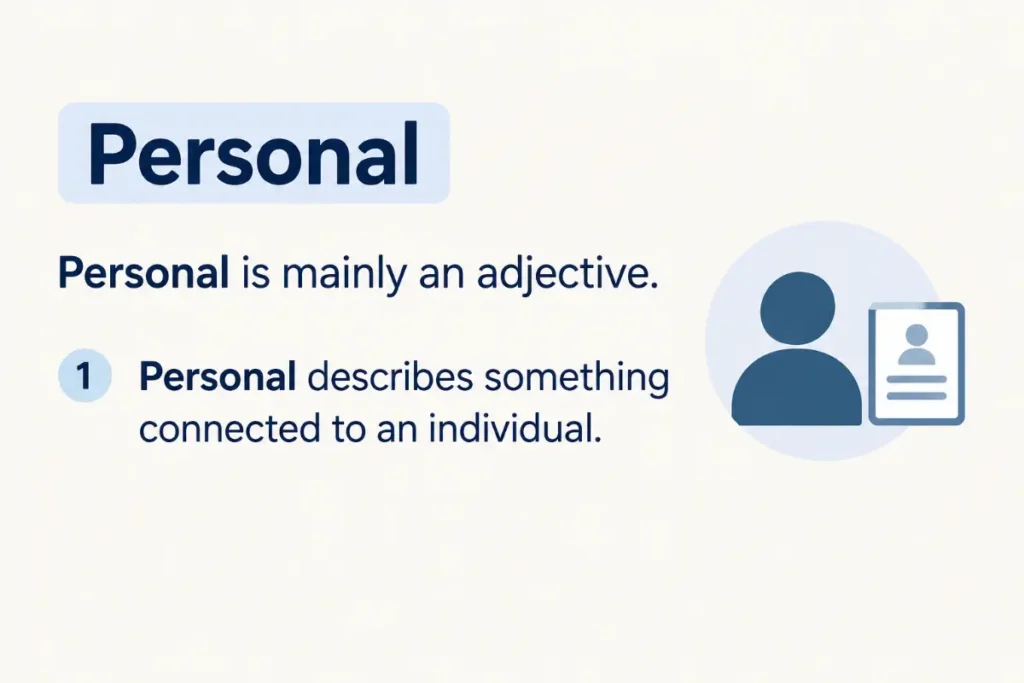
- Personal is mainly an adjective.
- Personal describes something connected to an individual.
- Personal can also refer to private matters or individual experiences.
- Personnel is a noun.
- Personnel commonly means employees or workers as a group.
- Personnel can also refer to an employee related department.
- Personal information concerns an individual.
- Personnel records usually concern employees within an organization.
- Personal has stronger stress near the beginning.
- Personnel has stronger stress on the final syllable.
- In casual American English, employees or staff may sometimes sound more natural than personnel.
- The simplest memory rule is person for personal and people at work for personnel.
Many readers also check jynx vs jinx Which Word Is Correct in 2026.
Conclusion
The difference between personal vs personnel comes down to meaning and grammar. Personal describes something connected to an individual, such as private information, opinions, or experiences. Personnel refers to the employees or staff of an organization. Both are standard English words, but they can’t replace each other without changing the sentence’s meaning.
Remember one simple rule. If you’re describing a person’s private life or individual experience, choose personal. If you’re talking about workers or staffing, choose personnel. When editing, check the meaning of the entire sentence instead of relying on spelling tools alone. That small habit will help you write more clearly and avoid a common mistake in professional and everyday communication.
FAQs
Is Personal or Personnel the Correct Word?
Both are correct English words. Personal is an adjective that describes something related to an individual. Personnel is a noun that refers to the employees or staff of an organization. Choose based on meaning, not on which spelling looks more familiar. A private matter is personal, while a group of workers is personnel.
What Does Personnel Mean in a Job Description?
In a job description, personnel usually refers to employees or staff members within an organization. For example, a personnel manager may handle hiring, employment records, workplace policies, or staff support. Some organizations now prefer the terms human resources or HR. The exact job duties depend on the employer and the position.
What Is a Personal Matter?
A personal matter is an issue that concerns an individual’s private life, feelings, relationships, or circumstances. For example, someone might say, I need to take time off for a personal matter. The phrase doesn’t usually explain the details because the speaker may want to keep the situation private.
Why Do People Confuse These Two Words?
The words look and sound similar, and both relate to people. Their different grammatical roles make the distinction easy to overlook when writing quickly. However, the endings and meanings differ. Learning a few common phrases, such as personal information and personnel records, can help you recognize the right form more quickly.
How Do You Pronounce Personal and Personnel?
In American English, personal is commonly pronounced PUR suh nul, with stress on the first syllable. Personnel is pronounced pur suh NEL, with the main stress on the last syllable. The similar opening sounds can cause confusion, so listen for the stronger syllable and use the sentence’s meaning to identify the intended word.
Can Personal and Personnel Be Used Interchangeably?
No. They serve different grammatical purposes and express different meanings. You can describe a private opinion as personal, but you can’t normally call it personnel. Likewise, a company may hire personnel, but it wouldn’t usually hire personal. If the sentence refers to one worker, use employee or staff member instead.
What Is a Synonym for Personnel?
Useful alternatives include staff, employees, workers, and team members. The best choice depends on context. Employees clearly refers to people employed by an organization, while staff is common in everyday workplace communication. Personnel can sound more formal and is often used in administrative, military, and official settings.
Is Personnel Appropriate in Formal Writing?
Yes. Personnel is appropriate in formal reports, workplace policies, government documents, and other organizational writing. However, it can sound formal or bureaucratic in casual conversation. If you want a simpler word, staff or employees may be easier for readers to understand. Choose the term that best matches your audience and purpose.