
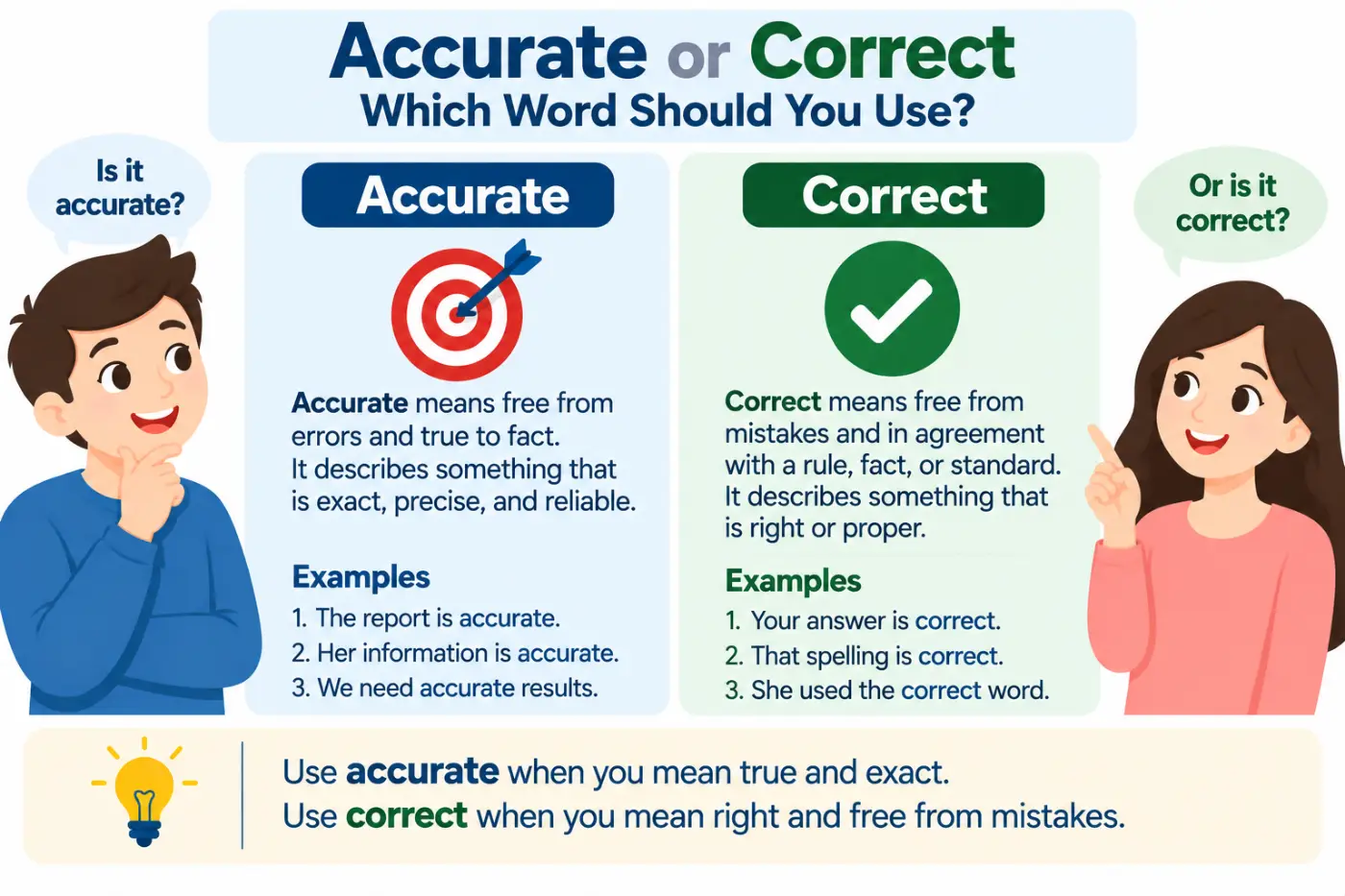
Choosing between accurate or correct can be tricky because both words describe something that is right or free from error. However, they do not always mean the same thing. Accurate usually means precise, reliable, or close to the truth, while correct means right according to a fact, rule, standard, or accepted answer.
For example, a weather report can be accurate because its forecast closely matches what happens. A student’s answer can be correct because it follows the facts or gives the expected solution. You can also describe a statement as both accurate and correct, but the words emphasize different qualities.
The confusion often comes from situations where precision and correctness overlap. A measurement may be correct but not very precise, while an answer may be accurate in its details and also correct according to a rule. Understanding the distinction helps you choose the right adjective without making your writing sound awkward. This guide explains their meanings, grammar, pronunciation, common expressions, and practical examples so you can use both words with confidence.
You may also want to read chalet vs chateau Meaning and Key Differences.
Quick Answer
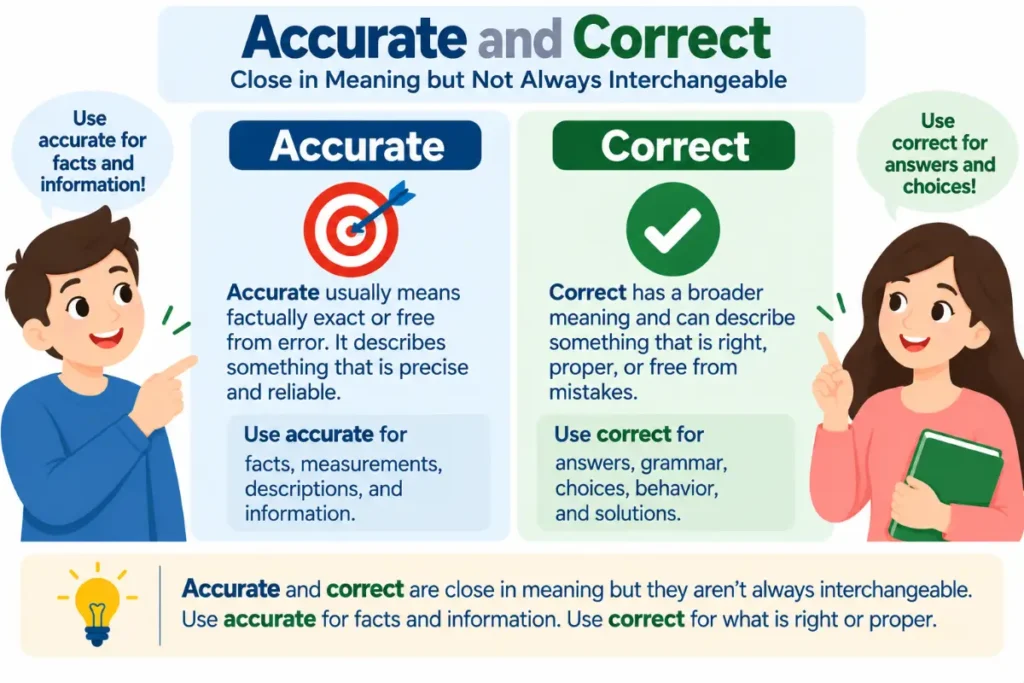
“Accurate” means precise, faithful to the facts, or close to the true value. “Correct” means right according to facts, rules, standards, or accepted answers. Use “accurate” when emphasizing precision and reliability. Use “correct” when emphasizing that something is right and contains no relevant error.
Comparison Table
| Feature | Accurate | Correct |
|---|---|---|
| Main meaning | Precise and faithful to the facts | Right or free from error |
| Part of speech | Adjective | Adjective |
| Main focus | Precision and reliability | Truth, rules, and standards |
| Common use | Reports, measurements, records, descriptions | Answers, spelling, grammar, behavior |
| Formality | Neutral and formal | Neutral and formal |
| Common phrases | Accurate information, accurate measurement, accurate description | Correct answer, correct spelling, correct method |
| Example | The map is accurate. | Your answer is correct. |
| Related noun | Accuracy | Correctness |
| Common adverb | Accurately | Correctly |
| Opposite | Inaccurate | Incorrect or wrong |
Meaning and Definition
What Does Accurate Mean?
“Accurate” is an adjective that describes something that is correct in its details, precise, and faithful to the facts or actual situation. It often suggests that information, measurements, descriptions, or results closely match reality.
For example, an accurate clock shows the right time. An accurate report gives a reliable account of events. An accurate measurement is close to the actual value being measured.
The word is especially useful when the quality of information or the level of precision matters. You might say that a map is accurate because it shows roads and locations correctly, or that a witness gave an accurate description because the details match what happened.
Common expressions include:
- Accurate information.
- Accurate data.
- Accurate measurements.
- Accurate records.
- Accurate description.
- Accurate prediction.
- Accurate calculation.
- Historically accurate account.
The adjective often appears before a noun, as in “an accurate report.” It can also follow a linking verb, as in “The report is accurate.”
It has a close connection with reliability. If information is accurate, readers can trust that it represents the facts with little or no meaningful error. However, accuracy does not always mean that every tiny detail is perfect. In ordinary language, the word can describe information that is sufficiently close to the truth for its purpose.
What Does Correct Mean?
“Correct” is an adjective that means right, proper, or free from an error. It describes something that agrees with facts, rules, instructions, accepted standards, or an expected answer.
For example, a student gives a correct answer when the response matches the required solution. A person uses correct grammar when the sentence follows accepted grammatical rules. A driver follows the correct route when the route takes them to the intended destination.
The word has a broad range of uses. It can describe facts, spelling, calculations, behavior, methods, choices, and instructions.
Common expressions include:
- Correct answer.
- Correct spelling.
- Correct grammar.
- Correct procedure.
- Correct information.
- Correct address.
- Correct decision.
- Correct method.
“Correct” can also function as a verb. In that role, it means to fix an error or make something right. For example, “Please correct the spelling mistake” asks someone to fix the mistake.
As an adjective, it tells readers that something meets the relevant standard. As a verb, it describes the act of fixing an error. This difference is important because the same spelling can perform different grammatical jobs.
Can Something Be Accurate but Not Correct?
Yes, depending on the context and the standard being used. A statement can contain precise details but still reach the wrong conclusion. For example, a report may accurately describe the measurements collected during an experiment but incorrectly explain what those measurements mean.
Similarly, a calculation can use accurate measurements but apply the wrong formula. The measurements may be accurate, yet the final answer may be incorrect.
This distinction is especially useful in science, research, mathematics, and data analysis. Accuracy describes the quality of the information or measurement, while correctness often describes whether the result or conclusion meets the relevant standard.
Can Something Be Correct but Not Accurate?
Yes. Something can be broadly right but lack precision or detail. Imagine someone asks how far a town is from a city, and you answer, “About 50 miles.” If the actual distance is 49.7 miles, your answer is correct for a general conversation, although it is not highly precise.
The same idea applies to summaries. A short summary can correctly describe the main point without including every detail. It may be correct as a general explanation but less accurate than a detailed account.
The context determines how much precision is needed. In a casual conversation, a rounded figure may be perfectly acceptable. In engineering or scientific work, that same level of detail may not be accurate enough.
Key Differences Explained
1. Precision Versus Rightness
The most useful distinction is the quality each adjective emphasizes.
“Accurate” focuses on how closely something matches the facts, actual value, or original information. It is especially useful for measurements, reports, records, descriptions, and predictions.
“Correct” focuses on whether something is right according to a rule, fact, instruction, or standard. It commonly describes answers, spellings, grammar, methods, and decisions.
Consider these examples:
- The scientist recorded accurate measurements.
- The scientist used the correct formula.
The first sentence describes the precision of the measurements. The second describes the suitability of the formula. Both qualities matter, but they are not identical.
2. Meaning and Context
The two adjectives often overlap, especially when describing information. However, some expressions strongly favor one word.
You normally say “correct spelling,” “correct answer,” and “correct grammar.” These phrases focus on following an accepted rule or giving the right response.
You normally say “accurate measurement,” “accurate description,” and “accurate record.” These expressions focus on precision and faithfulness to reality.
Some nouns work naturally with both. For example, “accurate information” and “correct information” are both acceptable. The first emphasizes reliability and factual precision. The second emphasizes that the information is right rather than wrong.
3. Grammar and Part of Speech
Both words function as adjectives, so they can describe nouns or follow linking verbs.
Examples:
- The information is accurate.
- Your answer is correct.
- We need an accurate report.
- Please provide the correct address.
However, “correct” also functions as a verb. You can correct a mistake, correct a record, or correct someone’s misunderstanding. “Accurate” does not normally function as a verb in modern everyday English.
The related nouns and adverbs also differ:
| Word | Noun | Adverb |
|---|---|---|
| Accurate | Accuracy | Accurately |
| Correct | Correctness | Correctly |
4. Formality and Tone
Both adjectives are suitable for formal and informal writing. Neither is automatically more professional than the other. The right choice depends on what you are describing.
In an email, you might ask someone to provide the correct file. In a research paper, you might discuss the accuracy of the collected data. Both sound natural because each word fits its subject.
Replacing one with the other just to make a sentence sound more formal can weaken its meaning. Clear writing depends on choosing the word that communicates the intended idea.
5. Accuracy in Measurements and Data
“Accurate” is particularly important in technical settings. Measurements, test results, records, and calculations may need to match a real value as closely as possible.
For example, a digital thermometer should provide an accurate temperature reading. A financial report should contain accurate figures that reflect the recorded transactions.
The word is also common in discussions of data quality. Accurate data represents the real situation faithfully. Inaccurate data may contain errors, missing details, or misleading values.
6. Correctness in Rules and Standards
“Correct” is often the better choice when a rule or accepted standard determines the answer.
For example, a sentence can have correct punctuation, a student can select the correct option, and a worker can follow the correct safety procedure.
The standard may be grammatical, mathematical, legal, technical, or practical. The central question is whether the action or result meets that standard.
7. Pronunciation and Spelling
The words have different pronunciations and spelling patterns.
“Accurate” has three syllables in common American pronunciation: AC-cu-rate. “Correct” has two syllables: cor-RECT. The final syllable receives the main stress in both words.
There is no spelling conflict between them. Both are standard English words, and neither is an incorrect form of the other.
8. Regional Usage
American, British, Canadian, and Australian English use both words with essentially the same meanings. There is no major regional spelling difference that changes the choice.
Differences in preference usually come from the subject and writing style rather than the country. A British scientist may discuss accurate measurements, just as an American teacher may mark a correct answer.
Which Word Is Correct?
Both words are correct. The choice depends on the meaning of the sentence rather than a spelling rule.
Use “accurate” when you want to show that information, a measurement, or a description is precise and faithful to the facts. Use “correct” when you want to show that an answer, spelling, method, or action follows the right standard.
Compare the following examples:
- Correct: The witness gave an accurate description of the car.
- Correct: The student chose the correct answer.
- Correct: The technician recorded an accurate temperature.
- Correct: Please use the correct password.
- Correct: The report contains accurate financial information.
Some sentences allow both adjectives, but the emphasis changes. “Accurate information” highlights its reliability and factual detail. “Correct information” highlights that it is right rather than mistaken.
A useful editing rule is to identify the standard you are judging. If the main concern is precision or closeness to reality, choose “accurate.” If the main concern is rightness according to a rule or expected answer, choose “correct.”
Sentence Examples
The following examples show how both adjectives work in ordinary and professional English.
Ten Natural Examples Using Accurate
- Everyday conversation: The directions were accurate, so we reached the restaurant without any trouble.
- Text message: I checked the address twice to make sure it was accurate.
- Workplace communication: Please make sure the customer records are accurate before sending the report.
- School: The student used an accurate description of the water cycle in her assignment.
- Academic writing: The researchers collected accurate data from several independent tests.
- Formal writing: The final document should provide an accurate account of the events.
- Social situation: His description of the meeting was accurate, although he left out a few minor details.
- Online communication: The website provides accurate information about the product’s features.
- Science: The laboratory needs accurate measurements to produce reliable results.
- News reporting: The journalist worked to provide an accurate summary of the public statement.
These sentences show how the adjective describes information that matches the facts. It works especially well when a reader needs to trust the details being presented.
Ten Natural Examples Using Correct
- Everyday conversation: I think you have the correct key for the front door.
- Text message: Can you confirm that I have the correct meeting time?
- Workplace communication: Please send the correct version of the presentation.
- School: The teacher explained why the second answer was correct.
- Academic writing: The equation gives the correct result when the values are entered properly.
- Formal writing: All applicants must submit the correct identification documents.
- Social situation: She chose the correct restaurant for the group dinner.
- Online communication: Make sure you select the correct option before submitting the form.
- Grammar: The sentence uses the correct verb tense.
- Daily life: Turn left at the next street to follow the correct route.
These examples focus on meeting a requirement or selecting the right option. The word is useful whenever a rule, fact, instruction, or expected result provides a clear standard.
Common Mistakes and Usage Problems
Even fluent English speakers sometimes choose the wrong adjective because the meanings overlap. These five problems are especially common.
1. Using Accurate When You Mean Correct
Awkward: “Your spelling is accurate.”
Better: “Your spelling is correct.”
The first sentence is understandable, but it sounds less natural in ordinary writing. Spelling is generally judged against accepted rules, so “correct” is the usual choice. You can use “accurate” for a transcription or written record when you want to emphasize how faithfully it reproduces the original.
2. Using Correct When You Mean Precise
Less precise: “The instrument gives a correct measurement.”
More natural: “The instrument gives an accurate measurement.”
The first sentence is not necessarily wrong, but the second better expresses the idea of precision. When discussing scientific readings or measurements, accuracy is often the more useful concept.
3. Treating the Words as Exact Synonyms
Awkward: “The report is accurate because it follows the correct formatting rules.”
Clearer: “The report follows the correct formatting rules and contains accurate information.”
Formatting and factual reliability are different qualities. A report can follow every style rule but still contain false information. It can also contain reliable facts while failing to meet a required format.
4. Confusing the Adjective and Adverb Forms
Incorrect: “She explained the process accurate.”
Correct: “She explained the process accurately.”
Use the adverb “accurately” to describe how someone performs an action. The adjective “accurate” describes a noun or follows a linking verb, as in “Her explanation was accurate.”
The same pattern applies to “correct” and “correctly.” Write “The answer is correct,” but “She answered correctly.”
5. Confusing the Noun Forms
Incorrect: “The accuracy of his answer was correct.”
Better: “His answer was correct.”
Also correct: “The accuracy of his measurements was impressive.”
“Accuracy” names the quality of being precise or faithful to the facts. “Correctness” names the quality of being right or free from error. Choose the noun that matches the point you want to make.
A Simple Way to Avoid These Mistakes
Before choosing an adjective, look at the noun it describes and the standard being used to judge it.
- For information that matches the facts, consider “accurate.”
- For an answer that meets the expected standard, consider “correct.”
- For a measurement that is close to the actual value, use “accurate.”
- For spelling, grammar, or a rule based answer, use “correct.”
- For a sentence describing how an action is performed, check if you need “accurately” or “correctly.”
This small check can prevent many word choice problems.
Pronunciation Guide
How Do You Pronounce Accurate?
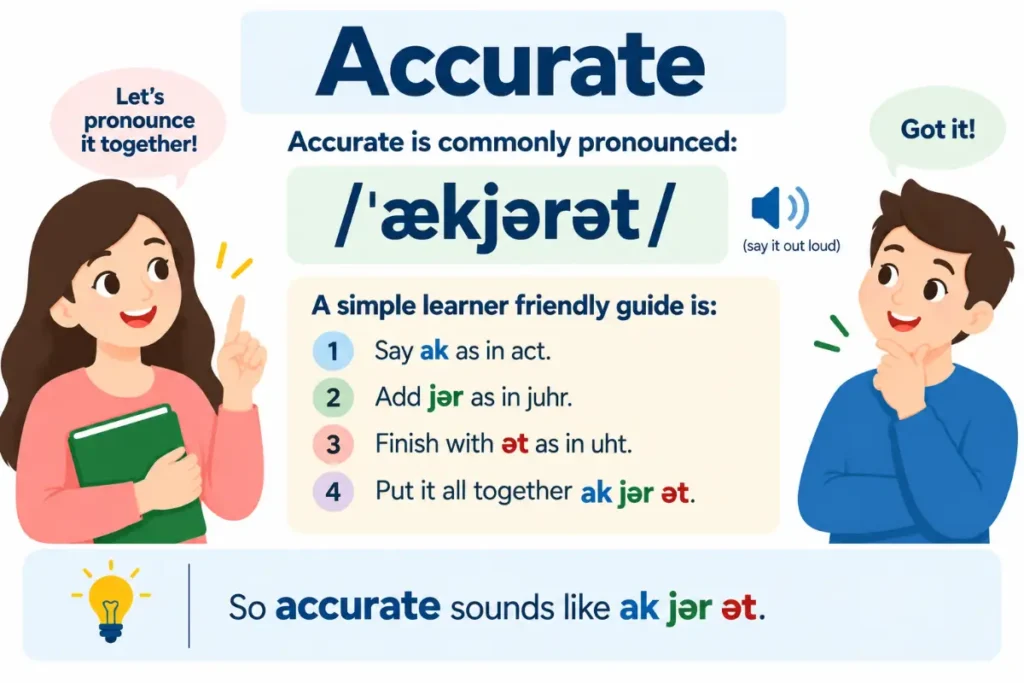
The common American English pronunciation of “accurate” is /ˈæk.jɚ.ət/. It has three syllables:
- AC.
- cu.
- rate.
The main stress falls on the first syllable. A simple guide is “AK-yuh-ruht.” The middle sound is light, and the final syllable is usually unstressed.
A common pronunciation mistake is giving too much stress to the last part of the word. Say the first syllable more strongly to keep the natural rhythm.
How Do You Pronounce Correct?
The American English pronunciation of “correct” is /kəˈrekt/. It has two syllables:
- cor.
- rect.
The stress falls on the second syllable. A simple guide is “kuh-REKT.” The first vowel is usually weak, while the final syllable receives the emphasis.
A common mistake is stressing the first syllable. In standard pronunciation, the second syllable carries the main stress.
Pronunciation Comparison
| Word | IPA | Syllables | Main Stress |
|---|---|---|---|
| Accurate | /ˈæk.jɚ.ət/ | 3 | First syllable |
| Correct | /kəˈrekt/ | 2 | Second syllable |
Pronunciation can vary slightly across English accents, especially in the vowel sounds. However, the syllable count and main stress patterns are useful guides for clear speech.
Still confused? Compare Sleave or Sleeve Which Spelling Is Correct? 2026.
Etymology and Word Origin
The History of Accurate
“Accurate” comes from Latin roots associated with doing something carefully or with attention. It entered English through Latin and later French influence. Its modern sense developed around careful work, precision, and freedom from error.
The related noun “accuracy” refers to the quality of being accurate. Both words are now common in everyday English, education, science, technology, and professional communication.
The historical link to careful work helps explain the modern meaning. An accurate description or measurement reflects attention to detail and a close match with the facts.
The History of Correct
“Correct” comes through French from Latin “corrigere,” meaning to set right or make straight. This root is connected to the modern idea of fixing an error or bringing something into line with a standard.
The word entered English in the Middle Ages and developed its familiar uses as both an adjective and a verb. As an adjective, it describes something that is right. As a verb, it means to fix or improve something that contains an error.
This history also explains the related noun “correction.” A correction is an action or change made to fix a mistake.
What the Word Origins Tell Us
The origins offer a useful memory aid, although modern usage should guide your choice. “Accurate” is connected with care and precision, while “correct” is linked with setting something right.
In practical writing, think of precision for the first adjective and rightness for the second. That simple distinction is more useful than memorizing historical details.
Regional Usage
American English
Both words are standard in American English. “Accurate” is common in discussions about data, reports, measurements, descriptions, and information. “Correct” is common in schoolwork, grammar, spelling, answers, instructions, and decisions.
American speakers may use both words to describe information. For example, “The information is accurate” and “The information is correct” are both natural. The first emphasizes factual reliability, while the second emphasizes that the information is not wrong.
British English
British English uses the same meanings and general grammar. Both adjectives are standard, and there is no major spelling difference between the American and British forms.
British writers also use “accurate” for measurements and descriptions, and “correct” for answers, grammar, and accepted methods. The choice depends on the subject rather than a regional rule.
Australian English
Australian English follows the same distinction. You can describe a record as accurate, a spelling as correct, or a measurement as accurate. Both forms are used in everyday communication and formal writing.
Canadian English
Canadian English also uses both words in the same general way. The difference between precision and rightness remains useful in education, business, research, and daily conversation.
For an audience across these English varieties, you can use the same basic guidance. Neither word has a special regional meaning that changes the central distinction.
Grammar Rules and Part of Speech
Accurate as an Adjective
“Accurate” is an adjective. It describes the quality of a person, thing, statement, record, or result.
It commonly appears in two positions:
- Before a noun: “The company keeps accurate records.”
- After a linking verb: “The records are accurate.”
You can also use it after verbs such as “seem,” “remain,” and “become.” For example, “The description seems accurate” and “The figures remained accurate after the review.”
The word does not normally take a direct object. You would not say “accurate the report” to mean fix the report. Use the verb “correct” for that action.
Correct as an Adjective
As an adjective, “correct” describes something that meets a rule, fact, or accepted standard.
Examples include:
- Before a noun: “She gave the correct answer.”
- After a linking verb: “Your answer is correct.”
- After a linking verb with a complement: “The information appears correct.”
The adjective can also describe behavior or actions that meet social or practical standards. For example, “He followed the correct procedure” or “That was the correct response.”
Correct as a Verb
“Correct” also works as a verb meaning to fix an error or make something right.
Examples:
- Please correct the spelling mistake.
- The editor corrected the punctuation.
- The teacher corrected the student’s calculation.
- We need to correct the address before sending the package.
The verb can take a direct object. You correct a mistake, a document, a record, or an error.
Adverbs and Nouns
The adverb “accurately” describes how an action is performed. For example, “The technician measured the temperature accurately.”
The adverb “correctly” describes an action performed in the right way. For example, “The student answered the question correctly.”
The related nouns are “accuracy” and “correctness.” Accuracy is the quality of precision or factual reliability. Correctness is the quality of being right according to a standard.
Comparisons and Intensifiers
Both adjectives can be modified by words such as “very,” “highly,” and “fairly.”
Examples:
- The report is highly accurate.
- Her answer is completely correct.
- The measurements are fairly accurate.
- That is the most correct option under the stated rules.
In some technical settings, “more accurate” and “most accurate” are useful comparisons. They describe different levels of precision. “More correct” is also grammatically possible, but writers often prefer “more appropriate,” “more suitable,” or “closer to the accepted answer” when comparing choices.
Punctuation and Sentence Structure
Neither adjective requires special punctuation. Place commas according to the structure of the sentence, not the choice of adjective.
For example, “The report is accurate, but it is incomplete” uses a comma before the coordinating conjunction joining two independent clauses. The same punctuation applies in “The answer is correct, but the explanation is unclear.”
Real Life Usage Examples
Daily Conversation
In everyday speech, the choice is usually easy once you identify the meaning.
- “Is this the correct bus for the city center?”
- “The directions were accurate, so we found the house easily.”
The first asks if the bus follows the right route. The second praises directions that matched the actual location.
Email and Workplace Communication
Professional writing often needs both qualities.
- “Please check that the figures in the spreadsheet are accurate.”
- “Use the correct form when submitting your expense claim.”
The first concerns reliable figures. The second concerns following a required process. In workplace writing, using the right adjective makes instructions easier to understand.
Academic Writing
Academic work may discuss factual reliability and the validity of an answer or method.
- “The researchers used accurate measurements to compare the samples.”
- “The correct interpretation of the results depends on the study design.”
The first describes the quality of the data. The second concerns the interpretation that follows the evidence.
News and Journalism
Journalists need to provide accurate accounts and correct errors when they occur.
- “The newspaper published an accurate summary of the council meeting.”
- “The editor issued a correction after discovering an error in the report.”
The first uses the adjective to describe a reliable summary. The second uses the related noun to describe a public fix.
Literature and Storytelling
In fiction and storytelling, both words can help describe facts, memories, or decisions.
- “Her memory of the old house was accurate down to the smallest detail.”
- “He knew the correct answer, but he remained silent.”
The first emphasizes detailed recall. The second describes knowing the right response.
Related and Confused Terms
These eight related words can help you express precision, truth, and correctness more clearly.
1. Precise
“Precise” means exact and carefully defined. It is close to “accurate,” but it often emphasizes the level of detail or exactness. A precise measurement gives a specific value, while an accurate measurement is close to the true value.
2. Exact
“Exact” means completely specific or matching a required value, detail, or form. For example, an exact copy reproduces the original without differences. “Accurate” allows for context dependent degrees of closeness, while “exact” often suggests no difference at all.
3. Right
“Right” is a common alternative to “correct.” It can describe an answer, choice, direction, or action. For example, “You are right” means that your statement is correct. It is often more conversational than “correct.”
4. Wrong
“Wrong” is a common opposite of “correct.” It means mistaken, false, or not suitable for a particular purpose. For example, an incorrect answer is wrong according to the expected solution. “Wrong” is more common in casual speech, while “incorrect” can sound more formal.
5. Inaccurate
“Inaccurate” is the opposite of “accurate.” It describes information, measurements, or descriptions that do not match the facts closely enough. An inaccurate report may contain wrong details, misleading figures, or unreliable information.
6. Incorrect
“Incorrect” is the opposite of “correct.” It means not right according to a rule, fact, or standard. You might describe an incorrect spelling, an incorrect answer, or an incorrect calculation. It is often used in education and formal feedback.
7. Reliable
“Reliable” means dependable or worthy of trust. Reliable information is usually consistent and trustworthy, but reliability and accuracy are not identical. A source may provide information consistently yet still contain errors. Accuracy focuses more directly on factual precision.
8. Valid
“Valid” means acceptable, sound, or supported under a particular rule or system. A valid argument follows logical standards, while a correct answer meets the expected answer criteria. A measurement can be accurate without proving that the method used to obtain it was valid.
Expert Editor Insight
A professional editor checks what the sentence is trying to judge before choosing between these adjectives. For measurements, records, descriptions, and factual details, “accurate” is often the better fit. For answers, spelling, grammar, and methods, “correct” is usually more natural. The words can overlap, so grammar tools may accept both even when one expresses the intended meaning more clearly. A useful editing habit is to replace the adjective temporarily with a short explanation: “close to the facts” or “right according to the rule.” The phrase that fits the sentence will often reveal the better choice.
Key Takeaways
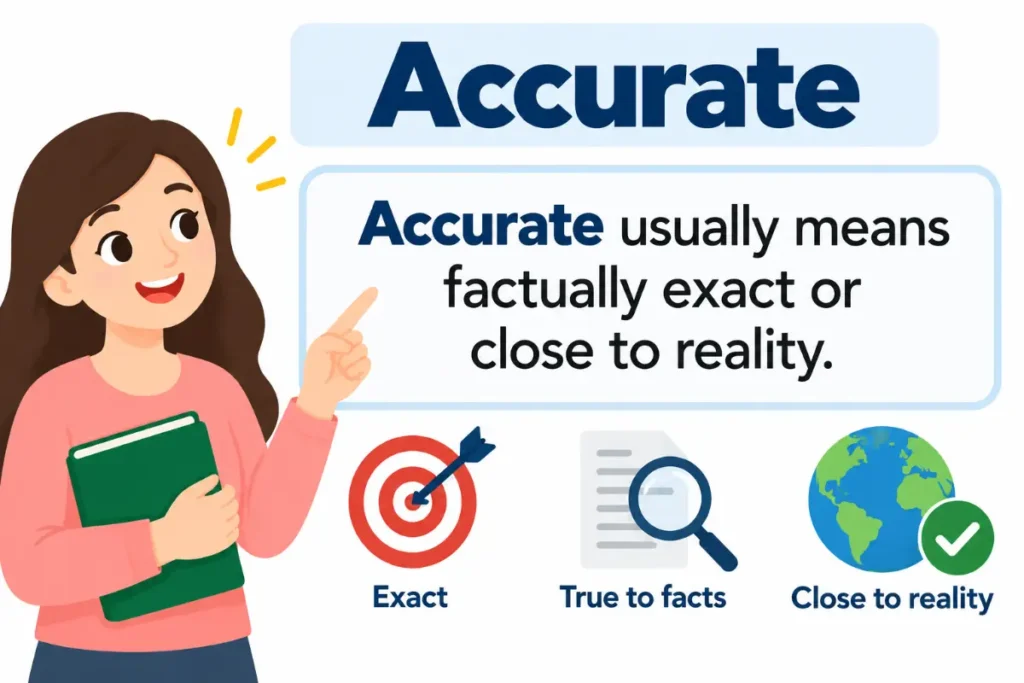
- Accurate usually means factually exact or close to reality.
- Correct usually means right or free from error.
- Accurate commonly describes data measurements descriptions estimates predictions and records.
- Correct commonly describes answers spelling grammar choices procedures and solutions.
- Both words can describe factual information.
- Accurate is closely related to factual precision.
- Correct has a broader meaning connected with rules standards and accepted answers.
- Accuracy and precision aren’t identical.
- The direct opposite of accurate is inaccurate.
- The direct opposite of correct is incorrect or wrong.
- Both words are standard in American English and British English.
- Choose the word based on what you’re actually evaluating.
Many readers also check treet vs treat Correct Spelling Meaning And Usage.
Conclusion
The choice between “accurate or correct” depends on the quality you want to describe. Use “accurate” for information, measurements, and descriptions that closely match the facts. Use “correct” for answers, spelling, grammar, and actions that meet an accepted standard. Both words are standard English, and some sentences can use either one with a slight change in emphasis. To remember the difference, connect accuracy with precision and correctness with rightness.
Before finishing a sentence, check the noun being described and ask what standard you are judging it against. That small habit will make your writing clearer and more natural.
FAQs
What Is the Main Difference Between Accurate and Correct?
“Accurate” focuses on precision and how closely something matches the facts or actual value. “Correct” focuses on being right according to a rule, standard, or expected answer. An accurate measurement is close to the true value, while a correct answer follows the required solution. The words sometimes overlap, but their main emphasis differs.
Is Accurate the Same as Correct?
No. The words are related, but they are not exact synonyms. Accurate describes something that is precise or faithful to reality. Correct describes something that is right or free from error. You can describe information as both accurate and correct, but a measurement may be accurate while an explanation based on it is incorrect.
Can Something Be Accurate but Incorrect?
Yes. A report can accurately describe the data collected during a study but give an incorrect explanation of what the results mean. The information may be recorded precisely, while the conclusion does not follow from it. This distinction is useful in research, science, and data analysis, where good measurements do not automatically guarantee correct conclusions.
Can Something Be Correct but Not Accurate?
Yes. A general answer can be correct without being highly precise. For example, saying that a town is about 50 miles away may be correct in casual conversation, even if the exact distance is 49.7 miles. In situations that require detailed measurements, that rounded answer may not be accurate enough.
Should I Say Accurate Information or Correct Information?
Both expressions are correct. “Accurate information” emphasizes that the details are reliable and match the facts. “Correct information” emphasizes that the details are right rather than mistaken. In many everyday situations, the phrases can be used in similar ways. Choose the one that best reflects the point you want to make.
Is Accurate More Formal Than Correct?
No. Both words are suitable for formal and informal writing. “Accurate” is common in scientific, technical, and factual contexts, while “correct” is common in education, grammar, instructions, and general communication. Neither is automatically more professional. The best choice depends on the noun being described and the meaning of the sentence.
What Is the Difference Between Accuracy and Correctness?
Accuracy is the quality of being precise and faithful to the facts. Correctness is the quality of being right according to a rule, standard, or accepted answer. For example, accuracy matters when checking measurements, while correctness matters when checking grammar or a mathematical solution. Both qualities can matter in the same task.
What Are the Adverb Forms of Accurate and Correct?
The adverb form of “accurate” is “accurately,” while the adverb form of “correct” is “correctly.” Use “accurately” to describe an action performed with precision, as in “She measured the room accurately.” Use “correctly” to describe an action performed in the right way, as in “He answered the question correctly.”