
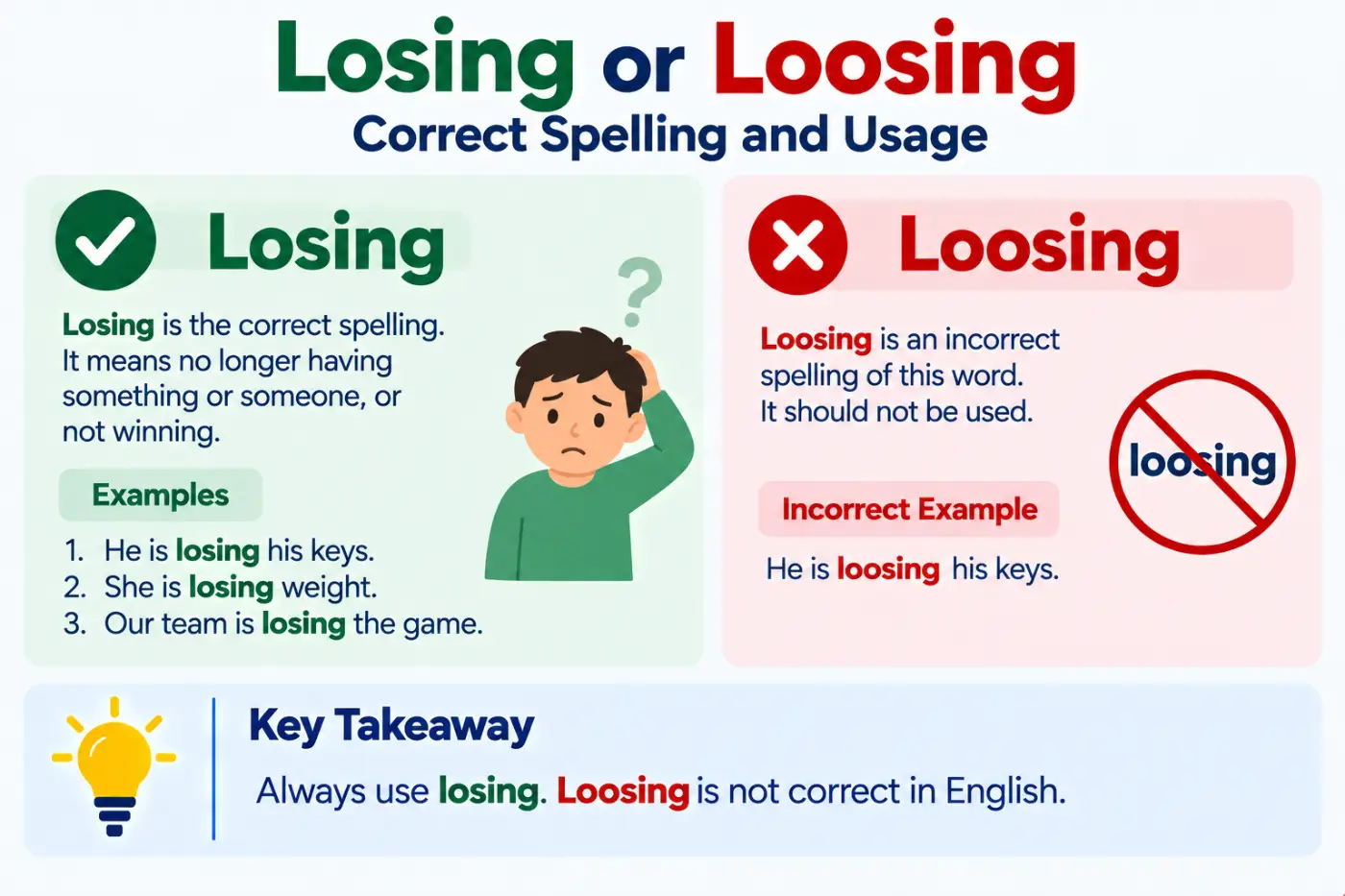
If you have ever typed a sentence like I am loosing my keys, you may have wondered if you chose the right spelling. The correct word in this sentence is losing. Although both forms exist in English, they have different meanings and cannot be used in the same situations.
Losing is the present participle of lose. It means failing to keep something, being defeated, or no longer having something. Loosing comes from the verb loose, which means to release, free, or make something less tight. The extra letter o changes the meaning of the word.
This mistake is common because the two forms look and sound similar. However, a simple grammar rule can help you remember the difference. If you mean that something is going away, you probably need losing. If you mean releasing something or making it less tight, loosing may be correct. The following guide explains both words with clear examples, pronunciation tips, common mistakes, and practical advice for choosing the right spelling.
Many readers also check Indulgent Vs Sober Understanding The Real Difference 2026.
Quick Answer
Losing is the correct spelling when you mean failing to keep something, being defeated, or experiencing a loss. Loosing is also a real word, but it comes from loose and means releasing or making something less tight. For most everyday sentences about loss, use losing.
Comparison Table
| Feature | Losing | Loosing |
|---|---|---|
| Base word | Lose | Loose |
| Part of speech | Present participle or gerund of a verb | Present participle or gerund of a verb |
| Main meaning | Failing to keep, win, or retain something | Releasing, freeing, or making something less tight |
| Pronunciation | /ˈluːzɪŋ/ | /ˈluːsɪŋ/ |
| First syllable | Sounds like lose | Sounds like loose |
| Final consonant in base word | /z/ sound | /s/ sound |
| Common usage | Very common | Uncommon |
| Typical contexts | Losing a game, losing money, losing weight | Loosing a rope, loosing an arrow, loosing a grip |
| Example | She is losing her patience. | He is loosing the rope from the post. |
Meaning and Definition
What Does Losing Mean?
Losing is the present participle of the verb lose. It describes the process of no longer having something, failing to win, or experiencing a decline or disadvantage. It can refer to physical objects, money, relationships, opportunities, competitions, or personal qualities.
For example, if you cannot find your phone, you might say you are losing it. If your team is behind in a match, it may be losing the game. If a business spends more money than it earns, it may be losing money.
The word also appears in situations that do not involve physical objects. Someone can be losing confidence, losing interest, losing control, or losing hope. In each case, the person is gradually experiencing a reduction or loss of something.
Common expressions include:
- Losing money.
- Losing a game.
- Losing weight.
- Losing patience.
- Losing confidence.
- Losing interest.
- Losing control.
- Losing an opportunity.
The base verb is lose, and its spelling changes when the ending is added. The final e is removed before adding ing, giving you losing rather than loseing.
What Does Loosing Mean?
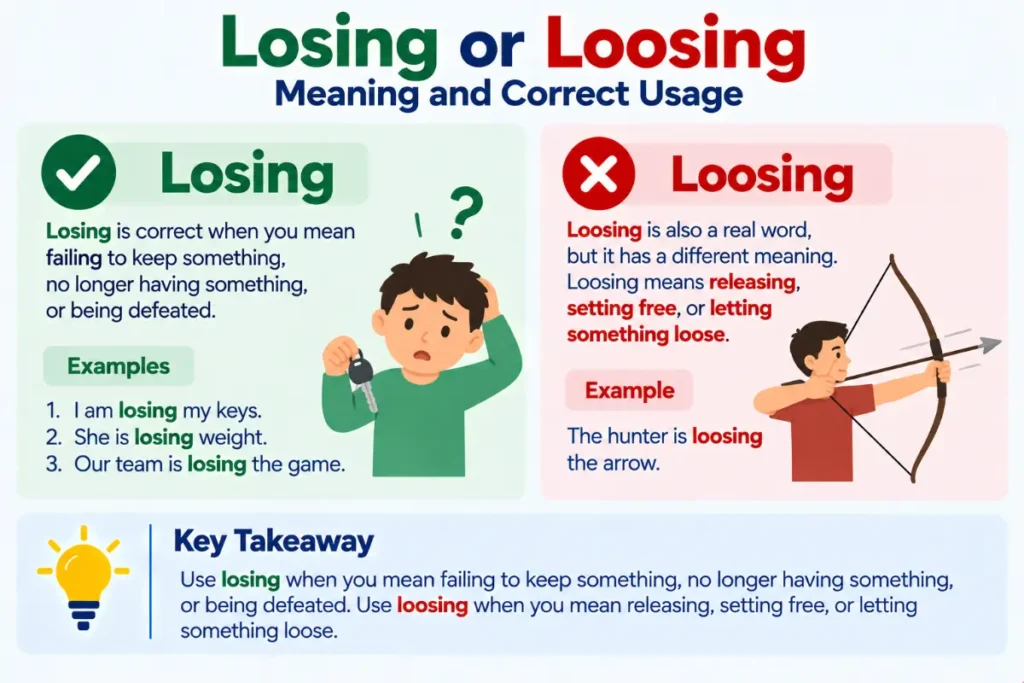
Loosing is the present participle of the verb loose. It means releasing something, setting something free, or making something less tight. It is a correct English word, but it is much less common than losing.
For example, someone might be loosing a horse from a stable, loosing an arrow from a bow, or loosing a rope that has been tied to a post. In these examples, the action involves releasing something or allowing it to move freely.
The word can also describe making a physical object less tight. For example, a person might be loosing a knot that has become difficult to untie. However, in everyday English, people are more likely to say loosening a knot.
Common examples include:
- Loosing an arrow.
- Loosing a horse from its stable.
- Loosing a rope from a post.
- Loosing a dog from its leash.
- Loosing a tightly held grip.
Although the word is grammatically correct, it is not a common choice in ordinary conversation. In many situations, releasing or loosening will sound more natural.
Is Loosing a Real Word?
Yes. Loosing is a legitimate English word formed from the verb loose. It is not simply a misspelling of losing, although writers sometimes use it by mistake.
The two forms have separate base words and meanings. Loose is an adjective or verb, while lose is a verb. Their spelling and pronunciation are close, which makes them easy to confuse.
Consider these sentences:
- The player is losing the match.
- The archer is loosing an arrow.
The first sentence describes a defeat. The second describes releasing an arrow. Both spellings are correct because they express different actions.
If you are writing about failure, defeat, or something disappearing, loosing is not the right choice. If you are describing an act of release, it may be appropriate, although a more familiar alternative may improve clarity.
Key Differences Explained
1. Spelling
The main spelling difference is the extra letter o in loosing. Both forms begin with the letters l and o, and both end with ing. However, they come from different base words.
- Lose becomes losing.
- Loose becomes loosing.
The spelling change is linked to the base word, not simply to a preference for one form. Learning the original verb makes the correct spelling easier to remember.
2. Meaning
Losing refers to experiencing a loss or failing to keep something. Loosing refers to releasing something or making it less tight.
For example, losing a key means you no longer know where the key is. Loosing a key from a chain would mean releasing it from the chain. The difference is the action being described.
3. Grammar
Both words are verb forms ending in ing, but they come from different verbs. Losing comes from lose, while loosing comes from loose.
Losing is often used with forms of be to create continuous tenses:
- She is losing her patience.
- They were losing the match.
- I am losing track of time.
Loosing can also appear in continuous forms, but its use is less common:
- The hunter was loosing the arrow.
- The handler is loosing the animal from its enclosure.
4. Part of Speech
Both forms can function as present participles or gerunds.
A present participle helps form a continuous verb tense. For example, in She is losing confidence, losing is part of the present continuous verb phrase.
A gerund functions as a noun. For example, Losing a close friend can be painful. Here, losing names an experience.
The same grammatical patterns can apply to loosing. For example, Loosing the rope required careful movement uses the word as a gerund. The difference is not the grammatical role but the meaning of the base verb.
5. Pronunciation
The words are pronounced almost alike, but their final consonant sounds differ.
- Losing: /ˈluːzɪŋ/. The base word ends with a voiced /z/ sound.
- Loosing: /ˈluːsɪŋ/. The base word ends with an unvoiced /s/ sound.
The vowel sound is the same in both forms. The small difference between /s/ and /z/ is easy to miss in quick speech, which contributes to spelling confusion.
6. Formality
Losing is common in everyday conversation and formal writing. It appears in news reports, school assignments, business documents, and personal messages.
Loosing is less common and may sound old fashioned or literary in some contexts. It is still correct when it describes releasing something, but many writers prefer more familiar alternatives such as releasing or loosening.
7. Context
The surrounding words often reveal which form you need.
Use losing with words related to defeat, disappearance, reduction, or decline. Examples include losing money, losing a match, and losing interest.
Use loosing when the action involves releasing or setting something free. Examples include loosing an arrow or loosing an animal. If the intended meaning is making something less tight, loosening is often the more natural choice.
8. Regional Usage
There is no major spelling difference between American and British English for these forms. Losing and loosing have the same basic meanings in both varieties.
The distinction also applies in Canadian and Australian English. The main difference is frequency: losing is widely used, while loosing is much less common.
Which Form Is Correct?
Both spellings are correct, but they are not interchangeable. Losing is the correct choice when you mean experiencing a loss, failing to win, or no longer keeping something. Loosing is correct when you mean releasing something or setting it free.
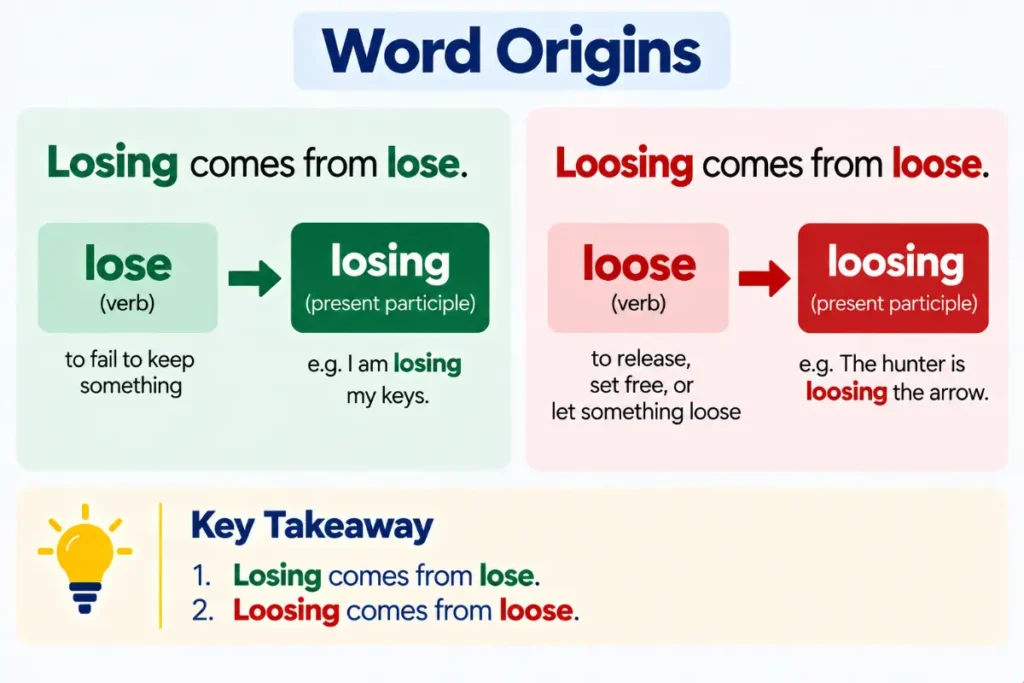
The spelling follows the base verb:
- Lose means to fail to keep something or be defeated. Adding ing gives losing.
- Loose means not tight or to release something. Adding ing to the verb gives loosing.
This distinction explains why you should write:
- Correct: I am losing my keys.
- Incorrect for this meaning: I am loosing my keys.
- Correct: The team is losing the game.
- Incorrect for this meaning: The team is loosing the game.
- Correct: The archer is loosing an arrow.
- Incorrect for this meaning: The archer is losing an arrow, if the intended meaning is releasing it.
The last example needs a little care. Losing an arrow could mean misplacing it or failing to retain it. Loosing an arrow means deliberately releasing it from a bow. The sentence must communicate the intended action.
A good editor checks the meaning before correcting the spelling. Simply changing every instance of loosing to losing would create an error in sentences that genuinely describe release.
Sentence Examples
Ten Natural Examples Using Losing
- Everyday conversation: I keep losing my glasses, even when I leave them on the same table.
- Text message: Sorry, I am losing track of time and may arrive a little late.
- Workplace communication: The company is losing customers because of its slow service.
- School: The student is losing marks because of careless spelling mistakes.
- Academic writing: The research suggests that some participants are losing interest in the activity.
- Formal writing: The organization is losing valuable resources due to poor planning.
- Social situations: He was losing patience while waiting for his friends.
- Sports: Our team is losing by two points with only a minute left.
- Personal development: She is losing confidence after receiving repeated criticism.
- Health and fitness: My brother is losing weight by following a balanced meal plan.
These examples show that the word can describe many kinds of loss. It can refer to a physical object, a competition, money, time, confidence, or interest. In each sentence, something is being lost, reduced, or no longer kept.
Five Examples Showing Loosing
The following examples use the less common form correctly.
- The archer was loosing an arrow toward the distant target.
- The handler was loosing the horse from its stable.
- The sailor began loosing the rope from the dock.
- The old story described a warrior loosing a flock of birds into the sky.
- The hunter was loosing his arrows one after another.
These sentences describe the act of releasing something. In modern everyday writing, releasing an arrow, freeing a horse, or untying a rope may sound more natural. The less common form is useful when the writer wants a traditional, literary, or specific sense of release.
Common Mistakes and Misspellings
Writers often confuse these words because they share most of their letters. The best way to avoid errors is to connect each form with its base verb and meaning.
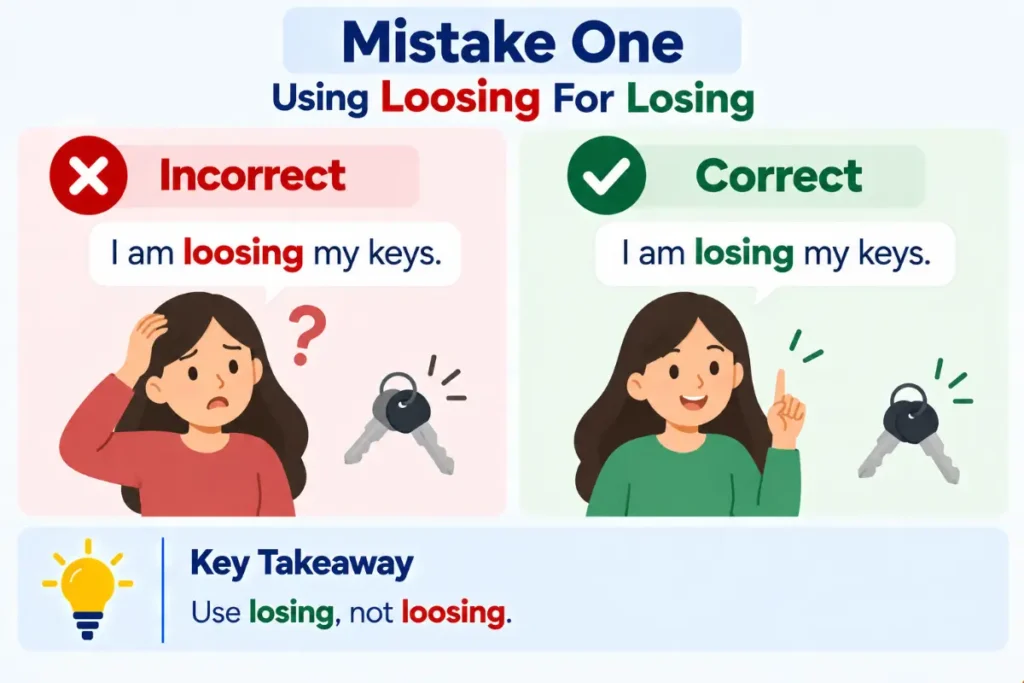
1. Writing Loosing Instead of Losing
Incorrect: I am loosing my phone again.
Correct: I am losing my phone again.
The sentence describes misplacing a phone, not releasing it. Since the base verb is lose, the correct form is losing. This is one of the most common mistakes because the extra o may seem natural when writing quickly.
2. Writing Losing Instead of Loosing
Incorrect for the intended meaning: The archer was losing an arrow from the bow.
Correct: The archer was loosing an arrow from the bow.
The intended action is releasing the arrow. The verb loose provides that meaning, so the correct form is loosing. If the writer means that the arrow was misplaced, losing would be appropriate instead.
3. Confusing Lose With Loose
Incorrect: I do not want to loose my job.
Correct: I do not want to lose my job.
Lose is a verb that means to no longer have something or fail to keep it. Loose usually describes something that is not tight. It can also function as a verb meaning to release. Remember that a loose shirt is not tight, but you may lose your job.
4. Writing Loseing Instead of Losing
Incorrect: She is loseing interest in the project.
Correct: She is losing interest in the project.
The final e in lose is dropped before the ing ending is added. The correct spelling is losing, not loseing. This follows a common English spelling pattern for verbs ending in a silent e.
5. Confusing Loosen With Loosing
Incorrect: He is loosing his belt because it feels tight.
Better: He is loosening his belt because it feels tight.
Although loosing can mean making something less tight, loosening is the more familiar and natural verb for this action. The word loosen is formed from loose and means to make something less tight or firm. Its present participle is loosening.
A Quick Way to Avoid These Mistakes
Use the base word as your guide:
- If you mean loss, defeat, or failure to keep something, start with lose and write losing.
- If you mean release or set free, start with loose and write loosing.
- If you mean make something less tight, use loosen and write loosening.
This approach is more reliable than choosing a spelling based on how the word looks or sounds.
Pronunciation Guide
How Do You Pronounce Losing?
The American English pronunciation of losing is /ˈluːzɪŋ/. It has two syllables: LOO and zing. The first syllable receives the main stress, and the second syllable sounds like the ending of words such as going or running.
The first part sounds like the word lose, which ends with a voiced /z/ sound. The final syllable begins with another /z/ sound in the standard pronunciation.
Say it slowly as LOO zing, then blend the two parts into one smooth word. Avoid replacing the /z/ sound with /s/, as this changes the pronunciation of the base word.
How Do You Pronounce Loosing?
The American English pronunciation of loosing is /ˈluːsɪŋ/. It also has two syllables, with the main stress on the first: LOO sing.
The first syllable sounds like loose, ending with an unvoiced /s/ sound. The second syllable follows the same basic pattern as the ending in losing.
The difference is small but meaningful. Losing has the /z/ sound from lose, while loosing has the /s/ sound from loose.
Common Pronunciation Confusion
Some speakers may not clearly distinguish the final /s/ and /z/ sounds, especially during fast conversation. Both sounds are made in a similar position in the mouth, but /z/ uses voice vibration and /s/ does not.
Try placing your fingers gently against your throat as you say lose and loose. You should feel vibration during the /z/ sound in lose. The /s/ sound in loose does not create the same vibration.
This small pronunciation check can help you hear the difference, but the meaning of the sentence remains the most reliable guide to spelling.
A related grammar guide is Focussing or Focusing Which Spelling Is Correct 2026.
Etymology and Word Origin
The Origin of Lose
Lose comes from Old English losian, a verb associated with perishing, being lost, or becoming destroyed. It developed through earlier forms of English before reaching its modern spelling and meaning.
Over time, the verb gained several related uses. It came to describe failing to keep something, being defeated, missing an opportunity, or no longer having a quality or ability. These meanings remain common in modern English.
The word is related to loss, which is a noun describing the act or result of losing something. This connection is useful when remembering the spelling: lose, losing, and loss all relate to the same general idea.
The Origin of Loose
Loose has a different history. It came into English through Old Norse and Middle English forms associated with being free, unrestrained, or not tightly bound. Its modern meanings include not tight, not firmly attached, and free from restraint.
As a verb, loose means to release or set free. Adding ing creates loosing. This form is less common than the adjective loose and the verb loosen, but it remains part of standard English.
Why Their Origins Matter
The words have different roots and developed different meanings. Their similar appearance does not mean they are alternate spellings of the same verb.
The connection between lose and loss can help you remember losing. The connection between loose and loosen can help you recognize loosing as a form related to release or freedom.
Regional Usage
American English
In American English, losing is the standard form for describing a loss, defeat, or reduction. It appears in everyday speech, newspapers, books, workplace documents, and school assignments.
Loosing is also a valid form, but it is uncommon. American writers may use it in historical writing, storytelling, or descriptions of releasing something. In everyday situations, releasing and loosening are often more familiar choices.
British English
British English uses the same spelling and basic meanings. Losing refers to experiencing a loss, while loosing refers to releasing something or setting it free.
There is no major British spelling variation that changes the distinction. The same base word rule applies: lose becomes losing, and loose becomes loosing when the verb takes the ing ending.
Australian English
Australian English follows the same pattern. Losing is widely used for defeat, disappearance, and reduction. Loosing is a valid but less common verb form that describes releasing something.
There is no special Australian spelling rule that makes one form correct in place of the other. Meaning and grammar determine the choice.
Canadian English
Canadian English also uses both forms with the same meanings found in American and British English. Losing is the usual word in everyday communication, while loosing appears in more specific contexts involving release.
Across these English varieties, the spelling distinction remains consistent. You do not need a regional spelling rule to decide which one to use.
Grammar Rules and Part of Speech
Both forms are based on verbs, and both can work as present participles or gerunds. Their grammar follows ordinary English rules, but their base words give them different meanings.
Losing as a Present Participle
A present participle can combine with a form of be to describe an action in progress.
Examples:
- She is losing her patience.
- The team was losing the match.
- They are losing valuable time.
- I have been losing sleep lately.
In these sentences, losing forms part of a continuous verb phrase. It describes an action or condition that is happening over a period of time.
Losing as a Gerund
A gerund is an ing form that functions as a noun. It can act as the subject or object of a sentence.
Examples:
- Losing a close friend can be painful.
- He dislikes losing important documents.
- Losing the final match disappointed the players.
- She worries about losing her job.
In these examples, losing names an experience or action rather than simply describing what a subject is doing.
Loosing as a Present Participle
Loosing can also form a continuous verb phrase when the intended meaning is releasing something.
Examples:
- The archer is loosing an arrow.
- The handler was loosing the horse.
- The sailor is loosing the rope from the post.
These sentences are grammatically possible, but the verb is uncommon in modern everyday English. Releasing may be clearer for most readers.
Loosing as a Gerund
The form can also function as a noun.
Example: Loosing the animal from its enclosure required care.
Here, loosing refers to the action of setting the animal free. The word is grammatically a gerund because it functions as the subject of the sentence.
Spelling Rules for Adding Ing
The difference becomes easier to understand when you look at how the verbs change.
| Base word | Meaning | Ing form |
|---|---|---|
| Lose | Fail to keep or be defeated | Losing |
| Loose | Release or set free | Loosing |
| Loosen | Make less tight | Loosening |
The final e in lose is dropped before adding ing. Loose already ends in e, but because it is being used as a verb, the ing form is written loosing. Loosen has its own spelling and becomes loosening.
Do not add an extra e to losing. The form loseing is incorrect.
Common Grammar Errors
One common error is using the adjective loose where the verb lose is needed. For example, “I do not want to loose my keys” should be “I do not want to lose my keys.”
Another mistake is using losing when the sentence describes releasing something. If a person deliberately releases an arrow, loosing may be correct. If the person misplaces the arrow, losing is the right choice.
The verb form should match the action, not simply the sound of the word.
Real Life Usage Examples
Daily Conversation
In ordinary conversation, losing appears far more often than loosing. People use it to talk about misplaced items, forgotten details, competitions, and changes in feelings.
- I think I am losing my wallet again.
- You are losing your patience, so take a short break.
Loosing is possible in speech, but it is not a common choice for ordinary requests. Most people would say releasing a horse or letting an animal go.
Email and Workplace Communication
The word losing is common in professional communication, especially when discussing time, money, customers, or business performance.
- We are losing valuable time because the software keeps crashing.
- The company is losing customers due to delayed deliveries.
Loosing may appear in a technical or descriptive context involving the release of an object, but it is not normally needed in business emails.
Academic Writing
Academic writing often uses losing to describe a decline, reduction, or failure to retain something. It can refer to participants, data, skills, memory, or resources.
- The participants reported losing interest during the final stage of the study.
- The results suggest that students are losing confidence in their reading skills.
Loosing is much less common in academic work. A writer would usually choose releasing or loosening to describe the action more directly.
News and Journalism
News articles often use losing when reporting elections, sports, financial changes, or public support.
- The candidate is losing support among younger voters.
- The company is losing money after a sharp drop in sales.
A news report might use loosing in a historical or literary description of releasing something, but such cases are unusual.
Literature and Storytelling
In fiction, losing can describe emotional pain, danger, or a character’s struggle. Loosing may appear in older sounding or dramatic writing to describe setting something free.
- The traveler feared losing his way in the dark forest.
- The warrior was loosing an arrow as the gates began to close.
The first sentence describes a possible loss. The second describes the release of an arrow. Both forms can create clear images when used in the right context.
Related and Confused Terms
Understanding these related words can help you avoid other common spelling and meaning mistakes.
1. Lose
Lose is the base verb of losing. It means to stop having something, fail to win, or be unable to find something. For example, I do not want to lose my phone. It is the word to use when describing a loss.
2. Loose
Loose is usually an adjective meaning not tight or not firmly attached. For example, the screw is loose. It can also function as a verb meaning to release something, which is where loosing comes from.
3. Loss
Loss is a noun that describes the result or experience of losing something. For example, the team suffered a major loss. Remember the difference: lose is a verb, losing is its ing form, and loss is a noun.
4. Loosen
Loosen is a verb meaning to make something less tight, firm, or strict. For example, you might loosen a tight knot or loosen your grip on a handle. Its ing form is loosening, not loosing, in most sentences about reducing tightness.
5. Losing Streak
A losing streak is a series of defeats in a competition or repeated unsuccessful results. For example, the team ended its losing streak after winning three games in a row. The expression always uses losing because it refers to repeated defeats.
6. Letting Go
Letting go means allowing someone or something to leave, or choosing to stop holding on emotionally or physically. It can be a natural alternative to loosing in many everyday sentences. For example, letting go of the rope allowed the boat to move.
7. Releasing
Releasing means setting something free, allowing it to leave, or making something available. It is often a clearer and more common alternative to loosing. For example, the handler was releasing the horse into the field.
8. Misplacing
Misplacing means putting something somewhere and then being unable to find it. It is closely related to one meaning of losing, but it is more specific. You might misplace your keys on a desk, while losing them can mean you no longer know where they are.
Expert Editor Insight
An experienced editor checks the base verb before correcting this spelling. If the sentence refers to defeat, disappearance, or failure to keep something, the correct form is losing. If it describes release, loosing may be valid, although releasing or loosening often sounds more natural. Spelling tools may flag loosing in ordinary sentences because it is uncommon, but that does not make it universally incorrect. Read the whole sentence and ask what action the writer intends to describe. This simple check prevents an editor from changing a valid word into the wrong one.
Key Takeaways
- Losing comes from lose.
- Loosing comes from loose.
- Losing usually means no longer having something, failing to win, or experiencing a decline.
- Loosing means releasing or setting something free.
- Losing is extremely common in modern English.
- Loosing is a real word but appears much less often.
- Losing your job is correct.
- Losing weight is correct.
- Losing a game is correct.
- Losing an opportunity is correct.
- Loosing an arrow can be correct when the meaning is releasing it.
- Loose means not tight.
- Lose means no longer have or fail to keep something.
- If you mean loss, think lose and losing.
- If you mean release, think loose and loosing.
Need another quick comparison? Read Filed vs Filled Correct Usage in Everyday English 2026.
Conclusion
The difference between loosing or losing depends on the meaning of the base verb. Losing comes from lose and describes defeat, disappearance, or failure to keep something. Loosing comes from loose and means releasing or setting something free. Both forms are correct, but they cannot replace each other.
For everyday writing, losing is the spelling you will need most often. A simple editing trick is to connect losing with loss and loosing with loose. Before choosing a spelling, check the action in your sentence. This small habit will help you write accurately and avoid one of English’s common spelling mistakes.
FAQs
Is Loosing a Real Word?
Yes. Loosing is a real English word formed from the verb loose. It means releasing something or setting it free. However, it is much less common than losing. If you are talking about misplacing something, being defeated, or experiencing a loss, losing is the correct form.
What Is the Difference Between Losing and Loosing?
Losing comes from lose and means failing to keep something, being defeated, or experiencing a decline. Loosing comes from loose and means releasing or setting something free. For example, losing a game means being defeated, while loosing an arrow means releasing it from a bow.
Why Do People Write Loosing Instead of Losing?
People often confuse the forms because they look and sound similar. Both contain the same letters except for an extra o, and their pronunciation differs by only one consonant sound. Writers may also remember loose and lose incorrectly. Checking the base verb and intended meaning helps prevent the mistake.
Is Losing Correct in American English?
Yes. Losing is the standard spelling in American English when describing a loss, defeat, or reduction. Loosing is also a valid word, but it has a different meaning and is much less common. American writers use it when describing the act of releasing something, although releasing is often more natural.
How Do You Pronounce Losing and Loosing?
Losing is pronounced /ˈluːzɪŋ/, while loosing is pronounced /ˈluːsɪŋ/. Both have two syllables and stress the first syllable. The main difference is the consonant sound: losing uses /z/, while loosing uses /s/. Listening for this small difference can help you recognize the words.
Is Losing a Verb or a Noun?
Losing is usually the present participle of the verb lose, but it can also function as a gerund. In She is losing her keys, it forms part of a continuous verb phrase. In Losing a friend is painful, it functions as a noun because it names an experience.
What Is the Correct Spelling for Losing Weight?
The correct expression is losing weight. It comes from the verb lose, which means to have less of something or reduce something. Loosing weight is incorrect in this context because it would refer to releasing or setting something free, not reducing body weight.
Should I Use Loosing or Loosening?
Use loosing when you specifically mean releasing or setting something free, although releasing is often more natural. Use loosening when you mean making something less tight, firm, or strict. For example, you are loosening a tight belt, but you may be loosing an arrow from a bow.