
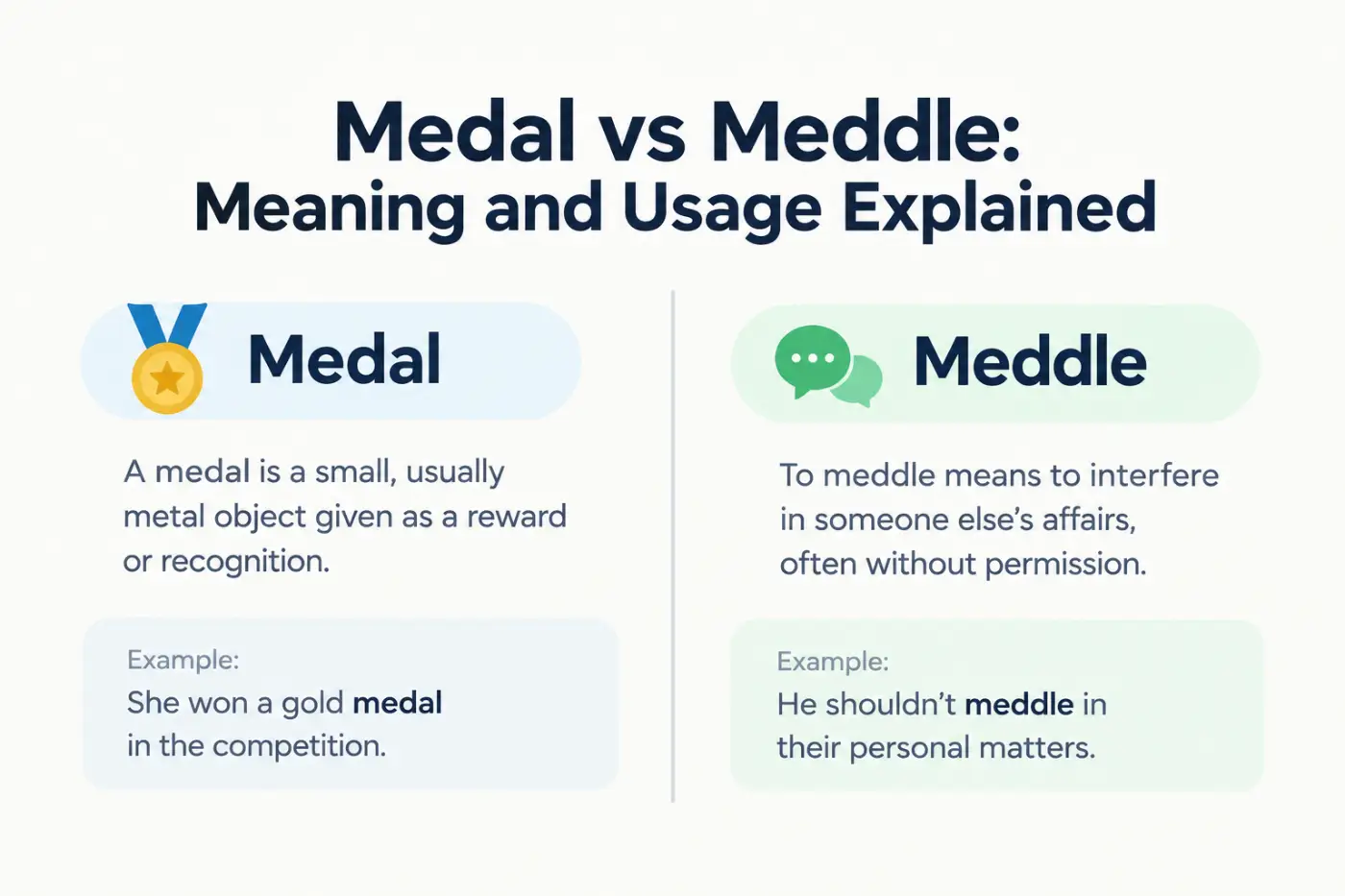
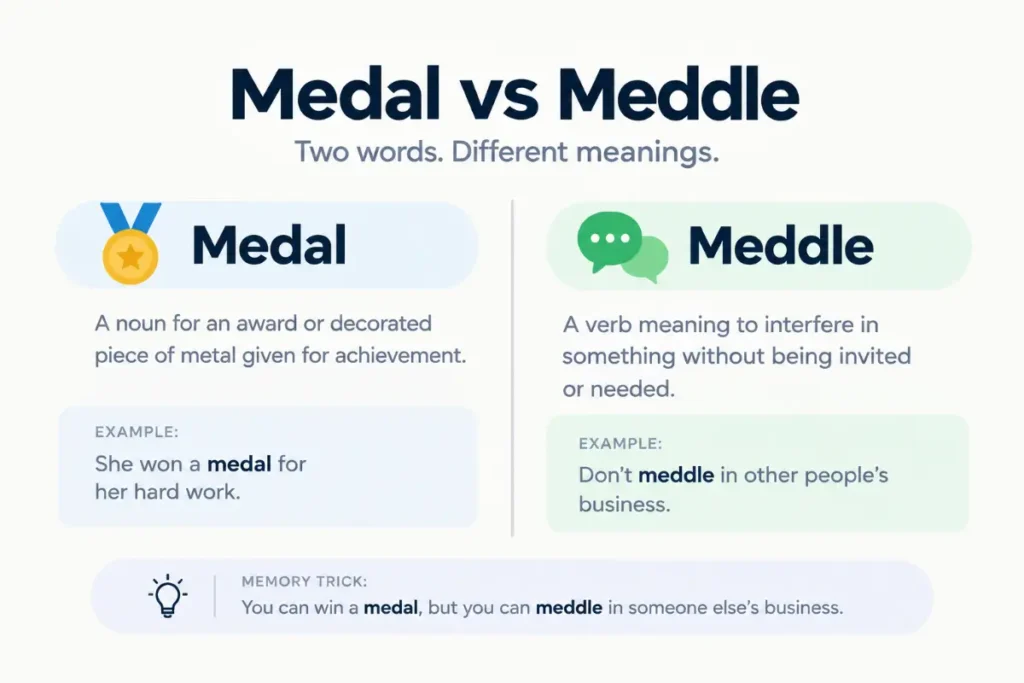
The words “medal” and “meddle” sound alike, but they have very different meanings. A medal is an award given to recognize an achievement, while meddle means to interfere in something that does not concern you. The difference is only one letter in the middle, yet using the wrong word can completely change your sentence.
You might win a medal in a swimming competition, receive a medal for bravery, or see a medal displayed in a museum. On the other hand, you might tell someone not to meddle in your personal affairs or complain that a neighbor keeps meddling in your business. One word is linked to honor and recognition. The other describes unwanted involvement.
This confusion often happens because both words are pronounced almost identically in many English accents. Their spelling also looks similar, so a quick typographical mistake can go unnoticed. Learning their meanings, grammar, and common sentence patterns will help you choose the right word in schoolwork, emails, everyday conversations, and formal writing.
Learn the difference in phenix vs phoenix Which Spelling Is Correct.
Quick Answer
A medal is a metal award given to someone for an achievement, service, or honor. Meddle is a verb that means to interfere in another person’s affairs or become involved in something without being invited. The words sound alike, but their meanings and grammatical roles are different.
Comparison Table
| Feature | Medal | Meddle |
|---|---|---|
| Meaning | An award or decoration | To interfere or become involved without invitation |
| Part of speech | Noun | Verb |
| Pronunciation | /ˈmed.əl/ | /ˈmed.əl/ |
| Main idea | Recognition or honor | Unwanted interference |
| Common contexts | Sports, ceremonies, military service, achievements | Personal matters, relationships, work, private affairs |
| Typical phrases | Win a medal, receive a medal, gold medal | Meddle in affairs, meddle with something |
| Formality | Standard in formal and informal English | Standard, but often expresses criticism |
| Example | She won a medal for swimming. | He should not meddle in their argument. |
Meaning and Definition
What Does Medal Mean?
A medal is a small, usually flat piece of metal given to a person as a sign of achievement, honor, or recognition. It may be awarded for winning a competition, serving a country, showing bravery, or making an important contribution.
Medals often have a special design. They may display a person’s name, the name of an event, a symbol, a date, or an image. Some medals are worn around the neck on a ribbon, while others are pinned to clothing or kept in a display case.
The word is most commonly used as a noun. It names the award itself rather than the action of winning it.
For example:
- The athlete received a gold medal at the international competition.
- My grandfather kept his service medal in a wooden box.
- The school gave each student a medal for outstanding performance.
- The rescue worker received a medal for bravery.
A medal does not always have to be made of pure gold, silver, or bronze. The material and design depend on the organization giving the award. In sports, the terms gold medal, silver medal, and bronze medal usually refer to first, second, and third place.
Types of Medals
Medals appear in many areas of life. Their purpose is usually to recognize something meaningful, but the reason for receiving one can vary.
1. Sports medals
Sports medals recognize performance in competitions. Olympic medals are well known examples, but schools, clubs, and local events also award medals to athletes.
2. Military medals
Military medals recognize service, bravery, leadership, or other actions connected with military duty. Some are awarded for specific acts, while others recognize a period of service or participation in a campaign.
3. Academic medals
Schools, colleges, and universities may award medals to students who achieve excellent academic results or make a notable contribution to education.
4. Civilian and public service medals
Governments and organizations may award medals to people who have served their communities, helped others, or made significant contributions to public life.
5. Commemorative medals
These medals mark a special event, anniversary, historical occasion, or important achievement. They may be given as keepsakes rather than competitive awards.
The shared idea is recognition. A medal represents an achievement, service, honor, or event that someone wants to remember.
What Does Meddle Mean?
Meddle is a verb that means to interfere in a situation, relationship, decision, or personal matter without being asked or without having a proper reason to become involved. It often carries a negative meaning because the person is interfering in something that is not their responsibility.
For example, a person might meddle in a friend’s relationship by giving unwanted advice, spreading private information, or trying to control the decisions of the people involved.
The word can also describe interfering with an object, system, or process in a way that may cause trouble. For instance, someone might meddle with electrical equipment or meddle with the settings on a computer.
Common examples include:
- Please do not meddle in my personal affairs.
- His relatives keep meddling in his marriage.
- The child was told not to meddle with the control panel.
- She refused to let anyone meddle with her plans.
The word often suggests that the interference is unwanted, unnecessary, or likely to cause problems. It can sound critical or annoyed, especially when someone uses it to describe another person’s behavior.
Does Meddle Always Have a Negative Meaning?
Usually, yes, but the strength of the criticism depends on the context. If you say someone is meddling in your business, you are generally suggesting that they should stay out of it. The word is stronger than simply saying that someone is involved.
Compare these expressions:
- “She is involved in the project.” This is neutral and may describe a normal role.
- “She is interfering in the project.” This suggests that her involvement is unwanted or disruptive.
- “She is meddling in the project.” This often suggests unnecessary interference and may express irritation.
The word does not always describe serious harm. A parent who keeps giving unwanted advice or a coworker who interferes with another person’s task may be described as meddling. The important point is that the involvement is not welcome or appropriate.
Key Differences Explained
1. Meaning
The biggest difference is what each word describes. A medal is something a person can earn, receive, display, or collect. Meddle describes an action in which someone interferes in a matter that is not theirs to control.
Think of a sports event. A runner may win a medal after finishing first. A spectator who tries to influence the judges or interfere with the race may be accused of meddling. One word describes recognition, while the other describes unwanted involvement.
2. Part of Speech
“Medal” is a noun. It names a physical object or award. You can use it as the subject or object of a sentence.
For example, “The medal was displayed in the school hall” uses the word as the subject. “The athlete proudly held her medal” uses it as the object.
“Meddle” is a verb. It describes what someone does. It can appear in different tenses, such as “meddles,” “meddled,” and “meddling.”
For example, “He meddles in other people’s decisions” uses the present tense. “He meddled in the discussion yesterday” uses the past tense.
3. Spelling
The words differ in their middle consonants. “Medal” has one d, while “meddle” has two d’s. Both words contain the letters m, e, d, and l, but the repeated d in the second word helps distinguish its written form.
A useful spelling reminder is to connect each word with its meaning:
- MedaL is an award you can receive.
- MeddLe describes an action you should often avoid.
The repeated d belongs to the verb “meddle.” It does not belong in the standard spelling of the award.
4. Pronunciation
In many English accents, the two words are homophones. This means they are pronounced the same way even though they have different spellings and meanings.
Both are commonly pronounced /ˈmed.əl/. The first syllable carries the stress, and the second syllable has a relaxed sound. Because their pronunciation is alike, you usually need to understand the sentence to know which word the speaker means.
5. Grammar
The words cannot replace each other because they perform different grammatical jobs. A medal can be the thing someone wins or receives. Meddle describes an action that a person performs.
Compare:
- Correct: “She received a medal for her service.”
- Correct: “She should not meddle in their disagreement.”
- Incorrect: “She received a meddle for her service.”
- Incorrect: “She should not medal in their disagreement.”
The incorrect sentences use a noun where a verb is needed or a verb where a noun is needed. The surrounding words often reveal the correct choice.
6. Common Contexts
The noun is common in sports, awards, ceremonies, military history, and education. You might read about a medal in a news report, see one in a museum, or receive one at a school event.
The verb is common in discussions about personal boundaries, family matters, relationships, workplace behavior, and interference with equipment or plans. It often appears in warnings such as “Do not meddle in other people’s affairs.”
7. Tone and Formality
Both words are standard English and can appear in formal or informal writing. However, they create different tones because their meanings are different.
“Medal” is generally neutral or positive. It often appears in praise, celebration, and official recognition. “Meddle” often sounds critical because it suggests that someone has crossed a boundary or interfered unnecessarily.
For example, “The officer received a medal” expresses recognition. “The officer meddled in the investigation” suggests improper involvement.
8. Regional Usage
There is no major spelling difference between American and British English for these words. The same spellings and basic meanings are used in the United States, the United Kingdom, Canada, and Australia.
Pronunciation can vary slightly by accent, but the two words often sound alike in all these varieties. Their meaning depends on the sentence rather than the speaker’s location.
Which Form Is Correct?
Both forms are correct English words. The correct choice depends on the meaning you want to express. Use “medal” when referring to an award or decoration. Use “meddle” when describing interference in another person’s affairs or involvement in something without proper permission.
Neither word is a misspelling of the other. They are separate words with different meanings and grammatical functions. Replacing one with the other can make a sentence confusing or incorrect.
Consider these examples:
- Correct: The swimmer won a medal at the championship.
- Correct: The swimmer’s coach told the parents not to meddle in training decisions.
- Incorrect: The swimmer won a meddle at the championship.
- Incorrect: The parents should not medal in training decisions.
The easiest way to check your choice is to identify the role of the word. If the sentence refers to an award, use the noun. If it describes interfering, use the verb.
A dictionary can help confirm both meanings, but you do not need a complicated grammar rule to remember the difference. The key is understanding the sentence before choosing the spelling.
Sentence Examples
The following examples show how the words work in everyday and professional settings.
Ten Natural Examples Using Medal
- The young swimmer won a gold medal at her first national competition.
- My grandfather gave me the medal he received for military service.
- The school presented a medal to the student who achieved the highest score.
- She wore her bronze medal proudly during the award ceremony.
- The runner hopes to earn another medal at the next championship.
- The museum displayed a rare medal from the nineteenth century.
- The rescue worker received a medal for saving two people from the river.
- Our team celebrated after bringing home the championship medal.
- The committee created a special medal to recognize years of public service.
- He keeps every medal he has earned in a glass cabinet.
These sentences show that the noun can refer to an award in sports, education, history, public service, or personal collections. It can also appear with verbs such as win, earn, receive, present, wear, and display.
Five Natural Examples Using Meddle
- Please do not meddle in my relationship with my friends.
- The manager warned the staff not to meddle with the approved settings.
- Her brother often tries to meddle in family decisions.
- The neighbors should not meddle in a private disagreement.
- He was asked to stop meddling with the equipment during the repair.
These examples show the verb in personal, family, workplace, and practical situations. Notice the common patterns “meddle in” and “meddle with.” The preposition changes according to the kind of interference being described.
Five Incorrect Examples and Their Corrections
The following sentences show how a spelling mix up can change the meaning.
1. Incorrect: She won a meddle for her performance.
Correct: She won a medal for her performance.
2. Incorrect: Stop trying to medal in my personal affairs.
Correct: Stop trying to meddle in my personal affairs.
3. Incorrect: The soldier received a meddle for bravery.
Correct: The soldier received a medal for bravery.
4. Incorrect: He always medals with the computer settings.
Correct: He always meddles with the computer settings.
5. Incorrect: The athlete proudly displayed her meddle.
Correct: The athlete proudly displayed her medal.
The incorrect forms are useful to recognize, but they should not be used in standard writing. In each case, the sentence gives a clue. Words such as “won,” “received,” and “displayed” usually point to the award. Words such as “stop,” “trying,” and “with” may point to the action of interfering.
Common Mistakes and Misspellings
The main problem is not that either word is difficult to spell on its own. The problem is that both words look and sound alike, so writers may choose the wrong one without noticing the change in meaning.
1. Writing Meddle When You Mean the Award
Incorrect: “The athlete received a meddle.”
Correct: “The athlete received a medal.”
The verb does not name an award. If someone wins, receives, wears, or displays an honor, the noun is needed. The phrase “received a medal” is the natural expression.
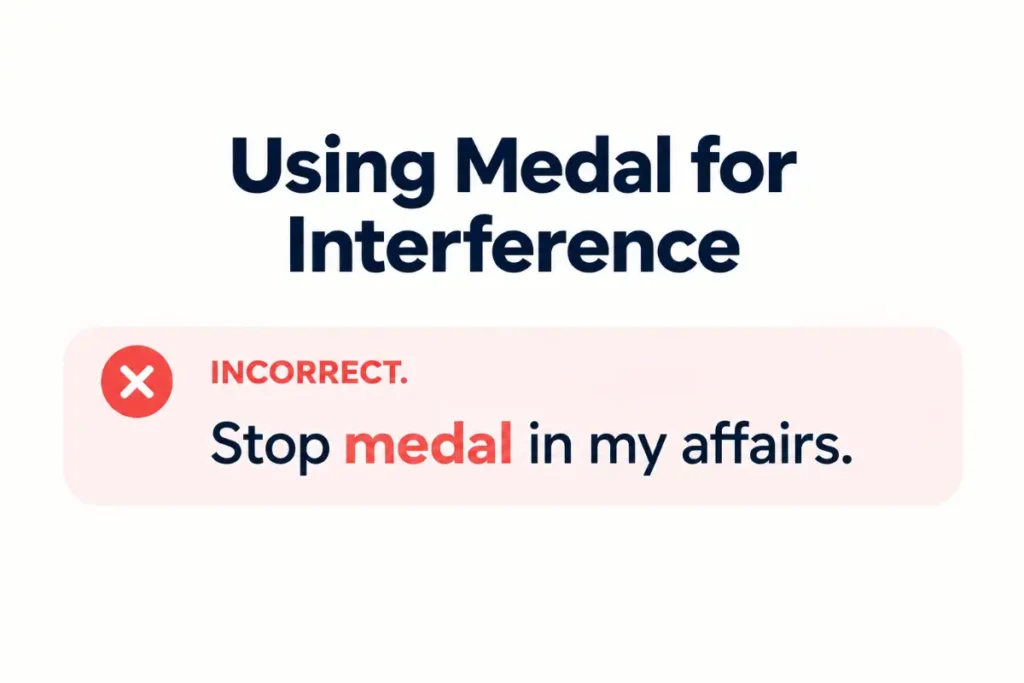
2. Writing Medal When You Mean Interference
Incorrect: “You should not medal in their private affairs.”
Correct: “You should not meddle in their private affairs.”
The sentence describes an action, so it needs a verb. The noun cannot perform this role in standard English. Remember that meddling means becoming involved in a matter without being invited or having a proper reason.
3. Using the Wrong Preposition With Meddle
Awkward: “She meddled about his personal life.”
Better: “She meddled in his personal life.”
The usual patterns are “meddle in something” and “meddle with something.” Use “in” when describing involvement in affairs, decisions, or situations. Use “with” when describing interference with an object, system, or process.
4. Confusing Meddle With Meddling
Incorrect: “He is meddle in our plans.”
Correct: “He is meddling in our plans.”
After the helping verb “is,” the present participle form is needed in this continuous tense. The correct form is “meddling,” with the final e removed before adding ing.
5. Confusing the Words Because They Sound Alike
Incorrect: “She earned a meddle in the race.”
Correct: “She earned a medal in the race.”
This error often happens during typing, speech to text, or proofreading. Since the words are commonly pronounced alike, listening to a sentence may not reveal the spelling mistake. Check the meaning and grammatical role instead of relying on sound alone.
A Practical Way to Avoid These Errors
Read the sentence and replace the word with a short explanation.
- If you can replace it with “award,” write “medal.”
- If you can replace it with “interfere,” write “meddle.”
- If neither replacement works, check the sentence structure and intended meaning.
For example, “He won an award” makes sense, so “He won a medal” is the right choice. “He interfered in the discussion” also makes sense, so “He meddled in the discussion” is correct.
This simple substitution test is especially useful when proofreading school assignments, reports, and emails.
Still confused? Compare onsite vs on-site: Correct Usage Explained.
Pronunciation Guide
How Do You Pronounce Medal?
The common American English pronunciation of “medal” is /ˈmed.əl/. It has two syllables:
- Med.
- Ul.
The stress falls on the first syllable. A simple guide is “MED ul.” The second syllable is relaxed, with a short unstressed vowel sound.
The word does not sound like “metal” in every accent, but the two are often pronounced alike in American English. This can create another spelling confusion because “metal” names a material, while “medal” names an award.
How Do You Pronounce Meddle?
“Meddle” is commonly pronounced /ˈmed.əl/ in American English. It also has two syllables, with the stress on the first one. The pronunciation guide is the same as for “medal”: “MED ul.”
The double d does not create a longer d sound. It is part of the spelling pattern, not a signal to pronounce the consonant twice.
Are Medal and Meddle Homophones?
Yes. In many English accents, the two words are homophones because they have the same pronunciation but different spellings and meanings. This is why context matters so much.
When someone says, “He won a medal,” the surrounding words make the meaning clear. In writing, the reader cannot rely on pronunciation, so the spelling must match the intended meaning.
Common Pronunciation Confusion
Some speakers may pronounce the unstressed second syllable slightly differently because of regional accent patterns. This does not change the standard spelling.
The most useful pronunciation tip is to remember that the words sound alike. Do not try to choose the spelling by listening for a difference that may not exist in your accent. Instead, identify the meaning first.
Etymology and Word Origin
The histories of these words help explain why they have different spellings and meanings today.
The Origin of Medal
“Medal” entered English through French and Italian forms connected with the Latin word “metallum,” meaning metal. The term developed into a name for a small metal object, especially one made to mark an achievement, honor, or important event.
Over time, medals became closely linked with military service, public recognition, sports, and formal ceremonies. Today, the word can refer to both traditional decorations and modern awards given by schools, clubs, governments, and organizations.
The connection with metal offers a useful memory clue. A medal is usually a metal award, so the spelling with one d belongs to the noun.
The Origin of Meddle
“Meddle” developed from an Old French word, “medler,” meaning to mix or mingle. It entered English with the sense of mixing things together and later developed the meaning of interfering in matters that concern other people.
The modern verb often carries a negative tone because unwanted involvement can disturb a situation or cross personal boundaries. The meaning is now quite different from the idea of simply mixing things together, but the historical connection helps explain its development.
The spelling with double d is the standard modern form. Its history does not make it a variation of the award noun. The two words have separate origins and separate meanings.
Why Their Histories Are Useful
You do not need to memorize the French or Latin roots to use these words correctly. However, their origins confirm that they are separate words rather than different spellings of the same word.
A simple memory connection is enough: a medal is a metal award, while to meddle is to interfere. Remembering the meanings is more useful than trying to find a pronunciation difference.
Regional Usage
The spellings and meanings of these words are consistent across major English varieties. The United States, the United Kingdom, Canada, and Australia all use “medal” for an award and “meddle” for interference.
American English
In American English, “medal” is common in sports reporting, award ceremonies, military records, and everyday conversation. People talk about winning a gold medal, receiving a medal of honor, or displaying a medal collection.
“Meddle” is also standard. It commonly appears in phrases such as “meddle in someone’s affairs” and “meddle with the equipment.” It can express annoyance when someone becomes involved without permission.
Examples:
- The gymnast earned a medal at the state championship.
- Parents should not meddle in every decision their adult children make.
British English
British English uses the same spellings and meanings. A British athlete may win a medal, and a person who interferes in another person’s private matters may be accused of meddling.
The pronunciation can vary slightly by accent, but the words are often homophones in British speech too. There is no general British spelling rule that changes one of these forms.
Examples:
- The runner received a medal for finishing first.
- The committee asked outsiders not to meddle in its work.
Australian English
Australian English follows the same standard usage. “Medal” appears in sports, school awards, and public honors. “Meddle” describes unwanted interference in personal, professional, or practical matters.
Examples:
- The team brought home a medal from the national competition.
- He told his colleagues not to meddle with the project files.
Canadian English
Canadian English also uses both words in the same way. The spelling does not change, and the basic grammar remains consistent with American and British English.
Examples:
- The student received a medal for academic excellence.
- She did not want her relatives to meddle in her financial decisions.
Is There Any Regional Spelling Difference?
No major regional spelling difference separates these words. You should use “medal” for an award and “meddle” for interference in all four varieties.
If a spelling checker marks one of them, check the sentence rather than assuming the word itself is wrong. Both are standard English words. The issue may be that the selected form does not fit the meaning.
Grammar Rules and Part of Speech
Understanding how each word behaves in a sentence is one of the easiest ways to avoid confusing them.
How to Use Medal as a Noun
“Medal” is a countable noun. This means you can use it with articles and numbers.
Examples:
- She won a medal.
- He received two medals.
- The medal was made of bronze.
- Their medals were displayed in the school hall.
Use “a” or “an” according to the sound of the following word. Since “medal” begins with a consonant sound, use “a medal,” not “an medal.”
You can also use the plural form “medals” when talking about more than one award. For example, “The athlete has won three medals during her career.”
Common Verb Combinations With Medal
The noun often appears with verbs that describe receiving, earning, or showing an award.
| Verb | Example |
|---|---|
| Win | She hopes to win a medal. |
| Earn | He earned a medal for his performance. |
| Receive | The soldier received a medal. |
| Award | The committee awarded her a medal. |
| Wear | The veteran wore his medal at the ceremony. |
| Display | The museum displays an ancient medal. |
| Present | The principal presented a medal to the student. |
| Collect | My uncle collects medals from sporting events. |
These combinations are useful because they show the word’s role as the name of an object or award.
How to Use Meddle as a Verb
“Meddle” is an intransitive verb in many common expressions. This means it does not usually take a direct object in the same way that a verb such as “fix” or “carry” does. It commonly appears with a preposition.
The two most useful patterns are:
- Meddle in something.
- Meddle with something.
Use “meddle in” when someone interferes in a situation, relationship, decision, or personal matter.
Examples:
- Do not meddle in their argument.
- He keeps meddling in the family’s business.
- The official was accused of meddling in the investigation.
Use “meddle with” when someone interferes with an object, device, system, or process.
Examples:
- Do not meddle with the electrical wires.
- Someone meddled with the computer settings.
- The children were warned not to meddle with the laboratory equipment.
The prepositions help explain the type of interference. They are not always interchangeable, so choose the expression that fits the situation.
Verb Forms of Meddle
The verb follows the regular spelling pattern used by many English verbs ending in e.
| Verb Form | Example |
|---|---|
| Base form | Do not meddle in their affairs. |
| Third person singular | He meddles in other people’s business. |
| Past tense | She meddled with the settings yesterday. |
| Present participle | They are meddling in the discussion. |
| Past participle | He has meddled in the process before. |
Notice that the final e disappears before adding ing. The correct form is “meddling,” not “meddleing.”
Can Medal Be Used as a Verb?
Yes, “medal” can also function as a verb, especially in sports. It means to win a medal or finish in a position that earns one.
For example:
- She hopes to medal at the national championships.
- The team medaled in several events.
- He has medaled at three international competitions.
This is a standard use in sports language. It does not mean that the athlete interfered with something. The meaning comes from the context of competition and awards.
This point is worth remembering because “medal” is not always a noun. However, the verb “medal” is mainly associated with winning an award, while “meddle” still means to interfere.
Punctuation and Sentence Structure
Neither word needs special punctuation. Use normal sentence punctuation based on the sentence type.
For example:
- “Did she win a medal?” is a direct question.
- “Please do not meddle in their affairs.” is a statement written as a warning.
- “The athlete won a medal, but her coach asked her to stay focused.” uses a comma to connect two related independent clauses.
The spelling does not determine punctuation. The sentence structure does.
Related and Confused Terms
Several other English words are useful to understand because they share a similar sound, spelling pattern, or meaning.
1. Metal
“Metal” refers to a material such as iron, copper, gold, or silver. A medal may be made of metal, but the two words do not mean the same thing.
Example: The medal was made from a bright metal.
A useful memory clue is that metal names the material, while medal names the award.
2. Mettle
“Mettle” means a person’s courage, strength, or ability to face a difficult situation. It often appears in the expression “show your mettle.”
Example: The young player showed her mettle during the final match.
This word sounds like “medal” and “meddle” in many accents, but it has a different meaning. It refers to character and determination, not an award or interference.
3. Interfere
“Interfere” means to become involved in a situation in a way that affects or disrupts it. It is one of the closest alternatives to “meddle,” although it can be more neutral in some contexts.
Example: Please do not interfere with the repair work.
“Meddle” usually suggests unnecessary or unwanted involvement, while “interfere” can describe both accidental and deliberate disruption.
4. Intrude
“Intrude” means to enter a place, situation, or person’s private life without being welcome. It often refers to crossing a boundary.
Example: I do not want to intrude on your family time.
“Meddle” and “intrude” can overlap, but they are not exact synonyms. Intruding may involve entering a private space or interrupting someone, while meddling usually involves interfering in an issue or decision.
5. Intervene
“Intervene” means to become involved in a situation to change its course or prevent a problem. It can have a positive or neutral meaning.
Example: The teacher intervened before the argument became serious.
Unlike “meddle,” intervention may be necessary, helpful, or officially required. A doctor, teacher, or emergency worker may need to intervene to protect someone.
6. Interference
“Interference” is the noun form related to the act of interfering. It describes unwanted involvement or an action that disrupts something.
Example: The manager complained about unnecessary interference in the team’s work.
“Meddling” and “interference” are closely related, but they have different grammatical forms. “Meddling” can function as a verb form or noun, while “interference” is a noun.
7. Award
“ Award” can mean a prize or honor given for an achievement. It is closely related to “medal,” but not every award is a medal.
Example: She received an award for her research.
A medal is one type of award. Other awards may include certificates, trophies, scholarships, titles, or cash prizes.
8. Decoration
A “decoration” can be an object used to make something look attractive. In military and official settings, it can also mean an honor given for service or bravery.
Example: The officer received a military decoration for his service.
A medal may be a decoration, but the word has a broader range of meanings. Context tells the reader which meaning is intended.
Expert Editor Insight
An experienced editor checks the meaning and grammatical role before correcting either spelling. If the sentence describes an award, the noun is usually clear from words such as “won,” “received,” or “displayed.” If it describes unwanted involvement, the verb often appears with “in” or “with.” Because the two words sound alike, spellcheckers may not catch a wrong choice if the selected word is spelled correctly. A useful editing habit is to read the whole sentence and ask if the word means an award or interference. This catches errors that a basic spelling check may miss.
Key Takeaways
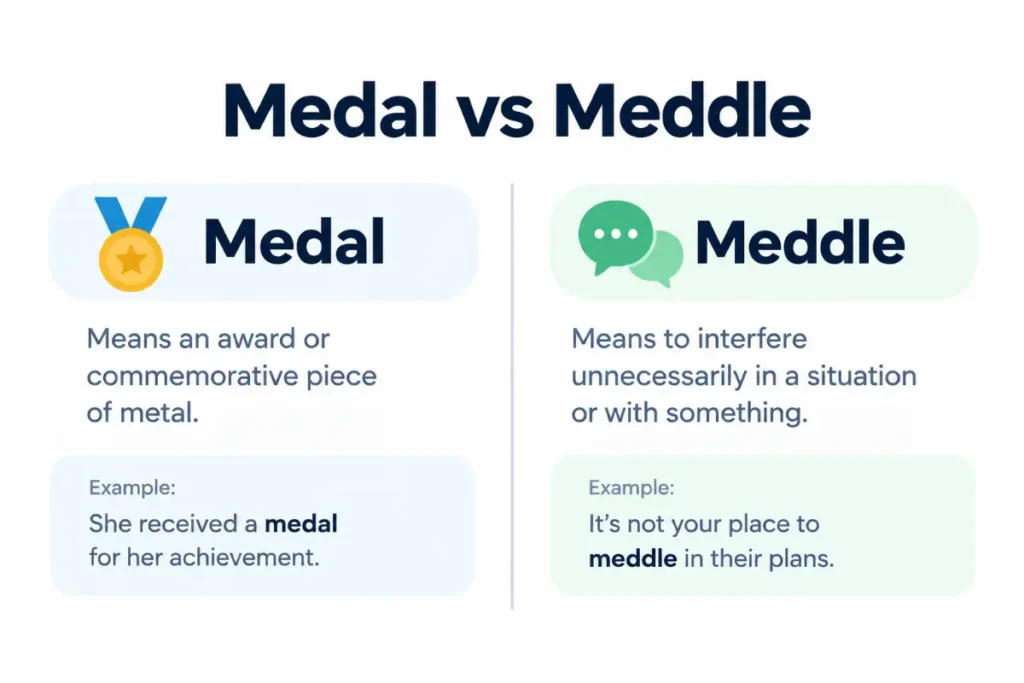
- Medal means an award or commemorative piece of metal.
- Meddle means to interfere unnecessarily in a situation or with something.
- The two words are commonly pronounced alike in American English.
- Medal is mainly a noun but can also work as a verb in sports writing.
- Meddle is a verb.
- Use meddle in for interference in people’s affairs or situations.
- Use meddle with for interference with objects, systems, or processes.
- Use context to choose the correct spelling when the words sound alike.
- Remember the simple connection: medal relates to achievement and meddle relates to interference.
Many readers also check ally vs allie Meaning Spelling and Usage.
Conclusion
The difference between “medal vs meddle” is simple once you connect each spelling with its meaning. A medal is an award for achievement, service, or honor. To meddle means to interfere in another person’s affairs or disturb a situation without being invited. Both words are correct, but they cannot be used in place of each other.
Remember the spelling clue: a medal is a metal award, while meddle describes interference. When proofreading, check if the sentence names something someone receives or describes something someone does. That quick test will help you choose the right word in everyday and formal writing.
FAQs
What Is the Main Difference Between Medal and Meddle?
A medal is an award given to recognize an achievement, service, or honor. Meddle is a verb that means to interfere in another person’s affairs or become involved without being invited. One word names an object, while the other describes an action. Their similar pronunciation is the main reason writers sometimes confuse them.
Is Meddle a Real Word?
Yes. “Meddle” is a standard English verb. It means to interfere in a situation, relationship, decision, or process, often without permission or a good reason. For example, “He should not meddle in their family matters” means he should stay out of a private issue that does not concern him.
What Does Medal Mean in English?
A medal is a small award, usually made of metal, given to recognize an achievement, act of bravery, service, or special contribution. People may win medals in sports, receive them for military service, or earn them for academic success. The word is a countable noun, so you can say “a medal” or “three medals.”
Are Medal and Meddle Pronounced the Same?
In many English accents, yes. Both words are commonly pronounced /ˈmed.əl/, with two syllables and stress on the first syllable. They are homophones in these accents, meaning they sound alike but have different spellings and meanings. Because pronunciation may not reveal the difference, context is the best guide when choosing the correct spelling.
Can Medal Be Used as a Verb?
Yes. In sports, “medal” can mean to win a medal or finish in a position that earns one. For example, “She hopes to medal at the next championship” is correct. This use is different from “meddle,” which means to interfere in something. The sentence context makes the intended meaning clear.
What Is the Correct Phrase: Meddle In or Meddle With?
Both expressions are correct, but they are used in different contexts. Use “meddle in” for affairs, relationships, decisions, or situations, as in “Do not meddle in their argument.” Use “meddle with” for objects, equipment, settings, or processes, as in “Do not meddle with the controls.”
What Are Some Synonyms for Meddle?
Useful alternatives include interfere, intrude, interfere with, tamper with, and involve yourself unnecessarily. The best choice depends on the context. “Intrude” often suggests crossing a personal boundary, while “tamper with” usually refers to changing or interfering with an object or system. “Interfere” is a broad alternative that can be neutral or negative.
How Can I Remember the Difference Between Medal and Meddle?
Connect “medal” with a metal award that someone can win or receive. Remember “meddle” as the action of interfering in something that is not your business. The award has one d, while the verb has two. Since the words often sound alike, use their meanings and sentence roles to check your spelling.