
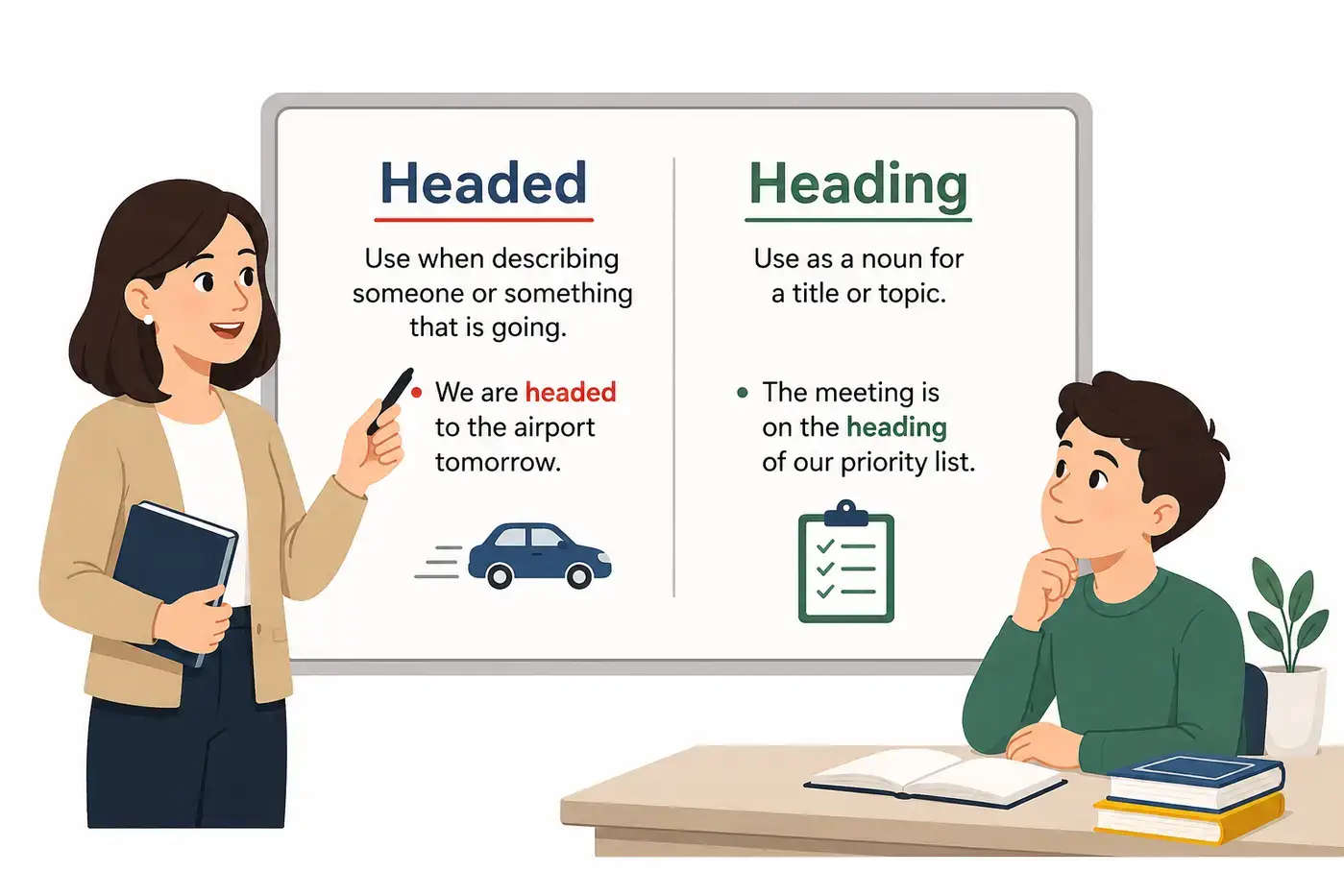
Confusing headed and heading is easy because both words come from the same verb, head. However, they serve different grammatical purposes and can express different ideas. Headed usually describes a past action or a direction, while heading commonly describes an action in progress, a title, or the direction someone or something is moving.
For example, you might say, “We headed home after dinner” to describe a completed action. You could also say, “We are heading home now” to describe an action in progress. In a document, you might use the word heading to describe the title of a section.
The correct choice depends on what you want to communicate. You do not need to memorize a complicated grammar rule to get it right. Instead, look at the sentence, identify the intended meaning, and check how the word functions.
This guide explains the difference between these two forms, including their definitions, pronunciation, grammar, regional usage, and common mistakes. You will also find practical examples that show how native English speakers use them in everyday conversations, workplace messages, academic writing, and other situations.
Learn the difference in withdraw or withdrawal Meaning Difference And Usage.
Quick Answer
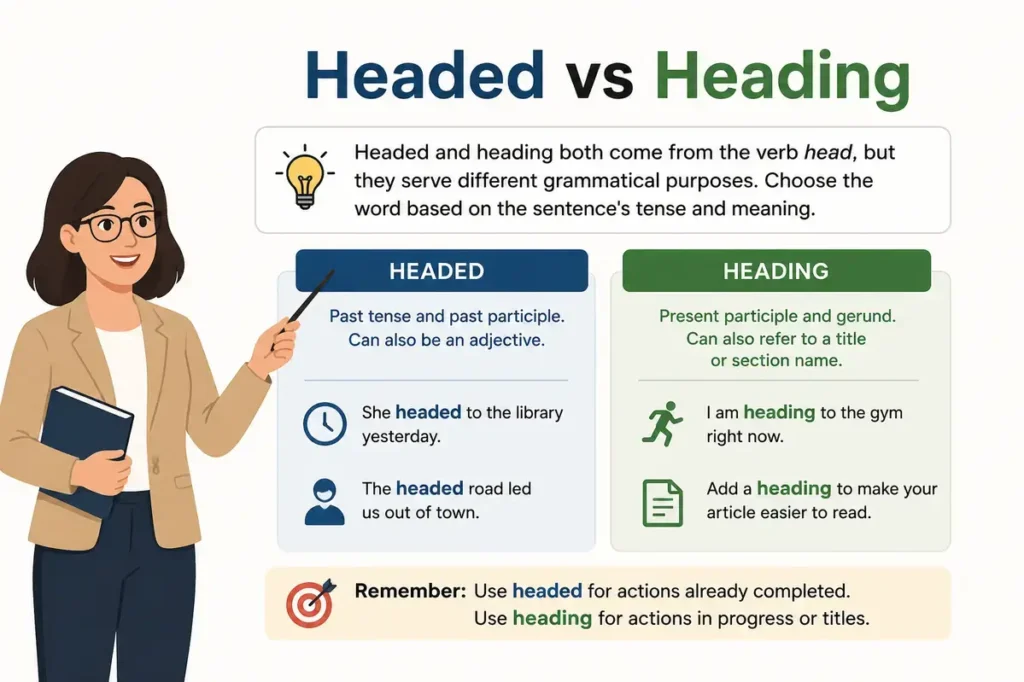
Headed and heading are both correct English words, but they serve different purposes. Headed is commonly the past tense or past participle of the verb head, as in “She headed home.” Heading is the present participle of that verb and can also mean a title or the direction of travel, as in “The heading is clear.”
The Main Difference Explained
The easiest way to understand these forms is to focus on their function in a sentence.
Headed often tells you that an action happened in the past or describes the direction someone took. Heading often describes an ongoing action, a planned direction, or a title placed above a section of text.
Consider these three sentences.
- “We headed toward the airport.” This describes a movement that began in the past.
- “We are heading toward the airport.” This describes movement in progress or a current plan.
- “The heading explains the topic.” This uses heading as a noun meaning a title or label.
The first two sentences use different forms of the same verb. The third uses a noun.
This distinction matters because the words are not interchangeable in every sentence. If you are describing a completed trip, headed may fit. If you are describing a section title, heading is the appropriate choice.
Comparison Table
| Feature | Headed | Heading |
|---|---|---|
| Main grammatical role | Past tense and past participle | Present participle and noun |
| Verb meaning | Moved toward or directed | Moving toward or directing |
| Noun meaning | Uncommon in ordinary modern usage | A title or direction |
| Typical time reference | Past action or completed event | Ongoing action or planned movement |
| Common phrase | Headed home | Heading home |
| Document usage | Rarely used as a section title | Commonly used as a section title |
| Pronunciation | HED id | HED ing |
| Formality | Standard English | Standard English |
| American English | Correct | Correct |
| British English | Correct | Correct |
The key difference is grammatical function rather than spelling accuracy. Both words belong to standard English, but each fits a different context.
What Headed Means
Headed is the past tense and past participle of the verb head. As a verb, head can mean to move in a particular direction, lead a group, or take charge of an organization.
When you use headed, you usually describe an action that happened earlier.
For example, “The students headed to the library after class” tells readers where the students went. Similarly, “Maya headed the research team” means Maya led the team.
The word can also appear in sentences about a future plan. In “We are headed for trouble,” the expression describes an expected outcome rather than a completed journey.
Headed as a Past Tense Verb
Use headed when you want to describe a movement or action that took place in the past.
- “I headed home before the storm started.”
- “The manager headed the project last year.”
- “They headed north after leaving the hotel.”
In each example, the surrounding words help explain the action. The verb can describe physical movement or leadership.
Headed as a Past Participle
The past participle often appears with forms of the verb be or have.
- “We have headed in the wrong direction.”
- “She was headed toward the main entrance.”
- “The company is headed by an experienced director.”
Notice that headed does not always refer to a finished event. Its meaning depends on the full verb phrase and the context.
For instance, “She was headed toward the station” describes the direction of her movement at a particular time. It does not necessarily tell you that she reached the station.
Headed in Common Expressions
English speakers use headed in several familiar expressions.
- Headed home means moving or going home.
- Headed north means moving toward the north.
- Headed for success suggests that success is likely.
- Headed by a director means led by that person.
- Headed in the right direction means making suitable progress.
These expressions appear in everyday speech, news reports, business communication, and casual messages.
What Heading Means
Heading has two main uses. It can function as the present participle of the verb head, or it can function as a noun meaning a title or direction.
This makes it especially useful in both conversation and writing.
Heading as a Verb Form
When heading functions as a verb, it often describes an action in progress or a planned movement.
For example, “I am heading to work” means that I am going to work or preparing to go there. “The hikers are heading toward the lake” describes their current direction.
The present participle heading commonly appears in progressive verb forms.
- “She is heading to the office.”
- “They were heading home when it began to rain.”
- “We will be heading out shortly.”
The form can also describe a process that is developing. In “The team is heading toward a major breakthrough,” the phrase suggests progress toward an outcome.
Heading as a Noun
As a noun, heading usually refers to a title or label that introduces a section of written material. It can appear in a report, essay, website, manual, email, or presentation.
For example, “Add a heading above the second section” tells the writer to insert a title. The word does not describe movement or an action in progress.
Headings help readers understand how information is organized. A clear heading tells readers what the next section covers before they read the details.
A heading can be short, such as “Benefits of Exercise,” or more descriptive, such as “How Regular Exercise Supports Better Sleep.”
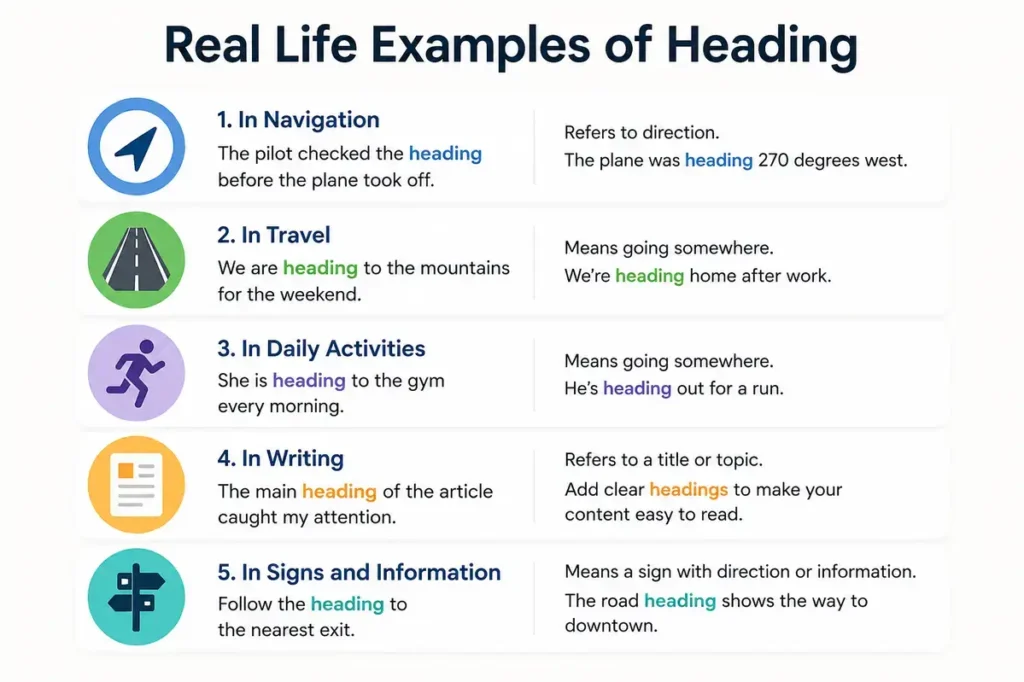
Heading as a Direction
Heading can also refer to the direction in which someone or something moves.
In navigation, a heading can describe the direction an aircraft, ship, or other vehicle travels. In everyday English, people also use the word to describe their intended destination.
For example, “What heading are we taking?” may refer to a direction of travel. The exact meaning depends on the setting.
Which Form Is Correct
Neither spelling is inherently wrong. The correct form depends on the meaning and grammatical structure of your sentence.
Use headed for a past action such as “He headed to the store.” Use heading for an action in progress such as “He is heading to the store.” Use heading as a noun when you mean a title, as in “The heading needs revision.”
A useful editing method is to identify the role of the word before choosing its form.
- If you describe a completed movement or action, consider headed.
- If you describe an ongoing movement, consider heading.
- If you refer to a title above a paragraph or section, use heading.
- If you describe leadership, check the sentence structure to decide between headed and heading.
For example, “She headed the department” means she led it in the past. “She is heading the department” means she currently leads it or is doing so during the period described.
Both sentences are grammatically correct. Their difference lies in the verb tense and the time frame.
Grammar Rules You Should Know
Understanding the basic grammar behind these forms makes choosing the right one much easier.
The Past Tense Rule
The verb head is regular. To form its simple past tense, English adds ed.
Head becomes headed.
This pattern appears in many regular English verbs, such as walk and walked or start and started. The spelling follows the standard rule for forming the past tense of a regular verb.
Use headed with a subject when describing a past action.
Example: “The guests headed to the dining room after the speech.”
The Present Participle Rule
To form heading, English adds ing to head.
This form appears in progressive verb phrases and can also function as a noun or adjective in suitable contexts.
Example: “The guests are heading to the dining room.”
The word are helps form the present progressive tense. Heading alone does not normally serve as the main verb of a standard present progressive sentence without an auxiliary verb.
The Past Participle Rule
Headed also serves as the past participle. You can use it with have, has, or had to form perfect verb phrases.
- “I have headed in that direction before.”
- “She had headed home by the time we called.”
- “They have headed several successful campaigns.”
The last example uses headed in the sense of leading. These structures show that the word can describe different kinds of action while keeping the same spelling.
The Noun Rule
When heading means a title, it functions as a noun.
It can appear after an article or possessive word, such as the, a, this, or your.
Examples include “The heading is too vague,” “Choose a clear heading,” and “Your heading should match the paragraph.”
In this role, heading does not need an auxiliary verb. It names an element of a document.
The Sentence Position Rule
Both words can appear at different points in a sentence. Their position alone does not determine the correct choice.
For example, “Heading toward the exit, Sam waved goodbye” uses heading in an introductory participial phrase. “Sam, headed toward the exit, waved goodbye” uses headed in a descriptive phrase.
The second sentence is grammatically possible, but it has a different structure and may sound less natural in ordinary conversation. Often, “Sam was headed toward the exit when he waved goodbye” communicates the idea more clearly.
Sentence Examples
The following examples show how both forms work in natural English.
Ten Examples Using Headed
- We headed home as soon as the meeting ended.
- She headed to the grocery store to pick up dinner.
- The hikers headed toward the mountain before sunrise.
- I headed out early to avoid traffic.
- The director headed the department for five years.
- After lunch, the students headed back to class.
- The discussion headed in an unexpected direction.
- The team has headed several important projects this year.
- We were headed for the station when the train was delayed.
- The new manager headed the effort to improve customer service.
These examples cover movement, leadership, and expected outcomes. They also show how the same form works with different subjects and verb structures.
Ten Examples Using Heading
- I am heading home now, so I should arrive soon.
- Are you heading to the office tomorrow?
- The children were heading toward the playground.
- We will be heading out after breakfast.
- The discussion is heading in a useful direction.
- Add a heading before the final section of your report.
- The heading on this page doesn’t match the content.
- The pilot adjusted the aircraft’s heading.
- Our team is heading into the next stage of the project.
- Please use a short heading to introduce the new topic.
Notice how the examples shift between verb and noun functions. That change is one of the most useful clues for selecting the right word.
A related grammar guide is Eg vs Ie Explained With Examples and Rules.
Common Mistakes to Avoid
These forms are straightforward once you understand their functions, but a few mistakes still occur in everyday writing.
Using Heading for a Completed Action
Incorrect: “Yesterday, we heading to the museum.”
Correct: “Yesterday, we headed to the museum.”
The first sentence lacks the verb form needed for a simple past statement. Use headed to describe the completed movement.
Using Headed for an Action in Progress
Incorrect: “I am headed to the store right now” is not necessarily incorrect, but it expresses a different structure from the progressive form.
Correct when emphasizing the action: “I am heading to the store right now.”
The first sentence is a valid expression of direction or intention. The second focuses more directly on the ongoing action. Context determines which sounds best.
Confusing a Heading With a Verb
Incorrect: “Please heading the next section.”
Correct: “Please add a heading to the next section.”
Heading is a noun in this context. The sentence needs a main verb such as add, create, or write.
Omitting the Auxiliary Verb
Incorrect: “She heading to work.”
Correct: “She is heading to work.”
In a standard progressive sentence, heading usually needs an auxiliary verb such as am, is, are, was, or were.
Choosing a Form Based Only on Sound
Incorrect: “They headed leaving now.”
Correct: “They are heading out now.”
Writers sometimes mix verb forms because both sound familiar. Check the sentence structure rather than relying on sound alone.
Pronunciation Guide
Headed and heading share the same first syllable. Their endings sound different, which helps distinguish them when speaking.
| Word | IPA | Easy pronunciation |
|---|---|---|
| Headed | /ˈhɛdɪd/ | HED id |
| Heading | /ˈhɛdɪŋ/ | HED ing |
How to Pronounce Headed
Headed has two syllables. The stress falls on the first syllable, which sounds like the word head. The ending has a short vowel sound followed by a d sound.
Say the word smoothly without placing strong stress on the second syllable.
How to Pronounce Heading
Heading also has two syllables, with stress on the first. Its ending contains the ng sound heard at the end of sing.
Avoid replacing that final sound with a separate hard g sound. The tongue position differs from the one used for a plain g.
A Simple Pronunciation Tip
Practice the words in short sentences rather than repeating them in isolation.
- “We headed home.”
- “We are heading home.”
Listening to the final syllable can help you recognize the difference in ordinary speech. The meaning and grammar of the sentence provide an additional clue.
Etymology and Word Origin
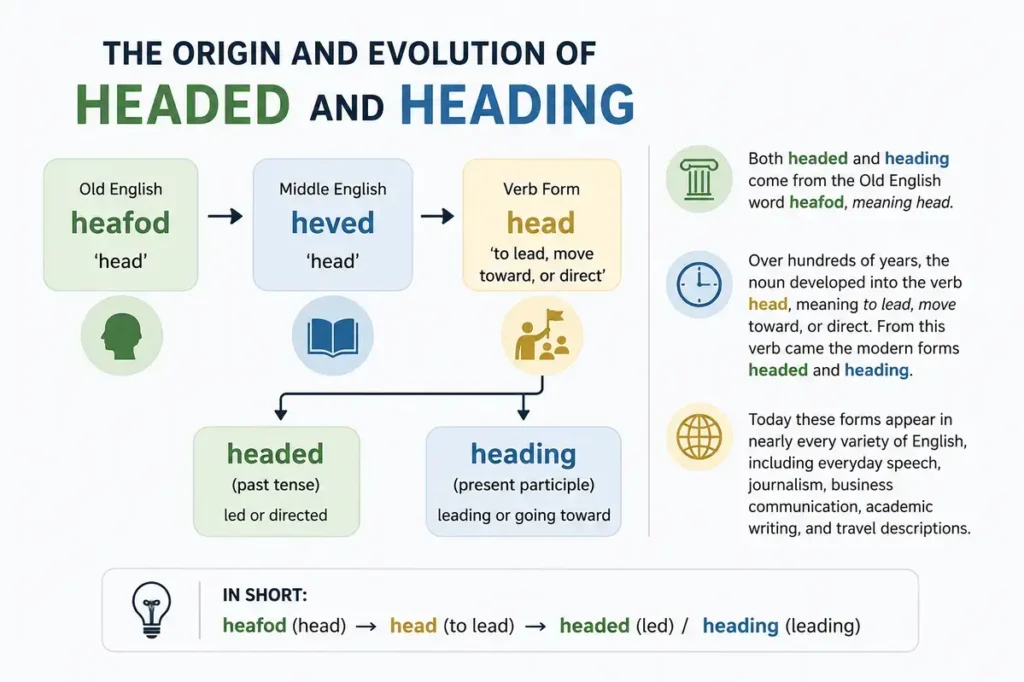
Both words come from the verb head, which developed from the Old English word heafod, meaning the head or the upper part of the body.
Over time, English speakers extended the word’s meaning beyond anatomy. Head came to describe the top or front of something, a leader, or the act of moving in a particular direction.
The past form headed follows the regular English pattern of adding ed to a verb. The form heading follows the common pattern of adding ing to express an ongoing action or create a related noun.
The noun heading developed from the same word family and came to refer to titles and labels placed at the top of sections. The connection makes sense because a heading often appears at the head of a written section.
These related meanings explain why the words share a spelling base while performing different grammatical jobs.
Regional Usage
The distinction remains consistent across major English varieties. American, British, Canadian, and Australian English all use headed and heading in standard writing and speech.
American English
In the United States, both forms are common. People regularly say “I’m heading home” and “We headed out early.” Writers also use heading to describe titles in reports, essays, websites, and other documents.
There is no special American spelling rule that changes one form into the other.
British English
British English follows the same basic grammar. Speakers use headed to describe past movement and heading to describe current movement or a title.
Differences in vocabulary or pronunciation may appear in specific expressions, but they do not change the standard distinction between these forms.
Australian English
Australian English also uses both words in everyday speech and formal writing. Expressions such as “heading home” and “headed north” follow the same grammatical patterns used in American and British English.
Canadian English
Canadian English follows the same spelling and grammar conventions for these words. Writers can use heading for a section title and headed for a past action without changing the form based on regional preference.
Real Life Usage Examples
Seeing the words in different settings helps you understand how people use them naturally.
Daily Conversation
- “I’m heading to the gym after work.”
- “We headed to the beach before it got crowded.”
The first sentence describes a current plan. The second reports an earlier action.
Email and Workplace Communication
- “I am heading into the client meeting now.”
- “Maria headed the review process last quarter.”
The first example describes an immediate action. The second describes a leadership role during a past period.
Academic Writing
- “The researchers headed the project that examined student learning.”
- “Use a descriptive heading to introduce each major section.”
Academic writing benefits from precise word choices. In the first sentence, headed describes leadership. In the second, heading names a part of the document.
News and Journalism
- “The delegation headed to the capital for further talks.”
- “The aircraft was heading east when the weather changed.”
News writing often uses these forms to report movement, travel, and developing events.
Literature and Storytelling
- “At dawn, the travelers headed into the forest.”
- “The young explorer was heading toward a distant village when she heard a strange sound.”
Both forms can create a sense of movement in a story. The past form often moves the plot forward, while the progressive form can describe an unfolding scene.
Related Words and Expressions
Several related words can help you express direction, leadership, or document structure more precisely.
- Head. The base verb can mean to lead, direct, or move toward a place. Example: “We head north at sunrise.”
- Heading out. This expression means leaving or preparing to leave. Example: “I’m heading out now.”
- Headed for. This phrase often describes a destination or expected outcome. Example: “The team is headed for success.”
- Lead. This verb can mean to guide people or take charge. Example: “She leads the research group.”
- Leading. This form can describe an ongoing leadership action or a position of influence. Example: “He is leading the discussion.”
- Title. A title names a work or identifies a section. It can be similar to a heading, but it may refer to a larger piece of writing.
- Subheading. A subheading introduces a smaller section beneath a main heading. It helps organize detailed information.
- Direction. This noun refers to the path or course someone or something follows. Example: “We changed direction after checking the map.”
These terms overlap in meaning, but they are not perfect substitutes. A title may name an entire article, while a heading usually introduces a section. Similarly, heading out describes leaving, while headed out can describe a departure that already happened or a person’s current direction.
Expert Editor Insight
An experienced editor looks at the job a word performs before changing its spelling or tense. The word heading often appears in document formatting, so a writer may accidentally treat it as a verb in a sentence that needs a different structure. Editors also check auxiliary verbs, time references, and parallel sentence patterns. Grammar tools can flag missing verbs or inconsistent tense, but they may not understand the intended meaning. Read the full sentence and confirm the meaning before accepting an automated correction.
Key Takeaways
- Headed is the past tense and past participle of head.
- Heading is the present participle and gerund of head.
- Heading is also a noun meaning a title or section name.
- Use headed for completed actions.
- Use heading for actions happening now.
- Headed can function as an adjective in expressions such as level headed and clear headed.
- Perfect tenses require headed.
- Continuous tenses require heading.
- Both words are standard in American and British English.
- Always identify the sentence’s tense and meaning before choosing the correct form.
You may also want to read less then or less than Correct Usage Explained.
Conclusion
Headed vs Heading comes down to meaning, tense, and grammatical function. Headed usually describes a past action, a leadership role, or a direction. Heading commonly describes an ongoing action, a planned movement, a title, or a direction of travel. Both forms are correct English, so you should choose the one that fits your sentence rather than treating either spelling as a mistake.
For a quick memory trick, connect the ed ending with a past action and the ing ending with an ongoing action. Then check the surrounding words to confirm the meaning. If heading refers to a document title, use it as a noun. A short review of the sentence will usually reveal the right choice.
FAQs
Is Headed a Correct English Word?
Yes. Headed is the standard past tense and past participle of the verb head. It can describe movement, leadership, or an expected outcome. For example, “We headed home” describes a past action, while “The company is headed by a new director” describes leadership. The word is correct in both casual and formal writing.
What Does Heading Mean?
Heading has two common meanings. It can be the present participle of head, as in “We are heading home,” or a noun that means a title above a section of text. It can also refer to a direction of travel. The surrounding sentence makes the intended meaning clear.
Which Form Should I Use for a Past Action?
Use headed when describing a completed action in the simple past. For example, “They headed to the airport after breakfast.” If you want to describe an action that was in progress at a past moment, use a structure such as “They were heading to the airport when I called.” The verb phrase determines the time frame.
Can Heading Be Used as a Noun?
Yes. Heading commonly functions as a noun in writing and document design. It identifies the title or label above a section, paragraph group, or topic. For example, “The heading should describe the section clearly.” In navigation, heading can also mean the direction in which a vehicle or person is moving.
How Do You Pronounce Headed and Heading?
Headed is pronounced /ˈhɛdɪd/, while heading is pronounced /ˈhɛdɪŋ/. Both words have two syllables, and both carry stress on the first syllable. The main difference lies in the ending. Headed ends with a d sound, while heading ends with the ng sound found in sing.
Can Heading Start a Sentence?
Yes. Heading can begin a sentence when it introduces a participial phrase or functions as a noun. For example, “Heading toward the exit, Alex checked his phone.” Here, heading describes an action. In “Heading selection affects readability,” the word functions as a noun describing a document feature.
What Is a Synonym for Heading?
The best synonym depends on the meaning. If heading means a title, you might use title, label, or subheading. If it describes movement, expressions such as traveling toward, moving toward, or going to may fit. For example, “We are heading home” can become “We are going home.” Choose a replacement that preserves the original meaning.
Are These Words Used Differently in American and British English?
No major grammatical difference separates American and British English in this case. Both varieties use headed for past actions and heading for ongoing actions or titles. Canadian and Australian English follow the same basic rules. Local expressions may vary, but the standard spelling and grammatical functions remain consistent across these varieties.