
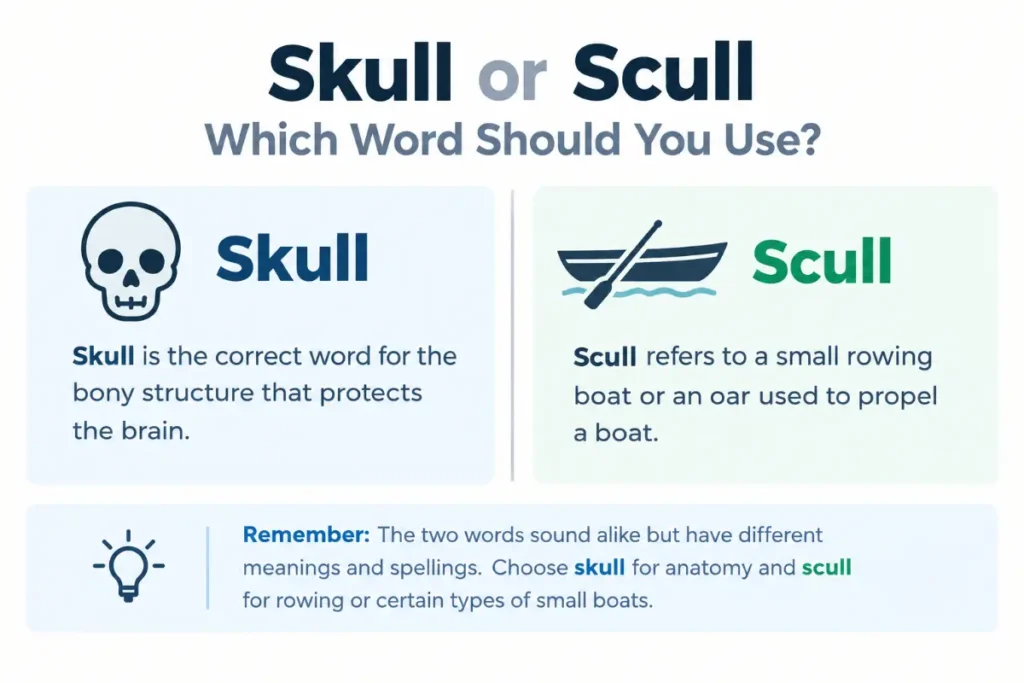
Skull or scull can be confusing because the two words look almost identical and sound the same in standard American English. However, they have different meanings, and using one in place of the other can change the meaning of your sentence completely. A skull is the bony structure of the head that protects the brain. A scull is an oar used to move a boat, a small rowing boat, or the act of moving such a boat with sculls.
The confusion usually comes from their similar spelling and pronunciation. Both words contain the same sounds, but their meanings belong to entirely different subjects. One appears in anatomy, medicine, education, and discussions about the human body. The other appears in rowing, boating, and water sports.
Understanding the difference is simple once you connect each spelling with its meaning. This guide explains both words, their origins, pronunciation, grammar, common mistakes, and everyday usage. You’ll also find practical examples and an easy memory tip to help you choose the correct spelling in school assignments, professional writing, and casual conversations.
You may also want to read Kinesthesiology vs Kinesiology Simple Rules Explained 2026.
Quick Answer
Both spellings are correct English words, but they aren’t interchangeable. Skull means the bony structure of the head, while scull refers to a rowing oar, a type of rowing boat, or the action of rowing with sculls. Remember that the correct spelling depends on the subject of your sentence.
Comparison Table
| Feature | Skull | Scull |
|---|---|---|
| Meaning | The bony structure of the head. | A rowing oar, a type of boat, or the act of rowing with sculls. |
| Part of speech | Noun. | Noun or verb. |
| Main subject | Anatomy and the human body. | Rowing and boating. |
| Pronunciation | /skʌl/. | /skʌl/. |
| Common context | Medicine, biology, fossils, and anatomy lessons. | Sports, rowing competitions, and boat handling. |
| Example | The doctor examined the skull. | She learned to scull across the lake. |
| Standard usage | Correct in all major English varieties. | Correct in all major English varieties. |
The main distinction is meaning, not pronunciation. Both words are established English terms, so neither is a misspelling of the other.
Meaning and Definition
What Does Skull Mean
A skull is the bony structure of the head. In humans, it protects the brain and supports the structures of the face. It also provides attachment points for muscles involved in chewing and other movements.
The word is a noun. You can use it to describe the skull of a person, an animal, or a fossil discovered during an archaeological or scientific investigation.
For example, a biology teacher might show students a model of a human skull to explain the structure of the head. A paleontologist might examine a fossil skull to learn about an extinct animal.
The word also appears in everyday expressions and descriptions. Someone might talk about a skull shaped like a decoration, a skull symbol on a warning sign, or a skull design printed on a shirt.
In each case, the word refers to the bony structure or an image representing it.
What Does Scull Mean
A scull has several related meanings connected to rowing and boats. As a noun, it can refer to an oar used to propel a boat. It can also refer to a small boat designed to be moved using sculls.
As a verb, to scull means to propel a boat using a particular rowing technique. Depending on the boat and the method, a rower may use two oars, one in each hand, or move a single oar at the stern from side to side to help move the boat.
For example, a rowing coach might tell an athlete to practice sculling before entering a competition. A person enjoying a quiet morning on a lake might scull a small boat along the shore.
In competitive rowing, sculling commonly describes a style in which each rower uses two oars. This differs from sweep rowing, in which each rower uses one oar.
The word therefore belongs mainly to boating, rowing, and water sports. It isn’t an alternative spelling for the bones of the head.
Is Either Word Incorrect
Neither word is incorrect. The confusion comes from treating two legitimate words as spelling variations of the same term.
Use the spelling that matches the subject. If you’re writing about anatomy, use the word for the head. If you’re writing about rowing equipment or the action of propelling a boat, use the rowing term.
This distinction matters in schoolwork, medical descriptions, sports reporting, and professional editing. A spelling checker may accept both words because both are valid. It may not recognize that you’ve selected the wrong one for your sentence.
Key Differences Explained
Spelling and Meaning
The words differ by one letter. The second letter in one is a K, while the second letter in the other is a C. That small difference signals a completely different meaning.
- Use skull when discussing the bones of a human or animal head.
- Use scull when discussing rowing, a rowing oar, or a boat propelled using sculls.
Consider these sentences. The museum displayed an ancient skull. The athlete trained to scull faster across the water. Both sentences use standard English, but the words cannot be exchanged without changing the meaning.
Grammar and Part of Speech
The word for the head is primarily a noun. It can appear as a subject, an object, or part of a longer noun phrase.
For example, the skull protects the brain. In this sentence, the word functions as the subject.
The rowing term can function as both a noun and a verb. You can own a scull, repair a scull, or scull a boat across a lake.
This grammatical difference is useful because the sentence structure often provides clues about the intended word. A phrase involving rowing equipment or an action on the water points toward the boating term.
Pronunciation
In standard American English, both words are pronounced /skʌl/. They have one syllable and share the same vowel sound found in words such as cup and luck.
Because they sound alike, listening alone may not tell you which spelling a writer intends. Readers need to rely on context to understand the meaning.
For instance, a sentence about a doctor examining a patient points toward the anatomical term. A sentence about an athlete training on a river points toward the rowing term.
Formality and Context
Both words are appropriate in formal and informal English. The difference lies in the subject, not the level of formality.
A medical report can use the anatomical term when describing an injury or examination. A sports article can use the rowing term when describing a competition or training session.
In casual conversation, the same distinction applies. The correct spelling depends on what the speaker or writer means.
Regional Usage
American, British, Canadian, and Australian English recognize both words with their established meanings. There is no general regional spelling rule that changes one into the other.
You may encounter different rowing terms in different sporting communities, but the basic distinction remains the same. The anatomical word refers to the head, while the boating term relates to rowing.
Which Form Is Correct
The correct form depends on the intended meaning. You shouldn’t automatically replace one spelling with the other because both are recognized English words.
Use the anatomical term in sentences such as these.
- The skull protects the brain from many external impacts.
- The students studied the skull as part of their anatomy lesson.
- Researchers discovered a fossil skull at the excavation site.
Use the rowing term in sentences such as these.
- The coach taught the beginners how to scull.
- She placed the scull carefully inside the boat.
- The athlete practiced sculling before the weekend race.
The best way to make the choice is to identify the topic before checking the spelling. If the sentence concerns bones, anatomy, or fossils, the first word is appropriate. If it concerns oars, rowing, or boats, the second is appropriate.
A dictionary can confirm the meanings of both words. However, a spelling checker may not flag an incorrect choice when the selected word is spelled correctly. Careful proofreading must account for meaning as well as spelling.
Sentence Examples
The following examples show how both words work in everyday English. Each sentence uses the spelling that matches its intended meaning.
Examples Using Skull
- The doctor explained how the skull protects the brain from injury.
- Our science teacher brought a model of a human skull to class.
- The museum displayed a fossil skull from an extinct animal.
- The helmet covered most of the cyclist’s skull and helped protect the head.
- The archaeologist carefully examined the skull before recording the discovery.
- The medical students labeled the major bones of the skull during their laboratory session.
- The injury caused concern because the impact occurred near the base of the skull.
- The artist drew a skull for a Halloween poster.
- The researchers compared the skull with other fossils to study changes in animal anatomy.
- The warning sign featured a skull to indicate a serious hazard.
Examples Using Scull
- My brother learned to scull on the lake during summer camp.
- The rowing coach showed the team how to hold each scull correctly.
- She placed her scull beside the boat before practice.
- The athlete trained every morning to improve her sculling technique.
- We watched the rowers scull across the water at sunrise.
- The club purchased new sculls for its beginner rowing program.
- He learned to scull a small boat while visiting his grandparents.
- The rowing team practiced sculling before the regional competition.
- The instructor explained how sculling differs from sweep rowing.
- Strong winds made it harder for the rower to scull in a straight line.
These examples also show why context matters. The spelling alone may not help you distinguish the words when you hear them aloud, but the surrounding details usually make the meaning clear.
Common Mistakes and Misspellings
Using the Anatomical Word in a Rowing Sentence
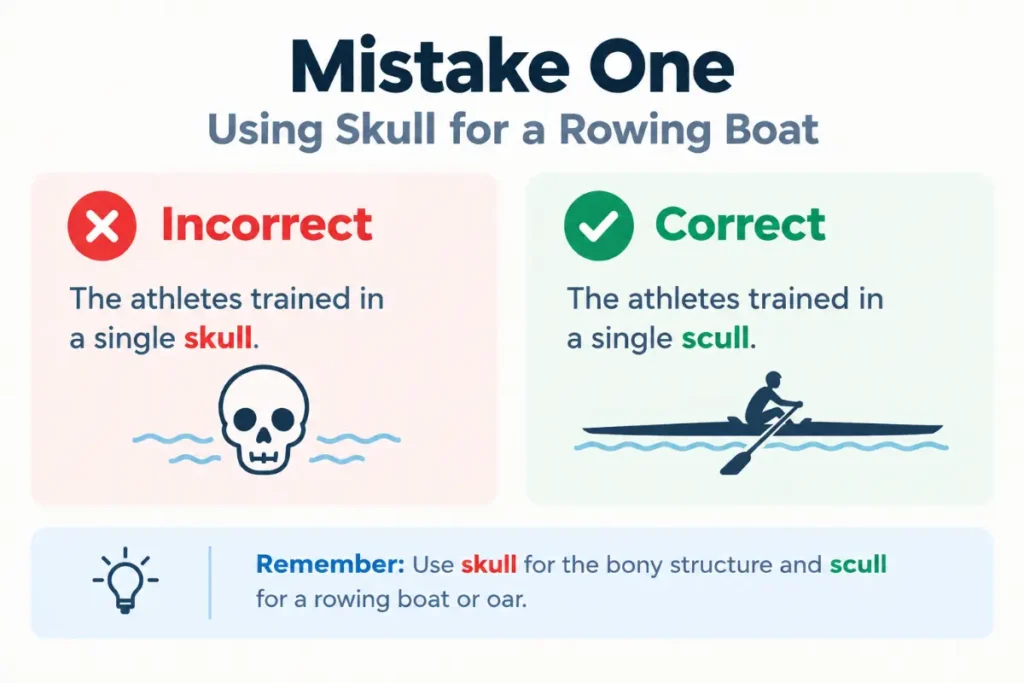
Incorrect: She learned to skull across the lake.
Correct: She learned to scull across the lake.
The sentence describes the action of moving a boat with oars. The spelling associated with the head doesn’t fit the intended meaning.
Using the Rowing Word in an Anatomy Sentence
Incorrect: The doctor examined the patient’s scull.
Correct: The doctor examined the patient’s skull.
The sentence concerns the bones of the head, so the anatomical spelling is required.
Assuming One Word Is a Typo
Incorrect assumption: Scull is simply a misspelling of skull.
Correct understanding: Both are established words with different meanings.
This mistake occurs when readers notice the similar spelling but don’t know the specialized rowing term. Checking the definition prevents an unnecessary correction.
Trusting Spell Check Without Checking Meaning
Incorrect: The paleontologist studied an ancient scull.
Correct: The paleontologist studied an ancient skull.
The first spelling may pass a basic spelling check because it is a valid word. However, it doesn’t fit the context of studying the bones of an ancient animal.
Confusing Sculling With Sweep Rowing
Incorrect assumption: Every rower uses the same rowing technique.
Correct understanding: Sculling generally involves two oars per rower, while sweep rowing involves one oar per rower.
This is a terminology mistake rather than a spelling mistake. Understanding the sporting context makes it easier to use the rowing word accurately.
Pronunciation Guide
Both words have the same standard pronunciation in American English. They sound alike, so you must use the meaning and sentence context to choose the correct spelling.
Skull
IPA: /skʌl/
One syllable. Rhymes with dull.
Need another quick comparison? Read hall vs haul: Correct Spelling, Meaning and Usage.
Scull
IPA: /skʌl/
One syllable. Rhymes with pull in accents where pull has the same vowel as dull.
How to Pronounce Both Words
Start with the /sk/ sound, as in the word school. Then say the short vowel sound /ʌ/, as in cup, followed by the final /l/ sound.
The result is a single syllable. You don’t need to stress one part more than another because each word has only one syllable.
A common mistake is to assume that the different letters must produce different sounds. English spelling doesn’t always work that way. In this case, both words share the same pronunciation despite their different meanings.
Etymology and Word Origin
The two words have separate histories, which helps explain why their spellings and meanings differ.
The Origin of Skull
The English word skull developed from older Germanic forms. Its exact historical path includes forms found in earlier English and related Germanic languages. Over time, the spelling settled into the modern form used for the bony structure of the head.
Today, the word appears in anatomy, medicine, biology, archaeology, and everyday speech. Its central meaning remains connected to the head and the bones that form its structure.
The Origin of Scull
The rowing term has a separate history associated with oars and the movement of boats. It developed through older English usage and related forms connected with rowing equipment and rowing actions.
Modern English uses it for rowing equipment, certain small boats, and the act of propelling a boat with sculls. Its meaning has remained closely tied to movement on water.
The important point is that these words didn’t develop as alternative spellings of one another. Their similar appearance in modern English doesn’t make them interchangeable.
Regional Usage
American English
Both spellings are standard in the United States. The anatomical term appears frequently in science education, health discussions, and descriptions of human or animal anatomy. The rowing term is familiar in boating clubs, rowing programs, and competitive sports.
American readers generally distinguish the words through context because their standard pronunciations are identical.
British English
British English also uses both spellings with the same basic meanings. The anatomical term refers to the bones of the head, while the rowing term relates to oars and rowing techniques.
Rowing is an established sport in the United Kingdom, so the second word appears naturally in discussions of rowing clubs and competitions.
Australian English
Australian English recognizes both words as standard. The spelling choice depends on the subject rather than a special Australian spelling rule.
A biology textbook may use the anatomical term, while a rowing coach may use the boating term.
Canadian English
Canadian English follows the same distinction. Both words are accepted, and the intended meaning determines the correct spelling.
There is no general American, British, Australian, or Canadian spelling difference that turns one of these words into a regional alternative for the other.
Grammar Rules and Part of Speech
Understanding how each word functions in a sentence makes the distinction easier to remember.
Using Skull as a Noun
The anatomical term is a countable noun. You can refer to one skull or several skulls.
It commonly appears as the subject or object of a sentence. It can also modify another noun when used in a compound expression, such as skull fracture or skull model.
For example, the skull protects the brain. Here, the word is the subject of the sentence. In the sentence the researcher examined the skull, it functions as the object.
Using Scull as a Noun
The rowing term can name a piece of equipment or a type of boat. Its exact meaning depends on the sentence.
For example, the rower picked up a scull before practice. In this sentence, the word refers to rowing equipment.
When discussing boats, the same noun may refer to a small craft designed for sculling. The surrounding words usually make the intended meaning clear.
Using Scull as a Verb
The rowing term also works as a verb. Its common forms include scull, sculls, sculled, and sculling.
- Present tense: I scull every morning.
- Third person singular: She sculls across the lake.
- Past tense: He sculled toward the dock.
- Present participle: They are sculling together.
Notice that the spelling remains connected to rowing in every form. You wouldn’t use the anatomical spelling to describe the act of propelling a boat.
Capitalization and Punctuation
Both words normally begin with a lowercase letter in the middle of a sentence. Capitalize either one at the start of a sentence or when it appears in a title that follows your chosen capitalization style.
Neither word requires quotation marks or special punctuation simply because it has a specialized meaning. Use normal sentence punctuation and let the context communicate the intended sense.
Real Life Usage Examples
The following examples show how these words appear in different types of communication.
Daily Conversation
- My little sister asked why the skull has so many different bones.
- Dad taught me how to scull a small boat on our vacation.
In everyday conversation, the surrounding situation usually makes the intended meaning clear. A discussion about the human body points to one word, while a conversation about boating points to the other.
Email and Workplace Communication
- Please include the skull diagram in the anatomy presentation before Friday.
- The rowing club needs to inspect each scull before the next training session.
In workplace writing, accuracy matters because a reader may rely on the wording to complete a task. Choosing the correct term prevents confusion in instructions, reports, and schedules.
Academic Writing
- The study examined the skull structure of several fossil specimens.
- The report compared sculling techniques used by experienced rowers.
Academic writing benefits from precise terminology. The first sentence concerns anatomy and scientific observation. The second concerns a sporting technique, so the rowing term is appropriate.
News and Journalism
- Researchers identified the fossil skull during an archaeological investigation.
- The rowing team improved its sculling performance during the final race.
Journalists should check specialized terms carefully. A valid spelling can still be wrong for the subject being reported, especially when two words sound the same.
Literature and Storytelling
- The explorer discovered a weathered skull beneath the old stone bridge.
- As the sun rose, the fisherman began to scull toward the quiet shore.
In storytelling, the choice of word helps readers picture the scene. One creates an image connected to anatomy or remains, while the other suggests movement across water.
Related and Confused Terms
These eight related words can help you build a clearer understanding of anatomy and rowing vocabulary.
1. Cranium. The cranium is the part of the skull that encloses and protects the brain. In everyday language, people sometimes use the terms more broadly as synonyms, but anatomy distinguishes the braincase from the entire skull.
2. Jawbone. The jawbone is a bone associated with the lower part of the face. It forms part of the skull but doesn’t mean the entire bony structure.
3. Skeleton. A skeleton is the supporting framework of bones in a human or animal body. The skull is one part of that framework.
4. Oar. An oar is a long pole with a broad blade used to propel a boat. A scull can be a particular type of oar used in rowing.
5. Rowing. Rowing is the activity of propelling a boat using oars. It includes sculling and sweep rowing.
6. Sculling. Sculling is a rowing technique in which each rower typically uses two oars. It can also refer to moving a boat using a single oar at the stern.
7. Sweep rowing. In sweep rowing, each rower uses one oar. This differs from sculling, where each rower typically handles two oars.
8. Skull fracture. A skull fracture is a break in one or more bones of the skull. The term belongs to medical language and has no connection to rowing equipment.
These terms are useful because they place each word within its proper subject area. Learning related vocabulary can help you recognize the intended meaning even when two words sound exactly alike.
Expert Editor Insight
An experienced editor checks meaning before correcting spelling. Both words are legitimate, so an automated spelling checker may accept either one without recognizing a contextual error. When proofreading, look at the surrounding nouns and verbs. References to bones, brains, fossils, or anatomy usually call for the anatomical term. References to boats, oars, and rowing point to the other word. This simple context check catches errors that basic spell check often misses.
Key Takeaways
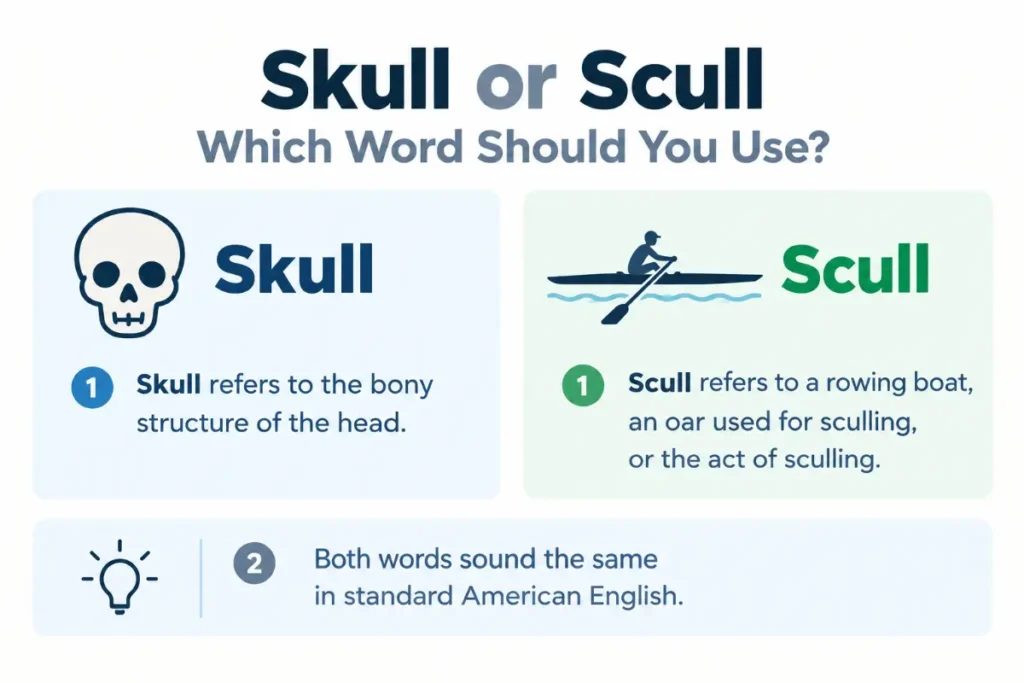
- Skull refers to the bony structure of the head.
- Scull refers to a rowing boat, an oar used for sculling, or the act of sculling.
- Both words sound the same in standard American English.
- Skull is a noun, while scull can function as both a noun and a verb.
- Single scull, double scull, and quadruple scull are established rowing terms.
- Both spellings are correct, but they aren’t interchangeable.
- A spell checker may accept the wrong word if it doesn’t fit the intended meaning.
- The simplest memory trick is to connect skull with the head and scull with the water.
For another common grammar confusion, see totalling or totaling Which Spelling Should You Use.
Conclusion
Skull or scull is a simple spelling choice once you understand the meaning of each word. Skull refers to the bony structure of the head, while scull relates to rowing equipment, certain small boats, and the act of rowing with sculls. Both words are correct, and neither should be treated as a misspelling of the other.
Remember this practical tip. Connect the K in skull with the bones of the head, and connect scull with boats and rowing. Before submitting an assignment or sending a professional message, read the whole sentence and check that the word fits its meaning. That quick habit will help you write clearly and avoid a common English usage mistake.
FAQs
Is Skull or Scull the Correct Spelling?
Both spellings are correct, but they have different meanings. Use skull when referring to the bony structure of a person’s or animal’s head. Use scull when referring to a rowing oar, a type of rowing boat, or the action of rowing with sculls. The subject of your sentence determines the correct choice.
Is Scull a Real English Word?
Yes. Scull is a standard English word used in rowing and boating. It can name an oar or a small rowing boat, and it can function as a verb meaning to propel a boat using sculls. It isn’t a misspelling of the anatomical term. The two words simply have different meanings and uses.
What Does Skull Mean?
Skull refers to the bony structure of the head. In humans, it protects the brain and supports the structures of the face. The word is a noun commonly used in anatomy, medicine, biology, and archaeology. You might encounter it in a science textbook, a medical report, or a description of a fossil discovered during an excavation.
How Do You Pronounce Both Words?
Both words are pronounced /skʌl/ in standard American English. Each contains one syllable and begins with the consonant sounds /sk/. The vowel sound is the same one heard in cup, followed by the final /l/. Since the words sound alike, you must rely on meaning and context to select the correct spelling when writing.
Can Scull Be Used as a Verb?
Yes. Scull is a regular verb that describes propelling a boat with sculls. For example, you can say that an athlete sculls across a lake or that a team is sculling during practice. Its past tense is sculled, and its present participle is sculling. The verb belongs to rowing and boating rather than anatomy.
What Is a Synonym for Skull?
Cranium is a related term often used to describe the part of the skull that encloses the brain. However, the words aren’t always exact substitutes in anatomical writing because the skull includes structures beyond the braincase. Head bones is a simpler descriptive alternative in casual conversation, but skull remains the most direct term for the complete bony structure.
Why Do People Confuse These Two Words?
People confuse them because they differ by only one letter and have the same standard pronunciation in American English. This makes the error difficult to catch by listening alone. Familiarity with one word may also make the other seem unfamiliar. Reading the entire sentence and identifying its subject usually resolves the confusion.
Is Scull Appropriate in Formal Writing?
Yes. Scull is appropriate in formal writing about rowing, boating, and related activities. It can appear in sports reports, academic discussions, training instructions, and technical descriptions. Using it in a sentence about the bones of the head would be incorrect for that meaning. Formal writing requires the right word for the context, not simply a recognized spelling.