
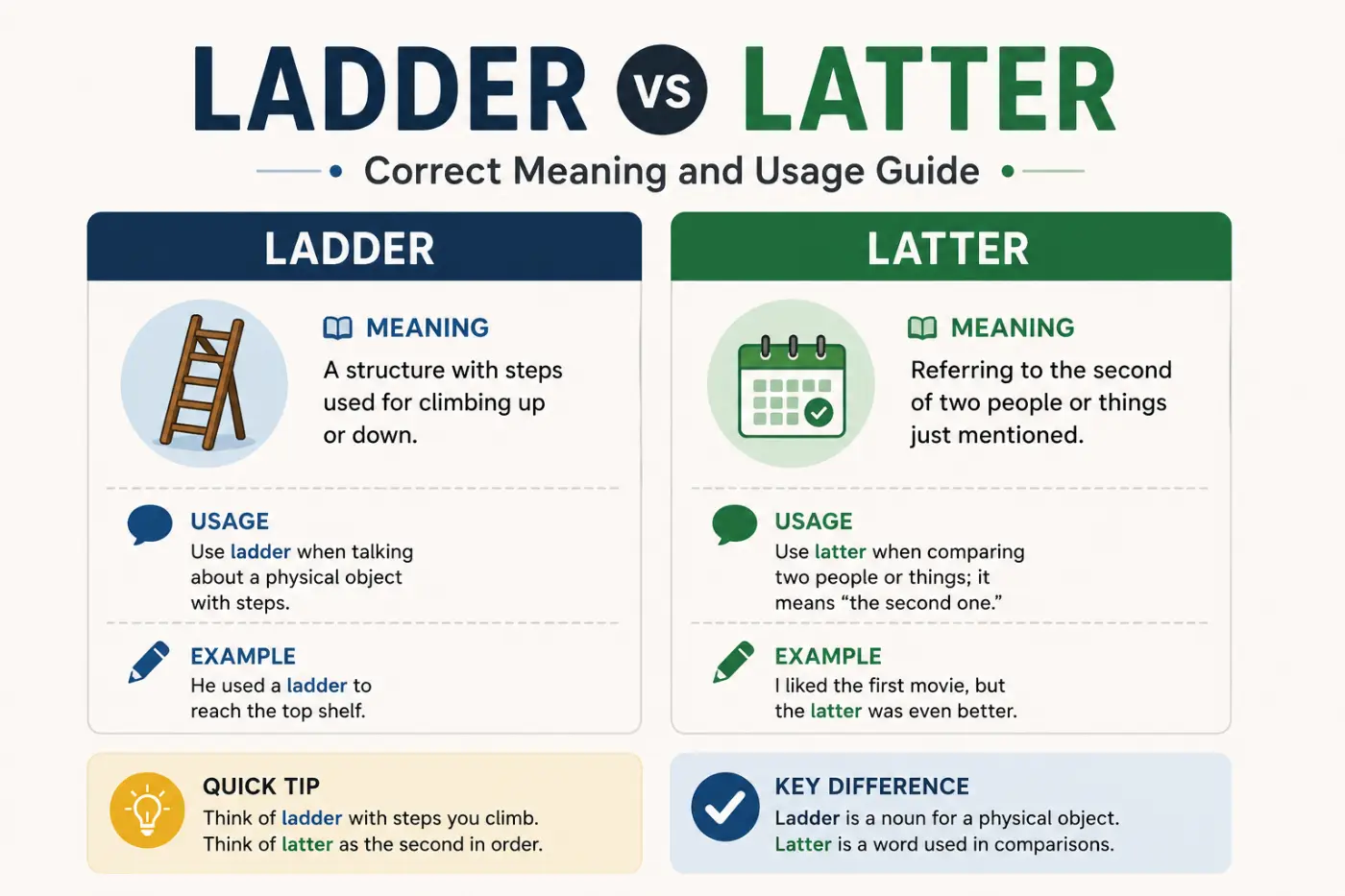
Have you ever typed one of these words and stopped because you weren’t sure which one belonged in the sentence? You’re not alone. Ladder vs latter is a common English word confusion because the two forms look remarkably similar and have closely related sounds.
The correct word depends completely on the meaning. Ladder is usually a noun for a structure used for climbing. Latter refers to the second of two things mentioned or to something closer to the end or later part of a period.
That one extra letter changes everything.
A ladder can help you reach a roof. The latter of two choices is the second choice. They aren’t interchangeable even though their spelling differs by only one letter.
This guide explains the difference in plain English. You’ll learn what each word means how to pronounce it how the words developed how native speakers use them and how to avoid the most common mistakes. You’ll also see practical examples from everyday conversation email academic writing news and literature.
Need another quick comparison? Read Smoothe or Smooth Which Spelling Is Correct?.
Quick Definition
Ladder is a noun that usually means a structure with steps used for climbing. Latter is an adjective or noun that identifies the second of two things or refers to something later or closer to the end. They have different meanings grammatical roles and uses.
Quick Answer
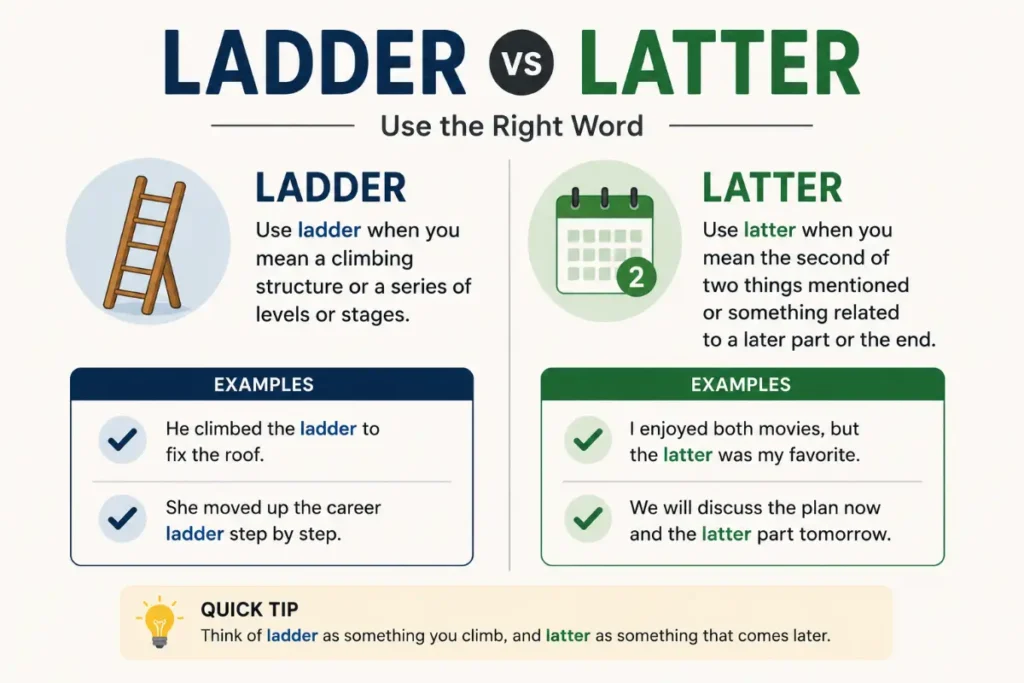
Use ladder when you mean a climbing structure or a series of levels or stages. Use latter when you mean the second of two things mentioned or something related to a later part or the end.
For example, you can climb a ladder, but you can choose the latter of two options. The words aren’t interchangeable.
Comparison Table
| Correct Form | Meaning | Part of Speech | Origin | Usage Frequency | Formality | Common Contexts | Example |
|---|---|---|---|---|---|---|---|
| ladder | A structure used for climbing or a series of stages | Noun | Old English hlǣder | Very common | Neutral | Home repair work careers progress | She climbed the ladder carefully. |
| latter | The second of two things or something later or closer to the end | Adjective and noun | Old English lætra | Common | Neutral to formal | Comparisons writing time periods formal prose | I prefer the latter option. |
Meaning and Definition
Meaning of Ladder
Ladder is primarily a noun. It refers to equipment that lets a person climb upward or downward. A typical ladder has two long sides connected by horizontal steps called rungs.
You might use a ladder to clean a window paint a ceiling reach a high shelf or repair a roof. The word can also have a figurative meaning.
For example:
She climbed the ladder to reach the attic.
The painter leaned the ladder against the wall.
He moved up the career ladder quickly.
That final example doesn’t involve physical climbing. The phrase career ladder describes a sequence of professional levels. Similar expressions include social ladder and corporate ladder.
The word can also appear in other specialized contexts. A ladder in a textile context can refer to a run or opening in knitted material. In sports business and other fields the word may describe a progression of stages.
The central idea remains the same. A ladder represents something that allows movement from one level to another.
Merriam Webster traces the noun to Middle English and Old English hlǣder. The word has been part of English for many centuries.
Meaning of Latter
Latter has a very different job.
It commonly refers to the second of two people things choices or ideas that have already been mentioned.
Consider this sentence:
I considered buying a laptop or a tablet. I chose the latter.
The reader knows that two options appeared earlier. The latter means the second one in that pair. In this case the second option is the tablet.
The word can also describe something that occurs later in a period or closer to the end.
For example:
The latter part of the meeting was more productive.
She spent her latter years writing poetry.
The latter stages of the project required more testing.
Merriam Webster defines latter as referring to a subsequent time or period and also as the second of two things or the last of several things referred to.
The noun phrase the latter is especially common when writers compare two choices.
For example:
You can take the bus or the train. The latter is faster.
Here the latter means the train.
This is one reason the word often appears with former. Former points to the first item while latter points to the second.
Key Differences Explained
- Spelling.
Ladder contains a double d while latter contains a double t. That small spelling difference marks two completely different words. - Meaning.
Ladder usually refers to something used for climbing or a sequence of levels. Latter refers to the second item mentioned or something later in a period. - Grammar role.
Ladder is mainly a noun. Latter is primarily an adjective and can also function as a noun in the expression the latter. - Context.
You might find a ladder in a garage construction site or home. You are more likely to find latter in comparisons formal writing discussions and descriptions of time. - Tone.
Ladder is an ordinary everyday word. Latter is also common but can sound more formal because writers often use it in structured comparisons.
A simple memory trick can help. Think of the d in ladder as standing for device. A ladder is a climbing device. Think of the tt in latter as connected with two things. The latter often identifies the second of two choices.
Which Spelling Is Correct
Both ladder and latter are correct spellings. The right choice depends on what you mean.
If you mean climbing equipment use ladder.
If you mean the second of two things use latter.
If you mean something that happens later or closer to the end use latter in the appropriate adjective construction.
Dictionary evidence supports this distinction. Cambridge defines ladder as equipment used for climbing and also records its figurative use for a series of stages. Merriam Webster defines latter in relation to a later period and the second or last item referred to.
That dictionary logic gives you a reliable editing rule. Don’t choose the spelling based on how the word sounds. Choose it based on the meaning the sentence needs.
Sentence Examples
Examples With Ladder
- The workers placed a ladder against the side of the house.
- She climbed the ladder to clean the upstairs windows.
- Please hold the ladder while I reach the top shelf.
- The old ladder had a broken rung.
- He carried the ladder into the garage after finishing the repair.
- She hopes to climb the corporate ladder over the next few years.
- The firefighter moved quickly up the ladder.
- We need a taller ladder to reach the roof.
- He carefully folded the ladder and stored it in the shed.
- Hard work helped her move up the career ladder.
Examples With Latter
- I can take the morning flight or the evening flight. I prefer the latter.
- The latter part of the book becomes much more emotional.
- Of the two plans the latter seems more practical.
- The latter stages of the competition were extremely demanding.
- She became more interested in painting during the latter years of her life.
- We discussed price and quality and the latter mattered more to the customer.
- The first proposal was expensive while the latter was easier to implement.
- His early work was simple but his latter work showed much greater confidence.
- The latter option will save us more time.
- The first half was quiet but the latter half was full of action.
Examples Showing The Common Mix Up
- Incorrect meaning: I climbed the latter to reach the roof.
Correct: I climbed the ladder to reach the roof. - Incorrect meaning: I chose the ladder of the two plans.
Correct: I chose the latter of the two plans. - Incorrect meaning: The latter was leaning against the wall and had three steps.
Correct: The ladder was leaning against the wall and had three steps. - Incorrect meaning: During the ladder part of his life he became a respected writer.
Correct: During the latter part of his life he became a respected writer. - Incorrect meaning: The latter helped the worker reach the second floor.
Correct: The ladder helped the worker reach the second floor.
Common Mistakes and Misspellings
Several mistakes appear because the words share the same first three letters and have similar pronunciation.
- Using ladder for a comparison.
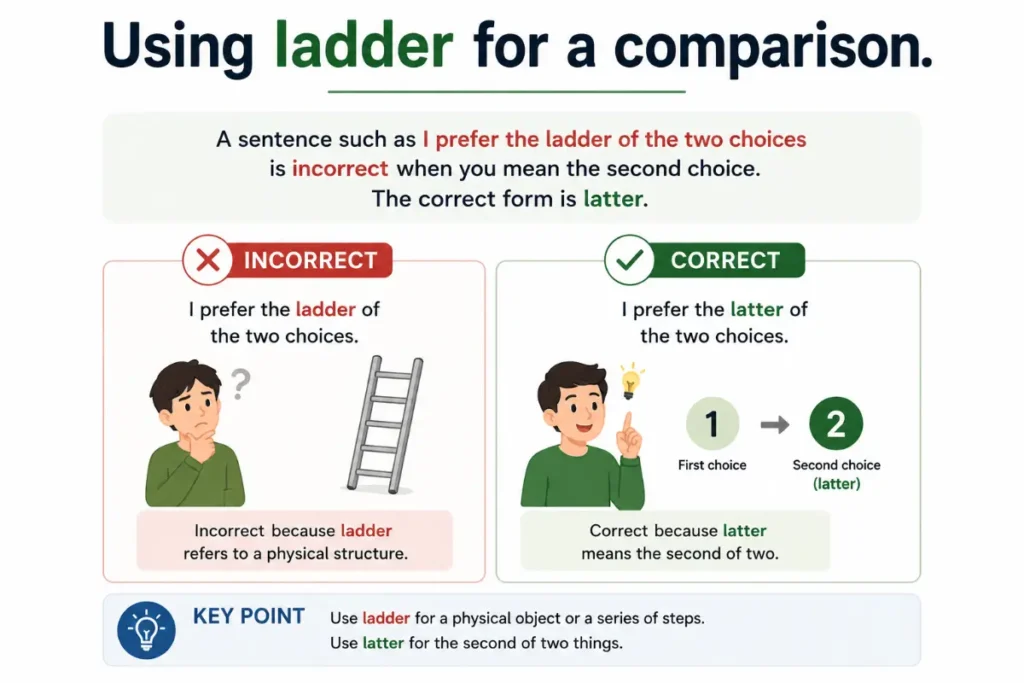
A sentence such as I prefer the ladder of the two choices is incorrect when you mean the second choice. The correct form is latter. - Using latter for climbing equipment.
A sentence such as He climbed the latter is normally wrong if you mean a physical climbing structure. Use ladder. - Confusing latter with later.
Later normally relates to time. Latter often identifies the second item mentioned or describes a later part of something. The words overlap historically but serve different roles in modern English. - Confusing latter with last.
Latter can refer to the second of two things and can also refer to the last of several things in actual modern usage. Still many style guides recommend using last when discussing three or more items because it gives readers a clearer reference. Merriam Webster recognizes broader modern usage but also notes that some usage guides object to it. - Choosing by sound alone.
Both words contain the same vowel sound and a similar ending. That makes them easy to confuse in speech. Context should guide the spelling.
Why People Confuse Ladder And Latter
The brain often recognizes familiar sound patterns before it processes every letter. Ladder and latter are close enough in sound that a fast speaker may not make the distinction obvious.
There is also a useful NLP perspective here. When two words have similar spelling pronunciation and surrounding contexts they can become competing lexical candidates during writing. The writer knows the intended concept but selects the wrong visual form.
That explains why a person might type latter when thinking about a ladder or type ladder when thinking about the second option.
The solution isn’t memorizing a complicated rule. Build a meaning based association.
Ladder means climb. Latter means second or later.
That short contrast handles most everyday cases.
Pronunciation Guide
The pronunciation difference is subtle enough to cause confusion.
Cambridge gives the US pronunciation of ladder as /ˈlæd.ɚ/ and the UK pronunciation as /ˈlæd.ə r/.
The US pronunciation of latter is /ˈlæt̬.ɚ/ while the UK pronunciation is /ˈlæt.ə r/.
You can think of the syllables this way:
Ladder sounds like LAD er.
Latter sounds like LAT er.
The key difference is the middle consonant.
In many American accents the d in ladder and the t in latter can sound remarkably similar. Both may use a quick flap sound in natural speech. That means pronunciation alone may not always make the distinction obvious.
Listen to the context.
If someone says they climbed a ladder, the meaning involves movement or levels.
If someone says they chose the latter, the meaning involves a previous comparison.
For pronunciation practice say these pairs slowly:
Ladder and latter.
Ladder and later.
Latter and later.
Then place each word into a sentence. Context helps your brain connect the sound with the correct meaning.
Many readers also check Oversite vs Oversight Which Is Correct.
Etymology and Word Origin
The two words have separate historical paths even though their modern forms look similar.
Ladder comes from Old English hlǣder through Middle English forms. Merriam Webster connects it with Old High German leitara and notes that the word has been in English since before the twelfth century.
The history of latter is different. Merriam Webster traces it to Middle English and Old English lætra, which was the comparative form of læt meaning late. Its first known use dates to before the twelfth century.
This historical connection explains something useful. Latter is related to the idea of being later or closer to the end. That makes its modern meanings easier to understand.
The word latter developed alongside later. Modern English gradually separated their functions. Today later usually deals with time while latter commonly identifies the second item in a comparison or describes a later part of something.
The double t spelling in latter developed historically as well. Etymological sources note Middle English variation between forms related to later and latter.
So although ladder and latter look like close relatives on the page they don’t share the same origin or meaning.
Regional Usage In The US
American English uses ladder for the physical climbing structure and for figurative sequences such as the corporate ladder and career ladder.
American English also uses latter in formal and everyday written comparisons. You might see a sentence such as I considered two options and chose the latter.
The pronunciation can create extra confusion in the United States because the consonants may sound similar in natural speech. Cambridge lists /ˈlæd.ɚ/ for ladder and /ˈlæt̬.ɚ/ for latter in US pronunciation.
Regional Usage In The UK
British English follows the same basic distinction. A ladder is climbing equipment while latter points to the second item or a later part.
The British pronunciation shown by Cambridge separates the middle consonants more clearly in its phonetic representation. Ladder is /ˈlæd.ə r/ while latter is /ˈlæt.ə r/.
British writers also use latter frequently in formal prose. Still the basic rule remains unchanged. Use ladder for the climbing structure and latter for the comparison or later period.
Regional Usage In Australia
Australian English follows the same standard distinction found in British and American English.
A person can climb a ladder. A writer can refer to the latter of two choices.
Australian speakers may have regional pronunciation differences but those differences don’t change the spelling rule. The context determines the correct word.
Regional Usage In Canada
Canadian English also keeps the two words distinct in spelling and meaning.
Ladder refers to climbing equipment or a figurative series of levels. Latter refers to the second item mentioned or something associated with a later stage or period.
Canadian writers therefore use the same basic distinction found across standard English varieties.
Grammar Rules and Part of Speech
Understanding grammar makes the difference much easier.
Ladder As A Noun
Ladder is mainly a countable noun.
You can say:
I bought a ladder.
The ladder is outside.
We need two ladders.
The word can also appear in compound expressions such as career ladder and corporate ladder.
It can sometimes be used as a verb in specialized contexts. For example a person may ladder something in certain technical or textile contexts. That use is much less common than the noun.
Latter As An Adjective
Latter often functions as an adjective.
Examples include:
The latter part of the meeting was productive.
During the latter half of the year sales improved.
In these sentences latter modifies nouns such as part and half.
Latter As A Noun
The phrase the latter can function as a noun phrase.
For example:
We can travel by train or bus. I prefer the latter.
Here latter stands for bus.
This usage depends on a previous reference. Readers need to know what the word points back to.
Placement In A Sentence
Latter usually appears directly before a noun when it describes a later part.
The latter stages were difficult.
The latter years were peaceful.
When it stands alone it often appears as the latter.
Of the two plans the latter is cheaper.
Ladder is usually easier grammatically because it behaves like an ordinary noun.
The ladder is broken.
She carried the ladder.
They painted the ladder.
Punctuation
Neither word requires special punctuation simply because it is ladder or latter.
The punctuation depends on the complete sentence.
For example:
Of the two options I prefer the latter.
The sentence doesn’t need a comma after options.
You might use a comma when the normal rules of sentence structure call for one.
Don’t add punctuation simply to highlight the word.
Real Life Usage Examples
Daily Talk
- Can you bring the ladder from the garage?
- I looked at the blue jacket and the black jacket and chose the latter.
These examples show how differently the words work in ordinary conversation. The first involves a physical object. The second refers back to a choice.
- Please make sure the ladder is stored safely after the repair.
- We discussed the two proposed dates and agreed to use the latter.
In workplace email latter can sound concise and professional. Still use it only when the reference is obvious.
Academic Writing
- The researcher used a ladder model to describe the stages of development.
- The study compares two approaches and examines the advantages of the latter.
Academic writers often use latter because it provides a compact way to refer back to a previously mentioned option. Clarity still matters more than elegance. If the reader has to search backward to discover what latter means, repeating the noun may be better.
News Writing
- Fire crews used a ladder to reach the upper floor.
- The government considered two proposals but ultimately supported the latter.
News writing can use both words naturally. The physical meaning of ladder is straightforward while latter often appears in analytical or explanatory passages.
Literature
- The character stood beside the ladder and looked toward the attic.
- In the latter part of the novel the character becomes more reflective.
Literary writing also uses latter to describe a later section of a story or period of a person’s life.
Related and Confused Terms
Several words sit close to latter in meaning but aren’t exact replacements in every sentence.
- At last means after a long wait or following a period of delay.
Example: At last the rain stopped. - Eventually means something happens after some time or after a series of events.
Example: She eventually found the missing file. - Ultimately means finally or in the end especially after considering the final result.
Example: The decision ultimately depends on cost. - At the end refers to the final point of a specific period place event or sequence.
Example: We met at the end of the hallway. - Conclusively means in a way that settles an issue or proves something clearly.
Example: The evidence did not conclusively prove the claim. - In the end means after everything has been considered or after events have finished.
Example: In the end they decided to stay. - Lastly usually introduces the final item in a sequence.
Example: Lastly check that all the doors are locked. - Later refers mainly to a time after the present or after another point in time.
Example: I’ll call you later.
These words can overlap with the broader idea of time or finality but they aren’t interchangeable with latter.
One especially important distinction is latter vs later.
Use later when you’re talking about time.
I’ll see you later.
Use latter when you’re referring to the second of two mentioned things.
I prefer the latter.
This distinction is worth memorizing because later and latter are much closer in meaning than ladder and latter.
Expert Editor Insight
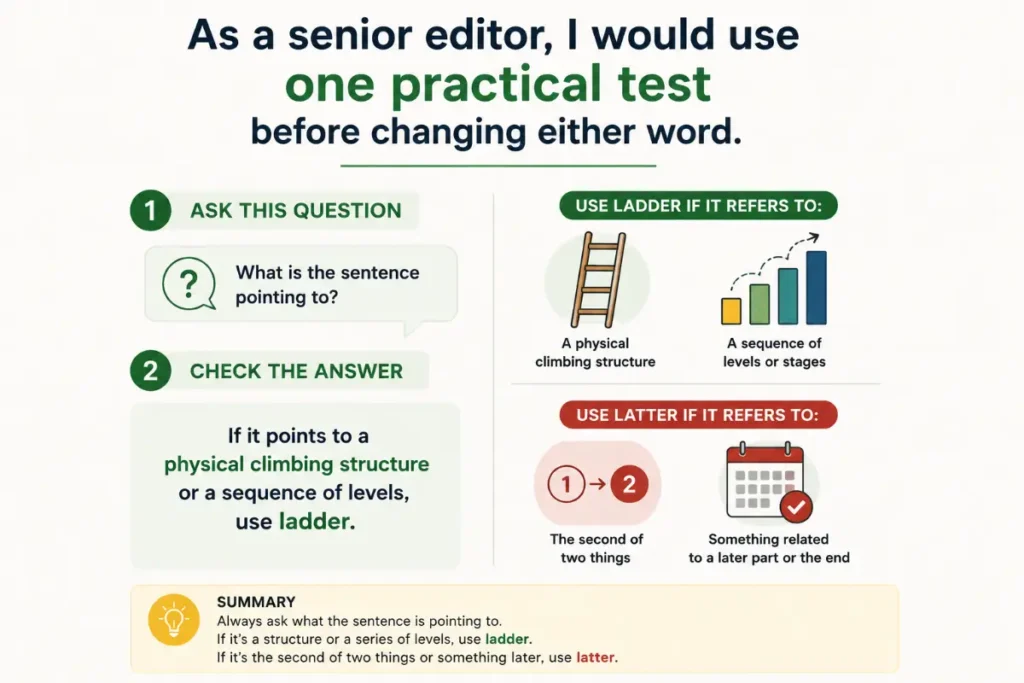
As a senior editor I would use one practical test before changing either word. Ask what the sentence is pointing to. If it points to a physical climbing structure or a sequence of levels use ladder. If it points backward to the second item in a comparison or forward to a later part of a period use latter. Modern spelling tools can catch many obvious errors but they may not catch a wrong word when both forms are valid English. That is why context based editing still matters. A spell checker can recognize a word. It can’t always recognize your intended meaning.
A useful editorial tip is to avoid the latter when the reference is far away. Readers shouldn’t have to hunt through a paragraph to remember the two items you mentioned earlier. In clear professional writing repetition is sometimes better than a clever shortcut. Merriam Webster similarly notes that former and latter can become inconvenient for readers when they force them to look backward through a passage.
You may also want to read Courtesy Vs Curtesy Which Word Should You Use in 2026.
Conclusion
The difference between ladder vs latter becomes simple once you connect each word with its meaning. A ladder is usually something you climb. Latter points to the second of two things mentioned or describes something later or closer to the end. Their similar appearance and pronunciation cause the confusion but their grammatical roles and meanings are quite different.
Here’s a practical tip you can remember: ladder means climb while latter means second or later. If you’re talking about a roof a wall or a physical object you probably need ladder. If you’re comparing two choices and mean the second one use latter. Keep that distinction in mind and this common English mix up becomes much easier to avoid.
FAQs
Is Ladder A Real Word?
Yes. Ladder is a standard English word. It usually refers to a structure with two sides and horizontal rungs that people use to climb. It can also have figurative meanings such as a career ladder or corporate ladder. Dictionaries trace the word back through Middle English to Old English and record its use in English for many centuries.
What Does Latter Mean?
Latter commonly means the second of two things that have already been mentioned. It can also describe something that belongs to a later period or a part closer to the end. For example I considered tea and coffee and chose the latter means I chose coffee. In the latter half means the second or later half of a period.
Ladder Or Latter Which Is Correct?
Both are correct words but they have different meanings. Use ladder for climbing equipment or a sequence of levels. Use latter for the second of two mentioned things or for something connected with a later part or period. If you can climb it use ladder. If you’re choosing between two previously mentioned options you probably need latter.
How Do You Pronounce Ladder And Latter?
In American English Cambridge gives ladder as /ˈlæd.ɚ/ and latter as /ˈlæt̬.ɚ/. They can sound extremely similar in natural conversation. The main distinction is the middle consonant represented by d in ladder and t in latter. Say ladder as LAD er and latter as LAT er while practicing slowly.
Can Latter Start A Sentence?
Yes. Latter can start a sentence when its reference is clear from the surrounding context. For example: Latter stages of the project required more testing. However this structure can sound less natural than The latter stages of the project required more testing. When using latter as a reference to an earlier pair make sure the reader already knows which two things you’re comparing.
What Is A Synonym For Latter?
The best synonym depends on the meaning. When latter refers to the second item in a pair you can often say second or the second one. When it refers to a later period you might use later or final depending on the sentence. In the latter part can sometimes become in the later part. Context matters because these words don’t have identical meanings.
Why Do People Confuse Ladder And Latter?
People confuse them because they have nearly identical spelling patterns and very similar pronunciation. The first three letters are the same and both words end with er. In some American accents the middle consonants can sound especially similar. Fast typing also encourages visual substitutions. The best solution is to connect each spelling with its meaning. Ladder means climb. Latter means second or later.
Is Latter Suitable For Formal Writing?
Yes. Latter is common in formal writing especially when a writer needs to refer back to one of two previously mentioned choices. It appears in academic prose professional writing essays reports and edited publications. Still don’t use it simply to sound formal. If the reference isn’t immediately clear then repeating the noun may make the sentence easier to understand. Clear writing beats unnecessary sophistication.