
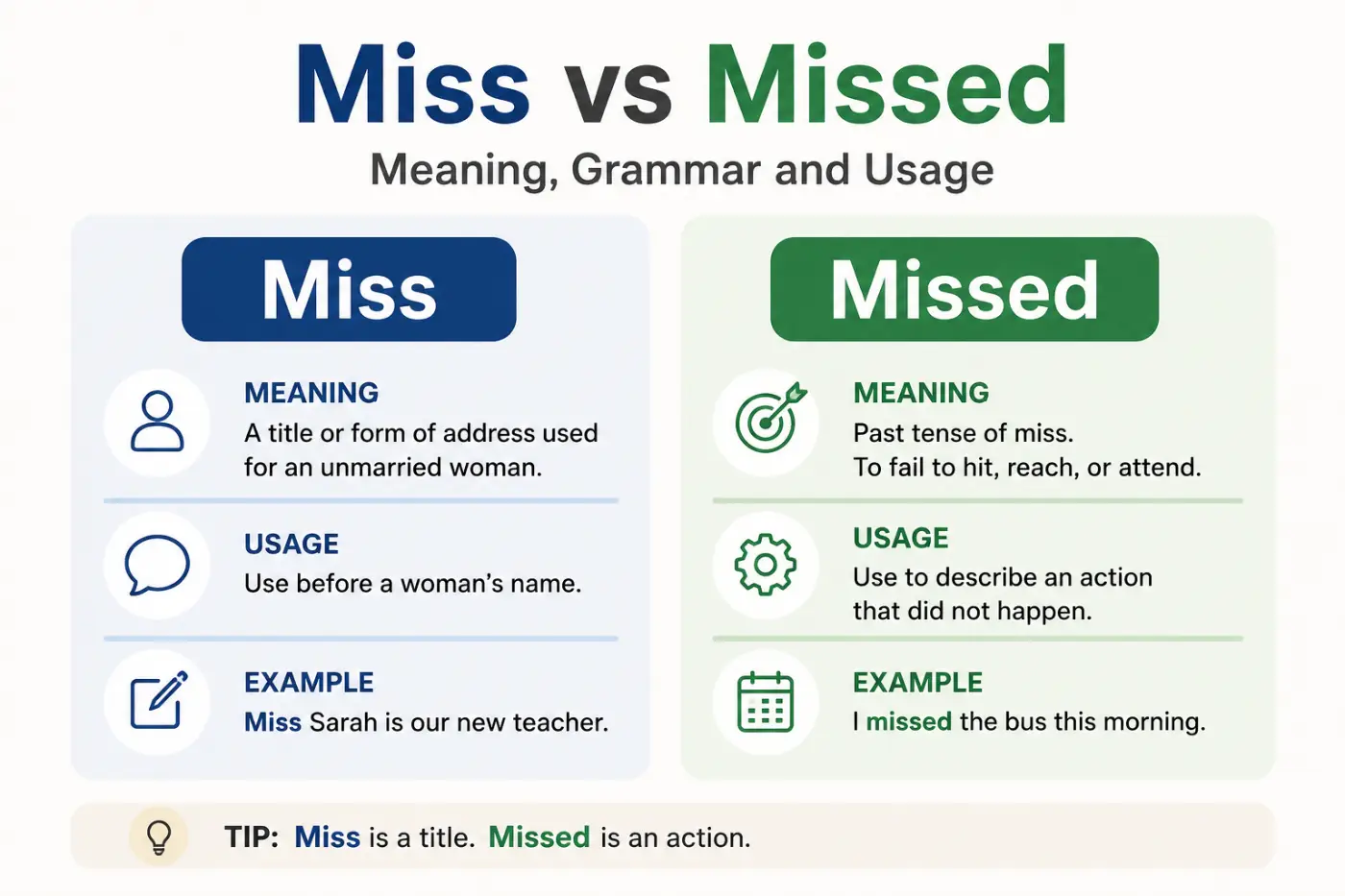
Have you ever written a sentence and wondered if you should use miss vs missed? Both words are correct, but they serve different grammatical purposes. The main difference is tense and the way each word fits into a sentence.
Miss is the base form and present tense form of the verb. It can describe a feeling you have now, something you regularly do, or an action that may happen. Missed is the simple past and past participle form. It usually describes something that happened before now.
For example, “I miss my family” describes a present feeling, while “I missed my family while I was away” describes a feeling during a past period. The difference can seem small, but choosing the right form makes your writing clearer and grammatically accurate.
Learn the difference in gizmo vs gismo: Which Spelling Is Correct?.
Quick Definition
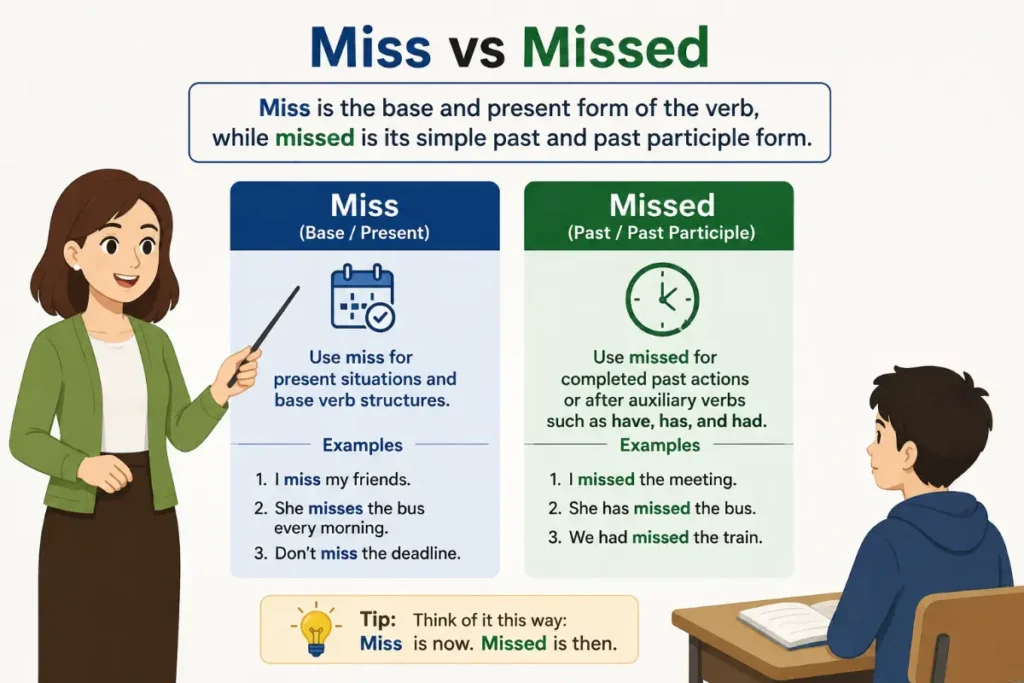
Miss is the base and present form of the verb, while missed is its simple past and past participle form. Use miss for present situations and base verb structures. Use missed for completed past actions or after auxiliary verbs such as have, has, and had.
Quick Answer
The easiest way to understand miss vs missed is to look at time and sentence structure.
“I miss you” describes a feeling that exists now.
“I missed you” normally describes a feeling during a past period.
“Did you miss the bus?” is correct because did already carries the past tense.
“I have missed you” is correct because have is followed by the past participle missed.
Both words are correct. The sentence determines which form you need.
Comparison Table
| Feature | Miss | Missed |
|---|---|---|
| Correct form | Yes | Yes |
| Main meaning | Present or base form of miss | Past and past participle form |
| Part of speech | Mainly a verb | Verb |
| Basic tense | Present or base form | Simple past |
| Past participle | No | Yes |
| Formality | Neutral | Neutral |
| Common contexts | Feelings, transport, meetings, opportunities, details | Past feelings, missed transport, past events, past mistakes |
| Pronunciation | /mɪs/ | /mɪst/ |
| Example | “I miss my family.” | “I missed my family.” |
Meaning of Both Terms
What Does Miss Mean?
The verb miss has several meanings. Its exact meaning depends on the context. The most familiar meaning is to feel the absence of someone or something.
“I miss my parents.”
This means the speaker feels sadness or longing because the parents aren’t present.
Miss can also mean failing to catch transportation.
“I don’t want to miss the train.”
Here, the meaning is to fail to board the train before it leaves.
The verb can describe failure to attend an event.
“She doesn’t want to miss the meeting.”
It can also mean failing to notice or understand something.
“You missed an important detail.”
Another meaning is failing to hit a target.
“The ball missed the goal.”
These meanings are different, but they share a general idea of something not being reached, experienced, noticed, or present.
What Does Missed Mean?
Missed is the simple past and past participle form of miss.
“I missed the bus.”
The bus left before the speaker could board it.
“She missed the meeting.”
The meeting took place, but she wasn’t there.
“I missed my friends while I was away.”
The feeling occurred during a past period.
Missed can also appear in perfect constructions.
“I have missed several classes.”
“She had missed an important detail.”
In these examples, missed works as a past participle.
Miss vs Missed in Grammar
The most important difference is tense.
Miss is used as the base form of the verb. It also functions as the present form with I, you, we, and they.
“I miss my hometown.”
“We miss our old friends.”
“They miss their family.”
With he, she, or it, the present form becomes misses.
“She misses her brother.”
Missed is the simple past form.
“I missed the train.”
“They missed the appointment.”
“She missed the announcement.”
The past form stays the same for every subject.
“I missed.”
“He missed.”
“We missed.”
“They missed.”
This is an important difference from the present tense.
Miss vs Missed and Time
Time often tells you which form to choose.
“I miss my friends.”
The feeling is presented as current.
“I missed my friends.”
The feeling belongs to a past period.
“I will miss my friends.”
The feeling is connected to the future.
“I have missed my friends.”
The past feeling is connected to the present.
“I had missed my friends.”
The feeling happened before another past event.
This shows that missed isn’t simply a word for anything related to the past. It also appears as a past participle in perfect verb structures.
Which One Is Correct?
Both miss and missed are correct English words.
The correct choice depends on the grammatical structure of the sentence.
Use miss when you need the base form or present form.
“I miss my family.”
“Do you miss your hometown?”
“Don’t miss the opportunity.”
“We might miss the train.”
Use missed for a completed past action.
“I missed the train.”
“She missed the meeting.”
“They missed their flight.”
You also need missed after have, has, and had when forming perfect constructions.
“I have missed you.”
“She has missed several classes.”
“They had missed the deadline.”
A particularly important rule applies after did. When did is used to form a past question or negative sentence, the main verb returns to its base form.
Correct: “Did you miss the bus?”
Incorrect: “Did you missed the bus?”
The same principle applies to other regular verbs.
“Did you walk?”
Not “Did you walked?”
“Did you watch?”
Not “Did you watched?”
Examples of Miss in Sentences
“I miss my family when I’m traveling.”
“Don’t miss the last bus home.”
“Do you miss your old school?”
“We don’t want to miss the beginning of the movie.”
“I miss having conversations with my friends.”
“She doesn’t want to miss this opportunity.”
“You may miss the point if you read too quickly.”
“I miss the quiet mornings at home.”
“Try not to miss any important details.”
“They miss their hometown.”
These examples show that miss can describe feelings, transportation, opportunities, information, and attendance.
Examples of Missed in Sentences
“I missed the train this morning.”
“She missed the meeting.”
“We missed the first part of the movie.”
“He missed an important detail in the report.”
“I missed my friends while I was away.”
“They missed the deadline.”
“The player missed the goal.”
“She missed her flight because of traffic.”
“I realized that I had missed an important message.”
“We have missed several chances to discuss the issue.”
Here, missed describes completed actions or works as a past participle.
A related grammar guide is Oversite vs Oversight Which Is Correct.
Common Mistakes With Miss and Missed
Using Missed After Did
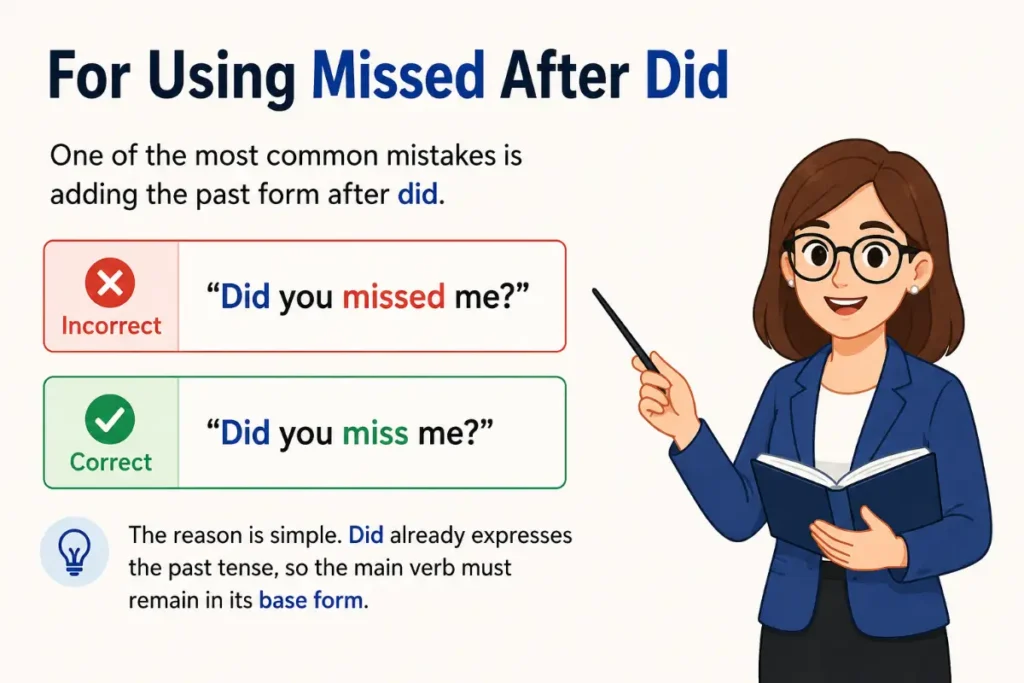
One of the most common mistakes is adding the past form after did.
Incorrect: “Did you missed me?”
Correct: “Did you miss me?”
The reason is simple. Did already expresses the past tense, so the main verb must remain in its base form.
Using Miss With a Clear Past Time
Incorrect: “Yesterday I miss the bus.”
Correct: “Yesterday I missed the bus.”
The word yesterday places the event in the past, so the simple past form is appropriate.
Using Missed After Will
Incorrect: “I will missed you.”
Correct: “I will miss you.”
After will, use the base form of the verb.
The same rule applies to can, could, may, might, should, and would.
“I might miss the train.”
“You should not miss the meeting.”
“She could miss the deadline.”
Confusing Miss With Lose
Miss and lose can sometimes appear in similar situations, but they don’t have the same meaning.
“I missed the bus.”
The bus left before I could get on it.
“I lost my ticket.”
The ticket is no longer in my possession.
The distinction becomes even more important when talking about people.
“I miss my friend” means I feel the person’s absence.
“I lost my friend” can mean I can no longer find the person, and in some contexts it can have a much more serious meaning.
Pronunciation Guide
Miss is pronounced /mɪs/. It has one syllable.
Missed is pronounced /mɪst/. It also has one syllable.
The vowel sound is the same in both words. The main difference is the final sound.
In miss, the final sound is /s/.
In missed, the ed ending is pronounced /t/.
So the words sound like:
miss: /mɪs/
missed: /mɪst/
A common learner mistake is pronouncing missed as two syllables. Standard pronunciation has only one syllable.
Etymology and Word Origin
The modern verb miss comes from Old English missan. The word originally carried meanings connected with failing to hit, reach, perceive, or obtain something.
Over time, English expanded the verb’s meaning.
A person can miss a target because they fail to hit it.
A passenger can miss a train because they fail to catch it.
A student can miss a class because they fail to attend it.
A reader can miss a point because they fail to notice or understand it.
A person can miss someone because that person is absent.
The past form developed through the regular English pattern of adding ed.
Thus:
miss → missed
The verb remains regular in modern English.
Regional Usage
The distinction between miss and missed is consistent across major varieties of English.
American English
American English uses miss as the base and present form and missed as the past and past participle form.
“I miss my hometown.”
“I missed my flight.”
British English
British English follows the same grammatical pattern.
“I miss the old neighborhood.”
“I missed the train.”
There is no major regional difference in the basic rule.
Australian English
Australian English also uses the two forms according to standard tense rules.
“I don’t want to miss the bus.”
“I missed the bus yesterday.”
Canadian English
Canadian English follows the same pattern.
“I miss my family.”
“I missed the meeting.”
Therefore, this isn’t mainly a British versus American spelling issue. The distinction is grammatical across standard English varieties.
Grammar Rules
Present Tense
Use miss with I, you, we, and they.
“I miss my friends.”
“They miss their parents.”
With he, she, and it, use misses.
“She misses her hometown.”
Simple Past
Use missed for completed past actions.
“I missed the bus.”
“They missed the class.”
“He missed the opportunity.”
Questions With Do and Does
Use the base form after do and does.
“Do you miss your family?”
“Does she miss her hometown?”
Questions With Did
Use the base form after did.
“Did you miss the train?”
“Did they miss the meeting?”
Perfect Tenses
Use missed after have, has, and had.
“I have missed you.”
“She has missed several classes.”
“They had missed the announcement.”
Future and Modal Structures
Use miss after will and modal verbs.
“I will miss you.”
“You might miss the train.”
“She could miss the deadline.”
“We should not miss this opportunity.”
Real Life Usage Examples
Daily Conversation
In everyday conversation, miss frequently describes emotions.
“I miss you.”
“I miss my old friends.”
Missed commonly describes completed situations.
“I missed your call.”
“I missed you while you were away.”
“Sorry, I missed the bus.”
Academic Writing
Academic writers may use miss when discussing an overlooked point or a possible limitation.
“The analysis may miss an important factor.”
They use missed when describing a past oversight.
“The original study missed an important variable.”
In formal writing, a more precise expression can sometimes be preferable.
“The analysis failed to account for an important factor.”
This version tells the reader exactly what happened.
Professional Communication
Both forms are common in workplace English.
“We don’t want to miss the deadline.”
This refers to a possible future problem.
“We missed the deadline.”
This reports a completed problem.
“I missed your call.”
This explains a past event.
The tense can therefore change the practical meaning of a professional message.
Literature
Writers often use miss to express longing and emotional absence.
“I miss the days when we lived there.”
They may use missed when recalling an earlier experience.
“I missed the sound of rain.”
The verb can also be metaphorical.
“He missed the meaning behind her words.”
Related Words and Confused Terms
Miss and Lose
Miss can mean failing to catch or experience something. Lose often means no longer having something.
“I missed the train.”
“I lost my ticket.”
Miss and Skip
Skip can suggest intentionally avoiding something.
“I skipped class.”
“I missed class.”
The second sentence doesn’t explain why the person was absent.
Miss and Forget
Forget focuses on memory.
Miss can focus on failing to attend, catch, notice, or experience something.
“I forgot the appointment.”
“I missed the appointment.”
Miss and Fail
Fail has a broader meaning.
“I failed to attend the meeting.”
“I missed the meeting.”
The second is often more natural in ordinary conversation.
Miss and Long For
Long for can express a strong desire or emotional longing.
“I miss my hometown.”
“I long for my hometown.”
The second expression can sound more literary or emotionally intense.
Expert Language Insight
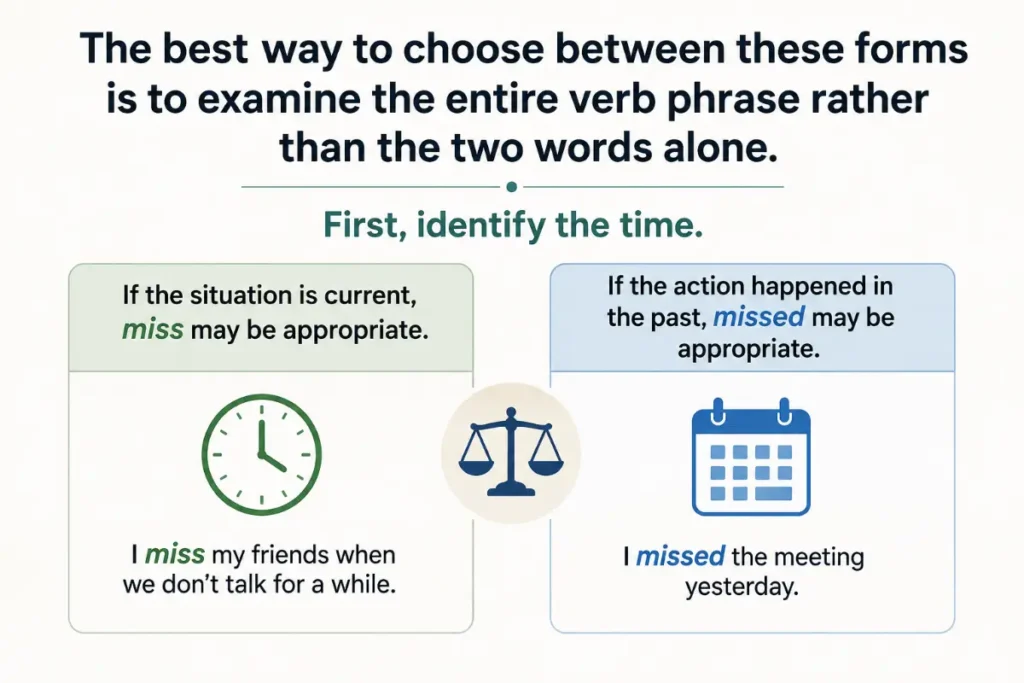
The best way to choose between these forms is to examine the entire verb phrase rather than the two words alone.
First, identify the time.
If the situation is current, miss may be appropriate.
If the action happened in the past, missed may be appropriate.
Then check for an auxiliary or modal verb.
After did, use miss.
After will, can, could, may, might, should, or would, use miss.
This approach works because English grammar often places tense information in an auxiliary verb instead of the main verb.
There is also an important point about emotional language. “I miss you” and “I missed you” aren’t simply different versions of the same sentence. The first presents the feeling as current. The second normally connects the feeling with an earlier period of separation.
Context can soften that distinction. Someone might say “I missed you” immediately after a loved one returns, even though the feeling may continue. Native speakers understand the time reference from the situation.
A related grammar guide is Shinning or Shining Which Is Correct in 2026?.
Conclusion
The difference between miss vs missed is simple once you focus on grammar and time. Use miss as the base form, for present situations, and after words such as did, will, can, could, may, and might. Use missed for completed past actions and as the past participle after have, has, and had.
Remember these examples:
“I miss you.”
“I missed you.”
The important lesson is that neither word is more correct than the other. Each has a specific grammatical role. Look at the complete sentence, identify the tense and verb structure, and then choose the form that fits. Once you understand that pattern, choosing between miss and missed becomes natural and straightforward.
Frequently Asked Questions
Is miss or missed correct?
Both are correct. Miss is the base and present form, while missed is the simple past and past participle form. The correct choice depends on the sentence. “I miss you” describes a present feeling, while “I missed you” normally describes a past period of absence.
What is the difference between miss and missed?
The main difference is tense. Miss is used for present situations and base verb structures. Missed normally describes a completed past action or works as a past participle. Both can describe absence, failure to attend, failure to catch something, or failure to notice something.
Is I miss you grammatically correct?
Yes. “I miss you” is grammatically correct and extremely common. It expresses a current feeling caused by someone’s absence. The phrase is commonly used with family members, friends, romantic partners, and other people who are important to the speaker.
Is I missed you correct?
Yes. “I missed you” is grammatically correct. It normally refers to a past period when someone was absent. For example, a person returning from a trip might hear, “I missed you while you were away.” The phrase is also common when greeting someone after a separation.
Should I say did you miss or did you missed?
The correct form is “Did you miss?” After did, the main verb must use its base form. Therefore, “Did you miss the train?” is correct. “Did you missed the train?” is incorrect in standard English because it uses two past tense markers.
Is missed the past tense of miss?
Yes. Missed is the regular simple past form of miss. It is also the past participle. “I missed the bus” uses the simple past, while “I have missed the bus” uses missed as a past participle.
How are miss and missed pronounced?
Miss is pronounced /mɪs/ and has one syllable. Missed is pronounced /mɪst/ and also has one syllable. The ed ending in missed sounds like /t/. It doesn’t create an extra syllable.
Can miss and missed mean the same thing?
They can express the same general idea, but they place the situation in different grammatical contexts. “I miss my family” presents the feeling as current. “I missed my family” places the feeling in the past. The surrounding sentence determines the exact meaning.