
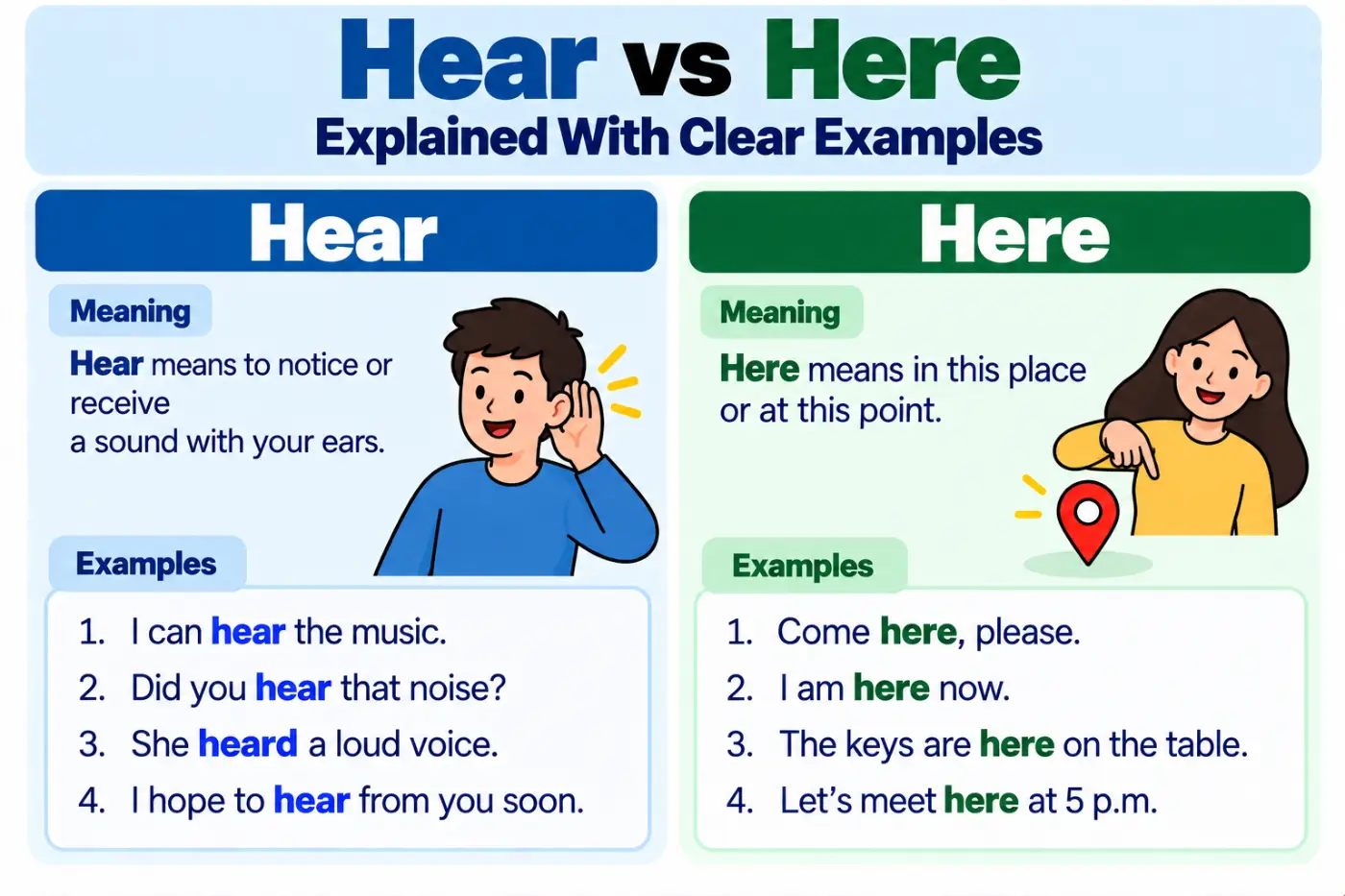
Have you ever stopped while writing a sentence because you were unsure whether to use “hear” or “here”? You are not alone. These two words sound exactly alike in most English accents, but their meanings and uses are completely different. Understanding the difference between hear vs here is simple once you know what each word does in a sentence.
The word “hear” relates to sound, listening, and the ability to perceive noise with your ears. In contrast, “here” refers to a place, position, or location. One is mainly a verb, while the other is primarily an adverb. This difference matters in text messages, emails, school assignments, professional documents, and everyday conversations.
In this guide, you will learn the meaning of both words, their grammatical roles, pronunciation, origins, and common spelling mistakes. You will also find practical examples, memory tricks, and answers to frequently asked questions so you can use each word correctly and write with confidence.
For another common grammar confusion, see Propose vs Purpose Which One Should You Use 2026.
Quick Answer: What Is the Difference?
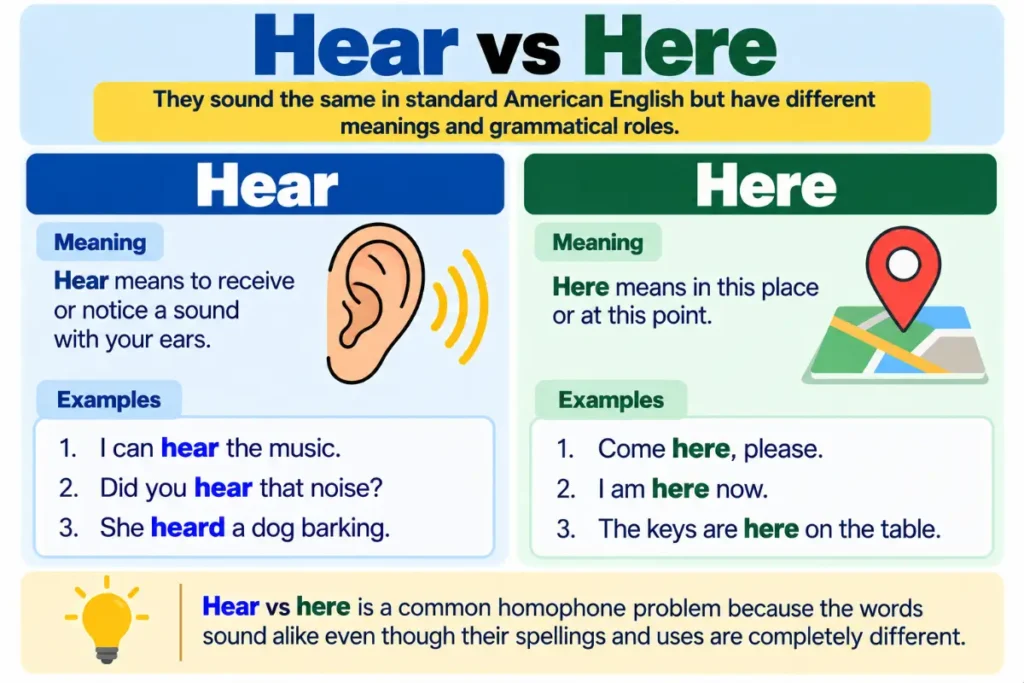
“Hear” is a verb that means to notice, perceive, or listen to sounds with your ears. “Here” is an adverb that identifies a particular place or location, meaning in or at this place. They sound alike but have different spellings, meanings, and grammatical functions. Use “hear” for sounds and “here” for places.
Comparison Table: Hear and Here
| Feature | Hear | Here |
|---|---|---|
| Meaning | To perceive sound through the ears | In or at this place |
| Part of speech | Verb | Primarily an adverb |
| Main function | Describes hearing or receiving sound | Identifies a location or position |
| Pronunciation | /hɪr/ | /hɪr/ |
| Syllables | One | One |
| Word origin | Old English hīeran | Old English hēr |
| Formality | Standard in formal and informal English | Standard in formal and informal English |
| Common contexts | Listening, conversations, music, sounds, news | Directions, locations, instructions, conversations |
| Example | I can hear the birds singing. | Your keys are here. |
| Common mistake | Using it to describe a location | Using it to describe listening |
Both words are standard English vocabulary. The correct choice depends on the meaning you want to communicate, not on which spelling sounds more natural.
Meaning and Definition
What Does “Hear” Mean?
“Hear” is a verb that means to perceive sound through your ears. It describes the natural ability to notice sounds, whether you are paying attention to them or not.
For example, you might hear a phone ringing while reading a book, hear someone speaking in another room, or hear music playing in a store. In each situation, sound reaches your ears.
The word can also describe listening to information, receiving news, or considering someone’s words or opinions.
Consider these examples:
- I can hear someone knocking on the door.
- Did you hear the announcement?
- I would like to hear your opinion.
- We heard some exciting news yesterday.
In grammar, this word is commonly used as a main verb. It can appear in several forms:
| Verb Form | Example |
|---|---|
| Base form: hear | I hear music. |
| Third-person singular: hears | She hears a strange noise. |
| Past tense: heard | We heard the news. |
| Past participle: heard | I have heard that song before. |
| Present participle: hearing | He is hearing things outside. |
Notice that the past tense and past participle are “heard,” not “heared.” This is because the verb is irregular.
What Does “Here” Mean?
“Here” is primarily an adverb that refers to the place where someone or something is located. It usually means “in this place” or “at this location.”
You use it when describing your current position, giving directions, pointing out an object, or telling someone where something can be found.
For example:
- I am here.
- Please put your bag here.
- Your package has arrived here.
- We have everything we need here.
The word can also refer to a particular point in a conversation, written argument, or situation.
For example, “Here is where the problem begins” identifies a specific point in an explanation rather than a physical location.
It also appears in common expressions such as:
- Here and there: In different places.
- Here we go: An expression used when something is about to begin.
- Here you are: An expression used when giving something to someone.
- From here on: Starting at this point and continuing into the future.
- Here and now: At the present time and in the present place.
Although its main grammatical role is adverbial, “here” can also function as a noun in expressions such as “the here and now.” It is also used in introductory expressions such as “Here is your answer.”
Is Either Word Incorrect?
No. Both are legitimate English words with established meanings. Neither is a misspelling when used correctly.
The mistake happens when writers select one spelling instead of the other because they sound identical. For example, writing “I can here you” is incorrect because the sentence refers to hearing a sound. The correct sentence is “I can hear you.”
Similarly, writing “Come hear” when asking someone to come to your location is incorrect. The intended expression is “Come here.”
Key Differences Explained
The easiest way to understand these words is to focus on what each one communicates. One relates to sound, while the other relates to location.
1. Difference in Meaning
“Hear” describes the experience of receiving sound. “Here” identifies a place or position.
- Hear: I hear the rain outside.
- Here: The umbrella is here.
The first sentence describes something you perceive with your ears. The second tells you where an object is located.
2. Difference in Spelling
The two words have only one letter of difference in their spelling.
- Hear contains the letter “a.”
- Here contains the letter “e.”
That small difference changes the meaning completely. Because both words are pronounced alike, relying on sound alone will not help you select the correct spelling.
3. Difference in Grammar
“Hear” is primarily a verb. It describes an action, ability, or experience involving sound.
“Here” is primarily an adverb. It modifies or identifies a location and can also introduce a statement.
Examples:
- I hear the children playing.
- The children are playing here.
In the first sentence, the verb describes what the speaker perceives. In the second, the adverb identifies where the children are playing.
4. Difference in Pronunciation
In most American English accents, both words are pronounced /hɪr/. They are homophones, meaning they share the same pronunciation but have different meanings and spellings.
Some English accents pronounce the vowel slightly differently, but the distinction in meaning remains the same.
5. Difference in Context
The surrounding words usually make the intended meaning clear.
Use the verb when discussing:
- Music or sounds.
- Conversations and speech.
- News and announcements.
- Opinions and feedback.
- Listening and perception.
Use the location word when discussing:
- Physical places.
- Directions and instructions.
- Someone’s position.
- The location of objects.
- A particular point in a discussion.
6. Difference in Formality
Neither spelling is informal, slang, or incorrect by itself. Both are accepted in professional emails, academic assignments, business reports, books, and everyday communication.
The difference is entirely grammatical and semantic. Choosing the wrong one can make a sentence confusing or incorrect, regardless of how formal the writing is.
7. Difference in Regional Usage
There is no major spelling difference between American and British English. Both varieties use the same two spellings and distinguish them by meaning.
Australian and Canadian English follow the same general rule.
Which Form Is Correct?
Both forms are correct English words. The correct spelling depends on whether your sentence describes sound or a location.
Use “hear” when referring to sound, listening, or receiving spoken information. Use “here” when referring to a place, position, or point in a situation.
For example:
- Correct: Can you hear me?
- Incorrect: Can you here me?
- Correct: I will meet you here.
- Incorrect: I will meet you hear.
The grammatical reason is straightforward. The first pair requires a verb because it describes the perception of sound. The second pair requires an adverb because it identifies a meeting location.
Established English dictionaries treat these as separate entries with different meanings and grammatical functions. Their shared pronunciation does not make them interchangeable.
A useful way to check your writing is to replace the word temporarily:
- If “listen” or “perceive sound” makes sense, choose “hear.”
- If “in this place” or “at this location” makes sense, choose “here.”
This simple substitution test works in most everyday sentences.
10 Sentence Examples
The following examples demonstrate how both words appear naturally in different situations.
- Everyday conversation: I can hear the neighbors talking outside my window.
- Text message: I am here, waiting near the main entrance.
- Workplace communication: Please let me know if you can hear everyone clearly during the meeting.
- School: The teacher asked the students to come here before the lesson started.
- Academic writing: Researchers can hear variations in speech patterns when examining recorded conversations.
- Formal communication: We are pleased to have you here for today’s important discussion.
- Social situations: Did you hear what your friend said about the party?
- Online communication: Can you hear me clearly, or should I adjust my microphone?
- Giving directions: Leave the documents here on my desk before you go.
- Family conversation: I heard the baby crying, so I went upstairs to check on her.
Each example uses the spelling that matches its grammatical purpose. Pay attention to the surrounding sentence rather than the way the word sounds.
Five Common Incorrect Sentences
These examples show typical mistakes and their corrections.
| Incorrect Sentence | Correct Sentence |
|---|---|
| I can here the music. | I can hear the music. |
| Come hear and sit beside me. | Come here and sit beside me. |
| Did you here that noise? | Did you hear that noise? |
| Your phone is over hear. | Your phone is over here. |
| I want to here your opinion. | I want to hear your opinion. |
These errors are common in quick messages and informal online writing. However, they should be corrected in professional and academic work.
Common Mistakes and Misspellings
Because the two words share the same pronunciation, people sometimes choose the wrong spelling without noticing. Here are five mistakes worth watching for.
1. Writing “Here” Instead of “Hear”
Incorrect: I can here the birds.
Correct: I can hear the birds.
The sentence describes the perception of sound, so it needs a verb. The location word cannot perform that grammatical function.
2. Writing “Hear” Instead of “Here”
Incorrect: Please come hear.
Correct: Please come here.
The speaker is telling someone to move to a particular location. Therefore, the sentence needs the adverb that identifies that place.
3. Confusing the Words in Questions
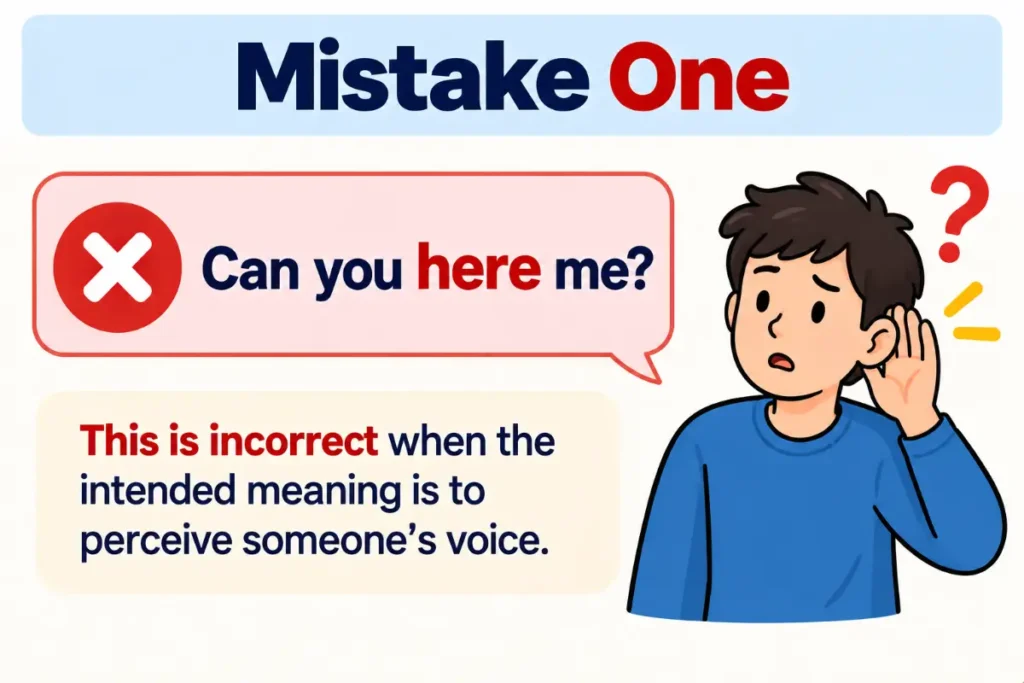
Incorrect: Can you here me?
Correct: Can you hear me?
Questions about sound, microphones, phone calls, or conversations require the verb. This mistake often appears in messages sent quickly without proofreading.
4. Confusing Them in Directions
Incorrect: Your seat is over hear.
Correct: Your seat is over here.
Directions identify positions, so the location word is necessary. Expressions such as “over here,” “right here,” and “come here” all refer to a place.
5. Relying Only on Pronunciation
Incorrect: I want to here what happened.
Correct: I want to hear what happened.
Both words sound alike, so listening to yourself read a sentence may not reveal the error. Instead, think about the meaning and grammatical role before selecting the spelling.
A useful proofreading habit is to scan for both words whenever you write about listening, directions, or locations. This is especially helpful when using speech-to-text software, which may select the wrong homophone based on context.
Pronunciation Guide
Both words have the same pronunciation in most American English accents. This makes them a classic example of homophones.
| Pronunciation Detail | Hear | Here |
|---|---|---|
| IPA | /hɪr/ | /hɪr/ |
| Syllables | 1 | 1 |
| Easy pronunciation | Heer | Heer |
| Stress | Single syllable | Single syllable |
How to Pronounce Them
Start with the /h/ sound, as in “house.” Follow it with the vowel sound /ɪ/, similar to the vowel in “sit.” Finish with the American English /r/ sound.
The result is a single syllable that sounds like “heer.”
There is no difference in stress because each word contains only one syllable.
Common Pronunciation Mistakes
Some speakers may pronounce the vowel too long or use a vowel sound closer to the one in “hair.” Regional accents can affect these sounds, but the important point is that the two words are normally pronounced identically within the same accent.
Do not try to distinguish them by changing your pronunciation. Their difference is in spelling, meaning, and grammatical use.
For another common grammar confusion, see Sheath vs Sheathe and How to Use Each Word..
Etymology and Word Origin
Although these words sound alike today, they developed from different Old English words.
Origin of “Hear”
“Hear” comes from the Old English verb “hīeran,” which meant to hear or perceive sound. It developed through earlier forms of English and has Germanic roots.
Its meaning has remained closely connected to sound and perception. Modern expressions such as “hear a voice,” “hear the news,” and “hear someone’s concerns” reflect this central meaning.
The verb also developed wider uses. For example, hearing someone’s argument can mean listening to and considering what they have to say.
Origin of “Here”
“Here” comes from the Old English word “hēr,” which referred to this place or location. It has Germanic roots and is related to similar location words in other Germanic languages.
Its central meaning has remained stable over time. It continues to identify a place near the speaker or a particular point in a situation.
Why Do They Sound Alike?
English pronunciation and spelling have changed over many centuries. The two words developed different spellings but came to share the same pronunciation in many modern English varieties.
This is why they are classified as homophones. Their sound is the same, but their historical roots and meanings are different.
Regional Usage
The distinction between these words is consistent across major English-speaking regions. There is no standard regional spelling change that makes one form replace the other.
American English
Both spellings are standard in the United States. “Hear” is used for listening and sound perception, while “here” identifies a place.
Examples:
- I can hear the television from my bedroom.
- Your delivery is here.
American speakers commonly pronounce both as /hɪr/.
British English
British English follows the same spelling and meaning rules. The words remain separate in writing even though their pronunciation can vary slightly across regional accents.
Examples:
- I can hear the rain outside.
- Please wait here until the bus arrives.
Some British accents use a different vowel quality or a non-rhotic pronunciation, which means the final written “r” is not pronounced in the same way as in standard American English. However, this does not change the distinction in spelling or meaning.
Australian English
Australian English also uses both forms according to their standard meanings. The words are not interchangeable, and there is no special Australian spelling rule that changes their usage.
Examples:
- Can you hear the announcement?
- Put your suitcase here.
Canadian English
Canadian English follows the same general conventions as American and British English. Writers use the verb for sound and the adverb for location.
Examples:
- I could hear the engine running.
- We can meet here tomorrow.
The main takeaway is that the distinction is based on meaning and grammar, not geography.
Grammar Rules and Part of Speech
Understanding the grammatical function of each word makes it easier to use the right spelling in any sentence.
How to Use “Hear” as a Verb
“Hear” is an irregular verb. It can function as a transitive or intransitive verb, depending on the sentence.
A transitive verb takes an object:
- I hear the music.
- She heard the announcement.
- We heard a strange noise.
An intransitive verb does not require a direct object:
- I can hear.
- Speak louder so everyone can hear.
- I heard clearly from the back of the room.
The verb can also appear in common patterns.
Hear + noun:
- I hear a sound.
- We heard the news.
Hear + about:
- Did you hear about the new project?
These patterns help explain why the word appears in so many different sentence structures.
How to Use “Here” as an Adverb
“Here” usually identifies a location or position. It can appear at the beginning, middle, or end of a sentence.
Examples:
- Here is your coffee.
- I live here.
- Please place the box here.
It often appears with other words to give more precise directions:
- Right here.
- Over here.
- From here.
- Down here.
- Up here.
In some sentences, it introduces the subject and verb in a different order:
- Here comes the bus.
- Here are your documents.
The subject follows the verb in these introductory constructions. This is a standard English sentence pattern.
Can “Here” Function as a Noun?
Yes. Although it is mainly an adverb, it can function as a noun in certain expressions.
For example:
- We should focus on the here and now.
- The artist explores the relationship between the here and the beyond.
In these examples, the word refers to a place or state of existence as an idea rather than simply modifying a verb.
Can “Hear” Be Used in Formal Writing?
Yes. The verb is perfectly appropriate in formal writing.
Examples include:
- The committee will hear the evidence tomorrow.
- The researcher could hear a difference between the two recordings.
- We would appreciate hearing your feedback.
It is also used in legal language, where a court may hear a case or hear arguments.
Punctuation and Sentence Position
Neither word requires special punctuation. Both follow normal English punctuation rules.
Use a comma after introductory expressions when the sentence structure requires one:
- Here, we can begin the discussion.
- Here is the information you requested.
The verb follows ordinary sentence punctuation:
- I can hear the alarm, but I cannot see where it is coming from.
The punctuation depends on the structure of the complete sentence, not on the spelling of either word.
Real-Life Usage Examples
These practical examples show how the two words work in different situations.
Daily Conversation
In everyday speech, people use the verb when talking about sounds and the location word when referring to where someone or something is.
- Can you hear the birds outside?
- Come here for a moment. I want to show you something.
Email and Workplace Communication
Both words are common in professional messages. The first may refer to communication or feedback, while the second identifies a place or point in a process.
- I would be happy to hear your suggestions before the meeting.
- The updated documents are available here for your review.
Academic Writing
Academic writing uses the verb to discuss sound perception, spoken language, or recorded material. The location word may identify a particular section, point, or stage of an argument.
- Participants were asked to hear several recordings and identify differences in pronunciation.
- Here, the results show a clear pattern across the three groups.
News and Journalism
Journalists use the verb when reporting statements, testimony, or sounds. The location word can introduce a place or refer to a specific point in a report.
- Residents heard several loud explosions during the night.
- Here in the city center, public transport services have returned to normal.
Literature and Storytelling
Writers use both forms to create atmosphere, describe a character’s experience, or establish a setting.
- From the dark hallway, she could hear footsteps approaching.
- Here, beneath the old oak tree, he had spent most of his childhood.
These examples demonstrate that the words can appear in almost any style of writing without changing their core meanings.
Related and Confused Terms
Several English words and expressions are connected to these two terms. Learning their meanings can help you understand the wider vocabulary surrounding sound and location.
1. Listen
“Listen” is a verb that means to pay attention to sound deliberately.
Example: Please listen carefully to the instructions.
Unlike hearing, which can happen without conscious effort, listening usually involves attention.
2. Sound
“Sound” can be a noun or a verb. As a noun, it refers to something that can be heard. As a verb, it can mean to produce or make a sound.
Example: I heard a strange sound outside.
3. Hear About
This expression means to receive information or learn news about something.
Example: Did you hear about the new restaurant?
It does not necessarily mean that you physically heard a sound. It often refers to receiving information.
4. Hear From
“Hear from” means to receive communication from someone.
Example: I hope to hear from the hiring manager soon.
The expression is common in professional emails, job applications, and personal conversations.
5. Over Here
“Over here” is a phrase used to point out a nearby location or attract someone’s attention.
Example: Your friends are waiting over here.
It is a more specific location expression than the word used alone.
6. Nearby
“Nearby” is an adverb or adjective that means close to a particular place.
Example: There is a pharmacy nearby.
It is related in meaning to the location word but does not always identify the speaker’s exact position.
7. There
“There” is an adverb that commonly identifies a place away from the speaker or refers to a location already mentioned.
Example: Your jacket is over there.
A simple distinction is that “here” usually means this place, while “there” usually means that place.
8. Where
“Where” is an adverb used to ask about or refer to a location.
Example: Where did you leave your phone?
It is useful to remember the difference among “here,” “there,” and “where”: one identifies this place, one points to another place, and one asks about a place.
Expert Editor Insight
An experienced English editor looks at meaning and sentence function rather than pronunciation when checking these words. Since they sound alike in most American accents, a spelling checker may miss a mistake if the incorrect word is still a valid English word. For example, both spellings are accepted individually, so software may not flag an incorrect choice in a sentence. The best editing habit is to read the sentence for meaning: does it describe a sound, or does it identify a location? This simple context check catches errors that ordinary spell-checking cannot always detect.
Key Takeaways
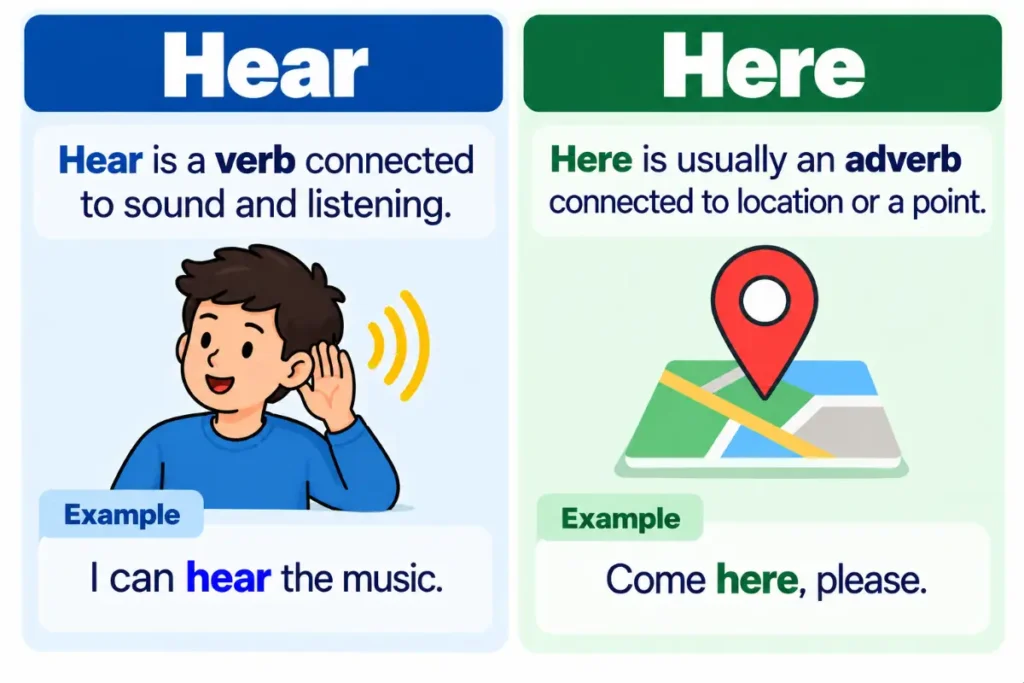
- Hear is a verb connected to sound and listening.
- Here is usually an adverb connected to location or a point.
- Hear and here are homophones in standard American English.
- They generally have the same pronunciation but different spellings.
- Hear can become heard in the past tense.
- Here often appears in expressions such as here is, here are, come here, and here you go.
- Use hear when the sentence involves receiving or noticing sound.
- Use here when the sentence identifies a place or point.
- Context is the best way to choose the correct spelling.
- A useful memory trick is to connect hear with ears and here with a place.
Many readers also check Altogether vs All Together: Meaning and Correct Usage.
Conclusion
Understanding hear vs here becomes easy when you remember that one word relates to sound and the other refers to a place. Use “hear” when talking about listening, speech, music, or receiving information. Choose “here” when identifying a location, giving directions, or pointing out a particular position. Both are correct English words, but they cannot replace each other. A simple editing trick is to substitute “listen” for the first word or “in this place” for the second.
If the sentence still makes sense, you have probably selected the right spelling. Practice this distinction, and these common homophone mistakes will become much easier to avoid.
FAQs
1. What Is the Difference Between Hear and Here?
“Hear” is a verb that refers to noticing or perceiving sounds with your ears. “Here” is primarily an adverb that identifies a location or position. Both words have the same pronunciation in most American English accents, but their meanings and grammatical functions are different. The correct spelling depends on what you want your sentence to communicate.
2. Is “Here” a Real Word?
Yes. “Here” is a standard English word that refers to a particular place or location. It is commonly used in directions, everyday conversation, instructions, and formal writing. Expressions such as “come here,” “right here,” and “here and now” are all correct. It can also function as a noun in expressions such as “the here and now.”
3. What Does “Hear” Mean in English?
“Hear” means to perceive sound through your ears. It can describe noticing music, speech, noise, or other sounds. It can also mean receiving information or considering someone’s opinion. For example, “I hear a strange noise” describes sound perception, while “I would like to hear your opinion” refers to receiving someone’s thoughts.
4. Which Word Should I Use in a Sentence About Listening?
Use “hear” whenever your sentence describes perceiving sound, listening, or receiving spoken information. For example, write “I can hear the music” rather than “I can here the music.” Remember that the verb can also appear in expressions such as “hear about something,” “hear from someone,” and “hear what happened.”
5. Are Hear and Here Pronounced the Same Way?
Yes. They are homophones in most English accents, meaning they have identical pronunciations but different spellings and meanings. In standard American English, both are generally pronounced /hɪr/, with one syllable. Some regional accents pronounce the vowel or final sound differently, but the grammatical distinction remains unchanged.
6. Can “Here” Start a Sentence?
Yes. “Here” can naturally appear at the beginning of a sentence. For example, “Here is your receipt” and “Here comes the train” are both correct. It can introduce a location, draw attention to something, or present information. Its position at the beginning does not change its core meaning or make it grammatically incorrect.
7. Why Do People Confuse These Two Words?
People confuse them because they sound identical in many English accents. When writing quickly, the brain may select the wrong spelling because it recognizes the sound without fully checking the meaning. Autocorrect and speech-to-text tools can also make mistakes. Learning the difference between a verb describing sound and an adverb describing location helps prevent these errors.
8. Are Both Words Appropriate in Formal and Academic Writing?
Yes. Both are standard English words and are appropriate in formal, professional, and academic writing. The only requirement is to use each one according to its meaning. For example, “The participants could hear the recording” is correct, as is “Here, the study presents its main findings.” Neither word is informal or unsuitable for professional communication.