
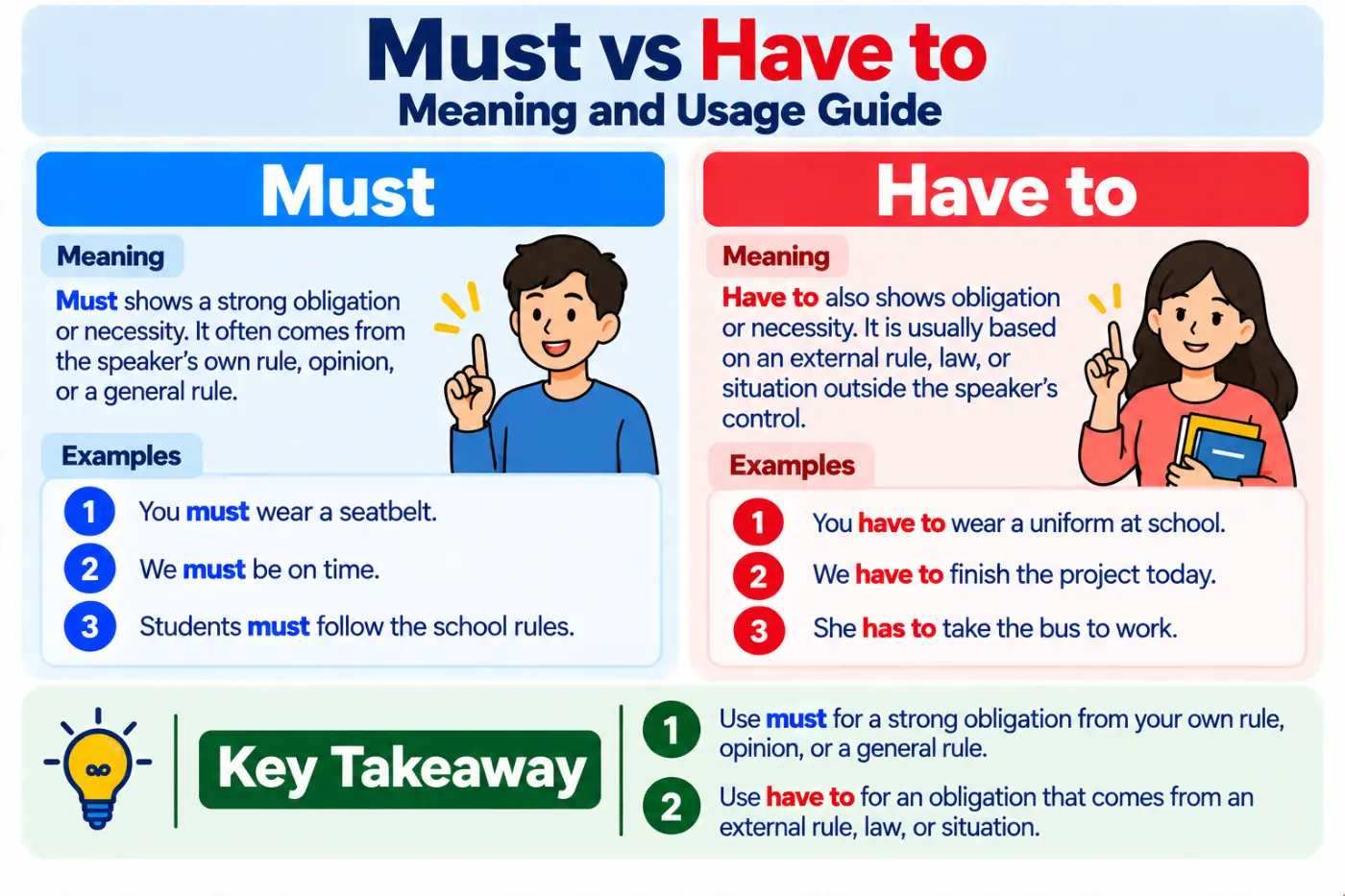
Have you ever wondered whether to say “I must finish this today” or “I have to finish this today”? Both sentences are grammatically correct, but they can express slightly different ideas. Understanding must vs have to helps you choose the right expression when talking about duties, rules, personal decisions, and everyday responsibilities.
The main difference is that “must” often expresses a strong obligation or a speaker’s personal decision, while “have to” commonly describes a requirement imposed by circumstances, rules, or another person. However, this distinction is not absolute. In many situations, both expressions communicate the same basic meaning.
English learners often find these expressions confusing because they are both used to talk about things people need or are required to do. Their grammar also differs, especially when forming questions, negative sentences, and different verb tenses. This guide explains their meanings, differences, pronunciation, and practical usage so you can use both expressions naturally and confidently.
Need another quick comparison? Read Too Many or To Many Which Is Correct?.
Featured Snippet: Quick Definition
“Must” and “have to” are modal expressions used to describe obligation or necessity. “Must” often emphasizes a strong requirement or personal conviction, while “have to” commonly describes an obligation caused by external circumstances. Both can express similar meanings, but their grammar differs, particularly in negative sentences and questions.
Quick Answer: Which Should You Use?
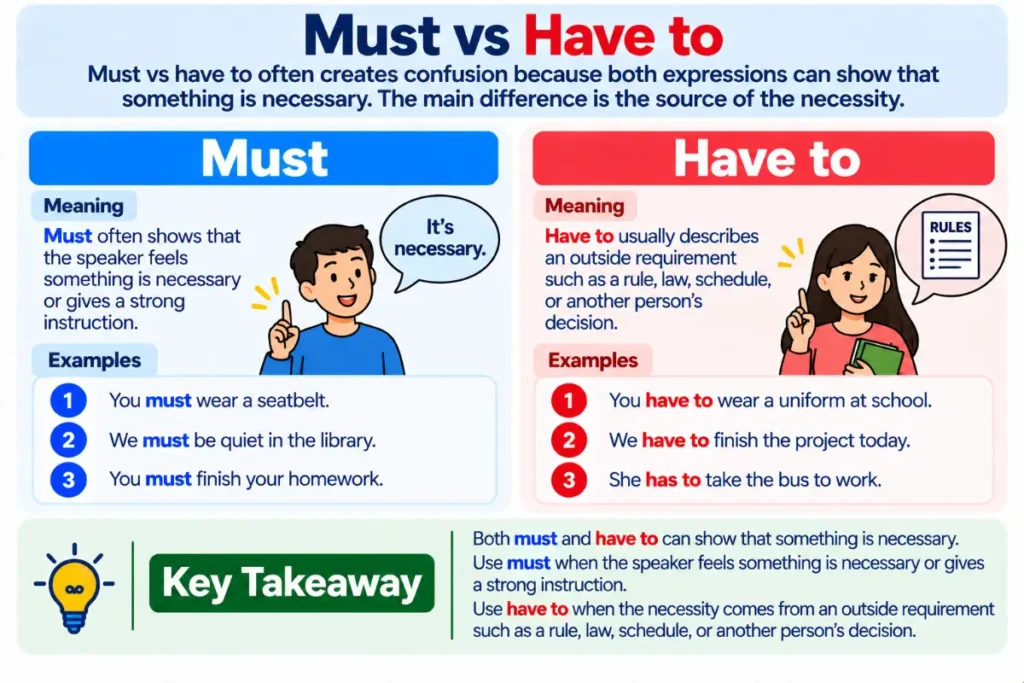
Both expressions are correct, but they are not always interchangeable. Use “must” to express a strong obligation, firm instruction, or personal determination. Use “have to” for everyday responsibilities, external requirements, and situations where something is necessary because of circumstances.
For example:
- I must remember to call my mother. (Personal determination.)
- I have to wear a uniform at work. (External requirement.)
One important rule: “must not” means something is prohibited, while “do not have to” means something is not necessary.
Comparison Table: Must and Have To
| Feature | Must | Have to |
|---|---|---|
| Meaning | Strong obligation or necessity | Obligation or necessity |
| Grammatical form | Modal auxiliary verb | Semi-modal construction |
| Main function | Expresses strong requirements or personal conviction | Expresses requirements, duties, and practical necessity |
| External obligation | Yes | Yes |
| Personal obligation | Common | Possible |
| Present tense | Must | Have to / Has to |
| Past tense | No ordinary past form | Had to |
| Future meaning | Must / Will have to | Will have to |
| Negative form | Must not | Do not have to |
| Question form | Must I…? | Do I have to…? |
| Formality | Often more formal or forceful | Common in everyday conversation |
| Pronunciation | /mʌst/ | /ˈhæf tə/ |
| Common contexts | Instructions, rules, strong advice | Work, school, routines, daily responsibilities |
The central distinction is not simply that one expression is correct and the other is incorrect. Both are standard English. The choice depends on the intended meaning, sentence structure, and situation.
Meaning and Definition
What Does “Must” Mean?
“Must” is a modal auxiliary verb that expresses obligation, necessity, strong advice, or logical certainty.
It tells someone that an action is important, required, or strongly recommended. The speaker may be expressing a personal judgment, communicating a rule, or giving a firm instruction.
Examples:
- You must submit your application before Friday.
- I must remember to buy groceries.
- Students must follow the examination rules.
- She must be very tired after working all day.
Notice that the last example expresses a logical conclusion rather than an obligation. The speaker believes that being tired is highly likely.
The word usually appears before the base form of a verb.
Examples:
- I must leave.
- You must listen.
- They must finish.
You do not add “to” after this modal.
Incorrect: I must to leave.
Correct: I must leave.
What Does “Have To” Mean?
“Have to” is a semi-modal expression that communicates obligation, necessity, or something that circumstances make necessary.
It is especially common when discussing responsibilities, schedules, workplace policies, school rules, and everyday situations.
Examples:
- I have to wake up early tomorrow.
- She has to complete her homework.
- We have to pay the electricity bill.
- They have to attend the meeting.
Unlike the modal auxiliary “must,” this construction changes according to the subject and tense.
For example:
- I have to work.
- He has to work.
- They had to work.
- We will have to work.
The word “to” is an essential part of the construction. It is followed by the base form of the main verb.
Are Both Expressions Legitimate English?
Yes. Neither is a spelling mistake, grammatical error, or nonstandard expression.
Both have established meanings and are widely used in American and British English. They belong to the same semantic category because they express obligation and necessity.
The difference is mainly grammatical and contextual rather than a difference between a correct and incorrect word.
Key Differences Explained
1. Personal Obligation vs. External Obligation
One common distinction concerns the source of the obligation.
“Must” often communicates an obligation that comes from the speaker’s own decision, belief, or sense of responsibility.
Example:
“I must exercise more often.”
The speaker is expressing a personal decision or strong feeling.
“Have to” commonly describes an obligation created by an outside situation.
Example:
“I have to exercise because my doctor recommended it.”
Here, the obligation is connected to advice from another person.
However, this is a tendency, not a strict grammar rule. You can use “must” for external rules and “have to” for personal responsibilities.
For example:
- Visitors must show identification.
- I have to remember my friend’s birthday.
2. Strength and Emphasis
“Must” can sound stronger, more direct, or more forceful than “have to.”
For example:
“You must complete this assignment.”
This sounds like a firm instruction.
“You have to complete this assignment.”
This communicates a requirement but may sound more conversational.
The exact strength depends on context, voice, and the relationship between speakers. Neither expression is automatically stronger in every situation.
3. Negative Meaning
This is one of the most important grammatical differences.
“Must not” means that something is forbidden or prohibited.
Example:
“You must not enter this room.”
This means entering the room is not allowed.
“Do not have to” means that something is optional or unnecessary.
Example:
“You do not have to enter this room.”
This means entering is not required, but it is not necessarily forbidden.
Compare these sentences:
- You must not wear shoes here. (Wearing shoes is prohibited.)
- You do not have to wear shoes here. (Wearing shoes is optional.)
Confusing these expressions can completely change the meaning of a sentence.
4. Questions and Sentence Structure
Both expressions can form questions, but their structures are different.
With “must,” place the modal before the subject.
Examples:
- Must I attend the meeting?
- Must we finish everything today?
- Must she leave immediately?
With “have to,” use the auxiliary verb “do” or “does” in the present simple.
Examples:
- Do I have to attend the meeting?
- Does she have to leave?
- Do they have to bring their books?
In everyday American English, questions with “have to” are generally more common in ordinary conversation.
5. Past and Future Tenses
“Must” does not have an ordinary past-tense form when expressing obligation.
Instead, English speakers usually use “had to” to describe a past requirement.
Examples:
- I had to work late yesterday.
- She had to visit the doctor.
- We had to cancel our plans.
For future obligations, both forms are possible, depending on meaning.
Examples:
- I must finish this project tomorrow.
- I will have to finish this project tomorrow.
The first sounds like a strong present commitment or instruction about the future. The second emphasizes a future necessity.
6. Formality and Everyday Communication
“Must” is common in formal instructions, regulations, official notices, and firm statements.
Examples:
- All applicants must provide valid identification.
- Employees must follow safety procedures.
“Have to” is widely used in everyday American English.
Examples:
- I have to pick up my kids.
- We have to leave soon.
However, both expressions can appear in formal and informal communication. The choice depends more on the intended tone than on a strict formality rule.
7. Pronunciation
The pronunciation of both expressions differs.
“Must” is pronounced with a short vowel sound, while “have to” often has a connected pronunciation in natural speech.
In casual conversation, “have to” may sound like “hafta.” This is a pronunciation pattern, not a different written form.
8. Regional Usage
There is no major difference between American and British English regarding the basic meanings of these expressions.
Both varieties use them to express obligation and necessity. Differences are mainly related to conversational preferences, sentence context, and individual speaking styles.
Which Expression Is Correct?
Both expressions are grammatically correct. Neither should be labeled as an incorrect spelling or an improper alternative.
The correct choice depends on what you want to communicate.
Use “must” when you want to:
- Express a strong personal decision.
- Give a firm instruction.
- Communicate a strict requirement.
- Offer strong advice.
- Express logical certainty.
Use “have to” when you want to:
- Describe everyday responsibilities.
- Explain an external requirement.
- Talk about past obligations.
- Discuss practical necessity.
- Ask about something that is required.
For example:
“I must finish this report.”
This can communicate a strong personal commitment.
“I have to finish this report.”
This can communicate that completing the report is necessary because of a deadline, workplace expectation, or other circumstance.
Both sentences are correct. The context helps the reader understand the intended meaning.
10 Natural Sentence Examples
Here are ten examples showing how these expressions work in different situations.
- Everyday conversation: I have to wake up at six tomorrow because my flight leaves early.
- Personal decision: I must start eating healthier food and exercising regularly.
- Workplace communication: All employees must wear their identification badges inside the building.
- School: Students have to complete their assignments before the end of the semester.
- Academic writing: Researchers must consider the limitations of their data before drawing conclusions.
- Formal instructions: Visitors must register at the reception desk before entering the office.
- Social situations: We have to leave now if we want to catch the last train.
- Text messages: I have to finish some work tonight, so I might be late.
- Strong advice: You must see this movie. The ending is incredible!
- Personal responsibility: I must remember to send my grandmother a birthday card.
These examples demonstrate that both forms are useful in everyday communication. The difference becomes clearer when you consider the reason behind the obligation.
Common Grammar Mistakes
Even advanced English learners sometimes confuse these expressions. The following mistakes are worth avoiding.
1. Adding “To” After Must
Incorrect: I must to finish my homework.
Correct: I must finish my homework.
Why it happens: Learners sometimes apply the grammar pattern used with “have to” to the modal verb “must.” However, a modal auxiliary is followed directly by the base form of the main verb.
2. Forgetting the Third-Person Singular Form
Incorrect: She have to attend the meeting.
Correct: She has to attend the meeting.
Why it happens: The form of “have” changes with the subject in the present simple. Use “has to” with he, she, and it.
3. Using Must Not to Express Lack of Necessity
Incorrect for the intended meaning: You must not bring food.
Correct: You do not have to bring food.
Why it happens: Some learners assume that every negative expression of obligation means something is unnecessary. However, “must not” expresses prohibition, not an absence of obligation.
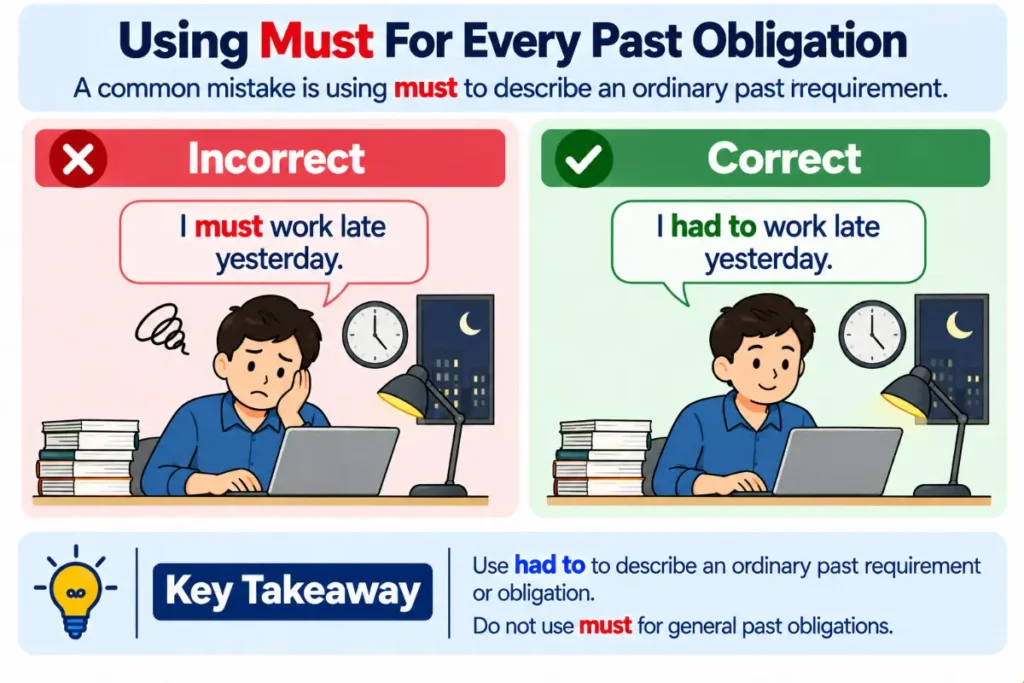
4. Using Must for Every Past Obligation
Incorrect: I must visit the dentist yesterday.
Correct: I had to visit the dentist yesterday.
Why it happens: “Must” does not normally change into a past form when expressing obligation. Use “had to” to describe a requirement or necessity in the past.
5. Using the Wrong Auxiliary in Questions
Incorrect: Do I must attend the meeting?
Correct: Must I attend the meeting?
Also correct: Do I have to attend the meeting?
Why it happens: Learners may combine two different question patterns. Use inversion with “must” and the auxiliary “do” with “have to.”
Still confused? Compare Theater or Theatre Which Should You Use in 2026.
Pronunciation Guide
Understanding pronunciation helps you recognize both expressions in natural conversation.
Pronunciation of Must
- IPA: /mʌst/
- Syllables: One
- Easy pronunciation: MUHST
- Stress: The entire word receives stress.
The vowel sound is similar to the vowel in “cup” in many American accents.
A common mistake is pronouncing the vowel like the long “oo” sound in “food.” This changes the sound of the word.
Pronunciation of Have To
- IPA: /ˈhæv tuː/ in careful speech.
- Common connected pronunciation: /ˈhæf tə/
- Syllables: Usually two spoken parts.
- Easy pronunciation: HAV-tuh.
- Stress: The main stress generally falls on “have.”
In natural American speech, the final /v/ sound in “have” often changes to /f/ before the voiceless /t/ in “to.” This is a regular connected-speech process.
For example:
“I have to go.”
In careful speech, the words may be pronounced separately. In casual speech, they often blend together.
Remember that “hafta” is an informal pronunciation guide, not the standard spelling.
Etymology and Word Origin
Understanding the history of these expressions helps explain why their grammatical forms are different.
Origin of Must
“Must” developed from Old English “mōste,” the past-tense form of an earlier verb associated with being able or being required to do something.
Over time, its grammatical role changed. It became a modal auxiliary used to express obligation, necessity, and strong conclusions.
Modern English preserves its special modal behavior. It does not take the usual third-person singular ending or use “do” to form ordinary questions.
For example:
- She must leave.
- Must she leave?
Origin of Have To
The expression “have to” developed from the ordinary English verb “have” followed by an infinitive construction with “to.”
The verb “have” has a long history in Germanic languages and developed from Old English forms associated with possession.
Its use in expressing obligation grew through the grammatical development of English.
Unlike “must,” it retains many features of an ordinary verb. That is why it can change into forms such as “has to,” “had to,” and “will have to.”
These different histories help explain their modern grammatical behavior.
Regional Usage
Both expressions are established in major English varieties. There is no separate spelling rule for either expression.
American English
In American English, both are standard.
“Have to” is especially common in everyday conversations about responsibilities and practical requirements.
Examples:
- I have to pick up my daughter from school.
- We have to finish the presentation today.
“Must” is common in strong instructions, official notices, and personal statements.
Examples:
- Passengers must remain seated.
- I must call my parents tonight.
British English
British English also uses both forms.
“Have to” is common in ordinary conversation, while “must” is often used for firm instructions, rules, and strong advice.
Examples:
- You must wear a seat belt.
- I have to go to work tomorrow.
The underlying grammar is essentially the same as in American English.
Australian English
Australian English follows the same basic grammatical patterns.
Both expressions are used naturally in conversation, workplaces, schools, and official instructions. There is no special Australian spelling distinction between them.
Canadian English
Canadian English also uses both expressions in much the same way as American and British English.
The choice depends on the intended meaning, tone, and sentence structure rather than a regional grammar rule.
Grammar Rules and Sentence Structure
The easiest way to use these expressions correctly is to understand their grammatical patterns.
1. Affirmative Sentences
For affirmative sentences, use the following structures:
Must + base verb
Examples:
- I must study.
- She must leave.
- They must listen.
Subject + have/has to + base verb
Examples:
- I have to study.
- She has to leave.
- They have to listen.
Notice that “must” does not change according to the subject. However, “have to” changes to “has to” with third-person singular subjects.
2. Negative Sentences
The negative forms have different meanings.
Must not + base verb
This expresses prohibition.
Examples:
- You must not smoke here.
- Students must not cheat during examinations.
Do not/Does not have to + base verb
This expresses a lack of necessity.
Examples:
- I do not have to work tomorrow.
- She does not have to attend the meeting.
In American English, contractions are common:
- I don’t have to go.
- He doesn’t have to pay.
3. Question Formation
Use the following patterns.
Must + subject + base verb?
Examples:
- Must I wait?
- Must we leave now?
Do/Does + subject + have to + base verb?
Examples:
- Do you have to work?
- Does he have to travel?
In ordinary conversation, questions using “do” or “does” with the second expression often sound more natural.
4. Past Tense
To describe a past obligation, use “had to.”
Examples:
- I had to study last night.
- She had to take a taxi.
- We had to postpone the event.
The form “must have” can also refer to the past, but it usually expresses a logical deduction rather than a past obligation.
Example:
“She must have forgotten the appointment.”
This means the speaker believes she probably forgot it.
5. Future Tense
For future necessity, you can use “will have to.”
Examples:
- I will have to travel next week.
- They will have to submit the documents tomorrow.
You can also use “must” for future obligations or instructions.
Example:
“You must complete the form before Monday.”
6. Passive Voice
Both expressions can appear in passive constructions.
Examples:
- The report must be submitted today.
- The documents have to be signed.
- The rules must be followed.
- The equipment has to be checked regularly.
The passive voice focuses on the required action rather than the person performing it.
7. Punctuation
Neither expression requires special punctuation.
- You must finish the work.
- I have to leave early.
- Must we attend the event?
- Do you have to pay now?
Real-Life Usage Examples
The following situations show how these expressions appear in different types of communication.
Daily Conversation
People often use “have to” to talk about everyday responsibilities and practical needs.
Example 1:
“I have to stop by the grocery store before going home.”
Example 2:
“You must try the new restaurant near the station.”
The first sentence describes a practical responsibility. The second expresses strong enthusiasm or advice.
Email and Workplace Communication
In professional communication, both forms are useful.
Example 1:
“All team members must complete the annual training before December 15.”
Example 2:
“I have to reschedule our meeting because another appointment has been added to my calendar.”
The first communicates a firm requirement. The second explains a practical scheduling issue.
Academic Writing
Academic writing often uses “must” to express necessary conditions, rules, or logical requirements.
Example 1:
“Students must provide evidence to support their arguments.”
Example 2:
“Researchers must consider the possible effects of sampling errors.”
“Have to” can also appear in academic writing, especially when describing practical requirements or procedures.
News and Journalism
News reports may use both expressions when describing official requirements and real-world situations.
Example 1:
“Drivers must follow the new traffic regulations introduced this week.”
Example 2:
“Residents have to show proof of address before registering for the program.”
The first sentence emphasizes an official rule. The second describes a practical requirement.
Literature and Storytelling
Writers use these expressions to show a character’s feelings, responsibilities, or circumstances.
Example 1:
“I must find a way to tell her the truth,” Daniel whispered.
Example 2:
“She had to leave the village before sunrise to avoid being seen.”
The first reveals a character’s strong personal determination. The second describes a necessity in the past.
Related and Confused Terms
Several English expressions communicate ideas similar to obligation, necessity, and responsibility. Understanding their differences can make your writing more precise.
1. Need To
“Need to” expresses necessity or something that is required.
Example: I need to finish this assignment before Friday.
It often sounds less forceful than “must,” although the exact strength depends on context.
2. Should
“Should” expresses advice, recommendation, or an expectation.
Example: You should get more sleep.
It is generally less forceful than an obligation expressed with “must.”
3. Ought To
“Ought to” expresses advice, duty, or moral responsibility.
Example: We ought to help people in need.
It is similar to “should,” although it can sound more formal or less conversational.
4. Be Required To
This expression communicates an official or formal requirement.
Example: Employees are required to attend the safety training.
It is especially useful in workplace policies, regulations, and official documents.
5. Be Supposed To
“Be supposed to” describes an expectation, arrangement, or duty.
Example: I am supposed to meet my manager at ten.
It can describe what someone is expected to do, even when that person does not necessarily want to do it.
6. Be Obliged To
“Be obliged to” expresses a formal duty or requirement.
Example: Visitors are obliged to follow the building regulations.
It is more formal than ordinary conversational expressions.
7. Be Necessary To
This construction describes something that is essential or needed.
Example: It is necessary to check the documents before signing.
It focuses on necessity rather than the person who has the obligation.
8. Be Allowed To
“Be allowed to” expresses permission rather than obligation.
Example: Students are allowed to use calculators during the examination.
This distinction is useful because being required to do something and being permitted to do something are different ideas.
Expert Editor Insight
Experienced English editors look beyond individual words and examine the meaning a sentence is intended to communicate. Both expressions are grammatically correct, so automatically replacing one with the other can change the tone or meaning. Editors pay particular attention to negative forms, tense, subject agreement, and question structure. Grammar tools may flag unusual constructions, but they cannot always recognize the intended difference between prohibition and lack of necessity. A useful editing habit is to ask whether the sentence describes a strict rule, a personal decision, or simply something that is needed. That small check prevents many common errors.
Key Takeaways
- Must and have to can both express necessity and obligation.
- Must often presents an obligation as a personal decision strong instruction or firm requirement.
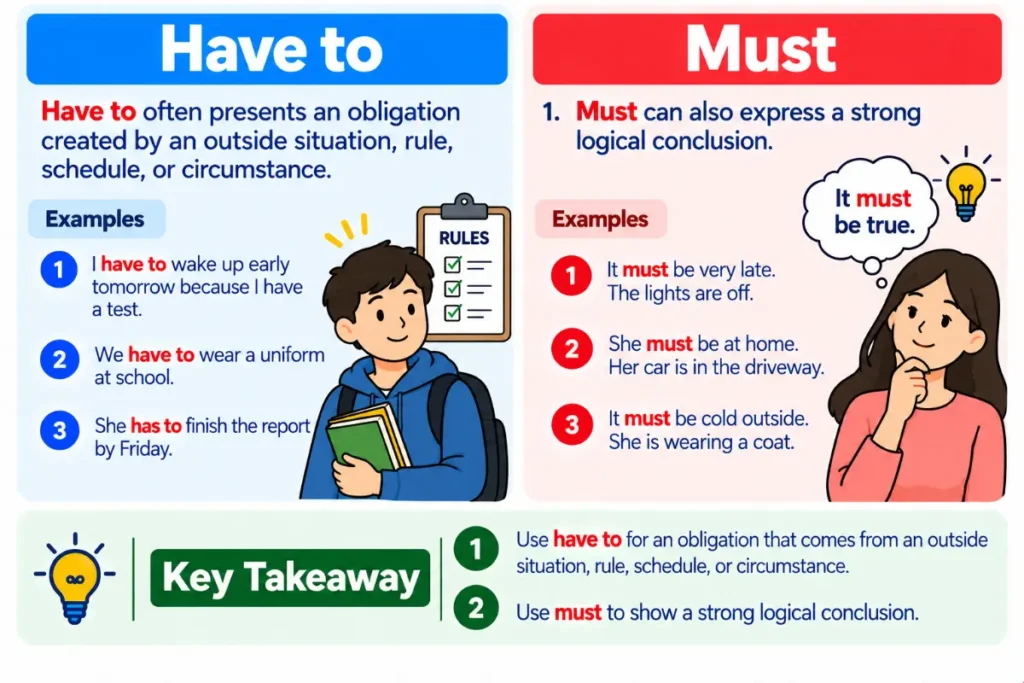
- Have to often presents an obligation created by an outside situation rule schedule or circumstance.
- Must can also express a strong logical conclusion.
- Must does not normally change for different subjects.
- Have to becomes has to with he she and it.
- Use had to for ordinary past obligations.
- Use will have to for future obligations.
- Must not means something is prohibited.
- Do not have to means something is not necessary.
- Do I have to is common in everyday American English.
- Must often sounds firm or authoritative but context determines the exact tone.
Learn the difference in all-time vs all time Meaning and Correct Usage.
Conclusion
Understanding must vs have to makes it easier to express obligations, responsibilities, and necessity accurately. Both expressions are correct, but they have different grammatical patterns and can create different tones. Use “must” for strong instructions, personal determination, and firm requirements. Choose “have to” for everyday responsibilities, practical necessities, and obligations caused by external circumstances. Most importantly, remember that “must not” means something is prohibited, while “do not have to” means something is optional.
A simple editing tip is to check the source of the obligation and the intended meaning before choosing your expression. This will help you communicate clearly and naturally.
FAQs
1. Which is correct: must or have to?
Both are correct English expressions. They are used to communicate obligation and necessity, but their grammar and common uses differ. “Must” often expresses strong instructions, personal conviction, or firm requirements. “Have to” is especially common when describing everyday responsibilities and obligations created by external circumstances. Choose the form that best matches your intended meaning.
2. What is the main difference between these two expressions?
The main difference is often the source and tone of the obligation. “Must” commonly emphasizes a strong requirement or the speaker’s personal decision. “Have to” often describes something made necessary by rules, circumstances, or another person’s expectations. However, both can express external and personal obligations, depending on context.
3. Does must not mean the same as do not have to?
No. “Must not” expresses prohibition, meaning an action is not allowed. “Do not have to” expresses a lack of necessity, meaning an action is optional. For example, “You must not leave” means leaving is prohibited, while “You do not have to leave” means leaving is not required. This is one of the most important distinctions to remember.
4. Can I use must in everyday conversation?
Yes. “Must” is completely natural in everyday English. People use it to express personal decisions, strong advice, and firm instructions. For example, “I must call my sister” communicates a personal intention, while “You must see this movie” expresses enthusiasm. However, “have to” is often more common for ordinary daily responsibilities.
5. Is have to more informal than must?
“Have to” is particularly common in everyday conversation, so it may sound more conversational in many situations. “Must” can sound more formal, direct, or forceful, especially in official instructions and rules. However, neither expression belongs exclusively to formal or informal English. Both can be used naturally in different communication settings.
6. How do you pronounce must and have to?
“Must” is pronounced /mʌst/, with one syllable and a short vowel sound. “Have to” is pronounced /ˈhæv tuː/ in careful speech. In connected American English, it often sounds like /ˈhæf tə/, which can be written informally as “hafta” to represent pronunciation. The standard written expression remains “have to.”
7. Can must and have to be used in the past tense?
“Must” does not normally have a regular past-tense form for expressing obligation. Instead, use “had to.” For example, “I had to work yesterday” describes a past responsibility. However, “must have” can express a conclusion about a past event, as in “She must have forgotten.” These two constructions have different grammatical meanings.
8. Which expression should I use in formal writing?
Both expressions are suitable for formal writing. “Must” is common in policies, regulations, official instructions, and strong statements of necessity. “Have to” is also correct when describing practical requirements or circumstances. For a clear formal style, choose the expression that accurately communicates the obligation and maintain consistent grammar throughout the document.