
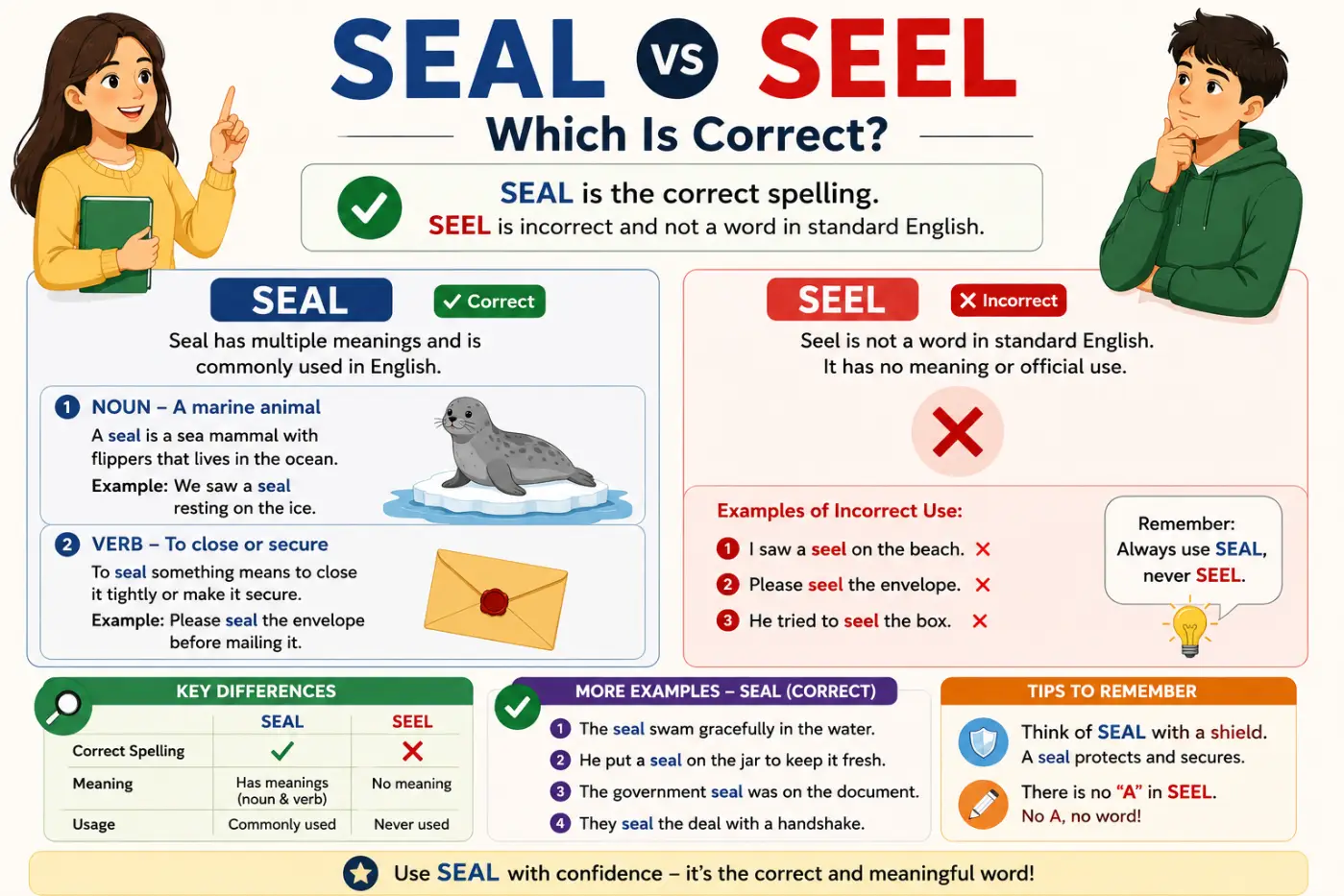
Have you ever wondered whether you should write seal or seel? The two spellings look almost identical and sound the same in many English accents, which makes them easy to confuse. However, they do not have the same meaning or level of use.
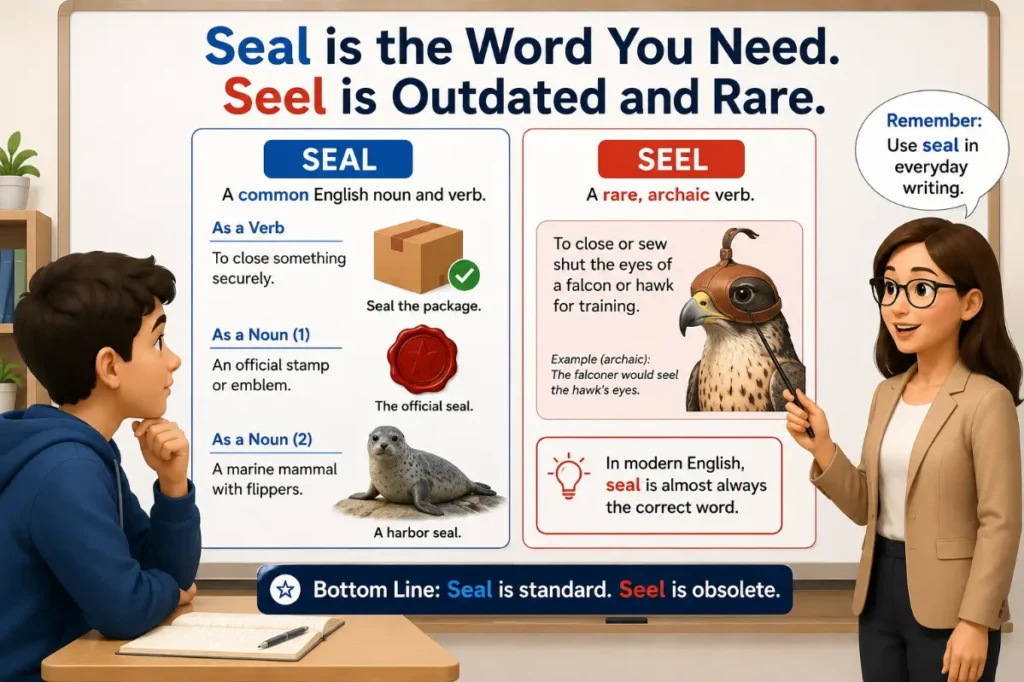
Seal is the correct spelling in almost all everyday situations. It can refer to a sea animal, an official mark, a device that prevents leaks, or the action of closing something tightly. Seel, on the other hand, is a genuine but very rare English word. It has a historical meaning connected to closing or sewing up the eyes of a trained hunting bird.
The difference matters because a spelling that looks wrong may sometimes be a real word with a specialized meaning. Understanding the distinction will help you choose the right spelling in emails, school assignments, professional documents, and everyday conversations. It will also help you recognize unusual historical uses without confusing them with modern standard English.
Need another quick comparison? Read Timeslot or Time Slot Which Spelling Is Correct?.
Quick Answer
Seal is the correct and preferred spelling for ordinary English writing. It means to close something securely, an official mark of approval, or a marine mammal. Seel is a legitimate but obsolete or highly specialized verb associated with closing the eyes of a hunting bird. Unless you are discussing historical falconry or an unusual literary context, use seal.
Meaning and Definition
Understanding the meanings of both forms is the easiest way to avoid confusion. Although their pronunciation is generally identical, their definitions and practical uses are very different.
What Does Seal Mean?
Seal is a standard English word that can function as both a noun and a verb. Its meaning depends on how it is used in a sentence.
As a noun, it has several common meanings:
- A marine animal: A seal is a marine mammal with flippers that lives in coastal waters and oceans.
- An official mark: A seal is a symbol, stamp, or impression used to show that a document or object is authentic or officially approved.
- A closing device: A seal is a material or component that prevents air, water, gas, or another substance from escaping.
- A secure closure: The word can describe the condition of something that has been closed tightly.
As a verb, it means to close something securely or prevent access, movement, or leakage.
For example:
- Please seal the envelope before mailing it.
- The company placed its official seal on the document.
- A rubber seal prevents water from entering the container.
- The authorities sealed the building after the inspection.
The word also appears in familiar expressions such as seal of approval, seal the deal, and airtight seal.
What Does Seel Mean?
Seel is a real English word, but it is extremely uncommon in modern communication. It is primarily known as a historical falconry term.
As a verb, it refers to closing or sewing up the eyelids of a trained hunting bird, traditionally to keep the bird calm during certain stages of training.
The practice belongs to historical falconry, an activity involving the training and use of birds of prey for hunting. The word may appear in older literature, historical accounts, and specialized discussions of traditional bird training.
For example:
- The historical account described how a falconer would seel a hawk.
- The unusual verb appeared in an old passage about medieval falconry.
In modern everyday writing, most readers will not recognize this word. It should not be used as a substitute for seal when discussing envelopes, packages, animals, documents, or containers.
Is Seel a Misspelling?
Not always. It is a legitimate historical English word, but using it in place of the ordinary word seal is a spelling mistake.
For instance:
- Incorrect: Please seel the package before shipping it.
- Correct: Please seal the package before shipping it.
The unusual form is appropriate only when its specialized historical meaning is intended. Context determines whether it is a genuine word or an error.
Comparison Table: Seal vs. Seel
| Feature | Seal | Seel |
|---|---|---|
| Standard spelling | Yes | No, for ordinary modern usage |
| Is it a real word? | Yes | Yes |
| Part of speech | Noun and verb | Primarily verb |
| Main meaning | Marine mammal, official mark, secure closure, or closing action | Historical action of closing a hunting bird’s eyes |
| Pronunciation | /siːl/ | /siːl/ |
| Syllables | One | One |
| Everyday usage | Very common | Extremely rare |
| Formality | Standard in formal and informal English | Historical or specialized |
| Common contexts | Packaging, business, law, wildlife, construction | Historical falconry and older literature |
| Example | Please seal the envelope. | The falconer would seel the hawk. |
The most useful distinction is not pronunciation. Both forms are pronounced the same way in standard English. Their meanings and contexts determine which spelling belongs in a sentence.
Key Differences Explained
The two forms differ in several important ways. Knowing these distinctions makes it easier to identify the correct spelling without relying only on how a word sounds.
1. Spelling
The standard modern spelling is seal.
The unusual form, seel, contains the same letters in a different order. It is not an alternative spelling for the ordinary verb or noun.
Remember that a similar sound does not always mean two words share the same spelling or meaning.
2. Meaning
The word seal has several established meanings. It can describe an animal, an official symbol, a protective closure, or the action of closing something.
The word seel has a much narrower meaning connected to historical falconry. It does not carry the ordinary meanings associated with the more familiar spelling.
3. Grammar
The common form works as both a noun and a verb.
Examples:
- Noun: The seal on the contract was clearly visible.
- Verb: The manager will seal the envelope.
The historical form is primarily used as a verb. Its limited grammatical use reflects its specialized meaning.
4. Pronunciation
Both spellings have the same usual pronunciation: /siːl/.
The sound begins with an /s/, followed by a long /iː/ vowel, and ends with /l/. Because they sound alike, listening alone will not help you identify the correct spelling.
5. Formality
The standard form is appropriate in casual conversations, business communication, academic assignments, and formal documents.
The unusual form belongs mainly in historical or specialized writing. Using it in ordinary professional communication will usually look like a typographical error.
6. Context
Context provides the strongest clue.
If you are talking about closing a box, securing a contract, stamping a certificate, or describing a marine animal, use seal.
If you are discussing the historical treatment of a hunting bird’s eyelids, the specialized verb may be appropriate.
7. Regional Usage
There is no major American-versus-British spelling distinction here. The standard spelling remains the same across major varieties of English.
Which Form Is Correct?
Seal is correct for normal modern English usage.
The reason is simple: it is the established standard spelling for the meanings most people intend. It appears in ordinary vocabulary related to animals, packaging, security, official documents, and mechanical equipment.
The unusual form has a separate historical definition. Its existence does not make it an acceptable replacement for the standard word.
A useful way to make the decision is to ask what you mean:
- Are you closing a package? Write seal.
- Are you describing a sea animal? Write seal.
- Are you referring to an official stamp? Write seal.
- Are you describing a waterproof or airtight closure? Write seal.
- Are you discussing historical falconry and the closing of a bird’s eyelids? The specialized verb seel may be appropriate.
Established dictionary practice distinguishes words according to their definitions and usage. A rare historical entry does not automatically become a modern spelling alternative.
For everyday writing, there is no need to hesitate: choose seal.
Sentence Examples
Here are ten natural examples showing how the standard spelling works in different situations.
- Everyday conversation: Please seal the bag before putting it in the refrigerator.
- Text message: I forgot to seal the envelope, so I’ll fix it before sending it.
- Workplace communication: Please make sure the shipping boxes are properly sealed before collection.
- Business writing: Both parties must sign the agreement before the final seal is applied.
- School assignment: A seal is a marine mammal that spends much of its life in or near water.
- Academic writing: The researchers examined how temperature affects the strength of a rubber seal.
- Formal writing: The certificate must carry the official seal of the issuing institution.
- Social conversation: We watched a seal swimming near the rocks during our coastal trip.
- Online communication: Check the lid to make sure the seal is still intact.
- Professional communication: The maintenance team replaced the damaged seal to prevent further leakage.
These examples demonstrate that the same spelling can serve different grammatical purposes. The surrounding words make its meaning clear.
Common Spelling Mistakes
A few related spelling and word-choice errors can cause confusion. Understanding them can improve your writing and proofreading.
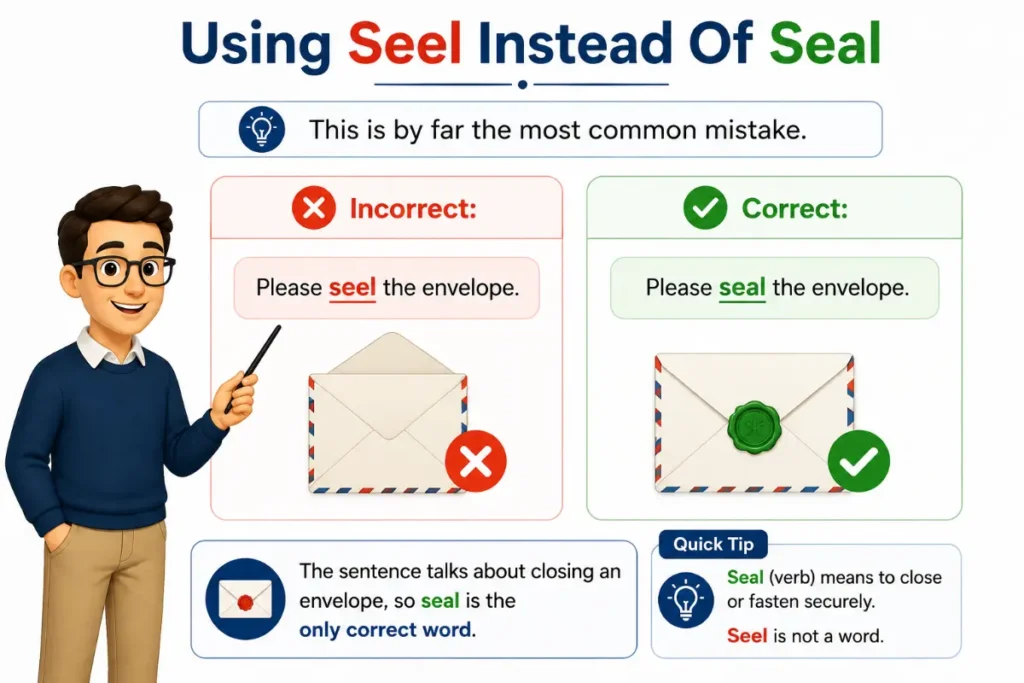
1. Using Seel Instead of Seal
- Incorrect: Please seel the box.
- Correct: Please seal the box.
The mistake occurs because both forms sound alike. The correct spelling for closing a package is the standard form.
2. Treating Seel as an Alternative Spelling
- Incorrect: The document needs an official seel.
- Correct: The document needs an official seal.
The historical word does not replace the ordinary noun. A document’s official mark is always spelled with the standard form.
3. Confusing Seal With See
- Incorrect: I can sea the seal near the shore.
- Correct: I can see the seal near the shore.
The words see and sea are homophones, but they have different meanings. The first describes the act of looking, while the second refers to a large body of salt water.
4. Confusing Seal With Ceiling
- Incorrect: The room needs a new sealing.
- Correct: The room needs a new ceiling.
A ceiling is the upper interior surface of a room. A seal is a closure or protective barrier. Similar beginnings do not make the words interchangeable.
5. Confusing Sealed With Sealed Off
- Incorrect: The workers sealed the area from visitors by locking the gate.
- Better: The workers sealed off the area to keep visitors away.
Both constructions can be grammatical, but seal off is the clearer expression when the intention is to block access to a particular place.
The main lesson is to check the intended meaning rather than choosing a spelling based only on sound.
For another common grammar confusion, see goodmorning or good morning Correct Spelling And Usage.
Pronunciation Guide
The two spellings are generally pronounced identically in English.
| Feature | Pronunciation |
|---|---|
| IPA | /siːl/ |
| Syllables | 1 |
| Easy pronunciation | SEEL |
| Beginning sound | /s/ as in sun |
| Main vowel | Long /iː/ as in see |
| Ending sound | /l/ as in light |
| Stress | One syllable, so no separate stress pattern |
How to Pronounce It
Break the word into three sounds:
- Start with the soft /s/ sound.
- Add the long /ee/ vowel sound, as in see.
- Finish with the /l/ sound.
Put them together: /siːl/.
The pronunciation is short and simple. The main difficulty is remembering that the same sound can represent two different spellings.
Common Pronunciation Mistakes
Some speakers may use a shorter vowel because they are influenced by another language or an unfamiliar spelling pattern. The standard pronunciation uses the long /iː/ sound.
Also, do not assume that pronouncing the historical spelling differently will make its meaning clearer. The usual pronunciation is the same, so written context remains essential.
Etymology and Word Origin
The history of the standard word helps explain why it has several related meanings.
Origin of Seal
The modern English word comes through Old English and is historically connected with Germanic forms. Its development is associated with the idea of a mark, sign, or device used to authenticate or secure something.
The noun and verb developed around related ideas. A physical mark could show that a document was genuine, while the act of sealing could make a container or opening secure.
Over time, the word gained several connected meanings:
- An official mark or impression.
- A device that closes an opening.
- The act of securing something.
- The marine animal known by the same modern spelling.
The animal’s name has a separate historical development, tracing through Germanic language forms. This is a useful reminder that one modern spelling can represent words with different historical backgrounds.
Origin of Seel
The rare verb has a separate historical background associated with the practice of falconry. Its use is recorded in older English, where it described closing a bird’s eyes as part of traditional training.
The word is related to older French usage and entered English through historical language contact.
Its meaning remained specialized rather than becoming part of everyday vocabulary. That is why it is still encountered mainly in older texts and discussions of historical hunting practices.
Regional Usage
The spelling distinction does not change significantly across the main varieties of English. Both American and British readers recognize the standard spelling.
American English
In the United States, seal is the standard spelling for the animal, an official mark, and the act of closing something securely.
Common American expressions include:
- Seal the package.
- A seal of approval.
- A waterproof seal.
- Seal the deal.
The historical verb is rarely used outside specialized or literary contexts.
British English
British English uses the same standard spelling. There is no general rule that changes the ordinary word to the unusual form.
British writers also use expressions such as sealed envelope, official seal, and airtight seal.
Historical writing about falconry may contain the less familiar verb, but that is a matter of specialized vocabulary rather than a regional spelling difference.
Australian English
Australian English follows the same general convention. The standard form is used in business, education, everyday communication, and technical writing.
There is no established Australian spelling rule that makes the unusual form a normal alternative.
Canadian English
Canadian English also uses the standard spelling. The same noun and verb meanings apply, and the specialized historical word remains uncommon.
Across these English varieties, the important distinction is meaning and context, not geography.
Grammar Rules and Part of Speech
Understanding the grammatical role of the standard word will help you use it naturally in sentences.
Seal as a Noun
As a noun, it can identify an animal, an official mark, or a device that prevents something from passing through an opening.
Examples:
- The seal rested on a rock near the water.
- The agreement carried the company’s seal.
- The plumber replaced the damaged seal.
The plural form is seals.
Examples:
- Several seals were swimming near the coast.
- The machine requires two replacement seals.
Seal as a Verb
As a verb, it describes the action of closing or securing something.
Examples:
- Please seal the container.
- The company sealed the agreement.
- The workers sealed the entrance.
The common verb forms are:
| Verb Form | Example |
|---|---|
| Base form | seal |
| Third-person singular | seals |
| Past tense | sealed |
| Past participle | sealed |
| Present participle | sealing |
Examples in sentences:
- She seals every package carefully.
- He sealed the letter yesterday.
- The documents have been sealed.
- They are sealing the windows before winter.
Common Grammatical Patterns
Several expressions appear regularly with this word.
Seal something: Use this pattern when an object is being closed securely.
Example: Seal the envelope before mailing it.
Seal something with something: Use this when identifying the material or tool used.
Example: The technician sealed the joint with waterproof material.
Seal off something: Use this when an area is closed to prevent entry or movement.
Example: The police sealed off the street.
Seal something against something: Use this to explain what a closure protects against.
Example: The cover seals the container against moisture.
A seal of approval: Use this noun phrase to describe official or public acceptance.
Example: The product received a seal of approval from the review committee.
Grammar Mistakes to Avoid
Do not use the unusual historical spelling as the past tense of the ordinary verb. The correct form is sealed, not seeled.
Also, remember that seal can be countable or used in broader technical expressions depending on its meaning. You can count individual marine animals or physical sealing components, while expressions such as a proper seal refer to a successful closure.
Real-Life Usage Examples
The standard spelling appears in many areas of everyday life. The following examples show how its meaning changes according to context.
Daily Conversation
People often use the word when discussing packages, containers, or wildlife.
- Did you seal the food container before putting it away?
- We saw a seal swimming close to the beach.
In these examples, the first use is a verb, while the second is a noun referring to an animal.
Email and Workplace Communication
In professional communication, it commonly relates to document approval, packaging, and maintenance.
- Please ensure that every package is sealed before dispatch.
- The signed agreement will receive the company’s official seal.
The spelling remains unchanged in formal business writing.
Academic Writing
Students and researchers may encounter the word in biology, engineering, history, and legal studies.
- Marine biologists studied the feeding behavior of seals in coastal habitats.
- The experiment measured the effectiveness of a rubber seal under different pressure conditions.
The surrounding subject makes the intended definition clear.
News and Journalism
News writing often uses the term in reports about animals, government action, or public safety.
- Wildlife officials reported an increase in seal sightings along the coast.
- Authorities sealed the building while investigators examined the site.
The first example uses the animal meaning. The second describes an action taken to restrict access.
Literature and Storytelling
In fiction and historical writing, the word can describe physical actions or symbolic ideas.
- She broke the wax seal and opened the letter.
- His promise was meant to seal the agreement between the two families.
Writers may also use it metaphorically to suggest that a decision is final or a relationship is formally confirmed.
Related and Confused Terms
Several English words and expressions are closely connected to this topic. Some share a similar sound, while others have related meanings.
1. Sealed
This is the past tense and past participle of the standard verb.
Example: The package was sealed before delivery.
It describes something that has already been closed securely.
2. Sealing
This is the present participle or gerund form of the verb.
Example: Sealing the windows can help prevent drafts.
It describes the process or action of making something secure.
3. Sealant
A sealant is a material used to close gaps, joints, or openings and prevent substances from passing through.
Example: The contractor applied sealant around the bathroom tiles.
It is a related noun, but it does not refer to an official mark or a marine animal.
4. Closure
Closure means the act or condition of closing something.
Example: The closure of the container was not secure.
It can be used in general situations where the emphasis is on the result of closing rather than the specific material or method.
5. Stamp
A stamp is a mark, impression, or printed symbol.
Example: The certificate carried an official stamp.
A stamp may serve a purpose similar to an official seal, but the two terms are not interchangeable in every legal or administrative context.
6. See
See is a verb meaning to look at or notice something.
Example: I can see the boat from here.
It is a homophone of sea, not of the standard word discussed here.
7. Sea
A sea is a large body of salt water.
Example: The boat sailed across the sea.
It sounds like see and may appear in the same sentence as the marine animal, but its meaning is entirely different.
8. Seel
This is the rare historical verb associated with closing the eyes of a hunting bird.
Example: The old falconry text explained how a falconer might seel a bird.
It is useful to recognize the word in historical material, but it should not be used as an ordinary alternative spelling.
Expert Editor Insight
An experienced English editor would normally correct seel to seal unless the surrounding passage clearly discusses historical falconry. The confusion is common because both spellings have the same pronunciation, making the error difficult to catch through proofreading alone. Spelling tools usually flag the unusual form in ordinary contexts, although specialized dictionaries may recognize it as a valid word. The best editing practice is to check meaning before changing an unfamiliar spelling. This avoids correcting a legitimate historical term while still keeping everyday writing clear and accurate.
Still confused? Compare Cord vs Chord: Meaning, Difference, and Usage.
Conclusion
The choice between seal and seel depends on meaning, but seal is the correct spelling in almost every ordinary writing situation. It can describe a marine animal, an official mark, a protective device, or the act of closing something securely. The alternative is a genuine but extremely rare historical verb connected to falconry, not a general spelling variation.
Remember this simple editing tip: if you are closing a package, protecting an opening, or referring to an animal, write seal. Checking the meaning before choosing the spelling will help you avoid mistakes in both casual and professional communication.
FAQs
Is Seel a Real Word?
Yes, it is a real English word, but it is extremely rare in modern usage. It is primarily a historical falconry verb describing the closing of a hunting bird’s eyes. It is not a standard alternative spelling for the common noun or verb used in packaging, documents, wildlife descriptions, or everyday communication.
Which Is Correct: Seal or Seel?
For ordinary English writing, seal is correct. It refers to a marine mammal, an official mark, a protective closure, or the action of closing something securely. The other spelling has a separate historical meaning and should only be used when that specialized definition is intended.
What Does Seal Mean?
It has several meanings. As a noun, it can refer to a marine mammal, an official mark, or a device that prevents air or water from passing through an opening. As a verb, it means to close or secure something. Its precise definition depends on the sentence.
How Do You Pronounce Seal and Seel?
Both forms are generally pronounced /siːl/. The word has one syllable and sounds like the word feel with an initial /s/ sound. Because their pronunciations are identical, you cannot reliably distinguish their spellings by listening. You need to consider the intended meaning and the context.
Can Seal Be Used as Both a Noun and a Verb?
Yes. As a noun, it can describe an animal, an official mark, or a protective device. As a verb, it describes the action of closing something securely. For example, in “The seal is damaged,” it is a noun. In “Please seal the box,” it functions as a verb.
What Is a Synonym for Seal?
The best synonym depends on the meaning. For the action of closing something, possible alternatives include close, secure, fasten, and shut.
Why Do People Confuse the Two Spellings?
The main reason is pronunciation. Both forms sound identical, so a writer may choose the wrong spelling based on memory or typing habits. The fact that the unusual form is a genuine historical word can also make automated spelling checks less decisive. Understanding the definitions is the most reliable way to avoid confusion.
Is Seal Appropriate in Formal Writing?
Yes. It is a standard word used in professional, academic, legal, technical, and everyday writing. Expressions such as official seal, sealed agreement, and airtight seal are appropriate when they match the intended meaning. The historical spelling should be reserved for specialized contexts in which its unusual definition is relevant.