
Have you ever paused while writing and wondered whether the correct spelling is filing or filling? The two words look almost identical, but they have different meanings. Choosing the wrong one can change the meaning of your sentence, especially in emails, business documents, school assignments, and everyday communication.
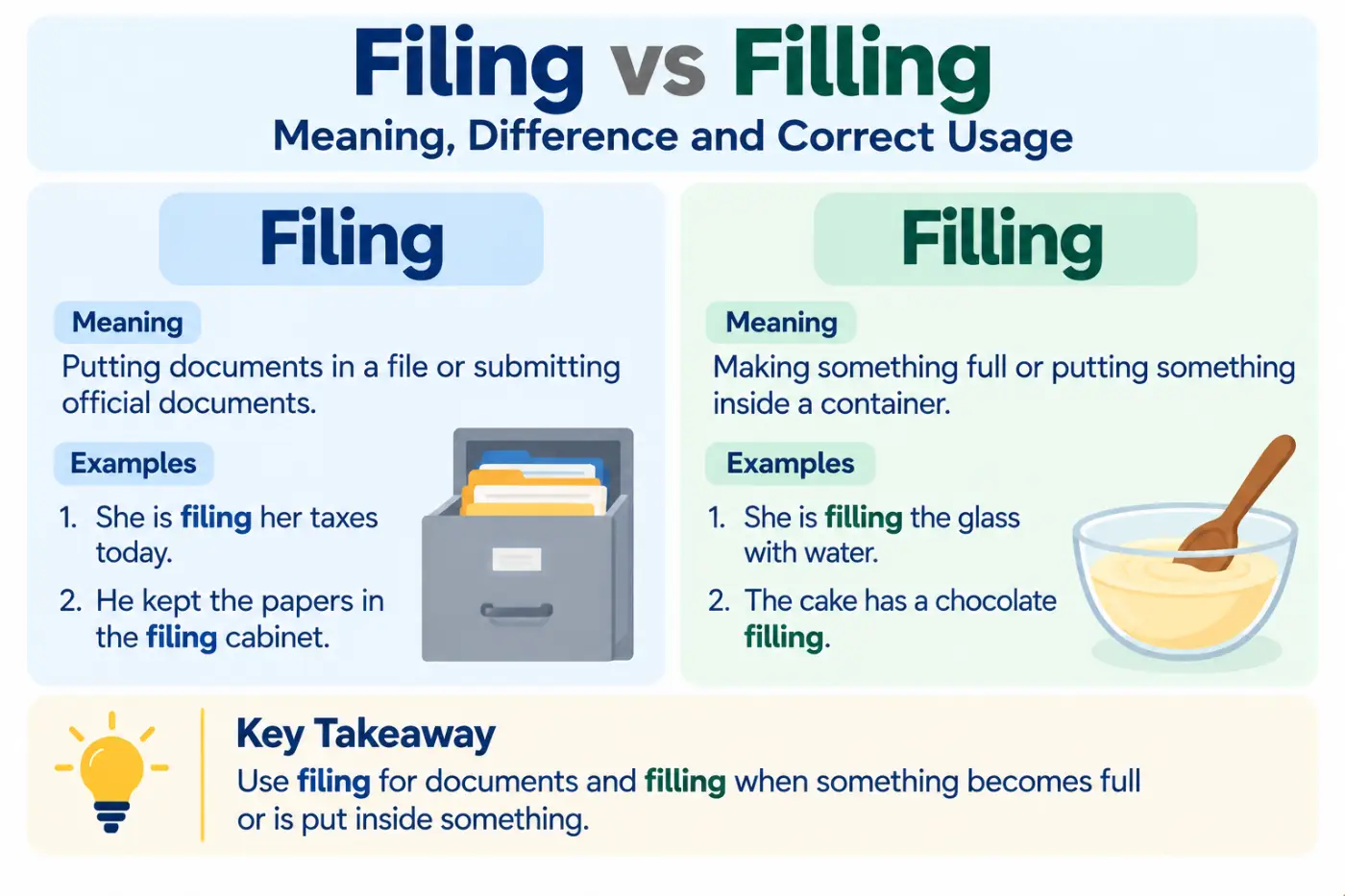
The good news is that both spellings are correct. The difference comes from their root words: filing comes from the verb file, while filling comes from the verb fill. Filing usually refers to submitting, organizing, or using a tool to smooth something. Filling means making something full or adding material to an empty space.
Understanding this simple difference will help you avoid spelling mistakes and use each word naturally. Below, you will find clear definitions, pronunciation guides, grammar rules, real-life examples, and practical tips to remember which spelling belongs in your sentence.
Need another quick comparison? Read signalling or signaling Which Spelling Is Correct.
Quick Answer: Filing or Filling?
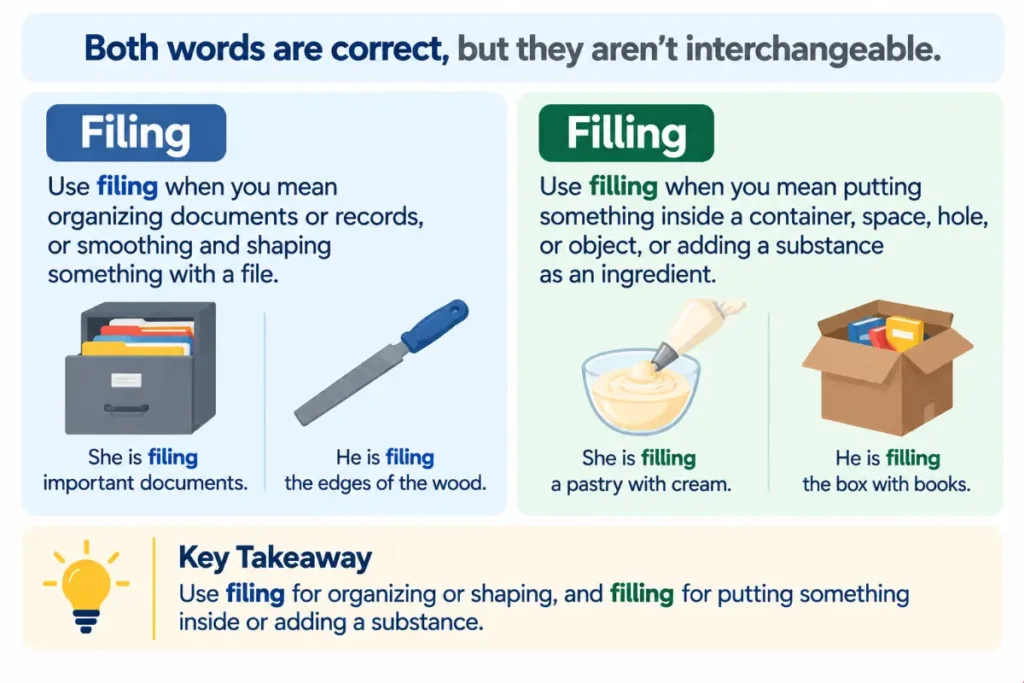
Both filing and filling are correct English words, but they have different meanings. Filing is the act of submitting, organizing, or smoothing something with a file. Filling means making something full or putting material into an empty space. Choose the spelling based on whether your sentence refers to file or fill.
Comparison Table: Filing vs Filling
| Feature | Filing | Filling |
|---|---|---|
| Root word | File | Fill |
| Part of speech | Noun, verb form | Noun, verb form |
| Main meaning | Submitting, organizing, or smoothing | Making something full |
| Common use | Filing taxes, filing documents, filing a complaint | Filling a container, filling a form, dental filling |
| Pronunciation | FY-ling | FIL-ing |
| IPA | /ˈfaɪ.lɪŋ/ | /ˈfɪl.ɪŋ/ |
| Spelling pattern | One L in the root | Two Ls in the root |
| Formality | Standard in formal and informal English | Standard in formal and informal English |
| Example | She is filing her tax return. | She is filling her water bottle. |
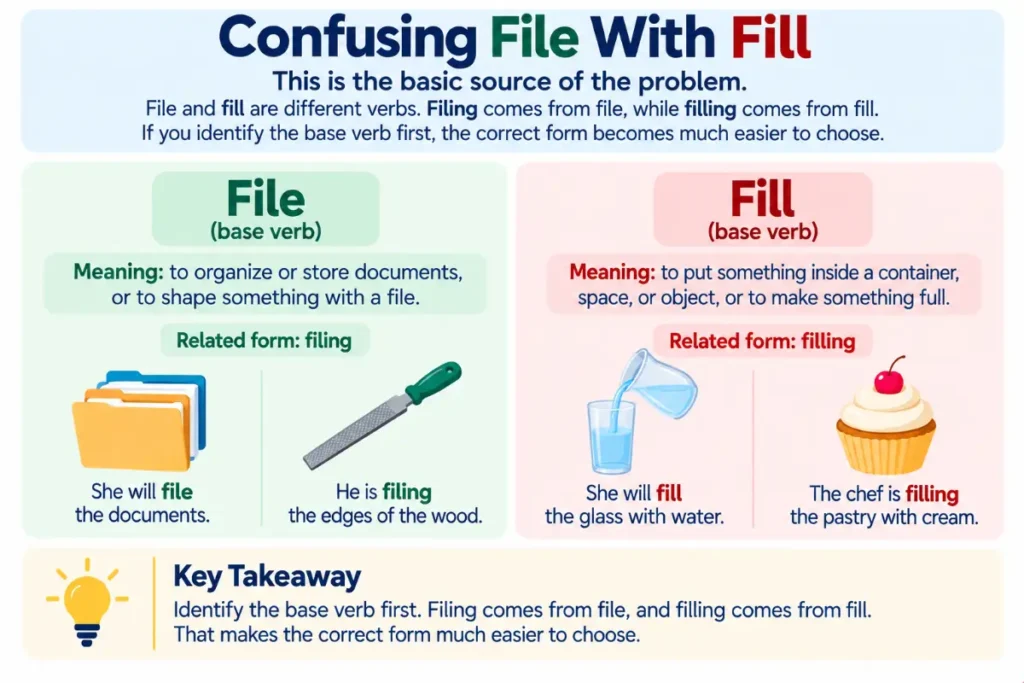
The most useful way to remember the distinction is to look at the original verb. If the action comes from file, use filing. If it comes from fill, use filling.
Meaning and Definition of Each Word
Although these words differ by only one letter, they describe different actions. Understanding their individual meanings makes the spelling much easier to remember.
What Does Filing Mean?
Filing is the present participle or gerund form of the verb file. It can also function as a noun that describes the act or process of filing something.
The word has several common meanings, depending on the situation.
1. Submitting official documents
Filing often refers to officially submitting paperwork, forms, or legal documents to the proper person or organization.
Examples:
- Filing a tax return with the government.
- Filing an insurance claim after an accident.
- Filing a legal complaint in court.
- Filing an application for a new position.
In these situations, the word describes an official process of submitting information for review or recordkeeping.
2. Organizing documents and records
The word can also describe arranging documents so they are easy to find later.
For example, an office employee may spend the afternoon filing invoices, receipts, contracts, and customer records. This process keeps important information organized.
3. Smoothing or shaping something with a tool
Filing can refer to using a file, which is a tool with a rough surface, to smooth, shape, or remove small amounts of material.
Examples include filing your nails, filing a piece of metal, or filing the rough edge of a wooden object with an appropriate file.
4. The act of submitting or organizing information
As a noun, filing describes the action or process itself.
Example: “The filing of the application must be completed before the deadline.”
In this sentence, the word refers to the act of submitting the application.
What Does Filling Mean?
Filling is the present participle or gerund form of the verb fill. It describes the action of making something full, adding material to a space, or supplying something that is missing.
It is also used as a noun for material placed inside something.
Here are its main meanings.
1. Making something full
The most common meaning is adding something until a container, space, or area has the desired amount.
Examples:
- Filling a glass with water.
- Filling a bucket with sand.
- Filling a room with furniture.
- Filling a bottle with juice.
In each example, something is being added to increase the amount inside a space.
2. Completing a form or document
Filling is also used when someone writes information in the spaces provided on a form.
For example, filling out an application means entering the requested details, such as your name, address, and contact information.
The expression “filling in a form” is also common, particularly in British English.
3. Food placed inside another food item
In cooking, a filling is the food or mixture placed inside another item.
Examples include:
- Cream filling in a cake.
- Cheese filling in a sandwich.
- Fruit filling in a pie.
- Chocolate filling in a pastry.
Here, filling functions as a noun rather than an action.
4. Material used to repair or complete something
The word can describe a substance used to fill a hole, gap, or damaged area.
For example, a dentist may use a dental filling to repair a cavity. In construction, filling material may be used to fill gaps or low areas.
5. Satisfying an empty space or need
The word can also have a figurative meaning.
For example, “Her new role is filling an important gap in the team.”
This means the role provides something that was previously missing.
Key Differences Explained
The main distinction is simple: one word comes from file, while the other comes from fill. However, several smaller differences are worth understanding.
1. Spelling Difference
The first difference is the number of letters in the root word.
- File becomes filing.
- Fill becomes filling.
The verb file already ends in a silent E. When adding the suffix -ing, the final E is dropped.
Therefore:
File + ing = Filing
The verb fill does not end in a silent E. Its final L remains, and the suffix is added directly.
Fill + ing = Filling
The double L in the second word is not an extra or accidental letter. It belongs to the original verb.
2. Difference in Meaning
The meanings are not interchangeable.
- Filing refers to submitting documents, organizing records, or smoothing something with a tool.
- Filling refers to making something full, adding material, or supplying something missing.
Consider these sentences:
“She is filing the documents.”
This means she is organizing or submitting the documents.
“She is filling the documents.”
This is not normally the intended expression. If she is completing the paperwork by entering information, the natural wording is “She is filling out the documents” or “She is completing the documents.”
3. Grammatical Difference
Both words can function as gerunds, present participles, and nouns.
Their grammatical roles depend on how they appear in a sentence.
Examples:
- Filing the paperwork takes time.
- Filling the paperwork takes time.
Both sentences can be grammatical, but their meanings differ. The first can refer to submitting or organizing paperwork. The second can refer to entering information into paperwork, although “filling out the paperwork” is generally more natural.
4. Pronunciation Difference
The words are pronounced differently because their first vowel sounds are different.
- Filing: /ˈfaɪ.lɪŋ/
- Filling: /ˈfɪl.ɪŋ/
The first has the long I sound, as in “time” or “five.” The second has the short I sound, as in “sit” or “little.”
This difference is especially helpful when speaking because it allows listeners to distinguish the words even though their written forms are similar.
5. Difference in Context
Context determines which word is appropriate.
Use filing when talking about:
- Tax returns.
- Legal documents.
- Office records.
- Official complaints.
- Smoothing nails or metal.
Use filling when talking about:
- Containers and bottles.
- Forms and applications.
- Food ingredients.
- Dental treatment.
- Empty spaces or missing positions.
6. Difference in Formality
Neither word is more formal or more correct than the other. Both are standard English words.
You can use filing in a legal report, a business email, or casual conversation. Similarly, filling is appropriate in academic writing, medical records, cooking instructions, and everyday speech.
The choice is based on meaning, not formality.
7. Regional Usage
There is no major spelling difference between American and British English for these two words. Both varieties use the same spellings and basic meanings.
Some related expressions differ by region. For example, “filling out a form” is especially common in American English, while “filling in a form” is common in British English.
Which Form Is Correct?
Neither spelling is universally incorrect. Both are correct, but each belongs in a different context.
Use filing when the action involves a file or the process of submitting or organizing records. Use filling when something is being made full or material is being added to a space.
The linguistic reason is that the two words are formed from different base verbs:
- File + ing = Filing
- Fill + ing = Filling
English spelling rules explain the different forms. When a verb ends in a silent E, that E is usually dropped before adding -ing. When a verb ends in two Ls, those letters are generally retained.
Established English dictionaries recognize both as standard words. Their definitions are separate because their root verbs have different meanings.
The easiest test is to remove the ending and check which original verb makes sense. If file fits the sentence, use filing. If fill fits, use filling.
10 Natural Sentence Examples
The following sentences show how both words work in everyday English.
Examples Using Filing
- I am filing my tax return before the April deadline.
- The office assistant is filing the customer records alphabetically.
- She spent the morning filing a formal complaint about the service.
- He is filing the legal documents with the court today.
- My sister is filing her nails before the party.
Examples Using Filling
- I am filling my water bottle before leaving home.
- She is filling out an application for a new job.
- The baker is filling the pastries with fresh cream.
- The dentist recommended filling the damaged tooth.
- We are filling the empty seats before the meeting begins.
These examples demonstrate why replacing one spelling with the other can change the meaning of a sentence.
Common Spelling Mistakes and How to Avoid Them
Writers sometimes confuse these words because they share most of the same letters and have similar pronunciations. The following mistakes are worth watching for.
1. Writing “Filling” When You Mean Submitting Documents
Incorrect: I am filling my tax return today.
Correct: I am filing my tax return today.
Why it happens: The writer may associate paperwork with completing spaces on a form rather than officially submitting a document.
Remember that filing a tax return means submitting it to the appropriate tax authority. Filling out a tax return means entering the required information.
2. Writing “Filing” When You Mean Adding Something
Incorrect: She is filing the glass with water.
Correct: She is filling the glass with water.
Why it happens: The two words look similar, so writers may choose the wrong vowel without noticing.
Remember that you fill a container because you are adding something to it.
3. Confusing “Filing Out” With “Filling Out”
Incorrect: Please file out this application.
Correct: Please fill out this application.
Why it happens: Both expressions sound familiar in office and administrative settings, but only one describes entering information into a form.
Use “fill out” when completing a document. Use “file” when submitting or organizing it.
4. Adding an Extra L to the Wrong Word
Incorrect: I am fillling the container.
Correct: I am filling the container.
Why it happens: Repeated letters can create typing errors, particularly when writing quickly.
The root verb has two Ls, so the correct form contains three consecutive Ls only if another word boundary or suffix is involved? In this case, it contains exactly two Ls followed by I: filling.
5. Removing an L From the Correct Word
Incorrect: The filling was delicious.
Correct: The filling was delicious.
Why it happens: Some writers may mistakenly apply the spelling pattern of filing to the other word and reduce the double L.
Remember that the root word is fill, not fil.
A useful proofreading habit is to check the original verb before deciding which spelling to use.
A related grammar guide is Brite vs Bright Which Spelling Should You Use in 2026.
Pronunciation Guide
Although the two words look similar, their vowel sounds make them easy to distinguish when spoken correctly.
How to Pronounce Filing
- IPA: /ˈfaɪ.lɪŋ/
- Syllables: fi-ling
- Easy pronunciation: FY-ling
- Stress: First syllable
The first syllable has the long I sound, similar to the vowel in “five,” “time,” and “light.”
Example: “She is filing the paperwork.”
How to Pronounce Filling
- IPA: /ˈfɪl.ɪŋ/
- Syllables: fill-ing
- Easy pronunciation: FIL-ing
- Stress: First syllable
The first syllable has the short I sound, similar to the vowel in “fish,” “sit,” and “milk.”
Example: “He is filling the bottle.”
Common Pronunciation Mistakes
Some speakers pronounce both words almost identically, especially when speaking quickly. This can make the intended meaning less clear.
To avoid confusion, practice the vowel contrast:
- FY sounds like the beginning of “five.”
- FIL sounds like the beginning of “filter.”
Both words have two syllables and stress on the first syllable. The main difference is the vowel sound, not the stress pattern.
Etymology and Word Origin
The two words developed from separate English verbs with different historical roots.
Origin of Filing
The word filing comes from the verb file. In the sense of using a tool to smooth or shape material, file has an Old English history associated with the word feol, referring to a file or similar tool.
The verb developed to describe the action of working on a surface with that tool.
The administrative meaning of file developed around the idea of arranging documents in an orderly way. A file could refer to a collection of papers kept together, and filing came to describe organizing or submitting records.
Today, the word is widely used in business, government, law, and everyday conversation.
Origin of Filling
The word filling comes from the Old English verb fyllan, meaning to fill or make full. It belongs to the Germanic language family and is related to similar words in other Germanic languages.
Over time, the verb developed into the familiar modern English form fill. Adding the suffix -ing creates filling, which describes the action or material associated with making something full.
Its modern meanings include filling containers, completing forms, adding food ingredients, and repairing empty spaces.
The historical difference between these roots helps explain why the two spellings should not be treated as interchangeable.
Regional Usage: American, British, Australian, and Canadian English
The spellings themselves remain consistent across the major English varieties. The differences are mainly found in related expressions and everyday preferences.
American English
Both words are standard in the United States.
Americans commonly use filing in expressions such as:
- Filing taxes.
- Filing a complaint.
- Filing documents.
- Filing a legal claim.
The word filling appears in expressions such as:
- Filling out a form.
- Filling a glass.
- Filling a position.
- Pie filling.
“Filling out a form” is a particularly familiar American expression.
British English
British English uses the same spellings and basic definitions.
The main difference is often the phrase used for completing paperwork. British speakers commonly say “filling in a form,” while Americans frequently say “filling out a form.”
Both expressions are understood in both countries.
The distinction between filing and filling remains the same.
Australian English
Australian English also uses both spellings without a special regional spelling change.
Filing is used for administrative and legal processes, while filling describes making something full or adding material.
Expressions such as “filling out a form” and “filling in a form” are both understandable.
Canadian English
Canadian English follows the same basic spelling and meaning rules.
Canadians use filing for tax submissions, document management, and legal processes. Filling is used for completing forms, adding material, and describing food ingredients or dental repairs.
There is no special Canadian spelling rule that changes one word into the other.
Grammar Rules and Parts of Speech
Both forms can serve several grammatical purposes. Knowing how they function in a sentence will help you choose the correct word.
1. Present Participle
A present participle is a verb form ending in -ing. It is commonly used with a form of the verb be to describe an ongoing action.
Examples:
- She is filing the documents.
- He is filling the container.
The structure is:
Subject + am/is/are + verb-ing
The meaning depends on the original verb.
2. Gerund
A gerund is an -ing verb form that functions as a noun.
Examples:
- Filing takes longer than expected.
- Filling the tank is part of the daily routine.
In the first sentence, filing is the activity being discussed. In the second, filling is also the name of an activity.
3. Noun
Both words can function as nouns.
Examples:
- The filing was completed yesterday.
- The cake has a chocolate filling.
The first refers to an administrative action or process. The second refers to material placed inside a cake.
4. Common Verb Patterns
The words appear in different expressions.
Common patterns with filing:
- Filing a tax return.
- Filing a complaint.
- Filing documents.
- Filing a report.
- Filing your nails.
Common patterns with filling:
- Filling a container.
- Filling out a form.
- Filling in a blank.
- Filling a position.
- Filling a cavity.
Learning these combinations can make correct usage more natural.
5. Sentence Position
Both forms can appear at the beginning, middle, or end of a sentence.
Examples:
- Filing the report took two hours.
- She is filing the report now.
- The report is ready for filing.
Similarly:
- Filling the bottle is easy.
- He is filling the bottle.
- The filling is ready for the pastries.
The grammatical position does not determine the spelling. The intended meaning does.
6. Punctuation and Formal Writing
Neither word requires special punctuation. Follow normal sentence punctuation rules.
For example:
“After filing the complaint, she received a confirmation email.”
“After filling the form, she submitted it online.”
In both cases, the opening phrase is followed by a comma because it introduces the main clause.
Real-Life Usage Examples
Seeing these words in different situations makes their meanings easier to remember.
Daily Conversation
Example 1:
“Are you filing the documents today, or will you do it tomorrow?”
Here, filing means organizing or submitting paperwork.
Example 2:
“Can you help me with filling these bottles before the guests arrive?”
Here, filling means adding liquid to empty containers.
Email and Workplace Communication
Example 1:
“Please complete the filing of all outstanding invoices by Friday.”
This refers to organizing or processing business records.
Example 2:
“Make sure you finish filling out the employee information form before your first day.”
This refers to entering the requested details.
Academic Writing
Example 1:
“The filing of research materials helps maintain an accurate record of the study.”
Filing describes the organized storage of information.
Example 2:
“Filling the missing sections in the questionnaire improved the completeness of the collected data.”
Filling describes adding information to empty sections.
News and Journalism
Example 1:
“The company announced the filing of a new legal complaint against its former supplier.”
The word refers to an official legal action.
Example 2:
“Local volunteers are filling food boxes for families affected by the storm.”
The word describes adding food items to containers.
Literature and Storytelling
Example 1:
“She watched the clerk carefully, filing each letter into a separate folder.”
The word creates an image of orderly document management.
Example 2:
“The smell of freshly baked bread filled the kitchen, while the baker prepared the filling for the pies.”
Here, filling refers to the ingredients placed inside the pies.
Related and Commonly Confused Terms
Several related words and expressions can help you understand the difference more clearly.
1. File
File is the root verb of filing. It can mean submitting documents, arranging records, or using a tool to smooth a surface.
Example: “I need to file my tax return.”
2. Fill
Fill is the root verb of filling. It means making something full or adding material to a space.
Example: “Please fill the bottle with water.”
3. Filing Out
“Filing out” is generally not the correct expression when you mean completing a form.
The correct phrase is “filling out.”
Example: “She is filling out the application.”
4. Filling In
Filling in means adding information to blank spaces or completing missing details.
Example: “Please fill in your contact information.”
It can also mean temporarily doing someone’s job.
Example: “He is filling in for the manager today.”
5. Filing Away
Filing away means storing documents or information in an organized place.
Example: “The assistant is filing away the completed reports.”
6. Completing
Completing means finishing something that is unfinished.
Example: “She is completing the application.”
It is often a useful alternative to “filling out” when the focus is on finishing a task.
7. Submission
Submission is the act of presenting something for review, approval, or consideration.
Example: “The submission of the application is due tomorrow.”
It is closely related to the administrative meaning of filing, although the words are not interchangeable in every situation.
8. Contents
Contents refers to the things inside a container, document, or other space.
Example: “The contents of the box were carefully checked.”
This term is related to filling because filling often involves adding contents to something.
Expert Editor Insight
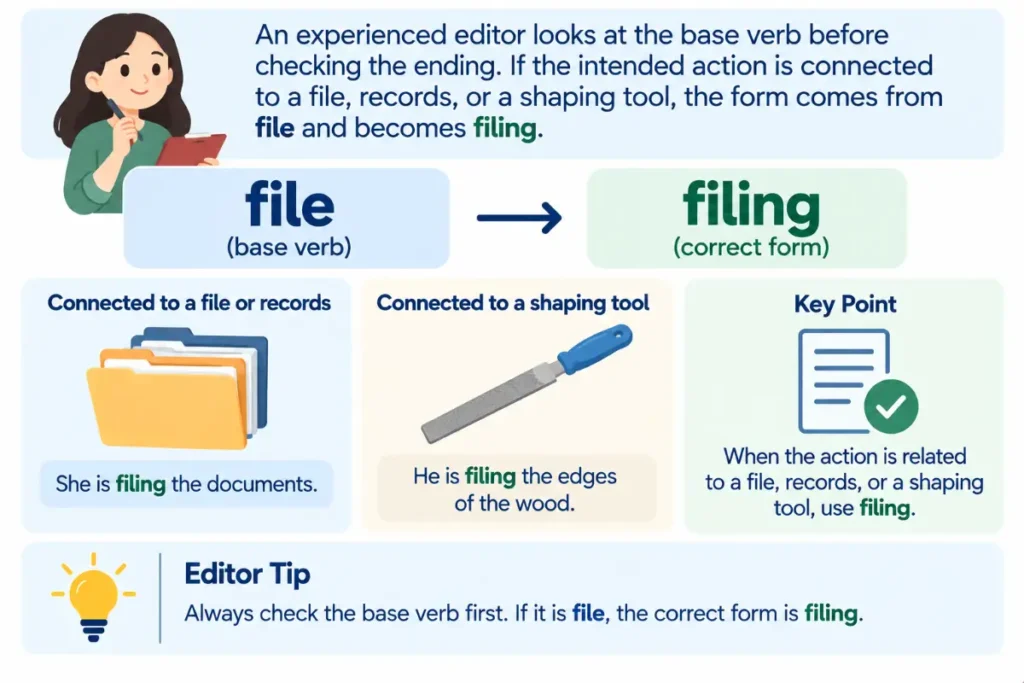
An experienced English editor looks beyond the appearance of a word and checks what the sentence is trying to communicate. The confusion between these forms is common because both have two syllables, share several letters, and end in the same sound. However, professional proofreading focuses on the root verb and the surrounding context. Spelling tools may flag an actual typo, but they may not catch a correctly spelled word used with the wrong meaning. For example, both words can pass a basic spell-check even when the writer has selected the wrong one. The best editing habit is to replace the -ing form with its base verb and read the sentence again.
Still confused? Compare infront or in front Correct Spelling Meaning and Usage.
Conclusion
Understanding filing vs filling becomes easy once you recognize their different root words. Filing comes from file and refers to submitting documents, organizing records, or smoothing a surface. Filling comes from fill and means making something full, adding material, or completing empty spaces. Both are correct spellings, but they cannot be used interchangeably.
A simple editing trick is to remove -ing and check whether file or fill makes sense in your sentence. Remember this distinction, and you will be able to choose the right word confidently in everyday conversations, professional emails, and formal writing.
FAQs
1. Which is correct: filing or filling?
Both are correct English words, but they have different meanings. Filing comes from the verb file and refers to submitting or organizing documents or smoothing a surface with a tool. Filling comes from fill and means making something full or adding material to a space. The correct choice depends entirely on what you want to describe.
2. Is filling a real English word?
Yes, filling is a standard English word. It is the -ing form of the verb fill and can also function as a noun. It describes making something full, adding material to an empty space, or the substance placed inside food. Examples include filling a bottle, filling out an application, and cream filling in a cake.
3. What does filing mean in simple English?
Filing means submitting or organizing documents, or using a file tool to smooth or shape something. For example, filing taxes means submitting a tax return, while filing papers means arranging documents for storage. It can function as a verb form or a noun, depending on the sentence.
4. What does filling mean in simple English?
Filling means making something full by adding material, liquid, information, or another substance. For example, filling a glass means putting liquid into it, while filling out a form means entering the requested information. The word can also describe something placed inside food, such as the filling in a pie.
5. How do you pronounce filing and filling?
Filing is pronounced FY-ling, with the first vowel sounding like the I in “five.” Its IPA transcription is /ˈfaɪ.lɪŋ/. Filling is pronounced FIL-ing, with the short I sound heard in “sit.” Its IPA transcription is /ˈfɪl.ɪŋ/. Both words have two syllables with stress on the first.
6. Should I say filing out a form or filling out a form?
The correct expression is “filling out a form” when you mean entering information into its blank spaces. Filing a form usually refers to officially submitting it to an organization or authority. For example, you fill out an application before filing or submitting it. The two actions may happen during the same process, but they are not identical.
7. Can filing and filling be used in formal writing?
Yes, both words are appropriate in formal writing. Filing is common in legal, financial, administrative, and business documents. Filling is used in academic, medical, technical, and everyday professional contexts. Neither word is informal or incorrect. The main requirement is choosing the spelling that matches the intended meaning and using the correct grammatical expression.
8. Why do people confuse these two spellings?
People confuse them because they share most of their letters, have similar pronunciation patterns, and both end in -ing. Fast typing and unfamiliarity with the root verbs can also contribute to mistakes. Remembering that filing comes from file and filling comes from fill is a simple way to avoid confusion.