
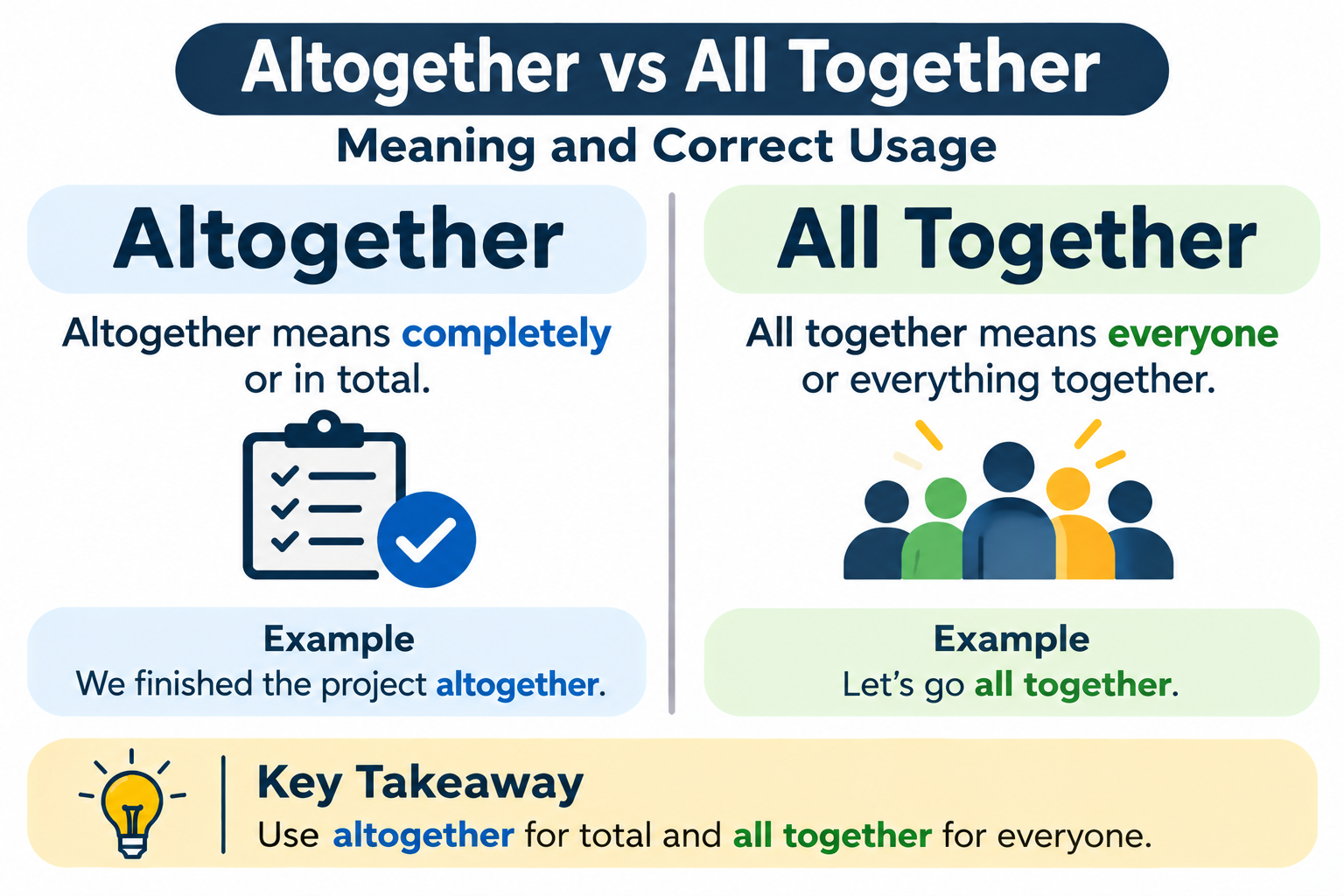
The difference between altogether vs all together can be confusing because the two expressions look almost identical and sound the same in normal speech. However, they do not mean the same thing. Altogether is one word that means entirely, completely, or when everything is considered. All together is two words that means everyone or everything in the same place or at the same time.
The confusion usually comes from their similar pronunciation and spelling. Since both expressions contain the words all and together, it is easy to assume they are interchangeable. They are not. Choosing the wrong form can change the meaning of your sentence or make your writing unclear.
The good news is that the distinction is simple once you understand what each expression does. You will learn their meanings, grammatical roles, pronunciation, common mistakes, and practical examples. You will also discover an easy editing trick that helps you choose the right form whenever you write.
Still confused? Compare Might vs Could What Is the Difference and When to Use Each?.
Quick Answer
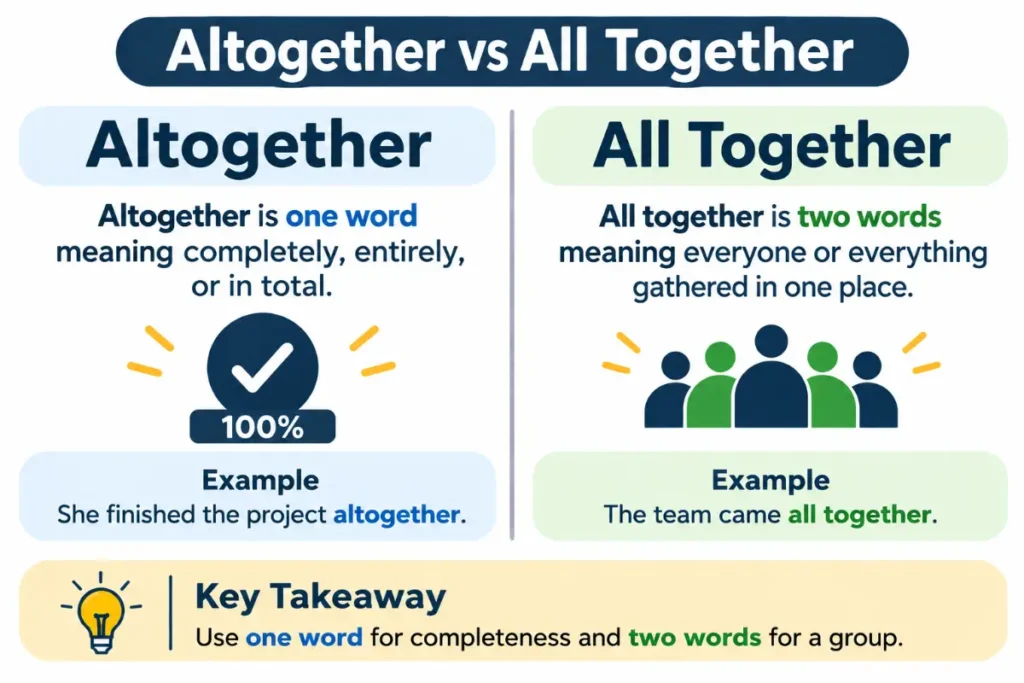
Altogether is one word meaning completely, entirely, or in total. All together is two words meaning everyone or everything gathered in one place or doing something at the same time. Both are correct English expressions, but they serve different purposes. Use one word for completeness or a total and two words for people or things acting as a group.
Comparison Table
| Feature | Altogether | All Together |
|---|---|---|
| Spelling | One word | Two words |
| Meaning | Completely, entirely, or in total | Everyone or everything in one group |
| Part of speech | Adverb | Adverbial phrase |
| Grammatical function | Modifies a verb, adjective, or statement | Describes a group acting or being considered collectively |
| Pronunciation | /ˌɔːltəˈɡɛðər/ | /ˌɔːl təˈɡɛðər/ |
| Formality | Standard in formal and informal writing | Standard in formal and informal writing |
| Common contexts | Opinions, totals, degree, conclusions | Meetings, gatherings, group activities |
| Example | The plan was altogether unnecessary. | We were all together at the meeting. |
Meaning and Definition
Understanding the meaning of each expression is the easiest way to avoid spelling and grammar mistakes. Although they share similar sounds and letters, their meanings are different.
What Does Altogether Mean?
Altogether is an adverb that means completely, entirely, or in total. It describes the full extent of something or gives a combined amount.
It usually appears when you want to express that something is complete, that a situation has a particular overall quality, or that several amounts should be considered as one total.
For example:
- The experience was altogether wonderful.
- The repairs cost $500 altogether.
- I altogether disagree with that decision.
In the first sentence, the word expresses the overall quality of the experience. In the second, it refers to the combined cost. In the third, it emphasizes complete disagreement.
There are three common meanings worth remembering:
1. Completely or entirely
This meaning describes the full extent of an action, condition, or opinion.
Example: The proposal was altogether unacceptable.
2. In total or collectively
This meaning refers to a combined amount or final sum.
Example: We invited 25 people altogether.
3. On the whole or considering everything
This meaning expresses a general judgment about a situation.
Example: The event was altogether a success.
In each case, the word functions as a single adverb. It does not describe people physically standing together.
What Does All Together Mean?
All together is a two word expression made up of the determiner all and the word together. It refers to everyone or everything being in the same place, participating in the same activity, or acting at the same time.
It emphasizes a group rather than completeness or degree.
For example:
- The children were all together in the garden.
- We sang all together during the celebration.
- Put all the books together on the table.
In the first sentence, the children are gathered in one location. In the second, everyone sings at the same time. In the third, the books are placed in one group.
The expression can describe people, objects, animals, or events.
Here are three common situations in which it appears:
1. People in the same location
Example: The entire family was all together for dinner.
2. People doing something at the same time
Example: The students shouted all together.
3. Objects collected into one group
Example: Keep all the documents together in one folder.
The central idea is unity or grouping. The expression tells the reader that separate people or things are being considered as one group.
Key Differences Explained
The most important distinction is meaning. One form describes the degree or total of something, while the other describes a group acting or existing collectively.
Let’s examine the differences more closely.
1. Difference in Spelling
The first expression is written as one continuous word:
– Altogether
The second expression contains two separate words:
– All together
The space is not optional. It changes the grammatical structure and meaning of the expression.
For example:
- The project was altogether successful.
- The team worked all together on the project.
The first sentence describes the overall success of the project. The second describes how the team worked as a group.
2. Difference in Meaning
The meanings are related to different ideas.
Altogether focuses on completeness, degree, or a combined total.
All together focuses on people or things being united in one place or participating at the same time.
Consider these examples:
- The movie was altogether disappointing.
- We watched the movie all together.
In the first sentence, the speaker gives an overall judgment. In the second, the speaker explains that everyone watched the movie as a group.
3. Difference in Grammar
Altogether is a single adverb. It can modify adjectives, verbs, and sometimes an entire statement.
Examples:
- The suggestion was altogether reasonable.
- I altogether forgot about the appointment.
- Altogether, the situation was manageable.
All together is a phrase that combines separate grammatical elements. The word all refers to the complete group, while together describes the group’s shared position or action.
Examples:
- They were all together in the classroom.
- We prepared all the materials together.
This distinction matters because you cannot replace one expression with the other without changing the sentence’s meaning.
4. Difference in Context
The surrounding words often reveal which form you need.
Use the one word version in sentences about:
- Complete agreement or disagreement.
- Overall opinions.
- Total amounts.
- General conclusions.
- The full extent of a situation.
Use the two word version in sentences about:
- Family gatherings.
- Group activities.
- People meeting in one place.
- Objects collected in one location.
- Several people performing an action simultaneously.
5. Difference in Formality
Neither expression is more formal than the other. Both are standard English and appropriate for professional, academic, and everyday communication.
For example:
- The results were altogether satisfactory.
- All participants were together in the conference room.
The first sentence uses a formal adverb to describe the results. The second uses a normal phrase to describe the participants’ location.
6. Difference in Pronunciation
In most varieties of American English, both expressions have nearly identical pronunciation. The difference is mainly grammatical and appears in writing.
This explains why people sometimes confuse them when typing. Hearing the expression alone may not tell you which spelling is appropriate.
Which Form Is Correct?
Both forms are correct. Neither is a misspelling of the other.
The correct choice depends on the meaning you want to express. Use altogether when you mean completely, entirely, or in total. Use all together when you mean that people or things are gathered, grouped, or acting at the same time.
Consider these examples:
- The proposal was altogether unreasonable.
- The employees were all together for the annual meeting.
The first sentence describes the proposal’s overall quality. The second describes a group of employees gathered for an event.
Established English dictionaries recognize both forms as standard expressions with distinct meanings. The spelling difference reflects their separate grammatical functions, not a difference between American and British spelling.
A useful rule is to check the purpose of the sentence before deciding how to spell the expression.
Sentence Examples
The following examples show how each form works in natural English.
10 Examples Using Altogether and All Together
1. The vacation was altogether worth the money we spent.
2. We were all together at my grandmother’s house for Thanksgiving.
3. The three repairs cost $250 altogether.
4. The manager thought the new proposal was altogether unnecessary.
5. The children stood all together near the school entrance.
6. I altogether forgot to bring my notebook to class.
7. The team completed five projects altogether during the month.
8. Everyone sang all together at the end of the ceremony.
9. The experience was altogether different from what I expected.
10. Let’s put all the photographs together so we can choose the best ones.
Notice how the meaning changes depending on the form. The one word version expresses an overall judgment, degree, or total. The two word version describes grouping or shared participation.
Common Mistakes and Misspellings
Even experienced English writers sometimes confuse these expressions. Most mistakes happen because the words sound almost identical in everyday conversation.
Here are five common errors and how to correct them.
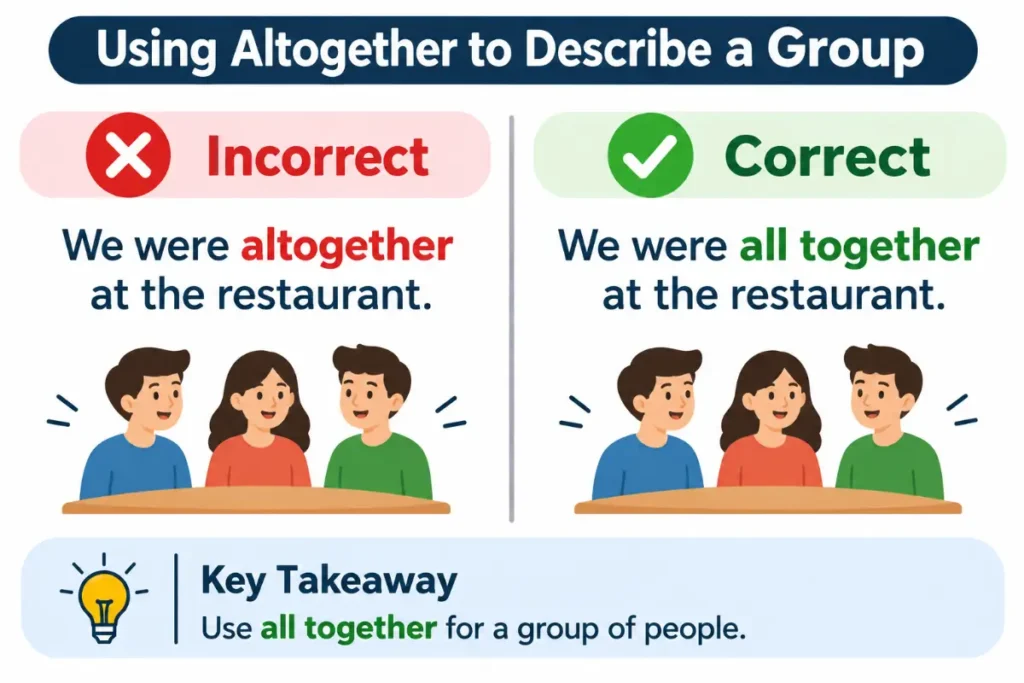
1. Using Altogether to Describe a Group
Incorrect: We were altogether at the restaurant.
Correct: We were all together at the restaurant.
The sentence describes people gathered in one location. Therefore, the two word expression is appropriate.
2. Using All Together to Mean Completely
Incorrect: I all together disagree with the decision.
Correct: I altogether disagree with the decision.
The speaker means complete disagreement, not that several people disagree as a group.
3. Writing Alltogether as One Word
Incorrect: The event was alltogether successful.
Correct: The event was altogether successful.
Writing the expression as alltogether is a spelling error. The standard one word form does not contain an extra l.
4. Separating Altogether Incorrectly
Incorrect: The total came to all together $300.
Correct: The total came to $300 altogether.
When referring to the final combined amount, use the single adverb.
5. Assuming Both Forms Are Interchangeable
Incorrect: The students were altogether in the library.
Better: The students were all together in the library.
The intended meaning is that the students shared the same location. Using the one word form could suggest a different meaning and make the sentence awkward.
Editing tip: Before choosing a spelling, ask yourself what the sentence communicates. If it describes a complete amount or degree, choose the single word. If it describes a group, choose two words.
Many readers also check Indulgent Vs Sober Understanding The Real Difference 2026.
Pronunciation Guide
Both expressions sound almost identical in American English. Their pronunciation does not provide a reliable way to distinguish their spelling.
IPA Pronunciation
A common American English pronunciation is:
- Altogether: /ˌɔːltəˈɡɛðər/
- All together: /ˌɔːl təˈɡɛðər/
The exact vowel quality may vary by speaker and regional accent.
Syllable Breakdown
The expressions can be divided into syllables as follows:
Altogether:
- Al
- to
- geth
- er
All together:
- All
- to
- geth
- er
Both have four spoken syllables in this pronunciation.
Easy Pronunciation Guide
You can pronounce both expressions approximately as:
awl-tuh-GETH-er
The strongest stress usually falls on the syllable GETH.
The word together contains the voiced TH sound /ð/, as in the word this. It is not the unvoiced TH sound /θ/ found in words such as think.
Common Pronunciation Mistakes
- Pronouncing the TH sound like the sound in think instead of this.
- Placing too much stress on the first syllable.
- Trying to pronounce the expressions differently when ordinary speech does not require a clear distinction.
Remember that the spelling difference is mainly a matter of meaning and grammar, not pronunciation.
Etymology and Word Origin
Understanding the history of these expressions helps explain why they look so similar.
Origin of Altogether
The word altogether developed from the combination of the words all and together. Historically, English writers used related expressions to communicate the idea of considering everything as one complete whole.
Over time, the expression became established as a single adverb. Its modern meanings include entirely, completely, and in total.
The word reflects a common process in English called lexicalization. This happens when a group of words becomes established as one independent vocabulary item with its own spelling and grammatical role.
Origin of All Together
The expression all together retains its separate word structure.
The word all comes from Old English eall, which referred to the whole amount or entire number of something.
Together developed from Old English forms related to the idea of being assembled or in the same company. Its modern meaning describes people or things existing, moving, or acting in combination.
Unlike the single adverb, this expression continues to show the separate grammatical roles of its words.
Why Their Histories Matter
Both forms developed around the ideas of completeness and unity. That shared background explains their similar appearance.
However, modern English uses them differently. The single word expresses completeness or a total, while the two word phrase emphasizes a group or shared action.
Historical similarities do not make two modern expressions interchangeable. Their present meanings and grammatical functions determine how you should write them.
Regional Usage
The distinction remains consistent across major varieties of English. There is no major regional spelling difference that changes the meaning of either expression.
American English
Both forms are standard in American English.
Examples:
- The performance was altogether impressive.
- We were all together at the school event.
American writers use the one word form for completeness, total amounts, and general judgments. They use the two word form for groups and shared activities.
British English
British English follows the same distinction.
Examples:
- The decision was altogether unexpected.
- The family gathered all together for lunch.
The spellings and grammatical functions are the same as those used in American English.
Australian English
Australian English also recognizes both forms.
Examples:
- The experience was altogether enjoyable.
- The players stood all together before the match.
There is no special Australian spelling rule that changes the distinction.
Canadian English
Canadian English follows the same standard usage.
Examples:
- The results were altogether satisfactory.
- We were all together at the community center.
Canadian writers can use either form according to the intended meaning.
Regional takeaway: You do not need to memorize separate rules for American, British, Australian, or Canadian English. The same meaning based distinction applies across these varieties.
Grammar Rules and Part of Speech
The two expressions have different grammatical structures. Understanding those structures makes the spelling rule easier to apply.
How Altogether Works in a Sentence
Altogether functions as an adverb. It can modify an adjective, a verb, or a complete statement.
1. Modifying an adjective
It can strengthen the meaning of an adjective.
Example: The suggestion was altogether inappropriate.
Here, it emphasizes the degree of inappropriateness.
2. Modifying a verb
It can describe the completeness of an action or feeling.
Example: She altogether abandoned the original plan.
Here, the adverb emphasizes that she abandoned the plan completely.
3. Modifying a whole statement
It can appear at the beginning of a sentence to introduce an overall judgment.
Example: Altogether, the project was a success.
In this position, it communicates a general assessment of the project.
4. Expressing a total
It can appear near the end of a sentence to show the combined amount.
Example: We collected 80 donations altogether.
The adverb refers to the final total.
How All Together Works in a Sentence
All together is a phrase in which all identifies the entire group and together describes its shared position or action.
1. Describing people in one place
Example: The guests were all together in the living room.
The phrase indicates that the guests were gathered in the same location.
2. Describing simultaneous action
Example: The children clapped all together.
The phrase describes the children performing the action at the same time.
3. Describing objects in one group
Example: Keep all the files together.
Here, all refers to the files, while together describes how they should be organized.
Sentence Position
Both expressions can appear in different parts of a sentence.
Altogether commonly appears:
- Before an adjective: altogether different.
- Before a verb: altogether rejected.
- At the beginning of a sentence: Altogether, the plan worked.
- At the end of a sentence: The cost was $100 altogether.
All together commonly appears:
- After a linking verb: They were all together.
- After an action verb: They sang all together.
- After an object: Put the papers all together.
The exact position depends on the sentence structure and the intended emphasis.
Punctuation Rules
Neither expression requires special punctuation.
However, when altogether begins a sentence as an introductory adverb, a comma is often useful.
Example: Altogether, the results were encouraging.
The comma separates the introductory comment from the rest of the sentence.
When the word appears within a sentence, a comma is generally unnecessary.
Example: The results were altogether encouraging.
All together also follows ordinary punctuation rules.
Example: We were all together, so nobody felt left out.
The comma separates two independent clauses.
Formal and Informal Grammar
Both forms work in formal and informal writing.
You can use them in:
- Emails.
- School assignments.
- Business reports.
- Academic discussions.
- Newspaper articles.
- Everyday conversations.
The key is to preserve their correct meanings rather than choosing one form based on formality.
Real Life Usage Examples
Seeing these expressions in different settings makes their grammatical functions easier to recognize.
Daily Conversation
People use both expressions naturally when discussing plans, opinions, and everyday experiences.
1. “The restaurant was altogether better than I expected.”
2. “Let’s get all together this weekend and celebrate.”
The first describes an overall opinion. The second suggests a group gathering.
Email and Workplace Communication
Professional communication often uses the single word to summarize results and the two word phrase to describe team activities.
1. The proposed changes are altogether reasonable and should improve our workflow.
2. Please make sure all team members are together before the presentation begins.
The first sentence expresses an overall judgment. The second gives an instruction about gathering employees.
Academic Writing
Both forms can appear in academic writing, depending on the intended meaning.
1. The findings were altogether consistent with the original hypothesis.
2. The participants were all together in the laboratory during the final observation.
The first describes the general nature of the findings. The second describes the participants’ location.
News and Journalism
News writing often uses the one word form for overall assessments and totals.
1. The city spent $2 million altogether on the public improvement project.
2. Residents gathered all together outside the town hall to discuss the proposal.
The first sentence reports a total expense. The second describes a group gathering.
Literature and Storytelling
Writers can use both expressions to create clear descriptions and convey a particular mood.
1. The journey had been altogether more difficult than the travelers had imagined.
2. At sunset, the villagers stood all together near the old stone bridge.
The first emphasizes the overall difficulty of the journey. The second creates an image of people gathered in one place.
Related and Confused Terms
Several English expressions have meanings close to these forms. Learning their differences can help you choose more precise language.
1. Entirely
Meaning: Completely or fully.
This is a useful synonym for the single adverb when describing degree.
Example: The explanation was entirely accurate.
2. Completely
Meaning: To the fullest extent, with nothing missing or unfinished.
Example: The building was completely renovated.
It can often replace altogether when the intended meaning is entirely.
3. Wholly
Meaning: Entirely or completely.
It is slightly more formal in many contexts.
Example: The decision was wholly unexpected.
4. Collectively
Meaning: As a group or through combined effort.
Example: The employees collectively completed the assignment.
It can describe group action, but it does not always mean that people are physically in the same place.
5. Together
Meaning: In the same place, at the same time, or working in cooperation.
Example: The children played together in the garden.
It is a central part of the two word expression.
6. In Total
Meaning: The combined amount or final sum.
Example: The company hired 15 employees in total.
This phrase can replace altogether when referring to a numerical amount.
7. As a Whole
Meaning: Considering something in its entirety rather than looking at individual parts.
Example: The community benefited as a whole.
It is useful when discussing a general situation or group.
8. Jointly
Meaning: Together with another person or group, usually through shared responsibility or action.
Example: The two companies jointly funded the research.
Unlike together, jointly often emphasizes cooperation or shared responsibility.
These expressions are related, but they are not perfect replacements in every sentence. Always consider the intended meaning before selecting a synonym.
Expert Editor Insight
An experienced English editor looks at the meaning of the sentence before checking its spelling. The main difficulty is that both expressions sound almost identical, so pronunciation alone cannot guide the writer. In professional editing, I recommend checking the words around the expression. If it describes an overall judgment, complete action, or final amount, use the single word. If it describes people or objects sharing a location or activity, use two words. Grammar checkers may catch some errors, but they can miss context based mistakes because both forms are legitimate English.
A related grammar guide is Nonresponsive vs Unresponsive Which Is Correct in 2026?.
Conclusion
Understanding altogether vs all together becomes easy once you focus on the meaning rather than the pronunciation. Both expressions are correct, but they serve different purposes. Altogether means completely, entirely, or in total, while all together describes people or things gathered in one place or participating at the same time.
Remember this simple editing trick: if you can replace the expression with completely or in total, write one word. If you mean everyone or everything in a group, write two words. This small distinction will help you write clearer sentences and avoid a common English usage mistake.
FAQs
Is Altogether One Word or Two Words?
Altogether is one word when you mean completely, entirely, or in total. However, all together is two words when you describe people or things gathered in one place or doing something at the same time. Both spellings are correct, but they have different meanings. The surrounding sentence helps you choose the appropriate form.
What Is the Main Difference Between Altogether and All Together?
The main difference is that altogether expresses completeness, degree, or a combined total, while all together describes a group. For example, “The plan was altogether unnecessary” expresses a complete judgment. “We were all together at dinner” describes people sharing the same location. The expressions are similar in sound but different in function.
Is Alltogether a Real Word?
Alltogether, written as one word with two l letters in the middle, is not the standard spelling of either expression. It is generally a spelling mistake. The correct forms are altogether and all together. Choose the first for meanings such as completely or in total, and the second for people or things grouped together.
Can Altogether Mean In Total?
Yes. Altogether can mean in total when you refer to a combined amount or final sum. For example, “The three books cost $45 altogether” means their combined price was $45. It can also mean completely or entirely, depending on the sentence. The surrounding words make its intended meaning clear.
Can All Together Be Used at the Beginning of a Sentence?
Yes. You can use all together at the beginning of a sentence when the context supports it. For example, “All together, the students walked toward the auditorium” describes the students moving as one group. However, “Altogether, the students were ready” expresses an overall judgment. The intended meaning determines the spelling.
How Do You Pronounce Altogether and All Together?
Both expressions are usually pronounced almost identically in American English. A common pronunciation is awl tuh GETH er, with the main stress on GETH. The TH sound is voiced, as in the word this. Since pronunciation does not clearly distinguish the spellings, you should rely on the meaning and grammar.
Is Altogether Appropriate in Formal Writing?
Yes. Altogether is a standard English adverb and works well in professional, academic, and formal writing. You can use it to express a complete judgment or combined amount. For example, “The findings were altogether consistent with the expected results” is appropriate in a formal report. All together is equally acceptable when describing a group.
What Is Another Word for Altogether?
Several words can replace altogether, depending on its meaning. Completely, entirely, wholly, and fully are useful alternatives when it means to the fullest extent. In total and combined can work when referring to an amount. However, these synonyms are not interchangeable in every context, so choose one that preserves the original meaning.