
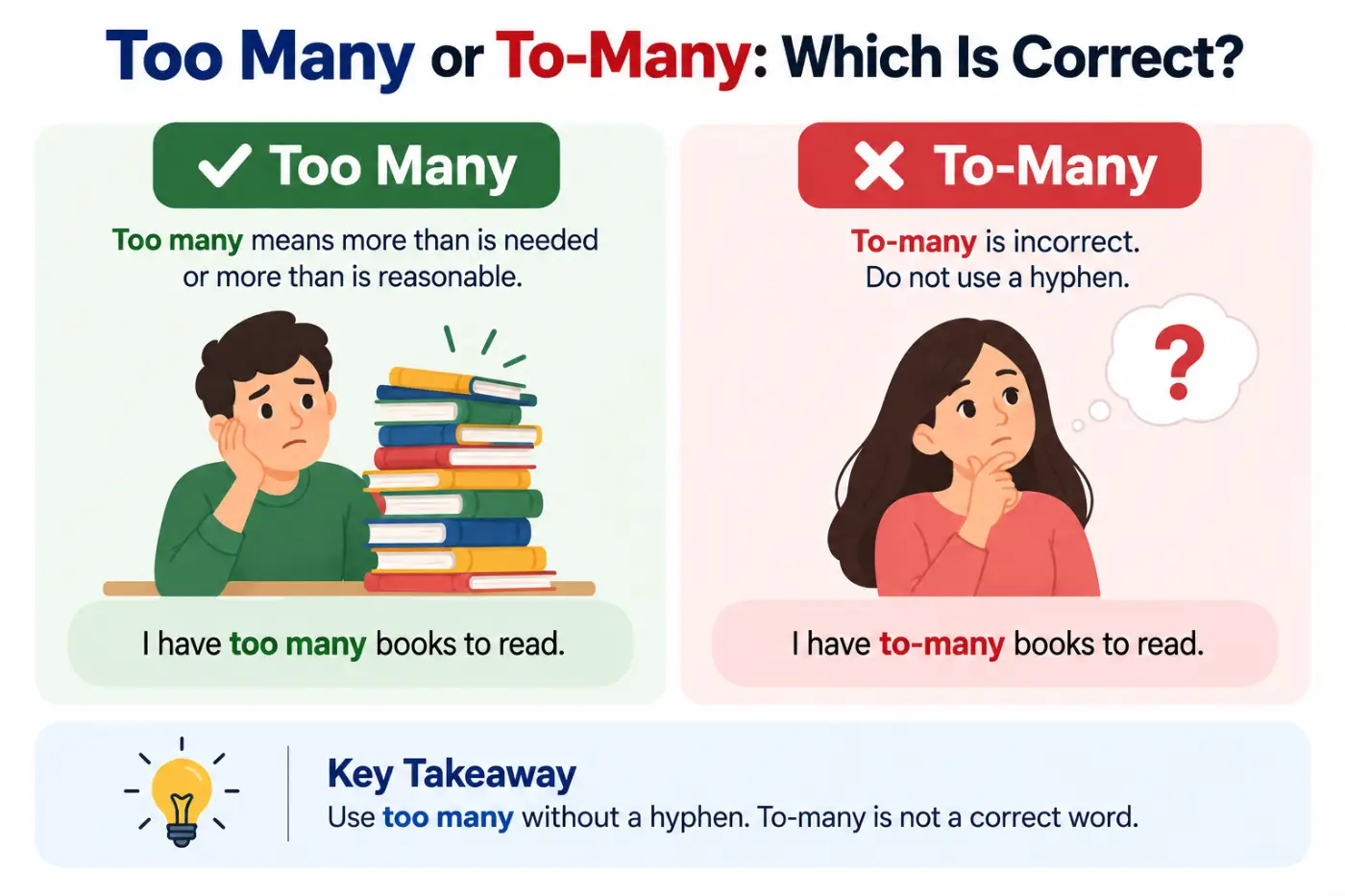
If you are unsure how to write “too many” or “to many,” the correct choice usually depends on one small but important difference. “Too many” is the standard phrase when you mean more people or things than needed, expected, or wanted. For example, you can say, “There are too many cars on this road.” The phrase “to many” is not a standard replacement for this meaning.
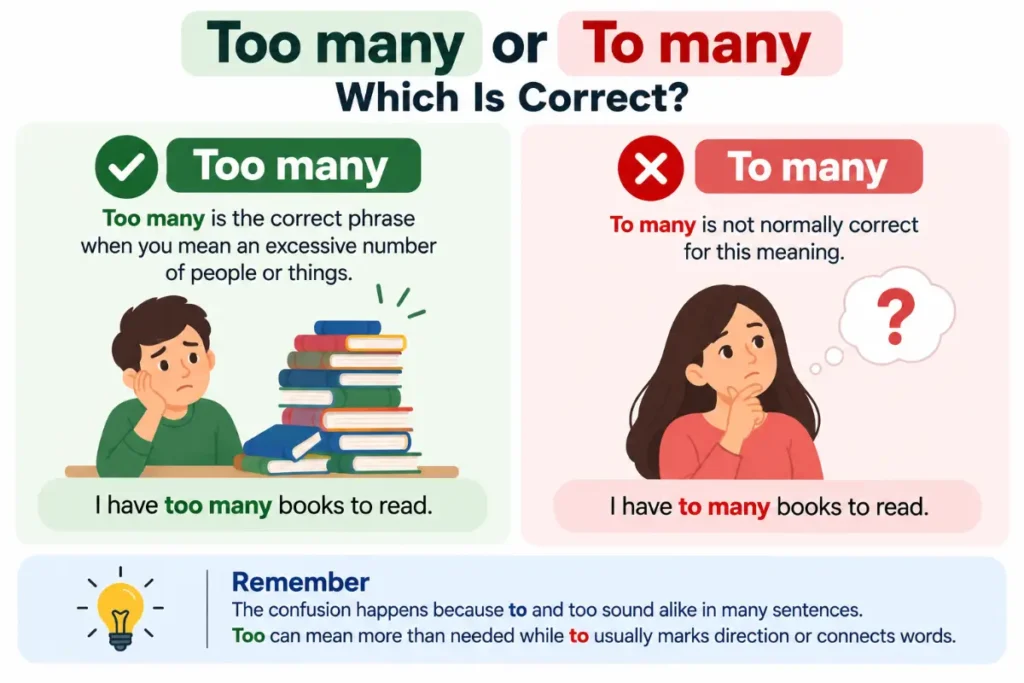
The confusion happens because “too” and “to” sound alike in most varieties of English. However, they have different meanings and grammatical jobs. “Too” can mean “more than enough” or “also,” while “to” commonly introduces an infinitive verb or shows direction, movement, or a relationship.
Knowing how these words work makes the choice much easier. You will learn the meaning of each form, the grammar behind the phrase, common mistakes, pronunciation, and examples from everyday speech and formal writing. You will also see how to use similar expressions such as “too much,” “too few,” and “a lot of” correctly.
Learn the difference in Into vs In To: Meaning, Difference and Correct Usage.
Quick Answer
Use “too many” when you mean an excessive number of countable people or things. “Too” means more than is needed or wanted, while “many” describes a large number. “To many” is not correct for this meaning, although the words “to” and “many” can appear next to each other in a sentence for separate grammatical reasons.
Comparison Table
| Feature | Too Many | To Many |
|---|---|---|
| Standard phrase for an excessive number | Yes | No |
| Main function | Describes an excessive quantity | “To” has a separate grammatical role |
| Part of speech | “Too” is an adverb; “many” is a determiner or pronoun | “To” is usually a preposition or infinitive marker; “many” is a determiner or pronoun |
| Meaning | More than enough, necessary, or wanted | No combined meaning as a standard quantity phrase |
| Common context | Too many people, mistakes, choices, or tasks | Separate grammatical constructions |
| Example | There are too many books on the desk. | I spoke to many students after class. |
| Formality | Standard in formal and informal English | The sequence can be correct when the words have separate functions |
| Common error | Confusing “too” with “to” | Using it instead of “too” to describe excess |
Meaning and Definition
What Does Too Many Mean?
“Too many” means more than the right, useful, expected, or acceptable number. It describes an excessive quantity of people, objects, events, or other things that can be counted individually.
For example, if a teacher says, “There are too many students in this room,” the teacher means the number of students is greater than the room can comfortably or safely hold. The phrase does not simply mean that many students are present. It suggests that the number has gone beyond a suitable limit.
The expression has two parts:
- “Too” is an adverb that means excessively or more than is desirable.
- “Many” is a determiner or pronoun used with countable plural nouns.
Together, they express an excessive number. You can use the phrase before a plural noun, as in “too many emails,” or without a noun when the noun is already clear, as in “I bought too many.”
Common examples include:
- Too many people.
- Too many questions.
- Too many mistakes.
- Too many expenses.
- Too many responsibilities.
- Too many choices.
The phrase often has a negative meaning because it suggests that something has become difficult, inconvenient, or undesirable. However, the context can change the feeling. Someone might say, “There are too many beautiful places to visit in one trip,” meaning they have more attractive options than they can fit into their schedule.
What Does To Many Mean?
“To many” is not a standard phrase meaning “an excessive number.” If you want to say that there are more people or things than necessary, writing “to many” is a spelling and word choice error.
However, the two words can appear next to each other correctly when they perform separate grammatical functions. For example:
- I gave the invitation to many guests.
- She spoke to many parents at the meeting.
- The guide was helpful to many visitors.
- This decision matters to many families.
In these sentences, “to” is a preposition. It connects the preceding word or phrase to “many guests,” “many parents,” “many visitors,” or “many families.” The word “many” describes the plural noun that follows it.
The sequence is correct because the words do not form the expression used to describe an excessive quantity. The surrounding sentence gives “to” its own meaning.
This distinction matters. It would be inaccurate to say that “to many” is always wrong. It is wrong when used as a substitute for “too many,” but it can be perfectly correct in a sentence such as “I sent the message to many people.”
What Does Too Mean?
“Too” has two common meanings in English.
1. Excessively or more than needed.
This is the meaning used in the expression discussed here.
Examples:
- The coffee is too hot.
- The suitcase is too heavy.
- We have too many bags.
- The music is too loud.
In these examples, “too” adds the idea of excess. The coffee has an uncomfortable temperature, the suitcase has more weight than is convenient, and the number of bags is greater than desired.
2. Also or in addition.
“Too” can also mean “also.” It often appears at the end of a sentence or clause.
Examples:
- I want to come too.
- She likes reading too.
- My brother is joining us too.
This meaning is different from the one in “too many,” but the spelling remains the same.
What Does To Mean?
“To” has several important uses. It commonly works as a preposition that expresses direction, destination, connection, or a relationship.
Examples:
- We drove to the airport.
- Give the folder to Maria.
- The package belongs to my neighbor.
- He walked to the front door.
It also works as an infinitive marker before the base form of a verb.
Examples:
- I want to learn.
- She needs to study.
- They decided to leave.
- We plan to travel.
These uses explain why “to” cannot replace “too” in the expression for an excessive number. “To” does not carry the meaning of “more than enough.”
Key Differences Explained
The main difference is meaning, but the words also have different grammatical roles. Understanding these points will help you make the right choice without relying only on memorization.
1. Spelling
“Too” contains two letter o’s, while “to” contains one. The extra letter is a useful visual reminder that the words are different.
- Too many assignments.
- To the office.
- Too much noise.
- To finish the work.
A quick spelling check can prevent a common typing mistake. If the sentence describes excess, choose the two o’s.
2. Meaning
“Too” means excessively in this expression. “To” does not.
Compare:
- There are too many people in the waiting room.
- I spoke to many people in the waiting room.
The first sentence says the number of people is higher than desired. The second says someone spoke with a large number of people. Neither sentence is automatically negative, but the meanings are different.
3. Grammar
“Too” modifies the quantity word “many.” The word “many” then describes a plural countable noun.
For example, in “too many questions,” the word “too” increases the force of “many” and gives the phrase an excessive meaning.
In “to many questions,” the word “to” would need to connect the phrase to something else in the sentence. It cannot simply act as a modifier that means “excessively.”
4. Part of Speech
In the expression “too many,” “too” is an adverb and “many” is a determiner. It can also function as a pronoun when the noun is understood from context.
In “to many people,” “to” is a preposition and “many” is a determiner. The grammatical roles are different, even though the words may appear side by side.
5. Pronunciation
In most American English accents, “too” and “to” are pronounced the same way: /tuː/ or, in connected speech, /tə/. This makes them homophones in common speech.
The listener usually understands the intended word from the sentence. In writing, however, the reader sees the spelling, so choosing the correct form matters.
6. Formality
“Too many” is standard in both casual and formal English. It is suitable for a text message, school assignment, business report, or academic discussion.
The sequence “to many” is also suitable in formal writing when “to” is a preposition, as in “The policy provides support to many households.” The issue is not formality. It is the meaning and grammatical function.
7. Context
Context tells you which word belongs in the sentence.
Use “too many” when you want to express an excessive number:
- We received too many applications.
- The recipe contains too many ingredients.
Use “to many” when “to” introduces a person or group:
- The organization sent invitations to many families.
- The announcement was important to many employees.
8. Standard and Incorrect Usage
The expression “too many” is standard for an excessive number. Using “to many” for that meaning is an error in standard written English.
However, the words can appear together legitimately when the sentence requires the preposition “to.” Always examine the complete sentence before deciding that the sequence is wrong.
Which Form Is Correct?
If you mean an excessive number of people or things, “too many” is correct. The word “too” adds the meaning of excess, while “many” refers to a large number of countable items.
For example:
- Correct: There are too many cars on this street.
- Incorrect for the intended meaning: There are to many cars on this street.
The reason is grammatical, not just a spelling preference. English uses “too” as an adverb to modify “many.” The word “to” cannot perform that job.
However, do not assume that every sentence containing the words “to many” has an error. Consider this example:
– Correct: The new program offers free classes to many children.
Here, “to” is a preposition that connects “offers free classes” with the people receiving them. The phrase is not describing an excessive number.
A useful way to check your sentence is to replace “too many” with “more than enough.” If the sentence keeps its intended meaning, use the two o’s.
Example: “We have too many orders” becomes “We have more orders than we can handle.” The meaning still works, so “too many” is the correct choice.
Sentence Examples
Here are ten natural examples that show how to use the standard expression in different situations.
- Everyday conversation: There are too many people waiting outside the restaurant.
- Text message: I have too many things to do tonight, so I might be late.
- Workplace communication: Our team received too many requests to complete them all today.
- School: The teacher said there were too many spelling errors in the assignment.
- Academic writing: Too many variables can make the results of an experiment difficult to interpret.
- Formal writing: The committee received too many applications to review in a single session.
- Social situations: We invited too many guests to fit comfortably around the dining table.
- Online communication: This website displays too many advertisements on one page.
- Shopping: I bought too many groceries and could not fit them all in the refrigerator.
- Family conversation: You have too many toys in your bedroom to keep everything organized.
Each sentence describes a number that exceeds a useful, expected, or comfortable amount. The phrase can refer to physical objects, people, tasks, choices, or abstract items that can be counted.
Examples Showing the Incorrect Choice
The following sentences show a common mistake. In each case, the writer intends to express excess, so the two o’s are needed.
| Incorrect Sentence | Correct Sentence |
|---|---|
| There are to many dishes in the sink. | There are too many dishes in the sink. |
| She made to many mistakes. | She made too many mistakes. |
| We have to many meetings this week. | We have too many meetings this week. |
| There were to many questions during the lesson. | There were too many questions during the lesson. |
| I added to many details to the report. | I added too many details to the report. |
Do not use these incorrect examples as models for your own writing. They are useful only because they show how a small spelling change can alter the grammatical meaning.
Common Mistakes and Misspellings
Writers often confuse these words because they sound alike. The best way to avoid the error is to understand the role each word plays in a sentence.
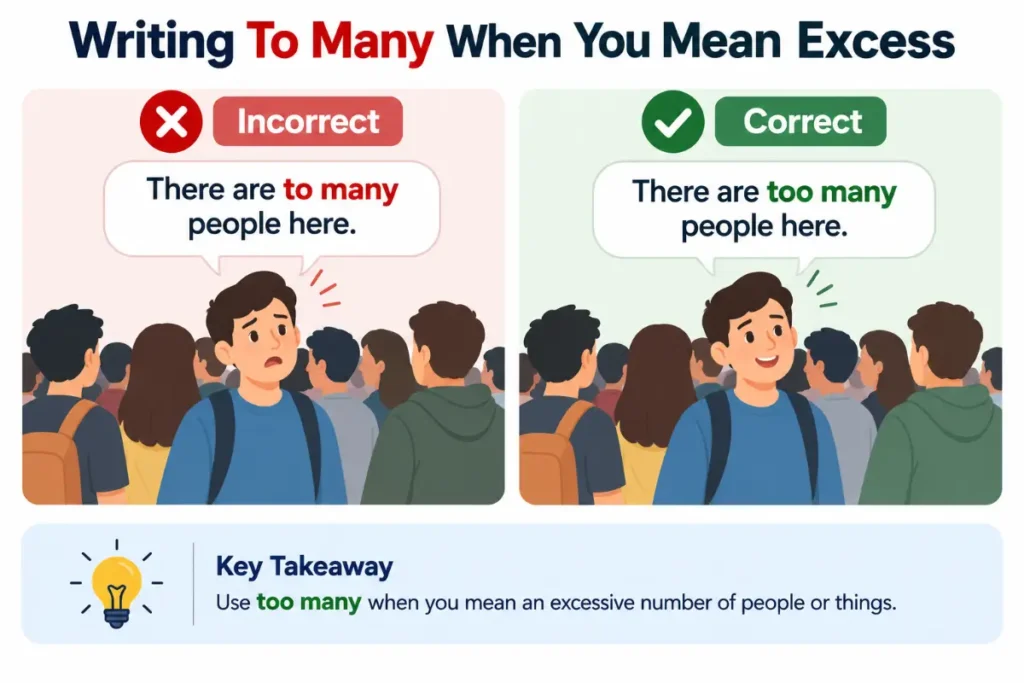
1. Writing To Many When You Mean Excess
Incorrect: There are to many people in the room.
Correct: There are too many people in the room.
The writer wants to say that the room contains more people than it can comfortably hold. The word “too” expresses that excess. The single o form does not have that meaning.
2. Writing Too Much Instead of Too Many
Incorrect: There are too much books on the shelf.
Correct: There are too many books on the shelf.
“Books” is a countable plural noun, so it takes “many.” Use “much” with uncountable nouns such as water, time, money, and noise.
Compare “too many bottles” with “too much water.” The choice depends on the noun, not simply on the amount.
3. Using Too Many With a Singular Noun
Incorrect: There are too many furniture in this room.
Correct: There is too much furniture in this room.
“Furniture” is generally an uncountable noun in English. You can count individual pieces of furniture, but you do not normally use “many” directly with the word itself.
A natural alternative is “There are too many pieces of furniture in this room.”
4. Confusing Too With Also
Incorrect: I want to many join the group.
Correct: I want to join the group too.
In the incorrect sentence, the writer may be mixing the phrase “too many” with the meaning of “also.” Remember that “too” can mean “also,” but its position and grammar depend on the sentence.
For example, “I want to join too” means that you also want to join. “I have too many invitations” means you have more invitations than you need.
5. Adding an Unnecessary Word
Incorrect: There are too many of students in the class.
Correct: There are too many students in the class.
You do not need “of” before a noun used directly after “too many.” However, “of” is correct before a determiner or pronoun, as in “too many of the students” or “too many of them.”
This is a small grammar point, but it can make a sentence sound much more natural.
Pronunciation Guide
How Do You Pronounce Too?
In American English, “too” is usually pronounced /tuː/. It has one syllable and uses the long oo sound heard in “blue,” “food,” and “school.”
The word begins with a /t/ sound and ends with the vowel sound /uː/. It is usually easy to pronounce, but the spelling can be difficult because the sound is shared with another common word.
How Do You Pronounce To?
“To” is also commonly pronounced /tuː/ when spoken carefully or given emphasis. In natural conversation, it often becomes /tə/, with a shorter, unstressed vowel sound.
For example, speakers may pronounce “I need to go” with a reduced form of “to.” This is a normal feature of connected English speech.
Why Do People Confuse the Two Words?
The main reason is that the words are homophones in many common pronunciations. Homophones are words that sound alike but have different meanings or spellings.
Because speech does not always reveal the spelling, a person may choose the wrong word while typing. Spellcheck tools may not catch the error because both “to” and “too” are valid English words.
Syllables and Stress
Both words contain one syllable. In the phrase “too many,” the word “too” can receive extra emphasis when a speaker wants to highlight the excessive amount.
For example, “There are TOO many people here” makes the complaint stronger. In ordinary speech, the stress depends on the speaker’s intention and the rhythm of the sentence.
You may also want to read Serpent vs Snake What Is the Difference and When to Use Each.
Etymology and Word Origin
The Origin of Too
The modern word “too” developed from earlier English forms associated with the idea of addition or excess. Its meanings expanded over time. Today, it commonly means “also” or “more than is needed.”
These two meanings are still easy to recognize in modern sentences:
- I would like to come too. Here, it means “also.”
- The room is too small. Here, it means “more than is acceptable” in relation to the required space.
The same spelling carries both meanings, but the sentence structure makes the intended sense clear.
The Origin of To
“To” comes from Old English “tō,” a word used to express direction, movement, destination, and relationships. It developed into one of the most frequently used words in modern English.
Today, it has two major grammatical roles. It works as a preposition in phrases such as “go to school” and as an infinitive marker in expressions such as “to read” or “to write.”
Why the Origins Help
The histories of the words show that they developed different roles in English. Their similar pronunciation does not mean they share the same meaning or grammatical function.
You do not need to memorize their historical forms to spell them correctly. It is more useful to remember that “too” expresses excess or addition, while “to” usually connects words or introduces a verb.
Regional Usage
There is no meaningful spelling difference between American, British, Australian, and Canadian English for these words. The same distinction applies across these varieties.
American English
In American English, “too many” is the standard phrase for an excessive number. It is common in speech, emails, schoolwork, newspapers, and formal writing.
Examples:
- There are too many cars on the highway.
- The company received too many complaints.
The sequence “to many” is also correct when “to” is a preposition, as in “The service is available to many customers.”
British English
British English follows the same spelling and grammar rules. Writers use “too many” to describe excess and “to many” when the preposition has a separate function.
Examples:
- Too many people attended the event.
- The announcement was helpful to many families.
The difference is not regional. It comes from the meaning of the sentence.
Australian English
Australian English uses both forms in the same way. “Too many” describes an excessive number, while “to many” can appear when “to” connects the sentence to a group of people or things.
For example, “There were too many visitors at the beach” and “The new service is available to many residents” are both standard.
Canadian English
Canadian English follows the same rule. The two forms are not regional spelling alternatives, and neither is exclusive to a particular English speaking country.
If you are writing for an international audience, use “too many” for excess and reserve “to many” for sentences where “to” has its own grammatical purpose.
Grammar Rules and Part of Speech
Understanding the grammar behind the phrase makes it easier to use correctly in longer sentences.
The Role of Too
In this expression, “too” is an adverb. It modifies “many” and adds the idea that the number is excessive.
Consider this sentence:
“The company hired too many workers for the available positions.”
The word “too” changes the meaning of “many.” Without it, “many workers” simply describes a large number. With it, the sentence suggests that the number is greater than the company needs.
“Too” can also modify adjectives and other adverbs:
- The water is too cold.
- The instructions are too complicated.
- She speaks too quickly.
- The bag is too heavy.
In each example, it adds a sense of excess.
The Role of Many
“Many” is a determiner when it appears before a plural countable noun. It can also function as a pronoun when the noun is already understood.
Examples:
- Many students attended the lecture.
- Too many students attended the lecture.
- Many were unable to find a seat.
- Too many were waiting outside.
The word is associated with nouns that can be counted individually, such as students, chairs, books, and questions.
Using Too Many With Countable Nouns
Use this expression with plural countable nouns. These are nouns that have individual units you can count.
Examples:
- Too many apples.
- Too many cars.
- Too many emails.
- Too many people.
- Too many problems.
The noun normally appears in its plural form. Do not write “too many apple” when referring to more than one apple.
Using Too Much With Uncountable Nouns
Use “too much” with uncountable nouns. These refer to substances, concepts, or quantities that are not normally counted as separate units.
Examples:
- Too much water.
- Too much sugar.
- Too much information.
- Too much traffic.
- Too much stress.
Some nouns can be countable or uncountable depending on their meaning. For example, “too much coffee” refers to the drink as a substance, while “too many coffees” can refer to individual cups or orders.
Using Too Few and Too Little
The expression “too many” describes an excessive number. Its opposite in many contexts is “too few,” which describes an insufficient number.
Examples:
- We have too many chairs for this room.
- We have too few chairs for the guests.
“Too little” is used with uncountable nouns:
- There is too little water in the tank.
- We have too little time to finish the work.
These patterns help you describe amounts accurately.
Using Too Many in Questions
You can use the phrase in direct questions and indirect questions.
Direct questions:
- Are there too many people in the room?
- Did we order too many pizzas?
- Have I given you too many details?
Indirect questions:
- I wonder if we ordered too many supplies.
- She asked if there were too many applicants.
- We need to decide if the schedule includes too many meetings.
A question mark is needed for a direct question. An indirect question normally ends with a period when it appears inside a statement.
Using Too Many at the Beginning of a Sentence
The phrase can start a sentence naturally. It does not need a special punctuation rule.
Examples:
- Too many people arrived after the doors had closed.
- Too many questions remained unanswered.
- Too many changes can make a project difficult to manage.
The phrase works at the beginning because it introduces the subject or quantity being discussed.
Using Too Many Without a Noun
You can leave out the noun when readers already know what you are talking about.
For example:
- I bought five notebooks, but I only needed two. I bought too many.
- We invited twenty people, but the room can hold only twelve. We invited too many.
The noun is understood from the earlier sentence, so repeating it is unnecessary.
Using Too Many of
Use “too many of” before a determiner or pronoun that identifies a particular group.
Correct examples:
- Too many of the students arrived late.
- Too many of these boxes are damaged.
- Too many of them were missing.
- We received too many of the same complaints.
Compare “too many students” with “too many of the students.” The first refers to an unspecified group. The second refers to a particular group already known to the reader.
Real Life Usage Examples
The expression appears in many types of communication. It can describe a problem, an unwanted amount, or simply more options than someone can manage.
Daily Conversation
People often use the phrase when talking about schedules, shopping, family life, or everyday problems.
- “I have too many errands to run before dinner.”
- “There are too many cars on this road during rush hour.”
In casual speech, the expression is direct and natural. It does not sound overly formal or technical.
Email and Workplace Communication
In professional messages, it can describe workloads, requests, meetings, or business concerns.
- “Our department has received too many support requests to handle them all this morning.”
- “We should avoid scheduling too many meetings during the product launch.”
The phrase works well in workplace writing because it communicates a clear quantity problem. If you need a more neutral tone, you can use expressions such as “a high number of” or “more requests than the team can currently handle.”
Academic Writing
In academic work, the expression can describe a large number of variables, observations, sources, or participants.
- “Too many variables may affect the reliability of the experiment.”
- “The researcher excluded responses that contained too many missing details.”
Academic writing does not require complicated vocabulary for simple ideas. The phrase is appropriate when it accurately describes an excessive number.
News and Journalism
Journalists may use the expression when reporting on public concerns, traffic, costs, or crowded places.
- “Residents say too many trucks are using the residential road.”
- “The review found too many delays in the public transportation system.”
The phrase can communicate a complaint or finding. However, a journalist should make clear who considers the number excessive if the statement represents an opinion rather than an established fact.
Literature and Storytelling
Writers can use the phrase to show frustration, pressure, confusion, or an overwhelming situation.
- “There were too many unanswered questions for Elena to ignore.”
- “He had too many memories of that place to return without feeling uneasy.”
In storytelling, the phrase can describe more than a physical quantity. It can also express emotional pressure or a situation that feels difficult to manage.
Related and Confused Terms
These expressions are useful because they describe different kinds of quantity. Choosing the right one helps you avoid errors with countable and uncountable nouns.
1. Too Much
“Too much” describes an excessive amount of something that is usually uncountable.
Examples:
- There is too much salt in the soup.
- I have too much work to finish today.
Use “too much” with nouns such as water, time, information, and sugar. Use “too many” with countable plural nouns such as bottles, hours, reports, and questions.
2. So Many
“So many” emphasizes a large number. It does not always suggest that the amount is excessive or unwanted.
Example: “There were so many people at the concert.”
This sentence expresses a large number but does not necessarily say that the crowd was a problem. By contrast, “There were too many people at the concert” suggests that the crowd was larger than desirable.
3. Very Many
“Very many” can emphasize a large number, but it is less natural in many everyday positive statements than “so many” or “a great many.”
Example: “Not very many students attended the optional session.”
It is more common in negative sentences and questions than in ordinary positive statements. Do not use it as a direct replacement for every instance of “too many.”
4. Too Few
“Too few” means that the number is smaller than necessary or expected. It is often the opposite of an excessive number.
Examples:
- There are too few chairs for the guests.
- We have too few employees to complete the project.
Use it with plural countable nouns. It describes a shortage rather than an excess.
5. Too Little
“Too little” describes an insufficient amount of something that is usually uncountable.
Examples:
- There is too little milk for the recipe.
- The team has too little time to finish the work.
The expression is the opposite of “too much” in many contexts. It is not normally used before a plural countable noun.
6. A Lot Of
“A lot of” means a large quantity or number. It works with both countable and uncountable nouns.
Examples:
- A lot of people attended the event.
- A lot of water spilled onto the floor.
Unlike “too many,” it does not automatically mean that the amount is excessive. It simply describes a large amount or number.
7. Many Too
“Many too” is not the standard word order for describing an excessive number. The usual expression is “too many.”
Incorrect: “There are many too problems to solve.”
Correct: “There are too many problems to solve.”
The order matters because “too” modifies “many.” Place it before the quantity word.
8. To Much
“To much” is a common spelling error when someone intends to describe an excessive amount.
Incorrect: “You added to much sugar.”
Correct: “You added too much sugar.”
The correct form uses “too” because it expresses excess. The word “to” cannot perform that function.
Expert Editor Insight
An experienced editor checks the meaning of the sentence before correcting the spelling. The two forms sound alike, so even careful writers can type the wrong one. A grammar checker may miss the error because both words are valid on their own. The best editing habit is to replace “too” with “more than enough” in your mind. If that keeps the intended meaning, the two o’s are needed. Also check the noun after “many”: it should normally be plural and countable. This simple review catches both spelling and quantity errors.
Key Takeaways
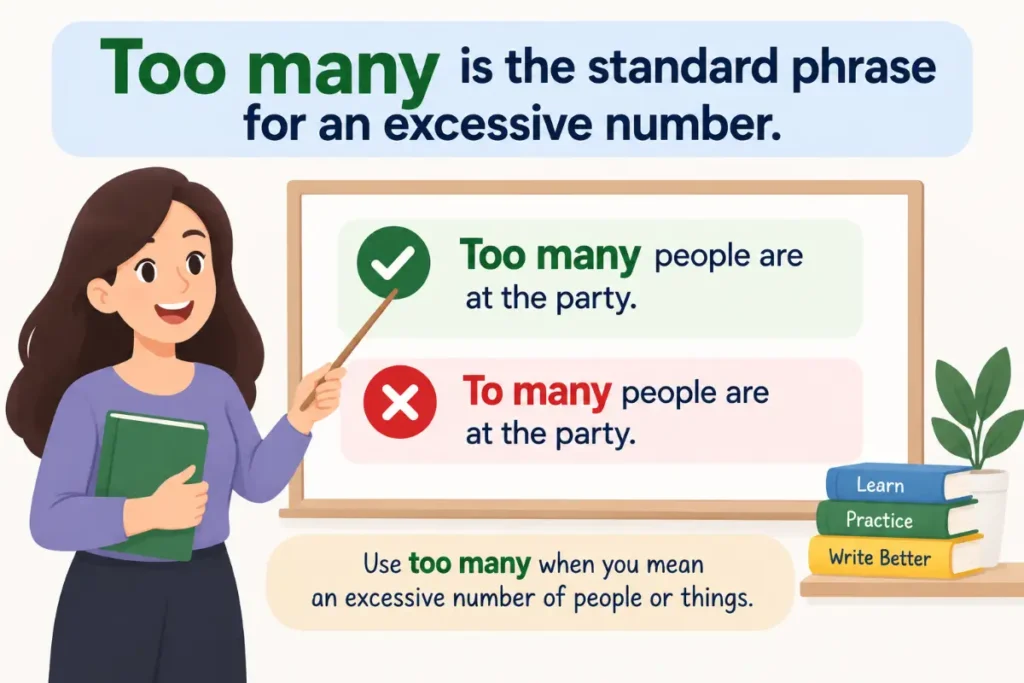
- Too many is the standard phrase for an excessive number.
- To and too have different grammatical functions even though they often sound alike.
- Use too many with plural countable nouns.
- Use too much with uncountable nouns.
- Many simply describes a large number while too many adds the idea of excess.
- To many can be correct in sentences where to functions as a preposition.
- The phrase too many works in casual conversation and formal writing.
- Pronunciation usually won’t help you distinguish the two words.
- Context and meaning provide the best way to choose the correct spelling.
- A quick editing test is to ask if the word means more than needed. If it does use too.
Need another quick comparison? Read Wholey Vs Wholly Which Spelling Is Correct in 2026?.
Conclusion
The difference between “Too Many or To Many” is simple once you understand the role of each word. Use “too many” to describe an excessive number of countable people or things. Use “to many” only when “to” has a separate grammatical purpose, such as connecting an action to a group. Both words sound alike, but their meanings are different.
For an easy memory tip, replace “too” with “more than enough.” If the sentence still makes sense, use the two o’s. This small check will help you avoid a common spelling mistake in everyday and professional writing.
FAQs
Is Too Many or To Many Correct?
“Too many” is correct when you mean more people or things than needed, expected, or wanted. The word “too” expresses excess, while “many” describes a number of countable items. “To many” is not correct for this meaning, but the two words can appear together when “to” is a preposition, as in “I spoke to many people.”
Is To Many Ever Grammatically Correct?
Yes. The words can appear together when they perform separate grammatical jobs. For example, “The service is available to many families” is correct because “to” is a preposition connecting the service with its recipients. The sequence is incorrect only when someone uses it to mean an excessive number.
What Does Too Many Mean?
“Too many” means more than a suitable, necessary, or acceptable number. It usually appears before plural countable nouns, such as people, books, questions, and mistakes. For example, “There are too many cars outside” means the number of cars is greater than desired or convenient. The phrase can express a complaint or simply an amount that cannot be managed.
Why Do People Confuse Too and To?
People confuse these words because they sound alike in most common English accents. This makes it easy to select the wrong spelling while typing. The words also appear frequently in everyday writing, so mistakes can happen quickly. Remember that “too” means excessively or also, while “to” commonly expresses direction or introduces an infinitive verb.
Can Too Many Start a Sentence?
Yes. The phrase can naturally begin a sentence when it introduces the excessive number being discussed. For example, “Too many people arrived after the doors had closed.” It can also begin a longer sentence, such as “Too many changes during the final stage can delay the project.” No special punctuation is required.
Should I Use Too Many or Too Much?
Use “too many” with plural countable nouns, such as chairs, books, emails, and people. Use “too much” with uncountable nouns, such as water, money, information, and time. For example, write “too many questions” but “too much information.” The type of noun determines which expression is correct.
What Is Another Way to Say Too Many?
You can use “an excessive number of,” “more than enough,” “a large number of,” or “more than necessary,” depending on the sentence. These expressions do not always have exactly the same tone. “An excessive number of” is more formal, while “too many” is shorter and more natural in everyday writing.
Is Too Many Appropriate in Formal Writing?
Yes. “Too many” is standard English and works in formal writing when it accurately describes an excessive number. You can use it in reports, academic papers, business emails, and official documents. If you need a more measured tone, consider “a higher number than expected” or “an excessive number of.” The best option depends on the level of formality and the meaning.