
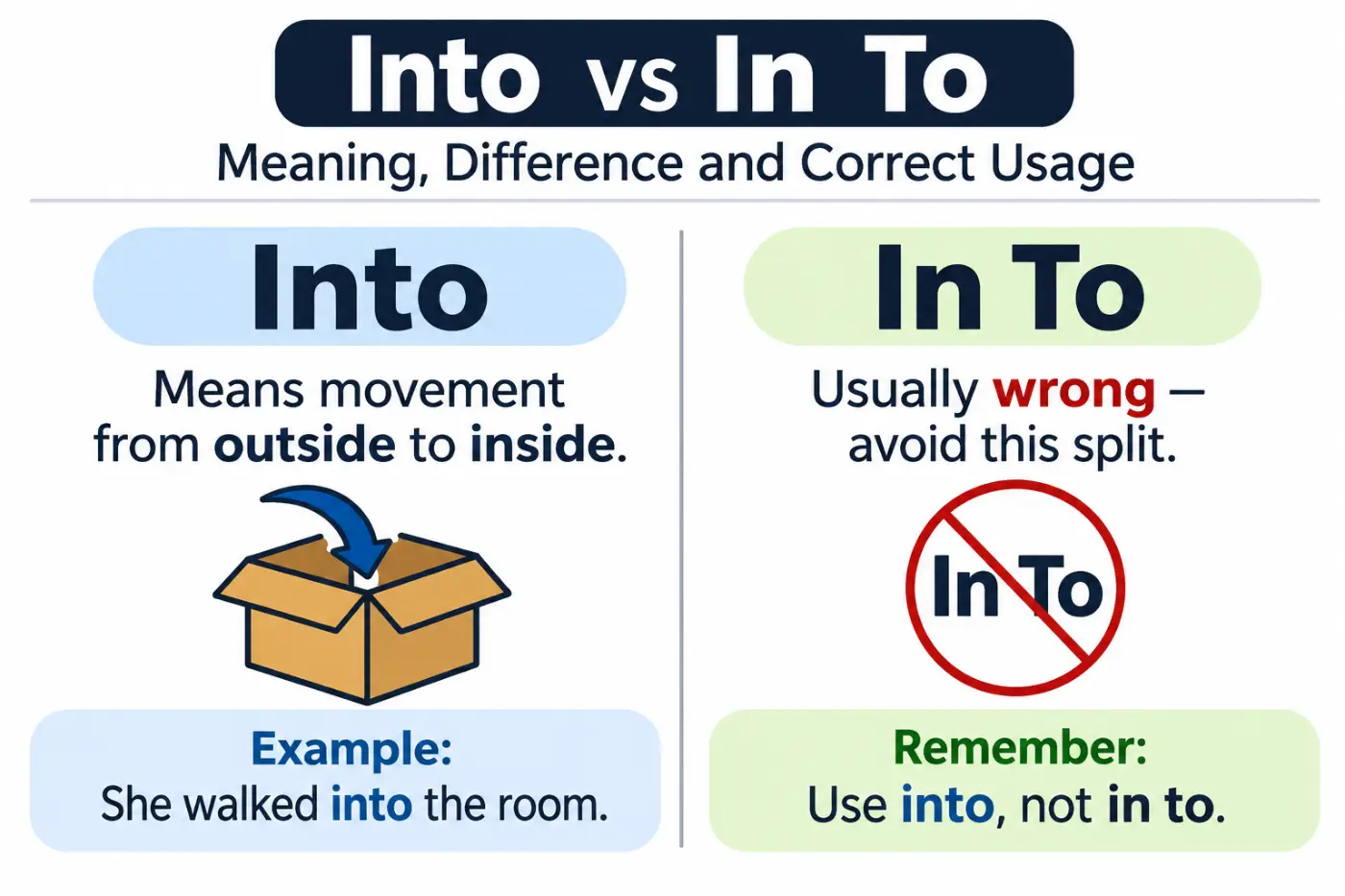
Choosing between into vs in to can be confusing because both expressions contain the same words, but their meanings and grammatical functions are different. The good news is that both forms are correct English. The right choice depends on how the words work together in your sentence. Into is a preposition that often describes movement toward the inside of something, a change in condition, or involvement in an activity.
In to is two separate words that appear next to each other when in belongs to one part of the sentence and to belongs to another. For example, you might walk into a room, but you might log in to your account. Understanding this small difference can help you avoid common writing mistakes.
This guide explains the meaning, grammar, pronunciation, and correct usage of both forms. You will also find practical examples, common mistakes, and simple editing tips that make choosing the right expression much easier.
You may also want to read Would or Will: Difference, Meaning, and Correct Usage.
Quick Definition
Into is one word and usually functions as a preposition that expresses movement toward the inside of something, transformation, or involvement. In to consists of two separate words, with in usually connected to a preceding verb or phrase and to serving its own grammatical purpose. Both are correct, but they are not interchangeable. The sentence meaning determines the correct form.
Quick Answer
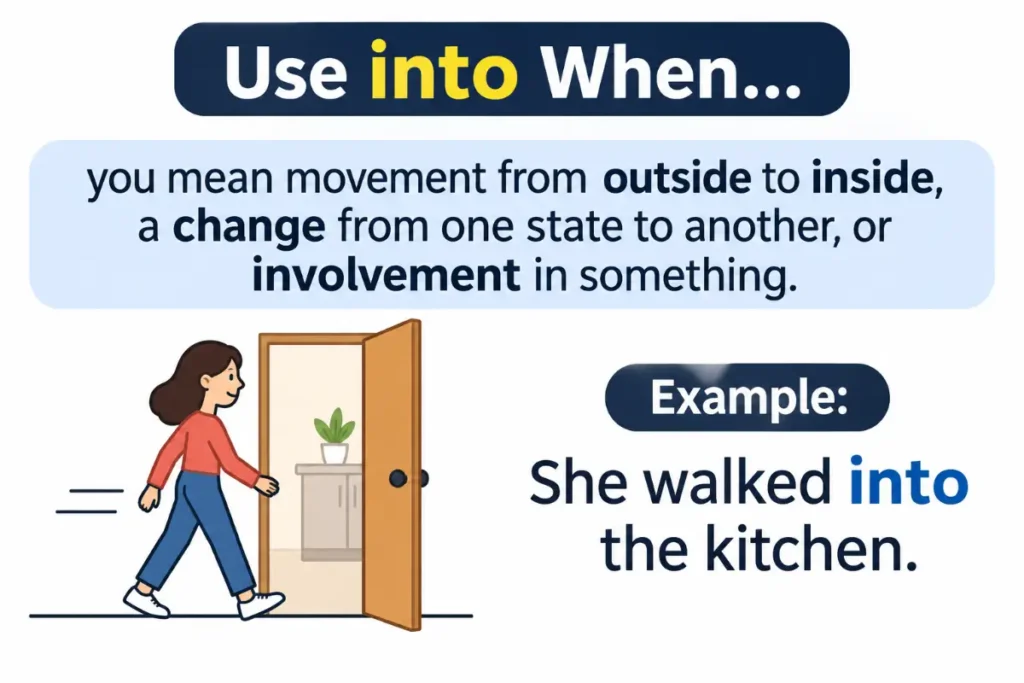
Use into when you mean movement from outside to inside, a change from one state to another, or involvement in something. For example, “She walked into the kitchen.”
Use in to when in belongs to the preceding verb or expression and to begins the next part of the sentence. For example, “She came in to talk.”
Neither spelling is automatically incorrect. You need to look at the relationship between the words and the meaning of the complete sentence.
Comparison Table: Into and In To
| Feature | Into | In To |
|---|---|---|
| Spelling | One word | Two separate words |
| Meaning | Movement, direction, transformation, or involvement | Two independent grammatical elements appearing together |
| Part of speech | Preposition | Usually a particle or adverb followed by a preposition or infinitive marker |
| Grammar | Connects a noun or pronoun to another part of the sentence | Each word performs its own grammatical function |
| Pronunciation | IN-too | IN TOO, usually the same sound |
| Formality | Standard English | Standard English |
| Common contexts | Movement, change, interest, and physical direction | Phrasal verbs, instructions, and infinitive constructions |
| Example | He jumped into the pool. | She came in to help. |
Meaning and Definition
Understanding the individual meanings of these expressions is the first step toward using them correctly. Although they look similar, their grammatical structure is different.
What Does Into Mean?
Into is a preposition that describes movement, direction, position, transformation, or involvement. It often shows that something moves from an outside position toward the inside of another object or place.
For example:
- The child ran into the garden.
- Pour the milk into the glass.
- The caterpillar turned into a butterfly.
In the first two examples, the word describes physical movement or direction. In the third example, it describes a change from one form to another.
The expression can also describe interest, participation, or involvement.
For example:
- My brother is really into photography.
- She got into trouble at school.
- They entered into an agreement.
In these sentences, the word does not describe physical movement into a container. Instead, it communicates a relationship between a person or subject and an activity, situation, or condition.
The word can also appear in expressions involving investigation or detailed examination.
For example:
- The journalist looked into the complaint.
- We need to look into this problem.
Here, the expression suggests examining something carefully to discover more information.
What Does In To Mean?
In to consists of two separate words. They happen to appear together, but each word has its own grammatical role.
The word in may function as an adverb or particle, often completing a phrasal verb. The word to may function as a preposition or an infinitive marker.
Consider this sentence:
“She came in to speak with the manager.”
Here, in belongs to the verb phrase “came in.” It describes entering a place. The word to introduces the purpose of coming in, which is to speak with the manager.
Another example is:
“He handed his assignment in to the teacher.”
In this sentence, in belongs to the phrasal verb “hand in,” meaning to submit something. The word to introduces the person receiving the assignment.
Notice that neither example needs the two words combined into a single preposition.
The same structure appears in many everyday expressions:
- Come in to see the doctor.
- Drop in to say hello.
- Turn in to the office.
- Log in to your account.
- Check in to the hotel.
Some of these expressions have alternative forms in everyday usage, but keeping the grammatical roles separate helps explain why the two word sequence appears.
Is In To a Misspelling?
No. In to is a legitimate and grammatically correct combination in English. It is not a misspelling simply because the words appear next to each other.
The confusion happens because English speakers often hear the same pronunciation for both forms. Writers may also assume that two words with related meanings should always be joined together.
However, English grammar does not work that way. A preposition can be written as one word, while two separate grammatical elements can appear together without forming a compound word.
For this reason, you should never automatically replace every instance of in to with into. Doing so can change the sentence meaning or make the grammar incorrect.
Key Differences Explained
The most useful way to understand these expressions is to examine their grammatical functions rather than focusing only on spelling.
1. Spelling Difference
The first difference is simple.
Into is one word. It is a single preposition with its own established meaning.
In to contains two separate words. The space matters because each word performs a different grammatical job.
Compare:
- She walked into the building.
- She came in to collect her package.
The first sentence describes movement toward the inside of a building. The second describes someone entering a place for a particular purpose.
2. Difference in Meaning
The one word form often communicates movement, direction, transformation, or involvement.
The two word form usually preserves the meaning of the preceding verb phrase while allowing to to introduce another grammatical element.
For example:
- He looked into the box.
- He looked in to see the children.
In the first sentence, he examined the inside of the box. In the second, he looked inside for the purpose of seeing the children.
The surrounding words determine the intended meaning.
3. Grammatical Difference
Into functions as a preposition. It connects a noun or pronoun to another part of the sentence.
For example:
“The dog jumped into the car.”
The word connects the action of jumping with the destination, the car.
In to does not function as a single grammatical unit. Instead, in and to have separate roles.
For example:
“Please come in to discuss the report.”
Here, in completes the expression “come in,” while to introduces the purpose of coming.
4. Difference in Part of Speech
Into is a preposition.
In to is a combination that may contain an adverb or particle followed by a preposition or infinitive marker.
The exact role of to depends on what follows it.
For example:
- She went into the classroom.
- She came in to study.
In the second sentence, to introduces the infinitive verb “study.”
5. Difference in Context
Use the one word form when describing:
- Entering a room, building, or container.
- Moving toward a particular place.
- Changing from one condition into another.
- Developing an interest in an activity.
- Becoming involved in a situation.
Use the two word form when the preceding verb requires in and the following construction independently requires to.
For example, “log in” is a familiar verb phrase. If you add a purpose or destination, the next word may be to.
6. Difference in Pronunciation
Both forms are generally pronounced the same way in ordinary American English.
The pronunciation is usually /ˈɪn.tuː/, with stress on the first syllable.
This similarity explains why listening alone is not a reliable way to choose the spelling. You must examine the sentence structure.
7. Difference in Formality
Both forms are acceptable in formal and informal English when used correctly.
You can use into in academic writing, business communication, journalism, and everyday conversation.
You can also use in to in professional documents when the grammar requires two separate words.
Neither form is inherently more formal than the other.
Which Form Is Correct?
Both into and in to are correct English expressions. The correct choice depends on the grammatical structure and intended meaning of your sentence.
Use into when it acts as a preposition expressing direction, movement, transformation, or involvement.
Examples:
- The students walked into the library.
- The ice melted into water.
- She developed an interest in painting and got into photography.
Use in to when in completes an expression and to serves a separate grammatical purpose.
Examples:
- He came in to ask a question.
- Please log in to your account.
- The employee handed the documents in to the supervisor.
A useful test is to examine the words around the expression. If the sentence describes movement toward the inside of something, transformation, or involvement, the one word form is often appropriate.
If the verb already forms an expression with in, check if the following to belongs to another part of the sentence.
The Verb Replacement Test
One practical way to identify the correct form is to replace the expression with a similar phrase.
Consider:
“She walked into the office.”
You can replace the phrase with “entered the office.”
The sentence still makes sense:
“She entered the office.”
This indicates that into expresses movement toward the inside.
Now consider:
“He came in to talk.”
You can separate the sentence into two ideas:
“He came in. He wanted to talk.”
The first part describes entering. The second explains the purpose.
This is a strong indication that the two words should remain separate.
However, treat this as a helpful editing method rather than an absolute rule. Some expressions have more than one accepted construction, and their meaning depends on context.
Sentence Examples
The following examples show how these forms work in realistic situations. Notice that both spellings are correct, but their grammatical functions differ.
10 Examples Using Into and In To
- Everyday conversation: My little brother ran into the living room when he heard the music.
- Text messages: I just logged in to check my messages, but I could not find your reply.
- Workplace communication: Please look into the customer complaint before the end of the day.
- School: The students walked into the classroom quietly before the lesson started.
- Academic writing: The research examines how social conditions develop into broader economic challenges.
- Formal writing: The two organizations entered into a formal agreement after several months of discussion.
- Social situations: She came in to say goodbye before leaving for the airport.
- Online communication: You need to sign in to your account before accessing the course materials.
- Storytelling: As the sun disappeared, the traveler stepped into the dark forest.
- Business communication: The assistant handed the completed documents in to the department manager.
Five Examples Showing the Wrong Choice
The following examples demonstrate how choosing the wrong form can affect meaning or grammar.
- Incorrect: The cat jumped in to the box.Correct: The cat jumped into the box.Reason: The sentence describes physical movement from outside the box to the inside.
- Incorrect: She walked in to the swimming pool.Correct: She walked into the swimming pool.Reason: The one word form communicates movement into the pool.
- Incorrect: Please log into check your email.Correct: Please log in to check your email.Reason: The verb phrase is “log in,” while to introduces the purpose of logging in.
- Incorrect: He came into to help us.Correct: He came in to help us.Reason: In belongs to “came in,” and to introduces the purpose of his arrival.
- Incorrect: The company entered in to a new partnership.Correct: The company entered into a new partnership.Reason: Enter into is the established expression for beginning an agreement or relationship.
Common Mistakes and Misspellings
Many mistakes happen because writers focus on the sound of the expression rather than its grammatical role. Here are five common problems and how to correct them.
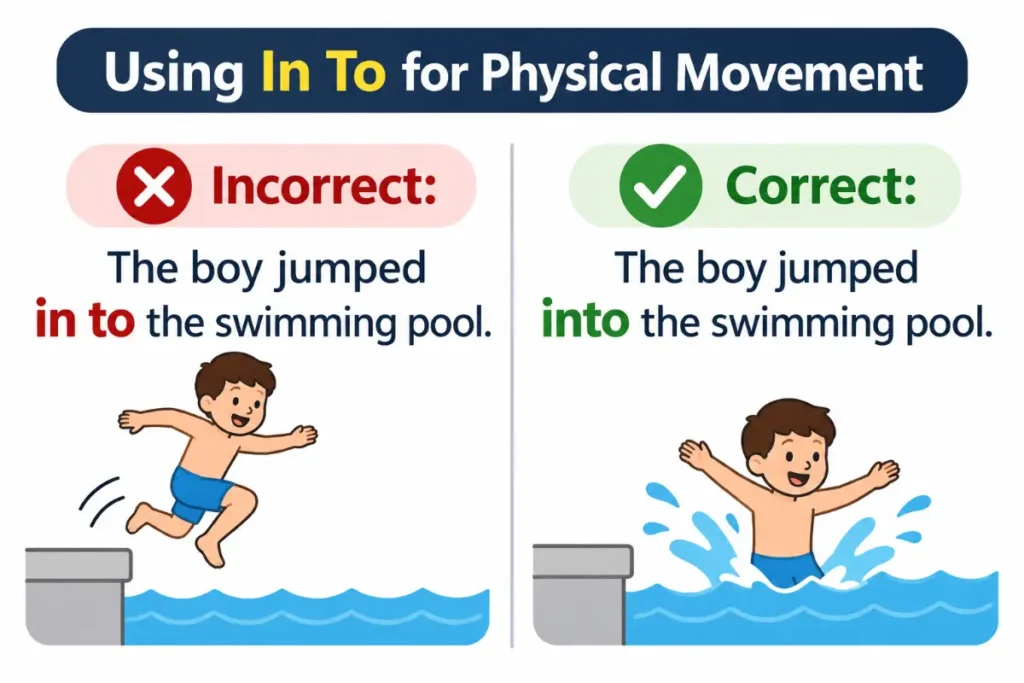
1. Using In To for Physical Movement
Incorrect: The boy jumped in to the swimming pool.
Correct: The boy jumped into the swimming pool.
The sentence describes movement toward the inside of the pool. The preposition should be written as one word.
2. Joining Words That Have Separate Functions
Incorrect: She came into ask for help.
Correct: She came in to ask for help.
The expression “came in” describes entering a place. The word to introduces the action she wants to perform.
Combining the words changes the grammatical structure.
3. Confusing Log In To and Log Into
Incorrect: Please log in into your account.
Correct: Please log in to your account.
The verb phrase “log in” already expresses the action of accessing an account. Adding another into creates an unnecessary and awkward construction.
In ordinary usage, “log into your account” is also widely accepted. The important point is to avoid doubling the preposition.
4. Using Into Before an Infinitive Verb
Incorrect: He came into speak with the teacher.
Correct: He came in to speak with the teacher.
The word to introduces the infinitive verb “speak.” It is not part of the preposition into.
A quick way to recognize this structure is to check if the next word is a base verb such as speak, ask, help, or explain.
5. Assuming Every Pair of Words Should Be Combined
Incorrect: She turned in to a beautiful butterfly.
Correct: She turned into a beautiful butterfly.
The intended meaning is transformation. The expression into communicates that one thing changes into another.
However, in a different sentence, the two words can be correct:
“She turned in to speak with the director.”
Here, in belongs to the verb phrase “turned in,” and to introduces the purpose.
A related grammar guide is onsite vs on-site: Correct Usage Explained.
Pronunciation Guide
Both expressions usually sound alike in American English. Their pronunciation does not provide a reliable clue to their spelling.
IPA Pronunciation
| Expression | IPA | Easy Pronunciation |
|---|---|---|
| Into | /ˈɪn.tuː/ | IN too |
| In to | /ˈɪn.tuː/ | IN too |
Syllable Breakdown
The pronunciation generally contains two syllables:
- In: The first syllable sounds like the word in.
- Too: The second syllable sounds like the number two or the word too.
The main stress usually falls on the first syllable.
Common Pronunciation Mistakes
Some speakers may place too much emphasis on the second syllable or pronounce the two words with an unnatural pause.
In normal speech, the two forms usually flow together. There is generally no clear pause that tells a listener which spelling the writer should use.
For example, the following sentences can sound almost identical:
- She walked into the room.
- She came in to talk.
The spelling difference becomes clear through grammar and meaning, not through pronunciation alone.
Etymology and Word Origin
The history of the one word form helps explain its modern meaning.
Origin of Into
The word into developed from the combination of the English words in and to. Both have roots in Old English and related Germanic forms.
The word in has a long history as a term expressing position, location, or presence within something. The word to developed from an Old English form used to express direction, destination, and relationships.
Over time, the combination became established as a single preposition. Its modern uses expanded beyond physical movement to include transformation, involvement, and changes in condition.
For example, the meaning of “walk into a room” relates to physical direction, while “turn into a butterfly” describes transformation.
Origin of In To
The two word sequence does not represent a separate compound word with its own independent historical meaning.
Instead, it reflects the normal combination of two English words that retain their separate grammatical roles.
The word in can complete a verb phrase, while to introduces another phrase or an infinitive verb.
This grammatical structure continues in modern English because words can appear next to each other without becoming a single word.
The historical connection between the two words helps explain their similar appearance, but their modern grammatical functions determine the correct spelling.
Regional Usage
There is no major regional spelling difference between American, British, Australian, and Canadian English for these expressions.
Both forms are standard in all four varieties when used according to their grammatical functions.
American English
In American English, into is commonly used to describe movement, direction, and transformation.
Examples:
- She walked into the grocery store.
- The water turned into ice.
The two word construction is also common in expressions such as:
- Come in to talk.
- Log in to your account.
- Check in to the hotel.
American writers use both forms in everyday conversation, professional communication, and academic writing.
British English
British English follows the same basic distinction.
Writers use into for movement and transformation, while in to appears when the words perform separate grammatical functions.
For example:
- He went into the garden.
- She came in to collect her books.
There is no special British spelling that replaces the standard American form.
Australian English
Australian English also follows the same grammatical rules.
Into is standard when describing movement or a change in condition. In to remains appropriate when the words belong to separate grammatical constructions.
For example:
- The children ran into the house.
- He dropped in to see his neighbors.
The difference is grammatical rather than regional.
Canadian English
Canadian English follows the same conventions as American and British English.
Both forms are accepted in Canadian writing. The writer must simply choose the form that matches the intended meaning and sentence structure.
For example:
- She moved into a new apartment.
- He came in to speak with the landlord.
You do not need to learn a separate Canadian spelling rule for these expressions.
Grammar Rules and Part of Speech
Understanding the grammar behind each form makes the distinction much easier. The most important point is that the one word form acts as a preposition, while the two word sequence contains separate grammatical elements.
Into as a Preposition
A preposition usually connects a noun or pronoun with another part of a sentence.
Into commonly introduces a destination, direction, state, or relationship.
For example:
“The children climbed into the treehouse.”
The word connects the action of climbing with the destination.
Another example:
“The discussion developed into an argument.”
Here, the preposition introduces the new condition that resulted from the discussion.
Into can appear after several kinds of verbs, including:
- Walk into.
- Run into.
- Jump into.
- Turn into.
- Enter into.
- Look into.
- Get into.
- Break into.
The meaning changes according to the verb and the surrounding context.
In as an Adverb or Particle
In can function as an adverb or as a particle in a phrasal verb.
A phrasal verb combines a main verb with another word to create a particular meaning.
For example:
- Come in.
- Log in.
- Hand in.
- Turn in.
- Check in.
- Drop in.
When another phrase follows, to may appear separately.
Examples:
“Come in to see the new office.”
“Hand your assignment in to the teacher.”
“Log in to access your profile.”
In each example, the word in belongs to the preceding verb expression.
To as a Preposition
To can function as a preposition when it introduces a noun or pronoun that identifies a destination, recipient, or relationship.
For example:
“She handed the letter in to her supervisor.”
The word to introduces the recipient of the letter.
Another example:
“He came in to the office.”
Here, in can describe the direction of movement in the wider construction, while to introduces the destination.
Depending on the sentence, writers may also choose “came into the office.” The precise construction and intended emphasis matter.
To as an Infinitive Marker
To also introduces the base form of a verb. This grammatical construction is called an infinitive.
Examples include:
- To speak.
- To help.
- To learn.
- To understand.
- To explain.
Consider:
“She came in to explain the situation.”
The word to introduces the verb explain. It does not combine with in to create the preposition into.
This is one of the most useful clues when editing sentences.
Sentence Position
Into normally appears before a noun or pronoun that completes its meaning.
Examples:
- Into the house.
- Into the water.
- Into trouble.
- Into a new career.
The two word form appears wherever the sentence requires in and to separately.
Examples:
- Come in to help.
- Hand it in to the teacher.
- Log in to the website.
Punctuation Rules
Neither form requires special punctuation simply because of its spelling.
You should follow the normal punctuation rules of the sentence.
For example:
“She walked into the office, closed the door, and sat down.”
“Please come in to discuss the results.”
A comma may be necessary to separate introductory phrases or independent clauses, but it does not depend on choosing one spelling over the other.
Formal and Informal Grammar
Both constructions are appropriate in formal and informal writing.
The one word form is common in academic and professional descriptions of movement, transformation, and relationships.
The two word form is equally acceptable in formal communication when the grammar requires it.
For instance, “The company entered into a new agreement” is suitable for a business report, while “Please log in to review your account” is suitable for a professional email.
The key is grammatical accuracy rather than formality.
Real Life Usage Examples
The following situations demonstrate how these expressions appear in everyday communication, professional writing, academic work, journalism, and storytelling.
Daily Conversation
People use both forms naturally in everyday speech.
Example 1: “Come into the kitchen. Dinner is ready.”
The one word form describes movement toward the inside of the kitchen.
Example 2: “I came in to see if you needed anything.”
The two word construction explains why the speaker entered.
Email and Workplace Communication
Professional writing often includes both expressions.
Example 1: “Please look into the issue and send me an update by Friday.”
Here, look into means to investigate or examine something.
Example 2: “You can log in to the company portal to review your schedule.”
Here, in completes the verb phrase log in, while to introduces the destination or purpose.
Academic Writing
Academic writing uses the one word form to explain changes, relationships, and processes.
Example 1: “The study explores how small businesses develop into larger organizations.”
The word describes a change in condition.
Example 2: “The researcher came in to present the findings to the committee.”
The two word construction explains the purpose of entering.
News and Journalism
News writing frequently uses the one word form when reporting movement, investigations, and changes.
Example 1: “Emergency crews entered into the damaged building to search for survivors.”
The expression describes entering a building. In this particular sentence, “entered the damaged building” would be more natural because enter already expresses movement inside.
Example 2: “Officials are looking into reports of unusual activity in the area.”
The expression look into means investigate.
Journalists need to pay attention to verb choice because some verbs already contain the meaning of movement or investigation.
Literature and Storytelling
Writers use these expressions to describe physical actions, emotions, and changes in a character’s situation.
Example 1: “The young traveler stepped into the forest, unsure of what awaited him.”
The preposition describes movement into a place.
Example 2: “She came in to tell him that the journey was finally over.”
The two word construction connects the action of entering with the purpose of speaking.
Related and Confused Terms
Several other English expressions follow similar grammatical patterns. Understanding them can help you recognize the difference between a single preposition and separate words that appear together.
1. In vs Into
In usually describes a position or location inside something. Into often describes movement toward that position.
Examples:
- The keys are in the drawer.
- She put the keys into the drawer.
The first sentence describes location. The second describes movement.
2. Onto vs On To
Onto is a preposition that commonly describes movement to a surface.
Example:
“The cat jumped onto the table.”
On to contains two separate words when on belongs to the preceding expression and to has its own role.
Example:
“She moved on to the next chapter.”
Here, on is part of the expression move on, while to introduces the next chapter.
3. In vs Inside
In and inside can both describe location within something.
Example:
“The children are in the house.”
“The children are inside the house.”
However, in is generally more flexible and can serve several grammatical roles.
4. Into vs Inside
Into usually expresses movement toward the interior of something.
Inside generally describes a position within an enclosed area.
Examples:
- He walked into the garage.
- He waited inside the garage.
The first sentence describes movement. The second describes location.
5. Enter vs Enter Into
Enter is a verb that commonly means to go into a place or situation.
Example:
“She entered the building.”
Enter into is used in certain expressions involving agreements, relationships, discussions, or commitments.
Example:
“The two businesses entered into a partnership.”
In ordinary English, you should not automatically add into after enter when referring to physical movement. “Enter the room” is normally the more natural construction.
6. Log In vs Login
Log in is a verb phrase that describes accessing a computer system or account.
Example:
“Please log in before starting the lesson.”
Login can function as a noun or an adjective.
Examples:
- I forgot my login.
- Enter your login details.
This distinction is useful when deciding how to write expressions involving in to.
7. Sign In vs Sign Into
Sign in is a verb phrase that describes recording your arrival or accessing an account.
Example:
“Please sign in at the reception desk.”
Sign into is commonly used to describe accessing a particular account or system.
Example:
“Sign into your account to view your results.”
The form “sign in to your account” is also standard and makes the separate grammatical elements clear.
8. Turn Into vs Turn In To
Turn into describes transformation or a change in condition.
Example:
“The small problem turned into a major disagreement.”
Turn in can mean submit something or go to bed. When to introduces another part of the sentence, the words remain separate.
Example:
“He turned his report in to the supervisor.”
The context helps distinguish the expressions.
Expert Editor Insight
An experienced English editor does not choose between these forms by looking at their pronunciation or appearance. The editor checks the verb, the words that follow it, and the intended meaning. One of the most common problems occurs when writers combine words that perform separate grammatical functions. Grammar checkers may identify suspicious constructions, but they cannot always understand the intended meaning from an isolated phrase. My practical editing tip is to identify the main verb first. If in completes that verb and to introduces another phrase or infinitive, keep the words separate. If the sentence expresses movement, transformation, or involvement through a preposition, use the one word form.
Need another quick comparison? Read Kinesthesiology vs Kinesiology Simple Rules Explained 2026.
Conclusion
Understanding into vs in to becomes much easier when you focus on grammar instead of pronunciation. Both expressions are correct, but they do different jobs in a sentence. Use into when describing movement toward the inside of something, a transformation, or involvement in an activity. Use in to when in belongs to a preceding verb or expression and to introduces another grammatical element.
Remember this simple editing trick: identify the main verb and check the words that follow it. If the meaning involves entering or changing into something, the one word form is usually right. If the words serve separate purposes, keep them apart.
FAQs
1. Which Is Correct: Into or In To?
Both forms are correct English, but they have different grammatical functions. Use into to describe movement, direction, transformation, or involvement. Use in to when in belongs to the preceding verb or expression and to serves a separate purpose. Always examine the complete sentence before deciding which spelling to use.
2. Is In To a Real Expression in English?
Yes. In to is a standard combination of two separate English words. It commonly appears after phrasal verbs such as come in, log in, hand in, and drop in. The word to may introduce an infinitive or a destination. Its correctness depends on the grammatical structure of the sentence.
3. What Does Into Mean in a Sentence?
Into is a preposition that often describes movement from outside toward the inside of something. It can also express transformation, involvement, or interest. For example, “She walked into the classroom” describes physical movement, while “He got into photography” describes developing an interest in an activity.
4. Should I Write Log Into or Log In To?
Both log into and log in to are commonly accepted in standard English. The expression log in is a phrasal verb, and to can introduce the account or destination. Many writers prefer log in to when they want to show the grammatical structure clearly. Choose one construction and use it consistently.
5. Is It Walk Into the Room or Walk In To the Room?
The natural standard expression is “walk into the room.” The sentence describes movement from outside to inside a room, so the preposition into is appropriate. Writing “walk in to the room” usually separates the words unnecessarily and does not communicate the intended movement as clearly.
6. How Do You Know When to Use the Two Word Form?
Check if in belongs to a verb phrase and to introduces another part of the sentence. For example, in “She came in to help,” in belongs to came in, while to introduces the verb help. Looking at the main verb and the following words is usually the easiest way to identify the correct construction.
7. Do Into and In To Sound the Same?
Yes. In most American English speech, both expressions have the same or nearly identical pronunciation: /ˈɪn.tuː/. This means you usually cannot identify the correct spelling by listening alone. You need to understand the sentence meaning and grammatical structure to choose the appropriate written form.
8. Can I Use Both Forms in Formal Writing?
Yes. Both forms are suitable for academic, professional, and formal writing when used correctly. Into is appropriate for movement, transformation, and involvement, while in to is necessary when the two words perform separate grammatical functions. Professional writers should focus on sentence meaning and grammar rather than treating one form as more formal.