
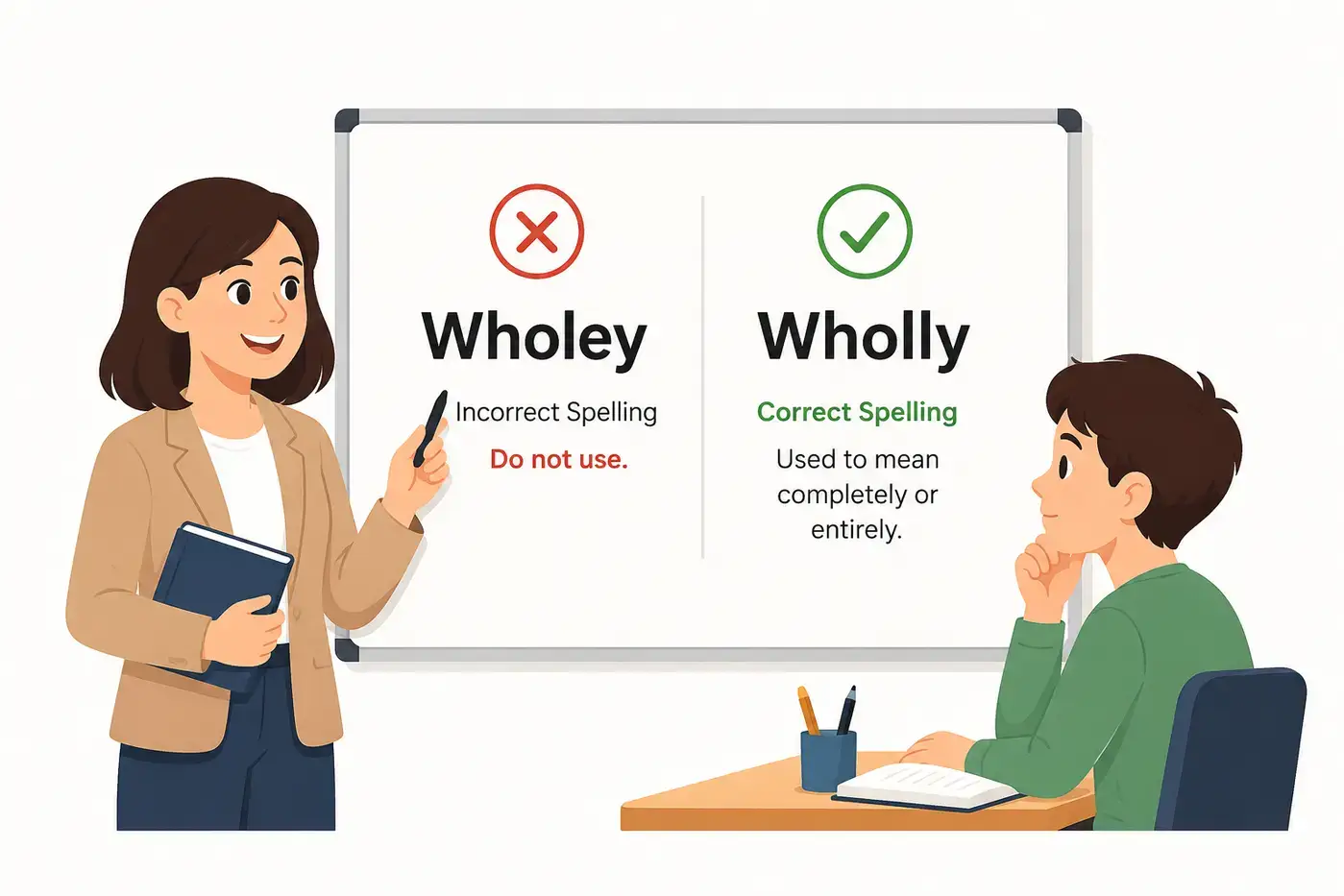
People often stop for a second after typing wholey vs wholly. Both words look believable. Both follow familiar English spelling patterns. Yet only one belongs in standard English dictionaries. The short answer is simple. Wholly is the correct spelling in modern English. It means completely entirely or fully. Wholey is almost always a misspelling and should not appear in formal writing academic papers business documents or everyday communication.
The confusion comes from pronunciation. Many English words ending in the long E sound use the letter Y. That makes some writers assume an adjective like whole should become wholey when they want an adverb. English does not follow that pattern here. Instead it forms the adverb by adding ly to whole and dropping one letter to create wholly.
This guide explains everything you need to know about these words. You’ll learn the correct spelling the meaning the grammar the pronunciation the history behind the word and dozens of real examples. By the end you’ll know exactly why professional editors always choose wholly and why native speakers rarely hesitate over this spelling.
Many readers also check Nonresponsive vs Unresponsive Which Is Correct in 2026?.
Quick Definition
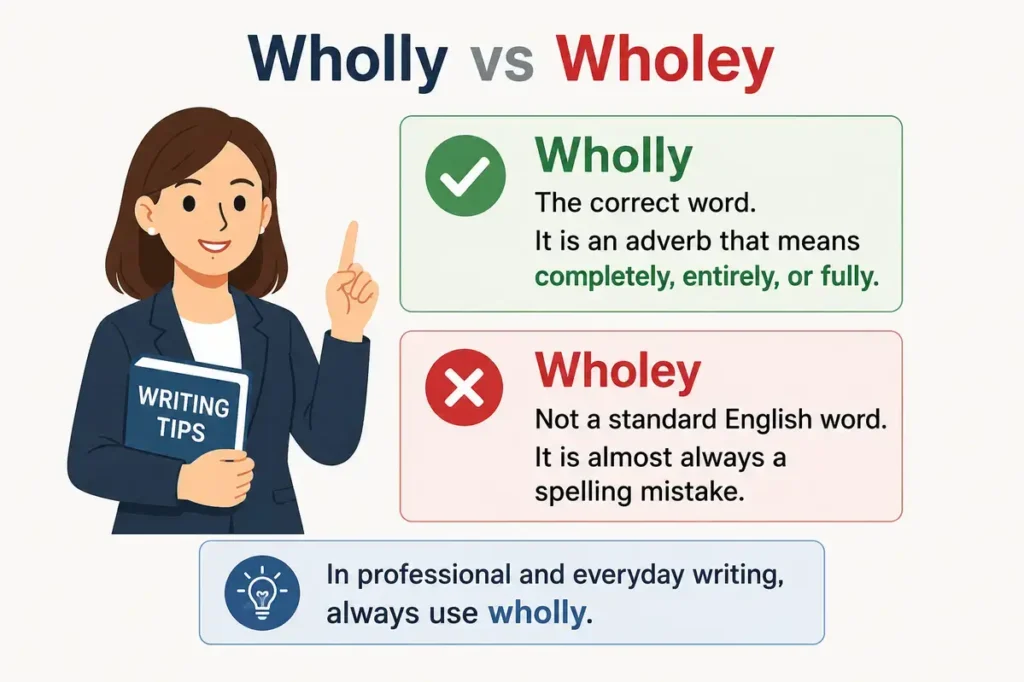
When comparing wholey vs wholly the correct word is wholly. It is an adverb that means completely entirely or fully. Wholey is not recognized as a standard English word and is almost always treated as a spelling mistake. In professional and everyday writing always use wholly.
Quick Answer
If your goal is to say completely entirely or fully the answer is easy.
- Use wholly in every standard English context.
- Avoid wholey because dictionaries do not recognize it as a standard spelling.
- Editors teachers publishers and style guides consistently recommend wholly.
- The spelling stays the same in American English British English Canadian English and Australian English.
The easiest way to remember it is this. If you mean complete in every sense use wholly.
Wholey Vs Wholly Comparison Table
| Feature | Wholey | Wholly |
|---|---|---|
| Correct form | No | Yes |
| Meaning | No accepted standard meaning | Completely Entirely Fully |
| Part of speech | Not recognized in standard English | Adverb |
| Origin | Misspelling based on the word whole | Developed from the adjective whole |
| Usage frequency | Extremely rare | Very common |
| Formality level | Incorrect | Suitable for informal and formal writing |
| Common contexts | Typing errors | Everyday conversation business writing academic writing legal documents journalism |
| Example | Incorrect spelling | She was wholly committed to the project. |
Meaning Of Wholey
In standard English wholey does not have an accepted dictionary definition. Most appearances of this spelling happen because someone guesses the adverb should end with the letter Y. That assumption feels reasonable at first glance. English contains many words that end in Y and produce similar sounds. Still spelling is built on history as much as pronunciation.
Professional editors usually treat wholey as a simple spelling error instead of a separate word. Spell checkers grammar tools publishers and dictionaries flag it because it does not belong in standard written English. If you notice wholey in an article email report or social media post it almost always means the writer intended to type wholly.
Meaning Of Wholly
Wholly is an adverb that means completely entirely fully or to the greatest possible extent. It describes something that exists without exception or something that happens in a complete way. The word often emphasizes total agreement complete ownership full responsibility or absolute commitment.
You will find wholly in every type of writing.
- Business documents.
- Academic research.
- Government publications.
- Newspapers.
- Books.
- Everyday conversation.
Because the meaning is precise writers use it when they want to remove doubt. Instead of suggesting something is partly true wholly tells readers it is true in full.
Here are a few natural examples.
- The company is wholly owned by its founder.
- I wholly agree with your conclusion.
- Her explanation was wholly accurate.
- The decision was wholly unexpected.
- The museum is wholly funded through donations.
In every example the word strengthens the idea of completeness.
Wholey Vs Wholly Key Differences
Although these spellings differ by only one letter the difference is much bigger than it appears.
Meaning
- Wholly means completely entirely or fully.
- Wholey has no accepted meaning in standard English.
Grammar
- Wholly functions as an adverb.
- Wholey has no recognized grammatical role.
Dictionary Status
- Wholly appears in major English dictionaries.
- Wholey does not appear as a standard English word.
Professional Writing
- Editors accept wholly.
- Editors correct wholey immediately.
Everyday Usage
- Native speakers naturally write wholly.
- Wholey usually appears because of typing mistakes unfamiliarity with the spelling or automatic assumptions based on pronunciation.
One extra letter can make a piece of writing look less polished. Using the correct form shows attention to detail and builds credibility.
Which One Is Correct
The correct spelling is wholly. English dictionaries style guides publishers universities and professional editors all recognize this form. It has been part of the language for centuries and remains the accepted spelling across every major English speaking country.
The incorrect version often appears because writers look at the adjective whole and expect the adverb to follow a predictable pattern. English does not always behave that neatly. Some words preserve older spelling traditions that survive long after pronunciation changes.
Experienced editors rarely stop to think about this word. After reading thousands of books articles reports and legal documents they instinctively recognize wholly as the standard form. The incorrect spelling stands out immediately because it interrupts a familiar pattern that fluent readers have seen countless times.
If you want writing that looks professional and trustworthy always choose wholly.
Examples In Sentences Using Wholey
The following examples show common mistakes that should be corrected.
- The report was wholey inaccurate.
- She was wholey responsible for the outcome.
- I wholey support your decision.
- The building is wholey owned by the city.
- They were wholey prepared for the meeting.
- His explanation was wholey convincing.
- We were wholey surprised by the announcement.
- The team was wholey committed to the project.
- The proposal was wholey rejected.
- The organization is wholey independent.
Every sentence above contains the same spelling mistake. Replace wholey with wholly to make each sentence correct.
Examples In Sentences Using Wholly
Here are natural examples that reflect how native English speakers use the word.
- I wholly support your decision.
- The museum is wholly funded by private donations.
- She was wholly prepared for the interview.
- His explanation was wholly convincing.
- The company is wholly owned by the family.
A related grammar guide is Unenroll vs Disenroll Correct Usage and Meaning.
Examples In Sentences Using Wholly Continued
- The committee was wholly satisfied with the final proposal.
- Their success was not wholly unexpected after months of careful planning.
- She wasn’t wholly convinced by the explanation.
- The old bridge was wholly rebuilt after the flood.
- His actions were wholly consistent with the company’s values.
These examples reflect natural English that you can hear in conversations or read in books newspapers business reports and academic writing. Notice that wholly often appears before an adjective past participle or verb phrase to emphasize complete agreement total responsibility or absolute certainty.
Common Mistakes With Wholey Vs Wholly
Spelling mistakes often happen because English is full of patterns that seem logical until they suddenly are not. This pair is a perfect example.
Using Wholey Instead Of Wholly
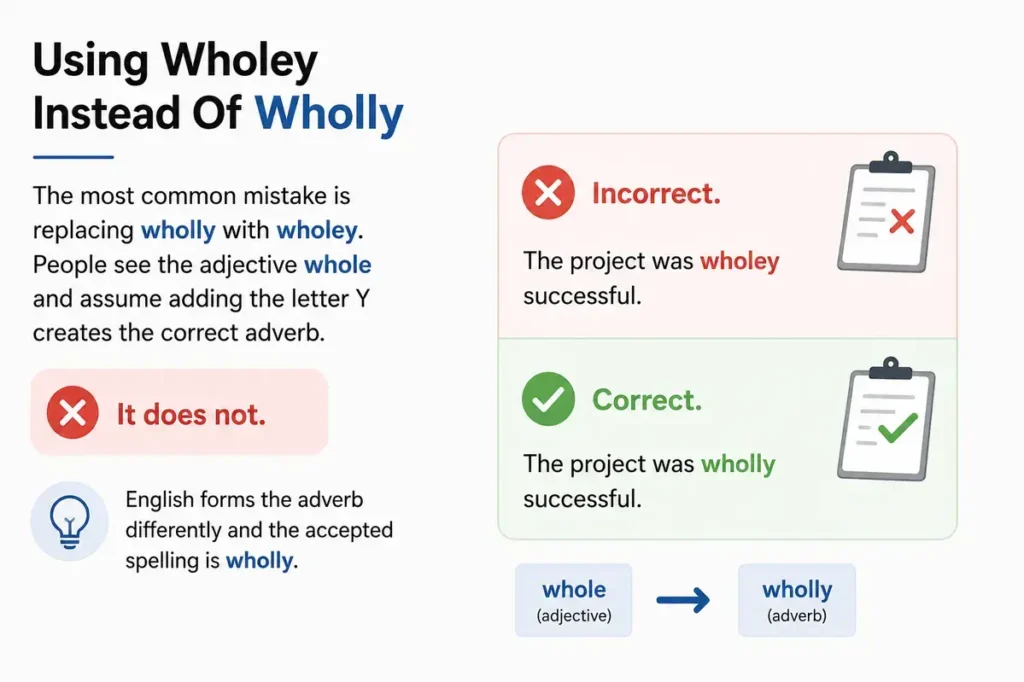
The most common mistake is replacing wholly with wholey. People see the adjective whole and assume adding the letter Y creates the correct adverb.
It does not.
English forms the adverb differently and the accepted spelling is wholly.
Incorrect.
The project was wholey successful.
Correct.
The project was wholly successful.
Trusting Pronunciation Instead Of Spelling
The pronunciation gives very little help. Both spellings could sound almost identical to someone hearing the word in conversation. That is why experienced writers rely on familiarity instead of guessing. Reading high quality books newspapers and magazines helps reinforce the correct spelling until it becomes automatic.
Ignoring Spell Check Warnings
Most spelling checkers immediately flag wholey because it is not recognized in standard English. Some writers ignore the warning and publish the mistake anyway. Taking a few extra seconds to review spelling makes your writing look more polished and professional.
Confusing Whole With Wholly
These words are closely related but they do different jobs.
Whole is usually an adjective or a noun.
Examples.
- I ate the whole pizza.
- The whole class agreed.
Wholly is an adverb.
Examples.
- I wholly agree.
- The statement is wholly accurate.
Remember this simple distinction. If you need a word that means completely use wholly.
Wholey or Wholly Pronunciation Guide
Although one spelling is incorrect many people wonder how the accepted word sounds.
IPA Pronunciation
Wholly
American English.
/ˈhoʊl.li/
British English.
/ˈhəʊl.li/
Syllable Breakdown
Whole.
Ly.
The stress falls on the first syllable.
Pronunciation Tips
Say the word whole first.
Then add the sound lee.
The result is.
Whole.
Lee.
When spoken naturally the word flows smoothly and sounds almost effortless.
Common Pronunciation Mistakes
Most pronunciation mistakes come from rushing. Some speakers reduce the second syllable too much. Others overemphasize both syllables. Listening to native speakers quickly shows that the first syllable carries the emphasis while the second remains lighter. Fortunately pronunciation causes far fewer problems than spelling.
Etymology And Word Origin
Understanding the history makes the spelling much easier to remember. The adjective whole comes from Old English hāl. It originally meant healthy uninjured complete or entire. Over time English developed an adverb from this adjective.
Instead of becoming wholey it evolved into wholly through historical spelling changes that occurred centuries ago. English spelling often preserves older forms even after pronunciation changes.
That explains many familiar words.
- Truly.
- Fully.
- Duly.
- Awfully.
- Wholly.
At first glance these spellings may seem irregular. From a historical perspective they simply reflect the way English gradually developed over hundreds of years. Modern dictionaries continue to preserve these traditional spellings because they have remained stable across generations.
Regional Usage
One interesting fact about this word is its consistency. Unlike many English spellings there is no regional disagreement.
American English
American English uses wholly.
Writers editors journalists teachers and publishers all follow this spelling.
British English
British English also uses wholly.
Major dictionaries newspapers universities and publishing houses all recognize the same form.
Australian English
Australian English follows exactly the same spelling.
No accepted alternative exists.
Canadian English
Canadian English also uses wholly in both formal and informal writing. This consistency makes the word easier to learn. You never need to switch spellings based on your audience. If your readers live in New York London Sydney or Toronto the correct choice remains exactly the same.
Grammar Rules
Understanding the grammar behind this word helps you use it naturally.
Part Of Speech
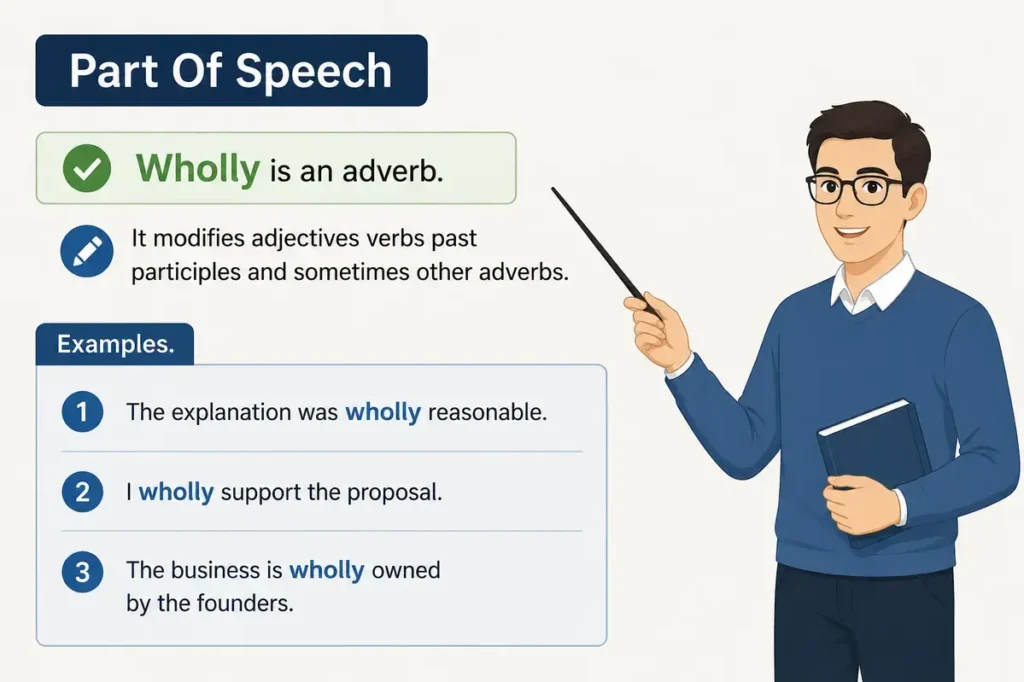
Wholly is an adverb.
It modifies adjectives verbs past participles and sometimes other adverbs.
Examples.
- The explanation was wholly reasonable.
- I wholly support the proposal.
- The business is wholly owned by the founders.
Position In A Sentence
The word usually appears before the adjective or verb it modifies.
Examples.
- She was wholly responsible.
- They wholly accepted the decision.
- The report was wholly accurate.
This placement sounds natural and matches standard English usage.
Tense Usage
Since wholly is an adverb it does not change with tense.
Examples.
- I wholly agreed.
- I wholly agree.
- I will wholly support the plan.
Only the verb changes.
The adverb remains exactly the same.
Plural Forms
Adverbs do not have plural forms.
That means wholly always keeps the same spelling regardless of the subject.
Examples.
- One student was wholly prepared.
- Ten students were wholly prepared.
The word never changes.
Common Sentence Structures
You will often see wholly used in these patterns.
- Wholly responsible.
- Wholly owned.
- Wholly independent.
- Wholly committed.
- Wholly accurate.
- Wholly convinced.
- Wholly different.
- Wholly unacceptable.
- Wholly successful.
- Wholly justified.
Reading these common combinations helps the word feel familiar much faster.
Real Life Usage Examples
Professional writers choose wholly because it expresses complete certainty without sounding dramatic. Here are examples from everyday situations.
Daily Conversation
- I wholly understand your concern.
- She wasn’t wholly happy with the result.
- We wholly support your decision.
Academic Writing
- The evidence does not wholly support the original hypothesis.
- The findings are wholly consistent with earlier research.
- The conclusion is not wholly dependent on one experiment.
Academic writing values precision. That makes wholly especially useful.
Professional Communication
- Our company is wholly committed to customer satisfaction.
- The proposal is wholly aligned with our objectives.
- The software is wholly compatible with existing systems.
Business writing often uses the word to communicate complete agreement ownership or responsibility.
Literature
Novelists frequently use wholly to strengthen descriptions without making sentences feel exaggerated.
Example.
She was wholly unaware of the danger waiting beyond the gate.
The single adverb creates a stronger emotional picture than simply writing unaware.
Media And Journalism
News organizations also use the word regularly.
Examples include.
- The investigation was not wholly complete.
- The company is wholly owned by the parent organization.
- Officials were wholly confident in the safety measures.
Across conversation journalism education business and literature one pattern remains constant. Native speakers naturally choose wholly because it is the accepted spelling and the clearest way to express complete certainty.
Related Words And Confused Terms
Many English words express the idea of completeness. Some are close in meaning to wholly while others are often confused with it. Knowing the difference helps you choose the right word for every situation.
Words With Similar Meanings
- Completely.
- Entirely.
- Fully.
- Totally.
- Absolutely.
- Thoroughly.
- Perfectly.
- Entirely.
- Utterly.
- Quite.
These words can often replace wholly, but they are not always interchangeable. The best choice depends on the sentence and the level of emphasis you want.
Words People Commonly Confuse
- Whole.
- Wholly.
- Fully.
- Entirely.
- Completely.
- Total.
- Entire.
The most common confusion comes from whole and wholly.
Whole describes a noun.
Example.
I read the whole book.
Wholly modifies a verb adjective or another adverb.
Example.
I wholly agree with your opinion.
Understanding that simple grammar rule eliminates most mistakes.

Expert Language Insight
After reviewing thousands of business reports academic papers website articles and marketing documents one pattern appears again and again. Very few native English speakers intentionally write wholey. Most mistakes happen because people type quickly and rely on sound instead of memory.
Professional editors recognize wholly instantly because they have seen it throughout books newspapers legal documents and published articles for years. The incorrect spelling immediately catches the eye because it interrupts a familiar reading pattern. Another interesting observation is that experienced writers rarely overuse wholly. They choose it only when complete emphasis adds value.
Compare these examples.
- I agree with your idea.
- I wholly agree with your idea.
The second sentence carries stronger conviction. That extra emphasis makes sense only when complete agreement is important.
Good writing is not about using bigger words. It is about choosing the right word at the right moment. Wholly succeeds because it communicates complete certainty with clarity and precision.
Frequently Asked Questions
Is wholey a real English word.
No. Standard English dictionaries do not recognize wholey as an accepted word. In almost every case it is simply a spelling mistake. If you mean completely entirely or fully the correct spelling is wholly.
Why is wholly spelled with two letters L.
The spelling comes from historical developments in English rather than modern pronunciation. Many English words preserve older spelling patterns that no longer seem obvious. Although it looks unusual today wholly has been the accepted spelling for centuries.
Can I use wholey in informal writing.
No. Even in casual emails text messages or social media posts wholly remains the correct spelling. Using wholey may distract readers and make your writing appear less polished.
Does wholly mean the same as completely.
In many situations yes. Both words express the idea of total completeness. Still wholly often sounds slightly more formal and frequently appears in business legal and academic writing.
Is wholly used in American English.
Yes. American English uses wholly exactly as British English Australian English and Canadian English do. There is no regional spelling difference for this word.
Is wholly an adjective or an adverb.
Wholly is an adverb. It modifies verbs adjectives and other adverbs. The related adjective is whole.
How can I remember the correct spelling.
Read quality English regularly and pay attention to common expressions like wholly owned wholly responsible and wholly committed. Repeated exposure makes the correct spelling become second nature.
Do professional editors ever accept wholey.
No. Editors consistently replace wholey with wholly. Style guides dictionaries and publishing standards all recognize only wholly as the correct spelling.
Still confused? Compare Skeptical vs Sceptical Which Spelling Is Correct.
Conclusion
The answer is clear.
When comparing wholey vs wholly only wholly is correct in standard English. It is the accepted adverb that means completely entirely or fully. Wholey is not recognized by modern dictionaries and is almost always a spelling mistake. Although the incorrect form looks believable the history of English explains why the accepted spelling developed differently. Once you understand that pattern the confusion quickly disappears.
Remember these three simple points.
- Use whole as an adjective or noun.
- Use wholly as the adverb that means completely.
- Never replace it with wholey in professional academic or everyday writing.
Small spelling choices shape how readers judge your work. Using the correct form shows accuracy attention to detail and confidence. After reading enough well edited English you will recognize wholly instantly and the incorrect spelling will look out of place.