
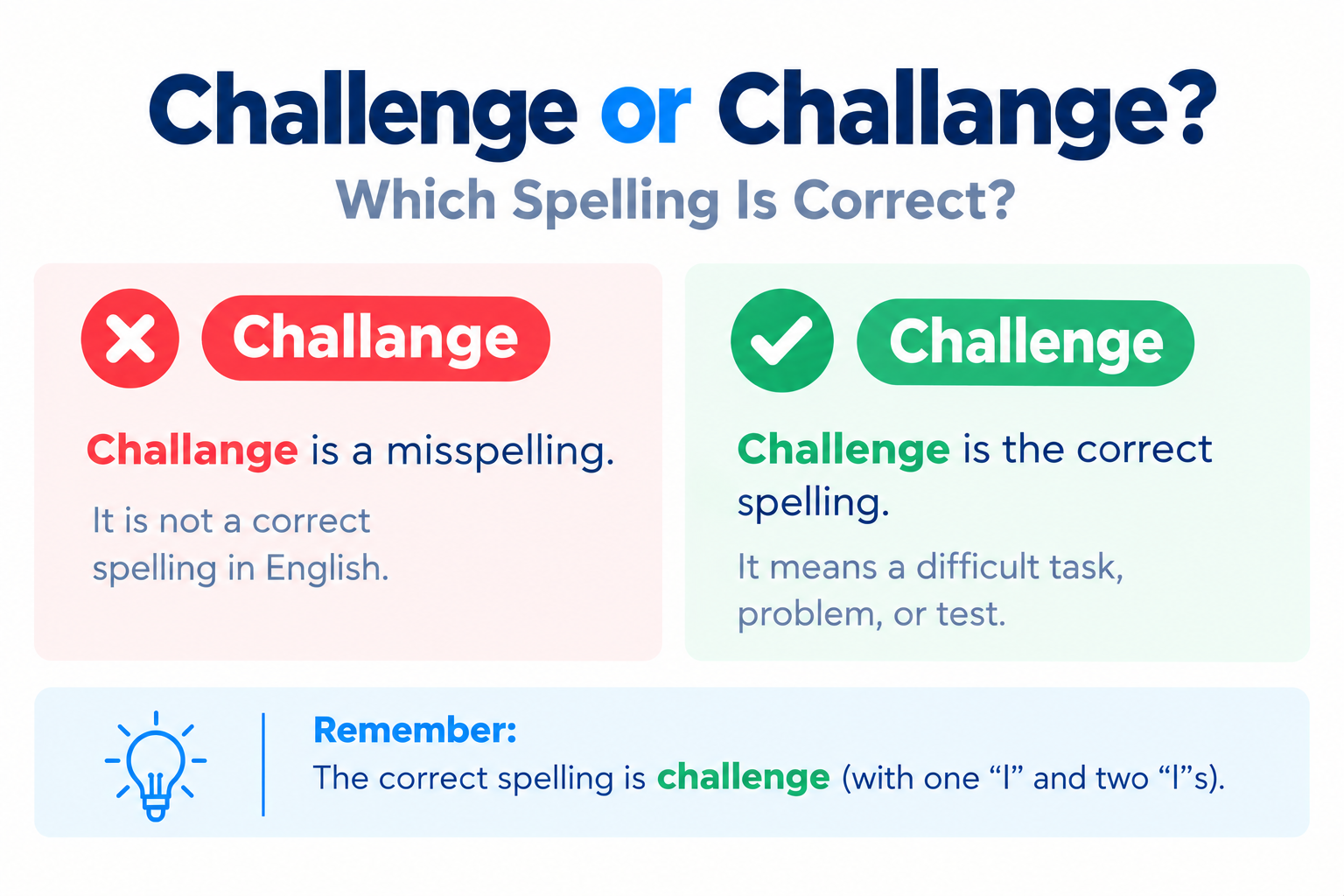
If you have ever paused while typing challenge vs challange, you are not alone. The correct spelling is challenge, with one A in the middle and an E before the final NGE. Challange is a common misspelling and is not the standard spelling in English. The confusion often happens because the word contains an unstressed vowel sound that can make its spelling less obvious when you say it aloud.
The word challenge can work as both a noun and a verb. It can describe a difficult task, a test of ability, or an act of questioning an idea or decision. You might face a challenge at work, accept a personal challenge, or challenge someone to explain their position.
Knowing the correct form helps you write more confidently in school assignments, emails, reports, applications, and everyday messages. This guide explains the spelling, meaning, pronunciation, grammar, word origin, and common mistakes. You will also find practical examples and simple ways to remember the correct form.
Many readers also check Soo vs So Which Spelling Is Correct.
Quick Answer
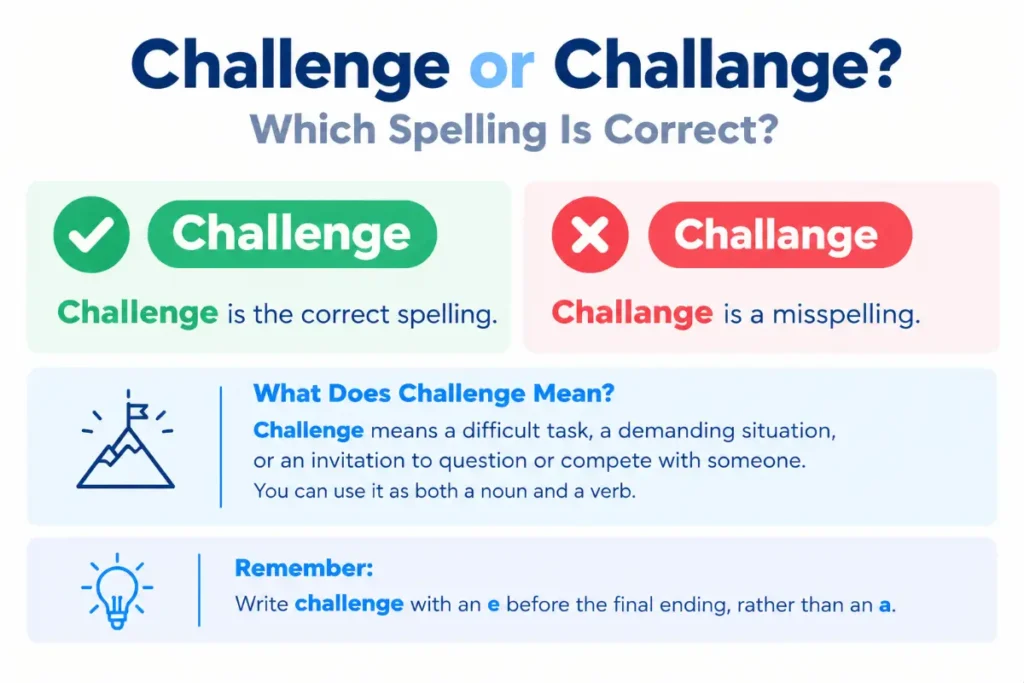
Challenge is the correct spelling in standard English. Challange is a misspelling, not an accepted alternative spelling. The correct word can be a noun meaning a difficult task or problem, or a verb meaning to question, test, or invite someone to compete.
Comparison Table
| Feature | Challenge | Challange |
|---|---|---|
| Spelling status | Correct standard spelling | Incorrect spelling |
| Meaning | A difficult task, test, or act of questioning | No standard English meaning |
| Part of speech | Noun and verb | Not a standard English word |
| Pronunciation | /ˈtʃæl.ɪndʒ/ | Usually intended to represent the same sound |
| Word origin | Entered English through Old French | No separate established origin |
| Formality | Suitable for formal and informal writing | Should be corrected |
| Common contexts | School, work, sports, debate, personal goals | Typing and spelling mistakes |
| Example | Learning a new language can be a challenge. | Learning a new language can be a challange. |
Meaning and Definition
What Does Challange Mean?
Challange is not the standard spelling of the English word. In ordinary writing, it is considered a spelling mistake rather than a separate word with its own meaning.
People usually type this form because they remember the sound of the correct word but choose the wrong vowel combination. The middle syllable is not strongly stressed, so its spelling may be harder to recall. This can lead writers to use A where the standard spelling requires E.
For example:
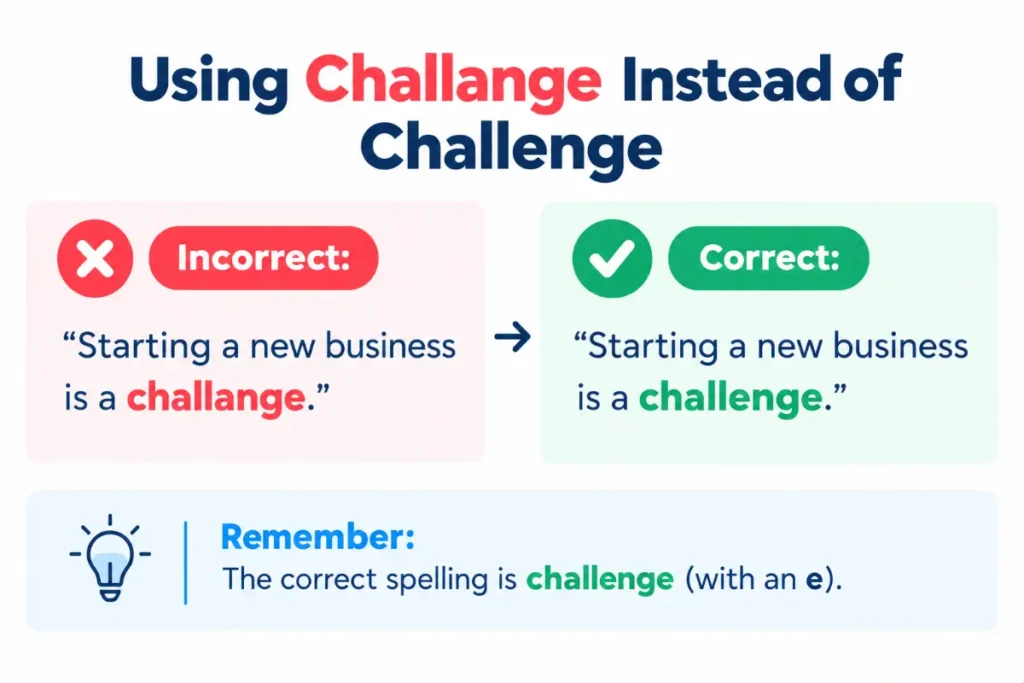
- Incorrect: The final exam was a difficult challange.
- Correct: The final exam was a difficult challenge.
The meaning in the incorrect sentence is clear, but the spelling is not acceptable in standard written English. A teacher, editor, or spelling checker would normally mark it as an error.
You should not use this form in schoolwork, professional documents, articles, emails, or other edited writing. If you see it in an old document or online post, treat it as a likely typing or spelling error unless it is clearly being used as a name or deliberate stylized spelling.
What Does Challenge Mean?
Challenge is a standard English word with two main grammatical uses. It can be a noun or a verb, and its meaning changes slightly depending on how it appears in a sentence.
As a noun, it describes something difficult that requires effort, skill, courage, or careful thought. A difficult exam, a demanding job, and a personal goal can all be challenges.
Examples:
- Learning to drive can be a challenge for a new driver.
- The team faced a serious challenge during the final match.
- Finding enough time to study is my biggest challenge.
As a verb, challenge means to test someone’s ability, question an idea, or invite someone to compete. It can also mean to ask someone to prove that a claim or decision is correct.
Examples:
- The coach challenged the players to improve their performance.
- The lawyer challenged the accuracy of the report.
- My friend challenged me to run five miles.
The word is useful because it covers both difficulties and actions that test ideas or abilities. Its meaning is usually clear from the words around it.
Challenge as a Noun
As a noun, challenge refers to a task or situation that requires effort and may be difficult to complete. It can describe a physical test, an intellectual problem, a personal struggle, or a serious issue.
For example, a student may find a math problem challenging because it requires several steps. A business may face a challenge because its costs have increased. An athlete may accept a challenge to compete against a stronger opponent.
The noun also appears in expressions such as:
- Face a challenge.
- Accept a challenge.
- Overcome a challenge.
- Meet a challenge.
- Rise to a challenge.
- A major challenge.
- A personal challenge.
These expressions describe different ways people respond to difficult situations. You can face a challenge without accepting it, but overcoming one means you have dealt with the difficulty successfully.
Challenge as a Verb
As a verb, challenge describes an action that tests, questions, or pushes someone to do something difficult. It can be used in several situations.
A teacher may challenge students to think more carefully. A lawyer may challenge evidence in court. A player may challenge an opponent to a match. A person may also challenge an unfair rule or decision.
Common verb patterns include:
- Challenge someone to do something.
- Challenge an idea.
- Challenge a decision.
- Challenge a statement.
- Challenge someone in a competition.
- Challenge the results of a test.
For example, the sentence The teacher challenged the students to find another solution uses the verb to describe an invitation to think harder. In The employee challenged the decision, it means the employee questioned or disputed a choice.
Key Differences Explained
Spelling
The main difference is the middle vowel. The standard spelling uses E before the final NGE, while the incorrect form uses A.
Correct: challenge.
Incorrect: challange.
English spelling does not always match pronunciation exactly. In this case, the unstressed middle sound can make the correct vowel difficult to identify by listening alone. That is why remembering the written form is more reliable than trying to spell it from sound.
Meaning
Only the standard spelling has an established meaning in ordinary English. It can describe a difficult task or the act of testing, questioning, or inviting someone to compete.
The incorrect form does not have a separate standard definition. Readers will usually understand what the writer intended, but the spelling still needs correction.
Grammar
The correct word can function as a noun or a verb. As a noun, it names a difficulty or test. As a verb, it describes the act of testing someone’s ability or questioning something.
The misspelled form has no accepted grammatical role in standard English. It should not be used as a noun, verb, adjective, or any other standard word form.
Pronunciation
The correct spelling is pronounced with two syllables: CHAL and inj. The first syllable carries the main stress. The second syllable contains a short, unstressed vowel sound.
The incorrect form is usually an attempt to represent the same spoken word. It does not create a separate standard pronunciation.
Formality
The correct form is suitable for every level of writing. You can use it in casual messages, school essays, professional emails, academic papers, and official documents.
The incorrect spelling is not suitable for standard edited writing. Even if readers understand the intended meaning, it may make the writer appear careless or reduce confidence in the document.
Context
The correct form appears in many settings, including education, sports, employment, law, personal development, and public discussion. Its broad use makes it a valuable word to learn.
The incorrect form may appear in rushed messages, unedited posts, or documents containing typing mistakes. Its appearance does not make it an accepted alternative.
Regional Usage
There is no standard American or British spelling difference here. American, British, Canadian, and Australian English all use challenge.
The spelling remains the same across these major English varieties. Regional accents may affect pronunciation slightly, but they do not change the written form.
Which Spelling Is Correct?
Challenge is the only standard spelling for the common English word. The spelling challange is incorrect because it does not follow the established written form used in modern English.
The correct form is recognized as both a noun and a verb. It appears in standard dictionaries and established written usage. The incorrect version is generally treated as a spelling error rather than a regional variation or accepted alternative.
A useful way to remember the spelling is to focus on the final part of the word. Write CHALL followed by ENGE. The middle vowel is E, not A.
Compare these sentences:
- Correct: Completing the project was a challenge.
- Incorrect: Completing the project was a challange.
- Correct: The coach challenged the team to work harder.
- Incorrect: The coach challanged the team to work harder.
The same spelling rule applies to related forms. When you change the word into a verb form or add an ending, keep the correct spelling pattern.
Ten Correct Example Sentences
The following examples show how the word works in everyday and professional situations.
- Everyday conversation: Learning how to cook healthy meals has been a fun challenge for me.
- Text message: I have a new challenge for you this weekend.
- Workplace: Managing several projects at once can be a challenge.
- School: The science teacher gave us a challenge to build a working model.
- Academic writing: One challenge in the study was collecting accurate information from all participants.
- Formal writing: The organization must address the challenges created by rising operating costs.
- Sports: The captain challenged the team to give its best performance.
- Social situations: My friend challenged me to try a new activity.
- Online communication: The video creator invited viewers to take part in a fitness challenge.
- Public discussion: The citizens challenged the decision because they believed it was unfair.
Each sentence uses the standard spelling. Notice that the word can name a difficult experience or describe an action. The surrounding words help readers understand its role.
Five Examples of the Common Misspelling
The following examples show the incorrect form only to help you recognize the mistake. Do not copy these spellings into your own writing.
- Incorrect: The students completed a difficult challange.
- Incorrect: She accepted the challange without hesitation.
- Incorrect: The new job will challange his skills.
- Incorrect: We need to overcome this challange together.
- Incorrect: The teacher challanged the class to solve the puzzle.
Correct versions:
- The students completed a difficult challenge.
- She accepted the challenge without hesitation.
- The new job will challenge his skills.
- We need to overcome this challenge together.
- The teacher challenged the class to solve the puzzle.
These examples also show why it is useful to learn the related forms. The correct spelling remains consistent in the noun and verb forms.
Common Spelling Mistakes
The main spelling problem is replacing E with A, but other errors can happen when people add endings or type quickly. Learning the correct base form makes these mistakes easier to avoid.
1. Replacing E With A
Incorrect: challange.
Correct: challenge.
This is the central spelling error. The unstressed middle syllable can make the vowel less clear when you hear the word. Some writers choose A because it seems to match the sound, but the standard spelling uses E.
2. Adding an Incorrect Ending
Incorrect: challanged.
Correct: challenged.
The past tense of the verb is formed by adding D to the correct base form. The final E is already part of the spelling pattern, so you should not change the middle vowel when adding the ending.
Example: The teacher challenged the students to explain their answers.
3. Misspelling the Present Participle
Incorrect: challanging.
Correct: challenging.
The present participle is formed by removing the final silent E and adding ING. However, the middle E remains in the correct base spelling pattern only as part of the original word before the ending is added. The correct result is challenging, not challanging.
Example: The new assignment is challenging but enjoyable.
4. Confusing Challenge With Challenging
Incorrect: The task is challenge.
Correct: The task is challenging.
Challenge is commonly a noun or a verb. Challenging is the adjective or present participle form used to describe something that requires effort.
Example: The exam was challenging because it tested several skills.
5. Using the Wrong Word Form
Incorrect: She accepted to challenge.
Correct: She accepted the challenge.
The noun and verb forms serve different grammatical roles. You accept a challenge, but you challenge someone or something. Knowing the difference helps you avoid errors that spelling tools may not detect.
Learn the difference in complement vs compliment Explained With Examples.
Pronunciation Guide
How Do You Pronounce Challenge?
The standard pronunciation in American English is /ˈtʃæl.ɪndʒ/. The word has two syllables:
- CHAL.
- Inj.
The main stress falls on the first syllable. Say the opening sound like the CH in chair, followed by the short A sound in cat. The second syllable sounds similar to inj.
A simple pronunciation guide is CHAL inj. Say the first syllable clearly and keep the second one short and unstressed.
Common Pronunciation Mistakes
Some speakers may pronounce the second syllable too strongly or add an extra syllable. Others may use a vowel sound that makes the word seem as if it contains A in the middle.
The best approach is to listen to the word in normal speech and repeat it with two clear syllables. The spelling does not change because of differences in accent.
Pronunciation of Related Forms
The related forms follow a similar pattern, although their endings change the sound and rhythm.
| Word | IPA | Syllables |
|---|---|---|
| Challenge | /ˈtʃæl.ɪndʒ/ | 2 |
| Challenged | /ˈtʃæl.ɪndʒd/ | 1 or 2 depending on speech rhythm |
| Challenging | /ˈtʃæl.ɪn.dʒɪŋ/ | 3 |
In ordinary American speech, the endings may sound connected to the base word. The spelling remains consistent with the standard form.
Etymology and Word Origin
The word challenge entered English through Old French. Its history is linked to the Old French word chalenge, which referred to an accusation, claim, or dispute. It also has roots in medieval Latin forms connected with making a claim or accusation.
Over time, the meaning expanded. The word came to describe not only a formal dispute or accusation but also an invitation to fight, compete, or prove one’s ability. Its modern meanings include a difficult task, a test of skill, and an act of questioning a decision or statement.
This development explains why the word appears in so many different contexts today. A person can challenge an opponent, challenge a claim, or face a challenge at work. Although these uses differ, they all involve testing, questioning, or putting something to the test.
The spelling developed through its historical forms into the modern English form challenge. The incorrect spelling challange is not an older standard version. It is simply a modern spelling error in ordinary English use.
Regional Usage
American English
Challenge is the standard spelling in American English. It is commonly used in school, business, sports, law, and everyday conversation.
American speakers use the word as both a noun and a verb. For example, a student may face a challenge in class, while a lawyer may challenge a decision in court. The spelling does not change in either use.
British English
British English uses the same spelling. There is no accepted British version written as challange.
The word also has the same basic meanings in the United Kingdom. Differences may occur in accent or in the phrases people prefer, but the spelling remains challenge.
Australian English
Australian English follows the same standard spelling. People use the word to describe difficult tasks, competitions, and acts of questioning or testing something.
There is no special Australian spelling variation that changes the E to A.
Canadian English
Canadian English also uses challenge. The spelling is the same as in American and British English, and the noun and verb forms follow the same basic grammar rules.
Is There Any Regional Spelling Difference?
No major regional spelling difference exists for this word. If you are writing for an American, British, Australian, or Canadian audience, use challenge.
The incorrect form should not be treated as a regional spelling choice. It remains a spelling mistake in standard written English.
Grammar Rules and Part of Speech
Understanding the word’s grammatical role helps you use it correctly in different sentences. It can function as a noun or a verb, and its form changes depending on the sentence.
Challenge as a Noun
As a noun, challenge names a difficult task, problem, or test. It can be singular or plural.
Examples:
- The final exam was a challenge.
- The company faces several challenges.
- Her greatest challenge was learning to manage her time.
A singular countable noun usually needs a determiner such as a, the, or this. For example, write “It was a challenge,” not “It was challenge,” when you mean one difficult task.
You can also use the word with adjectives that describe the difficulty or importance of the task.
Examples include:
- A major challenge.
- A difficult challenge.
- A personal challenge.
- A serious challenge.
- An exciting challenge.
Challenge as a Verb
As a verb, challenge means to question, test, or invite someone to compete.
Examples:
- The student challenged the teacher’s explanation.
- The coach challenged the players to improve.
- The lawyer challenged the evidence.
The verb can take a direct object. You challenge a person, a statement, a decision, or an idea. It can also be followed by an infinitive phrase, as in “The coach challenged the team to work harder.”
Common Verb Forms
The word follows a regular spelling pattern in its main verb forms.
| Verb form | Correct spelling | Example |
|---|---|---|
| Base form | Challenge | I challenge the decision. |
| Third person singular | Challenges | She challenges the old method. |
| Past tense | Challenged | He challenged the result. |
| Present participle | Challenging | They are challenging the rule. |
| Past participle | Challenged | The claim was challenged. |
Pay attention to the spelling changes when adding endings. The middle vowel remains E in the base word, while the final silent E is removed before ING is added.
Challenge as an Adjective
Challenge itself is not normally used as an adjective. The related word challenging is commonly used to describe something difficult or demanding.
Correct: The course is challenging.
Incorrect: The course is challenge.
You can also use challenging before a noun, as in “a challenging assignment” or “a challenging situation.” This form helps describe the level of effort required.
Punctuation and Sentence Position
The word does not require special punctuation. Use a period for a statement and a question mark when the whole sentence asks a direct question.
Examples:
- The new task is a challenge.
- Can you accept this challenge?
- The committee challenged the proposal.
When using the noun in a list, follow normal punctuation rules. The spelling does not affect comma placement or sentence structure.
Real Life Usage Examples
Daily Conversation
People use this word in everyday speech to describe a task that takes effort or a situation that tests their ability.
- Getting up early every morning is a challenge for me.
- My brother challenged me to finish the puzzle before dinner.
The first sentence uses the noun to name a difficulty. The second uses the verb to describe a test or competition.
Email and Workplace Communication
In professional writing, the word can describe a business problem or an action that questions an idea.
- One challenge with the current plan is the limited budget.
- I would like to challenge one point in the proposal before we approve it.
The first sentence identifies a problem that needs attention. The second politely questions part of a proposal. Both are suitable for workplace communication.
Academic Writing
Students and researchers use the word to discuss problems, methods, and ideas that need careful examination.
- A major challenge in the research was finding reliable data.
- The results challenge the assumption that all participants respond in the same way.
The noun describes a research difficulty. The verb shows that the results question an existing belief or assumption.
News and Journalism
News reports often use the word to describe public problems, legal disputes, or questions about official decisions.
- The city faces a challenge as its population continues to grow.
- Local residents challenged the decision to close the community center.
The first sentence describes a public issue. The second reports an action taken by residents.
Literature and Storytelling
In stories, the word can describe a character’s struggle or an event that tests their courage.
- The journey across the mountains became the greatest challenge of her life.
- The old knight challenged the young traveler to prove his strength.
The noun helps describe the difficulty of the journey, while the verb creates a moment of conflict or competition.
Related and Confused Terms
Several English words have meanings close to challenge. Understanding their differences helps you choose the most accurate word.
Difficulty
A difficulty is something that makes a task harder to complete. A challenge can include one or more difficulties, but it may also be an opportunity to test your skills.
Example: The main difficulty was finding enough time to practice.
Problem
A problem is something that needs to be solved or corrected. A challenge may be difficult without being harmful or negative.
Example: The broken computer caused a problem for the office.
Obstacle
An obstacle is something that blocks progress or makes it harder to reach a goal. A challenge may include an obstacle, but it can also be a test of skill or effort.
Example: Lack of experience was the biggest obstacle to getting the job.
Test
A test measures knowledge, ability, or performance. A challenge can be a test, but it may also involve questioning a claim or inviting someone to compete.
Example: The final exam was a test of everything we had learned.
Contest
A contest is an event in which people compete. A challenge can invite competition, but the word also has broader meanings.
Example: She entered a writing contest at school.
Dispute
A dispute is a disagreement or argument about something. As a verb, challenge can mean to question or dispute a claim, decision, or statement.
Example: The lawyer disputed the accuracy of the report.
Question
To question something means to ask for an explanation or express doubt about it. To challenge an idea can mean to question its truth or value.
Example: The student questioned the teacher’s conclusion.
Challenging
Challenging is the adjective form commonly used to describe something difficult or demanding. It comes from the same word but has a different grammatical role.
Example: The training program was challenging but rewarding.
Expert Editor Insight
An experienced editor treats challenge as the standard spelling in every ordinary English context. The misspelling often appears because the middle vowel is unstressed and writers try to spell the word from its sound. A spelling checker will usually flag the incorrect version, but automated tools may miss errors when a wrong form is also a name or appears in a specialized context. When editing, check the base word first, then review its related forms: challenges, challenged, and challenging. A useful proofreading habit is to search for the incorrect vowel pattern in longer documents instead of relying only on automatic correction.
Key Takeaways
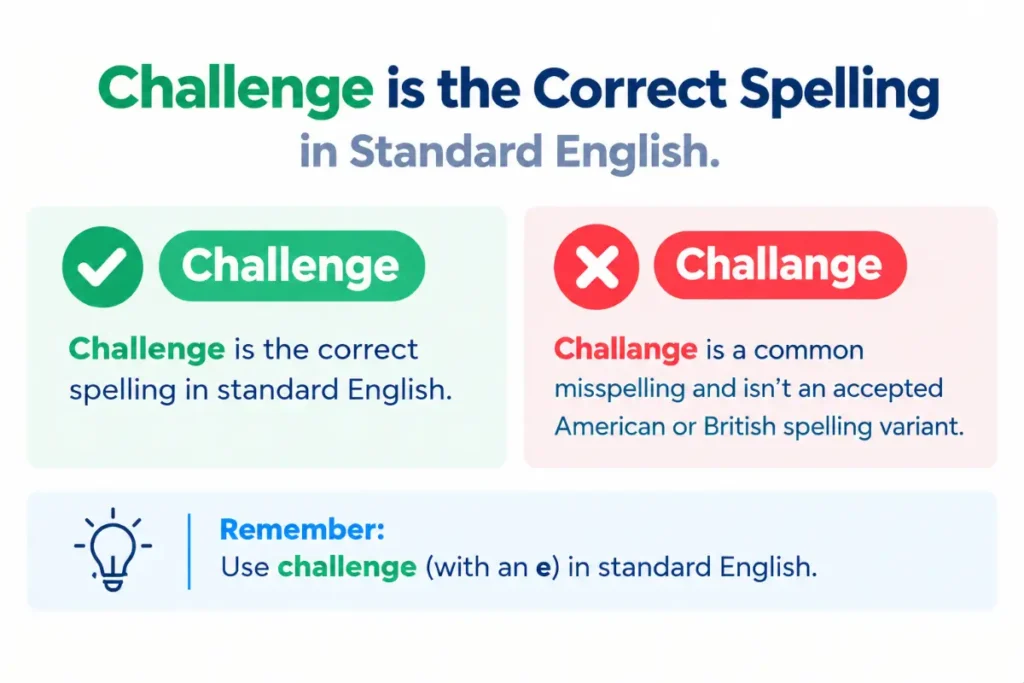
- Challenge is the correct spelling in standard English.
- Challange is a common misspelling and isn’t an accepted American or British spelling variant.
- Challenge can function as both a noun and a verb.
- The plural form is challenges.
- The past tense is challenged.
- The present participle is challenging.
- The word can describe a difficult task, a competition, or an act of questioning.
- A simple memory trick is to remember the e in the final part of challenge.
- Proofreading and regular practice can help prevent repeated spelling mistakes.
- Spell check is useful, but reading the sentence carefully remains important.
For another common grammar confusion, see Inconsolable or Unconsolable Correct Spelling and Meaning.
Conclusion
The correct spelling is challenge, not challange. The standard form can be a noun describing a difficult task or a verb meaning to question, test, or invite someone to compete. Its spelling stays consistent across American, British, Canadian, and Australian English. The easiest way to remember it is to focus on the E before NGE.
When proofreading, also check related forms such as challenges, challenged, and challenging. Learning the base spelling makes these forms easier to write correctly and helps you avoid a common mistake in school, work, and everyday communication.
FAQs
Is Challange a Real Word?
Challange is not a standard English word with an accepted dictionary meaning in ordinary use. It is usually a misspelling of challenge. You may see it in usernames, names, or stylized text, but those special uses do not make it a standard spelling. In normal writing, use challenge.
What Is the Correct Spelling of Challenge?
The correct spelling is challenge. It contains the letters C, H, A, L, L, E, N, G, and E. The incorrect form replaces the middle E with A. Remember the E before NGE to avoid this common spelling mistake in schoolwork, emails, and professional documents.
Why Do People Spell Challenge Incorrectly?
People often make this mistake because the middle syllable is unstressed, so the vowel may not sound clear. Writers sometimes choose A instead of E when spelling the word from memory. The best way to avoid the error is to learn the written form and remember that the correct spelling is challenge.
What Does Challenge Mean?
As a noun, challenge means a difficult task, problem, or test that requires effort or skill. As a verb, it means to question something, test someone’s ability, or invite someone to compete. For example, a difficult exam is a challenge, while questioning an unfair decision is to challenge that decision.
Is Challenge a Noun or a Verb?
Challenge can be both a noun and a verb. As a noun, it names a difficult situation or task, as in “The project was a challenge.” As a verb, it describes testing or questioning something, as in “She challenged the decision.” The sentence structure tells you which grammatical role the word performs.
How Do You Pronounce Challenge?
In American English, challenge is pronounced /ˈtʃæl.ɪndʒ/. It has two syllables, with the main stress on the first. The first part sounds like CHAL, and the second sounds like inj. Saying the word slowly can help you remember its sound, although the correct spelling must still be learned separately.
Is Challenging Spelled With One L or Two?
Challenging is spelled with two Ls. It is formed from challenge by removing the final silent E and adding ING. The correct spelling is challenging, not challanging. For example, “The assignment is challenging” uses the adjective form to describe something that requires effort or skill.
Is Challenge the Same in American and British English?
Yes. Challenge is the standard spelling in both American and British English. Canadian and Australian English use the same form as well. There is no accepted regional spelling that changes the middle E to A. You can use challenge confidently in writing for readers across these English speaking regions.