
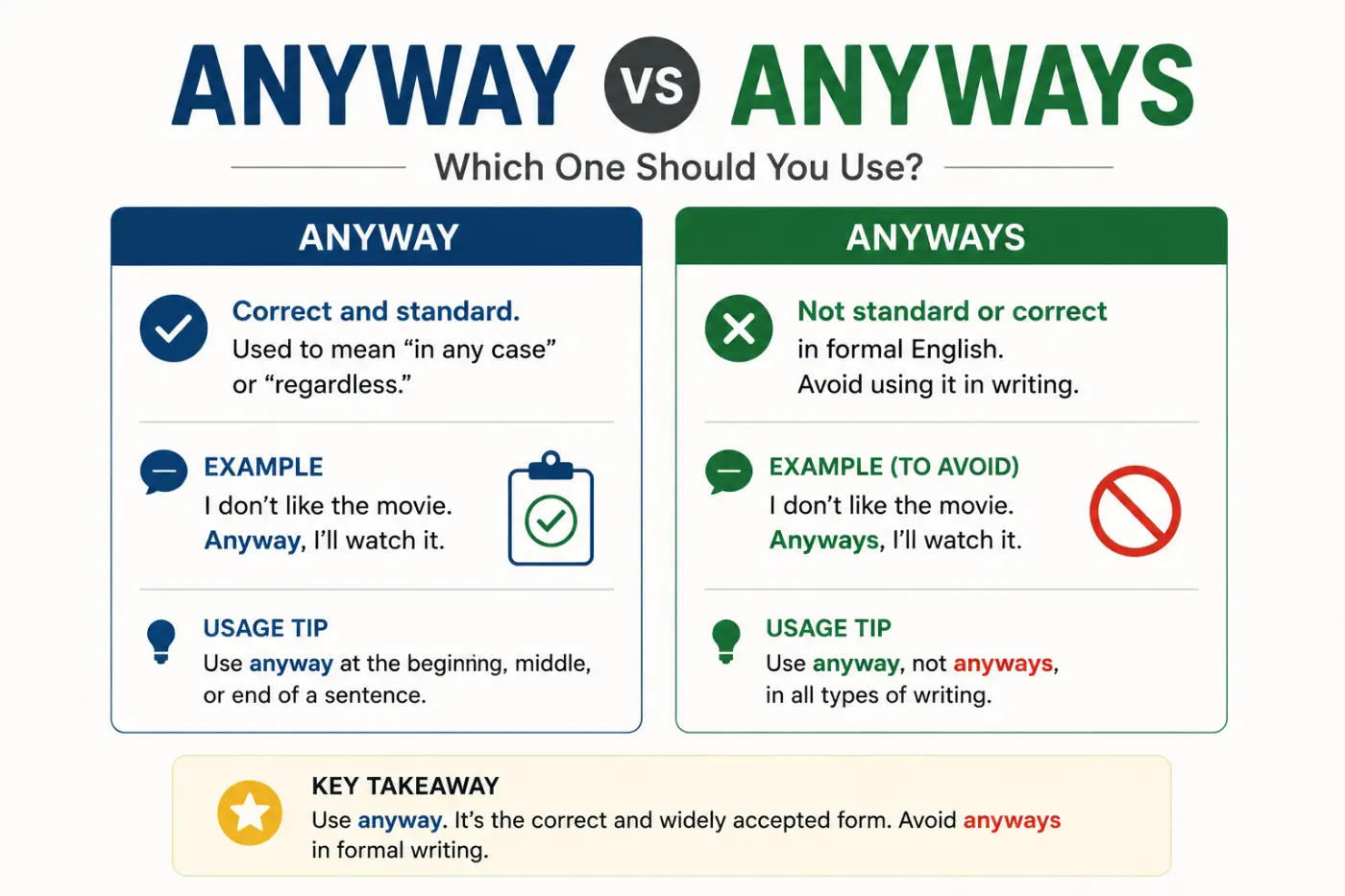
Many English speakers use anyway vs anyways in conversation, but the two forms do not carry exactly the same level of formality. The standard choice for most writing is anyway. Anyways is also used in everyday speech, especially in informal American English, but it is often avoided in formal documents, academic work, and professional communication.
The confusion makes sense because both words can mean in any case, regardless, or returning to the main point. You may hear someone say, Anyways, what were we talking about? You may also see someone write, Anyway, we need to finish the project today. Both sound natural in casual conversation, but the first has a more relaxed tone.
Knowing the difference helps you choose the right form for your audience and situation. It also prevents unnecessary corrections when someone uses the informal version in speech. This guide explains the meanings, grammar, pronunciation, regional patterns, common mistakes, and practical examples so you can use both forms with confidence.
Need another quick comparison? Read lessen vs lesson Meaning, Spelling and Usage Explained.
Quick Answer
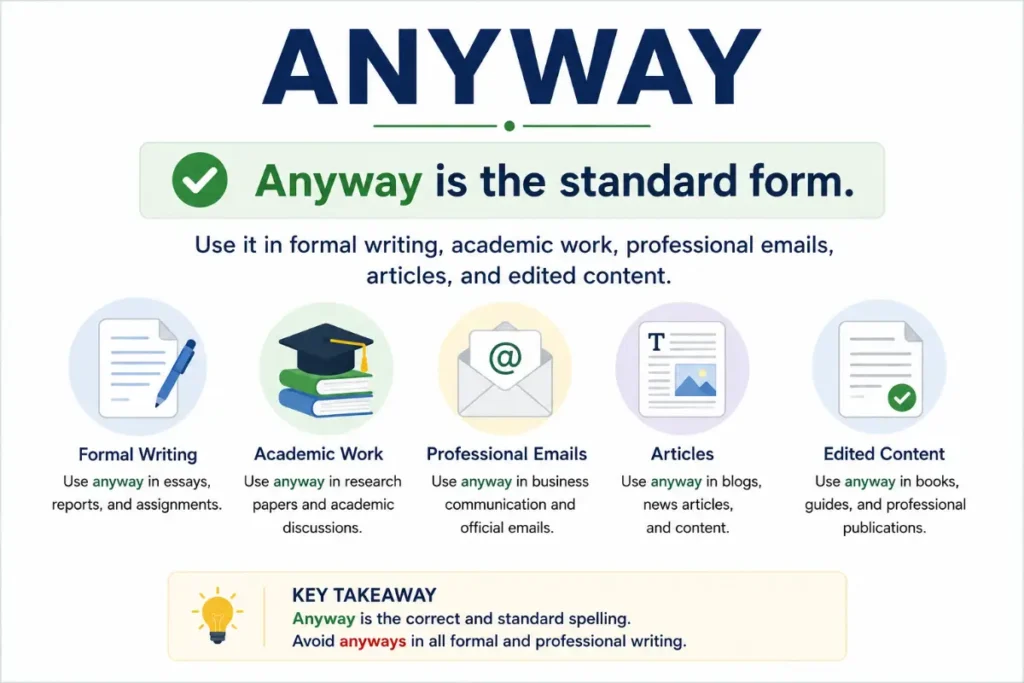
Anyway is the standard form and the safest choice in formal and informal writing. Anyways is an informal variant that appears often in casual conversation, especially in American English. Both can mean in any case or regardless, but anyway is more widely accepted in professional, academic, and edited writing.
Comparison Table
| Feature | Anyway | Anyways |
|---|---|---|
| Main meaning | In any case, regardless, or returning to the main point | Usually the same as anyway |
| Part of speech | Adverb | Adverb |
| Standard usage | Standard English | Informal variant |
| Formality | Neutral and suitable for formal writing | Casual and conversational |
| American English | Common in speech and writing | Common in informal speech |
| British English | Standard and widely used | Informal and less common in careful writing |
| Canadian English | Standard | Informal |
| Australian English | Standard | Informal |
| Common contexts | Emails, essays, conversations, reports | Text messages, casual conversations, informal posts |
| Example | Anyway, we should leave now. | Anyways, we should get going. |
Meaning and Definition
What Does Anyway Mean?
Anyway is an adverb with several closely related uses. It can mean in any case, regardless, despite something, or returning to the main subject of a conversation. It helps connect ideas and shows that a particular fact does not change the main point.
For example, you might say, I was tired, but I went to the meeting anyway. The word shows that being tired did not stop you from attending. You could also say, Anyway, we need to talk about tomorrow’s schedule. Here, it signals a return to the main topic.
Common meanings include:
- Regardless: I will finish the work anyway.
- In any case: Anyway, we have enough time.
- Despite a problem: It was raining, but we went outside anyway.
- Returning to a topic: Anyway, what happened next?
- Adding a final thought: I do not think it will work, but we can try anyway.
The word can appear at the beginning, middle, or end of a sentence. Its position depends on the purpose of the sentence and the emphasis you want to create.
What Does Anyways Mean?
Anyways is an informal variant of anyway. It usually carries the same basic meanings, such as regardless, in any case, or returning to a topic. However, it often sounds more conversational and relaxed.
For example:
- Anyways, I need to get ready for work.
- I did not enjoy the movie, but I watched it anyways.
- Anyways, tell me what happened at school.
These sentences are common in casual conversation and informal messages. Many speakers use the form naturally without intending to change the meaning.
However, the extra s does not make the word more correct or more complete. In standard edited English, anyway is generally preferred. You should normally choose it for school assignments, professional emails, reports, formal articles, and academic writing.
Is Anyways a Real Word?
Yes. Anyways is a recognized informal English variant, not simply a typing error. It appears in everyday speech and informal writing, and many native English speakers use it naturally.
However, being a real word does not mean it suits every situation. Standard written English generally favors anyway. If you are writing for a teacher, employer, academic audience, or professional publication, the shorter form is the safer choice.
Does Anyway Have More Than One Meaning?
Yes. Its meaning changes slightly according to its position and the sentence around it. It can show that an action happened despite a problem, indicate that something remains true, or help a speaker return to an earlier topic.
Compare these examples:
- I knew it was expensive, but I bought it anyway.
- Anyway, we should discuss the next step.
- She did not agree with me. I respected her opinion anyway.
In the first and third examples, the word means regardless or despite the situation. In the second, it helps move the conversation forward.
Key Differences Explained
1. Standard Usage
The biggest difference is standardness in edited writing. Anyway is the established standard form used in both formal and informal English. Anyways is an informal variant that appears more often in casual speech and relaxed writing.
For example:
- Standard: Anyway, we should begin the presentation.
- Informal: Anyways, we should begin the presentation.
Both are understandable, but the first is more suitable for a business report or academic paper. The second may fit a friendly text message.
2. Meaning
In most everyday situations, both forms express the same basic meaning. They can show that something happens regardless of a problem or that a speaker is moving back to the main subject.
For example:
- I was busy, but I called her anyway.
- I was busy, but I called her anyways.
The meaning is almost identical. The main difference is the tone and level of formality, not the basic message.
3. Grammar
Both words function as adverbs. They modify a verb, clause, or entire statement by adding a sense of continuation, contrast, or return to a topic.
Examples:
- We decided to go anyway.
- We decided to go anyways.
The grammar is the same in these sentences. The choice between them is mainly a matter of style and audience.
4. Formality
Anyway is suitable for nearly every writing situation. You can use it in a casual text, a work email, an academic paper, or a formal report.
Anyways is more relaxed. It can sound natural when talking with friends, posting online, or writing dialogue for a character. In formal writing, it may appear careless or overly conversational.
This does not mean you must avoid every informal expression. It simply means you should match your language to the situation.
5. Sentence Position
Both forms can appear at the beginning, middle, or end of a sentence, although some positions are more common than others.
At the beginning:
- Anyway, let’s get started.
- Anyways, let’s get started.
At the end:
- I wanted to stay, but I had to leave anyway.
- I wanted to stay, but I had to leave anyways.
In the middle:
- We were going to cancel anyway, so there was no reason to wait.
- We were going to cancel anyways, so there was no reason to wait.
The first form is more suitable for standard writing in all three positions.
6. Pronunciation
The two forms sound slightly different. Anyway has three syllables: any-way. Anyways usually has three syllables as well, but it ends with an additional /z/ sound.
The difference is small in fast conversation, so listeners may not always notice it. Still, the extra ending is part of the informal form.
7. Regional Usage
Anyway is widely used in American, British, Canadian, and Australian English. It is the standard form across these varieties.
Anyways is especially familiar in informal American English. It also appears in other English speaking regions, but its frequency and acceptance can vary by speaker and context. It is not a separate regional spelling rule.
8. Standard Versus Informal Usage
It is useful to understand the difference between a nonstandard form and an incorrect form. Anyways is not meaningless or automatically wrong in conversation. It is an informal variant that many speakers use.
However, formal writing follows a more consistent standard. In edited English, anyway is the preferred form. Choosing it avoids distracting readers who may view the longer version as casual or unnecessary.
Which Form Is Correct?
Anyway is the standard choice in modern written English. Anyways is a real informal variant, but it is less suitable for formal and carefully edited writing.
The reason is not that the extra s creates a completely different meaning. In most contexts, both forms communicate the same idea. The difference comes from accepted usage and register. Standard dictionaries and edited writing generally treat anyway as the main form, while anyways is commonly labeled informal or conversational.
Use anyway in these situations:
- Academic essays and research papers.
- Professional emails and business reports.
- News articles and formal publications.
- School assignments and examinations.
- Official letters and applications.
- General writing for a wide audience.
Anyways can be appropriate in casual conversations, text messages, informal social media posts, and dialogue that reflects relaxed speech.
If you are unsure, choose anyway. It is natural, widely accepted, and suitable for almost every context. You do not need to use the longer form to sound friendly or conversational.
Sentence Examples
The following examples show how to use the standard form naturally in different situations.
Ten Natural Examples Using Anyway
- Everyday conversation: I know it is late, but I want to finish this movie anyway.
- Text message: I will call you tomorrow anyway, so we can talk then.
- Workplace communication: The team decided to continue with the project anyway.
- School: I did not understand the first explanation, but I tried the exercise anyway.
- Academic writing: The results remain useful even if the sample size is small.
- Formal writing: The applicant did not meet every requirement but was considered anyway.
- Social situations: I was feeling tired, but I joined my friends for dinner anyway.
- Online communication: The update is optional, but you may install it anyway.
- Family conversation: We already have enough food, but I bought some extra anyway.
- Daily planning: The weather may change, but we should prepare for the trip anyway.
These examples show how the word connects an action with a condition that does not stop it. It often adds the idea that something will happen regardless of what came before.
Five Informal Examples Using Anyways
The following sentences demonstrate the casual form. They are suitable for relaxed conversation, personal messages, or informal dialogue.
- Anyways, what did you decide about the trip?
- I was not hungry, but I ate a little anyways.
- Anyways, I have to leave before it gets too late.
- We can try again tomorrow anyways.
- I know the plan changed, but I am excited anyways.
These sentences are understandable and natural in informal settings. For formal writing, replace the longer form with anyway.
Examples Showing the Difference in Tone
Sometimes both forms fit the same sentence, but the tone changes slightly.
| Standard or Neutral | Informal |
|---|---|
| Anyway, I will see you tomorrow. | Anyways, I will see you tomorrow. |
| I finished the assignment anyway. | I finished the assignment anyways. |
| Anyway, we should move on. | Anyways, we should move on. |
| I wanted to go anyway. | I wanted to go anyways. |
| We can discuss it later anyway. | We can discuss it later anyways. |
The shorter form is more suitable for general writing. The longer form can reflect a casual speaking style, especially in personal messages.
Common Mistakes and Misspellings
The main problem with these words is not spelling accuracy but choosing a form that fits the context. Still, some writers make errors when they confuse the two forms with other expressions.
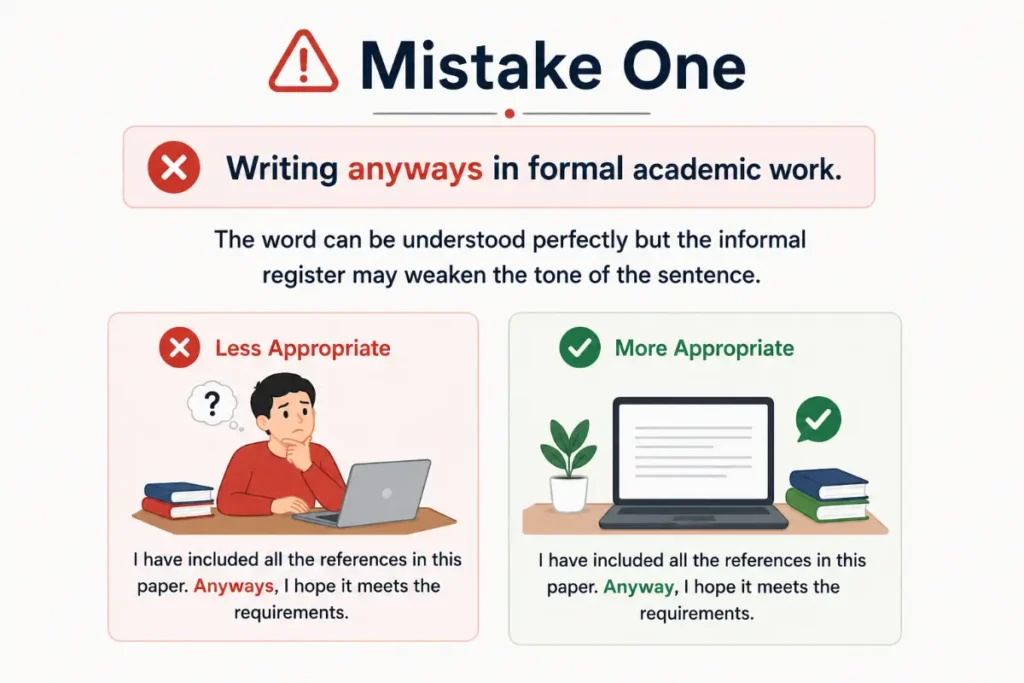
1. Using Anyways in Formal Writing
Less suitable: Anyways, the research shows a clear pattern.
Preferred: Anyway, the research shows a clear pattern.
The longer form is often considered too informal for academic work. Use the standard form when writing essays, reports, and research papers.
2. Adding an Extra S to Sound More Correct
Incorrect assumption: Anyways is more complete because it has an extra s.
Correct understanding: Anyway is the standard form.
Some people assume that a longer word must be more formal or grammatically complete. That is not the case here. The extra s does not make the word more correct.
3. Confusing Anyway With Any Way
Incorrect: I could not find anyway to solve the problem.
Correct: I could not find any way to solve the problem.
Anyway is an adverb that often means regardless. Any way is a two word phrase that means any method or manner.
For example, I will finish the task anyway means I will finish it regardless. I will find any way to finish the task means I will look for a method.
4. Confusing Anyway With Anyhow
Incorrect assumption: Anyway and anyhow always have exactly the same tone.
Better understanding: Both can mean in any case, but their tone and use can differ.
For example, Anyway, we should leave now sounds natural and direct. Anyhow, we should leave now is also possible, but it may sound more conversational or slightly different in style.
5. Using Either Form Too Often
Awkward: Anyway, I was tired. Anyways, I went home. Anyway, I slept early.
Better: I was tired, so I went home and slept early.
Repeatedly using a transition word can make writing sound repetitive. Sometimes the best choice is to remove it completely and connect the ideas more directly.
How to Avoid These Mistakes
Use these simple rules:
- Choose anyway for formal and general writing.
- Use anyways only when an informal tone is appropriate.
- Remember that any way is a separate two word phrase.
- Do not add the extra s because you think it makes the word more correct.
- Remove repeated transition words when they do not add meaning.
You may also want to read Soo vs So Which Spelling Is Correct.
Pronunciation Guide
How Do You Pronounce Anyway?
Anyway is pronounced /ˈɛniˌweɪ/ in common American English pronunciation. It has three syllables: en-y-way. The main stress usually falls on the first syllable.
A simple pronunciation guide is en-ee-way. Say the first part clearly, then connect it smoothly to way. The word should sound like one flowing unit rather than three separate words.
How Do You Pronounce Anyways?
Anyways is commonly pronounced /ˈɛniˌweɪz/. It has the same basic three syllables as anyway, with a final /z/ sound.
A simple guide is en-ee-wayz. The ending should sound like the z in words such as days and plays.
What Is the Difference in Sound?
The main pronunciation difference is the final sound. Anyway ends with the long a sound in way, while anyways adds a voiced /z/ sound.
This small difference is easy to hear when both forms are spoken slowly. In fast conversation, the final sound may be less noticeable, especially in relaxed speech.
Common Pronunciation Mistakes
- Dropping the final sound in anyways when trying to pronounce the longer form.
- Giving every syllable equal stress instead of making the first syllable clearer.
- Pronouncing the ending of anyway with an unnecessary /z/.
- Separating the syllables too strongly and making the word sound unnatural.
Neither form needs exaggerated pronunciation. Speak at a natural pace and keep the word connected.
Etymology and Word Origin
The Origin of Anyway
Anyway developed from the combination of any and way. The word any has roots in Old English, while way also comes from an Old English word related to a path, road, or manner of doing something.
Over time, the combined form developed the meaning of in any way or by any means. Its modern use expanded to include regardless, in any case, and returning to the main point of a conversation.
The word gradually became a common adverb in English. Today, it serves as a useful transition and helps speakers connect ideas without repeating a full explanation.
The Origin of Anyways
Anyways developed as a variant of anyway through the addition of the adverbial ending s. English has several words with similar informal forms, and some speakers use an s ending in relaxed speech.
However, the added s does not create a separate meaning in most modern uses. It mainly marks an informal variant. The shorter form remains the standard choice in edited writing.
Why the History Matters
The history helps explain why the two forms are so closely related. They share the same basic meaning and are used in similar sentence positions.
Still, word history does not decide every question of modern grammar. Current usage, writing standards, and the needs of your audience matter more when choosing between them.
Regional Usage
American English
In American English, anyway is standard in both conversation and writing. It appears in everyday speech, business communication, schoolwork, news writing, and academic papers.
Anyways is also familiar in the United States, especially in informal conversations, text messages, and social media posts. Many speakers use it naturally when changing topics or emphasizing that something will happen regardless.
For example:
- Anyway, I will finish the work tonight.
- Anyways, I will finish the work tonight.
Both are understandable, but the first is the preferred choice in standard writing.
British English
British English uses anyway as the standard form. It is common in conversations, books, newspapers, and professional writing.
Anyways also appears in informal British speech, but it is not generally the preferred form in formal writing. There is no major spelling difference between British and American English for these words.
Australian English
Australian English follows the same general pattern. Anyway is the standard choice, while anyways may appear in relaxed conversation and informal messages.
The difference is mainly one of tone rather than meaning. Writers should use the standard form in professional or academic work.
Canadian English
Canadian English also uses anyway as the standard form. Anyways is recognizable as an informal variant, but it is less suitable for formal documents and edited writing.
There is no special Canadian spelling rule that changes the choice. The same practical guidance applies across the major English varieties.
Is Anyways More Common in American English?
The form is especially familiar in informal American speech, but it is not limited to the United States. Speakers in other English speaking countries also use it.
Its frequency can vary by age, region, personal speaking style, and situation. It is safer to describe it as an informal variant rather than a word that belongs to one country.
Grammar Rules and Part of Speech
Both forms function as adverbs. They can modify a verb, a clause, or an entire sentence by showing that something happens regardless of a condition or by helping the speaker move to another topic.
Using Anyway at the Beginning of a Sentence
At the beginning of a sentence, anyway often works as a transition. It can signal a return to the main topic, introduce a final thought, or show that the previous information does not change what follows.
Examples:
- Anyway, we need to finish the report today.
- Anyway, I think we should give the idea another chance.
- Anyway, the meeting starts in ten minutes.
When the word introduces a new thought, a comma usually follows it. The comma helps separate the transition from the main sentence.
Using Anyway at the End of a Sentence
At the end of a sentence, it often means regardless or despite the situation.
Examples:
- I was tired, but I went anyway.
- She knew the answer, but she checked anyway.
- We did not have much time, but we finished anyway.
In these examples, the word reinforces the idea that an action happened despite a possible reason not to do it.
Using Anyway in the Middle of a Sentence
The word can also appear in the middle of a sentence when the writer wants to add a sense of continuation or contrast.
Examples:
- We were going to visit anyway, so we left early.
- He had already made his decision anyway.
- The event was going ahead anyway, despite the rain.
The exact punctuation depends on the sentence structure. Do not add commas automatically. Use them only when the word functions as a separate transition or interruption.
Can Anyways Start a Sentence?
Yes. In informal conversation, anyways can begin a sentence in the same way as anyway.
For example:
- Anyways, I need to get back to work.
- Anyways, what happened after that?
This use is common in casual speech and personal messages. For formal writing, use anyway instead.
Is Anyway a Conjunction?
No. Anyway is an adverb, not a coordinating conjunction. It can connect ideas in a sentence or conversation, but it does not perform the same grammatical role as and, but, or, and so.
For example:
– I was tired, but I went anyway.
Here, but is the conjunction connecting the clauses. Anyway is an adverb showing that the speaker went despite being tired.
Can Anyway Be Used in Formal Writing?
Yes. Anyway is suitable for formal writing, although it may not fit every sentence. It can be useful when showing that a condition does not change the main point.
For example, a report might say, The project continued anyway despite the delay. However, a more formal alternative such as nevertheless or regardless may sometimes suit the sentence better.
When Should You Avoid Anyways?
Avoid it in academic papers, official letters, formal reports, business proposals, and professional documents unless you are quoting someone or reproducing informal speech. In those situations, the standard form is more appropriate.
Real Life Usage Examples
Daily Conversation
In everyday speech, both forms are easy to understand. The shorter version is neutral, while the longer one can sound more relaxed.
- Anyway, are you coming to dinner tonight?
- I know it is cold, but I want to go for a walk anyway.
These examples show how the word can change a topic or show that a condition does not stop an action.
Email and Workplace Communication
In professional messages, the standard form is usually the best choice. It keeps the tone clear without sounding too casual.
- Anyway, I have attached the updated schedule for your review.
- The team decided to proceed anyway because the delay was minor.
In a highly formal email, you may choose alternatives such as regardless, nevertheless, or in any case. The best option depends on the sentence.
Academic Writing
Academic writing often uses anyway less frequently than ordinary conversation. Still, it can work when the meaning is clear and the tone is appropriate.
- The result was unexpected, but it supports the main argument anyway.
- The sample was small, but the findings remain useful anyway.
For more formal academic writing, a phrase such as despite this limitation or nevertheless may sound more precise.
News and Journalism
News writing generally favors the standard form when a transition is needed. However, journalists often choose stronger alternatives to avoid repetition.
- The proposal faced criticism but moved forward anyway.
- Anyway, the mayor said the final decision would be announced on Friday.
The second example sounds more conversational and would usually fit a direct quotation or informal report rather than a formal news statement.
Literature and Storytelling
Writers use both forms to show a character’s voice. The longer version can help create casual dialogue, while the standard form works in both narration and conversation.
- Anyway, I knew he would come back eventually.
- Anyways, she said, we have bigger problems to worry about.
The choice can help reflect a character’s personality and speaking style. In dialogue, informal language may be useful because people do not always speak in the same way they write.
Related and Confused Terms
Several words and expressions have meanings close to anyway. Understanding them can help you avoid repetition and choose a more precise transition.
1. Any Way
Any way is a two word phrase meaning any method, manner, or route. It is not the same as anyway.
- Anyway, I will finish the job.
- I could not find any way to finish the job.
The first means regardless. The second refers to a method of completing the task.
2. Anyhow
Anyhow is an adverb that can mean in any case or regardless. It is close in meaning to anyway and often sounds conversational.
For example, Anyhow, we should start preparing for the trip. It works as a transition, although the tone may differ slightly according to the speaker and context.
3. Regardless
Regardless means without being affected by a particular condition. It is often more formal and precise than anyway.
Example: We will continue regardless of the weather.
This expression works well in professional and academic writing when you want to make the relationship between two ideas clear.
4. Nevertheless
Nevertheless means despite what has just been mentioned. It is often used in formal writing to show contrast.
Example: The project faced several problems. Nevertheless, the team completed it on time.
It is not always a direct replacement for anyway, but it can express a similar sense of continuing despite difficulties.
5. Nonetheless
Nonetheless has a meaning close to nevertheless. It introduces a contrast and shows that the main point remains true despite the previous information.
Example: The instructions were difficult. Nonetheless, she completed the task.
It is useful in formal writing and often creates a more polished tone than a casual transition.
6. In Any Case
In any case means regardless of the situation or circumstances. It is a useful alternative when you want to return to the main point or emphasize that something remains true.
Example: In any case, we need to make a decision today.
This phrase is often suitable for workplace communication and general writing.
7. At Any Rate
At any rate means in any case or at least. It can introduce a conclusion or return to the main point.
Example: At any rate, we should be ready by noon.
It is slightly more formal or deliberate in tone than a casual use of anyway.
8. Still
Still can show that something remains true despite a problem or contrast.
Example: The road was difficult, but we still reached the village.
It is often shorter and more direct than anyway. However, the grammar and sentence structure may need to change when you replace one with the other.
Expert Editor Insight
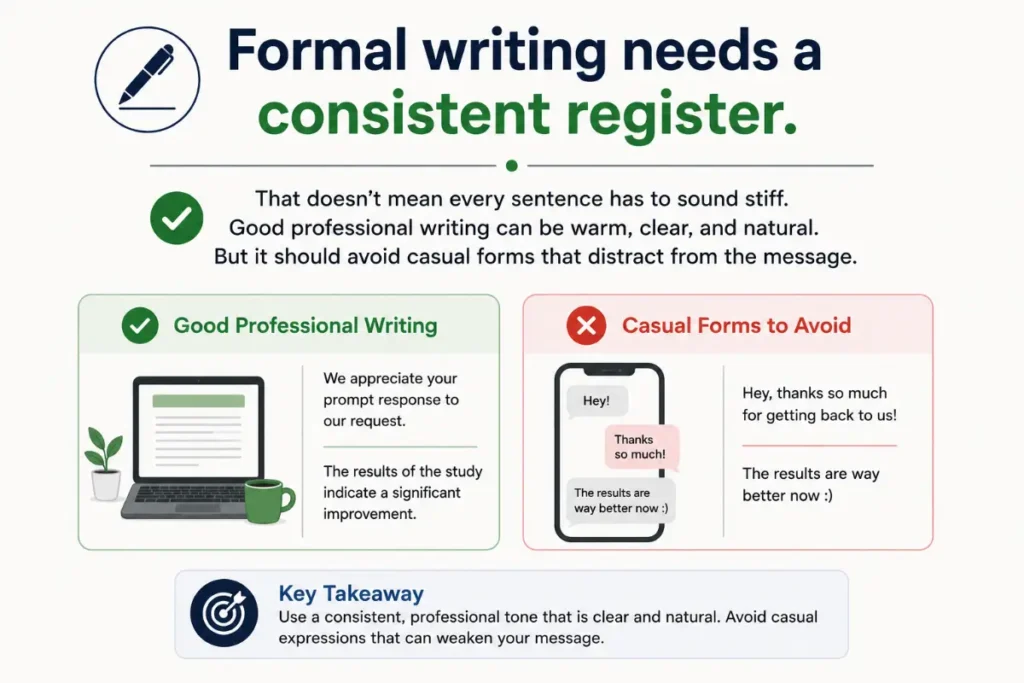
An experienced editor usually keeps anyway in general writing because it is standard, familiar, and suitable for a wide audience. The longer form is not automatically a spelling mistake, but it can make formal writing sound too casual. The main editing question is not simply which version a grammar tool accepts. It is whether the word fits the audience, tone, and sentence. A useful editing habit is to search for every use of anyways in a formal document and replace it with anyway unless the word appears in a direct quotation or intentional dialogue.
Still confused? Compare Imply vs Infer The Difference Explained.
Conclusion
The choice between anyway and anyways mainly depends on formality and audience. Anyway is the standard form and works in everyday conversation, academic writing, professional emails, and formal documents. Anyways is an informal variant that many speakers use naturally in casual speech and personal messages.
Both usually communicate the same basic meaning, so the extra s does not make the longer form more correct. For clear writing, remember one simple rule: use anyway as your default and save anyways for relaxed conversation or intentional dialogue. This choice keeps your language natural, accurate, and suitable for almost any reader.
FAQs
Is Anyways a Real Word?
Yes. Anyways is a recognized informal variant of anyway. Many English speakers use it in everyday conversation, text messages, and casual online writing. It usually carries the same meaning as the standard form. However, it is less suitable for formal documents, academic assignments, and professional writing, where anyway is generally preferred.
Which Is Correct for Formal Writing?
Anyway is the correct choice for standard formal writing. It is widely accepted in academic papers, professional emails, reports, and official documents. Anyways is more conversational and may sound too casual in these settings. If you are unsure which form your audience expects, use anyway because it works in both formal and informal contexts.
What Is the Difference Between Anyway and Anyways?
Both forms usually mean in any case, regardless, or returning to the main subject. The main difference is their level of formality. Anyway is the standard form, while anyways is an informal variant. You can use the standard version in nearly every setting, but the longer form is best kept for relaxed conversation.
Can Anyways Start a Sentence?
Yes. In casual conversation, anyways can begin a sentence to introduce a new thought or return to an earlier topic. For example, Anyways, what were we talking about? This sounds natural in informal speech. In an essay, report, or formal email, choose Anyway, what were we discussing? instead.
Is Anyways Grammatically Incorrect?
Anyways is not automatically grammatically incorrect. It is an informal variant that many speakers use naturally. However, standard edited English generally prefers anyway. The difference is mainly about register and writing conventions rather than a completely different grammatical meaning. For schoolwork or professional documents, the shorter form is the safer option.
What Is Another Word for Anyway?
Common alternatives include regardless, anyhow, nevertheless, nonetheless, in any case, and at any rate. Each has a slightly different tone and sentence pattern. Regardless is direct, while nevertheless and nonetheless are often more formal. Choose the alternative that fits the meaning instead of replacing the word without checking the sentence.
Why Do People Say Anyways Instead of Anyway?
People use anyways because informal speech often develops variants that feel natural to particular speakers or communities. The extra s has become familiar in everyday conversation, especially in American English. Many speakers use it without thinking about formal grammar. Its popularity in speech does not make it the preferred form in edited writing.
Should I Use Anyway or Anyways in a Text Message?
Both can work in a casual text message. Anyway is neutral and widely accepted, while anyways may sound more relaxed or conversational. For example, Anyway, I will call you later sounds natural and clear. If you are messaging a close friend, the longer version may also fit your usual speaking style.