
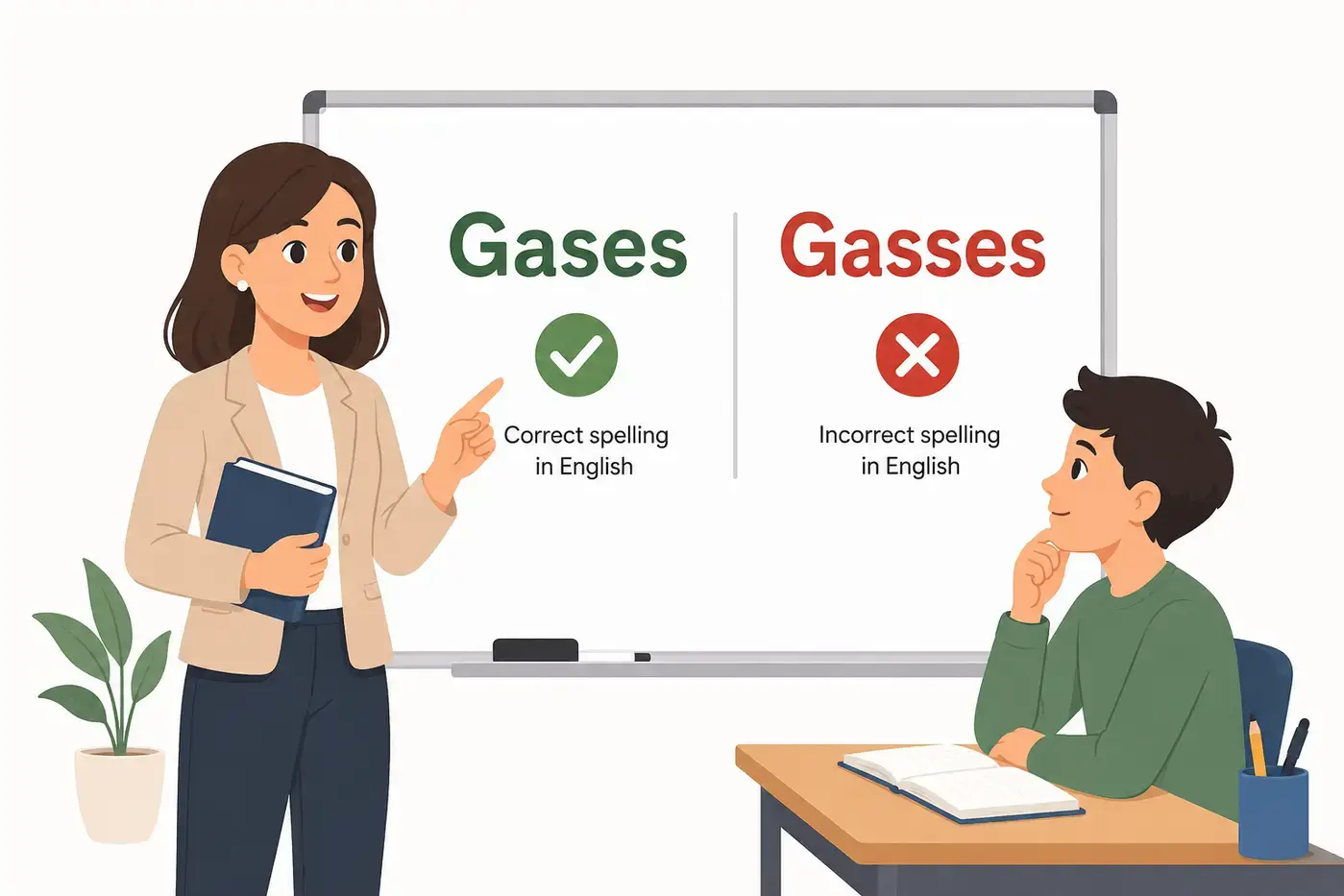
If you have ever paused while writing about air, oxygen, or other substances, you may have wondered if the correct spelling is gases or gasses. Gases is the standard plural of the noun gas, while gasses is a valid spelling of the verb that means to expose someone or something to gas, or to talk excessively in informal use. The two forms look almost identical, but they do different jobs in a sentence.
The confusion comes from a common English spelling pattern. Many words ending in a single consonant double that consonant when a suffix is added, so writers may expect gas to become gasses. However, the usual plural spelling does not follow that pattern. English also allows some words to have different spellings as nouns and verbs, which adds another layer of confusion.
Understanding this distinction will help you write clearly in school assignments, workplace documents, scientific reports, emails, and everyday conversations. You will learn the meaning of each form, the grammar behind the spellings, how to pronounce them, and how to avoid common mistakes. Once you connect each spelling to its role in a sentence, the choice becomes much easier.
Still confused? Compare Inconsolable or Unconsolable Correct Spelling and Meaning.
Quick Answer
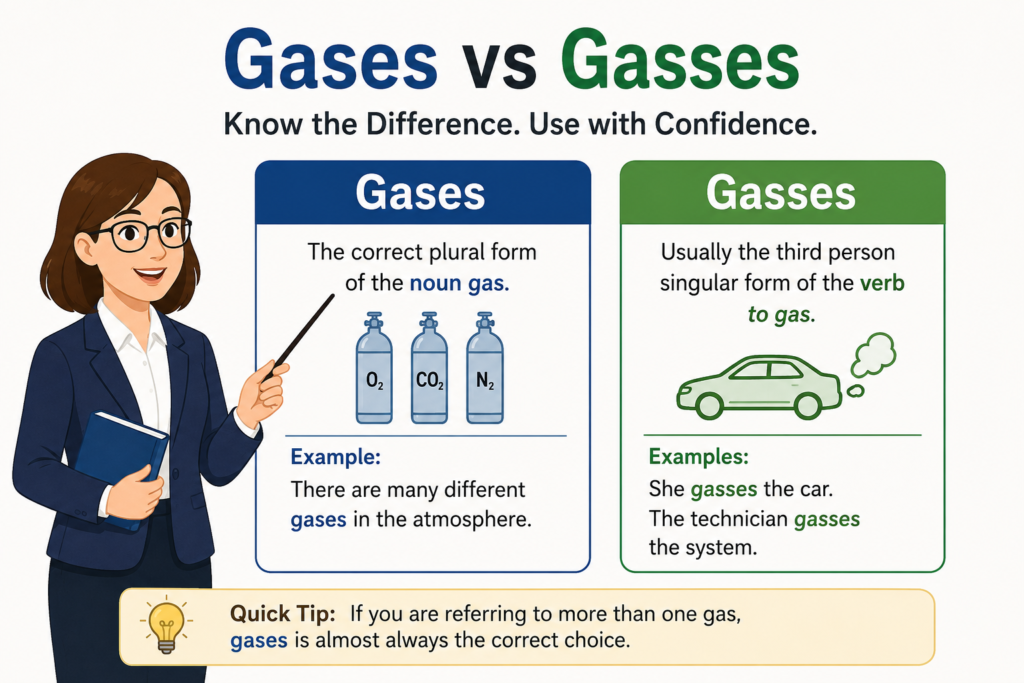
Gases is the correct plural form of the noun gas. Use it when referring to two or more gases, such as oxygen, nitrogen, or carbon dioxide. Gasses is not the standard plural spelling, but it is a legitimate verb form in expressions such as a car that gasses up or a person who gasses someone in a fictional story.
Comparison Table
| Form | Meaning | Part of Speech | Standard Usage | Example |
|---|---|---|---|---|
| Gases | More than one gas | Plural noun | Standard | Several gases are present in the sample. |
| Gas | A substance in the gaseous state | Noun | Standard | The gas escaped from the pipe. |
| Gasses | Exposes to gas or fills with gas | Verb form | Standard in the relevant verb sense | The character gasses the room in the story. |
| Gasses | More than one gas | Plural noun | Nonstandard in ordinary edited English | Write “gases” instead. |
The key is to identify the role of the word before choosing its spelling. If you are naming substances, use the plural noun. If you are describing an action, the verb spelling may be appropriate.
Meaning and Definition
What Does Gases Mean
Gases is the plural form of the noun gas. It refers to two or more substances in the gaseous state. Unlike solids and liquids, gases do not have a fixed shape or a fixed volume under ordinary conditions. They expand to fill the space available to them.
Common examples include oxygen, nitrogen, helium, hydrogen, and carbon dioxide. Air itself is a mixture of several gases, along with small amounts of other substances.
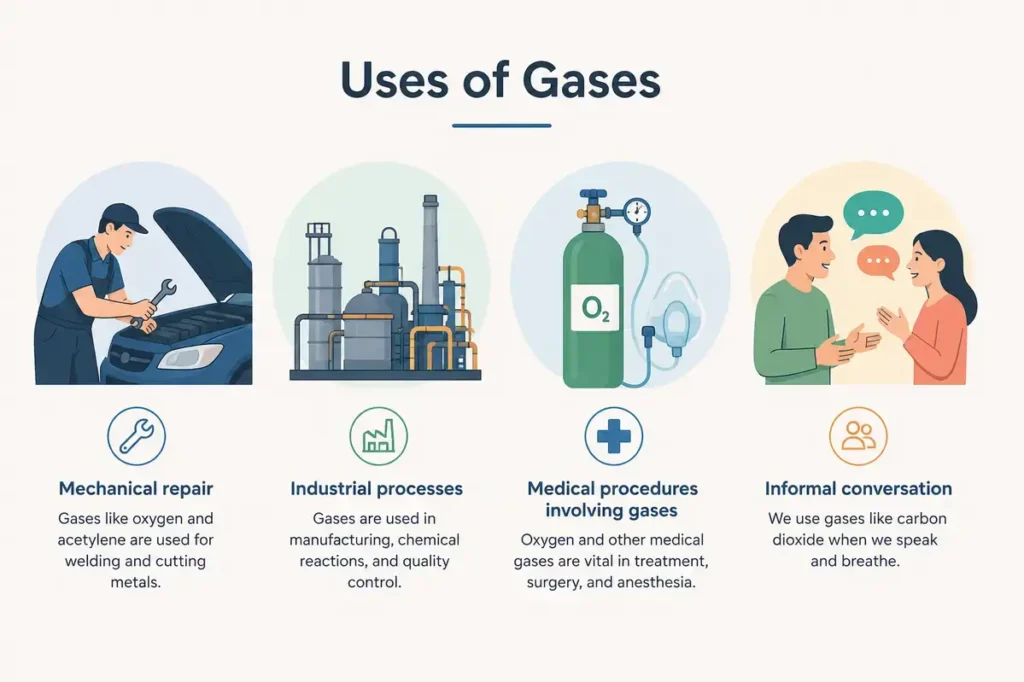
The word appears in many fields, including science, medicine, engineering, environmental studies, and everyday life. A science teacher might discuss the properties of gases, while an environmental report might examine greenhouse gases in the atmosphere.
Examples include:
- Oxygen and nitrogen are the main gases in Earth’s atmosphere.
- Some gases can be harmful when inhaled.
- The laboratory stores different gases in marked containers.
- Greenhouse gases affect the Earth’s climate.
In each sentence, the word names substances rather than describing an action.
What Does Gasses Mean
Gasses is a legitimate English spelling, but its meaning depends on how it is used. Most importantly, it can be a verb form rather than the usual plural noun.
As a verb, gas can mean to expose someone or something to gas. In a historical, military, or fictional context, a sentence might describe a person who gasses a room. The form can also appear in informal language related to filling a vehicle with fuel, especially in expressions such as gassing up.
In some informal contexts, the verb gas can also mean to talk at length or to deceive someone, though the exact meaning depends on the expression and region. The form gasses can serve as the third person singular present tense, as in “He gasses on about his new project.”
These uses do not make gasses the standard plural of the noun gas. A sentence about several chemical substances still calls for gases.
Is Gasses a Real Word
Yes, gasses is a real word when it serves as a verb form. It is not simply a meaningless typo in every context. However, using it as the plural noun for gas is generally considered nonstandard in edited English.
This distinction matters because a spelling checker may flag a word based on its context, but the spelling itself is not always wrong. For example, a writer describing a fictional character who releases a gas may correctly write that the character gasses a room. A chemistry student writing about several substances should use gases instead.
The best approach is to consider both meaning and grammar. Ask yourself if the word names substances or describes an action. That simple check usually settles the question.
Key Differences Explained
The main difference involves grammar, not pronunciation. The two spellings are closely related, but they do not serve the same purpose in standard written English.
1. Spelling
Use gases when you make gas plural. English has several nouns that form their plurals in ways that do not match the spelling pattern people expect. Gas is one of them.
For example, you write one gas and two gases. You do not normally write two gasses in scientific, academic, or professional writing.
Gasses appears when the word functions as a verb. The extra s is part of the verb spelling pattern used in forms such as passes, misses, and discusses. The form depends on the base verb and its grammatical use.
2. Meaning
Gases names substances. It may refer to gases in the atmosphere, gases produced by a chemical reaction, or gases used in a medical or industrial setting.
Gasses describes an action when it comes from the verb gas. The meaning may involve exposing someone to gas, supplying a vehicle with fuel in informal usage, or talking excessively in an expression such as gasses on.
Compare these sentences:
- Several gases were detected in the sample.
- The character gasses the room in the final scene.
The first sentence names substances. The second describes an action.
3. Grammar and Part of Speech
Gases is a plural noun. It often follows numbers or words such as several, many, different, and various.
Examples include “three gases,” “many gases,” and “different gases.”
Gasses is a verb form in sentences where the subject performs an action. It commonly follows a singular subject in the simple present tense, as in “The machine gasses the chamber.” The correct meaning depends on the verb being used.
4. Pronunciation
In ordinary speech, the plural noun gases and the verb form gasses are pronounced the same way. Both commonly sound like GAS iz, with stress on the first syllable.
This means pronunciation alone will not tell you which spelling to choose. You must use the meaning and sentence structure to decide.
5. Formality
Gases is appropriate in every register, from casual conversation to formal scientific writing. It is the standard plural noun.
Gasses is also appropriate when it is the correct form of a verb. However, using it as the plural noun in a school paper, technical report, or professional document may look like a spelling mistake.
6. Context
The surrounding words often make the distinction clear. If you see a phrase such as “greenhouse gases,” “toxic gases,” or “gases in the atmosphere,” the word is functioning as a noun.
If the sentence describes an action performed by a person, machine, or fictional character, the verb form may be suitable. Always check the whole sentence instead of judging the spelling by itself.
7. Regional Usage
American, British, Canadian, and Australian English generally use gases as the plural of gas. There is no major regional spelling difference for this noun.
Some verb expressions vary in frequency or meaning across regions. For example, informal expressions about putting fuel in a car may differ depending on local vocabulary. Those differences do not change the standard plural spelling.
Which Form Is Correct
The correct spelling for the plural noun is gases. This is the established form used in standard English dictionaries and in general scientific and professional writing.
The reason is simple: English plural formation does not follow one rule in every case. Many nouns add s or es, but writers must still learn the established spelling of each word. Gas forms its usual plural by adding es, producing gases.
The verb follows a different pattern. When gas is used as a verb in the relevant sense, its third person singular present form is gasses. For example, “The device gasses the chamber” describes an action rather than naming more than one gas.
Use these practical rules:
- Write gases when you mean multiple substances.
- Write gasses when it is the correct present tense form of the verb gas.
- Check the sentence if both spellings seem possible.
- In formal writing, do not use gasses as the plural noun.
A quick grammar check is often enough. If you can replace the word with “several substances,” choose gases. If the sentence describes what someone or something does, examine the verb meaning before selecting the spelling.
Sentence Examples
Here are ten natural examples showing the standard noun and the relevant verb form in context.
Examples Using the Plural Noun
- Everyday conversation: “The smell might come from gases escaping through the old pipe.”
- Text message: “The science lab is testing several gases today.”
- Workplace communication: “Please check the sensor readings for any dangerous gases in the storage area.”
- School assignment: “Plants and animals depend on the exchange of gases during several biological processes.”
- Academic writing: “The experiment measured how different gases behaved under changes in temperature and pressure.”
- Formal writing: “The facility must follow safety procedures for storing and transporting compressed gases.”
- Social conversation: “Some gases have no smell, so you cannot always detect a leak by breathing near it.”
- Online communication: “Greenhouse gases are one factor scientists study when they examine climate change.”
- News reporting: “Officials investigated reports of harmful gases near the industrial site.”
- Literature or storytelling: “Strange gases drifted through the abandoned tunnel, hiding the walls from view.”
These examples show how the noun works in different settings. It may appear after a number, an adjective, or a verb, but it keeps the same plural spelling.
Examples Using the Verb Form
Use these examples to understand why the other spelling can be correct in a different grammatical role.
- The fictional villain gasses the room before the guards arrive.
- The technician gasses the chamber as part of the controlled procedure.
- In the story, the machine gasses the tunnel to force the creatures outside.
- He gasses on about his favorite hobby until everyone checks the time.
- She says her brother gasses up the car before every long trip.
The verb meaning changes with context, and some examples are informal or specific to a particular setting. The important point is that these sentences describe actions. They do not use the word as the plural noun for gas.
Common Mistakes and Misspellings
Writers often make mistakes because English spelling patterns overlap. These are the most useful errors to watch for.
1. Using Gasses as the Plural Noun
Incorrect: The factory released several harmful gasses.
Correct: The factory released several harmful gases.
The writer has applied a familiar doubling pattern to the noun. In standard English, the plural is gases. This is the most important distinction to remember when writing about chemistry, pollution, air quality, or industrial safety.
2. Using Gases as a Verb
Incorrect for the intended present tense meaning: The character gases the room.
Correct: The character gasses the room.
When the intended meaning is exposing a place to gas, the verb form is gasses. The exact wording should still match the intended action and the context. In some situations, a clearer verb such as fills, exposes, or releases may make the sentence easier to understand.
3. Confusing the Plural Noun With a Singular Noun
Incorrect: The gases in the container is dangerous.
Correct: The gases in the container are dangerous.
The issue here is subject verb agreement. Gases is plural, so it normally takes a plural verb. Writers sometimes focus so closely on spelling that they overlook the grammar around the word.
4. Adding an Unnecessary Apostrophe
Incorrect: The gas’s in the room were tested.
Correct: The gases in the room were tested.
An apostrophe does not form an ordinary plural. It usually marks possession or a contraction. If you simply mean more than one gas, write gases without an apostrophe.
The spelling gas’s can be correct in another context, such as “the gas’s temperature,” where it shows possession. It is not the plural form.
5. Treating Every Use of Gasses as Wrong
Incorrect assumption: Gasses is always a misspelling.
Correct explanation: Gasses is a valid verb form, but gases is the standard plural noun.
Context matters. An editor should not automatically change every occurrence of gasses without checking the sentence. In a technical report about several substances, the word likely needs correction. In a sentence describing an action, the spelling may be right.
A Simple Editing Trick
Before you finalize a sentence, replace the word with a short explanation of its role. If it means “more than one gas,” use gases. If it means “performs an action involving gas,” check the verb and its intended meaning. This method is more reliable than relying on sound alone because the two forms are usually pronounced alike.
Pronunciation Guide
The noun gases and the verb form gasses are generally pronounced the same way in standard American English. The spelling difference does not create a meaningful difference in ordinary pronunciation.
- IPA: /ˈɡæsɪz/.
- Syllables: gas es.
- Easy pronunciation: GAS iz.
- Stress pattern: The first syllable receives the main stress.
The first part sounds like the word gas. The ending sounds like iz, similar to the ending in words such as boxes and classes. Say the word as two syllables rather than stretching the final sound into a separate stressed syllable.
Common Pronunciation Errors
One mistake is to pronounce the ending as a strong z sound without the extra vowel. In standard speech, the ending usually has two distinct syllabic parts: GAS and iz.
Another mistake is to assume that the spelling difference changes the pronunciation. It normally does not. Speakers rely on context to understand the intended meaning, while writers must choose the spelling that matches the grammar.
If you are reading aloud from a science textbook, the plural noun will be clear from phrases such as “several gases.” In a sentence about a character who gasses a room, the action and sentence structure reveal the verb use.
Still confused? Compare Molding or Moulding Which Spelling Is Correct.
Etymology and Word Origin
The word gas has an interesting history. It entered European scientific vocabulary in the early modern period and is commonly linked to the work of the Flemish chemist Jan Baptista van Helmont in the seventeenth century. He used a form of the word in his writing about substances released during processes such as burning and fermentation.
The word is often connected to the Greek word chaos, which refers to a vast or disordered space. Van Helmont used the term to describe a substance that did not behave like a solid or liquid. Over time, gas became the established English word for a state of matter.
The plural gases developed from the noun gas through the ordinary English process of plural formation. The form follows the established spelling convention for this particular noun, even though some writers expect a doubled s.
The verb gas developed from the noun. As English speakers began using the word to describe actions involving gas, it took on verb forms such as gasses and gassed. The same base word can therefore appear in different grammatical roles, with spelling changes that depend on its function.
The important lesson is that word history can help explain a spelling, but modern usage determines what you should write today. For current writing, gases remains the standard plural noun.
Regional Usage
The plural spelling is consistent across the major varieties of English. There is no established regional rule that changes the standard plural noun to gasses.
American English
In the United States, gases is the normal plural spelling in schoolwork, news reports, science writing, and everyday communication. Writers use it for substances such as oxygen, nitrogen, and carbon dioxide.
American English also uses gas as an informal term for gasoline. In this setting, phrases such as “get gas” and “gas up the car” refer to vehicle fuel. The verb forms depend on the sentence. For example, a person may say that someone gasses up a vehicle, though other expressions are more common in everyday speech.
Do not confuse this informal fuel related meaning with the plural noun. If you are discussing multiple substances, gases is still the standard choice.
British English
British English also uses gases as the plural of gas. Scientific, educational, and general writing follow the same spelling convention as American English.
One difference is everyday vocabulary for vehicle fuel. British speakers commonly use petrol instead of gas when referring to gasoline. This affects the words people choose in conversation, not the plural spelling of the scientific noun.
The verb gasses remains possible in the appropriate sense, but the surrounding context determines its meaning.
Australian English
Australian English follows the same standard plural spelling. A science textbook, workplace report, or news article will normally use gases to refer to multiple substances.
Local expressions for fuel and informal speech may differ from those in the United States. Those differences do not create a separate plural spelling rule.
Canadian English
Canadian English also uses gases as the standard plural noun. This form is appropriate in formal reports, classroom assignments, public information, and everyday writing.
Canadian usage often shares features with both American and British English, but the spelling distinction discussed here is not one of the major differences between those varieties. In all four varieties, choose gases for the plural noun and reserve gasses for the relevant verb form.
Grammar Rules and Part of Speech
Understanding the grammar makes the spelling easier to apply. The noun and verb forms share the same base word, but they behave differently in a sentence.
Gases as a Plural Noun
Gas is a count noun when you refer to separate types or samples of the substance. Its plural form is gases.
Examples:
- One gas escaped from the cylinder.
- Three gases were identified during the experiment.
- Several gases can contribute to air pollution.
- The researcher compared the properties of two gases.
The plural noun can act as a subject, a direct object, or the object of a preposition. It may also follow a determiner such as these, those, many, or several.
For example, in “These gases require careful handling,” the word gases is the subject. In “The device measures gases in the air,” it is the direct object. In “The report describes the behavior of gases,” it follows the preposition of.
Gas as a Mass Noun
Gas can also refer to the substance in general, without counting individual types or samples. In this use, it often behaves as a mass noun.
Examples include:
- Gas can expand when heated.
- The room smelled of gas.
- The equipment uses gas to generate heat.
You do not need a plural ending when talking about gas as a general substance. Use the plural when you mean distinct kinds, samples, or categories.
Compare “Gas is used in the process” with “Several gases are produced in the process.” The first sentence refers to the substance generally, while the second points to multiple types or substances.
Gasses as a Verb
As a verb, gas can have several meanings depending on context. The form gasses is commonly used with a singular third person subject in the simple present tense.
Examples:
- The machine gasses the chamber.
- He gasses on about the same topic.
- The driver gasses up before leaving.
The third example reflects an informal expression related to adding fuel. In formal technical writing, a more precise verb may be preferable. The first example describes an action involving gas, while the second uses a conversational expression.
Past Tense and Other Verb Forms
The verb gas can take other forms, including gassed as the simple past and past participle, and gassing as the present participle.
Examples:
- The technician gassed the chamber during the procedure.
- The team is gassing the test area in the fictional scene.
- The vehicle was gassed up before the trip.
These forms follow verb spelling rules rather than the plural noun rule. That is why the spelling changes across the verb forms.
Subject Verb Agreement
When gases is a plural noun used as the subject, pair it with a plural verb in ordinary present tense sentences.
Correct: The gases are stored in separate containers.
Incorrect: The gases is stored in separate containers.
However, gas as a singular mass noun normally takes a singular verb.
Correct: Gas is stored in the tank.
This distinction is especially useful in science writing, where both singular and plural forms appear frequently.
Articles and Determiners
Use a or an with the singular count noun when appropriate, but do not put either article directly before the plural noun.
Correct: A gas escaped from the container.
Correct: Several gases escaped from the container.
Incorrect: A gases escaped from the container.
You can also use the definite article with either number when the context identifies the substance or substances.
Examples: “The gas was measured” and “The gases were measured.”
Punctuation and Possession
Do not use an apostrophe to create a plural. Gases is the ordinary plural, while gas’s can mark possession in a phrase such as “the gas’s pressure.” The plural possessive form is gases’ in a phrase such as “the gases’ combined effect,” although a writer can often make the sentence simpler by rephrasing it.
In formal writing, punctuation should support the meaning rather than imitate the way a word sounds. The final s in gases does not require an apostrophe merely because the word ends in s.
Real Life Usage Examples
The word appears in daily life, work, school, journalism, and storytelling. The examples below show how the noun fits naturally into each setting.
Daily Conversation
- “The mechanic checked the car for gases that could leak from the exhaust system.”
- “Some gases have no color, so a person may not notice a leak right away.”
In conversation, people often use broad terms rather than technical names. The plural remains useful when discussing more than one substance or type.
Email and Workplace Communication
- “Please confirm that all compressed gases are stored in the designated area.”
- “The maintenance team found signs that gases may have escaped from the pipe.”
Workplace messages benefit from direct wording. In a safety notice, using the standard noun spelling helps avoid confusion, especially when the message concerns hazardous materials or operating procedures.
Academic Writing
- “The study compared the solubility of several gases in water.”
- “The results showed that different gases respond differently to changes in pressure.”
Academic writing often needs precise language. The noun gases can refer to a group of substances, while a more specific term may be needed when the report focuses on a single gas.
News and Journalism
- “Investigators tested the air after residents reported unusual gases near the facility.”
- “The report examined emissions of greenhouse gases from several industrial sources.”
News writing should distinguish confirmed findings from early reports. The spelling itself is straightforward, but the surrounding description should accurately reflect what investigators know.
Literature and Storytelling
- “Pale gases curled along the floor of the underground chamber.”
- “In the final chapter, the villain gasses the room before making his escape.”
Storytelling may use both forms in the same scene. The first example names mysterious substances, while the second describes an action. Fictional context can make the verb meaning clearer, but the grammar still determines the spelling.
Related and Confused Terms
These eight terms can help you discuss gases more precisely and avoid confusing related ideas.
1. Gas
Gas is the singular noun. It can refer to one type or sample of gas, or to the substance in general.
Example: “The gas in the container was tested.”
Use gas when referring to a single substance or to the material generally. Use gases when referring to multiple types or samples.
2. Gaseous
Gaseous is an adjective meaning in the form of a gas or related to gas. It describes a state, quality, or condition rather than naming several substances.
Example: “Water becomes gaseous when it changes into water vapor.”
This adjective often appears in scientific writing. It does not replace the plural noun.
3. Gasoline
Gasoline is a liquid fuel used in many vehicles. In American English, people often shorten the word to gas in everyday conversation.
Example: “I need to stop for gasoline before the trip.”
The everyday use of gas for fuel can cause confusion because gas also refers to a state of matter. Context usually makes the intended meaning clear.
4. Vapor
Vapor is the gaseous form of a substance that is normally a solid or liquid under given conditions. In everyday speech, people sometimes use vapor and gas loosely, but technical contexts may distinguish them.
Example: “The warm liquid released vapor into the air.”
Use the term that best matches the substance and the level of scientific precision required.
5. Emissions
Emissions are substances released into the air or another environment. They may include gases, particles, or other materials, depending on the context.
Example: “The company is working to reduce emissions from its equipment.”
Not all emissions are gases, so the terms should not be treated as exact synonyms.
6. Greenhouse Gases
Greenhouse gases are gases in the atmosphere that absorb and emit infrared radiation, helping retain heat in the climate system. Common examples include carbon dioxide, methane, and nitrous oxide.
Example: “Researchers study greenhouse gases to understand changes in the climate.”
This is a useful specific phrase when discussing climate science rather than gases in general.
7. Gas Leak
A gas leak occurs when gas escapes from a pipe, container, appliance, or other system that should contain it.
Example: “The residents left the building after a possible gas leak was reported.”
The phrase usually refers to an unwanted release. In real life, a suspected leak should be handled according to local emergency guidance rather than investigated by an untrained person.
8. Gassing
Gassing is the present participle or gerund form of the verb gas. Its meaning depends on the context. It may describe exposing an area to gas, filling a vehicle with fuel in informal speech, or talking excessively in a casual expression.
Example: “The character was gassing the room in the scene.”
This word is related to gasses as a verb, not to gases as the standard plural noun.
Expert Editor Insight
An experienced editor checks the sentence before changing the spelling. If a report mentions gases in a lab, the plural noun is clear. If a sentence says a character gasses a room, the word may be a correct verb form. Spelling tools can help, but they may not understand the intended meaning of every sentence. My practical tip is to check the word’s job first, then check the spelling. This prevents unnecessary corrections and helps you preserve the writer’s intended meaning.
Key Takeaways
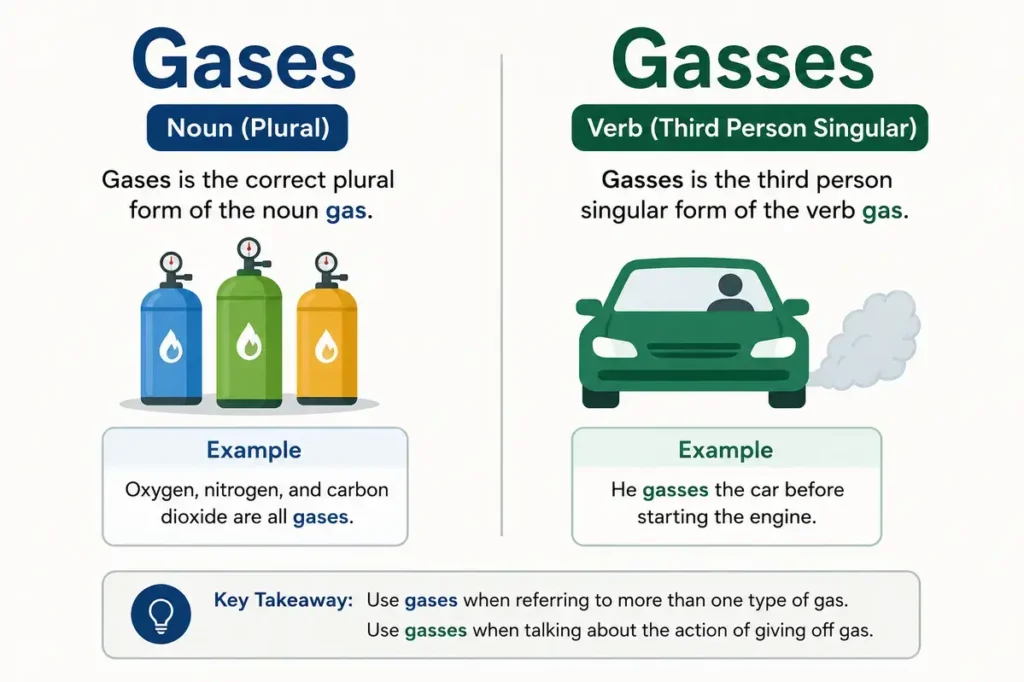
- Gases is the correct plural form of the noun gas.
- Gasses is the third person singular form of the verb gas.
- If you are referring to more than one gas, use gases.
- If someone is adding gas, fueling equipment, or exposing something to gas, use gasses.
- Both words are correct English spellings, but they have different grammatical functions.
- Gases is far more common than gasses in everyday writing.
- Scientific, medical, and environmental writing almost always uses gases.
- Sentence context determines which spelling is correct.
Many readers also check Conscience vs Conscious Which Word Is Correct.
Conclusion
The choice between Gases or Gasses becomes simple once you identify the word’s role in the sentence. Gases is the standard plural of gas and is the right choice when discussing multiple substances, from oxygen in the air to gases released by industrial processes.
Gasses is a valid verb form in the right context, but it should not replace the standard plural noun in formal writing. Since both forms usually sound the same, pronunciation alone cannot settle the spelling. Here is an easy editing tip to remember: if you mean more than one gas, write gases. Check the sentence’s meaning before making any other correction.
FAQs
Is Gasses a Real Word?
Yes, gasses is a real English word when used as a verb form. It can describe exposing someone or something to gas, or it can appear in informal expressions such as gassing up a vehicle or gassing on about a subject. However, it is not the standard plural spelling of the noun gas. For multiple substances, write gases.
What Does Gases Mean?
Gases is the plural form of gas. It refers to two or more substances in the gaseous state, such as oxygen, nitrogen, helium, or carbon dioxide. The word is common in science, environmental studies, medicine, and everyday conversation. For example, “The experiment measured several gases” refers to multiple substances, not to an action performed by a person or machine.
Which Is Correct Gases or Gasses?
Use gases when you mean more than one gas. This is the standard plural spelling in American English and other major English varieties. Use gasses only when it serves as the correct form of the verb gas. The distinction depends on grammar and meaning, not pronunciation, since the two forms are usually pronounced alike.
How Do You Pronounce Gases?
Gases is usually pronounced GAS iz, with two syllables and stress on the first syllable. Its IPA pronunciation is /ˈɡæsɪz/. The verb form gasses generally has the same pronunciation. Because the words sound alike, speakers rely on sentence context to understand the meaning, while writers must choose the spelling that matches the grammatical role.
Can Gases Start a Sentence?
Yes, gases can start a sentence when the word acts as the subject. For example, “Gases expand to fill the space available to them” is grammatically correct. Starting a sentence with the plural noun does not change its spelling or meaning. Just make sure the verb agrees with the plural subject, as in “Gases are present.”
What Is a Synonym for Gases?
There is no single synonym that fits every use of gases. In a scientific context, you might name the specific substances, such as oxygen or nitrogen. Words such as vapors or emissions can be related, but they do not mean exactly the same thing. Choose a replacement based on the substance, the context, and the level of scientific precision you need.
Why Do People Confuse Gases and Gasses?
People confuse the spellings because English often doubles a final consonant when adding certain endings. That pattern can make gasses look like the expected plural. However, the standard plural of gas is gases. The other spelling is valid as a verb form, which makes the distinction more subtle than a simple correct spelling versus a completely invented word.
Is Gases Appropriate in Formal Writing?
Yes, gases is the standard plural noun and is appropriate in formal writing, including academic papers, technical reports, workplace documents, and news articles. Use it when discussing multiple substances in the gaseous state. Avoid using gasses as the plural noun in edited work. If the word describes an action instead, check the sentence to confirm that the verb form is suitable.