
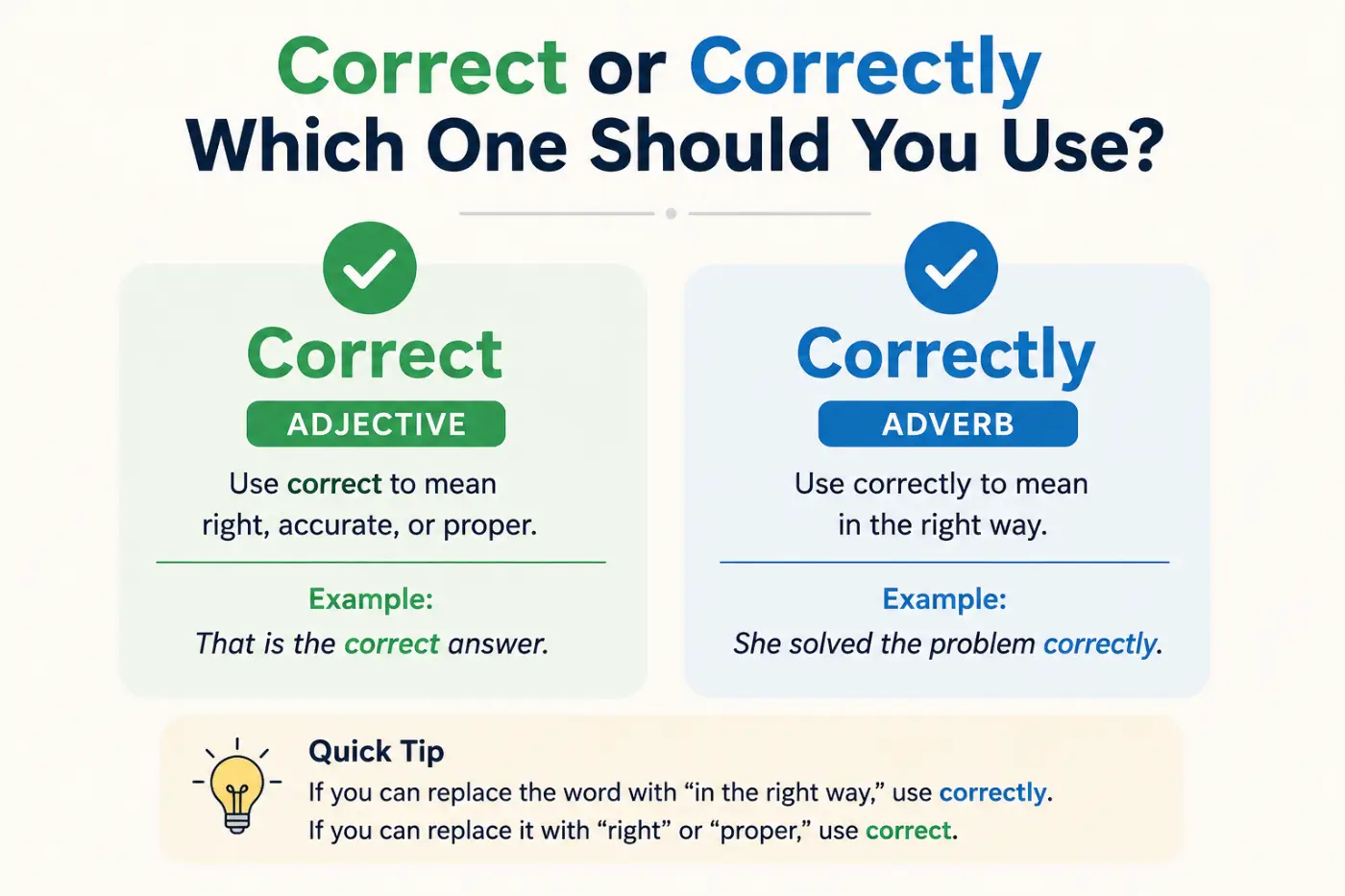
Choosing between correct or correctly can feel confusing because both words express the idea of being right. However, they serve different grammatical roles, so you cannot always use one in place of the other. The key is to look at what the word describes in your sentence.
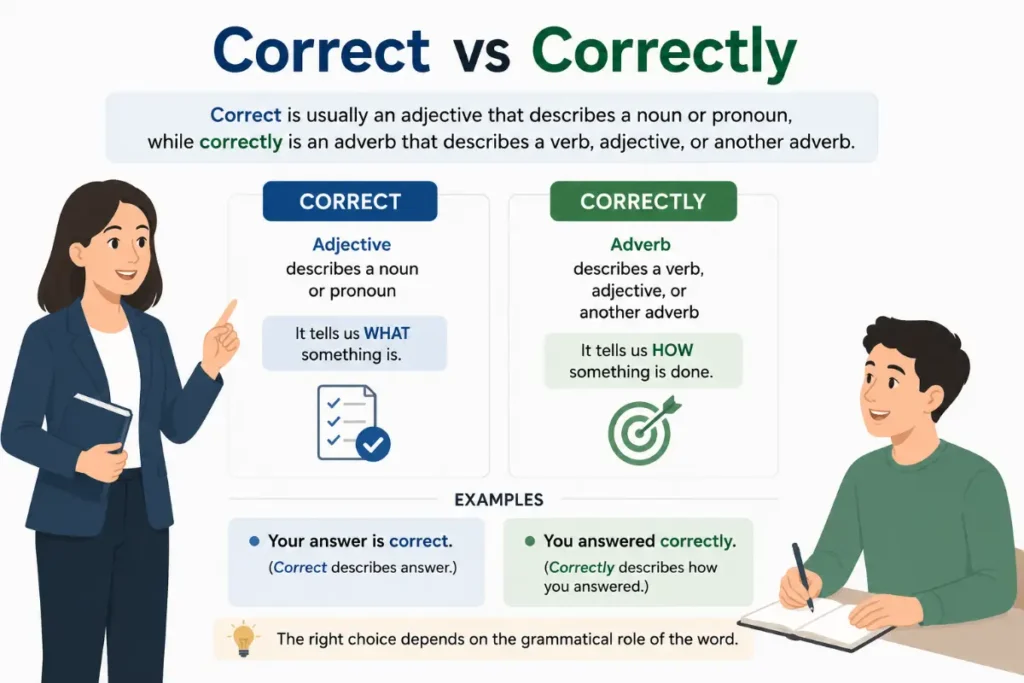
Use correct mainly as an adjective when you describe a person, answer, fact, choice, or action as right or accurate. Use correctly as an adverb when you explain how someone performs an action. For example, you can give a correct answer, but you answer correctly. The first describes the answer itself, while the second describes how you answered.
This distinction matters in school assignments, workplace emails, instructions, reports, and everyday conversation. Once you recognize the word that each form modifies, the choice becomes much easier. You will also learn how to avoid common grammar errors, understand related expressions, pronounce both words, and use them naturally in American English. The practical rule is simple: describe a thing with the adjective and describe an action with the adverb.
A related grammar guide is Emigrate vs Immigrate and How to Use Each Word.
Quick Answer
Use correct to describe something that is right, accurate, or free from error. Use correctly to describe an action performed in the right way. For example, “Your answer is correct” describes the answer, while “You answered correctly” describes how you answered.
Comparison Table
| Feature | Correct | Correctly |
|---|---|---|
| Part of speech | Usually an adjective; also a verb | Adverb |
| Main meaning | Right, accurate, or free from error | In the right or accurate way |
| Typical function | Describes a noun or follows a linking verb | Modifies a verb, adjective, or another adverb |
| Common pattern | A correct answer | Answer correctly |
| Pronunciation | kuh REKT | kuh REKT lee |
| Formality | Standard in formal and informal English | Standard in formal and informal English |
| Example | The spelling is correct. | You spelled the word correctly. |
| Common mistake | Using it to modify an action when an adverb is needed | Using it to describe a noun directly |
Meaning and Definition
What Does Correct Mean
Correct means right, accurate, suitable, or free from mistakes. It can describe a fact, answer, spelling, method, choice, statement, or piece of information. For example, “The address is correct” tells you that the address contains the right information.
In its most common use, the word is an adjective. Adjectives describe nouns and pronouns, and they can appear before a noun or after a linking verb such as is, seems, or looks.
Consider these examples.
- She selected the correct answer.
- Your phone number is correct.
- That seems like the correct approach.
- The teacher marked my response correct.
In each sentence, the word describes a person, thing, answer, or approach as right or accurate. It does not explain how someone performed an action.
The word can also function as a verb. To correct something means to fix an error or make an improvement. For instance, “Please correct the spelling in the report” asks someone to fix the mistakes. In this sentence, the word expresses an action rather than describing something.
What Does Correctly Mean
Correctly is an adverb that means in a right, accurate, proper, or acceptable way. It commonly modifies verbs by explaining how an action is performed.
For example, “He entered the password correctly” means he entered the right password or used the proper sequence. The adverb describes the action of entering, not the password as a noun.
Here are a few more examples.
- Maya answered the question correctly.
- Please install the software correctly.
- The machine is working correctly.
- You pronounced my name correctly.
The word can also modify adjectives or other adverbs in suitable contexts, though its most familiar role is modifying verbs. For example, “The statement is grammatically correct” uses grammatically to modify correct. In “The system is functioning correctly,” the adverb explains how the system is functioning.
The central distinction is the word’s job in the sentence. An adjective describes a noun or pronoun, while an adverb often describes an action or state.
Are the Two Words Related
Yes. Both forms share the same word family and express the idea of accuracy or conformity to a standard. The ending ly turns the adjective into an adverb in this case.
That pattern appears in many common English words. Quick becomes quickly, careful becomes carefully, and accurate becomes accurately. The form changes because the grammatical role changes.
However, the ending does not mean that every adverb can replace its related adjective. You still need to check what the word describes. A correct statement and a statement written correctly can communicate related ideas, but their grammatical structures are different.
Key Differences Explained
Spelling
The adjective is spelled correct. The adverb is spelled correctly, with the letters ly added to the end.
Both are standard English forms. Neither is a misspelling, and neither is automatically more formal than the other. The choice depends on grammar and meaning.
Meaning
The adjective identifies something as right or accurate. The adverb explains that an action was performed in the right or accurate way.
Compare these sentences.
- The form is correct.
- You completed the form correctly.
The first sentence evaluates the form. The second evaluates the way someone completed it.
Grammar
The adjective commonly appears before a noun or after a linking verb. The adverb commonly appears near the verb it modifies, although its position can change for emphasis or sentence flow.
For example, “She gave the correct answer” uses an adjective before the noun answer. “She answered the question correctly” uses an adverb to describe the action answered.
Part of Speech
In ordinary usage, the first form is most often an adjective, while the second is an adverb. The adjective can also work as a verb, as in “Correct the error.”
This distinction helps you choose the right form without relying on how a sentence sounds. Identify the noun or action first, then select the word that fits its role.
Pronunciation
Both forms begin with the same sound and share the same main stress. The adverb has an extra unstressed syllable at the end.
The adjective is pronounced kuh REKT. The adverb is pronounced kuh REKT lee. The additional syllable reflects the added ending, but the main stress stays on rect.
Formality
Both words are suitable for casual conversation, academic writing, professional emails, and official documents. The adverb is not inherently more formal, and the adjective is not inherently more casual.
What matters is the sentence structure. In a formal report, “The figures are correct” and “The figures were calculated correctly” are both appropriate, but they communicate different things.
Context and Regional Usage
American, British, Canadian, and Australian English use these forms in essentially the same way. There is no major regional spelling difference between them.
Some phrases may vary by region or workplace, but the basic adjective and adverb distinction remains consistent. A writer in the United States should follow the same core grammar rule as a writer in the United Kingdom.
Which Form Is Correct
Both forms are correct English words. The right choice depends on what you want to describe, not on which word is more proper.
Use the adjective when you describe a noun or pronoun as accurate. Use the adverb when you explain how an action happens or was performed.
Compare the following examples.
- Correct: Her calculation is correct.
- Correct: She calculated the total correctly.
- Incorrect for the intended meaning: She calculated the total correct.
- Correct: The machine is functioning correctly.
- Correct: The machine is in correct working order.
In the third example, the standard choice in formal American English is correctly because the word describes the action of calculating. Some speakers use adjective forms informally after verbs in certain expressions, but that does not make them the best choice for careful standard writing.
A useful test is to ask what the word describes. If it describes a thing, person, answer, or condition, the adjective may fit. If it describes how someone does something, the adverb is usually the better choice.
Dictionary entries distinguish these grammatical uses because the forms perform different jobs. This is a matter of standard grammar, not a difference in spelling preference.
Sentence Examples
These examples show how the two forms work in everyday situations. Notice that the adjective describes a thing or condition, while the adverb explains how an action is carried out.
Ten Examples Using the Correct Form
- Everyday conversation: Your directions are correct, so we should reach the store in ten minutes.
- Text message: I checked the date, and the time you sent me is correct.
- Workplace communication: Please make sure the customer’s mailing address is correct before sending the package.
- Schoolwork: The student chose the correct answer after reviewing the lesson.
- Academic writing: The results are correct according to the calculation method used in the experiment.
- Formal writing: Please confirm that all details in the application are correct before submitting it.
- Social situations: You pronounced her name correctly, and she appreciated the effort.
- Online communication: The website displayed the correct price after I refreshed the page.
- Technical instructions: The technician connected the cables correctly, allowing the device to start.
- Daily life: If you follow the recipe correctly, the cake should bake evenly.
Five Examples That Show a Common Error
The following sentences illustrate mistakes that can occur when someone uses the adjective in place of the adverb. The corrected versions show the standard form for careful English.
1. Incorrect: She completed the assignment correct.
Correct: She completed the assignment correctly.
2. Incorrect: He spelled my last name correct.
Correct: He spelled my last name correctly.
3. Incorrect: The technician installed the program correct.
Correct: The technician installed the program correctly.
4. Incorrect: You answered all the questions correct.
Correct: You answered all the questions correctly.
5. Incorrect: The employee entered the figures correct.
Correct: The employee entered the figures correctly.
In each example, the word describes how someone completed an action. That calls for the adverb in standard written English. In casual speech, you may hear adjective forms used in similar positions, but the adverb is the safer choice for schoolwork, business writing, and formal communication.
Correct or Correctly in a Sentence
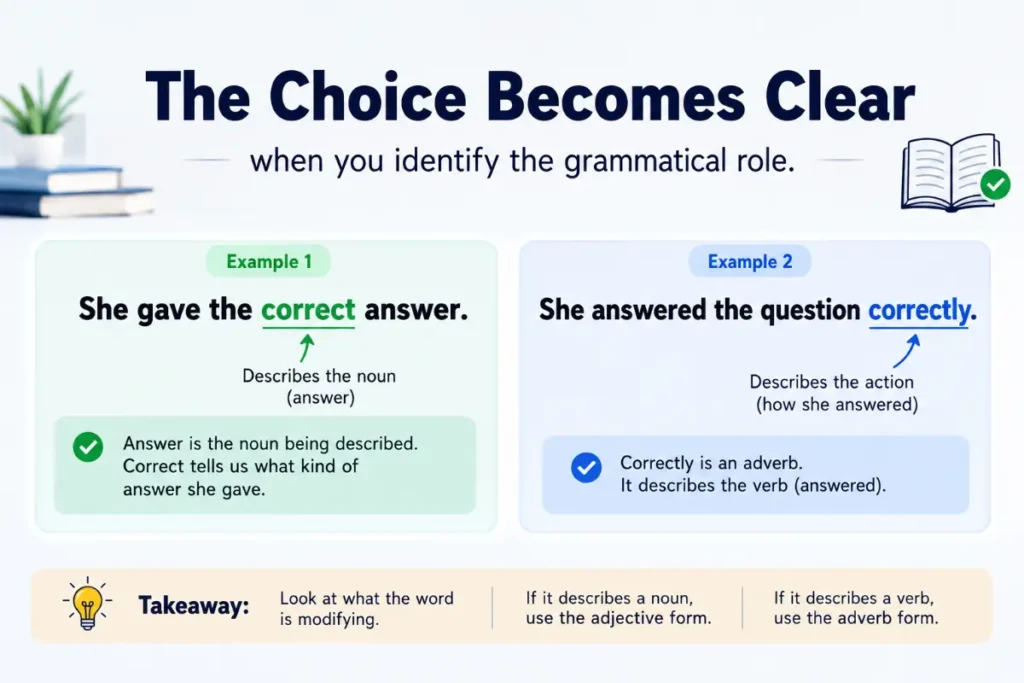
The choice becomes clear when you identify the grammatical role.
Consider “She gave the correct answer.”
Answer is the noun being described. Correct tells us what kind of answer she gave.
Now compare it with “She answered the question correctly.”
Common Mistakes and Misspellings
The most common problem is not spelling either word incorrectly. It is choosing the wrong grammatical form. A few other errors arise from adding the ending incorrectly or using the word in a sentence pattern that does not fit its meaning.
Using the Adjective After an Action Verb
Incorrect: He explained the process correct.
Correct: He explained the process correctly.
The word describes how he explained the process, so the adverb is the standard choice. A useful check is to identify the action verb and ask how the person performed it.
Using the Adverb to Describe a Noun
Incorrect: We received the correctly document.
Correct: We received the correct document.
The noun document needs an adjective to describe it. The adverb cannot directly fill that role in this sentence. Use the adjective before the noun.
Adding an Unnecessary Ending
Incorrect: The answer is correctly.
Correct: The answer is correct.
The linking verb is connects the subject to a description of its state. An adjective usually follows linking verbs such as be, seem, and appear when the sentence describes the subject.
Confusing Correctly With Correctly Spelled
These expressions are related, but they do not always mean the same thing. Saying that a word is spelled correctly focuses on its letters and spelling. Saying that a sentence is written correctly can refer to spelling, grammar, punctuation, and other language rules.
For example, a sentence may contain correctly spelled words but still have a grammar mistake. Check the specific issue you mean to describe.
Treating the Two Forms as Interchangeable
Incorrect for standard formal writing: She completed the form correct.
Preferred: She completed the form correctly.
The words share a root and a related meaning, but their grammatical functions differ. Do not choose based only on sound or habit. Check the role the word plays in the sentence.
A related grammar guide is Council vs Counsel Which Word Should You Use.
Pronunciation Guide
Both forms begin with the same sound and share the same stressed syllable. The adverb has one extra syllable because of its ending.
| Word | IPA | Syllables | Simple Guide |
|---|---|---|---|
| Correct | /kəˈrɛkt/ | Two | kuh REKT |
| Correctly | /kəˈrɛktli/ | Three | kuh REKT lee |
The main stress falls on the second syllable in the adjective and on the second syllable of the adverb. The added ending is unstressed.
Common Pronunciation Problems
- Putting stress on the first syllable. The usual pronunciation stresses REKT, not the opening kuh.
- Dropping the final sound. Make sure the adjective ends with the /t/ sound.
- Leaving out the extra syllable. The adverb has a clear final lee sound, which helps distinguish it in speech.
- Overstressing the ending. The ending should remain light. The main emphasis stays on the same syllable in both words.
Pronunciation can vary slightly by speaker and accent, but the basic stress pattern remains stable across common varieties of English.
Etymology and Word Origin
The word family has a long history connected to the idea of being straight, right, or in accordance with a rule. English received correct through French from Latin corrigere, a verb meaning to set straight, amend, or improve. The Latin word combines elements associated with making something right.
Over time, English developed the adjective correct for something that is accurate or free from error. The same word also became a verb meaning to fix or improve a mistake, as in correcting a report or correcting a misunderstanding.
The adverb correctly developed by adding the common English adverb ending ly to the adjective. This formation follows a familiar pattern seen in words such as clear and clearly. The shared history explains the related meanings, while the different endings signal different grammatical jobs.
Regional Usage
The distinction between the adjective and adverb is consistent across major English varieties. The spelling and basic grammatical functions do not change significantly from one region to another.
American English
In the United States, both forms are standard. Speakers commonly use the adjective in sentences such as “The answer is correct” and the adverb in sentences such as “You answered correctly.”
In schoolwork and professional writing, the adverb is generally expected when describing how an action was performed. Informal conversation may include looser constructions, but formal writing benefits from the standard distinction.
British English
British English follows the same rule. Writers use the adjective to describe a noun or state and the adverb to describe an action. There is no separate British spelling for either form.
The words are also suitable for both formal and informal communication. Any difference you notice is more likely to reflect personal style, sentence structure, or context than a regional grammar rule.
Australian English
Australian English also uses both forms according to their standard grammatical roles. For example, a person might say that a form is correct and that it was filled out correctly.
No major Australian spelling variation changes the distinction. Writers should focus on the function of the word in the sentence rather than trying to apply a special regional rule.
Canadian English
Canadian English uses the same standard forms. Both words appear in everyday speech, education, workplace communication, and formal documents.
The spelling choice does not depend on a Canadian versus American convention. The deciding factor is grammar: the adjective describes something, while the adverb explains how an action is performed.
Grammar Rules and Part of Speech
Understanding the main sentence patterns makes this distinction easier to apply. The same word family can describe a condition, explain an action, or express the act of fixing an error.
Use the Adjective Before a Noun
An adjective can appear directly before the noun it describes.
Examples include:
- We received the correct invoice.
- The correct procedure is listed in the manual.
- She provided the correct information.
In each sentence, the word describes a noun. It tells the reader which invoice, procedure, or information is right.
Use the Adjective After a Linking Verb
Linking verbs connect a subject with a word or phrase that describes it. The adjective often follows verbs such as be, seem, remain, and appear.
For example, “The total is correct” describes the total. “Your explanation seems correct” describes the explanation. In these sentences, the adjective does not describe an action performed by the subject.
Use the Adverb to Describe an Action
Adverbs often answer the question how. They explain the manner in which a person or thing performs an action.
Examples include:
- She entered the code correctly.
- The team followed the instructions correctly.
- He identified the problem correctly.
The adverb modifies the action in each sentence. It tells the reader how the code was entered, the instructions were followed, or the problem was identified.
Understand the Verb Correct
The word can also be used as a verb meaning to fix, amend, or point out an error. This use is separate from its role as an adjective.
Examples include:
- Please correct the date on the form.
- The editor corrected several errors in the report.
- I need to correct a mistake in my earlier message.
The verb may appear in different tenses, including corrects, corrected, and correcting. These forms describe an action rather than a quality.
Know When an Adverb Is Not Needed
Not every sentence needs an adverb. If you are describing a condition rather than an action, the adjective is often the right choice.
For example, “The figures are correct” is complete and natural. Replacing the adjective with the adverb would make the sentence incorrect for its intended meaning. First identify the sentence structure, then decide what kind of description it requires.
Place the Adverb Clearly
Adverbs can appear in different positions, but they should stay close enough to the action for the meaning to remain clear.
- She correctly identified the error.
- She identified the error correctly.
- She had correctly identified the error before the meeting.
All three sentences are grammatical. The placement changes the rhythm and emphasis, but the adverb still describes the act of identifying.
Use Punctuation Normally
Neither word requires special punctuation. Use commas, periods, and other marks according to the sentence structure, not because one form is an adjective and the other is an adverb.
For instance, “The answer is correct, so we can continue” uses a comma to join related independent clauses. The comma has nothing to do with the choice of word.
Real Life Usage Examples
The difference becomes easier to remember when you see both forms in realistic situations. The following examples show how they fit into conversations, work messages, academic writing, journalism, and storytelling.
Daily Conversation
People use these words when checking information, giving feedback, or describing a task.
- “Your address is correct, so the delivery should arrive tomorrow.”
- “You followed the directions correctly, even though the map was confusing.”
The first sentence describes the address. The second explains how someone followed the directions.
Email and Workplace Communication
Workplace writing often involves checking names, figures, dates, and instructions. Choosing the right form helps make requests and reports clear.
- “Please confirm that the figures in the attached report are correct before the meeting.”
- “The new employee completed the setup correctly by following each step in the guide.”
The adjective evaluates the figures, while the adverb describes the employee’s actions. Both forms are useful in professional communication.
Academic Writing
Students and researchers need to distinguish between an accurate result and the process used to reach it.
- “The final answer is correct, based on the values provided in the question.”
- “The researcher calculated the average correctly and recorded the result in the table.”
The first sentence evaluates a result. The second evaluates the method of calculation. In academic work, this distinction can make an explanation more precise.
News and Journalism
News writing often deals with facts, statements, records, and the methods used to verify them.
- “Officials confirmed that the figures in the public report were correct.”
- “The journalist correctly identified the date on which the policy took effect.”
The adjective describes the figures, and the adverb describes the journalist’s identification. Careful word choice helps distinguish the accuracy of information from the actions used to check it.
Literature and Storytelling
Stories use both forms to describe facts and show how characters act. The adjective can establish a detail, while the adverb can describe a character’s behavior.
- “The old map was correct, but the traveler had overlooked a narrow path.”
- “She carefully checked the locked door and correctly guessed that someone had entered the room.”
The first sentence describes the map. The second uses an adverb to show how the character reached a conclusion.
Related and Confused Terms
Several words share a meaning with these forms, but each has its own use. Knowing the distinctions helps you choose a word that communicates the exact idea you intend.
Accurate and Accurately
Accurate describes information or results that match the facts. Accurately describes an action performed with accuracy.
For example, “The measurement is accurate” describes the result, while “She measured the room accurately” describes the process. These words often overlap with the central pair, especially in technical or academic writing.
Right and Rightly
Right can mean correct, proper, or morally acceptable. Rightly often means justifiably or in a proper manner, depending on context.
For example, “Your answer is right” means the answer is correct. “She rightly questioned the claim” suggests that she had good reason to question it. The second word can carry a stronger sense of justification.
Exact and Exactly
Exact means precise or fully matching a required detail. Exactly can mean precisely, completely, or in precisely the stated way.
“The exact time is 3 p.m.” describes a specific time. “You described the problem exactly” explains how closely the description matched the facts. These words are useful when precision matters.
Proper and Properly
Proper means suitable, appropriate, or in line with accepted rules. Properly describes an action carried out in an appropriate way.
For example, “Use the proper equipment” describes the equipment. “Use the equipment properly” explains how to handle it. In some contexts, proper focuses more on suitability than factual accuracy.
Precise and Precisely
Precise describes something exact and clearly defined. Precisely means in an exact or specific way.
A precise measurement has little ambiguity. If someone follows instructions precisely, they follow them closely. These words are especially useful when small differences in detail matter.
Incorrect and Incorrectly
Incorrect is the opposite of correct when describing something wrong or inaccurate. Incorrectly describes an action performed in a wrong or inaccurate way.
For example, “The date is incorrect” evaluates the date. “She entered the date incorrectly” explains what went wrong during entry. The grammatical distinction is the same as that between the positive forms.
Correctness
Correctness is a noun that refers to the state or quality of being correct. It lets you discuss accuracy as an idea rather than describing a specific object or action.
For example, “The teacher checked the correctness of the answers” uses a noun to refer to their accuracy. In ordinary conversation, a simpler phrase such as “checked that the answers were correct” may sound more natural.
Correction
A correction is a change made to fix an error, or a statement that points out an error. It is a noun related to the verb correct.
For example, “The editor made a correction to the report” describes a change. “Please correct the report” uses the verb and asks someone to make the change. These forms belong to the same word family but perform different grammatical roles.
Expert Editor Insight
An experienced editor checks what each word modifies instead of relying on how a sentence sounds. If the word describes a noun, the adjective is usually the right fit. If it describes an action, the adverb is generally needed. Grammar checkers can flag some mistakes, but they may miss problems that depend on meaning or context. A reliable editing tip is to read the sentence and ask, “What is correct?” or “How was the action performed?” The answer usually reveals the form you need. This quick check works well for emails, school assignments, reports, and other everyday writing.
Key Takeaways
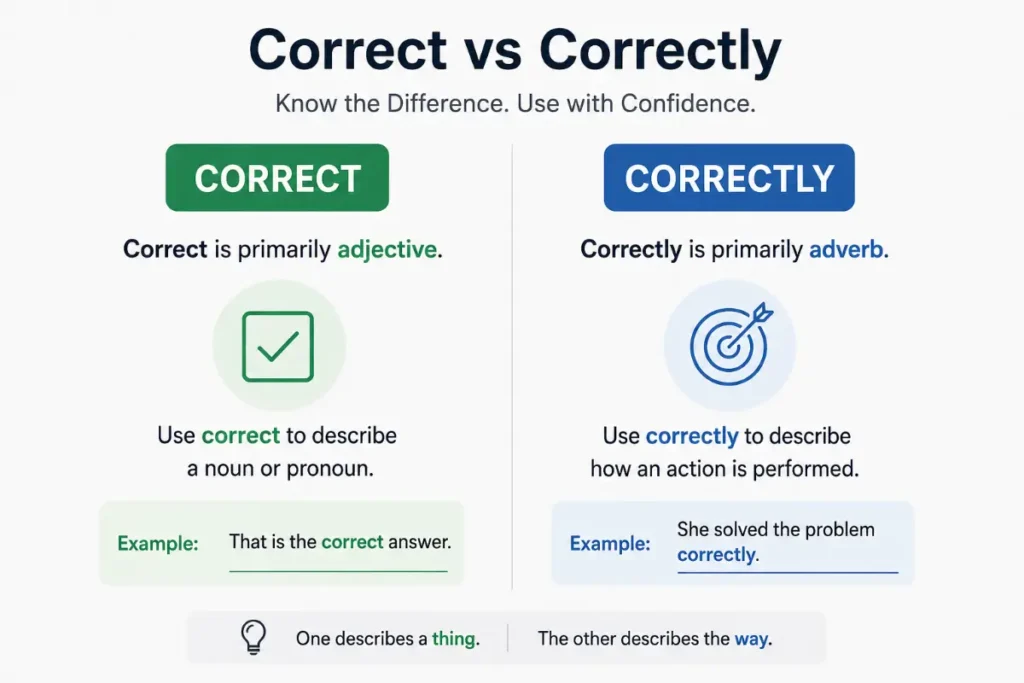
Correct is primarily an adjective.
Correctly is an adverb.
Use correct to describe a noun or pronoun.
Use correctly to describe how an action is performed.
You may also want to read Borrow vs Barrow Explained With Examples.
Conclusion
Choosing Correct or Correctly becomes simple when you understand the job each word performs. Use correct to describe something that is right or accurate, such as a fact, answer, spelling, or result. Use correctly to explain how someone performs an action, such as answering a question or completing a task.
Both forms are standard in American English, and neither is more formal than the other. The easiest editing trick is to ask what the word describes. If it describes a thing or condition, choose the adjective. If it explains how an action happens, choose the adverb. This small check can prevent many common grammar mistakes.
FAQs
Is correct or correctly the right choice in a sentence?
Both are standard words, but they serve different grammatical roles. Use correct to describe a noun or a subject after a linking verb, as in “The answer is correct.” Use correctly to describe an action, as in “She answered correctly.” The sentence determines the choice, so neither form is always right in every context.
What does correct mean?
Correct means right, accurate, suitable, or free from error. It is most often an adjective, as in “the correct number” or “the answer is correct.” It can also be a verb meaning to fix a mistake, as in “Please correct the spelling.” The intended meaning depends on how the word functions in the sentence.
What does correctly mean?
Correctly is an adverb meaning in a right, accurate, or proper way. It often describes how someone performs an action. For example, “He completed the form correctly” means he followed the required steps or entered the information properly. It does not usually describe a noun directly, so “the correctly answer” is not standard grammar.
Can I say that someone answered correct?
In standard formal English, “answered correctly” is the preferred form because the word describes the action of answering. You may hear “answered correct” in casual speech, but it is not the safest choice for academic or professional writing. Write “She answered the question correctly” when you want a clear, grammatically standard sentence.
How do you pronounce correct and correctly?
Correct is commonly pronounced kuh REKT, with two syllables and stress on the second syllable. Correctly is pronounced kuh REKT lee, with three syllables. Both forms keep the main stress in the same place. Saying the extra ending clearly can help listeners distinguish the adverb during conversation.
Can correct start a sentence?
Yes. The word can start a sentence when the sentence structure supports it. For example, “Correct information helps people make good decisions” uses it as an adjective before a noun. It can also start a command as a verb, as in “Correct the date before sending the document.” Capitalization does not change its grammatical role.
What is a synonym for correctly?
Useful alternatives include accurately, properly, precisely, and appropriately. The best choice depends on the meaning. Accurately emphasizes factual or numerical accuracy, while properly often emphasizes following the right method. Precisely stresses exactness, and appropriately focuses on suitability. These words are related, but they are not interchangeable in every sentence.
Is correctly appropriate in formal writing?
Yes. Correctly is standard in formal writing and works well in reports, essays, instructions, and professional emails. Use it when describing how an action was performed, as in “The figures were calculated correctly.” Use correct when describing a result or thing, as in “The figures are correct.” Both forms are appropriate when the grammar matches the intended meaning.