
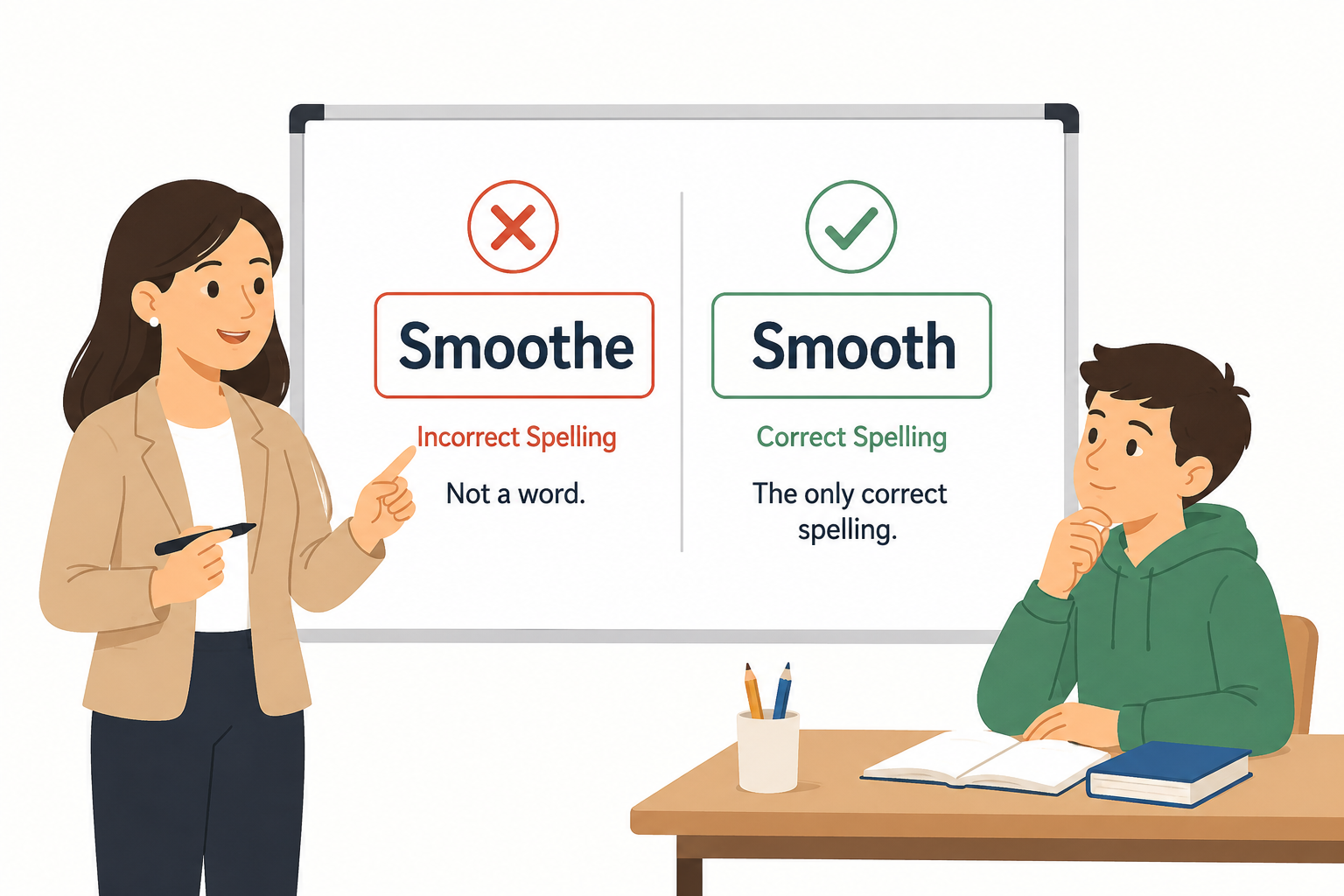
If you have ever paused while typing smoothe vs smooth, you are not alone. The two spellings look similar, and English has many words that end in a silent e, so the extra letter can seem reasonable. However, smooth is the standard spelling in modern English. The form smoothe is generally a misspelling when you mean even, soft, level, calm, or free from roughness.
The confusion also comes from grammar. Some English adjectives become verbs by adding a suffix, while others use the same spelling as both an adjective and a verb. Smooth belongs to the second group. You can describe a smooth surface, smooth a piece of wood, or smooth over a disagreement without adding an e to the end.
Knowing this simple rule helps you write more clearly in emails, school assignments, reports, product descriptions, and everyday messages. It also helps you recognize related forms such as smoother, smoothest, smoothly, and smoothness. Below, you will find the spelling rule, definitions, pronunciation, natural examples, common mistakes, and answers to frequently asked questions.
A related grammar guide is Gases or Gasses Which Spelling Is Correct.
Quick Answer
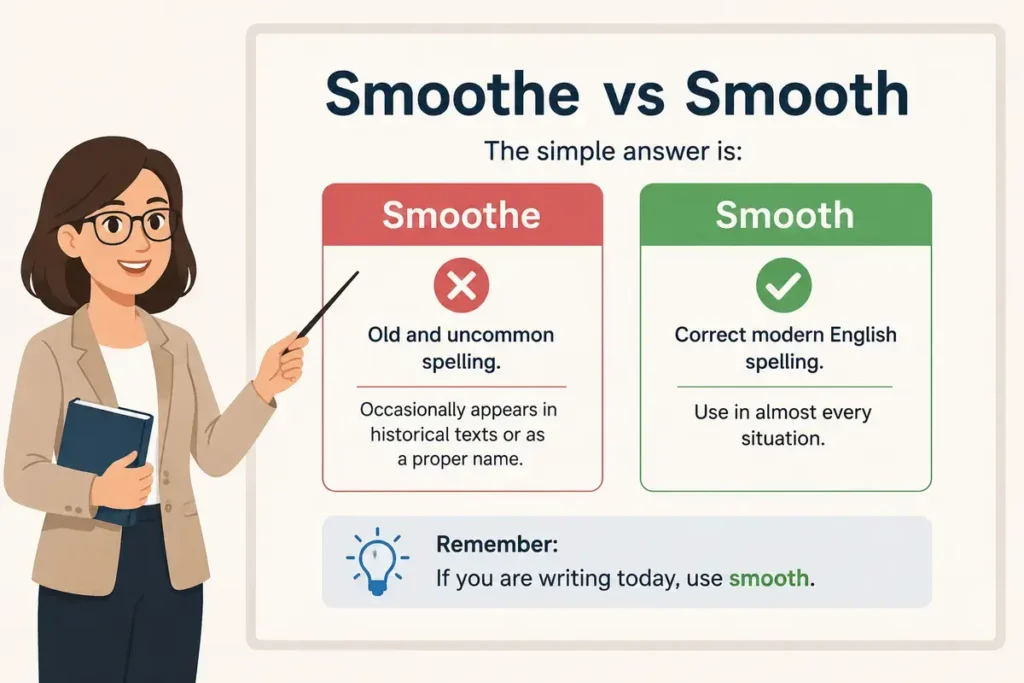
Smooth is the correct standard spelling in ordinary English. It can function as an adjective meaning even or free from roughness and as a verb meaning to make something even or less uneven. Smoothe is generally nonstandard when used in place of these forms, although it may appear in names, brands, or deliberate stylized writing.
Comparison Table for Smoothe vs Smooth
| Feature | Smooth | Smoothe |
|---|---|---|
| Standard spelling | Yes | No, not for ordinary use |
| Meaning | Even, soft, polished, calm, or easy | Usually intended to mean the same as smooth |
| Part of speech | Adjective, verb, and part of some established expressions | Not a standard spelling of the adjective or verb |
| Pronunciation | /smuːð/ | Usually intended to be pronounced like smooth |
| Formality | Suitable for formal and informal writing | Avoid in standard writing |
| Common contexts | Skin, surfaces, movement, speech, processes, and relationships | Occasional typos, names, brands, or stylized text |
| Comparative form | Smoother | Not the standard form |
| Superlative form | Smoothest | Not the standard form |
| Example | The table has a smooth finish. | The table has a smoothe finish. |
| Editorial recommendation | Use this spelling | Correct it to smooth unless it is an intentional proper name |
Meaning and Definition
What Does Smooth Mean
Smooth is a common English word with several related meanings. As an adjective, it describes something that feels even, has no noticeable bumps, moves without sudden interruptions, or happens with little difficulty. As a verb, it means to make a surface even, flatten wrinkles, or reduce tension in a situation.
The exact meaning depends on the context. A smooth stone feels even to the touch, a smooth voice sounds pleasant and steady, and a smooth process runs without unnecessary delays. The word connects these uses through the idea of reducing roughness, friction, or interruption.
Consider these examples.
- The cream left her skin feeling smooth.
- The car moved along the highway with a smooth ride.
- The presenter gave a smooth and confident speech.
- The team worked together to make the launch smooth.
- He used his hand to smooth the wrinkles from his shirt.
In each sentence, the word describes or creates a sense of evenness, ease, or reduced friction.
Is Smoothe a Real Word
Smoothe is not the standard spelling of the common adjective or verb. In regular English writing, readers generally expect smooth, so the extra e can look like a spelling error. It may appear as a personal name, business name, product name, username, or deliberate branding choice, but those special uses do not make it the standard spelling of the ordinary word.
This distinction matters because a spelling can appear in real text without being accepted as the usual form of a word. A company might choose an unusual spelling to make its name distinctive. A person might use it as a username. In those cases, the spelling belongs to the name or brand rather than to standard English grammar.
If you are writing a school assignment, workplace email, article, product description, or formal report, use smooth unless you are reproducing a proper name exactly as its owner writes it.
Why the Extra E Seems Plausible
English spelling can make the longer form look convincing. Words such as shape, shine, and close contain a final e, and writers sometimes assume that a similar pattern applies to other words. Yet English does not follow one universal spelling rule for every word.
Smooth already has its established spelling. It does not need an added e to function as an adjective or verb. Its common grammatical forms follow their own patterns: smooth, smoother, smoothest, smoothly, and smoothness.
The best approach is to learn the base word and its related forms together. That makes it easier to recognize the correct spelling when you write quickly.
Key Differences Explained
The practical difference between the two forms is mainly a matter of standard spelling, not meaning. When someone writes smoothe in an ordinary sentence, they usually intend the word smooth. The reader can often understand the intended message, but the spelling still needs correction in edited writing.
Spelling
Smooth ends with the letters o, t, and h. There is no final e. That spelling remains the same when the word functions as an adjective or a verb.
For example, you can write, The surface feels smooth, or She will smooth the fabric before sewing. Neither sentence needs an additional letter.
Meaning
The standard form can describe a physical surface, a person’s voice, a movement, a plan, or a social interaction. The nonstandard spelling usually carries no separate meaning in ordinary English. It is most often an attempt to write the same word.
Grammar and Part of Speech
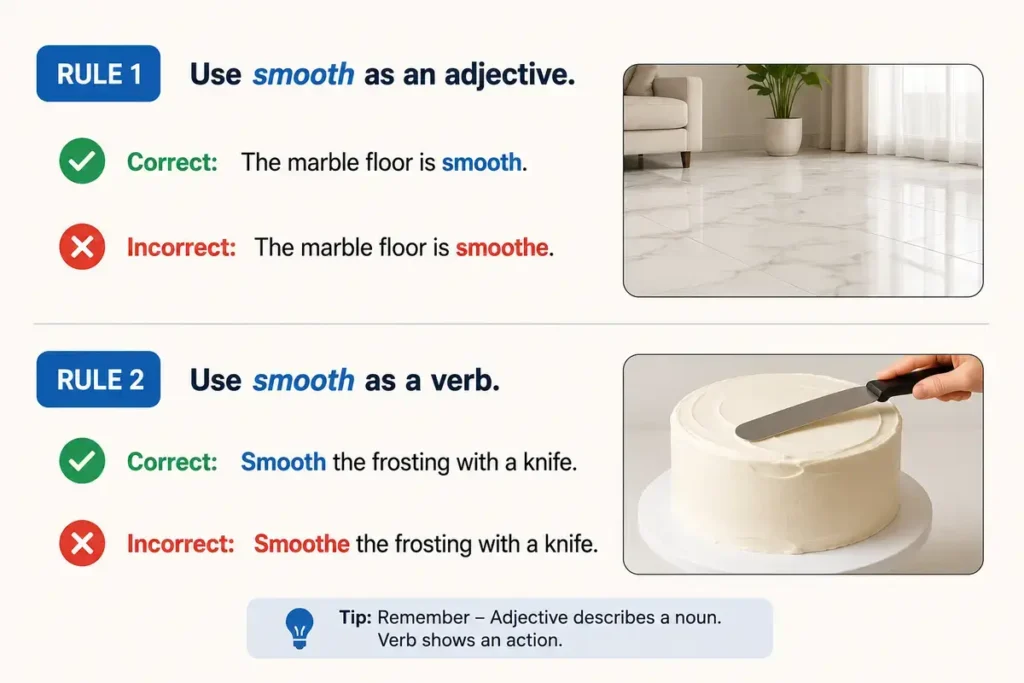
Smooth works as both an adjective and a verb. As an adjective, it describes a noun. As a verb, it describes an action.
- Adjective: The road is smooth.
- Verb: Please smooth the paper.
- Adverb: She spoke smoothly.
- Noun: The smoothness of the finish impressed the buyer.
The standard spelling changes only when a recognized suffix creates another form.
Pronunciation
The usual pronunciation is /smuːð/, with one syllable. The final th makes the voiced sound heard at the end of breathe, rather than the unvoiced sound at the end of breath.
The added e in the nonstandard form does not normally signal a different pronunciation. It is usually an unnecessary letter rather than a meaningful sound change.
Formality and Context
Smooth is suitable in conversation, business writing, academic work, journalism, and creative writing. It is not limited to casual speech.
Smoothe should generally be corrected in those settings. The main exception is an exact name or brand spelling. If a business officially uses that form, preserve it when referring to the business, but do not copy its spelling into ordinary sentences.
Regional Usage
American, British, Canadian, and Australian English all use smooth as the standard spelling. There is no major regional spelling distinction that makes smoothe correct in one of these varieties.
Which Form Is Correct
Use smooth in standard English. Established dictionaries recognize smooth as the adjective and verb, and its regular related forms include smoother, smoothest, smoothly, and smoothness. The spelling does not require a final e.
The grammatical reason is simple: smooth already serves as a complete base word. You do not need to change it into smoothe to describe a surface or express the action of making something even. The same spelling works in both roles.
For example, compare these sentences.
- Correct: The painter created a smooth finish.
- Incorrect in ordinary usage: The painter created a smoothe finish.
- Correct: She smoothed the paper with her palm.
- Incorrect in ordinary usage: She smoothe the paper with her palm.
Notice that the correct verb form in the past tense is smoothed. The final d marks the past tense; it does not require an e before it.
In edited writing, the goal is to follow the established spelling of the word rather than rely on what looks plausible. If a spell checker flags smoothe, replace it with smooth or the correct related form, depending on the sentence.
Sentence Examples
Here are ten natural examples showing how to use the standard spelling in different situations.
- Everyday conversation: This blanket feels smooth and soft against my skin.
- Text message: The drive was smooth, so we got there earlier than expected.
- Workplace communication: We need a smooth handoff between the sales and support teams.
- School assignment: The river gradually wore the rough stones into smooth shapes.
- Academic writing: The researchers observed a smooth transition between the two phases.
- Formal writing: The revised procedure should support a smooth review process.
- Social situation: She tried to smooth over the awkward moment with a friendly joke.
- Online communication: The new app has a smooth interface that is easy to navigate.
- Home improvement: Sand the wooden shelf until the surface feels smooth.
- Personal development: Practicing the speech several times helped him deliver a smooth presentation.
These examples show that the word is useful well beyond descriptions of physical texture. It can describe a process, a sound, a movement, a conversation, or an experience that feels easy and uninterrupted.
Common Mistakes and Misspellings
The extra e is only one possible spelling problem. Writers can also confuse related forms, choose the wrong grammatical ending, or mistake a similar word for the intended one.
Smoothe Instead of Smooth
Incorrect: The lotion leaves your hands feeling smoothe.
Correct: The lotion leaves your hands feeling smooth.
The error usually comes from adding a letter that seems to fit a familiar spelling pattern. In standard English, the final e is unnecessary.
Smoothly Instead of Smooth
Incorrect: The countertop feels smoothly.
Correct: The countertop feels smooth.
Smoothly is an adverb, so it generally describes how an action happens. Smooth is an adjective, so it describes the countertop’s condition. After a linking verb such as feels, an adjective is normally the right choice when describing the subject.
However, smoothly is correct in a sentence such as The machine runs smoothly. There, it explains how the machine runs.
Smooth Instead of Smoothed
Incorrect: Yesterday, she smooth the creases from the dress.
Correct: Yesterday, she smoothed the creases from the dress.
The word yesterday places the action in the past, so the regular past tense is needed. Add ed to the base form to create smoothed.
Smoothest Instead of Smoother
Incorrect: This fabric is the smoother of the three options.
Correct: This fabric is the smoothest of the three options.
Use smoother when comparing two items. Use smoothest when identifying the item with the greatest degree of smoothness among three or more, or across a group.
For example, This fabric is smoother than the first one compares two fabrics. This fabric is the smoothest in the collection identifies the top choice in a larger group.
Confusing Smooth With Smoothe in a Name
Incorrect editing: The editor changed a business’s official name from Smoothe Studio to Smooth Studio without checking.
Correct editing: Preserve Smoothe Studio if that is the business’s actual name, but use smooth in ordinary descriptive writing.
Names and brands can use unusual spellings by choice. An editor should not automatically change a proper name simply because it differs from standard spelling. First establish if the word is being used as a name or as an ordinary adjective or verb.
Pronunciation Guide
The standard word smooth is pronounced /smuːð/ in the International Phonetic Alphabet. It has one syllable, and the vowel sounds like the oo in food. The final th is voiced, meaning your vocal cords vibrate as you make the sound.
An easy guide is smooth, spoken as one steady syllable. Begin with the s sound, move into the m, hold the long oo vowel briefly, and finish with the voiced th sound. You can check the last sound by placing your fingers lightly against your throat. You should feel vibration as you pronounce it.
Common Pronunciation Errors
- Using the unvoiced th sound heard in thin. This changes the ending from the standard pronunciation.
- Adding another syllable. Smooth has one syllable, not two.
- Shortening the vowel too much. The standard form uses a long oo sound.
- Assuming the extra e in smoothe changes the pronunciation. In ordinary use, the nonstandard spelling is usually intended to sound exactly like smooth.
The spelling question and the pronunciation question are separate. A person may pronounce the word correctly but still spell it incorrectly. Learning the sound can help with recognition, but the written form still needs to be memorized.
A related grammar guide is Molding or Moulding Which Spelling Is Correct.
Etymology and Word Origin
Smooth has a long history in English. It developed from an Old English word, smōth, meaning smooth or even. Its history is connected to older Germanic forms, and it has remained in the language as both a description of texture and a way to express ease or lack of obstruction.
Over time, its meanings broadened beyond physical surfaces. A smooth stone is physically even, while a smooth performance is free from noticeable interruptions. A smooth conversation may feel relaxed, and a smooth process may proceed without avoidable trouble. These uses share a central idea of reduced roughness or friction.
The established spelling survived as the word developed these broader meanings. The extra e in smoothe is not needed to reflect its origin, pronunciation, or grammatical role. For modern writing, the useful point is not the full historical timeline but the established spelling that English readers recognize today.
Regional Usage
American English
In the United States, smooth is the standard spelling in schoolwork, news writing, business communication, and everyday conversation. American writers use it to describe surfaces, movement, voices, flavors, interactions, and processes.
For example, a person might describe a smooth flight, a smooth sauce, or a smooth transition between jobs. The spelling remains the same in each context. Smoothe is not a standard American variant for these uses.
British English
British English also uses smooth. There is no standard British spelling rule that adds a final e to create smoothe. Writers in the United Kingdom use the same base form and related spellings, including smoother, smoothest, smoothly, and smoothness.
Differences in vocabulary or style can occur across English speaking regions, but this is not one of the words that has a recognized American and British spelling split.
Australian English
Australian English follows the same spelling convention. Smooth is the accepted form in ordinary writing, and the extra e does not represent a recognized regional alternative. A brand or person’s name can still use a distinctive spelling, but that is a matter of naming rather than Australian grammar.
In Canadian English
Canadian English also uses smooth as the standard form. Canadian spelling combines features associated with British and American conventions, but neither tradition supports smoothe as the normal spelling of this word.
Across these major English varieties, the practical rule is consistent: write smooth in ordinary sentences and preserve unusual spellings only when they are part of an exact name.
Grammar Rules and Part of Speech
Knowing how a word works in a sentence makes spelling easier. Smooth is especially useful because it functions as an adjective and a verb without changing its base spelling.
Smooth as an Adjective
An adjective describes a person, place, thing, or idea. Smooth can appear before a noun or after a linking verb.
- Before a noun: We walked along a smooth path.
- After a linking verb: The surface feels smooth.
- After a linking verb: His explanation sounded smooth and confident.
In the first example, smooth describes the path. In the other examples, it describes the subject through the linking verbs feels and sounded.
Smooth as a Verb
As a verb, smooth means to make something even, flatten it, or reduce difficulty or tension. It can take a direct object.
- She smoothed the paper on the desk.
- He smoothed his hair before the photograph.
- The manager tried to smooth the transition to the new system.
The verb can describe a physical action or a figurative one. Smoothing paper changes its surface, while smoothing a transition makes a change easier to manage.
Common Verb Forms
| Form | Example |
|---|---|
| Base form | Please smooth the fabric. |
| Third person singular | She smooths the icing with a spatula. |
| Past tense | He smoothed the paper. |
| Present participle | They are smoothing the wall. |
| Past participle | The surface has been smoothed. |
These forms follow familiar English verb patterns. The past tense and past participle use smoothed, and the present participle uses smoothing. None requires the spelling smoothe.
Comparative and Superlative Forms
Use smoother to compare two things and smoothest to identify the greatest degree of smoothness.
- This road is smoother than the old one.
- Of the three samples, this one is the smoothest.
- The updated software provides a smoother experience.
Avoid adding extra letters to these forms. The accepted spellings are smoother and smoothest.
The Adverb Smoothly
Smoothly describes how an action occurs. It often appears beside a verb.
- The meeting ran smoothly.
- The car turned smoothly around the corner.
- The new system is working smoothly.
Do not use smoothly as a replacement for the adjective after every linking verb. In The fabric feels smooth, the adjective describes the fabric. In The fabric moves smoothly through the machine, the adverb describes the movement.
The Noun Smoothness
Smoothness is a noun that describes the quality or condition of being smooth. It works in sentences such as The smoothness of the surface made it easy to clean.
This form can refer to physical texture, the quality of a sound, or the ease of an experience. It is a useful alternative when a sentence needs to name the quality rather than describe something directly.
Punctuation and Formal Style
The word itself does not require special punctuation. Use normal sentence punctuation, capitalization, and possessive rules as the sentence demands. In formal writing, choose the form that matches the grammatical role and check that the surrounding words agree.
For example, write The process was smooth, not The process was smoothe. Write The process went smoothly when you want to describe how the process proceeded.
Real Life Usage Examples
The word appears in many kinds of writing. These examples show how its meaning shifts with the situation while keeping the same standard spelling.
Daily Conversation
- The coffee tastes smooth because the milk balances its bitterness.
- I used a little conditioner to make my hair feel smooth.
In everyday speech, smooth often describes how something feels, tastes, or looks. It can also describe an experience that happens without trouble.
Email and Workplace Communication
- We appreciate your help in making the transition to the new schedule smooth.
- Please review the attached instructions so the onboarding process runs smoothly.
In workplace writing, the word often refers to efficiency and coordination. It is useful in emails about handoffs, project plans, customer service, and changes to established routines.
Academic Writing
- The polished sample had a smooth surface with few visible irregularities.
- The data showed a smooth increase in temperature over the observed period.
Academic writing uses the word for both physical features and patterns in data. If precision matters, explain exactly what smooth describes. A smooth curve, for instance, has a different meaning from a smooth experimental procedure.
News and Journalism
- Officials reported a smooth start to the voting process, with few delays at local sites.
- The team made a smooth return to competition after several weeks of preparation.
In news writing, smooth can summarize an event that proceeded without major disruption. Editors should still check that the description fits the reported facts rather than using the word as a vague positive label.
Literature and Storytelling
- Her smooth voice softened the tension in the crowded room.
- The boat glided over the smooth water as the morning fog lifted.
Writers use the word to create a sense of calm, softness, or easy movement. It can also suggest skill or confidence when describing speech, behavior, or a performance.
Related and Confused Terms
Several words share part of the meaning or grammatical pattern of smooth. Understanding the differences helps you choose a more exact expression.
1. Smoother. This is the comparative form of the adjective. Use it to compare two surfaces, experiences, or movements. For example, This road is smoother than the previous one.
2. Smoothest. This is the superlative form. It identifies the item with the greatest degree of smoothness in a group. For example, This is the smoothest fabric in the store.
3. Smoothly. This adverb describes how an action happens. The presentation went smoothly means it proceeded without major problems. It does not mean the presentation itself had a smooth physical surface.
4. Smoothness. This noun names the quality of being smooth. It can describe texture, sound, movement, or the ease of a process. For example, The smoothness of the finish made the cabinet look polished.
5. Silky. This adjective describes something soft, fine, and pleasant to touch, like silk. It can suggest a softer texture than smooth, which mainly emphasizes an even surface or the absence of roughness.
6. Polished. This word can mean physically shiny or refined through practice. A polished wooden table has a finished surface, while a polished presentation is clear and well prepared. Smooth and polished can overlap, but they do not always mean the same thing.
7. Even. This adjective describes something level, regular, or balanced. An even surface may also be smooth, but even focuses on consistency or levelness. A surface can be even without being especially soft or glossy.
8. Seamless. This word often describes a process or experience with no obvious breaks or interruptions. A seamless transfer of information may also be smooth, but seamless puts more emphasis on the absence of visible divisions.
Choosing among these words depends on the idea you want to express. Use smooth for a general sense of evenness or ease, silky for a soft texture, polished for a refined finish, and seamless for an experience without noticeable breaks.
Expert Editor Insight
An experienced editor treats smooth as the standard spelling in ordinary prose and checks the word’s grammatical role before making changes. The extra e often appears because writers apply a familiar spelling pattern to a word that does not need it. A spell checker may flag smoothe, but context still matters because a name or brand may intentionally use that spelling. My practical editing tip is to check the whole word family together: smooth, smoother, smoothest, smoothly, and smoothness. Seeing the forms side by side makes the standard pattern easier to remember and helps catch related grammar mistakes.
Key Takeaways
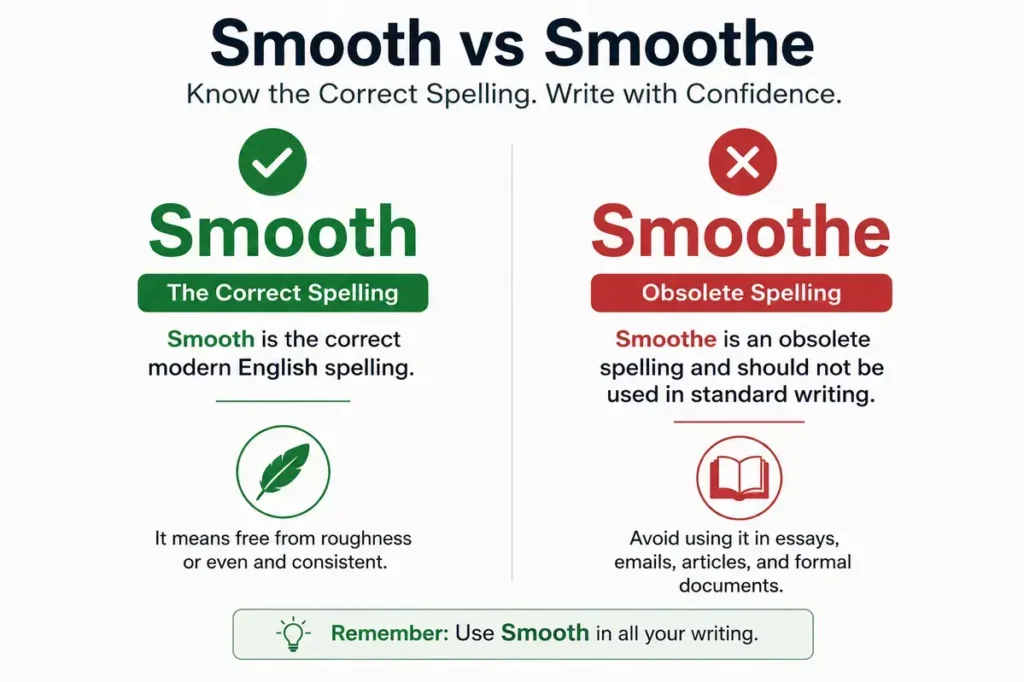
- Smooth is the correct modern English spelling.
- Smoothe is an obsolete spelling and should not be used in standard writing.
- Both American English and British English use smooth.
- Smooth functions as both an adjective and a verb.
- The past tense is smoothed.
- The adverb form is smoothly.
- Use smooth to describe texture, movement, speech, appearance, or actions that happen without difficulty.
- Smoothe may appear in historical texts, surnames, and business names, but not in everyday English.
- Spell checkers, dictionaries, and professional editors recommend smooth.
- If you are unsure, remember this simple rule: modern English always prefers smooth.
Learn the difference in function vs functionality Which Word Should You Use.
Conclusion
Smoothe vs Smooth comes down to a simple spelling rule. Smooth is the standard English form, used as both an adjective and a verb to describe even surfaces, easy movement, calm interactions, and processes without major interruptions. Smoothe is generally nonstandard when used for those meanings, though it may appear in proper names or branding.
The spelling stays consistent across American, British, Canadian, and Australian English. To remember it, learn the main word alongside smoother, smoothest, smoothly, and smoothness. Before submitting an email, assignment, or report, check for the extra e and correct it unless the spelling belongs to an official name.
FAQs
Is Smoothe a Real Word?
Smoothe appears in real world text, particularly in names, brands, usernames, and informal writing. However, it is not the standard spelling of the common English adjective or verb. If you mean even, soft, or free from roughness, write smooth. Preserve the unusual form only when it is part of a name or another intentional spelling that must remain exact.
What Does Smooth Mean?
Smooth can mean even, soft, polished, or free from roughness. It can also describe movement, speech, or a process that happens without difficulty. As an adjective, it describes something, as in a smooth surface. As a verb, it means to make something even or less uneven, as in smoothing a wrinkle from a shirt.
Which Is Correct Smoothe or Smooth?
Smooth is correct for standard English writing. The spelling works as both an adjective and a verb, so you can describe a smooth table or smooth a piece of fabric. Smoothe is generally a spelling error when used for these meanings. An exception applies when the unusual form is an official name or brand spelling.
How Do You Pronounce Smooth?
Smooth is pronounced /smuːð/ and has one syllable. Start with the s sound, move into the m, say the long oo vowel as in food, and finish with a voiced th sound. The tongue rests lightly near the teeth for the final sound. The nonstandard spelling smoothe is usually intended to have the same pronunciation.
Can Smooth Be Used as a Verb?
Yes. Smooth is both an adjective and a verb. As a verb, it can mean to flatten a surface, remove wrinkles, or make a situation easier. For example, She smoothed the paper before writing on it. The verb forms include smooths, smoothed, and smoothing. None uses the spelling smoothe in standard English.
What Is a Synonym for Smooth?
Useful synonyms include even, silky, polished, sleek, level, and seamless. The best choice depends on the context. Even often describes a level surface, silky suggests a soft texture, polished can mean refined, and seamless describes something without obvious breaks. For a process that happens easily, you might also use effortless or uninterrupted.
Why Do People Write Smoothe Instead of Smooth?
People may add the final e because many English words contain a silent e, and the spelling can look plausible at first glance. Fast typing and unfamiliarity with the word can also contribute to the mistake. The easiest fix is to remember the standard base form and learn its related forms, including smoother, smoothest, smoothly, and smoothness.
Is Smooth Appropriate in Formal Writing?
Yes. Smooth is suitable for formal writing, including reports, academic papers, business emails, and professional documents. It can describe a physical surface or a process that runs without difficulty. Choose a more precise term if the context requires technical detail, but there is no need to avoid smooth simply because it is a common everyday word.